
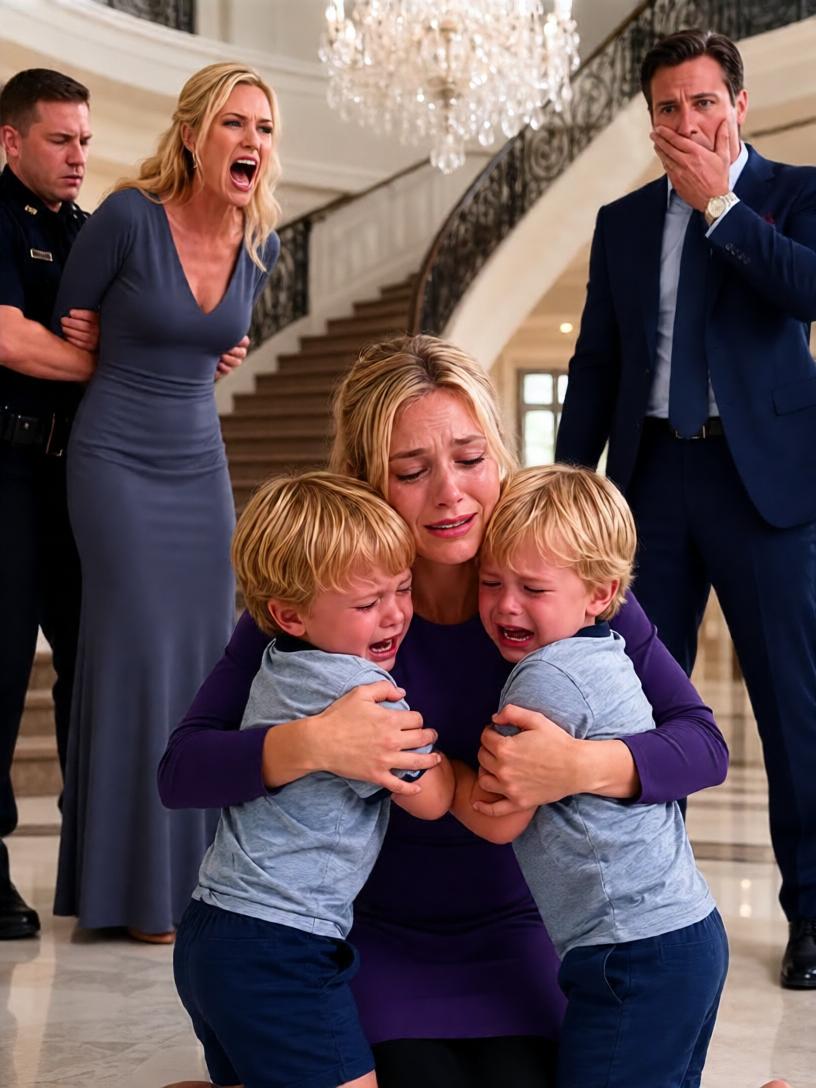
Part 1:
The timestamp kept blinking in the corner of the monitor, a red pulse that felt like it was striking directly against my skull.
One minute.
Two minutes.
Five.
I sat completely still in my office chair, my hand frozen over the mouse. The heavy mahogany desk in front of me did nothing to stop my world from falling apart.
On the screen was the upstairs hallway of my own house.
It was bright, spotless, and terrifyingly quiet.
I watched my six-year-old son, Ethan, disappear behind the thick wooden door of the cleaning closet.
At first, some desperate part of me tried to explain it away.
Maybe Vivian had only lost her temper.
Maybe she would come back in a few seconds.
Maybe there was some reasonable explanation, some tiny piece of logic I could hold on to before my perfect life collapsed completely.
But the timestamp kept moving.
Ten minutes.
Fifteen.
Twenty.
My fingers tightened around the mouse until my knuckles turned white.
The hallway remained empty.
Nothing moved.
Nothing changed.
And behind that narrow door, my little boy was trapped alone in the dark.
At minute twenty-seven, Maya appeared.
She was carrying a basket of neatly folded towels, walking quickly down the hallway. Then she suddenly stopped in front of the closet.
Her head tilted slightly, as if she had heard something faint coming from behind the door.
The basket slipped from her hands.
White towels scattered across the marble floor.
Maya grabbed the handle and yanked the door open.
Ethan stumbled out.
Even through the grainy security footage, I could see him shaking.
His small body rushed forward. He wrapped both arms around Maya’s waist and buried his face against her apron.
She immediately dropped to her knees.
She wiped his tears.
She touched his face.
She checked his arms and shoulders with trembling hands while her lips moved in frantic whispers I couldn’t hear.
Then she looked over her shoulder.
And I saw it clearly.
She was afraid.
Not of the dark.
Not of my sobbing child.
She was afraid of my wife.
My stomach twisted violently.
I clicked the next recording.
Another day.
Caleb had refused to eat his vegetables at dinner.
Vivian smiled with that cold, controlled expression I had once mistaken for self-discipline. She waited until I left the dining room to answer a business call.
The moment I was gone, she grabbed Caleb by the wrist.
Her manicured nails pressed into his skin.
Then she dragged him down the same hallway.
Maya followed several steps behind them, her posture rigid with fear. She looked trapped between terror and responsibility.
The closet door shut.
Seven minutes later, Maya returned.
Her hands were trembling as she opened the door.
Caleb came out sobbing.
She pulled him against her chest, holding him tightly.
But even while comforting him, her eyes kept moving toward the staircase, as if she were terrified Vivian might see her.
I clicked another clip.
Then another.
Then another.
By the fifth video, I was barely breathing.
By the tenth, the truth had settled over me like a burial cloth.
This was not one bad day.
This was not stress.
This was not a misunderstanding.
This was a pattern.
A quiet, organized system of cruelty had been happening under my own roof while I was away running private medical clinics, attending charity galas, signing contracts, meeting donors, and shaking hands with people who believed I had built the perfect family.
I had given my children everything money could buy.
Gates.
Security cameras.
Private drivers.
House staff.
A massive mansion.
I had believed wealth could protect them.
I had built a network of medical centers across Pennsylvania and Maryland. I knew the signs of trauma. I knew what fear looked like in a patient’s eyes.
And somehow, I had failed to recognize it in my own children.
That realization hurt more deeply than Vivian’s betrayal.
I was furious with her.
But I was also sickened by myself.
The office door clicked open behind me.
Vivian walked in wearing a silk blouse and diamond earrings. She carried a glass of chilled white wine in one hand and had the careless elegance of someone whose afternoon had been nothing more than mildly inconvenient.
“There you are,” she said softly. “I’ve been looking for you.”
I didn’t turn around.
I couldn’t.
If I looked at her too soon, I wasn’t sure what I would do.
On the monitor, Maya was frozen in place, kneeling beside Ethan outside the closet. One hand was cupping his tear-streaked cheek. The other was wrapped around his tiny trembling fingers.
Vivian’s heels stopped clicking.
The silence changed.
“What are you watching?” she asked.
My voice came out low and unfamiliar.
“The truth.”
She said nothing.
Slowly, I pushed my chair backward and turned toward her.
For the first time since I had married her, I saw real fear break through her flawless expression.
But it wasn’t guilt.
It was panic.
The panic of someone who had been exposed.
“You put your grandmother’s antique bracelet in Maya’s backpack,” I said.
Vivian’s lips parted.
Then she recovered.
Too quickly.
“Nathan, listen to me,” she said, using that soft, soothing tone she always used when she wanted to control a situation. “You’re upset. You don’t understand what happened.”
“I watched you take it from your closet.”
Her eyes flicked toward the monitor behind me.
“I was testing her.”
“You called the police.”
“She needed to learn her place.”
“You had her handcuffed and dragged out of this house in front of my sons.”
“Our sons,” she snapped.
Something inside me went cold.
“No,” I said, stepping toward her. “Not when you lock them in a dark closet.”
Her face drained of color.
For one second, she looked almost stunned.
Then she laughed.
It was small, breathless, and ugly.
“Oh, please,” she said, waving one hand. “Don’t be so dramatic. They’re children. Children exaggerate. It was a utility closet, Nathan, not a prison cell.”
I stared at her.
I couldn’t believe what I was hearing.
She was standing inside a mansion I paid for, wearing jewelry I had bought, only hours after framing the woman who had been trying to protect my children from her.
And somehow, she believed my reaction was the problem.
“You locked Ethan in the dark for twenty-seven minutes,” I said. “He is six years old.”
Vivian slammed her wineglass onto my desk.
“He ruined a thirty-thousand-dollar rug with juice.”
“He is six.”
“He is old enough to learn consequences.”
“Consequences are losing dessert,” I said, my voice shaking with restraint. “Consequences are apologizing. Consequences are cleaning up a mess. Consequences are not being shoved into a dark closet until your body shakes with fear.”
Her eyes hardened.
“You have no idea what it’s like to be here with them all day. You’re always at the clinics.”
“No,” I said quietly. “I don’t. But Maya was here all day. And she never hurt them.”
Vivian’s mouth twisted.
“Maya,” she spat. “Of course this is about her. Poor little saint Maya. The devoted servant. Do you hear yourself? Defending the help over your wife?”
There it was.
The rot beneath the polish.
I had seen glimpses of it before.
The way she spoke to waiters.
The way she complained about housekeepers.
The way she used the word “staff” as if it meant something less than human.
And I had explained it away.
Her upbringing.
Her temper.
Her standards.
I had softened her cruelty in my own mind because facing it honestly would have meant admitting that I had invited the wrong person into my children’s home.
“Her name is Maya,” I said. “And she is the reason my sons survived what you were doing to them.”
Vivian took a step back.
“You’re losing your mind.”
“No,” I said. “I’m finally finding it.”
She reached into her pocket for her phone.
I saw it immediately.
“Do not call anyone.”
Her eyes flashed.
“You don’t get to order me around in my own house.”
“You framed an innocent woman. You filed a false police report. You abused our children. Right now, Vivian, the only thing standing between you and consequences is how carefully I decide what happens next.”
For the first time in eight years, she had no answer.
I picked up my phone.
My hands were steady now.
First, I called my attorney.
Then I called the local police department.
Then I called the pediatric trauma therapist a colleague had once recommended—the same therapist Vivian had dismissed as “absurd” when Ethan began having night terrors.
Vivian stood there watching me.
By the time I ended the calls, she was crying.
Not real tears.
Controlled tears.
Useful tears.
“Nathan,” she whispered, reaching toward my shirt. “Please. Think about what you’re doing. Don’t destroy our family.”
I looked at her hands, then into her eyes.
“Our family was being destroyed inside a closet while I was gone,” I said. “I’m just putting out the fire.”
She pulled back as if I had burned her.
I walked past her and went downstairs.
The house felt different now.
It no longer felt elegant or peaceful.
It felt like a crime scene waiting to be understood.
Ethan and Caleb were sitting on the kitchen floor with their backs against the island, their knees pulled tightly against their chests.
Maria, our head housekeeper, had wrapped them in blankets and placed mugs of hot chocolate in front of them.
Neither boy had touched his drink.
When they saw me, both of them flinched.
That tiny movement broke something inside me.
I dropped to my knees in my suit and brought myself down to their level.
“I saw the cameras,” I said gently.
Caleb’s lower lip trembled.
“Are you mad at us?”
I hated that question more than anything I had ever heard.
“No, buddy,” I whispered. “I’m not mad at you. I could never be mad at you.”
Ethan stared at the floor.
“Mom said if we told you, Maya would go to jail forever,” he whispered. “She said it would be our fault.”
I closed my eyes for one second, fighting down a rage so violent that it frightened me.
When I opened them, I forced my voice to remain soft.
“Your mom lied.”
Caleb broke first.
He threw off his blanket and ran into my arms, burying his face against my neck.
Ethan hesitated.
He was quieter.
More watchful.
He was a child who had learned far too early that silence could sometimes feel safer than telling the truth.
I opened my other arm and waited.
He came slowly at first.
Then all at once.
Both my sons clung to me, shaking with sobs they had been holding inside for far too long.
“I’m sorry,” I whispered into their hair. “I am so sorry I didn’t see it sooner.”
Ethan pressed his face into my chest.
“Can Maya come home now?”
The guilt in my throat felt sharp enough to cut.
“I’m going to bring her back.”
“Promise?” Caleb asked.
I looked at both of them.
For the first time, I understood what a father’s promise truly meant.
Not comfort.
Action.
“I promise.”
Part 2:
I left the boys with Maria and walked outside into the cold evening air.
As I stepped onto the driveway, red and blue lights swept through the iron gates.
Vivian appeared behind me in the doorway, her arms crossed and her face wet with carefully controlled tears.
Two officers stepped out of the cruiser.
They were older and more serious than the officers who had taken Maya away earlier that day.
My attorney arrived moments later in a black car, accompanied by a child welfare investigator.
Vivian’s expression changed.
For the first time, reality seemed to be reaching her.
“Nathan,” she said, her voice trembling. “What is this?”
I didn’t answer.
Before the officers could reach us, Vivian pushed past me and hurried toward them.
“Thank God you’re here!” she cried, grabbing the lead officer’s arm. “My husband has lost his mind. He’s trying to take my children. He threatened to kill me if I didn’t give them up.”
The night went silent.
The officer’s hand moved toward his belt.
“Sir, step back.”
I immediately raised both hands and took three slow steps backward.
“My name is Nathan,” I said clearly. “I’m the one who called. I have more than thirty hours of security footage saved in my office. It shows evidence tampering, a false police report, and repeated incidents of child abuse by the woman standing beside you.”
Vivian’s breath caught.
She hadn’t known I had saved everything.
My attorney stepped forward and handed the officer his card.
“My client is cooperating fully,” he said. “The footage will speak for itself.”
The female officer looked at Vivian.
Then she nodded.
“Show us.”
The next twenty minutes destroyed every illusion Vivian had left.
In my office, I played the footage.
First came the recording of Vivian taking the antique bracelet from her closet and slipping it into Maya’s worn canvas backpack.
Then came the 911 call.
Then the closet.
The dragging.
The crying.
The repeated incidents.
The pattern.
Vivian tried to interrupt.
She claimed the footage had been altered.
She said Maya was unstable.
She said I was having some kind of breakdown.
My attorney stopped her from interrupting repeatedly and told her to let the officers review the evidence.
When the clip of Ethan being dragged down the hallway played, the female officer’s jaw tightened.
The child welfare investigator stood in the corner, writing quickly. She never looked away from the screen.
When the final video ended, the room became suffocatingly quiet.
The female officer turned toward Vivian.
“Mrs. Hale, turn around and place your hands behind your back.”
Vivian laughed sharply.
“This is ridiculous. Do you know who my father is?”
“Ma’am,” the officer said as she took out the handcuffs, “you are under arrest on suspicion of filing a false police report, evidence tampering, child endangerment, and unlawful restraint.”
Vivian looked at me.
For the first time in her life, money and family connections could not simply make the problem disappear.
“You would do this to me?” she whispered.
I felt nothing but cold emptiness.
“You did this to them.”
Her eyes filled with hatred.
There she was.
The truth behind the diamonds.
The woman who had turned my home into a place of fear.
“You’ll regret this, Nathan,” she hissed as the cuffs clicked around her wrists.
My attorney stepped forward.
“Officers, please note that threat.”
Vivian went silent.
They escorted her outside.
She didn’t scream.
Somehow, that made it worse.
She walked with her chin lifted, as if the officers were nothing more than drivers and the police cruiser waiting outside were another luxury vehicle.
But as they passed the kitchen archway, Caleb peeked out from behind Maria.
Vivian saw him.
For a brief second, something like pain crossed her face.
Then pride swallowed it.
She looked away.
The front door closed.
The mansion fell silent.
I stood in the foyer, staring at the marble floors, the crystal chandelier, the expensive furniture, and the family portraits where all four of us smiled in matching outfits.
It all looked grotesque now.
A beautiful stage where my children had been living in fear.
My phone buzzed.
It was my attorney calling from outside.
“They’re releasing Maya tonight,” he said. “The charges are being dropped. The captain reviewed the footage.”
I exhaled like I had been holding my breath for years.
“I’m going to get her.”
“Nathan,” he said carefully, “be prepared. She’s been humiliated and traumatized. She may not want to come back.”
He was right.
Maya had every reason to hate us.
The police station smelled like stale coffee, floor wax, and human panic.
Maya sat alone on a metal bench.
Her wrists were red from the handcuffs.
Her dark hair had fallen loose from its braid.
Under the harsh fluorescent lights, she looked smaller than I remembered.
She was only twenty-four.
Twenty-four, underpaid, frightened, and somehow braver than every wealthy adult in my home.
When she saw me, she jumped to her feet.
Not from respect.
From fear.
“Please,” I said quickly, raising my hands. “Sit down.”
She didn’t.
“Mr. Hale,” she said hoarsely. “I swear I didn’t steal anything.”
“I know.”
Those two words hit her visibly.
Her face crumpled before she fought to control herself.
“I saw the footage,” I continued. “I saw what Vivian did. I saw the jewelry. I saw the call. I saw the closet. I saw everything.”
Maya covered her mouth as tears slipped down her cheeks.
“I am deeply sorry,” I said. “I’m sorry I was blind. I’m sorry I didn’t protect you. And I’m sorry my home became a place where you had to protect my sons from their own mother.”
She shook her head, crying silently.
“I tried to tell you,” she whispered. “A month ago. But Mrs. Vivian caught me. She said if I spoke, you would laugh at me. She said no one would believe a poor nanny over your wife.”
My throat tightened.
“She was wrong.”
Maya looked up at me.
“Was she?”
I had no answer.
Because until that day, maybe Vivian had not been wrong.
Maybe our world had only been willing to believe someone like Maya after cameras made denial impossible.
I looked down, ashamed.
“I’ll spend the rest of my life making sure my sons know she was wrong.”
Maya wiped her face with the back of her bruised hand.
“Where are Ethan and Caleb?”
“At home. Safe with Maria. They keep asking for you.”
Her breath broke.
“They saw the police take me.”
“I know.”
“They were so scared. They hate loud noises.”
“I know.”
She rubbed her wrists.
“I don’t know if I can ever walk back into that house.”
“I understand,” I said. “You don’t have to. I didn’t come to pressure you. I came to apologize, tell you the truth, and drive you anywhere you want to go.”
She studied my face.
“What happens to Mrs. Vivian?”
“She was arrested. My attorney is filing for emergency sole custody and a protective order tomorrow morning.”
“And the boys?”
“They need help. Real help. Safety. Time.”
Maya looked away.
“They hate the dark, you know.”
“I know that now.”
“No,” she said softly. “You know the fact. You don’t know what their screaming sounds like when the door closes.”
The words cut straight through me.
She was right.
She had heard it.
I had only heard the silence of my office.
I drove her to her aunt’s small apartment in Baltimore.
She sat in the back seat for the entire ride, clutching the strap of the same canvas backpack Vivian had used to frame her.
When we arrived, Maya stepped out.
Then she paused.
“Please tell the boys I love them.”
“They know.”
She started to close the door.
“Maya.”
She turned.
“I’ll make this right. I swear.”
For the first time that night, anger flashed in her eyes.
“You can’t make it right, Mr. Hale. You can only make sure it never happens again.”
Then she shut the door.
I sat there for a long time after she disappeared inside.
That was the lesson.
Some damage cannot be repaired with money or apologies.
It can only be answered with change.
I drove home at 3:00 a.m., exhausted and hollow.
But when I reached the gates, every exterior light was blazing.
A silver Porsche was blocking the front entrance.
Vivian’s father.
The confrontation was brief and ugly.
The private security team I had hired stopped him before he could reach me. He shouted threats about ruining me socially and financially.
I stood still, cold and silent, until the guards escorted him away from the property.
The next morning, the mansion felt like a different place.
No perfume in the hallway.
No sharp voice coming from the master suite.
Vivian’s absence should have felt peaceful.
Instead, it revealed how much fear had been living inside the walls.
Ethan refused to leave his room.
Caleb followed me everywhere.
When Maria accidentally let a cabinet door slam, both boys flinched violently.
I canceled every meeting.
When my assistant called again and again, I finally answered.
“I’m not coming in,” I said. “Cancel my week. My children come first.”
At ten o’clock, the trauma therapist arrived.
Her name was Dr. Elaine Harper.
She wore a soft blue sweater and carried a canvas bag filled with wooden toys.
She didn’t force the boys to talk.
She simply sat on the living room rug and began building a crooked tower.
By the end of the hour, Caleb was sitting beside her, whispering toward the floor.
“The closet smelled like bleach.”
From the doorway, Ethan’s tiny voice followed.
“Mom said good boys don’t cry in the dark.”
I had to turn away and press my fist against my mouth to keep from breaking.
For the first week, I slept on a mattress outside their bedroom door.
During the day, I changed the house.
I removed the brass lock from the cleaning closet.
Then I had the entire door taken off its hinges.
I had the space painted bright yellow and turned it into an art nook with books, crayons, soft pillows, and a little lamp shaped like the moon.
I wanted the boys to see the room every day and know it no longer belonged to fear.
Two weeks later, the emergency custody hearing began in Philadelphia Family Court.
Vivian arrived wearing a cream-colored suit, looking every inch the polished mother.
My sons were not there.
Maya was.
When Vivian saw her sitting in the gallery, her expression hardened.
The hearing lasted six hours.
The judge watched the security videos in silence.
When Maya testified, her voice shook.
She described the sound of the boys scratching at the inside of the closet door.
When my attorney asked why she had not reported the abuse sooner, she looked directly at the judge.
“Because if I was fired,” she whispered, “there would be no one left in that house to open the door.”
At 4:30 p.m., the judge granted me immediate sole legal and physical custody.
It was a victory.
But I knew the real work was only beginning.
Part 3:
When I returned home, the house was silent.
“Maria?” I called.
No answer.
Panic shot through me.
I ran upstairs and threw open the boys’ bedroom door.
Empty.
The window was wide open, cold air blowing through the room.
My heart slammed against my ribs.
I was about to scream for security when I heard soft humming from downstairs.
I ran down the hallway.
Then I found them.
They were in the yellow art nook.
Maria was asleep against the wall.
Ethan and Caleb were sitting on the rug, coloring a giant cardboard castle, completely unaware that the wind had blown open the upstairs window.
I leaned against the doorway.
For a few seconds, I could barely breathe.
The room smelled like crayons.
The boys were safe.
And for the first time since the nightmare had begun, I understood how fragile that word could be.
Safe.
The months that followed were not magical.
There were nightmares.
Therapy appointments.
Bad days.
Nights when both boys climbed into my bed and clutched my shirt as if they were afraid the floor might disappear beneath them.
I learned that love was not a mansion.
Love was getting up at 2:13 a.m. when a trembling voice whispered,
“Dad, I had the closet dream again.”
Three months after Vivian’s arrest, Maya came to visit.
When the doorbell rang, Caleb ran toward the foyer.
He froze for half a second.
Then he screamed.
“Maya!”
Both boys ran into her arms.
She dropped to her knees and hugged them tightly.
One rainy afternoon, Ethan handed her a crumpled drawing.
It showed a little yellow house.
There was a brown door on the front.
A huge red X had been drawn across it.
“No more locked doors,” he whispered.
Maya pressed the drawing against her chest.
“I promise,” she said softly.
A year later, Vivian’s criminal case ended.
With the security footage making the central allegations difficult to dispute, she accepted a plea agreement that included five years of strict probation and mandatory psychiatric treatment.
The first time the boys saw her again was in a therapist’s office.
Vivian entered looking less polished than I had ever seen her.
She began crying almost immediately.
“I’m so sorry,” she said.
Caleb looked at her.
“For what?”
Vivian froze.
“For scaring you.”
Ethan’s voice was barely a whisper.
“For locking us in the dark?”
Vivian covered her mouth.
“Yes,” she said. “For locking you in the dark.”
The boys did not run to her.
They didn’t hug her.
They simply sat beside me.
Safe.
Still.
And that was enough.
Years passed.
Slowly and carefully, we built a fragile kind of peace.
On the boys’ tenth birthday, the house was filled with laughter.
Maya stood near the kitchen island, filming them as they smeared chocolate frosting across each other’s faces.
An hour later, Vivian arrived for her scheduled visit.
She carried two wrapped gifts.
Caleb approached first.
Ethan stood beside him.
They were taller now.
Steadier.
Older.
“You can come in,” Ethan said clearly. “But we don’t close doors in this house anymore.”
Vivian’s face crumpled.
“I know,” she whispered.
“No closed doors.”
Later that night, after the boys were asleep and the guests had gone, I found Maya in the kitchen wrapping leftover cake.
“I never thanked you enough,” I said.
She smiled gently.
“At first, you believed the cameras,” she said. “But then you did the harder thing. You learned to believe your sons without needing cameras. That is enough.”
I turned off the kitchen lights.
For the first time in years, I felt peace settle over the house.
The nightmare was over.
At least, I thought it was.
I walked toward the front door.
Then I saw a shadow move across the porch.
I froze.
The brass knocker slammed three times.
Bang.
Bang.
Bang.
My entire body went still.
Under the porch light stood a young woman I had never seen before.
She was shivering in the cold.
In her hands was a worn canvas backpack.
My heart began pounding.
It wasn’t Vivian.
It wasn’t anyone I knew.
I slowly opened the door.
The young woman looked at me with terrified eyes.
Then she whispered,
“They told me you were the only one who could stop him.”
I stared at her.
I didn’t know who “they” were.
I didn’t know who “he” was.
But as I looked at that worn canvas backpack, something about the situation felt horribly familiar.
For years, I had believed the cameras had shown me the whole truth.
Now I wondered if they had only shown me the first chapter.
The woman took a shaky breath.
“Please,” she whispered. “I don’t know where else to go.”
I stepped aside.
“Come in.”
And as she crossed the threshold, I realized something I had learned too late the first time.
Sometimes the people standing outside your door are not asking for money.
They are asking for someone to finally believe them.
If you want more stories like this, or if you want to share what you would have done in my place, I’d love to hear your thoughts. Your perspective helps these stories reach more people, so don’t hesitate to comment or share.
The End.
