
Part 1:
“Dad, if I don’t come home one day, please open the door for Captain. He knows everything,” Abigail whispered.
Christopher Barrett felt as if the air had suddenly disappeared from the room.
He sat beside the small metal-framed hospital bed at Children’s Hospital of Denver, staring at his seven-year-old daughter. Abigail lay beneath the thin blanket, clutching her old brown stuffed rabbit. One of its ears was much longer than the other, and years of love had left the rabbit’s fur worn and soft.
“Don’t talk like that, sweetie,” Christopher said gently. “You’re going to leave this place very soon. Then we’re going to order a pizza so huge it won’t even fit on our dining table.”
Abigail gave him the smallest smile.
Her face was pale after weeks of intense chemotherapy, and her little body looked exhausted. But even when she was weak, she still had the same serious stare that often made adults uncomfortable because she seemed to notice things they wished she wouldn’t.
Christopher was thirty-eight years old and worked as a maintenance engineer at a large manufacturing plant in Aurora. At work, he was known as the man who could find a machine problem before anyone else noticed it. He could hear a compressor making the tiniest unusual vibration and immediately know something was wrong.
At home, however, he was hopeless with simple chores.
Once, he had heated oatmeal for so long that the ceramic plate became permanently stuck to the bottom of the pan. Abigail thought the disaster was hilarious. For weeks, she showed the ruined pan to visitors and proudly told them about it.
“My dad fixes twenty-ton machines at work every day,” she would say with a teasing laugh, “but he can’t even fix a simple kitchen stove.”
Christopher always pretended to be offended.
“I’m an engineer, not a chef.”
Abigail would laugh even harder.
But ever since Samantha, Abigail’s mother, had walked out when her daughter was only three years old, Christopher had been forced to learn almost everything by himself.
He learned how to braid Abigail’s hair, cook simple meals, help with homework, prepare school lunches, and keep track of every little detail in his daughter’s life. He even started sleeping with his mobile phone directly under his pillow in case Abigail ever needed him during the night.
His sister Pamela had become his greatest support during those difficult years as a single father.
Pamela had a spare key to Christopher’s house. She picked Abigail up from elementary school, brought them warm meals, helped with household chores, and stayed overnight whenever Christopher had to work late shifts.
So when doctors suddenly diagnosed Abigail with a malignant kidney tumor, Christopher trusted Pamela without hesitation.
She was family.
He believed she would do anything to help his daughter.
Then Zachary appeared.
Zachary was Samantha’s manipulative brother, and he suddenly became extremely involved in their lives. He always seemed to know someone who could help.
A private specialist.
A medical foundation.
A pharmacy that supposedly imported rare medications.
A legal fixer who could supposedly speed up urgent hospital appointments.
“You just focus on taking care of your sick daughter and keeping your job,” Zachary repeatedly told Christopher. “I’ll handle all the complicated paperwork.”
Christopher was exhausted, frightened, and desperate.
So he trusted him.
He handed Zachary original medical studies, pharmacy prescriptions, official reports, and copies of personal identification documents without giving it much thought.
Zachary immediately created several social media fundraising campaigns using photographs of Abigail.
He told Christopher that donations were coming in to pay for expensive treatments that regular health insurance did not cover.
The weeks that followed became one long nightmare.
Christopher worked half days at the manufacturing plant, drove across the busy city, and then spent every night sleeping in an uncomfortable vinyl chair beside Abigail’s hospital bed.
Pamela and Zachary often came to the hospital carrying homemade food, official-looking payment receipts, and reassuring updates about the fundraising campaigns.
Everything seemed organized.
Everything seemed legitimate.
But something about Abigail began to change.
Whenever Pamela and Zachary left the room, the little girl became unusually quiet.
One evening, she looked directly at her father.
“Dad, have you actually seen all my new medications with your own eyes?” she asked.
“Of course I have, my love,” Christopher replied soothingly. “Your Uncle Zachary is personally helping us manage all of that.”
Abigail squeezed Captain tightly against her chest.
Then she stared at her father.
“What if someone says they’re helping you because they love you, but they’re actually hiding important things from you?”
Christopher frowned.
He thought the question was simply another sign of the fear and confusion caused by the hospital environment and her harsh treatments.
Pamela had already warned him that Abigail was becoming extremely sensitive because of the side effects from chemotherapy.
Christopher stroked his daughter’s hair.
“Don’t worry about those things, sweetheart. Your job is to get better.”
Abigail said nothing.
Three nights later, she asked him again to check on Captain if anything ever happened to her.
Christopher promised.
But he refused to imagine why his daughter was saying such things.
A week after that heartbreaking conversation, Abigail died in her hospital bed.
She was only seven years old.
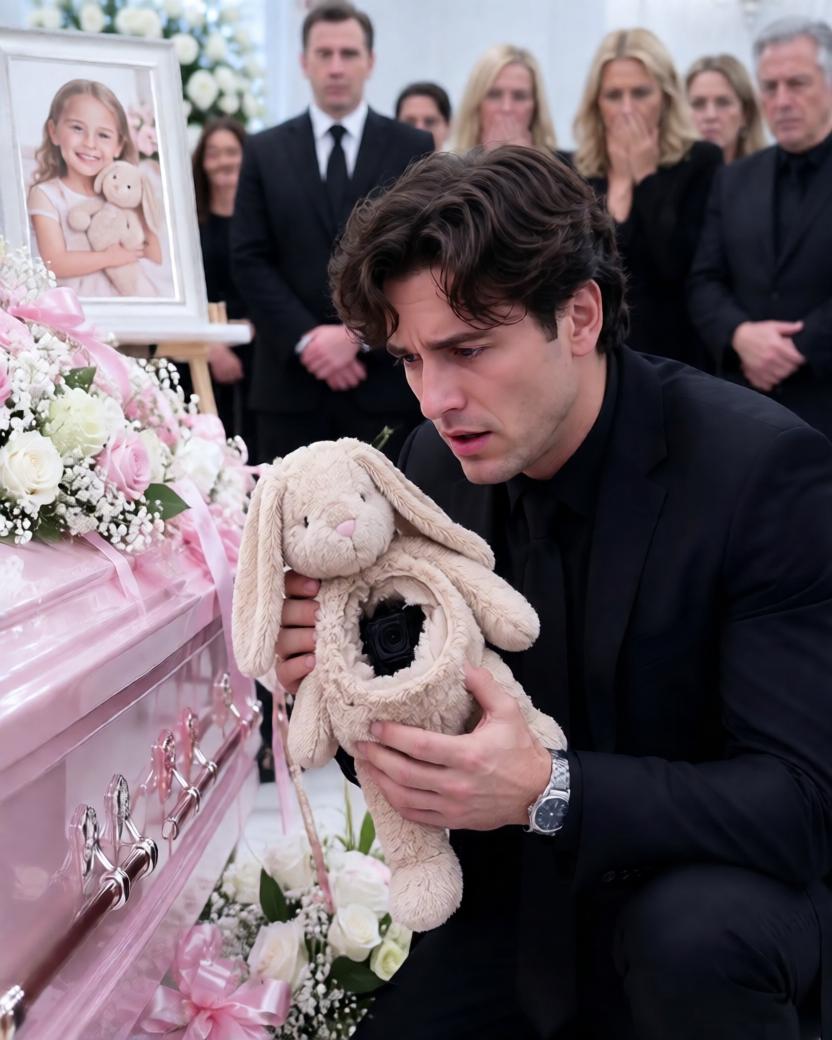
At the funeral, Christopher stood almost motionless, holding Captain against his chest.
Samantha cried loudly in front of the guests as though she had never abandoned her daughter years earlier.
Pamela hugged grieving relatives near the entrance.
Zachary spent much of the time outside, pacing while quietly speaking on his mobile phone about unresolved fundraising campaign expenses.
Christopher barely noticed.
He was too broken.
That night, he sat alone in Abigail’s empty bedroom.
The room was painfully quiet.
Her drawings were still on the walls. Her school things were still where she had left them. Her favorite belongings were still waiting for her, even though she would never return.
Christopher picked up Captain.
As he held the rabbit, his fingers suddenly felt something hard hidden inside the cotton stuffing.
He froze.
He turned the toy around and carefully examined it.
Then he grabbed a pair of scissors and gently cut open the rear seam.
Inside the stuffing was a modern smartwatch.
Christopher stared at it.
Everyone had believed Abigail had lost that watch months earlier.
His hands trembled as he picked it up.
There were several audio files saved on it.
He pressed play.
For a moment, there was only silence.
Then Abigail’s soft voice came through the tiny speaker.
“Dad is at work right now, and Aunt Pamela and Uncle Zachary think I’m fast asleep in my bed. Uncle Zachary just said that as long as I stay sick in the hospital, the donation money will keep coming in continuously.”
Christopher stopped breathing.
His heart began pounding violently against his ribs.
He replayed the recording.
Then again.
He still could not understand what he was hearing.
His own family.
His daughter.
Money.
And a secret.
Yet Christopher had no idea that this recording was only the beginning of the truth he was about to uncover.
Part 2:
Christopher played the short recording again.
Then he played it a third time.
He wanted to make absolutely certain that he had not misunderstood Abigail’s words.
There were more files.
He opened the second recording.
This time, Zachary’s voice came from what sounded like the narrow hospital hallway. His voice was calm, almost casual.
“As long as the girl remains hospitalized in this unit, our online publications will continue to work effectively,” Zachary said. “If she goes into remission or gets sent home, the public compassion ends immediately and the money tap gets turned off completely.”
Christopher felt sick.
Pamela answered in a quiet, nervous voice.
“Abigail listens to our conversations way too much. Yesterday she asked me why the pharmacy receipts had completely different names printed on them.”
Zachary did not sound worried.
“She’s only seven years old. Just tell her that her dad might get terribly sick if she worries him. That will shut her up for good.”
Christopher’s hands tightened around the watch.
Then he opened another file.
Pamela was speaking.
“You’re a very smart little girl, so don’t you ever tell your dad about our private conversations. He’s completely exhausted and might get severely ill from stress, and you certainly don’t want to hurt your dear father, do you?”
Abigail’s tiny voice answered.
“No, I don’t.”
Pamela responded sweetly.
“Then this will be our special secret to protect him.”
Christopher stopped the recording.
Tears filled his eyes.
The sister who had helped raise his daughter had deliberately used Abigail’s love for her father to force her into silence.
Pamela had made the child believe that telling Christopher the truth could make him sick.
Christopher wiped his face and opened the final audio file.
Abigail’s voice was weak.
She sounded as if she had been recording alone.
“Dad, I hid this watch deep inside Captain because nobody ever takes him away from me. They’re lying to you, and they talk about money whenever they think I’m sleeping soundly.”
Christopher closed his eyes.
The recording continued.
“They also mentioned that they switched some medical pages and that you should never see them. So please do something, because you know how to fix anything that breaks.”
Christopher began crying silently.
But he did not immediately call the police.
He did not call Pamela.
He did not call Zachary.
His years working at the manufacturing plant had taught him one important lesson: when a serious machine failure happens, an impulsive reaction can destroy the only physical evidence showing what went wrong.
So he carefully put the smartwatch away.
The next morning, Christopher contacted Nora Vance.
Nora was a highly experienced former public prosecutor who now worked as a private investigator.
She listened to the recordings without interrupting.
She photographed the smartwatch and then immediately requested every official medical and banking document connected to Abigail’s case.
After reviewing the first evidence, Nora looked directly at Christopher.
“Do not confront them yet,” she warned. “If they realize how much evidence you have, they could delete bank accounts, messages, emails, and other records before we can preserve them.”
Christopher nodded.
For the next six days, Christopher and Nora worked quietly.
They reviewed online campaign links, wire transfers, donation records, and alleged medical consultation documents.
The truth became darker with every discovery.
Zachary had created several fake charitable foundations.
He had used real photographs of Abigail.
He had altered her official diagnoses.
He had collected massive amounts of money through obscure third-party bank accounts.
And he had given Christopher fake receipts showing treatment costs that were sometimes four times higher than the real amounts.
But then Nora found something much worse.
Official hospital records showed that doctors had recommended changes to Abigail’s cancer treatment protocol on two separate occasions because her aggressive tumor was getting worse.
Christopher had never seen those documents.
The physical copies Zachary had given him recommended continuing the exact same passive treatment.
Nora compared the signatures.
They were crude forgeries.
She stared at the documents for several seconds before speaking.
“This is no longer just a financial fraud case,” Nora said gravely. “Someone intentionally delayed critical medical decisions for your daughter.”
Christopher felt as though someone had punched him in the chest.
He went straight to Pamela’s house.
He carried Captain with him.
When Pamela opened the door, she immediately stepped forward to hug him.
Christopher moved away.
“Don’t you dare touch me,” he said coldly. “Abigail left clear recordings behind.”
All the color disappeared from Pamela’s face.
Her hands began shaking.
“I honestly have no idea what you’re talking about, Christopher,” she stammered.
Christopher placed Captain firmly on her dining table.
“I’ll come back tomorrow morning,” he said. “And I expect to hear the absolute truth directly from your own mouth.”
Then he walked away.
That night, Nora’s monitoring equipment picked up several panicked phone calls between Pamela, Zachary, and Samantha.
There were also failed attempts to withdraw large amounts of money from three hidden bank accounts.
The following morning, Christopher returned to Pamela’s house.
This time, he wore a hidden microphone.
Nora sat in a parked car outside, monitoring the live signal.
Christopher stepped inside.
Zachary was already in the living room.
Christopher closed the front door behind him.
“Let’s talk about the stolen money, the forged medical documents, and the exact reason my daughter became a dangerous problem for the three of you,” he said.
Zachary slowly placed his coffee cup on the table.
“Christopher, there are complex things here that you simply don’t understand,” he said smoothly. “We had to make some very difficult practical decisions.”
Pamela suddenly broke down.
She began crying uncontrollably in her chair.
Christopher kept his eyes on Zachary.
“Then tell me who ordered the critical cancer treatment to be delayed.”
Zachary stared back at him.
And then he said something that would permanently change the entire legal case.
Part 3:
“The girl was already terminally ill anyway,” Zachary said coldly. “So we simply made the absolute most of the remaining time we had left.”
For a terrifying second, Christopher wondered if he had heard correctly.
Pamela suddenly raised her head.
“Shut your mouth right now, Zachary!” she screamed.
But it was already too late.
Every word had been clearly recorded.
Christopher remained completely still.
Nora had warned him not to shout, threaten them, or touch them. If he lost control, they could later try to make themselves look like the victims.
So Christopher forced himself to stay calm.
“What exactly did you take advantage of?” he asked.
Zachary wiped his forehead.
He finally realized he had said too much.
“I didn’t mean it like that,” he quickly argued. “You’re taking my exact words completely out of context. There were massive logistical expenses, field managers, private consultations, constant bank transfers, and other costs involved in the whole operation.”
Christopher stared at him.
“Manage? You raised millions of dollars using my dying daughter’s face on the internet!”
“It certainly wasn’t millions of dollars in personal net profit for us after expenses,” Zachary blurted out.
Silence filled the room.
His own words had just made everything worse.
Pamela sank lower into her chair.
Christopher looked at her.
“At first, we genuinely just wanted to help you, Christopher,” Pamela sobbed. “Zachary made the initial contacts and launched the first online campaign because you couldn’t cover the rising bills.”
She wiped her face.
“A massive amount of money came pouring in within just a few days. Then Zachary suggested that we should save some of it for future unexpected expenses.”
Christopher’s voice hardened.
“How much money did you monsters actually keep for yourselves?”
“I don’t know the exact figure,” Pamela whispered.
“Look me in the eye and tell me the real amount.”
Pamela finally looked at him.
“It was more than two million dollars split across all the hidden accounts,” she confessed. “Maybe even more. I only received occasional transfers and signed physical receipts.”
Christopher felt nauseous.
He remembered every extra factory shift.
Every meal he skipped because he needed to save money.
Every night he had slept in that awful hospital chair beside his daughter.
And while he was fighting to keep Abigail alive, his own sister had been calculating how much money could be made from his child’s illness.
“And what about Samantha?” Christopher asked.
Pamela closed her eyes.
She could not answer.
Zachary did.
“Samantha willingly agreed to lend us her personal identification details and appear in several promotional videos,” he said. “Donors give significantly more money when they see a heartbroken mother crying on camera.”
Christopher remembered the funeral.
He remembered Samantha standing beside the casket and crying loudly.
He had thought she was mourning the daughter she had abandoned years earlier.
Now he understood.
She had been mourning the collapse of a profitable operation.
Christopher looked at Zachary.
“Now tell me the complete truth about the altered medical documents.”
Zachary shifted uncomfortably.
“The head doctor was proposing an extremely expensive and highly risky experimental treatment,” he said quickly. “There were zero guarantees it would work.”
“The hospital documents prove that’s false,” Christopher replied. “They never presented it as an experimental treatment. They urged us to change the protocol and request an immediate specialist evaluation.”
“It was just a theoretical possibility they mentioned,” Zachary dismissed.
“You deliberately forged the doctor’s official sign-off sheet.”
“It was simply modified to keep you from panicking unnecessarily during an already stressful period.”
Christopher turned toward Pamela.
“Did you know about the forged medical sheets?”
Pamela hesitated for far too long.
Finally, she whispered, “Zachary explained that if Abigail was discharged or transferred to another facility, our media campaigns would lose all their momentum. He said we needed a few more weeks to gather enough funds.”
“Enough money for what?”
Pamela lowered her eyes.
“To pay pressing personal debts,” she admitted. “Zachary owed money to dangerous people. Samantha owed debts too. And I used some of the money to cover my overdue house mortgage.”
Christopher closed his eyes.
His daughter had been turned into a financial deadline.
“When the medical team insisted a second time that the treatment protocol needed to change, what did you do?” he asked.
Zachary suddenly slammed his fist against the wooden table.
“We’re not trained medical doctors!” he shouted. “And absolutely nobody can ever prove that a simple protocol change would have saved her life anyway!”
“But you knew the change could have given my daughter a real chance to survive,” Christopher answered steadily.
Neither Pamela nor Zachary could respond.
Christopher slowly reached into his pocket.
He pulled out the smartwatch.
Then he placed it beside Captain on the table.
“Abigail recorded that she heard you celebrating in the hallway when her condition worsened.”
Pamela shook her head violently.
“We never celebrated her physical pain, Christopher! I swear!”
“You specifically said that her new emergency admission would reactivate declining online donations.”
Pamela covered her face.
“I was desperate for money,” she sobbed.
“Abigail was desperate to live,” Christopher replied, his voice shaking with controlled rage. “And you manipulated her into staying silent because you told her that telling me would make me sick.”
Pamela could not look at him.
Zachary suddenly stood.
“That is enough of this nonsense!” he shouted. “You have absolutely no right to walk in here and accuse us as if we murdered someone!”
Christopher stared directly at him.
“My seven-year-old daughter became a dangerous liability to you because she was smart enough to understand your fraud.”
Zachary opened his mouth.
But anger and arrogance took control of him.
“Of course she was a massive risk to us!” he roared. “If that child had spoken to a hospital social worker or shown those hidden recordings to anyone, we would all end up rotting in federal prison! So what on earth did you expect us to do?”
Christopher heard Nora’s calm voice through the tiny wireless earpiece.
“That is more than enough evidence, Christopher. Walk out of the house right now.”
Christopher turned toward the front door.
Zachary stepped forward and tried to block his path.
Then heavy knocks suddenly thundered against the door.
The door opened.
Local police officers and agents from the prosecutor’s office rushed inside carrying an emergency search warrant.
Pamela froze.
Zachary immediately began shouting for his attorney.
“This is a private family dispute!” he protested.
The officers ignored him.
They seized mobile phones, personal computers, bank statements, tax folders, and other financial records from the house.
Later, investigators discovered something on Zachary’s laptop that made the entire operation even more disturbing.
There was a spreadsheet titled Impact Calendar.
Zachary had carefully scheduled social media posts around Abigail’s health relapses.
The spreadsheet contained calculated labels such as:
Hospital Admission.
Photo On Oxygen.
Devastated Mother.
Final Chance.
Each stage had a specific fundraising target attached to it.
Investigators also found text messages between Zachary and Samantha.
One message said:
“Upload a much more revealing photo of her, preferably one where she looks noticeably thinner.”
Another said:
“Make sure Christopher never finds out about the secondary bank accounts.”
Then investigators found an even more revealing message:
“If the doctors change her treatment and her condition actually improves, this whole structure falls apart completely.”
The cruelest evidence was a voice message sent by Samantha.
“As long as she is still breathing, money can keep coming in,” she said coldly. “And we can also run one final massive collection campaign right after the funeral service.”
Samantha was arrested two days later inside a commercial bank branch in suburban Littleton.
She had been attempting to withdraw a massive amount of cash.
She had never visited Abigail’s gravesite.
She had never brought flowers.
The investigation quickly spread across state lines.
Prosecutors discovered dozens of fraudulent bank accounts, fake donation websites, and forged accounting receipts.
Then they discovered something even more shocking.
Abigail had not been their only victim.
Zachary had been involved in similar schemes involving other sick children. He secretly took commissions and diverted charity donations while using authentic medical documents to make fake treatment plans appear legitimate.
In Abigail’s case, medical experts compared the original hospital reports with the altered copies that Christopher had received.
They confirmed deliberate changes to dates, treatment recommendations, and physician signatures.
Investigators also proved that two urgent specialist evaluation requests had been deliberately withheld.
An appointment with an oncology team had even been canceled through an email account controlled by Zachary.
The medical board carefully reviewed everything.
They could not say with absolute certainty that Abigail would have survived her aggressive cancer.
But they unanimously agreed on something important.
The deliberate treatment delay had drastically reduced her medical options and allowed the tumor to progress without proper intervention.
For Christopher, that official conclusion felt like losing his daughter all over again.
For months, he woke every morning believing he had failed Abigail.
He blamed himself for not checking every document.
He blamed himself for trusting his family.
He blamed himself for not understanding Abigail’s frightened warnings sooner.
One morning at the manufacturing plant, his elderly shift supervisor, Arthur Miller, found him sitting motionless in front of a silent industrial compressor.
Arthur looked at him.
“Barrett, you’ve been staring at that exact same iron bolt for twenty minutes.”
Christopher finally spoke.
“I should have realized what was happening much sooner, Art.”
Arthur removed the wooden toothpick from his mouth and sat beside him.
“You were taking care of your dying daughter, working exhausting shifts, and trying your absolute best not to completely fall apart,” Arthur said firmly. “Listen to me. The people who betrayed you chose the exact moment when you were at your weakest. The fault belongs to them.”
Christopher shook his head.
“I personally handed them all her medical paperwork.”
“You handed those papers over because they were your close family,” Arthur reminded him.
Christopher lowered his head.
“Abigail tried to warn me several times. I didn’t listen properly.”
Arthur placed a hand on his shoulder.
“Yes, you did listen to her in the end, Christopher. It took time, but you heard her voice. And because you had the courage to uncover the truth, those monsters will never be able to do this to another innocent child.”
Nearly a year later, the highly publicized criminal trial began in district court.
Outside the courthouse, reporters and families affected by similar scams gathered together. Many held photographs that had been used without permission in other fake fundraising campaigns.
Inside the courtroom, Zachary refused to look at Christopher.
Pamela appeared broken and much older.
Samantha wore simple clothes and held a glass rosary in her hands, apparently trying to look like a repentant mother.
Christopher attended every hearing with Captain carefully held in his hands.
When the judge finally allowed him to give his victim impact statement, Christopher walked to the front of the courtroom.
He placed the worn brown rabbit on the wooden table.
“My daughter was only seven years old,” he began. “She loved pizza with double cheese. She drew funny crowns on her pictures. And she truly believed her dad could fix absolutely anything that broke in this world.”
The courtroom became silent.
“You took her terminal illness and turned it into a business strategy. You used her face, her suffering, and her fear. Then you used my trust to hide medical information that could have changed her treatment.”
Samantha immediately began crying loudly from the defendant’s seat.
Christopher turned toward her.
“Don’t sit there and cry now just so everyone in this courtroom looks at you,” he said calmly. “Abigail waited for your love for years. You only showed up when you needed a photograph for your campaign.”
Samantha lowered her head.
Christopher then looked at Pamela.
“You were the one person in this world I would have trusted with my own life. Abigail loved you deeply. That’s why she obeyed you when you told her to stay quiet.”
Pamela began sobbing.
“You didn’t just steal money from us, Pamela,” Christopher continued. “You stole her sense of safety. You stole her belief that family is supposed to protect you.”
Finally, Christopher looked directly at Zachary.
“You believed a sick little girl would be easy to control and silence,” he said. “But Abigail was smarter than all of you.”
He touched Captain gently.
“She hid the truth inside her favorite stuffed rabbit because she knew nobody would ever take him away from her. Even when she was terrified, she spent her final days thinking about how to stop what you were doing.”
The prosecution then played the recovered smartwatch recordings through the courtroom sound system.
A heavy silence fell over everyone.
Abigail’s tiny voice echoed through the courtroom.
“Dad, please do something, because you know how to fix everything that breaks.”
Christopher clenched his teeth and fought to keep himself composed until the recording ended.
The court eventually delivered severe prison sentences to all three defendants.
Zachary received the maximum penalty for grand fraud, document forgery, criminal conspiracy, and reckless endangerment connected to the concealment of critical medical information.
Pamela and Samantha were convicted for their active involvement, illegal handling of diverted funds, and obstruction of justice.
All real estate and other assets purchased with stolen donation money were seized by the state to provide restitution to the families who had been victimized.
But no prison sentence could bring Abigail back.
No legal punishment could return the years Christopher had lost with his daughter.
Still, the investigation achieved something important.
Dozens of fraudulent charity websites were permanently shut down.
A substantial amount of stolen money was recovered.
And with the support of other families who had been victimized, Christopher eventually created a nonprofit organization dedicated to teaching people how to verify medical fundraising campaigns, demand complete financial transparency, and send donations directly to verified hospitals and legitimate medical foundations.
He named it Captain Abigail.
Christopher refused to plaster Abigail’s face across giant promotional posters.
He refused to turn her suffering into another fundraising tool.
Instead, he told the truth so other families could be protected.
During community meetings, he often repeated the same warning.
“The worst enemy doesn’t always arrive with an open threat,” Christopher explained. “Sometimes they arrive carrying a neat folder under their arm. They call you family. They promise to handle all your problems. And secretly, they’re calculating how much profit they can make from your tragedy.”
Several months after the trial ended, Christopher finally found the strength to clean Abigail’s bedroom.
He carefully folded her little dresses.
He organized her school notebooks.
He packed away her hair clips.
At the very bottom of an old storage box, he discovered a colorful drawing.
It showed a tall man wearing a yellow hard hat and a slightly crooked golden crown.
Beside him stood a little girl with long hair.
She was holding a brown stuffed rabbit.
Underneath the picture, written in uneven childhood letters, were the words:
“My dad is the bravest man ever, and he always uncovers the truth.”
Christopher sat down on the bedroom floor.
For the first time in years, he allowed himself to cry freely.
He finally understood something.
Human justice could punish the guilty, but it could never reverse the past.
It could not bring Abigail back.
It could not repair every broken piece of his life.
But Abigail had never thought of him as a father who arrived too late.
She had trusted him.
She believed he would eventually find the hidden watch.
She believed he would keep his promise.
Christopher took Captain to a local tailor.
The torn seam was carefully repaired with a neat blue fabric patch.
Then he placed the rabbit inside a glass display case in his living room.
Captain still had his long ear.
His fur was still worn.
He looked exactly like the little rabbit Abigail had loved.
One weekend, a fellow maintenance engineer from the Aurora plant visited Christopher.
The man noticed the rabbit behind the glass.
“Why do you keep that old stuffed rabbit under such strict security glass?” he asked curiously.
Christopher smiled.
It was a genuine smile.
For the first time in years, it did not come with a wave of guilt.
“He used to be the chief of security at my house,” Christopher replied warmly.
His friend smiled.
“Has he officially retired from duty now?”
Christopher looked at Captain.
“Yes,” he answered softly. “He officially closed the most important case of his entire life.”
Every year on the anniversary of Abigail’s death, Christopher buys a large double-cheese pizza.
He places a fresh slice beside her drawing on the table.
He does not do it because he believes Abigail will somehow return to eat it.
He does it because he believes some promises are too sacred to disappear.
Some promises deserve to live forever.
The family that should have protected Abigail betrayed her trust.
Her terrible illness stole precious time from her.
And legal justice arrived too late to save her young life.
But three greedy adults, protected by lies, fake bank accounts, forged documents, and complicated schemes, were finally defeated by a brave seven-year-old girl who hid the truth inside an old stuffed rabbit.
Abigail’s small voice was almost silenced.
But it survived.
It reached her father.
And he listened.
Her story left behind a lesson that could never be forgotten:
Trust should never stop us from asking difficult questions.
Another person’s suffering should never become a business opportunity.
And a child’s small voice, no matter how weak it sounds, can sometimes become stronger than an entire corrupt family determined to silence it.
THE END.
