
Part 1:
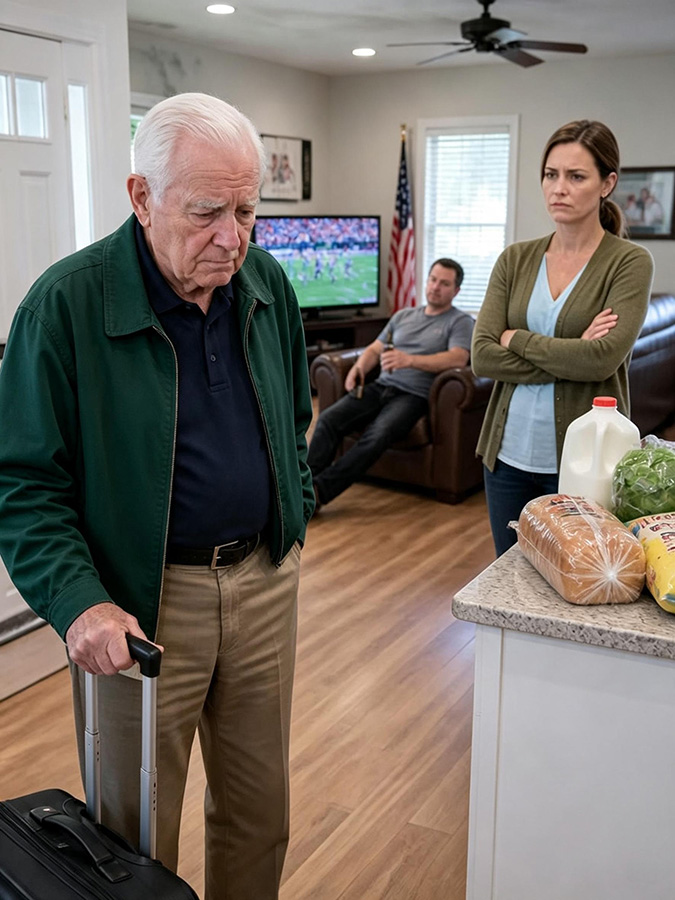
When my daughter told me that I had two choices—obey her husband or leave the house—I did not argue with her.
I did not remind her of all the mortgage payments I had made over the years. I did not remind her about the countless grocery trips, the heavy bags I had carried into the kitchen, or all the quiet sacrifices I had made because I believed that was what a father was supposed to do.
I simply gave her a tired, almost sad smile.
Then I walked to my bedroom, pulled my battered leather suitcase from the top shelf of the closet, and started packing.
That afternoon, I walked out of the house I had spent the best years of my life working to pay for.
My daughter, Elise, probably expected me to surrender like I had done so many times before. She thought I would calm down, apologize for causing trouble, and eventually crawl back.
After all, I had always told my family that I hated conflict.
But the man who had spent years trying to keep everyone happy was gone that afternoon.
I had finally reached my breaking point.
That Saturday morning had started like any other weekend.
I spent several hours at the local market, using most of my Social Security check to fill the pantry with groceries for Elise and her husband, Aiden. I bought everything they needed and even went out of my way to find Aiden’s favorite brand of imported craft beer.
Elise had once told me that he liked to have a cold beer after a long shift at the warehouse, so I had remembered.
That was the kind of father I had always been.
I remembered the little things.
I provided.
I helped.
And I rarely asked for anything in return.
When I finally came through the front door with my arms full of grocery bags, I immediately saw Aiden sitting in my favorite leather recliner.
That chair had belonged to my late wife, Jocelyn.
It was one of the few pieces of furniture I had kept because sitting in it always made me feel close to her.
Aiden was stretched out in it like he owned the place.
His feet were resting on my coffee table. A half-empty bottle of beer hung loosely from one hand, and his eyes were fixed on the television.
He didn’t even look at me when I walked in.
Then he spoke.
“Old man, go get me another beer from the kitchen.”
I stopped.
For a moment, I honestly thought I had heard him wrong.
I slowly placed the heavy grocery bags on the floor.
“Excuse me?” I asked.
Aiden finally waved his hand in my direction, still barely looking at me.
“You heard me. Get me another beer. And make sure it’s the imported stuff. Not that cheap swill you usually buy when it’s on sale.”
Something inside me went cold.
For years, I had swallowed insults and ignored disrespect because I wanted peace in the family.
But this felt different.
I had just walked through the door after spending most of my Social Security check on groceries for them, and Aiden was ordering me around like I was his servant.
“I just got home,” I said, keeping my voice calm. “I need to put these groceries away before the ice cream melts.”
Aiden finally turned his head and looked directly at me.
His face showed nothing but irritation.
“What is the big deal?” he snapped. “You’re already standing right there. Just get the beer and stop making a fuss over everything.”
I stared at him.
Then I took one step forward.
“The problem,” I said, “is that this is my house, and I’m tired of being treated like a servant in my own living room.”
Aiden slowly got out of the chair.
He was a big man, and he clearly knew it. He deliberately stood close to me, puffing out his chest as if his size alone would make me back down.
“Your house?” he said with a mocking laugh. “Really? Because as far as I can see, Elise and I are the ones living here now.”
“You live here because I allowed you to,” I replied. “And I did it because you’re my daughter’s husband.”
Aiden’s expression hardened.
“You don’t get to talk to me like that.”
Before I could answer, Elise walked into the living room.
She was holding a tablet and looked between the two of us with an annoyed expression.
“Dad,” she said, “just get him the beer. Why are you making such a big deal out of this?”
I looked at her.
I expected her to defend me.
I expected her to say something like, Aiden, that’s my father. Show him some respect.
Instead, she sighed.
“It’s not worth fighting about something this small.”
Aiden stepped closer.
“You live in our house now,” he said. “So when I ask you to do something for me, you do it without complaining.”
I looked at Elise again.
She was my daughter.
I had raised her.
I had paid for her college tuition. I had helped with her wedding. I had supported her when she needed me.
Surely, she would finally tell her husband that he had gone too far.
But she didn’t.
Instead, she stepped beside Aiden.
The two of them stood there together, facing me.
“Dad,” Elise said coldly, “you need to decide right now what you want to do.”
I said nothing.
She continued.
“Either you help Aiden and do what he asks, or you can pack your things and leave this house for good.”
The room suddenly became silent.
I stared at my daughter.
For a few seconds, I could barely process what she had said.
My own daughter had just told me to leave the home I had paid for.
The home I had opened to her.
The home where she and Aiden were living because I had allowed them to live there.
I slowly nodded.
“All right.”
Elise’s face immediately relaxed.
For a moment, I saw relief in her eyes.
Aiden smirked.
He thought he had won.
“Good,” he said. “Now, about that beer—”
“I’ll pack,” I said.
His smile disappeared.
Elise’s expression changed instantly.
“Dad, wait.”
But I was already walking away.
I went into my bedroom and closed the door behind me.
My hands were shaking, but my mind had never felt clearer.
I packed my clothes first.
Then I packed my daily medications and my reading glasses.
I gathered every important financial document I could find—bank papers, insurance information, account records, and anything else I might need.
Before leaving, I looked around my bedroom one last time.
Then I saw the framed photograph of Jocelyn at Silverwood Lake.
I picked it up carefully and placed it inside my suitcase.
That photograph was coming with me.
It was one thing in that house that truly belonged to my heart.
I zipped the suitcase shut.
When I rolled it into the hallway, Elise and Aiden were still standing there.
They looked completely shocked.
Neither of them had expected me to take their ultimatum seriously.
Elise opened her mouth.
“Dad, I didn’t mean—”
I raised my hand gently.
“It’s all right, Elise.”
She stared at me.
I didn’t yell.
I didn’t insult her.
I didn’t beg her to let me stay.
I simply walked past them.
I loaded my suitcase into the trunk of my car, got behind the wheel, and drove away.
Neither of them followed me outside.
Neither of them stopped me.
I drove to a quiet motel on the edge of the city.
That night, for the first time in years, I slept somewhere without listening to anyone arguing, demanding something from me, or making me feel guilty for having boundaries.
But I wasn’t finished.
Not even close.
The next morning, I opened my suitcase, placed my documents across the small, scratched table in the motel room, and began going through everything I had given my daughter and her husband.
That was when I decided to find out exactly how much their comfortable life had cost me.
And what I discovered would change everything.
Part 2:
I had spent thirty years working in the banking industry.
That experience had taught me two important things.
First, money always leaves a trail.
Second, people who think they can hide financial wrongdoing usually leave more evidence than they realize.
By Sunday morning, my motel table was covered with files.
I had bank statements, insurance policies, account numbers, receipts, automatic payment records, and pages of handwritten notes.
I began documenting every dollar I had spent supporting Elise and Aiden.
For years, I had never bothered to keep track.
Now I wished I had.
My first call was to the bank.
I stopped the automatic mortgage payment I had been making for the house.
My second call was to the insurance company.
I removed Aiden’s truck and Elise’s car from my personal insurance policy.
Then I spent the next two hours calling my credit card companies.
Elise had been an authorized user on several of my accounts.
I removed her from every one of them.
By noon, I had made eight carefully planned calls.
The mortgage payment was stopped.
The vehicles were no longer covered by my personal policy.
The credit cards were blocked.
Every automatic transfer I had been making for them was canceled.
I wrote down every confirmation number in my notebook in neat, careful handwriting.
I didn’t want anything left to chance.
My phone remained completely silent for the rest of the day.
That told me they had not yet realized what I had done.
But I knew they would soon.
And when they did, the comfortable life they had built around my money would begin to fall apart.
A few days later, I was having breakfast at a small local diner when I ran into an old coworker named Robert.
We had worked together in banking years earlier.
Robert sat down across from me, looked around the diner, and lowered his voice.
“Gavin,” he said, “I need to tell you something about Aiden.”
I put down my coffee.
“What happened?”
Robert leaned closer.
“Aiden tried to pull something nasty a few months ago.”
My stomach tightened.
“What do you mean?”
Robert hesitated before answering.
“He tried to get a home equity loan against your house.”
I stared at him.
“How much?”
“Fifty thousand dollars.”
My heart began pounding.
Robert continued.
“He told the bank the house belonged to him and that he had the right to borrow against the equity.”
I felt sick.
“Did they approve it?”
“No,” Robert said immediately. “The bank checked the property records. The title is completely in your name.”
I breathed out slowly.
Then Robert told me the part that made my blood run cold.
“The documents Aiden submitted were forged.”
For several seconds, I couldn’t speak.
Aiden hadn’t simply been rude to me.
He had tried to use my house as collateral for a loan he had no legal right to take.
Then Robert added another piece of information.
“There’s something else. People around the neighborhood have been saying Aiden has serious gambling debts.”
I immediately called Detective Knox Matthews, an old friend from my younger years.
After I explained what had happened, he confirmed what he knew.
Aiden owed around eighteen thousand dollars to various underground gambling operations.
Suddenly, everything made sense.
The constant demands.
The pressure.
The disrespect.
The attempts to control the house.
Aiden wasn’t simply trying to live comfortably.
He was using me to finance his problems.
He had found a source of money and assumed I would keep giving it to him forever.
And Elise had stood beside him.
I returned to the motel and opened my laptop.
I created a new folder.
I named it Evidence.
Then I began documenting everything.
Every payment.
Every account.
Every suspicious transaction.
Every conversation.
Every piece of information Robert and Detective Matthews had given me.
The next morning, I went to the courthouse and began the legal process to have Elise and Aiden removed from my property.
I also reported Aiden’s erratic behavior and the attempted loan fraud to the authorities.
Detective Matthews told me that, based on what I had documented, I had strong grounds to seek a restraining order against Aiden.
Then he told me something even more disturbing.
“Aiden has apparently been talking to a lawyer,” Matthews said.
“About what?”
“Adverse possession laws.”
I stared at him.
He explained that Aiden had apparently been looking for a way to argue that, because he had been living in the house for a period of time, he might eventually gain some kind of legal claim to it.
Of course, simply living in someone else’s home does not automatically make you the owner. But the fact that Aiden was researching ways to challenge my ownership told me something important.
This had not been a sudden plan.
He had been thinking about my house for a long time.
He had been looking for ways to make it his.
And he had probably hoped that I would eventually get old, tired, and disappear from the picture.
But I wasn’t disappearing.
By Thursday afternoon, the restraining order had been granted.
Aiden was prohibited from coming within one hundred yards of me or my property.
I also contacted the collection agencies that had been calling my home about Aiden’s debts.
I explained that he had no ownership interest in my house and that he was no longer financially connected to me.
Then the consequences began arriving one after another.
Aiden lost his warehouse job after he became so distracted by his creditors and financial problems that he stopped showing up for work.
The life he had built using my money began collapsing like a house of cards.
By Saturday, he was walking around the center of town telling anyone who would listen that I had cruelly abandoned my own daughter.
I happened to see him outside the bank.
A small group of people had gathered around him, mostly because they were curious about the loud argument.
When Aiden spotted me, he immediately raised his voice.
“There he is!” he shouted. “The man who threw his own daughter away without a second thought!”
Everyone turned toward me.
I walked over calmly.
I adjusted my jacket and looked him directly in the eyes.
“Hello, Aiden.”
He glared at me.
I smiled slightly.
“How are those gambling debts treating you today?”
The crowd went completely silent.
Aiden’s face turned bright red.
“You miserable old fool,” he spat.
I didn’t blink.
“I can document every dollar I spent supporting you and Elise for the past five years,” I said loudly enough for everyone nearby to hear. “Can you document where your own paychecks went?”
He opened his mouth.
Nothing came out.
I continued.
“Or were you too busy losing them at the tables?”
A few people in the crowd exchanged uncomfortable looks.
Aiden had no answer.
The confidence he had displayed only moments earlier disappeared.
He turned around and stormed away.
I watched him leave.
Then I returned to my motel room and added the incident to my evidence file.
By then, I knew the truth was finally catching up with him.
But I still had one person to confront.
My daughter.
Part 3:
Aiden tried one final trick.
He contacted me and claimed that Elise was pregnant.
He told me I was being a heartless grandfather by ignoring a family emergency.
For a moment, the claim could have sounded serious.
But I had already learned not to trust anything Aiden said.
So instead of giving him money, I called the local clinic.
I explained that if Elise truly had a medical emergency, I was willing to pay for her care directly.
The clinic checked its records.
There was no pregnancy record for Elise.
None.
I called her immediately.
When I confronted her with what I had learned, she panicked.
Then she hung up.
That was the last conversation I had with her for several days.
Soon after, Aiden disappeared.
He packed his truck while Elise was at work and left town without giving anyone a forwarding address.
It wasn’t difficult to understand why.
Once my money was gone, there was nothing left for him to take.
I had finally closed the door he had been using to keep himself afloat.
But Elise was still my daughter.
No matter how badly she had hurt me, that fact had not changed.
So I called her.
I asked her to meet me at the little diner we used to visit when she was younger.
She agreed.
When she arrived, I barely recognized her.
She looked as if she had aged ten years in only two weeks.
Her eyes were red.
Her clothes were wrinkled and disheveled.
She sat across from me and immediately began talking.
She told me about the aggressive debt collectors.
She told me about the endless phone calls.
She told me how frightened she had become.
Then she admitted something that hurt more than I expected.
Aiden had been using her credit cards at casinos.
She had trusted him.
And now she was facing the consequences of choices she had made because she had followed him instead of listening to her father.
I didn’t interrupt her.
I let her talk.
I listened until she had nothing left to say.
Only then did I speak.
“You have one chance to rebuild our relationship,” I told her.
She looked at me through tear-filled eyes.
“One chance?”
“One chance,” I repeated. “And it begins with complete honesty.”
She asked what I wanted from her.
I told her.
I wanted her to tell the truth publicly.
I wanted her to make a statement at church.
I wanted her to write a letter to the local newspaper.
And most importantly, I wanted her to admit what had really happened.
No excuses.
No blaming Aiden.
No pretending that I had abandoned her.
She looked terrified.
“What will the neighbors think of me?” she asked.
I looked at her for a long moment.
“They’ll think you had a father who gave up years of his retirement security to make your life easier,” I said. “And they’ll know that you took it for granted until it finally disappeared.”
She lowered her eyes.
After a long silence, she asked the question I knew was coming.
“What are you going to do with the house?”
She clearly still hoped there was a chance she could keep it.
I gave her the answer she wasn’t expecting.
“I donated it.”
Her head snapped up.
“What?”
“The house now belongs to the Riverdale Veterans Housing Initiative.”
She stared at me.
I continued.
“They’ll turn it into housing for veteran families. Three different families will have a stable place to live there starting next month.”
Her face crumpled.
She began crying.
But I didn’t change my mind.
“I’ve changed my will too,” I said. “Even if you do everything right from this point forward, that house is never coming back to you.”
She covered her face with her hands.
I waited.
Then I spoke more gently.
“I need to know that our relationship is based on love and respect, not money or inheritance.”
Her tears continued.
This time, they looked different.
There was no anger in her face.
Only regret.
“I am so sorry, Dad,” she whispered.
I nodded.
“Sorry is a beginning, Elise. It isn’t the finish line.”
We left the diner without saying much more.
That Sunday, Elise stood in front of the church congregation.
The church was full.
She walked to the front, took a deep breath, and told everyone the truth.
She admitted that I had paid her college tuition.
She admitted that I had helped pay for her extravagant wedding.
She admitted that I had provided the down payment for the house, paid bills, bought groceries, and supported her and Aiden financially for years.
Then she admitted the hardest part.
She had stood beside Aiden while he disrespected me.
She had watched him treat me like a servant.
And she had told her own father to leave the home he had paid for.
The church became completely silent.
Elise stood there with tears in her eyes, but she didn’t take anything back.
She didn’t make excuses.
For the first time, she told the whole truth.
After the service, people who had ignored me for months came over.
Some shook my hand.
Others hugged me.
Several apologized and told me they finally understood why I had walked away.
Later, Elise told me she had also posted the truth on social media.
She had sent her letter to the local newspaper.
She had filed for divorce from Aiden.
And she had started going to counseling.
For the first time in years, I believed my daughter might actually mean what she was saying.
But forgiveness would take time.
Trust would take even longer.
And that was all right.
I had finally learned that some things couldn’t be repaired overnight.
Part 4:
Months passed.
I eventually bought a small, quiet cabin near the shores of Silverwood Lake.
It wasn’t a mansion.
It wasn’t expensive.
It didn’t need to be.
It was peaceful.
Every morning, I sat on the wooden deck with a cup of coffee and watched the sunlight move across the water.
In the afternoons, I went fishing.
In the evenings, I read my favorite books.
Nobody demanded anything from me.
Nobody ordered me around.
Nobody made me feel guilty for saying no.
For the first time in years, my time belonged entirely to me.
Meanwhile, the old house was transformed.
It became a place where veteran families could start over.
When the first family moved in, I saw children’s bicycles standing near the white fence.
A small American flag appeared on the front porch.
A man stood beside the doorway, looking around the house with an expression I will never forget.
He looked like someone who had finally found a little peace.
That sight made me realize I had made the right decision.
The house had once been the center of my family’s greed and conflict.
Now it was giving other families a chance to build a better life.
And somehow, that felt more meaningful than keeping it for myself.
Elise and I slowly began rebuilding our relationship.
We met for coffee on the first Saturday of every month.
She never asked me for money.
She never asked me to give the house back.
She never asked about my will.
Instead, she asked about me.
She asked about my life.
My work.
My childhood.
My memories of her mother.
Sometimes we talked about Jocelyn for hours.
Those conversations meant more to me than she probably realized.
We weren’t trying to return to the relationship we had before.
Too much had happened for that.
Instead, we were building something new.
Something healthier.
Something based on respect rather than dependence.
One crisp October afternoon, Elise came to visit me at the cabin.
We sat together on the wooden deck and watched Silverwood Lake turn silver beneath the fading afternoon light.
For a while, neither of us spoke.
Then she finally broke the silence.
“I keep thinking about what you could have done with all that money,” she said quietly.
I looked at her.
“I would have spent it on you anyway,” I admitted with a small shrug. “I just would have spent it differently.”
She smiled sadly.
“With more boundaries?”
“With a lot more boundaries.”
She laughed softly.
Then she became serious again.
“I just didn’t understand what you were giving up for me.”
I looked out across the lake.
“No,” I said. “You didn’t.”
She lowered her eyes.
For a moment, I wondered if the conversation had gone too far.
Then I added, “But you understand now. And that’s what matters.”
She nodded.
We sat quietly for a while longer.
When she finally left, I remained on the deck alone.
I looked across the water and thought about Jocelyn.
I thought about the life we had built together.
I thought about Elise as a little girl.
I thought about all the years I had spent believing that being a good father meant giving everything away, even when doing so left nothing for myself.
For the first time in a decade, my home was completely quiet.
But this time, the silence didn’t feel lonely.
It felt peaceful.
My time was finally my own.
And I realized something I should have understood years earlier.
That was enough.
It had always been enough.
I just had to believe that I deserved a life of my own.
THE END.
