
Part 1: The Cold Courtroom and the Navy Shirt
The family courtroom in Concord, New Hampshire, felt even colder than the freezing winter morning outside. Through the tall glass windows, I could see the pale sky and the snow-covered streets, but the cold inside the courtroom seemed to come from somewhere deeper.
I sat at a long wooden table with my eight-year-old son, Toby, sitting quietly beside me. His small sneakers barely touched the floor, so his feet moved back and forth whenever he became nervous.
That morning, I had carefully picked out his nicest clothes. I dressed him in his cleanest pair of jeans, a dark navy shirt with a tiny embroidered moon near the front pocket, and his winter shoes that I had spent twenty minutes polishing with a damp kitchen towel.
The shirt was not new. Not even close.
The collar had become soft after being washed so many times. Near the bottom seam, there was still a faint dark stain that refused to disappear. I had tried cleaning it twice, scrubbing the fabric as hard as I could, but some marks simply refused to come out.
I looked at that little stain many times before we entered the courtroom. I knew exactly what Russell’s lawyer would see.
But I also knew what I saw.
I saw my son’s favorite shirt.
Across the narrow aisle sat my former husband, Russell Davenport, next to his expensive attorney. Russell looked like he belonged in that courtroom more than anyone else.
He wore a perfectly fitted charcoal suit, shiny leather shoes, and a heavy silver watch. It was the same watch he had purchased shortly after telling me he was struggling financially and could not afford to send his child support payments on time.
He looked calm.
Successful.
Completely prepared.
I looked down at my own clothes. I was wearing a secondhand cream-colored jacket over a simple black dress. I had no lawyer sitting beside me. No expensive legal team. No one whispering advice in my ear.
All I had was a thick paper folder sitting in front of me.
Inside were years of proof.
School report cards.
Doctor’s notes.
Rent receipts.
My work schedules.
Printed messages showing every promise Russell had made and every promise he had broken.
His lawyer, Benedict Welch, slowly stood from his chair and walked toward the judge.
“Your Honor,” Benedict began in a smooth and confident voice, “this hearing is not about whether my client’s former wife loves her child. Nobody is questioning that.”
He paused and looked around the courtroom.
“It is simply about whether basic affection can replace a complete lack of daily stability.”
My fingers tightened around the edge of the wooden table.
The rough surface pressed against my skin as I tried to stay calm.
Judge Leonard lowered his reading glasses and looked directly at the attorney.
“You may continue, Mr. Welch,” the judge said.
Benedict reached into his expensive leather briefcase and pulled out a large printed photograph.
He held it up so everyone in the courtroom could see.
The picture showed Toby leaving his elementary school three days earlier.
Wearing the exact same navy shirt.
The same shirt he was wearing right now.
“This photograph represents our concern,” Benedict said, pointing toward the image.
“The child repeatedly appears in public wearing old and worn clothing. His mother works unpredictable hours, lives in a small apartment, and depends heavily on an elderly family member for basic childcare.”
The moment those words left his mouth, Toby stopped moving his feet.
Completely still.
His little hands folded together in his lap.
Benedict walked closer to the judge and pointed toward the faint stain near the bottom of the shirt in the photograph.
“She cannot even provide presentable clothing for her son on a consistent basis.”
A few people sitting in the gallery shifted uncomfortably in their seats.
Some looked at Russell.
Others looked at me.
Toby lowered his head and stared down at his shoes.
My heart sank when I saw his expression.
Because in that moment, I understood what Russell was really trying to do.
This was not just about getting more weekends with our son.
Russell wanted the court to believe that because I struggled with money, I must also be failing as a mother.
He wanted everyone in that room to see a stained shirt.
But he did not know the story behind it.
He did not know what that shirt meant.
And he had no idea that my son knew the truth.
Part 2: The Life We Built After He Left
Russell had walked away from our marriage two years earlier.
I still remembered that day clearly.
He packed his clothes, his expensive coffee machine, the large television from our bedroom, and almost everything else he believed was valuable. Then he moved into a beautiful townhouse on the other side of the city.
As he zipped up his bags, he looked at me and spoke as if everything was simple.
“We are mature adults, Brenda,” he said calmly. “There is no reason to bring expensive lawyers into this or make things more complicated than they need to be.”
At the time, I wanted to believe him.
I wanted to believe that even though our marriage was ending, we could still be good parents together.
I believed Russell would continue showing up for Toby.
I believed he would keep his promises.
But only three months later, everything changed.
Most of my calls went unanswered.
Most of my messages were ignored.
The man who had once promised to always be there for his son slowly disappeared from our daily lives.
Then my mother, Martha, moved into our small apartment.
She arrived at our door carrying only one suitcase, a slow cooker, and the kind of quiet strength that could hold an entire family together.
She never asked if I needed help.
She never made me feel like a burden.
She simply walked inside and started helping.
On the very first night, while I sat there feeling completely lost, Martha looked at me and spoke gently.
“You can sit down and cry later,” she told me. “Right now, your boy needs a warm dinner, and you need some sleep.”
Those words stayed with me.
Because she was right.
No matter how broken I felt, Toby still needed his mother.
Our apartment was far from perfect.
It was located above a busy bakery and a small neighborhood dental office. Every morning, we woke up to the sounds of deliveries arriving below us. The window frames shook whenever large trucks drove down the street. The old radiators made strange noises, and sometimes they worked well, while other times they barely produced any heat.
The kitchen was so narrow that two adults could barely stand inside it together.
But despite all those problems, it was still our home.
It was where Toby laughed.
Where we ate dinner together.
Where we made memories.
I worked harder than I ever thought possible.
Every morning, I woke up early and worked shifts at a local diner downtown. Three evenings every week, I cleaned commercial office buildings after everyone else had gone home. On weekends, I drove around town delivering grocery orders whenever my old car decided it would start.
Some mornings, I left the apartment before Toby even opened his eyes.
Some nights, I returned home long after he was already asleep.
But there were things I never missed.
Not once.
I attended every parent-teacher conference at his school.
I packed his lunches every night, even when I was exhausted, and I always slipped a small handwritten note under his sandwich.
Sometimes it was something simple like:
“Have a great day, Toby.”
Or:
“Mom loves you.”
I checked his homework late at night, sometimes after midnight, when my eyes were burning and my body begged me to sleep.
Especially his math homework.
I wanted him to know that no matter how tired I was, he mattered more than anything.
Toby noticed everything.
More than I wanted him to notice.
He knew when I ate a simple bowl of cereal for dinner because there was only enough chicken left for him and his grandmother.
He knew why I turned down the hallway thermostat during the coldest winter nights.
He even noticed that the brightest red apple always ended up in his lunchbox while the bruised ones stayed on the kitchen counter for me.
I never told him these things.
I never wanted him to carry my worries.
But somehow, he saw them anyway.
One night, I came home late and found myself sitting at the kitchen table surrounded by unpaid bills.
The papers covered the entire surface.
I was staring at the numbers, trying to figure out which problem I could solve first.
Then I heard a quiet voice behind me.
“Mom?”
I quickly turned around.
Toby was standing there in his pajamas, rubbing his eyes.
“Are we in big trouble?” he asked softly.
My heart immediately broke.
I quickly gathered the papers and turned them face down so he could not see the red numbers written across them.
“No, sweetie,” I told him. “Not at all. I’m just deciding which of these bills needs my attention first.”
Toby walked closer and climbed onto the wooden chair beside me.
He looked at the papers for a moment, then smiled slightly.
“Sometimes I do my easiest reading homework first,” he said. “Maybe bills work the same way.”
For a second, I forgot how exhausted I was.
I laughed softly.
My eyes filled with tears, but I tried to hide them.
That was Toby.
Even when life felt heavy, he somehow found a small piece of hope.
He could look at a pile of overdue bills and still find a reason to smile.
And that was something Russell never understood.
A home was not built with expensive furniture or a large backyard.
A home was built with love, sacrifice, and the people who stayed when things became difficult.
Part 3: The Secret Behind the Moon Shirt
The navy moon shirt that became the center of the courtroom battle had a story behind it.
A story Russell never knew.
A story that proved how much a simple piece of clothing could truly mean.
I had bought that shirt about four months before the custody hearing.
At the time, Toby had developed a huge love for astronomy. It started after his second-grade class went on a field trip to a local planetarium.
From that day forward, space became his favorite subject.
Every evening, he talked about planets, stars, and distant galaxies. He would tell me about how light from stars could travel through space for millions of years before finally reaching Earth.
His eyes would light up every time he talked about it.
He was fascinated by the universe.
And I loved seeing him so excited about something.
One rainy evening, after finishing a long cleaning shift inside a downtown office building, I was walking home when I passed a small clothing store.
The store was having a clearance sale.
Old items were being sold for much cheaper prices.
As I looked through the window, something caught my attention.
A dark navy shirt hanging on a bargain rack near the front.
I stepped inside and picked it up.
The fabric was soft.
It felt strong enough to last a long time.
And right beside the front pocket was a tiny silver moon stitched into the fabric.
The moment I saw it, I thought of Toby.
I could already imagine his face when he noticed the moon.
I checked the price tag.
Twelve dollars.
I froze for a moment.
At that time, I only had eighteen dollars left in my bank account to survive until Friday.
My mind immediately told me what I should do.
Buy eggs.
Buy milk.
Save every dollar possible.
Be responsible.
But then I imagined Toby wearing that shirt.
I imagined him looking at the little moon and feeling special.
For once, I wanted to buy him something brand new.
Something that had never belonged to another child before.
Something that was just his.
So I made the decision.
I bought the shirt.
I carried it home inside a thin paper bag, holding it carefully the entire way.
When I arrived at the apartment, I quietly walked into Toby’s bedroom.
He looked like he was sleeping peacefully under his blankets.
I knew he was tired from school, so I did not wake him.
Instead, I folded the shirt neatly and placed it on the wooden chair beside his bed.
Then I stood there.
Longer than I should have.
I watched him breathe.
I looked at my little boy sleeping peacefully.
At that moment, I was exhausted.
My feet hurt from working all day.
My mind was filled with worries about next month’s rent.
I had no idea how I would handle every bill waiting for me.
But at the same time, I felt incredibly proud.
Because I had brought something home that would make my son happy.
Something small.
Something simple.
But something filled with love.
I smiled quietly in the darkness.
Then, without making a sound, I started crying.
Not because I regretted buying it.
Because I loved him so much.
I cried because I wished I could give him more.
A bigger bedroom.
More toys.
More opportunities.
A life without financial worries.
But what I did not know was that Toby was not asleep.
He had been awake the entire time.
His eyes were closed, but he had seen everything.
He saw me place the shirt beside his bed.
He saw the smile on my face.
And he saw the tears I tried so hard to hide.
I thought I was protecting him from our struggles.
I thought he did not notice the sacrifices I made.
But my son had been watching.
And he understood far more than I ever realized.
Part 4: A Voice From the Table
Back inside the cold courtroom, Benedict Welch continued presenting his argument.
He stood confidently in front of the judge, speaking as if everything was already decided.
“This case is not about judging someone’s financial situation,” Benedict said smoothly. “This is only about whether the child has a stable and consistent daily environment.”
He turned slightly toward Russell.
“Mr. Davenport can provide a larger home, a private bedroom, dependable transportation, organized activities, and a reliable household structure.”
Russell sat silently in his chair.
His hands were neatly folded on top of the polished wooden table.
He looked calm.
Confident.
Like he believed the courtroom would see things exactly the way he wanted.
Judge Leonard adjusted his glasses and looked down again at the photograph of Toby wearing the navy moon shirt.
His eyes stayed on the image for several seconds.
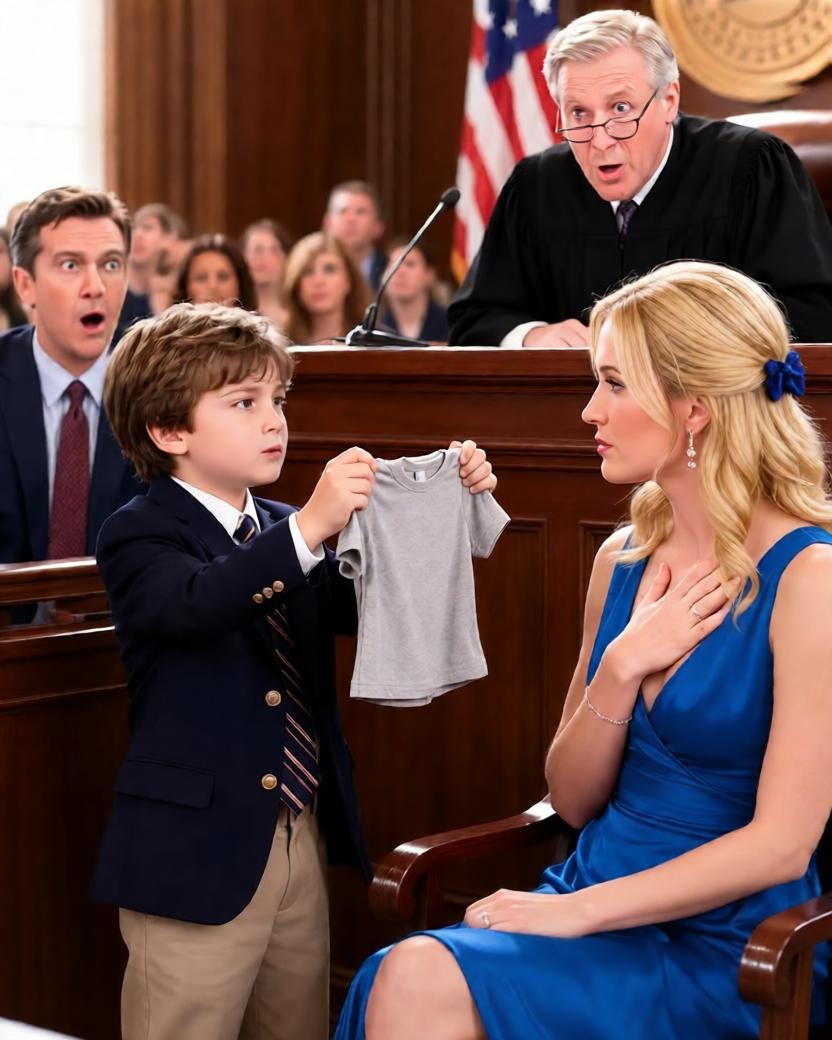
Then, without warning, Toby stood up.
The sudden movement surprised everyone.
Benedict stopped speaking in the middle of his sentence.
The entire courtroom turned toward my son.
I immediately reached over and grabbed his sleeve.
“Toby, please sit back down,” I whispered.
But he shook his head.
He did not move.
His ears had turned bright red, and his small fingers were shaking as he held the bottom edge of his shirt.
He looked nervous.
But he also looked determined.
“This is the exact shirt he is talking about,” Toby said.
His voice was small, but it carried through the silent courtroom.
Nobody moved.
Nobody spoke.
Benedict cleared his throat and quickly tried to regain control.
“Your Honor, the child is clearly overwhelmed emotionally, so perhaps we should—”
“Let the boy speak, counsel,” Judge Leonard interrupted firmly.
The judge leaned forward over his wooden desk.
“Toby may continue.”
My son looked up at the judge.
Then he took a deep breath.
“My mom bought this for me after working all night,” he said.
My chest tightened.
“She thought I was asleep when she brought it into my room, but I wasn’t.”
I looked down at the table because I could already feel tears building in my eyes.
“She smiled because she knew how much I loved stars and moons,” Toby continued. “And then she cried in the dark because she thought I didn’t see her.”
The courtroom remained completely silent.
I had spent two years trying to hide every difficult moment from my son.
Every bill.
Every worry.
Every sacrifice.
But he had quietly seen everything.
“My mom always gives me the best food on the plate,” Toby told the judge. “She says she isn’t hungry, but I know she is.”
His voice became stronger.
“She helps me study science even when she can barely keep her eyes open. She works so hard because she wants me to have good things. She doesn’t work because she doesn’t want to be with me.”
Across the room, Russell shifted uncomfortably.
He cleared his throat and looked away.
Toby reached down and carefully lifted the bottom part of his navy shirt.
“I wrote something special inside here.”
Judge Leonard looked curious.
“What did you write inside your shirt, son?”
Toby turned around and looked at me.
“Can I show him, Mom?”
I could barely speak.
I simply nodded.
The judge gave a small signal to the bailiff.
A friendly court officer walked over to our table and gently helped Toby hold the bottom seam of the shirt open.
Inside the fabric, written in faded blue ink, were several uneven handwritten words.
The letters were messy because they had been written by a child.
But the meaning was perfectly clear.
MY MOM MAKES OUR SMALL HOME FEEL LIKE THE WHOLE WORLD.
I covered my mouth with both hands.
Tears immediately filled my eyes.
I had washed that shirt so many times.
I had folded it.
Dried it.
Put it away.
I had looked at that shirt dozens of times.
But I had never noticed those words hidden inside the seam.
Judge Leonard leaned closer and silently read the message.
The courtroom stayed quiet.
Then the judge slowly lifted his eyes and looked across the room at Russell.
“Mr. Davenport,” he said, “were you aware that your son had written this inside his shirt?”
Russell looked uncomfortable.
For the first time that morning, he did not seem completely confident.
“I… I think I may have seen it once or twice,” he answered.
Before anyone else could speak, Toby interrupted.
“Dad told me it was embarrassing.”
Russell immediately turned toward his attorney and leaned over, whispering urgently.
But Judge Leonard noticed.
He brought his hand down firmly on the desk.
“Mr. Davenport.”
The entire room became still again.
“You will remain silent until this court directly addresses you.”
Russell quickly sat back.
The confident expression he had worn all morning was gone.
Because for the first time, the courtroom was no longer looking at a stained shirt.
They were looking at the love hidden inside it.
Part 5: The Truth Hidden in the Paperwork
Judge Leonard turned his attention back to Toby.
His voice became softer.
“Toby, what exactly did your father say was embarrassing about the message you wrote?”
Toby looked down at the floor.
His fingers played nervously with the edge of his shirt.
“He told me I needed to stop talking and acting like we were poor,” Toby whispered.
The courtroom immediately became uncomfortable.
A heavy silence filled the room.
Russell shifted in his chair and adjusted his tie.
“That is not what I meant by that comment, Your Honor,” he quickly said.
Judge Leonard looked over at him with a serious expression.
“You were instructed to remain silent, sir.”
Russell lowered his eyes.
Benedict Welch stepped forward quickly, trying to protect his client.
“Your Honor, even if an insensitive comment was made privately, it does not change the financial evidence we have presented regarding the mother’s unstable situation.”
He returned to his documents and began explaining his argument again.
Benedict showed the court official records proving that my apartment rent had been paid late three different times during the previous year.
He pointed out my unpredictable work schedule.
He emphasized that I depended on my mother for childcare in the evenings.
He presented everything as if it proved I was failing.
But he never mentioned why those struggles happened.
Judge Leonard carefully looked through the documents.
Then he asked a question that completely changed the direction of the hearing.
“Mr. Davenport,” the judge said, looking directly at Russell, “were you completely up to date with your court-ordered child support payments during the same months when your former wife’s rent payments were late?”
Russell’s confident expression disappeared.
For the first time, he looked nervous.
Benedict immediately tried to step in.
“Your Honor, there were some ongoing disagreements regarding the exact payment arrangements—”
“I did not ask you, counsel,” Judge Leonard interrupted.
His voice was firm.
“I asked Mr. Davenport.”
The room became silent again.
Russell swallowed.
He pulled at his collar.
“I was… temporarily behind on my financial responsibilities,” he admitted.
The judge continued looking at him.
“For how long were you behind?”
Russell hesitated.
“Approximately five months.”
Five months.
I stared across the courtroom.
Five months.
He said it like it was a small mistake.
Like it was a forgotten bill.
Like those months had not been filled with panic and sleepless nights.
Those were the months when I worried about keeping the electricity on.
The months when I counted every dollar at the grocery store.
The months when I wondered how I would provide for Toby.
Judge Leonard turned toward me.
“Mrs. Davenport, do you have proof of these missed payments with you today?”
“Yes, Your Honor,” I answered.
My voice shook slightly as I opened the thick folder sitting in front of me.
I handed over bank statements, official notices, and printed conversations between Russell and me.
The judge carefully reviewed every page.
One of the messages caught his attention.
It was from Russell.
It read:
You need to learn how to manage your own budget instead of expecting me to constantly fix your life.
Directly underneath was my response:
I am only asking you to send the child support that Toby is legally entitled to receive.
Judge Leonard continued reading.
The longer he looked through the evidence, the quieter Russell became.
Then Benedict quickly reached for another document.
“I would also like to present this email exchange, Your Honor,” he said.
He handed over a printed email chain.
“This clearly shows that Mrs. Davenport refused my client’s attempts to provide clothing for the child. It demonstrates that her pride interfered with Toby receiving basic necessities.”
I immediately recognized the email.
My heart sank.
“That printout is missing the most important part of the conversation,” I said.
Judge Leonard looked at me.
“Do you have the complete exchange?”
“Yes, Your Honor.”
I reached into my purse and pulled out my phone.
I quickly found the original email conversation and handed it to the bailiff.
The judge read through the complete version.
Then he read part of it aloud for everyone in the courtroom.
Russell’s original email said:
I will buy Toby an entirely new wardrobe if you sign a written statement admitting that you are unable to provide basic necessities for him. Having that admission will make the upcoming custody trial much easier for me.
The courtroom went completely quiet.
Then Judge Leonard read my response.
We do not need anything from you if your help requires me to humiliate myself. Just send the standard child support that you already owe us.
The judge slowly placed the papers down.
His expression had changed.
Cold.
Disappointed.
“Mr. Welch,” Judge Leonard said, looking at Russell’s attorney, “the evidence your client submitted to this court intentionally removed important context from the conversation.”
Benedict’s face turned red.
He looked toward Russell.
“I presented the evidence exactly as it was provided to me by my client, Your Honor.”
Judge Leonard stared at him.
“Then I strongly recommend that you carefully verify your client’s evidence before presenting it in my courtroom again.”
Benedict quietly returned to his seat.
Russell sat beside him, no longer looking confident.
The argument that had started with a stained shirt was now revealing something completely different.
The problem was never that Toby lacked what he needed.
The problem was that someone had been trying to make love and sacrifice look like failure.
Part 6: Grandma Takes the Stand
Benedict Welch knew he was losing control of the courtroom.
The evidence he had presented was no longer making Russell look like the responsible parent.
Instead, it was showing the opposite.
So he quickly changed his strategy.
“Your Honor, I would like to call Martha Howell to the witness stand,” Benedict announced.
My mother slowly stood from her seat.
She was wearing her favorite navy cardigan and a simple pair of pearl earrings. She walked toward the witness stand calmly, without fear or hesitation.
Martha had always been that way.
She did not need expensive clothes or a powerful voice to make people listen.
She simply spoke the truth.
She sat down, placed her hands neatly in her lap, and looked directly at Benedict.
The attorney approached her with a confident expression.
“Mrs. Howell,” he began, “you frequently take care of Toby while your daughter works long hours, correct?”
“Yes,” my mother answered clearly. “I help take care of my grandson.”
Benedict nodded.
“So it would be fair to say that you act as Toby’s primary caregiver most days, correct?”
My mother did not hesitate.
“No. That would not be correct.”
Benedict raised his eyebrows.
“But you prepare his meals, help with his homework, and stay with him during the evenings while his mother is working.”
“Yes,” Martha replied.
“Then isn’t it true that you are responsible for much of Toby’s daily care?”
My mother looked directly into his eyes.
“Helping my daughter raise her son does not mean I am replacing her.”
Her voice remained calm.
“It means our family supports each other.”
A few people in the courtroom looked over at us.
Because that simple sentence carried more truth than all the expensive arguments Russell’s lawyer had made.
Benedict shifted slightly.
He tried another approach.
“Mrs. Howell, do you ever become tired while caring for an energetic eight-year-old boy at your age?”
My mother answered honestly.
“Of course I get tired.”
Benedict gave a small smile.
He turned slightly toward Judge Leonard as if he believed he had made his point.
“Thank you,” he said.
But before he could move away, my mother continued.
“My daughter gets tired too.”
The smile disappeared from Benedict’s face.
“A lot of loving parents get tired,” Martha said firmly. “Being tired does not make someone a bad parent. It does not mean someone is irresponsible. It does not mean someone is unable to love their child.”
The courtroom became quiet.
Benedict looked slightly uncomfortable.
He tried to push forward.
“Wouldn’t Toby be better off in a quieter home?” he asked. “A place where the adults are not constantly struggling with work schedules and financial stress?”
My mother paused for a moment.
Then she answered.
“A larger house with expensive furniture does not automatically make a home a better place.”
The words hung in the courtroom.
Even Judge Leonard looked thoughtful.
Martha continued explaining our daily life.
She talked about Toby’s excellent grades.
She described how carefully I prepared his meals.
She explained how much time I spent helping him learn, even after exhausting workdays.
She told the judge that no matter how late I came home, I always walked into Toby’s bedroom before going to sleep.
Every single night.
I always checked on him.
I always made sure he knew his mother was there.
Benedict had tried to make my mother’s help look like proof that I was failing.
But Martha showed the court the truth.
Family support was not weakness.
It was love.
After answering all of Benedict’s questions, my mother slowly stood from the witness chair.
Before stepping down, she looked across the courtroom.
Straight at Russell.
Her expression was calm, but her words were powerful.
“You have spent this entire morning pointing out everything my daughter cannot afford to buy,” she said quietly.
Russell looked up.
Martha continued.
“But you have not said a single word about what your own son is afraid of losing.”
The courtroom went silent.
Russell looked away.
Because for the first time that day, someone had asked the question nobody else had asked.
Not who had the bigger house.
Not who wore the better clothes.
Not who had more money.
The real question was much simpler.
Who made Toby feel safe?
And everyone in that room was beginning to understand the answer.
Part 7: The Promises That Were Never About Love
After my mother stepped down from the witness stand, the judge called for a short mid-morning recess.
The courtroom slowly emptied as people stood, stretched, and quietly talked among themselves.
I stayed at the table with Toby.
Usually, he was full of questions and always wanted to tell me something.
But that morning was different.
He sat beside me quietly, staring down at his hands.
Something was bothering him.
I wrapped my arm around his shoulders and gently pulled him closer.
“What is it, sweetheart?” I asked softly.
For a moment, he said nothing.
He just looked down at the floor.
Then, after a long silence, he finally whispered:
“Dad promised me things.”
My heart tightened.
“What things?”
Toby took a small breath.
“He said if I lived with him at the townhouse all the time, I would get a really big bedroom.”
He paused.
“He said he would buy me a brand new mountain bike.”
His voice became even quieter.
“And he said I could have a golden retriever puppy.”
I listened carefully.
Part of me felt hurt.
Not because Toby wanted those things.
Every child dreams about new toys, a bigger room, or a puppy.
But because I understood what Russell was trying to do.
He was turning love into a deal.
I gently held Toby’s hand.
“Was there anything else?” I asked.
Toby looked uncomfortable.
Then he nodded.
“Yes.”
He swallowed.
“Dad said if I told anyone bad things about him in court, the puppy would have to go live with someone else.”
My heart dropped.
For a moment, I could barely speak.
Russell had not just offered rewards.
He had placed pressure on an eight-year-old child.
He had made Toby feel responsible for protecting his feelings.
When the judge returned and everyone took their seats again, I raised my hand.
“Your Honor,” I said carefully, “there is something important my son told me during the break.”
Judge Leonard looked toward me.
“Please explain.”
I told the court what Toby had shared.
The judge’s expression became serious.
Then he looked gently at my son.
“Toby,” he said, his voice much softer than before, “did your father tell you that getting a new puppy depended on what you said here today?”
Toby nodded slowly.
“Yes, sir.”
The judge leaned forward.
“What exactly did your father tell you?”
Toby looked nervous.
“He told me I should remember which house had the bigger backyard.”
The courtroom became completely silent.
Russell immediately leaned forward in his chair.
“Your Honor, I was only trying to make my son excited about spending more quality time with me!”
His voice sounded defensive.
But Judge Leonard lifted his hand immediately.
“Enough.”
Russell stopped talking.
The judge looked directly at him.
“A child’s love is not something you can purchase with gifts.”
His voice became firmer.
“And a child’s fears should never be used as a weapon in a custody dispute.”
Russell slowly leaned back into his chair.
For the first time all morning, he looked small.
The confidence was gone.
The expensive suit, the polished shoes, and the powerful attorney beside him could no longer hide what had happened.
For two years, Russell had found a way to make every excuse sound reasonable.
When he missed payments, there was always a reason.
When he disappeared from Toby’s life, there was always an explanation.
When he criticized me, he claimed he was only trying to help.
But inside that courtroom, those excuses finally stopped working.
Because the judge was no longer looking at money.
He was looking at behavior.
And he was seeing the difference between someone who wanted to be a parent and someone who wanted to win.
Part 8: The Decision and the Road Forward
Judge Leonard spent several quiet minutes reviewing the documents in front of him.
The courtroom was completely still.
Nobody spoke.
Nobody moved.
Toby held my hand tightly under the table. His small fingers wrapped around mine, warm and steady.
I could feel that he was nervous.
I was nervous too.
Even after everything that had happened, a part of me was still afraid.
Afraid that someone would look at our small apartment, our old car, and our financial struggles and decide that we were somehow not enough.
Finally, Judge Leonard lifted his head.
“This court does not decide a parent’s ability based on expensive clothing, the size of a home, or a polished appearance,” he began.
His eyes moved toward Russell.
“Financial resources are certainly one factor that can be considered. However, money does not excuse manipulation, dishonesty, or emotional harm.”
Russell looked down at the table.
The judge then turned toward me.
“Mrs. Davenport, the evidence presented today shows that you have worked extremely hard under very difficult circumstances.”
He picked up several documents.
“The court also finds that your recent financial difficulties were directly connected to delayed child support payments from Mr. Davenport.”
Benedict Welch stopped writing.
He slowly lowered his pen and leaned back in his chair.
The confident expression he had worn at the beginning of the hearing was gone.
Judge Leonard continued.
“The child is healthy. He is performing exceptionally well in school. He has a strong emotional connection with his mother and feels secure in her home.”
The judge reached for the photograph of Toby wearing the navy moon shirt.
He held it up.
“What was presented to this court as evidence of neglect was actually evidence of something very different.”
He looked at the picture again.
“It showed sacrifice. It showed dedication. It showed a child who clearly understands the love and effort his mother has given him.”
My eyes filled with tears.
For two years, I had felt like I was constantly defending myself.
Defending every meal.
Every late bill.
Every worn piece of clothing.
Every difficult choice.
But now, someone finally saw the truth.
Judge Leonard placed the photograph down.
“Primary physical and legal custody will remain with Mrs. Davenport.”
My breath caught.
“Mr. Davenport will receive structured visitation only after completing a mandatory co-parenting program.”
Russell’s face immediately changed.
“All future communication between both parents will take place through a monitored court-approved application.”
The judge looked down at the final documents.
“And all unpaid child support must be settled immediately.”
Russell turned pale.
Benedict quickly stood from his chair.
“Your Honor, my client respectfully requests immediate reconsideration—”
“The ruling is final, counsel,” Judge Leonard interrupted.
Benedict slowly sat back down.
I barely heard anything after that.
All I could feel was Toby’s hand in mine.
I leaned down and wrapped my arms around him.
I pressed my face into his hair.
“Can we go home now, Mom?” Toby whispered.
His voice was quiet.
Tired.
But hopeful.
“Yes, baby,” I said, my voice breaking as tears rolled down my face.
“We can go home now.”
Before we left the table, Judge Leonard called Toby forward one last time.
“Toby,” the judge said.
My son walked closer.
“You were incredibly brave today.”
Toby looked up at him.
“But there is something very important you need to remember.”
“What is it, sir?” Toby asked.
Judge Leonard’s expression softened.
“It was never your job to save your mother.”
Toby listened carefully.
“The adults responsible for protecting you should have handled this situation without putting you in the middle.”
He paused.
“You should never have felt like you needed to defend the person who loves you.”
Toby nodded slowly.
I could tell he was trying to understand those words.
The judge was reminding him of something important.
Children should not have to carry adult problems.
Outside the heavy courtroom doors, my mother was waiting for us.
The moment she saw us, she walked forward and wrapped both of us in a tight hug.
She cried softly into my hair.
“It’s finally over,” I whispered.
I stepped outside and took a deep breath of the cold winter air.
For the first time in a long time, I felt like I could breathe.
Martha smiled through her tears.
“No, sweetie,” she said gently.
“The hardest part is over.”
She hugged Toby closer.
“Now you two get to start fresh.”
I looked at my son.
At my mother.
At the people who had stayed beside me when life was at its hardest.
And I realized something.
Russell had spent years believing that money was the thing that created a family.
But he was wrong.
A family was created by the people who stayed.
The people who sacrificed.
The people who loved you even when there was nothing to gain.
Part 9: A New Beginning
Life did not suddenly become perfect after the courtroom decision.
There was no magical moment where every problem disappeared.
I still had to work hard every day.
Bills still arrived in the mailbox.
Our old apartment still had the same noisy pipes.
The radiators still made loud clanking sounds during freezing winter nights.
The kitchen was still small.
The windows still shook whenever large trucks drove past the building.
But something important had changed.
The fear was gone.
For the first time in years, we did not have to worry that Russell would take our struggles and use them against us.
We no longer had to wonder if a late bill or an old shirt could be turned into an argument about whether I was a good mother.
Because the truth had finally been seen.
A few months later, after the court forced Russell to pay the child support he owed, my life began to change.
The money did not make me rich.
It did not turn our lives into some kind of fairy tale.
But it gave us breathing room.
It gave me a chance to rebuild.
I was finally able to quit my evening office cleaning job.
After years of working late nights and exhausting myself, I found a full-time position as an office administrator at a medical clinic downtown.
The job came with steady daytime hours, better pay, and health insurance.
For the first time in a long time, I had a normal schedule.
I could wake up with Toby in the morning.
I could help him get ready for school.
I could come home before he was asleep.
My mother’s life changed too.
For so long, Martha had arranged her entire day around my unpredictable work schedule.
She had stayed up late waiting for me to come home.
She had changed her plans whenever I needed help with Toby.
But now she could finally relax.
She spent her afternoons doing what she loved.
Working in her garden.
Taking care of her flowers.
Enjoying the peaceful moments she had earned after helping us through the hardest years.
And Toby?
His love for space never disappeared.
If anything, it grew stronger.
He covered the ceiling of his bedroom with glow-in-the-dark stars.
Every night, he would turn off the lights and stare upward, pretending he was floating through the universe.
He proudly told everyone that one day he was going to design rockets and explore distant galaxies.
I never doubted him.
Because I had already seen the determination inside him.
The same determination that helped him stand in a courtroom and speak the truth.
Eventually, the navy moon shirt became too small.
The sleeves stopped reaching his wrists.
The bottom no longer fit properly.
But Toby refused to let me throw it away.
“Please don’t give it away, Mom,” he told me.
“It’s important.”
So together, we found a simple wooden picture frame.
We carefully placed the shirt inside.
We made sure the tiny stitched moon was visible.
We also made sure the faded handwritten message near the bottom seam could still be read.
The words were still there.
MY MOM MAKES OUR SMALL HOME FEEL LIKE THE WHOLE WORLD.
We hung the framed shirt in our hallway.
A place where everyone could see it.
Over the years, visitors would stop whenever they noticed it.
They would look at the small navy shirt behind the glass and ask about the story.
And every single time, Toby would look at me first.
He would smile warmly.
Then he would tell them the same thing.
“That was the day everyone learned that a simple shirt can tell two completely different stories.”
And he was right.
Russell’s expensive lawyer had looked at that shirt and only seen old fabric.
A soft collar.
A faded stain.
Something worn out.
Something that needed to be replaced.
But Toby had seen something completely different.
He had seen his mother coming home exhausted after working long hours.
He had seen a woman carrying a small paper bag with a twelve-dollar shirt inside.
A shirt bought with the little money she had left.
A shirt filled with love.
They saw what money could measure.
But Toby showed them what money never could.
They saw a stain.
He saw a sacrifice.
They saw an old shirt.
He saw a lifetime of love.
And in the end, that was the truth nobody could take away.
Because a home is not created by how much someone can buy.
A home is created by how much someone is willing to give.
THE END.
