
Part 1: The Bill
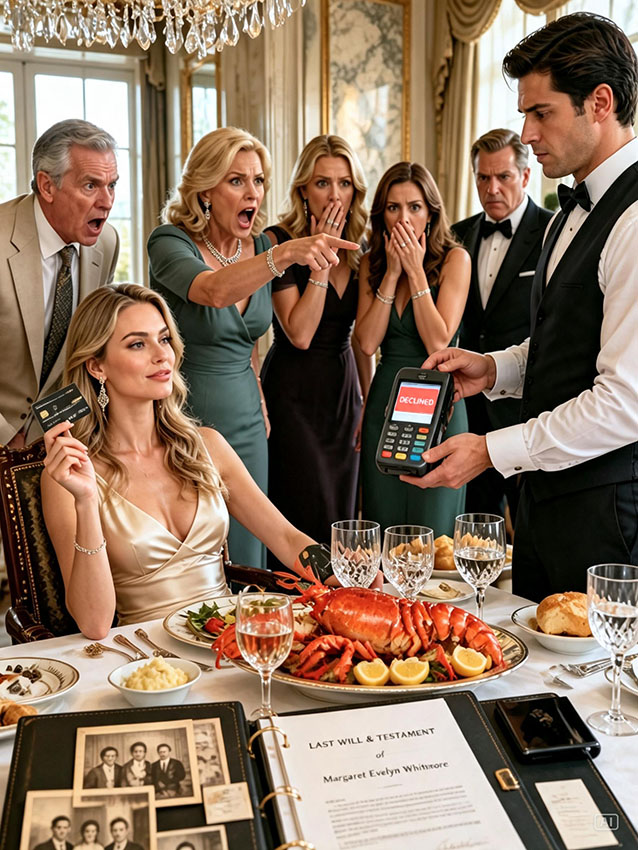
The waiter placed the black leather bill folder in the middle of the table.
My father, Roberto Varela, pushed it toward me with two fingers, almost as if he were sliding a loaded gun across the polished wood.
“You’re paying, right, Elena?”
Sixteen people were sitting around that table.
There was my father, Roberto, and my mother, Victoria.
My older brother, Alejandro, sat beside his wife, Camila.
My Aunt Beatriz was there too, along with ten of my cousins, all of whom had apparently been invited without telling me.
And then there was me.
The sixteenth person.
The person they had apparently decided would pay for everyone.
Not one of them looked surprised.
My mother folded her hands beneath her chin and smiled at me in the same way she used to smile whenever she had already decided what my answer would be.
Alejandro leaned back in his chair, his face red from wine, and laughed quietly under his breath.
Camila suddenly became very interested in her dessert.
Aunt Beatriz stared at the ice melting inside her glass.
My cousins stopped taking pictures of their lobster tails for Instagram and looked at me as if I were the final act of a show they had all paid to see.
Except I was the one they expected to pay.
The restaurant was Bellmont House, a beautiful place sitting along the Chicago River.
A huge wall of glass overlooked the water. Soft golden lights hung above the dining room. White tablecloths covered every table, and the customers spoke quietly because their money seemed to speak loudly enough for them.
It was the kind of restaurant where the menus did not even use dollar signs.
One bottle of wine could cost more than someone’s monthly car payment.
And spread across our table were the remains of a feast I had never ordered.
Cracked lobster shells.
Empty champagne flutes.
Oyster platters.
A half-empty bottle of Napa Cabernet that my father had proudly announced cost four hundred dollars.
Plates of steak.
Crab.
Imported caviar.
Desserts covered with edible gold.
Sixteen people had eaten like royalty for two hours.
Now they were staring at me as if I had been invited for one reason.
To be punished.
Three years earlier, I had walked away from my family.
It happened after they tried to take my grandmother’s inheritance from me.
My grandmother, Sofia Varela, had been the only person in that family who ever truly asked how I was doing and then waited long enough to hear my answer.
When she died, she left me her small lake cottage in Wisconsin and a modest investment account she had built during forty years of teaching.
My parents said it was unfair.
Alejandro accused me of manipulating her.
Aunt Beatriz said I was destroying the family.
Then they came to my apartment carrying papers.
They told me to sign everything over to the family.
“For the good of everyone,” my father had said.
I refused.
My father called me selfish.
My mother cried.
Alejandro screamed that I thought I was better than everyone because I had a corporate job downtown.
So I disappeared.
For three years, I ignored birthdays, holidays, family group chats, guilt-filled voicemails, and fake apologies that never once included the words, “We were wrong.”
Then, on a Tuesday night, my mother sent me a text.
Your father and I think it’s time to put the past behind us. Dinner? Just us. No pressure.
I stared at that message for almost ten minutes.
Just us.
Those two words affected me more than they should have.
I wanted to believe her.
I hated myself for wanting to believe her.
Some hurt part of me still remembered being eight years old, sitting beside my mother at the kitchen table while she braided my hair.
Back then, she had told me that family was forever.
By Friday, I agreed to dinner.
By Saturday evening, I was standing inside Bellmont House and realizing just how foolish I had been.
Because it was not “just us.”
It was everyone.
My father had made the reservation himself.
He had reserved a large table for sixteen under his own name, Roberto Varela, and had given the restaurant his phone number and a credit card to guarantee the reservation.
That part would become very important later.
At the time, however, I knew none of it.
My father stood up from the table with his arms spread wide.
“There she is!”
My mother’s face immediately lit up with a smile so polished it almost deserved applause.
“Elena, sweetheart!”
Alejandro lifted his wineglass.
“Look who finally decided to come back from exile.”
His words hit me like a bucket of ice-cold water.
I should have walked out right then.
But sixteen people were watching me.
So were several other diners.
And my father knew exactly how much I hated public scenes.
He knew I had spent most of my childhood swallowing humiliation because whenever I spoke up, I was called “dramatic,” “ungrateful,” or “too sensitive.”
So I walked to the table.
I sat down.
And for the next two hours, I watched them reveal their trap piece by piece.
My father ordered another bottle of wine without even looking at the price.
My mother raised her glass and announced, “Tonight is about healing.”
Alejandro told the waiter to bring extra lobster “for the table.”
Camila ordered another cocktail.
My cousins ordered expensive drinks with names that sounded like vacation destinations.
Aunt Beatriz told stories about my childhood, and every story came with a tiny insult hidden inside it.
“You were always so emotional,” she said with a smile.
“She was stubborn,” my father added. “Even when she was a kid.”
My mother reached over and touched my wrist.
“But we forgive you.”
That was when I finally understood.
They had not invited me there to reconcile.
They had invited me to kneel.
And then the bill arrived.
The waiter placed the black folder in front of me.
I opened it.
$4,386.72.
For one second, the number blurred.
Then everything inside me became strangely quiet.
My father chuckled.
“After all, you’re the executive now. You have the biggest salary at the table.”
Alejandro grinned.
“Consider it three years of family dues.”
My mother looked at me with shining eyes.
“It would mean so much to us, Elena. Think of it as a gesture.”
I looked around the table.
At my parents.
At my brother and his wife.
At Aunt Beatriz.
At my ten cousins.
At the people who had lied to me.
The people who had ambushed me.
The people who had insulted me.
The people who had spent three years trying to make me feel guilty for protecting what my grandmother had given me.
They had fed themselves on my silence.
Then I smiled.
My father’s grin disappeared.
“What’s funny?” he asked.
I closed the bill folder.
Then I raised my hand and called the waiter over.
When he leaned down, I quietly spoke to him.
“Could you please get your manager? I didn’t make this reservation, and I never agreed to pay this bill. The reservation was made by my father, Roberto Varela.”
The waiter looked briefly at my father.
Then back at me.
“Of course, ma’am.”
He nodded and walked away.
My father frowned.
“What was that about?”
“Nothing,” I said.
Fifteen minutes later, my family stopped smiling.
Part 2: The Trap
At first, nobody noticed what I had done.
That was the most beautiful part.
My mother continued talking about how difficult the last three years had been for her.
She spoke as if my absence had been something that happened to her, rather than something she had helped cause.
Aunt Beatriz dabbed the corners of her mouth with her napkin and nodded with tragic importance.
Alejandro poured the last of the expensive wine into his glass.
“Family, man,” he said. “You only get one.”
I almost laughed.
My father kept looking at the bill folder.
Then he looked at me.
Then back at the folder.
He was clearly waiting for me to take out my credit card.
I let him wait.
For the first time that entire evening, I felt calm.
Not happy.
Not cruel.
Calm.
It was the kind of calm that comes when you finally stop trying to earn love from people who only understand control.
Then the restaurant manager arrived.
He wore a dark suit and had the controlled expression of someone who was used to dealing with wealthy people when they behaved badly.
The waiter followed him, holding a small tablet.
“Good evening,” the manager said politely. “We need to clarify the payment arrangement for this reservation.”
My father immediately pointed at me.
“She’s taking care of it.”
The manager did not look at me.
Instead, he looked directly at my father.
“Sir, the reservation was made under the name Roberto Varela. It was made for sixteen guests, and your phone number and credit card were provided when the reservation was secured.”
My father’s smile cracked.
“Yes,” he said slowly. “That’s correct.”
The manager continued.
“Ms. Varela has informed us that she did not make the reservation and never agreed to pay for the party.”
My father stared at him.
“She’s my daughter.”
“I understand, sir.”
“And she’s paying.”
The manager remained polite.
“She is certainly welcome to pay voluntarily if she chooses to. However, she has told us that she does not authorize payment.”
The manager paused.
“Since you made the reservation and provided the card on file to guarantee it, the restaurant will need to collect the outstanding balance from you unless the guests voluntarily agree to another payment arrangement.”
My father’s smile vanished completely.
“What?”
My mother’s hand froze around her champagne glass.
The manager calmly repeated himself.
“The reservation is in your name, Mr. Varela. Your card is on file. Ms. Varela has not agreed to pay the bill.”
Silence fell over the table.
Instantly.
Completely.
And, to me, beautifully.
My father slowly turned toward me.
“Elena.”
I folded my hands together.
“Yes?”
“What did you do?”
“I clarified the truth.”
Alejandro sat up straight.
“Are you serious?”
“Completely.”
My mother leaned toward me.
Her voice was quiet, but beneath the sweetness was pure anger.
“This is embarrassing.”
I looked at the lobster shells.
The champagne glasses.
The empty wine bottle.
The plates nobody had hesitated to order because they had all assumed someone else would pay.
“Yes,” I said. “It is.”
My father’s jaw tightened.
“This is family.”
I looked him directly in the eyes.
“No.”
I tapped the bill folder lightly with one finger.
“This is a bill.”
The waiter placed the receipt in front of my father.
$4,386.72.
Aunt Beatriz sucked in a sharp breath.
One of my cousins whispered, “Oh my God.”
Another cousin quietly put her phone away.
Camila stared down at her plate as if she hoped the white tablecloth would somehow open up and swallow her.
For the first time that evening, nobody seemed to know what to say.
Part 3: The Confrontation
My father’s face changed from flushed wine-red to a pale, cold gray.
He stared at the number on the receipt as if he could somehow make the decimal point move.
“Roberto,” my mother whispered.
Her eyes darted toward the neighboring tables.
Several diners had begun looking in our direction.
“Just put your card down,” she said. “We’ll handle this at home.”
“I can’t, Victoria,” my father hissed under his breath.
His voice cracked.
“The corporate account is overdrawn from the marketing launch, and my personal card is almost at its limit.”
He swallowed hard.
“I thought…”
He looked toward me.
“I thought she was paying.”
Alejandro slammed his empty wineglass onto the table.
“Elena, this is cheap revenge!”
His voice was loud enough that several people nearby turned to look.
“You’ve been making executive money for three years while we’ve been struggling with the estate’s overhead,” he continued. “And you can’t even buy dinner for your own family? After everything we did for you?”
I looked at him.
My voice stayed completely calm.
“What did you do for me, Alejandro?”
He opened his mouth.
I continued before he could answer.
“Did you help me when you tried to forge Grandmother Sofia’s signature on her property deed while she was in hospice?”
Alejandro’s face went still.
“Did you help me when you told everyone I was mentally unstable because I refused to let you liquidate her teaching pension?”
Nobody spoke.
Not even my mother.
Aunt Beatriz finally cleared her throat loudly.
“Elena, that is ancient history.”
She looked around the table.
“We came here tonight in good faith. We wanted to welcome you back.”
I slowly stood up.
I smoothed the front of my jacket.
“No.”
Aunt Beatriz stared at me.
“No?”
“You didn’t come here to welcome me back.”
My voice carried clearly across the table.
“You came here because you found out Grandmother Sofia’s investment account had matured.”
My mother’s face tightened.
“And you wanted to see if you could guilt me into sharing it.”
I looked around the table at every single person.
“You ordered the most expensive things on the menu without even looking at the prices because you thought a daughter’s silence could be bought.”
I picked up my purse.
“You thought you could ambush me, embarrass me, and then make me pay for it.”
My father looked furious.
But beneath his anger, I could see something else.
Fear.
Part 4: The Exit
The restaurant manager stepped forward slightly.
His presence was a quiet but heavy reminder that Bellmont House was a restaurant, not a place for family arguments.
“Sir,” he said to my father, “how would you like to settle the balance tonight?”
My father looked at the manager.
Then he looked at the receipt.
Then finally, he looked at me.
All the authority he usually carried like a weapon was gone from his face.
His eyes were pleading now.
“Elena…”
His voice dropped.
“Please. Don’t do this to us. Not in front of everyone.”
I picked up my purse.
Then I looked around the table one last time.
Sixteen faces.
My parents.
My brother and his wife.
My aunt.
My ten cousins.
The cousins who had stopped filming.
The aunt who could no longer look me in the eye.
My brother, who was sweating through his expensive designer shirt.
His wife, who had suddenly become very quiet.
And my parents, who had spent the entire evening pretending this was about forgiveness.
I thought about my grandmother.
Sofia had always been the one person in that family who made me feel like I mattered.
Her voice came back to me.
The most expensive things in life are the ones that cost your self-respect.
I looked at my father.
“Grandmother Sofia always said that the most expensive things in life are the ones that cost your self-respect.”
Nobody moved.
I gave him a small smile.
“This dinner was very expensive, Father.”
My father lowered his eyes.
I turned toward the exit.
“But fortunately for me, it’s your bill.”
I walked away from the table.
Behind me, I heard the silence last for only a few seconds.
Then the arguments began.
My father started asking whether everyone could contribute.
One of my cousins immediately complained that she had only ordered a small amount.
Another cousin said she had not known the dinner would cost so much.
Alejandro argued that everyone had been invited by our father.
Aunt Beatriz insisted that the family should not be fighting over money.
My mother kept telling everyone to calm down.
Meanwhile, the manager patiently explained that the full balance needed to be settled before the table could leave, and that Roberto’s card was the card on file for the reservation.
The sixteen people who had spent two hours eating like royalty were suddenly scrambling to figure out how to pay for their own feast.
The bill was no longer my problem.
I did not turn around.
I walked across the polished dining room toward the entrance.
Then I stepped outside.
The crisp Chicago night air hit my face.
The city lights shimmered across the dark river.
For the first time in three years, I felt something I had almost forgotten existed.
Freedom.
I pulled out my phone.
I blocked my mother’s number.
Then my father’s.
Then Alejandro’s.
Finally, I deleted the family group chat.
For the last time.
I stood there for a moment, looking at the glowing windows of Bellmont House behind me.
The trap had closed.
But they were the ones caught inside it.
I slipped my phone back into my purse and started walking down the street.
I did not look back.
I left the bill exactly where it belonged.
With the people who had ordered it.
The End.
