
Part 1:
My name is Jasper Thorneley.
I was thirty-two years old the afternoon my father slammed the heavy oak door in my face.
If someone had told me only a month earlier that I would survive a brutal tour of duty overseas, only to return home and be rejected by my own father, I would have thought they were insane.
But that was exactly what happened.
The first thing my father said to me was not, “Welcome home.”
It was:
“We do not operate a nursing home here, Jasper.”
He stood in the doorway with a can of lukewarm beer in one hand. His broad body filled the entrance like a wall.
He wore the same faded blue flannel shirts he had worn throughout most of my childhood. He still had his heavy work boots on, and his face carried that familiar combination of irritation and self-pity.
My father had always been good at making other people’s needs feel like attacks on him.
Rain had started falling that afternoon. It was the steady gray drizzle that was common along the Oregon coast.
Behind me, the taxi was still waiting at the curb. Its exhaust drifted low across the wet pavement.
I had already wheeled myself up the steep driveway. My palms were burning from gripping the wheels, and my shoulders ached from pushing myself up the slope.
I knew that driveway well.
When I was a boy, I had shoveled it every winter before school. Back then, my legs worked perfectly, and my biggest problem was finishing my geometry homework.
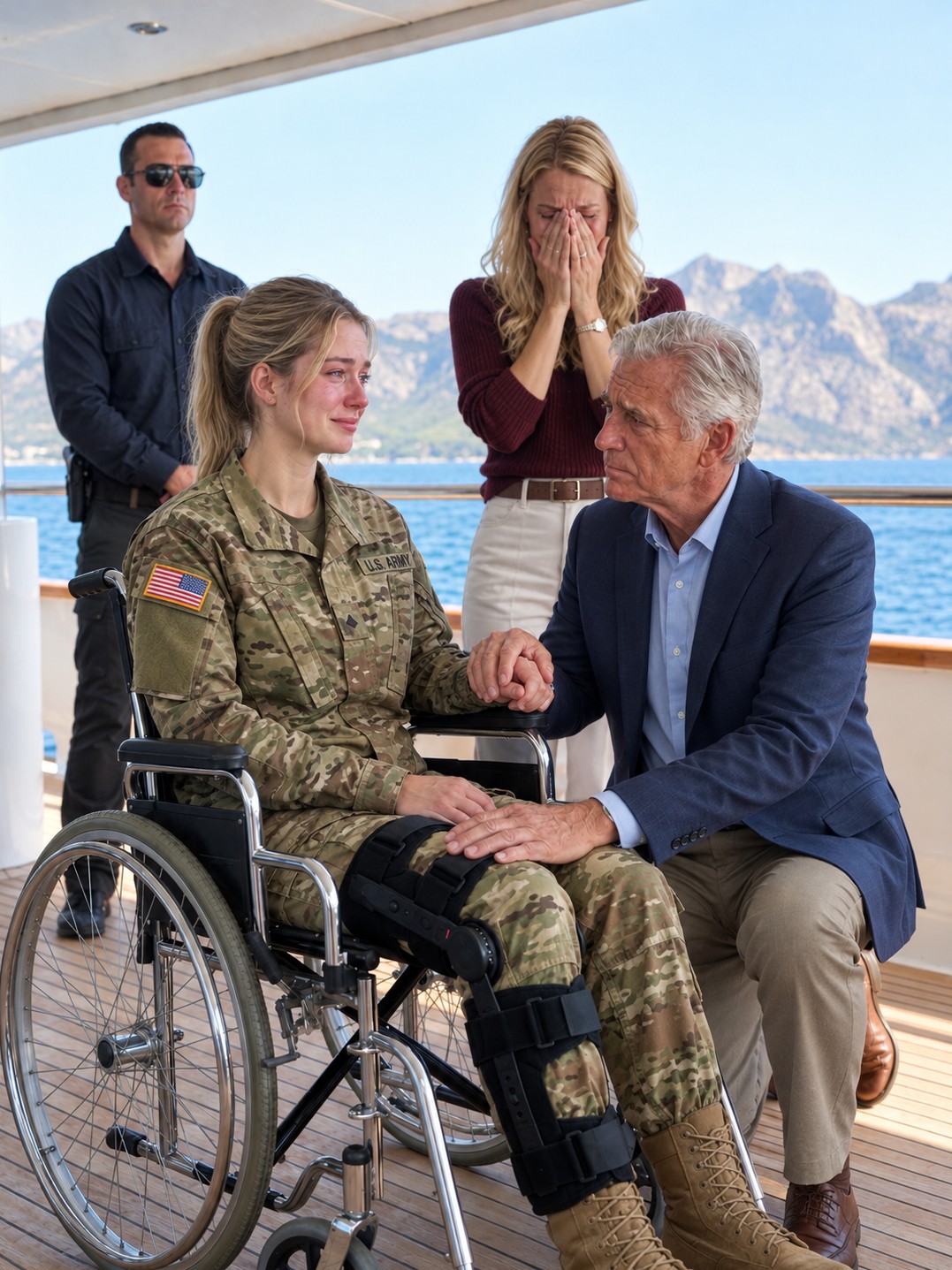
Now I sat in my dress blues, my medals polished and perfectly arranged.
The uniform felt stiff against a body that was still learning how to live with its new limitations.
My wheelchair rested on the porch boards.
I had paid to have those boards sanded and refinished only three summers earlier.
The house smelled exactly as I remembered.
Lemon polish.
Old carpet.
Stale cigarette smoke.
And something fried in far too much oil.
For one foolish second, I imagined my family waiting for me.
Maybe there would be a welcome-home banner.
Maybe my mother would hug me.
Maybe my father would give me one of those awkward pats on the shoulder that meant he cared but did not know how to say it.
Instead, my father looked at my wheelchair.
His eyes stayed there for several seconds.
There was no sadness in his face.
No sympathy.
Only irritation.
“Go to the military hospital in town,” he said. “We simply do not have room for cripples in this house.”
He had no idea what that house actually represented.
He did not know that the roof over his head and the solid floors beneath his boots had been paid for, in large part, with money I had earned during my military service.
Combat deployment pay.
Reenlistment bonuses.
Disability backpay.
My injury settlement.
For years, I had carefully sent money home while my father complained about mortgage payments and acted like he was carrying the entire family on his shoulders.
“Dad, it is me,” I said.
I forced my voice to stay calm even as phantom pain began burning through my missing left leg.
“It is your son. I am finally home. I tried calling you so many times from the transit base.”
My father took a long drink of his beer.
Then he leaned even harder against the doorframe, blocking my view inside.
“I can see that you are back,” he said. “And I can see the chair you are sitting in. I already told your mother that I am not turning this beautiful place into a medical facility for your sake.”
“People like me?”
I struggled to understand what I was hearing.
My voice shook, but not because I was afraid.
It was shock.
Nausea.
And something darker beginning to rise inside me.
“I am your own flesh and blood, Dad.”
“You are a burden, Jasper.”
He said it as casually as if he were discussing the weather.
“I am not interested in changing adult diapers at my age. We finally have this place looking exactly how we want it. So turn your chair around and find somewhere else to waste your time.”
His cruelty was not dramatic.
That somehow made it worse.
He spoke about me as if I were a broken appliance that had suddenly become too expensive to repair.
I looked past him into the hallway.
Then I saw something that made my heart jump.
A welcome-home sign was taped to the mirror.
For half a second, I thought it was for me.
Then I noticed the large, plush dog bed beneath it.
The celebration was not for me.
It was for the new puppy my sister had been begging for all winter.
And then Mallory appeared behind Dad.
My younger sister was twenty-two.
She was polished, fashionable, and beautiful in the expensive way that required a lot of money and even more attention.
She held a cold iced coffee in one hand.
The moment she saw me, her expression changed to pure disgust.
She looked at my wheelchair.
Then at me.
Then she wrinkled her nose.
“Are you being serious right now?” she asked.
She gave a short, sharp laugh.
“I literally just redid your old room into a walk-in closet for my shoes. The lighting in there is absolutely amazing. Where were you planning to sleep? The hallway?”
For a moment, I thought I had misunderstood her.
“My room?”
I could barely get the words out.
That room contained my childhood.
My old baseball trophies.
My vintage model airplanes.
The cheap wooden desk where I had filled out my enlistment paperwork when I was seventeen.
I had kept that paperwork hidden from Dad for three days because I knew he would accuse me of joining the military just to get attention.
“Well, you were not using it for the last five years, were you?” Mallory said.
She looked down at her perfectly manicured nails.
“And honestly, those rubber wheels are going to destroy the hardwood floors if you come inside.”
Before I could answer, something small rushed between my father and the doorframe.
It was my ten-year-old brother, Sammy.
He was skinny, bright-eyed, and holding the faded superhero blanket I had mailed him from my base in Europe.
He had once told me during a shaky video call that the blanket helped him sleep whenever thunderstorms rolled through the valley.
“Jasper!”
His entire face lit up.
He started running toward me.
But Dad grabbed him by the back of his shirt and yanked him backward.
Sammy stumbled.
“He can stay with me, Dad!” Sammy shouted.
He struggled against my father’s grip.
“I have a bunk bed in my room! He can take the top bunk! Please!”
Mallory snorted.
“He cannot climb up to the top bunk, you idiot.”
“Then he can have the bottom bunk!” Sammy yelled. “I will sleep on the floor!”
Tears were already filling his eyes.
“Please, Dad. Let him stay!”
“That is enough!”
Dad slammed his free hand against the doorframe.
The glass in the door rattled.
“You are embarrassing us in front of the neighbors. Get off this porch, Jasper.”
His voice became harder.
“Go stay at that cheap motel on Route 9. We will talk next week. Maybe.”
Then he stepped backward into the house.
He looked at me one last time.
There was no regret.
No sadness.
Not even real anger.
Only annoyance.
Then he closed the door.
The lock clicked.
The sound seemed impossibly loud in the wet air.
I sat there in the cold rain for several seconds.
Water ran down the back of my neck and soaked into the collar of my dress uniform.
I looked at the porch.
I had sanded and repainted it for Dad three summers earlier.
I looked at the flowerbeds.
I had paid to have them professionally landscaped after Mom once told me she missed having something beautiful to look at when Dad came home drunk and loud.
Then I reached inside my jacket.
My fingers touched the folded bank letter.
It was the surprise I had carried all the way home from my final tour.
I had planned to put it on the dinner table that night.
I was going to tell my parents that the mortgage was gone.
Paid in full.
I had planned to tell them that the house was finally theirs without a mortgage hanging over their heads.
I wanted Frank Thorneley to be able to retire without spending the rest of his life blaming everyone else for the life he had built.
But now the letter felt different.
It no longer felt like a gift.
It felt like a weapon.
I turned my wheelchair around.
The wheels hissed against the wet driveway as I rolled back toward the taxi.
By the time I reached it, the driver was looking at me with the careful kind of pity people usually reserve for funerals and hospital waiting rooms.
“Where to, soldier?” he asked quietly.
I folded the wheelchair and placed it in the trunk.
My hands were shaking from the cold, the adrenaline, and the anger building inside me.
“The motel on Route 9.”
Then I paused.
“And could you pass me that local phone book from up front?”
The driver handed it to me.
I opened it.
“I need the number for First National Bank.”
I looked down at the letter again.
This time, I was not calling the bank to give my family a gift.
I was calling to finish something I had started years ago.
Part 2:
Three days later, the rain had stopped.
But the weather was the least important storm brewing in town.
The motel room smelled strongly of mildew and industrial cleaner.
One section of wallpaper was peeling beside the vibrating air conditioner.
Outside, a neon vacancy sign flashed through the thin curtains every few seconds, filling the room with an ugly red glow.
A microwave lasagna sat untouched on the small laminate table.
Beside it was a stack of legal documents thick enough to stun a horse.
For seventy-two hours, I had barely stopped moving.
Title searches.
Wire authorizations.
Verification calls.
Signatures.
Notaries.
Bank officers.
An escrow attorney.
And enough paperwork to make my head hurt.
The process was complicated because I was not simply paying off the mortgage.
I wanted the house transferred into my name.
Years earlier, Dad had repeatedly asked me for money to keep the property from falling behind.
I had paid the mortgage arrears.
I had covered taxes.
I had helped with refinancing.
I had even paid for repairs.
But the property had remained in Frank Thorneley’s name.
Now I was changing that.
The bank had agreed to accept my full payoff of the remaining mortgage balance.
The payoff would satisfy the loan.
But because the house was still legally owned by my father, the bank could not simply give me ownership.
That required a separate deed transfer.
So I had arranged the entire transaction through an escrow attorney.
The agreement was simple.
I would wire the money to the escrow account.
The remaining mortgage would be paid in full.
Frank would sign the deed transferring the property to me.
The deed would then be recorded with the county.
Only after those steps were completed would the transfer become official.
It was the cleanest way I could find to turn years of financial support into actual legal ownership.
One legal clerk had looked at my wheelchair, then looked at the six-figure transfer amount I was making, and seemed to realize that the situation was far beyond anything she wanted to handle emotionally.
My phone buzzed.
It was a message from Sammy.
Dad and Mallory are screaming happy screams right now because they got a letter from the bank. Dad says we are finally rich.
I closed my eyes.
I could picture the scene perfectly.
Frank would be standing in the middle of the kitchen with the bank letter in his hands.
He would be staring at the zero balance on the mortgage.
And somehow, he would convince himself that the money belonged to him.
Maybe he thought it was a bank mistake.
Maybe he thought it was a payout.
Maybe he believed it was some kind of reward.
Frank had always believed the world owed him something simply because he existed.
Mallory would already be planning how to spend the money.
A designer bag.
A giant television.
New clothes.
Some other expensive object that would make her look successful while someone else paid for it.
That was the strange thing about people who spent their entire lives depending on others.
The moment someone removed a burden from their shoulders, they called it luck.
The moment a huge debt disappeared, they called it an inheritance.
They rarely asked why it happened.
They simply celebrated the result.
There was a firm knock on my motel door.
“Come in,” I said.
I did not bother trying to stand.
The door opened.
Mr. Henderson from First National Bank walked inside.
He wore a gray suit that looked painfully formal against the stained motel carpet.
He carried a leather briefcase.
His expression suggested that he was still trying to understand how a man in a cheap motel room had just transferred that much money.
“You know,” he said as he sat down, “given the size of the wire transfer you just made, you could have booked the finest penthouse downtown instead of this place.”
“I did buy my own place,” I replied.
I looked directly at him.
“I just need to finish the paperwork first.”
He placed his briefcase on the shaky table and opened it.
“Are you absolutely sure about this, Jasper?”
He paused.
“You are using your entire deployment bonus, your disability backpay, and your injury settlement. This is everything you have.”
“No.”
I shook my head.
“It is the price of admission to a new life.”
And that was the truth.
I was not simply buying revenge.
I was buying clarity.
The mortgage had always been in Frank’s name because, when I first started sending money home, I still believed I could save my family.
Over the years, I had made payments.
I had covered overdue bills.
I had paid tax deficiencies.
I had helped refinance the property twice to keep Dad from losing it.
And every time, I let him believe the same thing.
That somehow, surviving the consequences of his own bad decisions proved he was doing a good job.
This time would be different.
I wanted the public record clean.
I wanted the ownership absolute.
Henderson checked the documents one more time.
“The escrow attorney received your wire this morning,” he said. “The mortgage payoff has been authorized. Your father signed the deed transfer yesterday.”
I stared at him.
“Yesterday?”
“Yes. The deed was delivered to the county recorder this morning.”
He tapped the folder.
“It was officially recorded at 9:00 a.m. today.”
That was the moment I knew it was real.
Not a promise.
Not an arrangement.
Not something I hoped would happen.
The house was legally mine.
Henderson slid a certified copy of the recorded deed toward me.
I picked it up.
My name was on it.
Jasper Thorneley.
Owner.
I ran my fingers across the page.
For years, I had helped keep that house standing.
Now, for the first time, the legal record matched reality.
My phone buzzed again.
Another message from Sammy.
Mom is crying in her room. Dad and Mallory are throwing a huge party. They bought a new 85-inch TV on credit and ordered expensive lobster. I miss you so much.
I stared at the screen.
Then I typed:
Pack your backpack with your favorite toys. Keep your superhero blanket with you. Do not leave the house without Mom. I am coming.
I looked at Henderson.
“There is one more thing.”
He raised an eyebrow.
“My little brother is ten. I need to make sure he is safe.”
Henderson’s expression became serious.
“You cannot simply take custody of him because you own the house.”
“I know.”
That was important.
I did know.
Sammy was a child.
His father still had parental rights.
I could not legally decide on my own that Sammy belonged with me.
“But I am going there tonight,” I continued, “and if there is a genuine safety problem, I will contact the proper authorities.”
Henderson nodded.
“That is the right way to handle it.”
I checked the time.
“What time is the bank courtesy call?”
“In about an hour.”
“Good.”
I turned my wheelchair toward the door.
“I want to be there when my family learns who owns the house.”
Part 3:
By early evening, the driveway was packed with cars.
Frank had wasted no time.
He had invited his gambling friends, Mallory’s fashionable friends, and anyone else who might admire him for money he had not earned.
I parked the rental van, a hand-controlled model I hated but respected for what it allowed me to do, half a block away.
Then I rolled the rest of the distance under the cover of dusk.
Through the large bay window, I could see the new television.
It was already mounted on the wall.
It was enormous.
It completely dwarfed the stone fireplace.
Frank stood in the center of the living room wearing socks.
His face was red.
He was sweating.
He was pouring whiskey for his guests as if he had personally defeated the gods of debt.
Mallory was laughing with her friends.
White teeth.
Expensive heels.
Brittle laughter.
The house I had helped pay for with my own blood, work, and sacrifice had become a pathetic party stage.
Then the landline rang.
The sound cut through the music.
Frank grabbed the phone.
He was drunk enough to be bold but still sober enough to enjoy having an audience.
He pressed the speakerphone button.
“Talk to me,” he said with a grin.
“Hello,” Mr. Henderson said. “Is this the Thorneley residence?”
“Depends on who is asking, pal.”
“This is Daniel Henderson from First National Bank. I am calling to confirm the final mortgage and title-transfer details for the property at 42 Oak Street.”
Frank’s grin weakened.
“You got the payoff letter, right?”
“Yes.”
Frank laughed.
“Looks like your bank finally did something right for once.”
Henderson’s voice remained calm.
“The mortgage was satisfied in full this morning by a wire transfer from Jasper Thorneley.”
Frank stopped smiling.
Henderson continued.
“The deed transferring ownership from Frank Thorneley to Jasper Thorneley was recorded by the county at 9:00 a.m. today. The new owner now holds title to the property.”
The room went completely silent.
It was not normal silence.
It felt heavy.
The kind of silence that seems to suck the air from a room.
Mallory’s wineglass slipped from her hand.
It shattered against the hardwood floor.
Red wine splashed across her brand-new white heels.
Frank’s face went pale.
“But the bank letter said the mortgage was paid!”
“Yes,” Henderson replied.
“It was paid by Jasper Thorneley.”
Frank’s mouth opened.
No words came out.
Then I opened the front door with my key.
I did not knock.
I did not ring the bell.
I simply unlocked the door and rolled inside.
The house became even quieter.
The only sounds were the low hum of the giant television and the soft rubber of my wheels moving across the hardwood floor.
The same hardwood my father had told me I would ruin.
I was still wearing my dress blues.
My medals caught the light from the chandelier.
My wheelchair was clean and polished.
My posture was straight.
I stopped in the middle of the Persian rug Frank had once bragged about buying cheaply at a liquidation sale.
Then I looked around the room.
Frank stared at me.
“You bought my house?”
I took the blue folder from my lap.
I placed it on the coffee table beside the half-empty whiskey bottle.
“Correction,” I said.
I looked directly at him.
“I bought the house you refused to let me enter.”
Mallory recovered first.
“Dad! Do something about him!”
Frank lunged for the documents.
His hands shook as he ripped them open.
He read the recorded deed.
His face turned purple.
“You ungrateful little bastard!”
He threw the papers down.
“I raised you! I put food on your table for years!”
“And I put a roof over your head.”
My voice remained calm.
“For ten years, I sent money home. Where did it go, Frank?”
I pointed toward the whiskey.
“Gambling?”
Then toward Mallory.
“Cheap beer?”
Then toward her clothes.
“Mallory’s expensive wardrobe?”
I shook my head.
“Because it sure as hell did not go toward paying off the mortgage.”
“You cannot do this to us!” Mallory screamed.
Her face twisted with panic.
“Where are we supposed to go?”
“You have already been given notice,” I said.
That was another part of the legal paperwork.
As part of the property transfer, Frank had received written notice that possession of the house had to be surrendered after the closing.
He had ignored it.
I was not going to physically throw anyone onto the street.
But the legal process had already started.
“If you refuse to leave tonight,” I continued, “I will contact the sheriff and let the proper process handle it.”
Frank stepped toward me.
“I will call the police!”
“Please.”
I remained calm.
“Do exactly that.”
He pointed at me.
“I will have you removed from this property!”
“You can explain to them why you are refusing to leave a house that is no longer yours.”
Then I heard footsteps from upstairs.
Sammy came running down.
His backpack bounced against his shoulders.
His superhero blanket was tucked tightly beneath one arm.
He stopped when he saw me.
Then he ran straight toward my chair.
I held out my arms.
He hugged me.
Hard.
“Jasper!”
“I’ve got you.”
I looked over his shoulder.
“Where is Mom?”
Sammy pointed upstairs.
“She is crying.”
My mother appeared at the top of the stairs.
Her face was pale.
She looked smaller than I remembered.
Tired.
Defeated.
But there was something else in her expression.
Fear.
She came down slowly.
“Jasper,” she whispered.
Then she looked at Sammy.
“Take him.”
Frank spun around.
“What did you just say?”
My mother swallowed.
“I said take Sammy.”
“You are not taking my son!”
Frank’s voice became louder.
My mother finally looked directly at him.
“He cannot stay here with you tonight.”
Frank stared at her.
“You are choosing him over me?”
“I am choosing my son.”
The room went quiet.
My mother stepped closer to me.
“I should have protected you when you came home,” she said.
Her voice cracked.
“I should have stopped Frank. I didn’t. I am sorry.”
Then she looked at Sammy.
“I will sign whatever I need to sign so Jasper can keep him with him tonight.”
That still did not make me Sammy’s permanent legal guardian.
We all understood that.
My mother could consent to Sammy staying with me temporarily, but Frank still had parental rights.
So I did what I should have done.
I called the authorities.
A deputy arrived at the house that evening.
Because there were allegations of neglect, the deputy contacted Child Protective Services.
A caseworker came to the house and interviewed Sammy separately.
She asked him where he felt safe.
She asked what had happened when I came home.
She asked about the argument.
She asked about the conditions in the house.
My mother cooperated.
Frank did not.
He shouted that everyone was against him.
The caseworker eventually determined that Sammy should not simply be left alone with Frank while the situation was investigated.
My mother signed an emergency consent allowing Sammy to stay with me temporarily.
CPS arranged the emergency placement.
That meant Sammy could legally leave with me that night while the investigation continued.
It was not a permanent custody decision.
It was a safety measure.
That distinction mattered.
I did not want to steal my brother.
I wanted to protect him.
Later, a family court would make the longer-term decision.
But that night, the only thing that mattered was that Sammy was safe.
Frank stared at me.
“You are taking my son?”
I looked him in the eye.
“I am taking my brother somewhere he can sleep without being afraid.”
My mother lowered her head.
Frank’s anger exploded again.
But this time, it did not control the room.
The guests had already begun leaving.
Nobody wanted to stay for the end of the party anymore.
The new television was still playing silently in the background.
The lobster was sitting untouched on the dining table.
The expensive celebration was over.
The fantasy had collapsed.
Part 4:
By the end of the evening, Frank and Mallory had started packing.
They were not physically thrown out.
Instead, the deputy made it very clear that the property dispute would be handled through the proper legal process if they refused to comply with the possession notice.
Frank argued.
He threatened to call lawyers.
He shouted that I had betrayed him.
But eventually, reality became stronger than his anger.
He and Mallory began carrying their belongings outside.
Black trash bags.
Loose hangers.
Mismatched suitcases.
And the enormous 85-inch television they had purchased on credit.
It looked completely ridiculous sitting on the wet grass.
Neighbors watched through their windows.
The whole street had that strange, electric silence that comes when a private family scandal finally becomes public.
Before midnight, Frank and Mallory had left the property.
The legal possession process was documented, and the locks were changed only after the property had been formally surrendered.
That mattered to me.
I had spent enough years living inside chaos.
I did not want to create more of it.
I wanted everything clean.
The title.
The paperwork.
The house.
And Sammy’s situation.
Once the front door closed, I looked at my little brother.
He was standing in the entryway, clutching his superhero blanket with both hands.
His backpack sat beside him.
His eyes were wide.
He looked at me as if he had not yet decided whether I was a superhero or simply his big brother.
I smiled.
“So,” I said, forcing some brightness into my voice, “how do you feel about ordering pizza and watching cartoons on that giant television?”
His entire face changed.
“We can watch cartoons?”
“Especially cartoons.”
He ran toward the couch.
For the first time that day, I smiled for real.
But there was still one thing left to settle.
Sammy could not simply stay with me forever because I owned the house.
His custody had to be handled separately.
Over the following weeks, CPS continued its investigation.
My mother cooperated.
Sammy continued staying with me under the emergency placement.
The court reviewed the situation.
My mother told the court that she wanted Sammy to remain with me while she rebuilt her own life away from Frank.
She did not fight my request for guardianship.
Frank fought it.
He claimed I was trying to punish him.
He claimed I had manipulated everyone.
But the evidence was not about revenge.
It was about Sammy’s living situation.
The caseworker’s reports documented the circumstances surrounding the night I returned.
My mother confirmed what had happened.
Sammy’s statements were also considered.
After several hearings, the family court granted me temporary legal guardianship of Sammy while the case continued to be reviewed.
That meant I could legally make decisions for him, enroll him in school, take him to medical appointments, and provide his daily care.
My mother retained her parental rights.
But Sammy would live with me.
For the first time, he had a stable home.
And slowly, he began to change.
He slept through storms.
He stopped flinching whenever someone raised their voice.
He laughed without looking around first to see whether anyone would tell him to be quiet.
He started leaving his toys in the living room.
At first, he apologized every time.
Then, eventually, he stopped apologizing.
That was when I knew he was beginning to feel safe.
Part 5:
Six months later, the house smelled like fresh coffee and bacon every morning.
It no longer smelled like stale cigarette smoke and resentment.
Sunlight poured through the new, widened kitchen windows.
I had installed a slate floor because my wheelchair moved much more easily across it than it had across the old, uneven hardwood.
The house barely looked like the same place anymore.
Frank’s heavy, dark furniture was gone.
I replaced it with lighter wood and clean lines.
The rooms were more open.
The walls were brighter.
The clutter was gone.
A custom wheelchair ramp had been built into the front landscaping.
It blended in so naturally that most people did not notice it until they needed it.
The house finally felt like somewhere people could breathe.
Sammy sat at the kitchen table in his favorite pajama pants.
He was working on fourth-grade fractions.
He was also suffering dramatically.
Only a ten-year-old boy could make simple math sound like a personal attack.
He sighed loudly.
Then he dropped his pencil.
Then he picked it up again.
Then he sighed even louder.
I was at the stove, cooking breakfast.
Cooking from a wheelchair had taken time.
There had been plenty of frustration.
And more than a little swearing.
But eventually, I had developed a system.
Everything had its place.
Everything was within reach.
And everything had a reason for being there.
“Hey, Jasper,” Sammy said.
He held his pencil between his teeth.
“Mom called again this morning.”
I turned toward him.
“She wants to know if she can come over for Thanksgiving dinner.”
I stopped moving.
For a few seconds, I said nothing.
A lot had changed during those six months.
Frank and Mallory were living in a cramped two-bedroom apartment across town.
Mallory had gotten a boring receptionist job.
According to people in the neighborhood, she was learning a lesson she had never expected to learn.
Shoes were not nearly as exciting when you had to buy them with your own money.
Frank was working the night shift as a mall security guard.
He blamed everyone except himself for his situation.
They were unhappy.
And, from everything I had heard, neither had truly changed.
My mother was different.
Or maybe she had simply run out of energy defending the same man.
She had left Frank a month earlier.
For now, she was staying with her sister.
She called Sammy regularly.
She called me less often.
And I appreciated that.
Shame is much quieter when it is genuine.
“Tell her she can visit for the afternoon,” I said.
Sammy looked up.
“Really?”
“Just her.”
I pointed the spatula at him.
“And tell her Mallory’s shoe collection better stay in the car.”
Sammy laughed.
“You are pretty mean sometimes.”
“I am practical.”
He shook his head.
Then the phone on the counter rang.
I glanced at the screen.
Frank’s name appeared.
He called about once a week.
Sometimes he yelled.
Sometimes he begged.
Sometimes he managed to do both in the same conversation.
I looked at his name.
And felt nothing.
Not anger.
Not satisfaction.
Not grief.
He had become a ghost from another life.
A person who used to have access to me but no longer did.
“Are you not going to answer?” Sammy asked.
“Nope.”
I put another pancake on his plate.
“Breakfast outranks nonsense every single time.”
Sammy smiled.
Later that morning, I rolled onto the porch with a steaming cup of coffee.
The air was crisp.
Cold.
The kind of fall morning that made you realize winter was getting closer.
I looked down the driveway.
At first, I did it out of habit.
Then I saw a silver sedan slowly pull up to the curb.
It was not a taxi.
And it was not anyone from my family.
A woman stepped out of the driver’s seat.
She favored her right leg slightly.
It was barely noticeable.
But I noticed.
I knew that walk.
Before I even fully recognized her, I knew.
She wore simple jeans, boots, and a light jacket.
But there was something about the way she carried herself.
Military service leaves certain things in your body.
Certain movements.
Certain habits.
Certain memories.
It was Sarah.
She had been the medic in the sand.
The one whose hands remained steady while everything around us fell apart.
I had not seen her since the hospital in Germany.
Back then, everything smelled like iodine, metal, and desperate relief.
Now she was standing in my driveway.
She held a bottle of wine in one hand.
And she was smiling.
“I heard you run a pretty exclusive club,” she called.
Her voice carried easily through the quiet morning.
“Someone told me you have to be a true hero to get past the front gate.”
I smiled before I even realized I was doing it.
This felt different.
It was real warmth.
Not politeness.
Not survival.
Not pity.
Something easier.
Something natural.
I pressed the button for the automatic door opener.
The front door swung wide behind me.
“For the right people,” I said, rolling forward to meet her, “there is always plenty of room.”
I looked back at the house.
The house I had bought twice.
First with money.
Then with clarity.
Six months earlier, I had sat outside that same house in the rain while my own father told me I was a burden.
Now sunlight was falling across the porch.
Sammy was safe inside.
The house was quiet.
The front door was open.
And Sarah was standing in my driveway.
For the first time in a very long time, I felt something I had not felt that terrible afternoon.
It was not revenge.
It was not victory.
It was something much better.
It was home.
THE END.
