
Part 1:
“That little book is worthless. Let it rot with the old woman.”
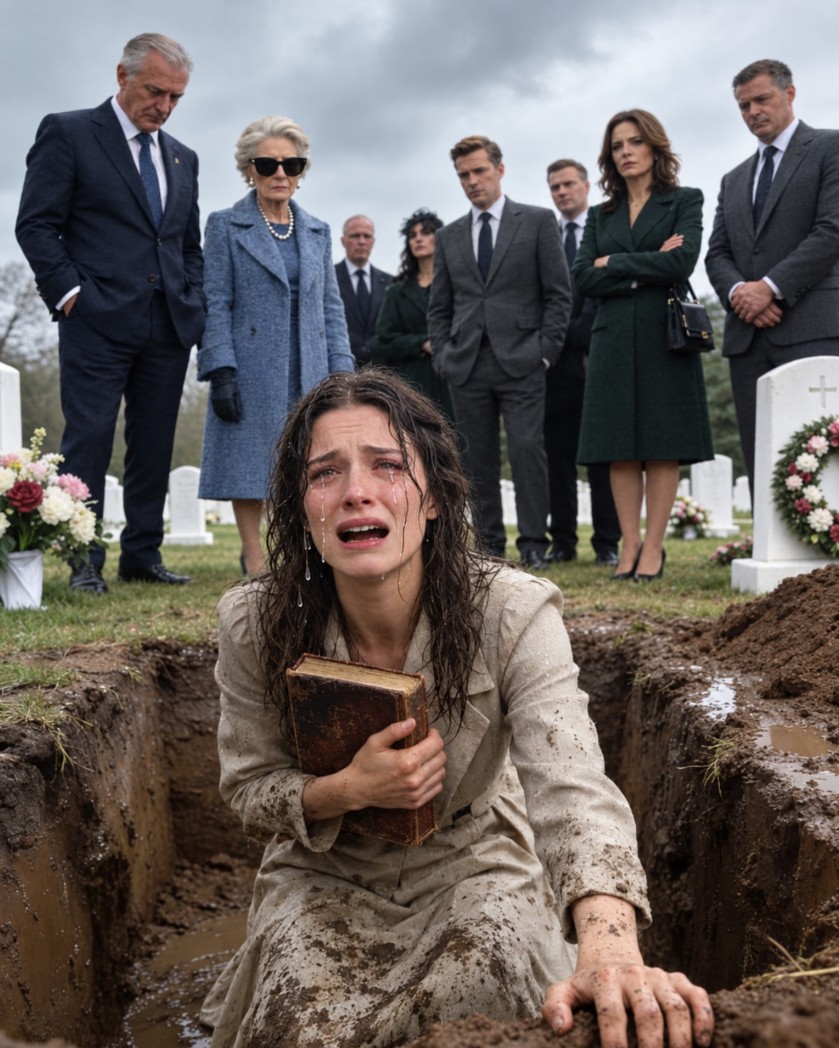
My father threw my grandmother’s savings passbook onto her open casket just moments before the funeral workers lowered it into the wet earth.
Nobody said a word.
Not my uncles. Not my cousins. Not even the priest who had just finished saying the final prayer.
Everyone stared at the muddy blue booklet as if it were nothing more than a piece of trash.
As if it weren’t the last thing my grandmother, Eleanor Hayes, had left me in this world.
I was twenty-seven years old, standing beneath the gray Chicago sky in a borrowed black dress. My hands were so cold that I could barely feel my fingers.
My father, Richard Hayes, adjusted his black gloves and gave me the same smile he used to wear when I was a little girl and he accused me of crying just to get attention.
“There’s your inheritance, Claire,” he said mockingly. “An old bankbook. No house. No land. No money. Your grandmother always loved pretending she had secrets.”
My stepmother, Denise, stood behind him in a black coat and dark sunglasses. She let out a quiet laugh.
“Poor thing,” she muttered. “She still thinks Grandma left her some kind of treasure.”
My half-brother, Tyler, leaned toward me and whispered in my ear.
“If there’s twenty bucks in there, you’re buying us burgers.”
A few of my cousins laughed.
I didn’t.
I couldn’t understand how they could stand beside my grandmother’s grave and treat the last thing she had left me like a joke.
Mr. Bennett, our family attorney, stood beneath the funeral tent. His face was pale, and he kept glancing between my father and me.
Only twenty minutes earlier, he had finished reading my grandmother’s will aloud.
The final sentence had been simple.
“To my granddaughter, Claire Hayes, I leave my savings passbook and all rights connected to it.”
My father had received nothing.
Not a single dollar.
That was why he was so furious.
My grandmother had raised me after my mother, Madison, died in a car accident when I was five years old. From that day on, Eleanor had been the person who made sure I had a home, food on the table, and someone to turn to when the world felt cruel.
She taught me how to stretch a dollar until it lasted through the week. She taught me never to sign a contract without reading every word. Most importantly, she taught me to look people directly in the eye when they tried to intimidate me.
My father had never liked that last lesson.
He preferred people who stayed quiet, obeyed him, and never questioned his decisions.
My grandmother was the only person in our family who had ever stood up to him.
One week before she died, I visited her in the hospital. She was weak, and her thin fingers trembled whenever she tried to lift her cup of water.
But when I took her hand, she squeezed it with surprising strength.
“When they laugh, let them,” she whispered. “Then go to the bank.”
I frowned, thinking the medication might be confusing her.
“Grandma, what are you talking about?”
She looked toward the hospital door before turning back to me.
“Promise me you’ll remember what I said.”
“I promise.”
She gave me a tired smile.
I wanted to ask her more questions, but she closed her eyes and fell asleep before I could.
Now, standing beside her open grave, I finally remembered those words.
When they laugh, let them. Then go to the bank.
I stared at the muddy blue passbook resting on her casket, and my hands began to shake.
I couldn’t leave it there.
It was the last thing she had entrusted to me.
I stepped toward the grave, but my father suddenly grabbed my arm.
“Don’t you dare.”
I turned to face him.
“Let go of me.”
He tightened his grip.
“Don’t embarrass yourself in front of everybody, Claire.”
I looked straight into his eyes.
“You’ve already done that for me.”
The laughter stopped.
Even the relatives who had been enjoying the show suddenly found something else to look at.
My father released my arm, but his expression promised that he wasn’t finished with me.
I carefully stepped down onto the muddy edge of the grave and reached for the passbook. My shoes sank into the wet ground, and the hem of my borrowed dress brushed against the mud.
I picked up the little blue booklet.
Dirt clung to its cover. It smelled of wet paper and freshly turned earth.
I wiped away as much mud as I could with my sleeve and pressed it against my chest.
“It belonged to her,” I said quietly. “Now it belongs to me.”
My father stepped closer. I could smell whiskey on his breath.
“Your grandmother couldn’t even save her own house,” he said. “What makes you think she saved anything for you?”
For years, I had been afraid of that voice.
It was the voice that had silenced me when I was a child. The voice that had made me believe I was always wrong, always too sensitive, and always asking for too much.
But something inside me had changed.
Maybe it had finally grown too cold to feel fear.
Or maybe, after years of being pushed down, it had finally caught fire.
I slipped the passbook into my purse and walked toward the cemetery gate.
Tyler hurried after me and stepped into my path.
“Where are you going?”
I looked past him at the rusty iron gates and the rainy street beyond them.
“To the bank.”
For a moment, he simply stared at me.
Then he burst out laughing.
My father laughed even louder.
Denise shook her head as if I had just proved everything she had ever believed about me.
I didn’t turn around.
I kept walking, my shoes splashing through puddles as the rain soaked my hair and ran down the back of my dress.
But Mr. Bennett didn’t laugh.
As I passed the funeral tent, I noticed him watching me with an expression I couldn’t understand.
He looked almost frightened.
It was the look of a man who had just watched someone strike a match beside a pool of gasoline.
I didn’t know it then, but my grandmother had made sure that the passbook would lead me somewhere my father never wanted me to go.
An hour later, I walked into a downtown Chicago branch of Chase Bank, completely soaked from the rain.
The lobby was warm and quiet. A few customers sat waiting near the service desks while employees worked behind glass partitions.
I approached a teller whose nameplate read Linda.
“Hello,” I said, pulling the muddy blue passbook from my purse. “I’d like to check this account, please.”
Linda smiled politely and took the booklet.
She opened it, looked at the account information, and then read my full name.
Her smile disappeared.
She looked at the passbook again, then at me.
Within seconds, the color drained from her face.
“Miss Hayes,” she said carefully, “could you please wait here for a moment?”
“Is something wrong?”
She didn’t answer directly.
Instead, she turned toward a colleague and whispered something I couldn’t hear. Then she picked up the phone with trembling hands.
“Please contact the police,” she whispered. “And secure the entrance. The young woman needs to remain here until the manager arrives.”
My stomach tightened.
“Why are you calling the police?” I asked. “Did I do something wrong?”
Linda looked at me with an expression that was almost apologetic.
“No, Miss Hayes. You haven’t done anything wrong.”
“Then why can’t I leave?”
She glanced down at the passbook.
“Because this account has special instructions attached to it.”
The floor seemed to tilt beneath me.
I had walked into the bank expecting to find an old, nearly empty account.
Instead, I had somehow triggered an emergency procedure.
And I had no idea why.
Part 2:
A few minutes later, a serious-looking woman in a navy suit approached the counter.
“Miss Hayes? I’m Diane Porter, the branch manager. Would you come with me, please?”
She led me into a small office with frosted glass walls. Linda followed us, carrying the passbook.
Diane closed the door and motioned for me to sit.
She placed the booklet on the desk with extraordinary care, almost as if it were a piece of evidence in a criminal investigation.
“Your grandmother opened this account when you were a child,” she explained. “She left specific written instructions concerning it.”
“What kind of instructions?”
“If you ever appeared at this branch with the original passbook, we were to verify your identity, notify the appropriate authorities, and secure all related documents.”
I stared at her.
“Why would she do that?”
Diane folded her hands on the desk.
“I can’t discuss every detail until your identity has been confirmed and the relevant records have been reviewed.”
I swallowed hard.
“Protect the documents from whom?”
She didn’t answer.
She didn’t need to.
“My father,” I whispered.
Diane’s expression changed slightly, but she remained silent.
That was all the confirmation I needed.
My mouth went dry.
“What did he do?”
Diane took a slow breath.
“According to the bank’s records, your father attempted to close this account on three separate occasions. The first time, he presented a death certificate for Claire Madison Hayes.”
For a moment, I couldn’t understand the words.
Then they sank in.
“My death certificate?”
Diane nodded.
My chest tightened so painfully that I struggled to take a full breath.
“That’s impossible. I’m standing right here.”
“You were thirteen years old when the document was presented,” she said quietly. “The certificate was later identified as fraudulent.”
I stared at her, unable to speak.
Someone had tried to prove that I was dead when I was still a child.
And that someone had been my own father.
Diane continued.
“Your grandmother came to the bank the following day and brought you with her. According to the employee who assisted her, she was extremely upset. She insisted that nothing connected to the account should ever be released unless you appeared in person and your identity was verified.”
A memory suddenly came rushing back.
I was thirteen again, sitting beside my grandmother on a bus.
We had visited a bank that afternoon. I remembered a teller giving me a cherry lollipop and asking whether I liked school.
I also remembered Grandma gripping my hand so tightly that it almost hurt.
On the ride home, she had cried quietly while staring out the window.
When I asked what was wrong, she wiped her cheeks and told me it was just allergies.
I had believed her.
Now I understood that she had been trying to protect me from something I was too young to comprehend.
My father hadn’t simply wanted control of the money.
He had been willing to pretend I didn’t exist if it meant getting his hands on it.
“Why would he do that?” I whispered.
Diane looked at the closed office door.
“I think the investigators will be in a better position to answer that question.”
A knock interrupted us.
Two detectives entered the office. One was a woman in her forties with sharp eyes and a calm expression.
“Claire Hayes?” she asked.
I nodded.
“I’m Detective Vanessa Reed. This is my partner. You’re not under arrest, and you haven’t done anything wrong. The alert was designed to protect you and preserve records connected to this account.”
I looked from her to Diane.
“Preserve them from my father?”
“We’re still reviewing the circumstances,” Detective Reed replied. “But your grandmother left clear instructions, and we intend to follow the evidence wherever it leads.”
Before I could ask another question, the office door opened again.
Mr. Bennett stepped inside, his coat dripping rainwater onto the carpet. He was clutching a yellow envelope.
I immediately stood up.
“Mr. Bennett? What are you doing here?”
He looked at the passbook, then at me.
“Your grandmother instructed me to give you this envelope only if you came to the bank on your own.”
I stared at him.
“You knew this was going to happen?”
“I knew your grandmother had prepared for the possibility. I didn’t know when, or whether, you would decide to follow her instructions.”
He held out the envelope.
I took it with trembling hands and carefully opened it.
Inside was a tiny brass key and a handwritten letter.
I recognized my grandmother’s handwriting immediately. Every letter was neat and careful, just as she had taught me to write when I was little.
I unfolded the paper.
My sweet girl,
If you are reading this, it means you were braver than they expected.
That passbook is not money. It is a door.
Your father stole what your mother left for you. He stole my home. He stole documents. And he spent years convincing you that none of it belonged to you.
Do not believe him.
Follow the records. Trust the evidence. And never let anyone make you feel guilty for asking for what is rightfully yours.
I love you more than you will ever know.
Grandma Eleanor.
By the time I reached the final line, tears were running down my face.
My grandmother had known what my father was capable of.
She had spent years preparing for the day when I would finally discover the truth.
And she had trusted me to be strong enough to face it.
Diane gently pushed a box of tissues toward me.
“There’s something else you need to see,” she said.
She led us downstairs to the bank’s vault, accompanied by Detective Reed and Mr. Bennett.
We stopped in front of a row of metal safety deposit boxes.
Diane checked the records before pointing to one of them.
“Box 117.”
The brass key from my grandmother’s envelope fit into the lock. Diane used the bank’s key, and together we opened the box.
I expected to find jewelry, perhaps some old family photographs, or a small amount of cash.
Instead, the box was filled with envelopes.
There were no diamonds. No gold. No expensive watches.
Just carefully organized documents, each marked with a handwritten label.
The first envelope read:
FOR CLAIRE — FINANCIAL RECORDS
I opened it.
Inside were investment statements, trust documents, insurance files, and account summaries dating back decades.
Some documents belonged to my mother. Others had my name printed across the top.
I turned page after page, struggling to understand what I was seeing.
Then I reached the final statement.
At the bottom was a number so large that my brain refused to accept it.
$4,800,000.
I read it again.
Then a third time.
“That can’t be real,” I whispered.
Diane examined the documents.
“The records indicate that your mother had life insurance, investments, and ownership interests in several properties. Your grandmother placed assets under trusts and other financial arrangements to protect them.”
She paused before continuing.
“The records suggest that your grandmother lived modestly to keep the full extent of these assets from becoming known to your father.”
I thought about the old cardigan my grandmother had worn for years, repairing the sleeves instead of buying a new one.
I remembered her watering down soup when money was tight, clipping coupons at the kitchen table, and turning off lights whenever we left a room.
She had never complained about her circumstances.
I had assumed she simply didn’t have much.
All that time, she had been protecting my future from the very man who wanted to take it away.
I looked at the documents again.
“Is all this money mine?”
“Some of these assets appear to have been held for your benefit through trusts and other arrangements,” Diane explained. “The precise ownership and current value will need to be verified. But these records provide a very clear starting point.”
I nodded, still struggling to process everything.
Then I noticed another envelope.
Its label contained just two words.
THE HOUSE.
My hands began to tremble before I even opened it.
Inside were property records, trust documents, and copies of old deeds.
I recognized the address immediately.
My childhood home in Oak Park.
It was a white brick house with blue shutters, a wide front porch, and lilac bushes along the garden path. I remembered running through those bushes as a little girl while my mother called me inside for dinner.
I remembered her perfume drifting through the hallway and the sound of her laughter coming from the kitchen.
That house had been my home until I was thirteen.
Then my father sold it.
He told me that my grandmother could no longer afford to keep it and that the family had no choice but to move on.
I had cried for weeks.
My father had told me to stop being childish.
Now I was holding documents suggesting that the house had never belonged to him in the first place.
“Then how did he sell it?” I asked.
Mr. Bennett’s jaw tightened.
“According to these documents, your mother placed the property in a trust for your benefit. Your father had no legal right to sell it as though it were his own.”
“But he did sell it.”
“Yes,” Mr. Bennett replied. “The records suggest that he used forged signatures, fraudulent powers of attorney, and a shell company connected to Denise’s brother to make the transaction appear legitimate.”
I felt sick.
My father hadn’t simply taken money that belonged to me.
He had taken the place where my childhood memories lived.
He had made me believe that the loss was unavoidable, that Grandma had failed to keep the family together, and that there was nothing anyone could do.
All those years, he had known the truth.
Before I could ask another question, a loud commotion erupted upstairs.
Someone was shouting.
Then came a series of heavy blows against the bank’s entrance doors.
“Open up!” my father screamed. “I know she’s in there!”
I froze.
Detective Reed moved toward the security monitor.
On the screen, I saw my father standing outside, soaked by the rain and red-faced with anger.
Denise stood behind him, her arms folded tightly across her chest.
Tyler was filming the scene on his phone.
“My daughter is stealing family property!” my father shouted at the security guard. “You have no right to keep her from me!”
I couldn’t believe he had followed me.
He must have guessed that the passbook was connected to something valuable.
Or perhaps he had always feared the day I would finally open it.
I moved closer to the monitor.
My father pressed his face against the glass and scanned the lobby.
Then he spotted me through the security blinds.
His expression changed.
The anger disappeared, replaced by a slow, chilling smile.
He lifted his chin and mouthed one word.
“Mine.”
My stomach twisted.
He still believed he could take everything from me.
Even now, with the police involved and the truth beginning to emerge, he thought he owned me.
Detective Reed turned toward her partner.
“Let’s bring him inside.”
The bank doors opened, and Richard Hayes entered with two officers beside him.
He immediately pointed at me.
“That’s my daughter! She’s confused. Her grandmother filled her head with lies, and now she’s trying to steal from her own family!”
Detective Reed remained calm.
“Richard Hayes, we need you to accompany us while we investigate several matters related to financial fraud and forged documents.”
“This is a family matter!” he snapped.
“No,” Detective Reed replied. “Now it’s evidence.”
Denise tried to slip toward the parking lot, but an officer intercepted her before she could reach her SUV.
Tyler slowly lowered his phone.
For the first time that day, he looked genuinely afraid.
My father continued shouting as the officers led him away.
He called me ungrateful. He accused my grandmother of poisoning my mind. He promised that I would regret everything I had done.
I stood beside the vault entrance, holding the documents that could finally expose him.
But there was still one envelope left in the safety deposit box.
It was smaller than the others, and its edges had yellowed with age.
The label made my blood run cold.
FOR LAW ENFORCEMENT — MADISON FILE.
Madison was my mother.
Detective Reed took the envelope from me and carefully opened it.
Inside were photographs of my mother’s crashed car, old mechanic receipts, copies of repair records, and a small flash drive.
The detective studied the photographs for several seconds.
Then she looked up at me.
Her expression had changed completely.
“Claire,” she said gravely, “what’s in this file may change everything you believe about your mother’s death.”
My knees nearly gave way.
For twenty-two years, I had believed my mother died in a terrible accident.
Now a detective was standing in front of me, holding evidence my grandmother had hidden for decades.
Before she could explain further, my father’s voice echoed from outside as officers guided him toward a police car.
“Claire! You have no idea what you’re doing!”
I turned toward the sound.
For the first time in my life, I wondered whether my father had been afraid of my grandmother for a reason far more terrible than money.
And as Detective Reed picked up the flash drive, I realized that the worst secret in the box might have nothing to do with the inheritance.
It might explain why my mother never came home.
Part 3:
The flash drive contained several recordings.
Detective Reed arranged for the files to be examined and copied as part of the investigation. The first recording was an old audio file made by my grandmother in her kitchen years earlier.
Her voice was clear enough to understand, although I could hear the faint sound of dishes moving in the background.
“I know about the accounts, Richard,” Grandma said. “I know you tried to declare Claire dead.”
My father’s voice followed.
“You can’t prove anything, old woman.”
“I also know Madison wanted to leave you.”
There was a long silence.
Then my father’s voice changed. It became lower, quieter, and far more threatening.
“Some women learn too late what happens when they try.”
The recording ended a few seconds later.
I sat completely still.
My mother hadn’t simply died in a random car accident.
At least, that was no longer something I could accept without question.
Detective Reed placed a hand on the table.
“Claire, this recording raises serious questions. We need to investigate the circumstances surrounding your mother’s death before we can draw any conclusions.”
I nodded, but I barely heard her.
My mind was filled with memories of my mother.
Her warm smile. Her perfume. The way she used to tuck me into bed and promise that nothing bad would ever happen to me.
I remembered the day someone told me she was gone.
I had been five years old.
My father had sat me down and explained that there had been an accident. He told me that my mother had died because the roads were dangerous and that nothing could have prevented it.
For years, I had accepted those words as the truth.
Now I wondered how much of my childhood had been built on lies.
The investigation reopened immediately.
Detectives reviewed the original accident report, examined the documents my grandmother had preserved, and searched for people who had been connected to the case.
They discovered payments my father had made to a mechanic in the weeks before the crash.
The payments had been concealed through other transactions, but investigators were able to trace them back to him.
They also uncovered altered repair reports and photographs showing damage to the car’s brake lines. That damage had never been properly explained in the original case file.
The evidence was troubling enough to justify a deeper investigation.
Then detectives located the mechanic.
He was elderly and seriously ill by the time they found him. At first, he denied knowing anything about the accident.
But when investigators showed him the photographs and financial records, his story began to fall apart.
Eventually, he confessed.
Through tears, he admitted that my father had paid him to tamper with my mother’s car.
According to his statement, Richard wanted to frighten Madison so she would stop trying to leave him. He also wanted to prevent her from taking me and the house away from him.
The mechanic claimed that the plan had been intended as a warning, not a murder.
But that night, it rained heavily.
The brakes failed completely.
My mother died.
And my father walked away from the crash with his secret intact.
For twenty-two years, he had allowed me to believe that her death was a terrible accident.
He had taken away my mother, stolen the money she left for me, and then spent years convincing me that I had no right to question him.
When Detective Reed finally explained what the investigation had uncovered, I didn’t cry.
I simply sat at the table, staring at my grandmother’s blue passbook.
The same passbook my father had thrown onto her casket like a piece of garbage.
I could still picture his face at the funeral.
The contempt in his eyes. The confidence in his voice. The way he had laughed while everyone else stood silent.
He had believed he was humiliating me.
He had never imagined that the little book he despised would lead investigators back to the crimes he had spent decades hiding.
For the first time, I understood why my grandmother had told me to go to the bank.
She hadn’t left me a fortune just to make sure I would be comfortable.
She had left me a path to the truth.
But finding the truth was only the beginning.
Justice did not come quickly.
The case took months to work through the legal system.
There were hearings, depositions, financial reviews, and long meetings with lawyers. I had to answer questions about my childhood, my mother’s death, the house, and the strange behavior of my father over the years.
Some days, I felt as if I were reliving my entire life, only this time I was seeing it through a different lens.
Every memory seemed to hold a question.
Every explanation my father had ever given me suddenly seemed suspicious.
And not everyone wanted the truth to come out.
Several relatives contacted me privately, urging me to reconsider.
One uncle called and told me I was destroying the family.
“Your father made mistakes,” he said. “But do you really want to send him to prison? He’s still your father.”
I stared at the phone in disbelief.
“Did you know what he did to my mother?”
He fell silent.
Then he said, “I don’t know anything about that.”
“Then let the evidence speak for itself.”
He hung up without another word.
Other relatives told me that family matters should remain private. They said I should think about the embarrassment the case would bring to everyone.
I began to realize that some people cared more about protecting the family’s reputation than protecting the people my father had hurt.
But my grandmother had prepared for almost every possibility.
The bank confirmed the repeated attempts to gain control of the account, including the fraudulent death certificate.
Mr. Bennett helped investigators establish how the house had been transferred through forged documents and a company connected to Denise’s brother.
Financial records revealed suspicious transactions that supported the allegations of theft and fraud.
Then investigators examined Denise’s laptop.
What they found was deeply disturbing.
Her search history included phrases such as:
“How to collect a dead child’s inheritance.”
“How to challenge inheritance due to insanity.”
“How to destroy bank records.”
The searches did not prove every allegation by themselves, but they gave investigators another reason to examine her role in the financial schemes.
They also found communications and financial records linking her to the transactions involving the house.
Denise had spent years pretending to be the reasonable one in the family.
She smiled at relatives, offered sympathetic comments, and acted as though she were simply trying to help my father manage his responsibilities.
At the funeral, she had laughed while he humiliated me.
Now her own actions were under investigation.
Tyler was questioned as well.
At first, he tried to defend our father. He claimed he had never known about the fraudulent documents and insisted that he had only followed Richard’s instructions.
But as the evidence mounted, Tyler eventually agreed to testify.
During one interview, he admitted that he had mocked me at the funeral because he wanted our father’s approval.
“I thought it was funny because Dad was laughing,” he said. “I didn’t think there was anything in that book.”
He lowered his head.
“I knew he hated Claire, but I never understood why.”
Then he told investigators something that stayed with me long after the interview ended.
“My dad hated Claire because she looked exactly like Madison.”
When I heard those words, I felt a fresh wave of grief.
My father had looked at his own daughter and seen the woman he had tried to control.
Perhaps every time he looked at me, he was reminded of the person who had dared to leave him.
But whatever his reasons, they could never excuse what he had done.
Part 4:
The trial finally began after months of investigation and legal preparation.
I sat in the courtroom with Mr. Bennett beside me, listening as the prosecution laid out the case against my father.
The evidence was presented piece by piece.
The fraudulent death certificate.
The financial records.
The forged documents connected to the sale of the Oak Park house.
The payments to the mechanic.
The altered repair reports.
And, finally, my grandmother’s recordings.
I had listened to those recordings several times before the trial, but hearing them played in a courtroom filled with strangers was different.
The room fell silent as my grandmother’s voice came through the speakers.
“I know about the accounts, Richard. I know you tried to declare Claire dead.”
My father’s voice answered from the recording.
“You can’t prove anything, old woman.”
I looked across the courtroom.
Richard sat at the defense table in a dark suit, his face tense and his jaw clenched.
He didn’t look like the powerful man who had stood over my grandmother’s grave and laughed at me.
He looked like someone who had finally realized that the world was no longer willing to accept his version of events.
The prosecution played another recording.
This one was even more painful.
My grandmother’s voice sounded tired but determined.
“Tell me why, Richard.”
“Because she was taking what belonged to me,” my father replied.
“Madison wasn’t yours.”
There was a pause.
Then my father’s voice returned.
“My daughter wasn’t going to belong to her either.”
I felt my fingers tighten around the edge of the bench.
My grandmother asked the question that everyone in the courtroom had been waiting to hear.
“Did you cut the brakes?”
For several seconds, there was nothing but silence.
Then my father’s voice answered.
“She chose to drive.”
The courtroom froze.
I could hear someone quietly gasp behind me.
The recording did not provide every detail of what had happened that night, but it showed the coldness with which my father spoke about the woman who had once been his wife and the mother of his child.
Combined with the mechanic’s testimony and the physical evidence, it helped the prosecution establish its case.
I didn’t look at my father.
I couldn’t bear to see whether he was angry, frightened, or simply annoyed that his plans had failed.
I had spent too many years trying to understand what he wanted from me.
Now I no longer needed an answer.
The jury eventually returned its verdict.
Richard Hayes was convicted of financial fraud, forgery, financial exploitation, and second-degree murder.
Denise was convicted of conspiracy and financial crimes connected to the scheme.
Her brother was also held accountable for his role in the fraudulent property transactions.
The courtroom remained quiet as the verdicts were read.
I felt no sudden rush of happiness.
There was no moment when all my pain disappeared or the years of lies magically became easier to bear.
Instead, I felt an enormous weight slowly lifting from my shoulders.
My mother had not been forgotten.
My grandmother had not been foolish.
And I had not imagined the cruelty that had shaped my childhood.
At the sentencing hearing, I stood before the judge holding my grandmother’s blue passbook.
My hands trembled, but my voice remained steady.
“My father said this was worthless,” I began.
I looked down at the muddy cover before raising my eyes again.
“But this passbook protected my grandmother’s courage, my mother’s love, and the truth he tried to bury. He just didn’t bury it deep enough.”
I paused, trying to gather my thoughts.
“For years, I believed I had lost everything because my mother died and my grandmother couldn’t protect us forever. I believed my father when he said we had no choice, when he said the house was gone, and when he told me to stop asking questions.”
I took a breath.
“But the truth was never his to control. My grandmother protected it when I was too young to understand what was happening. She left me the evidence and trusted me to follow it.”
I looked at the judge.
“I hope that no other child has to grow up believing that the person hurting them is the only person who can protect them.”
Then I returned to my seat.
I never looked at my father to see whether he felt remorse.
Men like him don’t always regret hurting people.
Sometimes, they regret only that they were caught.
Months later, after further legal proceedings to establish ownership and resolve the fraudulent property transfers, I regained ownership of the house in Oak Park.
Walking up the front path for the first time in years felt unreal.
The white paint was peeling in several places. The garden had become overgrown, and the lilac bushes were tangled with weeds.
The porch needed repairs, and one of the blue shutters hung crookedly beside a window.
But the house was still standing.
I took the key from my pocket and unlocked the front door.
The moment I stepped inside, the familiar smell of old wood and dust brought back memories I hadn’t thought about in years.
I could almost hear my mother moving around the kitchen.
I could almost see my grandmother standing by the window, watching me play in the garden.
For the first time since I was a child, I felt as if I had returned to a place that recognized me.
I walked slowly through the rooms, touching the walls and looking at the faded paint.
Then I entered the kitchen.
There, along one wall, I found the old pencil marks we had made when I was little.
My grandmother had used them to record my height as I grew.
The first mark read:
“Claire — age 4.”
The next one read:
“Claire — age 5.”
Higher up, written in my mother’s handwriting, was another note:
“Madison — first apartment key — age 19.”
I stood there for a long time, staring at those words.
I imagined my mother at nineteen, young and hopeful, holding the key to her first apartment. I wondered what she had dreamed about and what kind of life she had wanted for herself and for me.
Then the tears finally came.
I cried for the childhood I had lost, for the mother I barely remembered, and for the grandmother who had carried so many secrets alone.
But I also cried because something I had believed was gone forever had come back to me.
Not just the house.
Not just the money.
A piece of my own history.
Part 5:
Restoring the house took time, but I wanted to bring it back to life.
I repaired the porch, repainted the walls, and cleared the weeds from the garden. I planted new lilacs along the path where I remembered my mother walking with me.
I kept some of the old furniture and restored the kitchen as closely as I could to how it had looked when I was a child.
I didn’t want the house to become a monument to what my father had done.
I wanted it to become a place where something good could finally grow.
After the legal costs and the work needed to restore the property, I used part of the money that was rightfully mine to establish the Eleanor & Madison Hayes Foundation.
The foundation’s purpose was to help women and children escaping abuse and financial control inside their own homes.
I knew how frightening it could be to depend on someone who controlled the money, the property, and even the story everyone else believed.
I knew what it felt like to be told that asking questions made you ungrateful.
And I knew how easily people could dismiss the truth when the person telling it had less power than the person being accused.
I wanted to help women find a safe place to go, understand their legal options, and regain control over their lives.
The first woman who came to our office was named Rachel.
She arrived one rainy afternoon carrying a sleeping baby in her arms. A fading bruise was partly hidden beneath her makeup, and she kept glancing toward the door as if she expected someone to walk in behind her.
She sat down across from me and held her baby closer.
“I’m sorry to bother you,” she whispered.
I looked at her for a moment.
I recognized that fear.
I had seen it in my own reflection years earlier, when I believed I had no choice but to accept whatever my father decided.
I slid a folder across the desk.
Inside were information sheets about safe housing, legal assistance, and financial support. I explained that we could help her connect with professionals who would guide her through the next steps.
Then I looked her directly in the eyes.
“You never have to apologize for surviving.”
Her face crumpled, and she began to cry.
I moved a box of tissues closer to her and waited while she gathered herself.
In that moment, I understood something my grandmother had tried to teach me long before I knew about the money.
My inheritance had never been only about the assets my mother left behind.
It was about what I chose to do with the truth once I had it.
The money could give me security. The house could give me a home. The legal victory could give me a sense of justice.
But helping someone else escape the kind of fear that had shaped my childhood gave all of it a purpose.
That was when I finally understood what my grandmother had been protecting.
She hadn’t simply been protecting an account.
She had been protecting my chance to live a life that my father could never control.
I framed the blue passbook and hung it near the entrance of the restored house.
I could have cleaned it completely. I could have removed every trace of the mud from the cemetery.
But I chose to leave one visible dirt stain on the cover.
Some stains are not signs of shame.
Some stains are proof.
Beneath the frame, I placed a small engraved plaque.
It read:
“When they laugh, let them. Then go to the bank.”
Whenever I walked past it, I remembered my grandmother’s voice in the hospital room.
I remembered the way she had squeezed my hand and asked me to promise that I would never forget her words.
For years, I had thought she was simply trying to comfort me.
Now I understood that she had been preparing me.
She knew my father would try to make me feel small. She knew he would laugh at me, deny the truth, and tell me that I had no right to question him.
She also knew that one day I might have to stand alone and decide whether to believe him or trust what I knew was right.
My grandmother had made sure I wouldn’t be completely alone when that day came.
The passbook was her final lesson.
And it was one I would carry with me for the rest of my life.
People sometimes ask why I didn’t lock it away in a safe.
Why display something so ordinary when it was connected to such a painful part of my past?
My answer is simple.
That little book had already spent too many years hidden.
My grandmother hadn’t left it to me so I could spend the rest of my life being afraid of what might happen if the truth came out.
She left it to teach me that I should never surrender what belongs to me simply because someone more powerful tells me it is worthless.
She wanted me to understand that money can be stolen, property can be taken, and memories can be twisted by people who want to control us.
But the truth can survive, even when someone tries very hard to destroy it.
And sometimes, all it takes to uncover that truth is the courage to ask one more question, open one more envelope, or walk into one bank with a little blue book in your hands.
In America, just as in other parts of the world, families often hide terrible things behind familiar phrases.
“Don’t make a scene.”
“Respect your father.”
“Keep family business private.”
“Think about what people will say.”
When I was younger, I believed those words were rules I had to follow.
I thought keeping the peace meant staying quiet, even when something was wrong.
I thought respecting my family meant accepting whatever they told me.
And I thought that if I spoke up, I would be the one destroying everything.
Now I know better.
Family is not an excuse to hurt someone.
Respect does not mean surrendering your rights.
And keeping a secret is not always an act of love.
Sometimes, it is an act of control.
Sometimes, it is theft.
And sometimes, it is violence hiding behind a pressed shirt, a familiar face, and the same last name you carry.
My father threw that passbook into my grandmother’s grave because he believed he was burying the truth with her.
He thought the woman who had spent her life protecting me was finally gone, and that I would be too frightened to challenge him.
He thought a muddy old bankbook could never threaten the life he had built on lies.
But my grandmother understood something he never did.
A woman who protects something with love may have to keep it hidden for years.
She may have to stay quiet while others laugh at her, doubt her, or call her foolish.
She may have to wait until the right moment arrives.
But hiding the truth does not make it disappear.
And once that truth finally comes into the light, no lie is strong enough to bury it again.
The End.
