
Part 1:
My grandmother gave up the expensive first-class seat I had bought for her and asked to sit in economy instead. At first, I was deeply frustrated by her decision. I had spent nearly a year saving money to give her the most comfortable birthday trip possible, and I could not understand why she would willingly trade luxury for a cramped seat at the back of the plane.
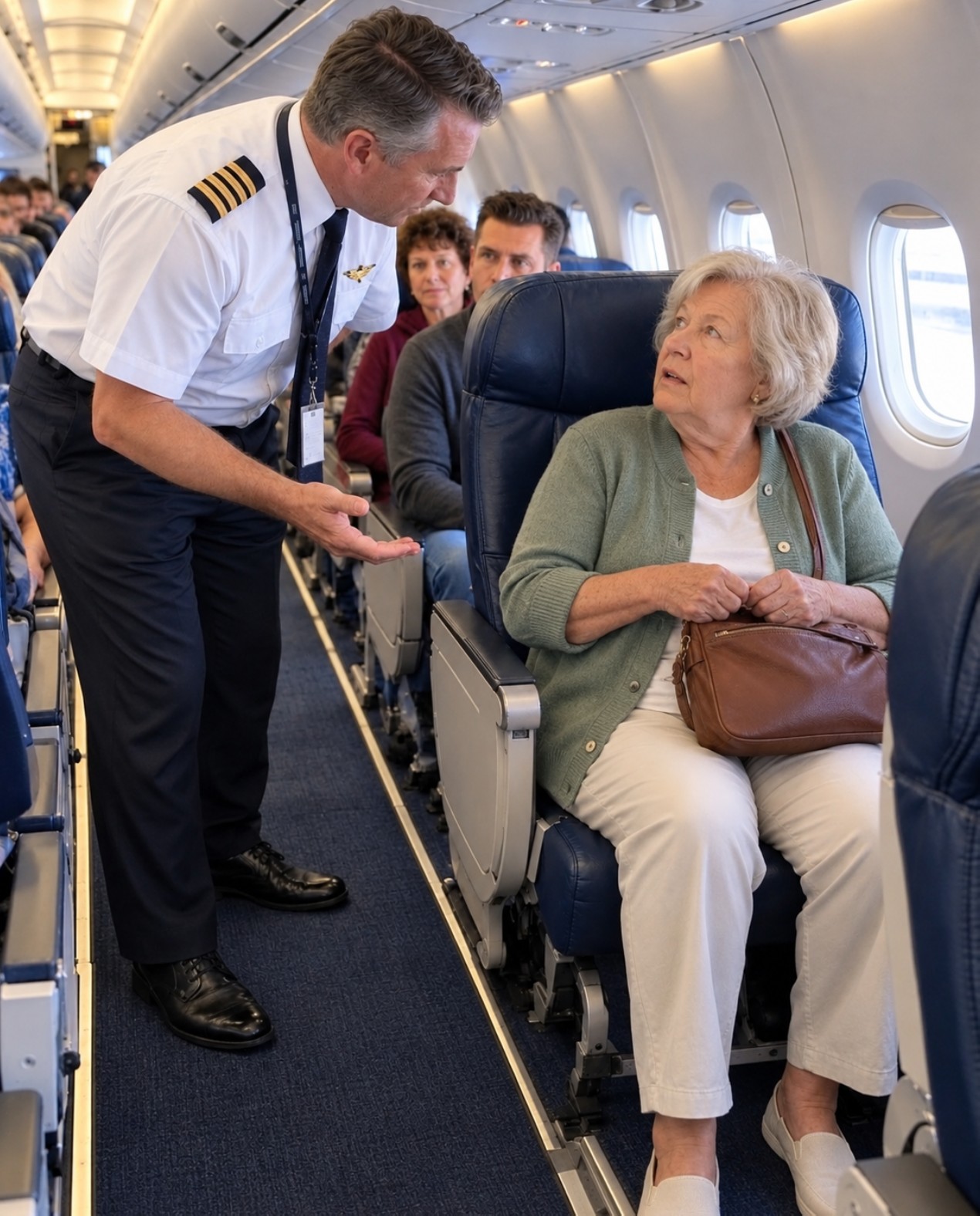
But halfway through our long flight across the country, one of the pilots stepped out of the cockpit and began walking down the aisle, searching for my grandmother.
When he finally found her, his eyes fell on the tiny silver wings attached to her old leather handbag. The moment he saw them, his entire expression changed.
Then he asked her a question that made my blood run cold.
“Mrs. Callahan, why did you specifically request seat 34A?”
My grandmother lowered her eyes, her lips trembling.
“Because that is where he told me to sit,” she whispered.
And in that moment, I realized that the woman I had known my entire life was carrying a secret connected to a man who had been dead for twenty-seven years.
To understand why that seat mattered so much, I need to take you back to the morning of our flight.
It was March 14, and we were standing at the departure gate at Minneapolis-Saint Paul International Airport. My grandmother, Ruth Callahan, had recently celebrated her eightieth birthday, and I had surprised her with a first-class ticket to San Diego, California.
She had not stepped onto an airplane in nearly thirty years. I wanted this journey to be as comfortable and special as possible for her.
I did not want her struggling with narrow seats or fighting for space in the overhead compartments. I wanted her to enjoy plenty of legroom, warm meals, attentive service, and a seat that reclined comfortably.
Most importantly, I wanted her to have nothing to worry about.
I had spent nearly an entire year saving every spare penny for this trip. I worked as a pediatric nurse at a hospital in Minnesota, regularly putting in twelve-hour shifts and picking up overtime whenever it was available.
Between paying my apartment rent and clearing my remaining student loans, I rarely had much money left at the end of the month.
Still, I had decided that my grandmother deserved something extraordinary.
My name is Sam, and I was twenty-seven years old. I had grown up near the coast in California before moving to Minnesota to complete my nursing degree. I had stayed there afterward because my grandmother was living alone, and I did not want her to feel that she had no family nearby.
Grandma still lived in the modest two-story house in Saint Paul where she had raised her family. Every spring, she tended to her flower garden. She completed difficult crossword puzzles in ink and called me every Sunday evening at six to make sure I was eating properly.
She was fiercely independent. Even when snow piled up outside her house, she preferred to shovel her own driveway rather than ask anyone for help.
That was one reason her request for her eightieth birthday had surprised me so much.
A year earlier, on her seventy-ninth birthday, I had asked her what she wanted most for her next milestone celebration.
I expected her to request a family dinner, a warm winter sweater, or perhaps some new gardening tools.
Instead, she put down her dinner fork and looked straight at me.
“I want to go to San Diego,” she said.
I stared at her in surprise.
“San Diego?”
“Yes, dear. I want to visit your mother.”
My mother had moved to southern California before I was born. She usually traveled to Minnesota to visit us, so Grandma had not needed to fly anywhere for years.
“Grandma, you haven’t traveled on an airplane in decades,” I reminded her gently.
“It has been twenty-seven years, to be precise,” she corrected me.
“But you always told everyone in the family that you would never step foot on another plane.”
Grandma calmly picked up her fork and resumed eating.
“Well, I have changed my mind about that.”
I thought that was the end of the conversation. Then she added something even more unexpected.
“I want us to leave on March fourteenth, on Flight 412. The morning flight.”
I paused.
“That’s an extremely specific request, Grandma.”
“Yes, it is,” she replied simply.
That evening, I searched online for the flight. Flight 412 was an active morning route from Minneapolis to San Diego. Although the airline was using a newer aircraft, the flight number and route were the same as those used on the historical service.
I found tickets for the date she had requested and began planning the trip.
When it was time to book, I chose first class for Grandma and reserved seat 3A for her. I booked myself into seat 3B, directly beside her.
The total cost made my stomach drop, but I put the tickets on my credit card anyway.
It was worth it. At least, that was what I thought at the time.
Now, standing at the airport departure gate, I watched my grandmother approach the airline agent.
She held her worn brown leather handbag tightly against her side. In her other hand was her original boarding pass.
She leaned toward the counter and spoke so softly that I almost missed her words.
“I would like to change my seat, please.”
The gate agent glanced at her computer screen.
“Of course, ma’am. You’re currently booked in first class, seat 3A.”
“I am aware of that,” Grandma replied with a gentle smile. “However, I would really like to sit in seat 34A instead, if that seat is available today.”
The agent looked at her in mild disbelief before tapping on her keyboard.
“It is available, ma’am. But if you voluntarily move to economy, the airline cannot refund the difference in ticket price.”
“That is perfectly fine with me,” Grandma said without hesitation.
I stepped forward, unable to hide my shock.
“Grandma, what are you doing?”
She did not answer.
A small printer whirred behind the counter, and the agent handed her a replacement boarding pass.
Grandma studied it for several seconds before carefully slipping it into the side pocket of her handbag. For a moment, I caught sight of a brittle, yellowed piece of paper tucked inside.
I had no idea what it was.
“Thank you very much for your help,” Grandma told the agent politely.
Then she turned toward me.
“I know you’re surprised, Sam,” she said.
“Grandma, that ticket cost me more money than I care to admit,” I replied, struggling to keep my frustration under control.
“I know it did, sweetheart.”
“Then why on earth would you give it up for a basic seat at the back?”
She reached out and took my hand. Her fingers felt surprisingly cold against my skin.
“I would simply rather sit at the back of the plane today.”
That was the only explanation she offered.
I tried again as we waited for boarding to begin.
“You’re going to spend six long hours sitting in economy. You could have had all that extra space in first class.”
“I am quite certain I will survive the journey,” she said with a faint smile.
“Those seats barely recline.”
“I do not need the seat to recline, dear.”
“Grandma, please make sense of this for me.”
She patted my wrist affectionately.
“Sam, what you did for me was incredibly generous. I know how hard you worked to afford these tickets. I know every extra hospital shift represented a little piece of this trip.”
Her clear blue eyes met mine.
“I am profoundly grateful for your kindness.”
“Then why did you ask to move to the back?”
She hesitated before answering.
“Because sometimes physical comfort is not the most important thing in the world.”
I did not understand what she meant.
When the airline announced boarding for first-class passengers, I looked down at my ticket.
“Fine,” I said. “Then I’ll change my seat to economy too.”
“No, you will not.”
Her answer was so firm that I stared at her.
“I’m not going to let you sit back there alone.”
“Yes, you are going to let me,” she replied, squeezing my arm. “Please do this for me, Sam.”
My grandmother almost never asked anyone for favors. She was the sort of woman who would struggle with a heavy shopping bag rather than admit that she needed help carrying it.
If she was drawing this particular boundary, I knew there had to be a reason.
“Alright, Grandma,” I finally conceded. “I’ll stay in my assigned seat.”
She smiled warmly.
“Thank you, sweetheart.”
We hugged briefly before the first-class passengers began boarding.
As I walked onto the aircraft, I kept looking back at her. She moved slowly with the help of her wooden cane, which had an antique brass handle that once belonged to her own mother.
I wanted to follow her and make sure she was comfortable, but she gave me a reassuring wave.
So I continued toward the front of the plane.
First class was every bit as luxurious as advertised. The seats were wide and covered in soft leather. The passengers had real glassware, plush blankets, and attentive service.
The flight attendant offered me a warm drink before takeoff.
I accepted it, but I felt miserable sitting there alone.
Seat 3A remained empty until the final moments of boarding, when a businessman in a dark suit settled into it. He placed his briefcase beside him and immediately began talking loudly on his phone.
He never even looked out the window.
I kept turning around, trying to catch a glimpse of the main cabin, but a heavy privacy curtain blocked my view.
As the aircraft climbed into the sky, my thoughts returned to my grandmother.
Why had she suddenly decided to fly again after twenty-seven years?
And why had she insisted on this particular flight?
There was something about my late grandfather’s story that I had never fully understood.
His name was Thomas Callahan, and he had worked as an aircraft maintenance supervisor at the local airport for more than thirty-four years. According to my mother, he had possessed extraordinary technical knowledge. He could sometimes identify a mechanical problem simply by listening to an engine idle.
He had died during the same week I was born.
I entered the world on March 13, 1999, and my grandfather died on March 14.
My family had always told me that he suffered a massive heart attack while traveling to California. Whenever I asked for more details, the answers were vague.
Grandma would grow quiet, and my mother would quickly change the subject.
There was only one photograph of him in Grandma’s house. It showed a handsome young man in a navy uniform, laughing as though the world had never given him a reason to worry.
And then there were the silver wings.
For as long as I could remember, a small, slightly tarnished aviation pin had been attached to the zipper of Grandma’s old brown handbag.
When I was little, I used to run my fingers over its metallic edges while sitting beside her in church.
One day, when I was about six, I finally asked her where it had come from.
“Your grandfather gave it to me a long time ago,” she had replied softly.
“Why?”
She had considered the question before answering.
“Because I was frightened of flying, and he wanted me to remember that I could always be brave.”
I had accepted that explanation without asking anything else.
But now, sitting aboard Flight 412, I found myself thinking about that little pin again.
I wondered whether it had something to do with her decision to give up first class.
I wondered whether the answer had been sitting in front of me all along.
I had no idea that, before the flight was over, I would learn the truth about my grandfather, the silver wings, and the seat my grandmother had spent twenty-seven years avoiding.
Part 2:
Roughly two hours into the flight, I finally decided that I could not sit still any longer.
I unbuckled my seatbelt, stood up, and walked toward the rear of the aircraft to check on Grandma.
The atmosphere in economy was completely different from first class. The aisles were narrower, the seats were packed closely together, and passengers were trying to sleep, watch movies, or find comfortable positions in the limited space.
I continued walking until I reached row 34.
There she was, sitting beside the window and staring silently at the endless blue sky outside. Her old brown leather handbag was pressed tightly against her chest.
A young, red-haired boy sat in the middle seat beside her. He appeared to be around eight years old. A plastic pouch hung around his neck, containing a brightly colored tag that read UNACCOMPANIED MINOR.
His name tag said Toby.
He held a coloring book on his lap, but he was not drawing anything. Instead, his legs bounced nervously beneath the seat.
The aisle seat beside them was empty, so I crouched down to speak with Grandma.
“How are you holding up?” I asked gently.
She turned toward me. For a brief moment, she looked completely lost, as though she had forgotten where she was. Then her familiar expression returned, and she offered me a small smile.
“I am doing just fine, Sam.”
I knew immediately that something was wrong.
Her hands were visibly shaking, and her eyes were filled with unshed tears. As a nurse, I had learned to recognize signs of emotional distress. Whatever my grandmother was experiencing, she was struggling to hide it.
“Are you feeling sick?” I asked quietly.
“No, dear. I am not sick.”
“Your hands are trembling.”
“It is merely a little travel anxiety,” she insisted.
Before I could ask another question, the young boy beside her looked up from his coloring book.
“I am feeling really nervous too,” he admitted.
Grandma immediately turned toward him. Her expression softened, and she placed one hand gently over his.
“Are you traveling all by yourself today, young man?” she asked.
He nodded.
“My mom dropped me off at the airport in Minnesota. My dad is going to pick me up when we land in San Diego.”
Then he looked down at his shoes.
“I really don’t like it when the airplane shakes around in the air.”
Grandma gave him a sympathetic smile.
“I do not particularly enjoy that either.”
The boy looked surprised.
“You don’t?”
“No, I do not,” she admitted. “But my late husband used to repair large airplanes for a living. He taught me that turbulence is a little like driving a car over bumps on a dirt road. The airplane is specially designed to handle those bumps safely.”
Toby considered her words.
“Did your husband help fix this specific plane?”
Grandma turned toward the window again. She looked at the clouds stretching into the distance, and a faint smile appeared on her face.
“Perhaps he did,” she murmured. “Perhaps he did.”
I watched them speak for another moment.
Despite her own obvious distress, Grandma seemed determined to make Toby feel safe. She asked him about his favorite subjects at school, the games he enjoyed playing, and whether his father had promised to take him somewhere special when they arrived in California.
Gradually, the boy’s shoulders relaxed.
It was such a familiar sight. My grandmother had always possessed that gift. Even when she was frightened or upset herself, she could somehow make another person feel that everything would be alright.
“I am going to head back to my seat now,” I told her. “Unless you need anything?”
“I am quite alright, Sam,” she assured me. Then she glanced at Toby and smiled. “You go back and enjoy your comfortable seat. I have wonderful company right here.”
I wanted to argue that I would rather stay with her, but I remembered her request at the airport.
She wanted to sit in seat 34A.
She wanted to make this journey on her own terms.
So I returned to first class, although my concern for her only grew.
About twenty minutes later, I heard the flight deck door open.
A younger co-pilot stepped into the forward galley and spoke quietly to one of the flight attendants.
I could not hear what he said, but the woman’s expression changed immediately. She looked startled, glanced toward the rear of the aircraft, and pointed down the aisle.
The co-pilot nodded and started walking.
He did not move like someone taking a routine walk through the cabin. His eyes moved from passenger to passenger, carefully examining the faces of the people sitting in each row.
He passed row fifteen.
Then row twenty.
Then row thirty.
Something about his behavior made me uneasy.
I unbuckled my seatbelt and followed him a few paces behind, curious to know what was happening.
When he reached row 34, he stopped so suddenly that the passengers behind him nearly collided with one another.
Grandma was still sitting beside the window. Toby was coloring a picture of a purple dinosaur.
The co-pilot stared at my grandmother.
Then his gaze shifted to her old leather handbag.
More specifically, he was looking at the tiny silver wings attached beside its zipper.
His entire expression changed.
He stepped closer and crouched beside her seat.
“Excuse me, ma’am,” he said, his voice trembling slightly. “Where did you get that pin?”
Grandma looked up at him, studying his uniform.
Her fingers tightened around the handbag.
“It belonged to someone very dear to me,” she replied quietly.
The co-pilot swallowed hard.
“Mrs. Callahan,” he said, “why did you specifically request seat 34A today?”
I froze a few rows behind him.
He knew her name.
Until that moment, I had assumed the gate agent had simply assigned Grandma an available economy seat. I had not realized that she had specifically requested this exact place.
Grandma lowered her eyes.
“Because that is where he told me to sit,” she whispered.
The co-pilot stared at her in disbelief.
“Who told you to sit here, ma’am?”
Grandma did not answer immediately.
Instead, she carefully opened the side pocket of her handbag and reached inside with trembling fingers.
She pulled out a yellowed piece of paper.
It was an old boarding pass, printed on heavy cardstock. Its edges had become soft and worn from decades of handling.
She held it out to him.
The co-pilot took the ticket carefully and unfolded it.
Even from where I stood, I could see that he had become deeply emotional.
He read the front once.
Then he read it again.
Finally, he turned the card over.
Whatever he saw on the back seemed to take his breath away.
His expression shifted from confusion to recognition, and then to something that looked almost like grief.
He turned toward the front of the aircraft.
“Sarah!” he called urgently. “Please get the Captain. Tell him he needs to come back here immediately.”
A senior flight attendant hurried toward us.
“David, what is going on?” she asked.
David held up the old boarding pass.
The moment she saw it, she brought one hand to her mouth.
“Oh, my goodness,” she whispered.
David looked back at Grandma.
“It really is her,” he said softly. “She is sitting right here in seat 34A.”
The flight attendant stared at my grandmother for several seconds before hurrying toward the cockpit.
David crouched beside Grandma again.
“I need to return to the flight deck for a moment so the Captain can come back here and speak with you,” he explained. “But before I go, there is something I need to tell you.”
Grandma looked into his eyes.
Her expression changed.
“You were the frightened little boy, weren’t you?” she asked quietly.
David froze.
Tears began gathering in his eyes.
He nodded.
“Yes, ma’am. I was the little boy sitting right beside him in seat 34B.”
He reached into his shirt pocket and took out a small object.
When he opened his palm, I saw a tiny pair of silver pilot wings.
They looked almost identical to the pin attached to Grandma’s handbag.
“Your husband gave these to me during that flight,” David whispered. “I have carried them in my pocket on every flight I have taken since that day.”
Grandma reached out and gently touched the metal.
“He had two matching pins,” she murmured.
David nodded.
“He told me about the matching pair while we were talking.”
Tears rolled down Grandma’s cheeks.
“When the authorities returned his personal belongings to me after he died, that pin was missing. I spent decades wondering what had happened to it.”
David lowered his eyes.
“I tried to find you over the years, but I didn’t have enough information. Your husband only referred to you as Ruthie.”
He glanced at her handbag again.
“When one of the flight attendants noticed the silver wings earlier today, she recognized that they might be connected to the story Captain Vance and I have carried with us for years. She told me about the woman sitting in 34A, and I knew I had to come back here.”
I stepped forward, unable to contain my confusion any longer.
“Why do you fly this exact flight every year?” I asked.
David looked at me seriously.
“Every year on March fourteenth, Captain Vance and I specifically request to fly Flight 412 together.”
“Why?”
His eyes moved back toward Grandma.
“Because your grandfather passed away on this route, sitting right here in seat 34A.”
I felt the blood drain from my face.
I lowered myself into the empty aisle seat beside Toby.
“My grandfather died on this airplane?” I asked.
David nodded slowly.
I turned toward Grandma.
“You always told me he died from a sudden heart attack,” I said. “You never told me he died on a plane.”
“He did suffer a heart attack, Sam,” she replied softly.
“But why was he flying to California alone?”
Grandma looked directly into my eyes.
“He was flying to California to meet you for the very first time.”
I could not speak.
For twenty-seven years, I had believed my grandfather had died somewhere far away from the rest of our family. I had never imagined that he had been sitting just a few rows away from where I was now, carrying a message that would take my grandmother decades to understand.
Grandma took a deep breath.
Then she began to tell me everything.
Part 3:
I had been born early in the morning on March 13, 1999, in California.
When my mother called our family in Minnesota to share the news, my grandfather, Thomas, had been overjoyed.
He immediately announced that he was going to buy a ticket on the next available flight to California.
He wanted to meet his new grandchild.
Grandma had originally planned to travel with him. They had reserved seats 34A and 34B so they could sit together during the journey.
But the night before their flight, she developed a high fever and became terribly ill.
My grandfather wanted to cancel his trip and stay home to care for her.
Grandma refused to let him do that.
“You have been talking about meeting that baby for months,” she told him. “You cannot stay home because of me. I’ll be fine, Thomas.”
He hesitated.
“I don’t like the idea of leaving you when you’re sick, Ruthie.”
“And I don’t like the idea of you missing your grandson’s first days in the world,” she replied. “Go and meet him. I’ll be waiting for you when you get back.”
Eventually, Thomas agreed to go ahead without her.
At the airport, Grandma’s unused economy ticket was reassigned to an eight-year-old boy who was traveling across the country alone.
That boy was David.
“Thomas called me from a payphone just before he boarded,” Grandma explained. “He told me that a frightened little boy was sitting in the seat that had originally been mine.”
She smiled faintly through her tears.
“He said the boy looked terrified. I told Thomas to look after him. I asked him to make sure the child didn’t feel alone.”
My grandfather had promised her that he would.
Then Grandma carefully unfolded the old boarding pass.
“He wrote something on the back during the flight,” she told me. “I’ve carried it with me ever since.”
She handed me the fragile paper.
I held it carefully between my fingers and read the faded pencil handwriting.
It said:
Ruthie,
We are flying right over the Rocky Mountains right now. There is crisp white snow everywhere and bright sunlight reflecting across the mountain peaks. You really should see this incredible view. It is easily the best view I have ever seen in my entire life.
I am keeping this seat warm for you until you get here.
Next time, we are going to sit right here together in seat 34A.
Promise me you will come see it.
Love, Thomas.
I read the message once.
Then I read it again.
My throat tightened, and my eyes filled with tears.
“You’ve carried this note for twenty-seven years?” I asked.
Grandma nodded.
“I have carried it in my handbag every single day.”
I looked at the silver pin beside her zipper.
“And that’s why you refused to fly again?”
She shook her head slowly.
“I was heartbroken, Sam. And I was afraid.”
Her voice broke as she continued.
“For nearly thirty years, I believed that Thomas had spent his final moments alone in the sky. I kept thinking about him sitting beside that window, looking at those mountains, knowing that he was dying.”
She pressed the old boarding pass against her chest.
“I wondered whether I could have helped him if I had been there. I wondered whether he would have survived if I had been sitting beside him.”
She took a shaky breath.
“I blamed myself for getting sick. I blamed myself for staying home. And every time I thought about flying, I imagined him alone in that seat.”
I could barely look at her.
“Grandma, you couldn’t have known what was going to happen.”
“I know that now, dear,” she replied. “But knowing something in your mind and accepting it in your heart are two very different things.”
Her words struck me deeply.
As a nurse, I had seen people struggle with grief. I had watched families search for answers after unexpected deaths, hoping that one small piece of information might make the pain easier to bear.
But I had never fully understood how grief could keep someone trapped in a single moment for decades.
Now I understood why my grandmother had been so determined to sit in seat 34A.
She was not trying to save money.
She was not being modest.
She had not suddenly decided that first class was unnecessary.
She had returned to the sky to fulfill a promise.
She wanted to see the mountains my grandfather had described in his final message.
And she wanted to know what had happened to him during his final moments.
“I am eighty years old now,” she said quietly. “I decided that I was tired of living in fear.”
She gently traced the faded pencil marks with her fingertip.
“He asked me to sit in this window seat someday. I wanted to see the view he saw.”
I reached for her hand.
“Grandma, why didn’t you tell me any of this?”
She looked at me sadly.
“Because I didn’t want you to carry my grief. And because your mother wanted to protect you from the details of what happened.”
My mother had been afraid that I might grow up feeling responsible for my grandfather’s death because he had been traveling to meet me when he died.
She had kept the details hidden, believing that silence would spare me from unnecessary guilt.
But there was something neither of us had known.
My grandfather had not been alone.
And the person who could finally tell us the truth was sitting beside us in the same row.
David had grown up to become an airline pilot.
He had carried those silver wings for twenty-seven years.
And he had returned to Flight 412 every March fourteenth to honor the man who had changed his life.
Before David could explain more, the flight deck door opened.
The Captain stepped into the aisle and began walking toward row 34.
He was an older man with graying hair. Four gold stripes were displayed prominently on the sleeves of his uniform.
When he reached us, he stopped and respectfully removed his hat.
“Mrs. Callahan,” he said warmly, “my name is Captain Robert Vance.”
Grandma looked up at him.
“It is an honor to meet you, Captain.”
He smiled sadly.
“I have hoped to meet you for twenty-seven long years.”
Part 4:
Captain Vance asked Grandma whether he could sit beside her.
She nodded, and he settled onto the edge of an empty seat across the aisle.
For a moment, he seemed to be gathering his thoughts. I could see that this was not an easy story for him to tell, even after so many years.
“Back in March 1999, I was the young First Officer on Flight 412,” he began. “I was serving alongside the Captain of that flight, and I was responsible for assisting with the flight operations.”
He looked at Grandma.
“We were flying over the mountains in Colorado. It was a beautiful, clear morning. The snow-covered peaks were visible below us, and the sunlight was reflecting off them.”
Grandma clutched my hand.
“Please tell me what happened that day,” she whispered.
Captain Vance nodded.
“A flight attendant contacted the cockpit and reported that a passenger in seat 34A was experiencing severe chest pain. We immediately began following our emergency procedures.”
He paused.
“I went back to the cabin to help. Your husband was pale and struggling to breathe. He was clearly in terrible distress.”
Grandma closed her eyes.
“But even while he was suffering, his greatest concern was the little boy sitting beside him.”
David stood nearby, listening quietly.
Captain Vance continued.
“David was terrified. He was only eight years old, traveling alone for the first time, and he had no idea what was happening. Your husband kept reassuring him while the cabin crew prepared for an emergency landing.”
He smiled faintly.
“Thomas had spent thirty-four years working as an aircraft mechanic. Even in that frightening moment, he remained remarkably calm whenever he spoke to the boy.”
“What did he say?” Grandma asked.
“He kept telling us to make sure the little boy was taken care of. He asked whether David would be able to reach his father safely after we landed.”
Captain Vance’s expression grew solemn.
“He also mentioned you, Ruthie. He told me your name and asked me to pass along a message.”
Grandma held her breath.
“What message?”
Captain Vance looked directly at her.
“He said, ‘Tell Ruthie that I am so sorry, and tell her that I saved the window seat for her.’”
Grandma covered her face with both hands.
For a moment, she could not speak.
The tears she had held back for so many years began falling freely.
Captain Vance waited until she was ready to listen again.
“Before your husband lost consciousness, he reached into the pocket of his maintenance jacket. He took out a small silver pilot wings pin and handed it to David.”
David looked down at the matching pin in his palm.
Captain Vance continued.
“Thomas told him, ‘You are going to grow up to be a wonderful pilot someday. Keep these wings and always be brave.’ Then he gently closed the boy’s hand around the pin.”
David wiped his eyes.
“I remember every word,” he whispered. “I was frightened, but he kept talking to me. He made me feel that I was going to be alright.”
He looked at Grandma.
“I didn’t understand how serious his condition was. I just knew that he was kind to me when I needed someone.”
Grandma reached out and touched his arm.
“He was always like that,” she said softly.
Captain Vance explained that the aircraft made an emergency landing so that Thomas could receive medical attention.
The crew had done everything they could to help him, but his heart attack was too severe. Despite their efforts, Thomas died.
He had not been abandoned.
He had not been forgotten.
He had been surrounded by people who were trying to save him, and even during his final moments, he had been thinking about someone else.
Captain Vance continued explaining what happened after the emergency landing.
“I personally stayed with David at the airport for several hours while arrangements were made to get him safely to his destination. He refused to let go of those silver wings.”
David gave a small, emotional laugh.
“I was eight years old. I didn’t know what else to do with them. I just knew that he had given them to me, and I didn’t want to lose the last thing he had touched.”
“Over the years, I stayed in touch with David,” Captain Vance explained. “When he began thinking about a career in aviation, I encouraged him. I helped mentor him as he worked toward his pilot qualifications.”
David had eventually earned his commercial pilot license and joined the airline.
When he became a First Officer, Captain Vance requested to fly with him regularly.
Their connection had lasted for decades, built around the memory of a man who had shown kindness to a frightened child during a terrible emergency.
“Every March fourteenth, David and I volunteer to fly Flight 412 together,” Captain Vance said. “We do it in honor of Thomas Callahan.”
He looked at Grandma.
“I am retiring from the airline very soon. This flight was supposed to be one of our final March fourteenth flights together before my retirement. I always hoped that we would find you before my time in the cockpit ended.”
Grandma looked at him through her tears.
“So he was not alone when he passed?” she whispered.
Captain Vance shook his head firmly.
“No, ma’am. He was not alone at all. He was surrounded by people who cared about him. And he was holding the hand of a little boy who needed his comfort.”
Grandma stared at him.
For twenty-seven years, she had imagined her husband’s final moments as something unbearably lonely.
She had pictured him sitting beside the window, frightened and in pain, wishing that she were there.
Now she was learning that he had spent those moments doing exactly what he had always done in life: caring for someone who needed him.
Captain Vance gently continued.
“If you had been sitting beside him that day, young David might have been sitting somewhere else in the cabin, without anyone to comfort him. Your husband’s kindness gave that terrified child the courage he needed.”
He gestured toward David.
“And now that very same child has grown up to fly the airplane carrying you safely across the country.”
Grandma looked at David.
The little boy she had once imagined as a stranger occupying her reassigned seat had become part of her grandfather’s final story.
He had received the silver wings from Thomas himself.
He had carried them throughout his life.
And he had become the very thing Thomas had predicted he would become.
A pilot.
Grandma reached out and took David’s hand.
“Thank you for remembering him,” she whispered.
David shook his head.
“Mrs. Callahan, I could never forget him. Your husband gave me something much more important than those wings. He gave me the courage to believe that I could do something extraordinary with my life.”
Grandma cried harder.
I sat beside Toby, struggling to absorb everything I had heard.
For years, I had thought of my grandfather as a man who had died before I could know him. I had imagined that I had missed the chance to learn who he was.
But now I was beginning to understand him through the people whose lives he had touched.
He had been an aircraft maintenance worker who cared about keeping people safe.
He had been a husband who promised his wife that he would save her a window seat.
He had been a grandfather who had been eager to meet a newborn baby.
And he had been a man who, while facing his own final moments, had reached out to comfort a frightened child.
I wished I could have met him.
I wished I could have heard his voice.
But for the first time, I felt as though I knew something real about him.
Not just the date of his death.
Not just the photograph in Grandma’s house.
I knew what he had done when it mattered most.
And I knew that his kindness had continued long after he was gone.
Part 5:
Captain Vance remained with us for a few more minutes, answering Grandma’s questions and explaining what the crew had done during the emergency.
Then his attention turned toward Toby.
The young boy had been sitting quietly through the entire conversation. He looked from the Captain to David, then down at the coloring book resting on his lap.
“Are you traveling all by yourself today, young man?” Captain Vance asked kindly.
Toby nodded.
“Is this your first time flying?”
Toby nodded again.
Captain Vance smiled.
“Well, then, I have something for you.”
He reached into his jacket pocket and pulled out a small plastic junior pilot badge.
“This may not be as fancy as those old silver pins,” he said, “but it carries the same message. Be brave today, buddy.”
He attached the badge to Toby’s shirt.
The boy’s face lit up.
“Really? I can keep it?”
“Absolutely,” Captain Vance replied. “It’s yours.”
Toby looked down at the badge with a huge smile.
“Thank you, Captain!”
“You’re very welcome.”
David gave the boy a friendly nod.
“And remember what Mrs. Callahan told you. Turbulence is a little like bumps in the road. The pilots know how to handle it.”
Toby nodded seriously.
“I’ll remember.”
Captain Vance and David eventually returned to the cockpit to prepare for our descent into San Diego.
I decided to remain in economy.
There was no longer any reason to return to my comfortable first-class seat. I wanted to stay beside Grandma, and I wanted to be there when she finally saw the view my grandfather had described.
A few minutes later, the intercom chimed.
Captain Vance’s voice came through the cabin speakers.
“Ladies and gentlemen, we are now passing directly over the magnificent Rocky Mountains. The weather is clear, and the views outside are particularly beautiful today.”
I glanced toward Grandma.
She was staring out the window, waiting.
Then the Captain continued speaking.
“I would like to share a brief story with everyone aboard this flight today.”
The cabin grew quiet.
He spoke about Thomas Callahan, an aircraft maintenance worker who had dedicated thirty-four years of his life to keeping airplanes safe.
He explained that Thomas had been traveling to California to meet his newborn grandchild when he showed extraordinary kindness to a frightened young boy sitting beside him.
He told the passengers how Thomas had comforted the child during a medical emergency and given him a pair of silver wings.
Then Captain Vance said something that made Grandma press her hand against her mouth.
“That frightened little boy is serving as my First Officer on this very flight today.”
There was a pause.
“And Mrs. Ruth Callahan is sitting in seat 34A today for the very first time in her life.”
The entire cabin fell silent.
Passengers turned toward row 34.
Some leaned into the aisle, trying to catch a glimpse of Grandma. Others simply looked out their windows, listening quietly.
Captain Vance continued.
“Mrs. Callahan, if you look outside your window now, you will see the exact view your husband wanted you to experience.”
Grandma slowly turned toward the glass.
And there they were.
The Rocky Mountains stretched across the horizon, their snow-covered peaks glowing beneath the bright golden sunlight. The white slopes seemed to shine against the deep blue sky, and the mountains extended so far into the distance that it was impossible to see where one ended and another began.
For several seconds, Grandma did not move.
She simply stared.
Then she pressed her palm against the cool windowpane.
“Oh, Thomas,” she whispered.
I felt tears fill my eyes.
This was the view my grandfather had described on the back of his boarding pass.
This was the sight he had wanted his wife to see.
He had promised to keep the seat warm for her until she arrived.
And twenty-seven years later, she had finally come.
Toby leaned toward the window, trying to see the mountains around Grandma.
“Wow,” he whispered. “They’re so big!”
Grandma turned toward him and smiled through her tears.
“Come closer, Toby. There’s plenty of room for both of us to share the window.”
She shifted slightly in her seat, making it easier for him to see.
The two of them sat together, an eighty-year-old grandmother and an eight-year-old traveler, gazing at the mountains side by side.
For a moment, I could almost imagine my grandfather sitting there, his arm resting beside the frightened little boy he had comforted decades earlier.
It was as though his kindness had traveled through time and found another child who needed it.
And now Grandma was passing that same kindness forward.
She had come aboard the airplane afraid of what she might remember.
Instead, she was discovering that the memories she had feared for so long contained something beautiful, too.
Her husband had loved her.
He had wanted to share the view with her.
And even when he was dying, he had been thinking about how to help someone else feel safe.
I sat beside Toby and watched my grandmother.
For the first time since we had boarded the aircraft, she looked peaceful.
Not because her fear had vanished completely.
Not because the years of grief had suddenly disappeared.
But because she finally knew what had happened to the man she loved.
She knew that he had not been alone.
She knew that the little boy he had comforted had grown into a man who remembered him.
And she had finally seen the mountains he had promised her.
For the rest of the flight, Grandma kept the old boarding pass in her lap.
Every so often, she unfolded it and looked at the handwriting on the back.
Then she would glance out the window again, as though she were sharing the view with Thomas.
Part 6:
Our airplane touched down safely in San Diego later that day.
As we taxied toward the gate, the flight crew politely asked the passengers to remain seated for a moment so Grandma could leave comfortably with her cane.
I helped her gather her handbag and boarding pass.
She moved slowly, but her expression had changed. The tension I had seen on her face throughout the flight had eased.
David and Captain Vance emerged from the cockpit and walked back toward row 34.
David knelt beside Grandma’s seat.
He opened his right hand, revealing the old silver wings.
“These belong to you, Mrs. Callahan,” he said gently.
Grandma looked down at the pin.
For a moment, I thought she might reach out and take it.
Instead, she gently closed his fingers around the metal.
“No, David. They belong to you.”
He stared at her.
“But your husband gave them away. I thought you might want them back.”
Grandma smiled through her tears.
“Thomas gave those wings to you and told you to be brave. And you have certainly been brave.”
She looked at his uniform.
“He would be immensely proud of the man you have become.”
David’s eyes filled with tears.
Grandma touched the matching silver pin attached to her handbag.
“We will each keep one pin, just as Thomas intended. You keep his wings, and I will keep mine.”
David nodded slowly.
“I promise I will take good care of them.”
“I know you will.”
Captain Vance stood behind them with a warm smile.
“Would you like to visit the cockpit before you leave the airplane, Mrs. Callahan?”
Grandma gave a surprised laugh.
“I am an eighty-year-old woman, Captain!”
“That sounds like a definite yes to me,” he replied playfully.
Grandma laughed again.
“It certainly is!”
Captain Vance helped her stand, and David accompanied us toward the front of the aircraft.
For the first time in twenty-seven years, my grandmother stepped into the flight deck of an airplane.
She looked at the instruments, the controls, and the rows of switches and displays.
Captain Vance explained how modern aircraft systems worked, while David showed her where the pilots sat during the flight.
Grandma listened with genuine interest.
“My husband would have loved to see all this,” she said.
“He would have been fascinated,” Captain Vance replied. “And I suspect he would have had plenty of questions for us.”
Grandma smiled.
“Oh, he certainly would have.”
Before we left, Captain Vance shook her hand.
“Thank you for coming back to Flight 412, Mrs. Callahan.”
Grandma looked at him warmly.
“Thank you for telling me the truth.”
He nodded.
“It was an honor.”
We finally stepped into the terminal, where my mother was waiting anxiously near the arrivals area.
She had been checking the flight information and watching the passengers emerge. When she spotted Grandma walking toward her with tear-stained cheeks, she immediately rushed forward.
“Mom! What happened? Are you alright?”
Grandma set her cane aside and gently placed both hands against her daughter’s cheeks.
“I sat in his seat today, dear,” she whispered. “I sat in seat 34A, and I saw the beautiful mountains.”
My mother froze.
Her eyes filled with tears.
“What?”
“And the pilots were there with me,” Grandma continued. “The wonderful people who were with your father during his final moments were on the plane.”
She smiled through her tears.
“That frightened little boy your father helped has grown up to be an airline pilot. He flew me here safely today.”
My mother stared at her in disbelief.
“Mom, I don’t understand.”
Grandma gently squeezed her hands.
“Your father was not alone at all.”
Those words seemed to break through a wall of grief that had stood between them for nearly thirty years.
My mother began crying.
She pulled Grandma into a tight embrace, holding her as though she were afraid to let go.
I stepped forward and wrapped my arms around both of them.
For a long moment, we stood together in the middle of the terminal, crying tears of relief.
My mother eventually turned toward me.
“Sam, I’m so sorry,” she said. “I’m sorry I never told you the whole story.”
I shook my head.
“You don’t have to apologize, Mom.”
She wiped her eyes.
“I was afraid that if you knew the truth, you would always feel guilty. Your grandfather was traveling to meet you when he died. I thought you might grow up believing that somehow his death was your fault.”
I took her hand.
“I never could have caused that, Mom. I was a baby.”
“I know,” she whispered. “But I was afraid you wouldn’t understand that when you were older.”
Grandma gently placed a hand on my mother’s shoulder.
“None of us was responsible, dear. It was his heart. Nothing more.”
For years, both women had carried the weight of that terrible day.
My mother had hidden the details because she wanted to protect me.
Grandma had kept her grief to herself because she could not bear the thought of Thomas dying alone.
Neither of them had known that the truth was waiting to be told by the people who had been there.
Now, at last, they could begin to let go.
We spent the next week together in California.
We visited local sights, walked along the coast, and enjoyed meals as a family. Grandma seemed lighter than she had in years.
She still missed my grandfather, of course. Nothing could change the fact that he had died before she had the chance to say goodbye.
But the memory of his final journey no longer filled her with the same terror.
She had learned that he had been surrounded by people who cared about him.
She had learned that his kindness had changed a frightened child’s life.
And she had finally seen the view he had saved for her.
On our final evening in California, we sat outside on the patio, listening to the gentle ocean breeze.
Grandma took the old boarding pass from her handbag.
She unfolded it and read Thomas’s message once more.
Then she carefully folded the paper along its familiar creases.
My mother sat beside her.
“Mom,” she asked gently, “what finally made you decide to take that flight after all these years?”
Grandma touched the silver wings on her handbag.
She looked toward the evening sky and smiled thoughtfully.
“Because I finally realized that I had spent too many years being afraid of something Thomas had always wanted me to enjoy.”
Then she began telling us a story none of us had ever heard before.
Part 7:
Back in 1966, when Grandma was just twenty years old, she took her very first airplane flight.
She had been terrified.
She had never liked the idea of being so far above the ground, surrounded by nothing but clouds and open sky.
As the airplane prepared for takeoff, she gripped the armrests so tightly that her fingers began to hurt.
The young man sitting beside her noticed immediately.
His name was Thomas Callahan.
He was a handsome young navy sailor, and he had a warm smile that made it difficult for anyone to remain frightened around him for long.
“Are you alright?” he asked.
Grandma tried to smile.
“I’m fine.”
Thomas glanced at her white knuckles.
“Are you sure about that?”
She finally admitted the truth.
“I am absolutely terrified.”
He laughed softly, not at her, but with the kind of understanding that made her feel less embarrassed.
“It’s your first flight, isn’t it?”
She nodded.
Thomas reached into his pocket and took out two small silver pilot wings.
His father had given him the matching pins when he was a child, and he had carried them with him for years.
He held one out to her.
“Here,” he said. “I want you to have this.”
Grandma stared at the little pin.
“Why?”
Thomas smiled.
“I’ll wear one, and you wear the other. That way, whenever you feel scared in the air, you can look at your pin and remember that someone else is wearing the matching one.”
He gently placed the pin in her hand.
“You won’t have to feel alone.”
Grandma looked at the silver wings, then back at the young sailor beside her.
“Do you promise?”
Thomas nodded.
“I promise.”
She pinned the little wings to her clothing.
And as the airplane lifted into the sky, she found herself watching him instead of gripping the armrests.
They talked for the rest of the journey.
By the time they landed, Grandma was no longer frightened of the airplane.
She was frightened of something else entirely.
She was afraid she might never see Thomas again.
But she did.
Their paths crossed repeatedly, their friendship grew, and eventually they fell in love and married.
They built a life together, raised a family, and spent decades sharing the ordinary joys that make a marriage meaningful.
Through all those years, Grandma kept the silver pin.
Thomas kept its matching pair.
Whenever she felt nervous about flying, she could touch the pin and remember the promise he had made to her.
Then, in March 1999, he gave his own pin to a frightened eight-year-old boy.
He did not know that David would one day become a pilot.
He did not know that the boy would carry those wings for twenty-seven years.
And he could never have imagined that the little pin would eventually help bring his wife peace.
Grandma sat quietly after finishing the story.
She looked down at the silver wings attached to her handbag.
“I realize now that I was waiting for someone to tell me that Thomas had not been alone during his final moments,” she said softly. “I just didn’t realize that was what my heart needed in order to heal.”
She looked toward the darkening sky.
“But now I know for certain that he was surrounded by love.”
My mother reached for her hand.
“And you don’t have to carry that fear anymore, Mom.”
Grandma smiled.
“No, dear. I don’t.”
I watched them sitting together on the patio.
For the first time, I understood that grief does not always disappear when we learn the truth. Sometimes, the truth simply gives us a different way to carry it.
Grandma would always miss Thomas.
She would always wish that he had lived long enough to meet me.
She would always wish that she could have sat beside him in seat 34A on that first flight.
But she no longer had to imagine his final moments as a lonely, frightening experience.
She could remember the kindness he had shown David.
She could remember the promise he had written to her.
And she could remember the mountains.
The next week, we flew home to Minnesota.
This time, I did not even consider booking first class.
I reserved two economy seats in row 34, choosing seats 34A and 34B.
When we arrived at the departure gate, an airline supervisor approached us.
“Mrs. Callahan?”
Grandma looked up.
“Yes?”
The supervisor smiled and handed her a sealed envelope.
“Captain Vance asked me to give this to you before your flight.”
Grandma thanked her and opened the envelope carefully.
Inside was a photograph of Captain Vance and First Officer David standing proudly beside their aircraft.
David was holding his hand out toward the camera, displaying the vintage silver wings in his palm.
Grandma turned the photograph over.
On the back, someone had written a message in clear ink.
Ruth,
We are still keeping the seat warm for you.
Always,
Captain Vance and First Officer David.
Grandma pressed the photograph against her chest.
Then she smiled.
“I think Thomas would have liked that,” she whispered.
She carried the photograph onto the plane and kept it on her lap throughout the flight home.
Whenever she looked out the window, she seemed to be thinking about the promise that had finally been fulfilled.
And I sat beside her, grateful that I had been there to witness it.
Part 8:
A full year passed after that unforgettable journey.
Captain Vance officially retired from the airline after completing his final commercial flight on Flight 412 from Minneapolis to San Diego.
Grandma and I were aboard that flight, sitting together in row 34.
David was serving as First Officer beside him.
The atmosphere on the aircraft was filled with excitement. Many passengers knew that this was Captain Vance’s final flight, and several members of the crew had come to congratulate him.
Grandma held her old handbag on her lap, the silver wings still attached beside the zipper.
She had also brought the photograph Captain Vance and David had given her.
When the aircraft landed, the airport fire trucks performed the traditional water cannon salute to honor the retiring Captain.
Water arched over the aircraft as it taxied toward the gate.
The passengers erupted into applause.
Grandma and I clapped along with everyone else, both of us crying tears of joy.
When Captain Vance eventually came into the cabin to thank the passengers, Grandma stood and embraced him.
“Thank you for everything you did for Thomas,” she told him.
Captain Vance returned her embrace.
“It was an honor, Mrs. Callahan.”
“And thank you for finding me.”
He smiled.
“I think Thomas had a hand in that.”
Grandma laughed softly.
“I think you may be right.”
David was eventually promoted to Captain.
When he received his fourth uniform stripe, he mailed Grandma a photograph of himself wearing his captain’s hat.
Inside the lining of his hat, he had carefully placed the old silver wings.
He included a short note thanking her for allowing him to keep the pin and for helping him understand the full meaning of the promise Thomas had made decades earlier.
Grandma treasured that photograph.
She placed it beside the picture of Captain Vance and David in her living room, near the single photograph she had kept of Thomas for so many years.
Now, when she looked at the pictures, she no longer saw only the man she had lost.
She saw the lives he had touched.
She saw the frightened little boy who had grown into an airline Captain.
She saw the people who had cared for Thomas during his final moments.
And she saw the promise he had kept, even after his death.
When Grandma celebrated her eighty-first birthday, I asked her what she wanted for her gift.
I expected her to request something simple.
Perhaps a new sweater.
Perhaps some gardening tools.
Instead, she smiled warmly.
“San Diego on March fourteenth,” she said. “Flight 412.”
I laughed.
“Are you sure?”
“Absolutely certain, dear.”
So I booked our economy tickets in row 34.
I selected seats 34A and 34B without hesitation.
I never even considered looking at first class.
This time, I understood.
I had not wasted my hard-earned money when I originally bought her that expensive first-class ticket. I had bought it because I loved her and wanted her to be comfortable.
But the luxurious seat was never what she needed most.
She needed the courage to return to the sky.
She needed to fulfill a promise written in faint pencil on a boarding pass that had been carried for twenty-seven years.
And she needed to learn that the man she loved had not spent his final moments alone.
For decades, Grandma had been afraid of the sky because it reminded her of the day she lost Thomas.
But that flight had shown her something else.
The sky was also where he had comforted a frightened child.
It was where he had passed on his silver wings.
It was where his kindness had begun a journey that continued long after he was gone.
And it was where Grandma finally found peace.
I never had the privilege of meeting my grandfather in person.
I never heard his laugh or listened to him tell stories about his years working with airplanes.
I never sat beside him at the dinner table or watched him work in the garden.
But I think about his legacy often now.
I think about a dedicated aircraft maintenance worker who had spent thirty-four years helping keep planes safe.
I think about the excitement he must have felt when he learned that his grandchild had been born.
I think about him looking out at the Rocky Mountains, knowing that he would never get to share that moment with his wife as he had hoped.
And I think about what he chose to do during his final moments.
He did not focus only on his own fear or pain.
He reached out to a frightened child.
He gave that child something to remember.
He offered him encouragement when he needed it most.
And he left behind a promise that would eventually bring his wife back to the place she had avoided for nearly three decades.
David carried those silver wings through every stage of his career.
He carried them when he was learning to fly.
He carried them when he became a First Officer.
And he carried them when he finally sat in the cockpit of Flight 412, knowing that the frightened little boy Thomas had comforted had become the pilot he once predicted he would be.
Grandma carried her matching pin, too.
She carried it through years of grief, through moments of fear, and through all the days when she could not bring herself to board an airplane.
Then she returned to seat 34A.
She looked out at the mountains.
And when she saw another frightened child sitting beside her, she made room at the window.
That was perhaps the most beautiful part of the entire story.
My grandfather’s kindness had not ended when his life ended.
It had continued through David, through Captain Vance, and through my grandmother herself.
It had reached across twenty-seven years and found its way into another moment when someone needed comfort.
And it had taught me something I will never forget.
Airlines divide passenger cabins into different classes. First class offers wider seats, business class provides additional comfort, and economy gets passengers where they need to go.
Some seats have more legroom.
Some recline farther.
Some come with better meals and more personal space.
But I learned an invaluable lesson aboard Flight 412.
The best seat on an airplane is not always the one that costs the most money.
Sometimes, the best seat is the one where someone takes your hand when you are frightened.
Sometimes, it is the place where a stranger makes sure you do not have to face your fears alone.
And sometimes, it is the window seat that someone promised to keep warm for you, even when it takes twenty-seven years for you to arrive.
My grandfather understood that truth completely.
Eventually, my grandmother understood it, too.
And it took me thirty-four rows to finally understand it for myself.
THE END.
