
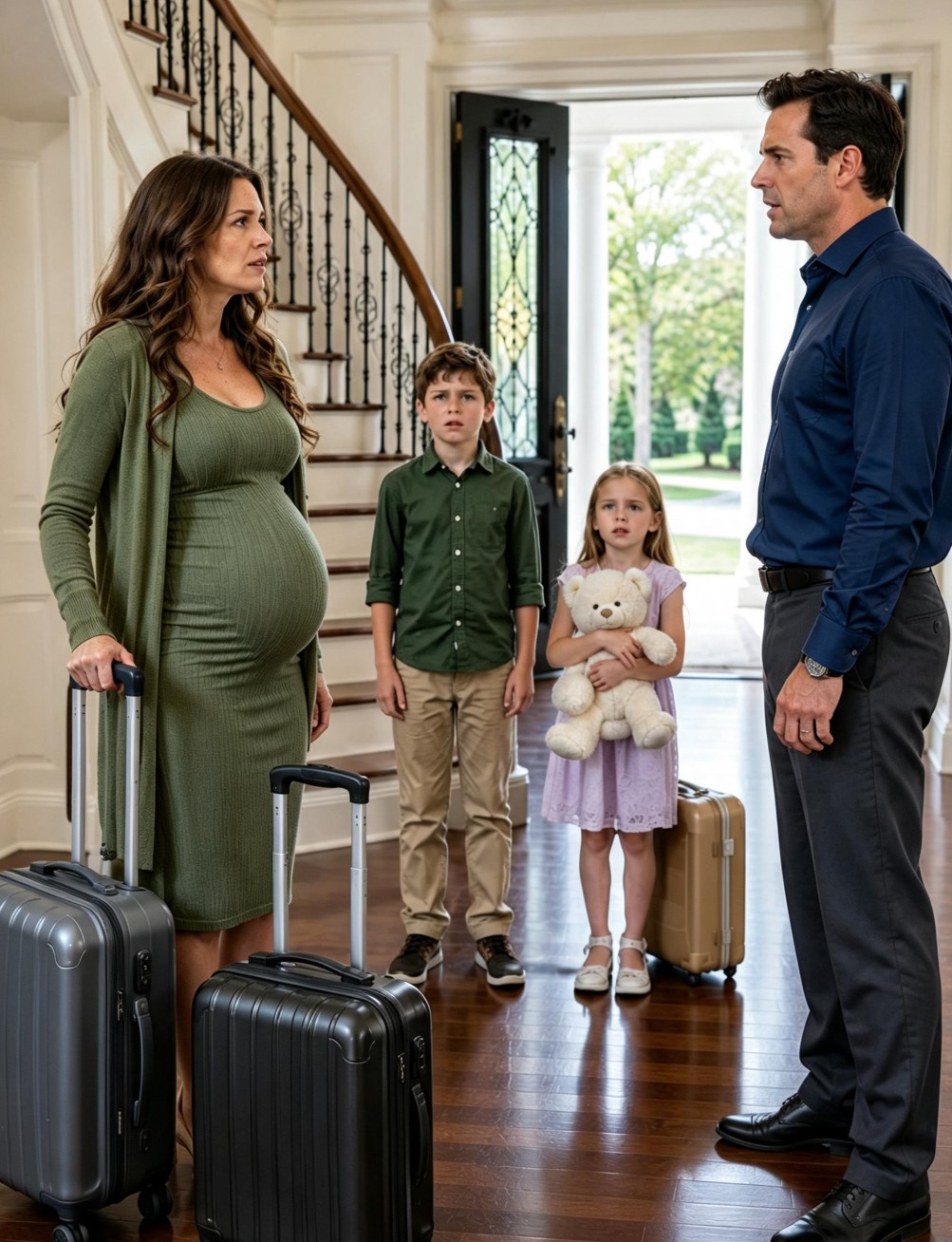
Part 1: The Woman in the Emerald Dress
My husband brought his mistress into our dining room while I was eight months pregnant. Then, right in front of our children, he took her hand and announced that she would be moving into our home.
That was the exact moment I realized the entire evening had been planned long before either of them walked through the doorway.
My name is Charlotte Palmer, and I had been married to Brandon Palmer for nine years.
Our six-year-old son, Lucas, was sitting beside me at the mahogany dining table. Across from us, our four-year-old daughter, Amelia, was complaining that the chicken on her plate had somehow been cut into pieces that were “too square.”
Brandon’s mother, Evelyn Palmer, was visiting for dinner, along with his younger brother, Justin Palmer.
Everything had seemed ordinary.
Until I heard Brandon coming down the hallway.
His firm footsteps were easy to recognize. But this time, another sound followed them.
The sharp click of high heels.
Brandon entered first.
He wore the calm, controlled expression he usually saved for difficult business meetings. But standing directly beside him was Cynthia Vance.
She wore a bright emerald evening dress that looked more suited to an expensive cocktail lounge than a Wednesday night family dinner.
I had seen photographs of Cynthia before.
Brandon had never admitted she existed.
But men who become convinced their wives are financially trapped eventually stop being careful.
The room went completely still.
Evelyn stopped moving her fork.
Justin slowly lowered his glass of bourbon.
Lucas pressed himself closer to my side.
And Brandon looked directly at me.
Only me.
“Charlotte,” he said, his voice completely flat, “I think we should finally stop pretending everything is normal.”
I quietly placed Amelia’s knife beside her plate.
Brandon then reached for Cynthia’s hand.
He took it openly, right there in front of everyone.
Then he announced, “Cynthia and I are together. Since the guest suite is empty, she will be staying here with us for the foreseeable future.”
Amelia looked up from her plate.
She tilted her little head and asked, “Is she staying for dinner?”
Nobody answered.
Cynthia simply gave me a small, confident smile.
Brandon slipped one arm around her waist and waited.
He was waiting for me to explode.
And that waiting mattered.
Because Brandon had spent months creating another version of me for anyone willing to listen.
According to his quiet comments, Charlotte had become too emotional during pregnancy.
Charlotte worried irrationally about money.
Charlotte could no longer handle stress.
Charlotte had become possessive about the children.
And if Brandon ever left her, Charlotte might become unpredictable.
Each statement, by itself, could sound like genuine concern from a tired husband dealing with a pregnant wife.
But together, they created something much more dangerous.
A story.
A story designed to make almost any reaction I had look completely unreasonable.
He had carefully assembled his witnesses.
His mother.
His brother.
His mistress.
And even our children were sitting at the table.
Brandon expected me to finish the story for him by losing control.
Instead, I looked directly at Cynthia.
“That is an interesting decision,” I said.
Her confident smile weakened slightly.
Brandon blinked.
“What is?” he asked.
“Moving Cynthia into this house,” I replied calmly.
His jaw tightened.
“That is everything you have to say?”
“For now, yes,” I answered quietly.
I slowly stood up.
At eight months pregnant, standing quickly was no longer something my body allowed me to do. My back hurt constantly, my ankles were swollen, and the baby seemed determined to use my ribs as a personal punching bag.
I reached one hand toward Lucas and the other toward Amelia.
“Come upstairs with me, please,” I said gently.
Brandon immediately stepped into my path.
“We are not finished talking about this, Charlotte,” he said, raising his voice.
For nine years, I had softened my words before saying them to Brandon.
I apologized before asking questions.
I changed my own memories whenever his version of an event sounded more confident than mine.
That evening, I stopped doing all of it.
“Actually, Brandon, we are finished,” I said firmly.
Then I walked around him.
I didn’t look back.
Downstairs, inside my handbag, a small recorder continued capturing every word.
Brandon had absolutely no idea it was still running.
Part 2: The Suitcases Were Already Packed
Inside Lucas’s bedroom, Amelia climbed onto his bed while clutching her stuffed rabbit.
Lucas remained near the door, staring anxiously at it as though he expected Brandon to come after us.
Then he looked at me.
“Is that woman really going to live here with us, Mom?” he asked quietly.
I carefully lowered myself in front of both children.
I kept my voice soft and steady.
“No, she is not going to live here with us,” I told them. “Because we are leaving tonight.”
Lucas’s eyes widened.
“Is Dad coming with us?”
That simple question hurt more than anything Brandon had said downstairs.
I took a slow breath.
“Your dad and I have serious adult problems,” I explained carefully. “So he will not be coming with us tonight. But none of this is your fault, and neither of you has to fix anything.”
Lucas swallowed.
He looked down at the floor.
Then he asked, “Does he still love us?”
I reached for his little hand.
“Your father loves you very much,” I assured him. “The adults are making choices that are difficult and painful right now, but that does not change how much he loves you.”
Amelia lifted her stuffed rabbit.
“Can Bunny come too?”
Despite everything happening around us, I smiled.
“Bunny absolutely comes with us.”
I stood carefully and walked toward the deep closet beside Lucas’s window.
Then I pulled aside several heavy winter coats.
Behind them were three large suitcases.
Lucas stared at them in shock.
“You already packed our things?”
“I prepared them three weeks ago,” I answered quietly.
I hadn’t known Brandon would bring Cynthia into our dining room that evening.
But I had known for eleven months that there might come a day when leaving safely would require preparation instead of courage alone.
The first suitcase contained my clothes and everything I would need for the baby.
The second contained everything Lucas and Amelia needed.
The third contained documents I refused to risk losing.
Birth certificates.
Passports.
Medical records.
Prenatal paperwork.
Insurance information.
School records.
Tax returns.
Printed financial statements.
Copies of corporate documents I was legally allowed to have.
Photographs of receipts.
And a backup drive.
Before marriage and children, numbers had been my career.
I had worked as a risk analyst for a financial-services firm in Atlanta. My job had been to study patterns, probabilities, exposure, and the difference between concern and actual evidence.
Brandon had once told people that my ability to notice things others missed was one of the reasons he had fallen in love with me.
After Lucas was born, however, Brandon slowly convinced me not to return to work.
At first, he presented it as concern.
Then he talked about childcare being more efficient.
Eventually, he called it better for the overall harmony of our family.
Little by little, almost every practical part of my independence became tied to him.
Our SUV belonged to his company.
Our medical insurance came through his company.
My phone was on his corporate plan.
Most of our household spending went through a credit card he controlled.
Whenever I mentioned working again, Brandon reminded me that his income was more than enough.
“Our children need you at home,” he would say.
And whenever I questioned an account statement, he would smile patiently.
“Charlotte, you’ve been away from finance too long. You don’t understand modern business accounting anymore.”
Eleven months earlier, I had stopped accepting that explanation.
I also stopped waiting until I felt completely certain before taking steps to protect myself.
Fifteen minutes after leaving the dining room, I returned to the staircase.
Both children were with me.
Three suitcases were beside us.
Brandon stood at the bottom of the stairs.
For the first time that evening, his expression looked completely honest.
He was shocked.
“What exactly do you think you are doing?” he demanded, staring at the luggage.
“This is a departure,” I said simply.
He laughed too quickly.
“Come on, Charlotte. You’re eight months pregnant, completely unemployed, and you’re trying to take two small children somewhere in the middle of the night.”
I continued toward the front door.
I didn’t slow down.
His voice became sharper.
“Every credit card you use can be canceled in minutes!”
I kept walking.
“The SUV belongs to my company!”
I reached the front door.
“Your phone is on my corporate plan!”
I stepped onto the porch.
“Your health insurance comes directly through my business!”
His threats came one after another.
Outside, a dark sedan was already waiting.
Its engine was running.
Brandon followed us onto the porch.
“Where do you think you can possibly go without my money?” he shouted.
I secured Amelia inside the car.
Lucas climbed in beside her.
Then I turned around and looked at my husband.
Behind all his anger, I finally saw the belief that had supported our entire marriage.
Brandon truly believed I could never afford to leave him.
I opened the front passenger door.
Then I looked him directly in the eyes.
“You should call your attorney, Brandon.”
For the first time that night, Brandon stopped speaking completely.
Part 3: Eleven Months of Quiet Preparation
Forty minutes later, the sedan entered the secure underground garage of an apartment building in downtown Baltimore.
My family-law attorney, Victoria Sterling, was waiting beside the elevator.
She had been quietly representing me for eleven months.
When she saw me step out of the vehicle, she said three words that almost broke the composure I had managed to hold together all night.
“You made it.”
I gripped the car door tightly as she reached out to steady my arm.
“He brought Cynthia into the house right in front of the children,” I whispered. “He told everyone she was moving into the guest suite.”
Victoria’s expression immediately hardened.
“Did you manage to record it?”
I handed her the small recording device.
“Everything is on here,” I said. “Including all his threats about the credit cards, the car, my phone, and our health insurance.”
She slowly exhaled.
“Good,” she said. “Now you don’t have to rely only on your memory to prove those threats.”
That distinction mattered more than I could explain.
Brandon had spent years making me question my own memory while presenting his version of events with absolute confidence.
My quiet preparation had started eleven months earlier with something completely ordinary.
Brandon had told me we needed to delay replacing a leaking section of our roof because one of his major clients had paid late and cash flow was tight.
That same week, I found a restaurant receipt inside a suit jacket he had asked me to take to the cleaners.
It was for dinner for two.
The bill was $386.
The restaurant was inside a luxury hotel.
Then I found another receipt.
And another.
Instead of becoming obsessed with each individual transaction, I did what my old profession had trained me to do.
I looked for patterns.
I noticed that some of Brandon’s business trips lasted one night longer than the itineraries he gave me.
Hotel parking charges matched perfectly with expensive dinners.
Money was moving through familiar accounts before appearing again inside entities I didn’t recognize.
When I questioned one particular transfer, Brandon gently took the statement from my hands.
Then he kissed my forehead.
“Charlotte, you haven’t worked in finance for years,” he said soothingly. “You’re stressing yourself over things you don’t understand anymore.”
The word “anymore” stayed in my mind for weeks.
A month later, I called Victoria from a prepaid phone outside a public library.
I told her Brandon had never hit me.
He had never physically locked me inside the house.
But somehow, I felt as though even breathing independently required his permission.
Victoria listened quietly.
Then she said, “Financial control is still control, Charlotte.”
Over the next ten months, I preserved only information I was legally entitled to access.
Household statements addressed to me.
Joint tax documents.
Records left in shared spaces.
Text messages.
Receipts.
Dates.
I never hacked into accounts.
I never stole passwords.
Victoria arranged for a forensic accountant to examine the records we could lawfully obtain.
The analysis revealed enough unexplained transfers to create serious concerns that marital assets could be moved beyond our reach once Brandon discovered that I planned to file for divorce.
Three days before Cynthia walked into my dining room, Victoria filed the divorce petition in court.
That very morning, a judge issued a temporary order preventing identified marital funds from being transferred, concealed, or dissipated while the matter was being reviewed.
The order did not declare Brandon guilty of anything.
It simply preserved our shared assets.
And that was exactly what I needed to protect our future.
Part 4: The Phone Call He Never Expected
Inside the temporary apartment, Lucas stood beside the window, watching the city lights.
Amelia, meanwhile, immediately wanted to know whether anyone had remembered to bring dinner.
Victoria had already ordered food for us.
While we were setting the table, her phone rang.
She listened for several minutes.
Then she looked at me.
“Brandon’s attorney has officially been notified,” she said. “And all the relevant banks have received the asset-preservation order.”
Almost immediately, my phone lit up.
Brandon’s name appeared across the screen.
Then the messages began arriving one after another.
“Bring my children home right now.”
“You cannot hide them somewhere I do not know about.”
“Answer your phone immediately, Charlotte.”
“I will shut down every card tonight if you continue playing this game.”
Then came the most useful message of all.
“The ridiculous way you are behaving right now proves exactly what I have been telling everyone about your mental state.”
Victoria read the message over my shoulder.
“Screenshot that immediately,” she said. “And preserve the original message.”
My phone rang again.
And again.
And again.
By the fifth call, Victoria reminded me that I did not have to answer.
That was exactly why I decided to pick up.
I turned on the speakerphone.
Brandon’s voice came through immediately.
His usual smooth confidence was gone.
“Charlotte, what on earth did you just do?” he demanded.
“I protected the financial assets that belong to our family,” I answered calmly.
“Did you seriously freeze my corporate accounts?” he shouted.
“I filed for divorce, and the court entered a temporary preservation order affecting identified funds. You should speak with your attorney about the details.”
Silence.
For several long seconds, he said nothing.
Then he asked, almost in disbelief, “You filed for divorce?”
“Three days ago.”
Brandon had believed bringing Cynthia to dinner was his opening move.
He had no idea that I was already several moves ahead of him.
“Charlotte, listen to me right now—” he began.
“Call your attorney, Brandon.”
Then I ended the call.
The moment the line went dead, my hands began shaking uncontrollably.
But being emotional did not mean I regretted anything.
Not one thing.
Part 5: The Story Brandon Had Prepared
Two days later, Brandon responded with a formal court filing.
In it, he described me as emotionally unstable during pregnancy.
He called me irrational about our family finances.
Jealous.
Suspicious.
Unemployed.
Dependent.
And prone to extreme overreactions.
He claimed I had suddenly taken the children from our family home after a normal marital discussion.
He asked the court to order Lucas and Amelia returned immediately while temporary custody was evaluated.
He also asked the court to loosen the financial restrictions so his business could continue operating normally.
Victoria read the documents with me in her office.
“He wanted you to explode at dinner,” she explained. “He needed witnesses to support this exact story.”
“Instead, he recorded himself threatening to take away my credit cards, transportation, medical insurance, and phone service,” I said.
“Exactly,” Victoria replied. “But remember, one recording does not automatically decide a custody case. Courts consider the overall pattern, credibility, parenting history, and the children’s best interests.”
The temporary hearing took place the following week in a formal courtroom.
Brandon arrived wearing a flawless navy suit.
Cynthia sat just three seats behind him in the gallery.
His attorney presented him as a deeply concerned father, a successful business owner, and the family’s sole financial provider.
According to their version, his pregnant wife had suddenly abandoned their home for no reason.
When it was our turn, Victoria calmly described what had happened at dinner.
She explained how Brandon had arrived holding Cynthia’s hand.
She described his announcement that Cynthia would be moving into the guest suite.
She explained how I had then left the house with the children.
Then she played the recording.
Brandon’s voice filled the quiet courtroom.
“Every credit card you use can be canceled in minutes.”
Then:
“The SUV belongs to my company.”
Then:
“Your health insurance comes directly through my business.”
And finally:
“Where do you think you can possibly go without my money?”
The courtroom became completely silent.
When I took the stand, Victoria asked why my suitcases had already been packed three weeks before that night.
“Because I knew I might eventually need to leave safely,” I testified. “I just didn’t know what Brandon planned for that specific night.”
Then she asked what financial control had meant in my everyday life, especially since I had lived in a large home and had access to expensive things.
“It meant I could use resources without controlling whether I was allowed to keep them,” I explained to the judge. “I had a car until he reminded me that it belonged to his company. I had insurance until he threatened to revoke it. I had credit until he threatened to cancel it.”
Brandon’s attorney questioned me during cross-examination.
He emphasized that all my material needs had been provided throughout our marriage.
I agreed.
“Yes.”
He looked at me.
“If all your needs were met, why do you still claim you were financially controlled?”
I answered steadily.
“Because receiving access to things is not the same as having control over whether you are allowed to keep them.”
The judge did not grant everything Victoria requested in our initial motion.
Brandon remained the children’s father and received scheduled parenting time.
The court ruled that cruelty toward me did not automatically prove that he was unsafe around the children.
However, Lucas and Amelia were not ordered back to the marital home.
Their temporary primary residence remained with me in the apartment.
Brandon was also ordered to maintain their current medical coverage and pay substantial financial support while the legal proceedings continued.
The asset-preservation order remained in place with strict oversight of business expenses.
And Cynthia was specifically barred from participating in Brandon’s parenting time while the temporary order remained active.
Outside the courtroom, in the hallway, Brandon approached me.
His face was furious.
“You are completely destroying everything we built,” he spat.
“You brought another woman into our home in front of our children and announced that she was moving into our space,” I replied calmly.
“Our marriage was already over anyway!” he snapped defensively.
“Then you should have had the courage to end it honestly.”
He stared at me.
“You would never have left me on your own.”
There it was.
He had finally said it out loud.
It wasn’t simply that he believed I would stay.
It wasn’t that he was uncertain about my feelings.
He believed my financial dependence guaranteed my complete submission.
“That assumption was your biggest mistake,” I said quietly.
Then I turned away.
Part 6: When the Numbers Became Evidence
The following months were a strange combination of ordinary motherhood and intense divorce litigation.
I went to my prenatal appointments.
I packed school lunches.
I answered long discovery requests from the lawyers.
I helped Amelia search for missing socks.
I reviewed complicated financial schedules.
I read Lucas bedtime stories.
And I spent hours working with our forensic accountant.
Over time, the financial analysis became extremely detailed.
It showed that some of Brandon’s transfers were legitimate business expenses.
Others clearly were not.
That difference was important.
We weren’t trying to make every unfamiliar transaction look suspicious.
We were identifying specific movements of money that needed clear legal explanations.
Certain funds connected to our marital assets had repeatedly moved into private entities shortly after I questioned Brandon about financial decisions, mentioned returning to work, or asked for direct access to our accounts.
The timing alone did not prove illegal intent.
But combined with inconsistent corporate accounting and hidden account structures, it provided enough reason for continued judicial oversight.
The preservation order had also done something extremely important.
It stopped those financial records from disappearing.
Eventually, Evelyn asked me to meet her privately at a quiet café.
During our conversation, she admitted that she had known about Cynthia for several months before that terrible dinner.
“Brandon told me your marriage was essentially over,” Evelyn said, staring down at her untouched cup of tea. “He said you were staying only because of the pregnancy and the children. He also told me you knew he was seeing someone else.”
I looked at her.
“Why did you choose to believe that version of the story?”
She was quiet for a moment.
“Because he is my son, Charlotte,” she finally admitted. “And I desperately wanted his explanation to be the truth.”
She apologized sincerely for sitting silently at our dining table that night.
But I did not immediately forgive her.
“For nine years, I translated Brandon’s selfish behavior into softer language because it made living with him easier,” I told her. “I’m not doing that anymore. And I don’t need anyone else doing it for me either.”
Evelyn slowly nodded.
She accepted my boundary.
Later in the proceedings, Justin was called to give a formal deposition about what had happened at dinner.
He honestly confirmed that Brandon had arrived holding Cynthia’s hand.
He confirmed that Brandon announced Cynthia would be moving into the guest suite.
And he confirmed that Brandon looked completely shocked when I came downstairs with packed luggage.
Victoria then asked Justin to describe Brandon’s exact expression at that moment.
Justin thought carefully before answering.
“He looked like a man who thought he knew exactly what was going to happen,” Justin said under oath, “and then suddenly realized he had no control over the situation at all.”
That one sentence captured the entire structure of my marriage.
Brandon controlled the money.
Therefore, Charlotte would stay.
Brandon humiliated Charlotte.
Therefore, Charlotte would collapse.
Charlotte collapsed.
Therefore, Brandon could present himself as the patient, reasonable husband dealing with an unstable wife.
His entire plan depended on my reaction.
But the plan failed because I refused to follow his script.
Part 7: A Life That Belonged to Me
The divorce was eventually finalized after months of detailed negotiations.
The financial issues were resolved through a court-approved settlement after experts fully examined the disputed asset transfers.
Brandon kept his main business interests, but he was required to make a significant monetary payout.
I received my legal share of the marital property, along with independent financial resources of my own.
Our final parenting arrangement reflected the reality that we were both still parents to our children.
I never tried to erase Brandon from Lucas and Amelia’s lives.
My goal had never been revenge.
I wanted stability.
Clear boundaries.
And the freedom to disagree with Brandon without having basic living expenses used against me.
Cynthia eventually disappeared from my life so completely that I stopped caring whether she and Brandon were still together.
Their relationship was no longer my concern.
Six months after the divorce decree was signed, I was officially working again as a senior financial consultant.
I hadn’t returned to work to prove something to the world about motherhood.
I returned because I genuinely missed using my skills.
I missed studying complex patterns.
Risk models.
Data.
Numbers.
My laptop now sat beside a sunlit window in my new downtown Baltimore apartment.
On the screen were detailed financial reports for a corporate client whose risk exposure I was analyzing.
My new baby girl, Clara, had arrived healthy and safe.
Lucas and Amelia had slowly adjusted to living between two different households.
Our daily routine was not as polished as it had been before.
But it was much more honest.
One afternoon, Brandon and I got into a sharp argument beside our cars in a parking lot.
We were discussing transportation arrangements for one of Lucas’s upcoming school events.
For a few minutes, the old machinery of our marriage came back.
The quick accusation.
The automatic defense.
The subtle twisting of facts.
And his clear expectation that I would eventually apologize just to keep the peace.
Then, halfway through his sentence, I stopped speaking.
“I’m not going to continue this conversation in this format,” I said calmly.
Brandon laughed bitterly.
“So now you just walk away whenever you hear something you don’t like?”
“When a conversation becomes completely unproductive, yes,” I replied. “I walk away.”
I opened my car door.
Something changed in his expression.
His defensive posture dropped.
For a moment, I saw something that looked almost like genuine vulnerability.
“Do you actually need anything from me anymore, Charlotte?” he asked softly.
That question contained more honesty than almost anything Brandon had said during our nine years together.
I turned toward him.
“We share three children together, Brandon, so yes, I need you.”
He looked at me.
“I need you to show up on time when you say you will. I need you to parent our children well. And I need you to communicate respectfully whenever a decision affects both of us.”
He looked down at the pavement.
“You know that’s not what I meant,” he muttered.
“I know,” I said gently.
He wanted me to say that I was completely self-sufficient.
That I didn’t need him at all.
But total independence had never been the real issue.
Freedom was.
“I’m simply no longer afraid that losing access to you means losing access to my own life,” I told him quietly.
This time, Brandon didn’t block my path.
He didn’t try to stop me from leaving.
Sometimes I still think about that Wednesday evening in our old dining room.
I don’t think about Cynthia’s emerald dress.
I don’t think about Brandon’s arm around her waist.
What I remember most is the look on his face while he waited for my reaction.
He had expected to see the frightened, dependent, unstable woman he had spent months describing to everyone else.
Instead, I wiped dinner crumbs from my daughter’s cheek.
I led my children upstairs.
Then I came back down with three packed suitcases.
The divorce petition mattered.
The asset-preservation order mattered.
The recording mattered.
The courtroom testimony mattered.
All of those things mattered immensely.
But Brandon’s master plan had actually failed long before any of those legal steps.
It failed the exact moment I refused to play the victim he had carefully written for me.
My phone now belongs completely to me.
My car belongs to me.
The money in my bank account is mine to manage.
And the analytical work waiting on my laptop belongs to the career I chose to rebuild with my own hands.
My life isn’t effortless.
It can be expensive.
Exhausting.
Complicated.
And sometimes intimidating.
But it belongs completely to me.
For nine years, Brandon had slowly taught me that walking away from him would cost me everything.
In the end, I discovered the one truth he had been most afraid I would learn.
I never needed his permission to leave my marriage.
I only needed proper preparation.
And by the night he brought his mistress into our home, I already had everything I needed.
THE END.
