
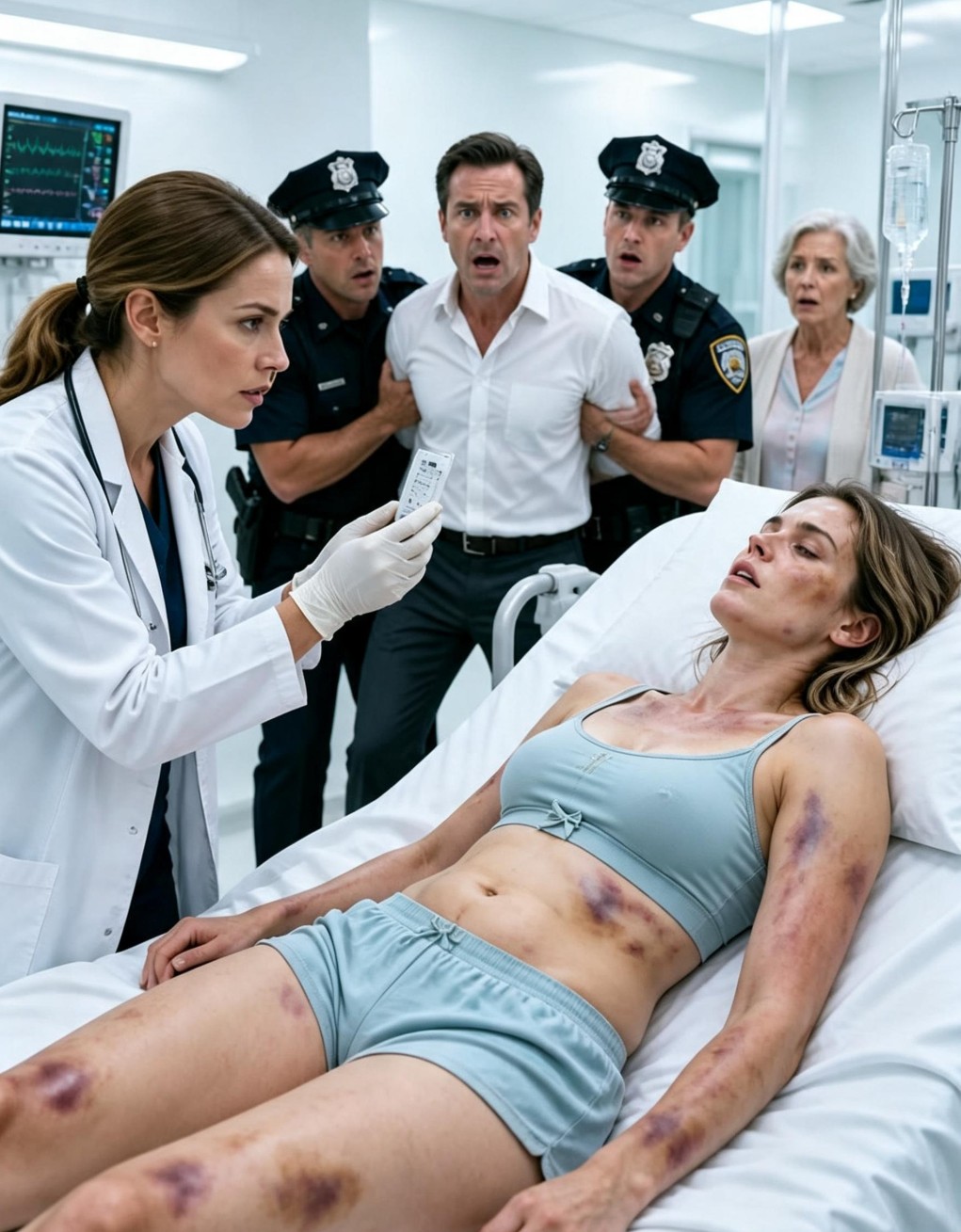
Part 1:
The last thing I remembered was Beckett’s hand tightening around my throat.
His fingers were crushing my neck, making it impossible to breathe. My vision had already started to blur when I heard his mother, Mary, standing nearby.
Her voice was calm.
Almost disturbingly calm.
“Not the face this time.”
Then everything went black.
The next thing I knew, cold rain was striking my eyelids.
I was lying on a gurney outside the emergency entrance of Fairview General Hospital. Rainwater ran down my face while paramedics rushed around me. Every breath felt like a knife cutting through my ribs.
I tried to move, but my body refused to cooperate.
My left eye was swollen completely shut. My ribs screamed whenever I inhaled. My throat felt as if someone had wrapped a steel cable around it.
And beneath my collarbone, something sticky was holding a tiny plastic square against my skin.
I knew exactly what it was.
The recorder.
I had taped it there myself before I confronted Beckett and Mary that night.
It was still attached to me.
Beckett stood beneath the ambulance canopy several feet away, looking perfectly dry inside his expensive dark coat.
Even now, he had somehow managed to look prepared.
One sleeve of his coat was deliberately torn.
He was already building his story.
His mother, Mary, clung to his arm like a grieving witness who had just watched her son suffer an unimaginable tragedy.
“She becomes violent whenever she is feeling unstable,” Mary told the police officer standing nearby.
Her voice was soft and filled with fake concern.
Then she pointed toward me.
“Those marks around her neck are self-inflicted. She does that to herself whenever she wants attention.”
She shook her head sadly, as though she were exhausted from years of dealing with me.
Beckett looked down at me with an expression of deep sorrow.
“I begged her to get help so many times,” he murmured.
It was a perfect performance.
If I had not known the truth, I might have believed him too.
Officer Thompson knelt beside my gurney.
“Ma’am, can you tell me what happened tonight?”
I opened my mouth.
I tried to scream.
I tried to tell him everything.
But no sound came out.
My throat was too badly damaged.
Beckett noticed.
And the moment Officer Thompson looked away from him, Beckett smiled.
It was not a sad smile.
It was a victorious one.
He thought he had won.
He thought I was helpless.
He had no idea that the truth was still attached to my body.
Inside the trauma bay, Dr. Hannah Scott immediately took control.
“Let’s get her vitals.”
Nurses moved quickly around me.
They checked my blood pressure and oxygen levels. They examined my ribs and documented the injuries.
Then they carefully examined my neck.
Finger-shaped bruises circled my throat like a dark, ugly necklace.
Dr. Scott’s expression became serious.
“Possible strangulation,” she said.
One of the nurses nodded and began documenting the injuries.
As the medical team cut away my damaged blouse and prepared me for treatment, Dr. Scott noticed something beneath my collarbone.
She stopped.
“What is this thing?”
She carefully looked closer.
A tiny digital recorder was still taped against my skin.
It was no larger than a coin.
For one second, Beckett’s face changed.
His expression went completely blank.
The sadness disappeared.
The fear underneath it showed itself.
Then the mask returned.
Dr. Scott carefully removed the recorder.
She did not simply place it on a nearby table.
She immediately told the nurse to preserve it as potential evidence.
The device was photographed before removal, including its position beneath my collarbone. The nurse documented the condition in which it had been found.
Then the recorder was placed into an evidence container and sealed.
The hospital recorded the date, time, location, and identity of the person who recovered it.
Officer Thompson was notified that a possible recording device had been recovered from me during emergency treatment.
Once my immediate medical treatment was complete and the evidence paperwork had been prepared, the sealed package was formally handed over to Officer Thompson.
He signed for it.
The hospital kept a record of the transfer.
From that moment forward, the police controlled the physical device.
That was important.
The original recorder would remain sealed and protected while investigators worked from a forensic copy of its contents.
If Beckett’s lawyers later claimed that someone had planted the device or changed the recording, investigators would be able to show exactly how it had traveled from my body to the hospital, and from the hospital to police custody.
Before Dr. Scott returned to treating me, she looked at my face.
“Did you put this here yourself?”
I managed the smallest nod.
That tiny movement hurt almost as much as breathing.
But I wanted her to understand.
The recorder had been my insurance policy.
I had prepared it before confronting Beckett and Mary that night. It had been designed to activate when pressure was applied to its outer casing.
I had taped it beneath my blouse because I knew Beckett controlled the security cameras in our house.
I also knew Mary regularly checked my private phone whenever she could get her hands on it.
I needed something they could not easily find or destroy.
If Beckett and Mary merely threatened me, the recording would give my best friend enough evidence to help me.
If they attacked me, the truth would travel with my body wherever the ambulance took me.
And that was exactly what had happened.
Three weeks earlier, I had discovered something that changed everything.
I had been using Beckett’s laptop to look for a financial document when I found a hidden folder buried several layers deep in the computer.
Inside were forged psychiatric reports.
There were photographs of my medication bottles.
There were notes about my behavior.
And there was a draft petition asking a court to declare me mentally incompetent.
They had been planning everything.
Beckett and Mary wanted to take control of the software company I had inherited from my late father.
Their plan was simple.
They needed to convince a court that I was mentally unstable, dangerous, and incapable of managing my own affairs.
Once that happened, they could seek control over my assets and voting shares.
What they did not know was that they had chosen the wrong person to deceive.
I had spent ten years building the cybersecurity division of that company from the ground up.
I understood digital trails.
I understood backups.
And I understood how people behaved when they thought they had successfully hidden something.
Every file I had discovered on Beckett’s laptop had already been copied.
The copies were stored on an encrypted server controlled by my attorney, Anne Freeman.
Every time someone opened or changed one of those files, the system created another record.
Beckett and Mary had been careful.
But they had not been careful enough.
And they certainly had not known about the recorder.
Back outside the trauma bay, Officer Thompson noticed Beckett slowly moving toward the exit doors.
“Sir,” he said sharply, “please stay exactly where you are.”
Beckett stopped.
Mary lifted her chin.
“My son is the true victim here.”
Dr. Scott looked at the bruises around my throat.
Then she looked at the sealed evidence container containing the recorder.
“We will let the physical evidence decide who the victim is,” she said calmly.
For the first time that night, Beckett stopped pretending to cry.
Part 2:
By the time the sun began to rise, Beckett had turned the quiet hospital corridor into his personal stage.
He spoke to detectives.
He showed them scratches on his wrist.
He produced a written statement from Mary.
And he repeated the same story over and over.
According to Beckett, I had attacked him after discovering that he wanted a divorce.
He claimed he had only defended himself.
Mary played her part perfectly.
She dabbed at her completely dry eyes with a silk handkerchief.
“Ella has always been jealous, obsessive, and completely unstable,” she told the detectives.
“She has been getting worse for months.”
From my hospital bed, I watched them through the glass.
They were performing their little play.
I had a neck brace around my throat and two cracked ribs.
Medication made my head heavy, and every ceiling tile seemed to swim whenever I opened my eyes.
But something inside me had changed.
The fear had finally burned itself out.
In its place was something colder.
Something stronger.
Determination.
I had spent too many years allowing Beckett to convince me that I needed him.
Now I understood that he had needed me.
He needed my money.
He needed my company.
He needed my reputation.
And most of all, he needed me to remain silent.
That was the one thing I could no longer give him.
My attorney, Anne Freeman, arrived before the police had finished their first full interview with Beckett.
She entered my room, closed the door behind her, and placed her leather briefcase beside my bed.
Then she leaned toward me.
“The server caught everything they downloaded earlier,” she whispered.
I looked at her through my one open eye.
“What?”
“The fake medical evaluations. The asset transfer documents. The internal company files.”
She paused.
“And the emails discussing tonight’s assault.”
My heart began beating faster.
“What about the recorder?” I rasped.
My voice sounded like gravel.
Anne gave me a small nod.
“The hospital transferred the original to Officer Thompson last night. The evidence log shows exactly when it was removed from you, sealed, and handed over.”
She opened her briefcase.
“The police have kept the original sealed. Their forensic team is working from a verified copy, so the original remains untouched.”
I closed my eyes.
For the first time since the attack, I allowed myself to breathe.
“Let them keep talking as much as they want,” I whispered.
And they did.
Outside my room, Beckett was already calling members of the company’s board.
He was so certain I would be arrested that he had already started planning what would happen next.
He told detectives I had been hallucinating for months.
He claimed my mental health had been deteriorating.
Mary even produced a bottle of antipsychotic medication with my name printed clearly on the label.
It looked convincing.
Almost perfect.
Except for one small problem.
The physician listed on the prescription had retired four years earlier.
Anne photographed the bottle before police sealed it into an evidence bag.
Then Beckett made the biggest mistake of his life.
Believing that I would soon be arrested and removed from control of my company, he called an emergency board meeting.
He presented the forged incompetency petition.
He told the directors that I was medically incapable of running the company.
Then he demanded temporary control of my voting shares.
“The business is in immediate danger under her leadership,” he announced.
The directors listened without saying much.
Beckett misunderstood their silence.
He thought they were afraid.
He thought they were surrendering.
He had no idea that Anne had already contacted the board chair and provided the evidence that could legally be shared at that stage.
The meeting continued.
Beckett appeared on the conference screen from the hospital corridor.
“My wife is medically unfit,” he declared.
“As her husband, I am the only responsible person available to lead the company.”
Anne placed her phone beside my pillow so I could hear everything.
Then Samuel Wilson, the board chair, adjusted his glasses.
“Mr. Vale,” he said, “are you aware that Mrs. Vale amended the corporate bylaws six months ago?”
Beckett frowned.
“She never told me anything about that.”
Samuel’s voice remained calm.
“She was not required to tell you anything.”
Beckett looked confused.
Samuel continued.
“Under the amended bylaws, any attempt to obtain control of the company through coercion, fraud, or a false incapacity claim automatically suspends the claimant’s access to company systems and triggers an independent investigation.”
Silence filled the meeting.
Then Mary’s voice suddenly came through the speaker.
“That is completely absurd!”
Samuel did not even react.
“Your building credentials have been revoked,” he told Beckett. “Security is currently preserving your office computer and relevant company equipment.”
Beckett stared at the screen.
His face turned red.
Then he disconnected the call.
He was furious.
Ten minutes later, he stormed into my hospital room.
The nurse had warned him that he was not allowed to enter without permission, but Beckett ignored her.
Mary followed him inside and firmly shut the door behind them.
The room became silent.
Beckett stood beside my bed.
His face no longer showed sadness.
There was no grief.
No concern.
Only rage.
“You think a tiny recording is going to save you?” he hissed.
I stared at him.
“You were unconscious when I found you,” he continued. “Nothing connects me to those bruises.”
He leaned closer.
“You have no idea what the police can actually prove.”
Mary moved beside him.
Her heavy perfume filled the room.
“Withdraw your accusations,” she whispered, “and sign over temporary control of the company.”
She smiled.
“If you cooperate, we might still tell the court that you need treatment instead of prison.”
I looked past them.
Above the hospital door was a small security camera.
A tiny indicator light was blinking.
Then I smiled.
“You should have checked whether this particular camera system records audio,” I said calmly.
Beckett froze.
His eyes moved toward the camera.
The color drained from his face.
He suddenly understood.
The door opened behind him.
Officer Thompson stood there with two other detectives.
Thompson looked directly at Beckett.
“Actually,” he said, “she should thank you for repeating that threat out loud.”
Beckett said nothing.
For once, there was no clever story.
No performance.
No explanation.
Only silence.
Part 3:
The next several weeks were a blur of doctors, investigators, lawyers, and evidence.
My physical injuries slowly began to heal.
My ribs needed time.
My throat needed even longer.
But while my body recovered, investigators were rebuilding the entire case against Beckett and Mary.
The recorder became one of the most important pieces of evidence.
The original device remained sealed in police evidence.
Investigators did not need to repeatedly handle it to listen to what it contained.
Instead, digital forensics created a verified forensic copy of the recording.
They documented the process carefully.
The original remained preserved while the investigators examined the copy.
The forensic examination showed that the recording had not been edited or manipulated.
Investigators also compared the voices on the recording with known samples of Beckett’s and Mary’s voices.
The results supported what everyone already feared.
The voices belonged to them.
The recording had captured the attack and their conversation about the plan.
But the recorder was not the only evidence.
Detectives had the forged psychiatric reports.
They had the fake prescription.
They had the stolen emails.
They had the financial documents.
They had the hospital-room threat.
And they had security footage showing Beckett dragging my unconscious body from his vehicle before leaving me outside in the rain.
Digital forensics recovered even more evidence from Mary’s tablet.
Her search history included questions about how to fake a psychotic episode.
There were searches about how long fingerprints remained visible on human skin.
And there were searches asking whether a spouse could inherit or control voting rights after the other spouse was institutionalized.
Every search made the plan clearer.
They had not acted in a moment of panic.
They had researched it.
They had prepared for it.
And they had expected me to disappear into their story.
The investigators eventually uncovered the full chain of events.
Beckett and Mary had planned to use the forged psychiatric records to make me appear mentally incompetent.
They intended to use the assault to create visible injuries while claiming those injuries were caused by me during an attack.
Then they planned to use my supposed mental instability as justification for taking control of my company.
They believed that once I was declared incapable of managing my affairs, Beckett could position himself as the person who would control my voting shares and finances.
They had prepared financial documents to support that plan.
They had prepared lies to support the injuries.
They had even prepared a story about my supposed mental deterioration.
Everything was connected.
And every connection led back to them.
Their lawyers fought hard to suppress the recorder.
They argued that the device should not be admitted into evidence.
But the prosecution could document the entire physical history of the device.
Dr. Scott had discovered it attached to my body during emergency treatment.
The hospital had photographed it before removing it.
A nurse had sealed it and documented the handoff.
Officer Thompson had signed for the sealed package and entered it into police evidence.
The forensic unit had created and examined a verified copy while the original remained sealed.
Every transfer had been documented.
The defense could challenge the evidence.
They could question witnesses.
They could argue about the circumstances.
But there was no unexplained gap in the recorder’s physical history.
Eventually, the court ruled that the recording could be used as evidence.
Beckett and Mary realized they were running out of places to hide.
They were arrested and formally charged with aggravated assault, strangulation, conspiracy, evidence tampering, and attempted financial fraud.
Mary faced charges for conspiracy, forgery, false reporting, and obstruction of justice.
Their expensive attorneys immediately began trying to blame each other.
Beckett’s lawyer argued that Mary had manipulated her son.
Mary’s lawyer claimed Beckett had created the entire scheme.
But the evidence told a different story.
They had both participated.
They had both lied.
And they had both believed they could control what happened to me.
They were wrong.
Part 4:
The criminal case did not end with the arrests.
There were months of hearings, motions, evidence reviews, and negotiations.
The defense attorneys challenged the prosecution’s evidence.
The court reviewed the arguments concerning the recorder and other digital evidence.
Investigators continued examining financial records and electronic files.
Meanwhile, my divorce proceedings moved forward separately.
I wanted nothing more to do with Beckett.
But I knew the criminal case had to follow its own process.
Eventually, the evidence became overwhelming.
The prosecution presented the forged psychiatric records.
They presented the financial documents.
They presented the recovered emails.
They presented the security footage.
They presented the forensic evidence from the recorder.
And they presented the evidence showing that Beckett and Mary had tried to build an entire false story around me.
When the recorder was played in court, the original device remained securely stored as evidence.
The court was not relying on a random audio file from someone’s phone.
The forensic copy had been authenticated against the preserved original.
The courtroom became completely silent.
First came Beckett’s voice.
Impatient.
Cold.
“Sign the transfer papers now.”
Then my voice.
“No. I will not do that.”
There was a pause.
A chair scraped against the floor.
Then came the sound of a heavy blow.
My gasp of pain followed.
And then Mary spoke.
“Hold her still so the bruises show up better.”
Nobody moved.
Nobody interrupted the recording.
Mary’s voice continued.
“The police already have the fake psychiatric file.”
Then Beckett laughed.
“By tomorrow, she will be locked away,” he said. “And the company will finally be ours.”
The recording ended.
For several seconds, nobody said anything.
The words hung in the courtroom.
There was no longer any room for Beckett’s carefully prepared story.
The prosecution had shown that the attack was not an accident.
The evidence showed planning.
The evidence showed deception.
And the evidence showed that the goal had never simply been to hurt me.
They wanted my company.
They wanted my money.
They wanted control.
And they believed they could take all of it by convincing the world that I was incapable of defending myself.
The court ultimately found Beckett guilty of the major charges against him, while Mary was convicted for her role in the conspiracy and related offenses.
Their attorneys continued asking the court for leniency.
But sentencing was scheduled only after the convictions and the required post-conviction proceedings had been completed.
By then, almost six months had passed since the night of the attack.
Part 5:
Six months after the attack, and after the criminal proceedings had reached the sentencing stage, I walked into the courtroom.
I did not wear a neck brace.
I did not need a cane.
There were no visible medical supports.
The bruises around my neck had long disappeared.
My ribs had healed.
But a thin white scar remained across my collarbone.
It was the mark left behind by the recorder that had been taped against my skin that terrible night.
Beckett noticed it immediately.
He stared at the tiny scar as though that little line had personally destroyed his entire life.
Perhaps, in a way, it had.
His attorney stood and asked the judge for mercy.
He described Beckett as a frightened husband who had made terrible mistakes under extreme emotional pressure.
I almost laughed.
Mistakes.
That was the word they wanted everyone to believe.
The judge looked directly at me.
“Mrs. Vale, would you like to speak to the court?”
I slowly stood.
Then I turned toward Beckett.
He would not look at me.
I took a breath.
“He did not make one mistake,” I said.
My voice was steady.
“He made hundreds of choices.”
The courtroom became completely silent.
“He forged medical records. He rehearsed elaborate lies. He recruited his mother. He studied my finances. He prepared documents to take control of my company.”
I looked at him.
“And he calculated exactly where to hurt me so that strangers would doubt what they saw with their own eyes.”
Beckett lowered his head.
“He truly believed fear would make me surrender my own voice,” I continued.
I paused.
“He was right about one thing.”
I looked toward the judge.
“I was afraid.”
Nobody moved.
“I was terrified that I might not survive that night.”
My fingers tightened around the edge of the podium.
“That is why I recorded him. I recorded him because I believed I might die.”
I looked at Beckett one final time.
“But fear is not consent.”
I turned toward the judge.
“Silence is not weakness.”
Then I looked back at my former husband.
“And marriage is not ownership.”
Beckett finally raised his eyes.
For the first time, I saw something in them that had not been there before.
Fear.
Mary suddenly jumped to her feet.
“She destroyed our entire family!” she screamed.
The judge immediately struck the gavel.
“Mrs. Vale, you will sit down.”
Mary continued crying as she returned to her chair.
I looked directly at her.
“No,” I said.
Her eyes met mine.
“I simply stopped you from destroying me.”
The judge sentenced Beckett to fourteen years in state prison.
Mary received seven years for her role in the conspiracy.
The financial consequences were just as devastating.
Restitution orders and civil judgments consumed the house they had expected to take from me.
Their private investment accounts were seized.
Almost everything purchased with money Beckett had secretly diverted from my company was recovered.
The company survived.
So did I.
I divorced Beckett before the sentencing process was even complete.
I never looked back.
Part 6:
After the sentencing and the completion of the criminal proceedings, the recorder remained in police evidence for a little while longer.
That mattered to me.
It had already been used as evidence in the case, but it could not simply be handed back to me the moment the judge announced the sentence.
The court and investigators first had to complete the required evidence-release process.
The original device had to be cleared for return.
The police evidence unit kept it securely stored until that process was finished.
Then, several weeks later, Anne contacted me.
“The police have formally released the recorder,” she said.
I looked at her.
“You’re sure?”
She nodded.
“The case is finished. The court no longer needs the original, and the evidence-release paperwork has been completed.”
She handed me a small evidence-release envelope.
I opened it.
Inside was the same tiny recorder that had once been taped beneath my collarbone.
For a moment, I simply stared at it.
It had traveled a long way.
It had gone from my skin to the hospital.
From the hospital to Officer Thompson.
From police evidence to the forensic laboratory.
From the laboratory back into secure evidence storage.
Then it had been used through a verified forensic copy in court while the original remained protected.
And now, after the case was finally over, it had come back to me.
I held it carefully.
For a moment, I was no longer standing in my office.
I was back in the rain.
I could feel the cold concrete beneath me.
I could remember the pain in my ribs.
I could hear Beckett’s voice.
I could see his cruel smile.
I could remember believing I might never see another morning.
Then I looked around my office.
At the people working inside it.
At the company my father had built.
At the company I had spent ten years helping protect.
And I realized something.
That tiny device had once been my last hope.
Now it had become a reminder.
A reminder that truth could survive even when someone tried to bury it.
Part 7:
One year after the attack, I stood on the rooftop of my company’s new trauma support center.
Morning sunlight spread across the city.
For the first time in years, I could look at the skyline without wondering what someone was planning behind my back.
The center had been created with money from the company.
But it was more than a building.
It was the beginning of something I had wished existed on the night I nearly died.
We funded emergency legal aid for people trapped in abusive and controlling relationships.
We provided discreet safety technology, including recording devices designed for people who needed a way to preserve evidence without putting themselves in greater danger.
We also helped build secure shelters for people who had nowhere safe to go.
Dr. Hannah Scott attended the opening ceremony.
She stood near the entrance, smiling as she watched the doors open.
Officer Thompson was there too.
He stood beside her, looking proud.
And Anne Freeman, my attorney, remained at my side.
After the ceremony, I showed Anne the recorder.
She smiled.
“You kept it,” she said.
“I had to.”
She looked toward the center’s first glass display case.
“Then I think it belongs here.”
I looked down at the device.
The same little recorder that had once been pressed against my skin was now sitting safely in my hand.
For a moment, I remembered everything.
The rain.
The cold.
The pain.
The fear.
The ambulance.
Beckett’s lie.
Mary’s performance.
Dr. Scott discovering the device.
The careful photographs.
The evidence bag.
Officer Thompson signing for it.
The forensic laboratory.
The courtroom.
And finally, the envelope that had brought it back to me.
The recorder had survived every step of the journey.
So had I.
I placed the recorder inside the center’s first glass display case.
Beneath it was a simple plaque.
It contained only three words:
THE TRUTH SURVIVED.
People walked past the display throughout the day.
Some stopped to read the plaque.
Some looked at the recorder.
They did not know every detail of what had happened.
They did not need to.
The message was enough.
Sometimes survival did not look like revenge.
Sometimes it looked like getting out.
Sometimes it looked like rebuilding.
Sometimes it looked like opening a door for the next person who thought they had nowhere to go.
And sometimes, survival was simply refusing to let someone else tell your story for you.
That evening, I went home alone.
For years, I had hated the silence of that house.
Every creak had made me nervous.
Every shadow had made me wonder who was watching.
Every locked door had felt like a warning.
But that night was different.
I opened every window.
Fresh air moved through every room.
There were no hidden cameras.
No whispered threats.
No footsteps behind me.
No one waiting to tell me what I was allowed to do.
I climbed into bed.
For the first time in a very long time, I closed my eyes without fear.
And I slept soundly.
Alone.
Free.
And finally safe.
THE END.
