
Part 1:
“If you ask me one more time what I do in there at four in the morning, I swear I’ll walk out of this house.”
That was what my husband told me after more than three decades of marriage.
My name is Eleanor Mitchell. I’m seventy-eight years old, and for most of my adult life, I slept beside a man I believed I knew completely.
We lived in a modest brick house on the South Side of Chicago, the kind of home built slowly over the years with overtime shifts, tax refunds, second mortgages, and sacrifice. My husband, Richard, was the kind of man people described as dependable. Quiet. Hardworking. The sort of man who never drank too much, never raised his voice, and never caused trouble.
Everyone used to tell me I was lucky.
I met Richard in 1969 at a church fundraiser. He was twenty-five and worked at a steel fabrication plant outside Gary, Indiana. I was twenty-two and still living under my father’s strict rules. We married the following spring and eventually raised two children together, Michael and Claire.
We never had luxury, but we survived every difficult season life threw at us.
Still, Richard had one strange habit that slowly began to hollow me out from the inside.
Every morning, without fail, he woke up at exactly four o’clock.
He would quietly leave our bed, walk through the back hallway to the downstairs bathroom near the laundry room, lock the door behind him, and stay there for nearly an hour.
At first, I assumed he had stomach problems.
Later, I began wondering if he was praying, crying, hiding an addiction, or even talking to someone in secret.
But none of it made sense.
He never smelled like alcohol. He never smoked. He never stayed out late. He didn’t have friends he disappeared with. Richard lived like a man who was terrified of making a mistake.
The strangest part wasn’t the routine itself.
It was the silence.
Sometimes I heard water running softly. I could hear medicine bottles tapping against the sink. Plastic wrappers opening. And once in a while, a low sound escaped him—something between a groan and a scream he was trying desperately to swallow.
The first time I asked him directly, all the color drained from his face.
“It’s my stomach, Eleanor,” he said sharply. “Please don’t ask questions.”
So I stopped asking.
That was how women of my generation were raised. Don’t pry. Don’t embarrass your husband. Don’t open doors that are better left closed.
But there were other things I couldn’t ignore.
Richard never wore short sleeves. Not even during brutal Chicago summers when the humidity clung to your skin like wet cloth.
He never changed clothes in front of me.
During intimacy, he insisted that every light remain off.
And if I ever wrapped my arms around him unexpectedly from behind, his entire body would suddenly lock up like stone.
One night, after our children were grown and had moved into their own lives, I finally lost my patience.
“Do you have another woman?”
The spoon slipped from Richard’s hand and clattered against the soup bowl.
He stared at me with pure fear in his eyes.
“Don’t say that.”
“Then tell me what you’re hiding.”
To my shock, Richard slowly stood from the table.
He was trembling.
And then he cried.
In all the years I had known him, I had never once seen my husband cry.
“I hide it to protect you,” he whispered.
That sentence chilled me more than any confession could have.
After that night, our house stopped feeling safe to me.
Michael always said his father was emotionally cold. Claire believed I was imagining things. But deep down, I knew there was something locked behind that bathroom door.
Then came the night everything changed.
It was early March. Around four in the morning, I pretended to be asleep while Richard quietly opened the bedroom closet.
He removed a small pharmacy bag hidden beneath his winter coats.
He moved carefully, almost as if every step hurt him.
I waited several minutes before following him.
A thin line of light glowed beneath the bathroom door.
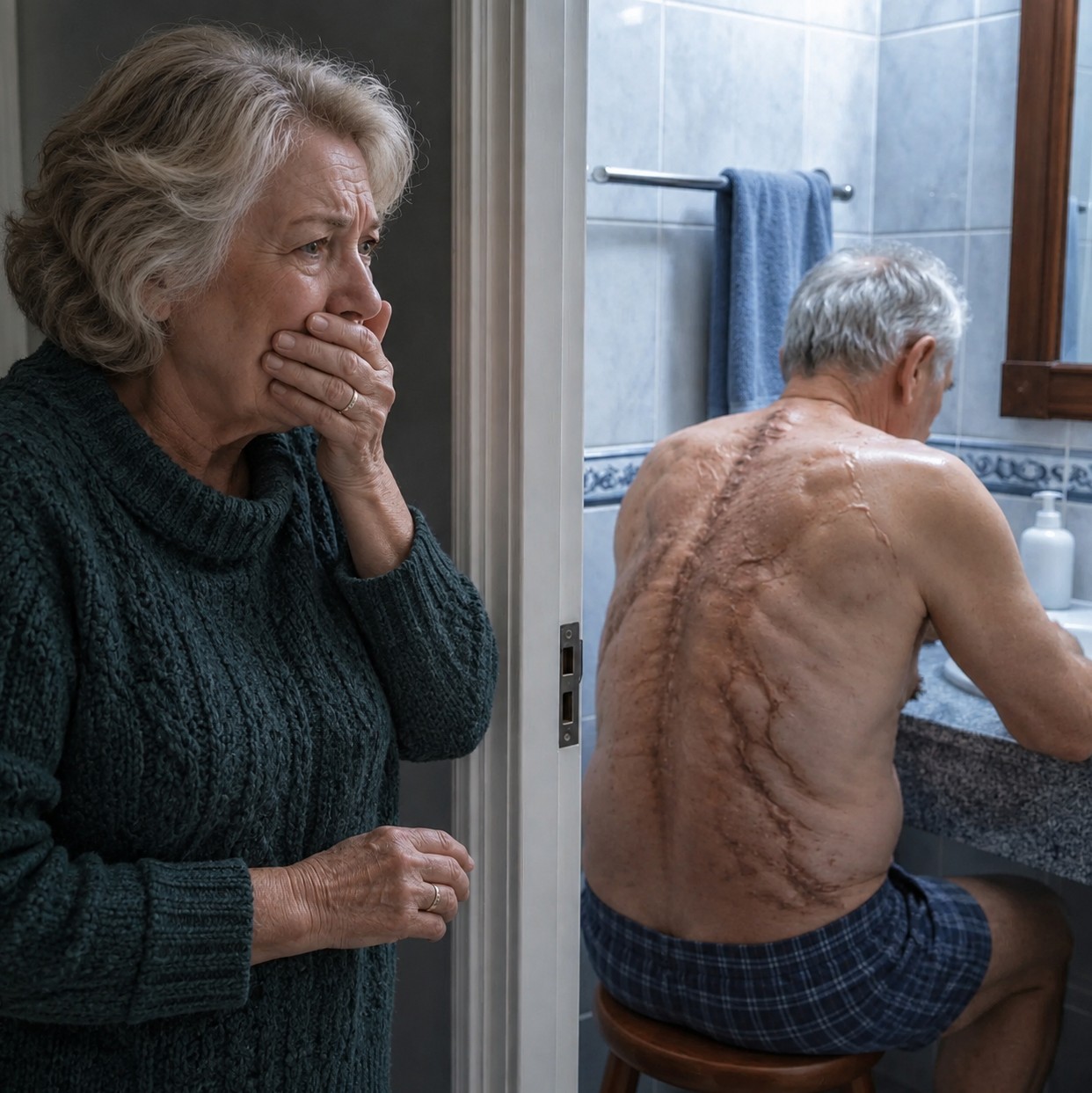
My hands trembled as I crouched beside it and carefully looked through the keyhole.
What I saw stole the air from my lungs.
Richard had removed his shirt.
His back barely looked human.
His skin was covered in scars—thick burns, deep indentations, and twisted marks that crossed his shoulders and ribs like shattered lightning. Some wounds looked decades old. Others still appeared raw and inflamed.
His entire body looked as though it had been destroyed and somehow forced to keep going.
He stood hunched over the sink, cleaning an open wound with gauze while biting down on a towel to stop himself from screaming.
I slapped my hand over my mouth to keep from crying out.
The man who had slept beside me for decades had been carrying unimaginable pain all alone.
And I had never known.
Part 2:
I climbed back upstairs, shaking so badly that I could barely walk.
I slid beneath the blankets and pretended to sleep while tears soaked my pillow.
When Richard finally returned to bed, he lowered himself onto the mattress carefully, as if every movement caused him pain.
Neither of us spoke.
In that silence, I realized that we had both been lying for decades.
He had pretended he wasn’t suffering.
And I had pretended I hadn’t just seen the truth.
The next morning, I made coffee and prepared breakfast exactly as I always did.
Toast. Eggs. Fresh jam.
But when Richard walked into the kitchen wearing another long-sleeved shirt buttoned all the way to the collar, I couldn’t look at him the same way anymore.
“Did you sleep okay?” he asked quietly.
“Not really.”
He lowered his eyes as though he already knew something had changed.
After he left for work, I opened the bedroom closet.
Hidden behind his shirts was the pharmacy bag.
Inside were burn creams, pain medication, medical tape, gauze pads, and bandages stained dark with old blood.
I sat on the edge of the bed holding those supplies and felt ashamed of myself.
For years, I had imagined affairs. Lies. Secret sins.
Meanwhile, my husband had been secretly treating wounds he never allowed anyone to see.
That night, I tried gently bringing up the past.
“Do you remember those years after we met?” I asked quietly over dinner. “The city felt dangerous back then.”
Richard froze.
“Don’t start.”
“I just want to understand.”
Suddenly, he slammed his hand against the table.
“Some things are better left buried.”
That Saturday, our son Michael came to visit.
During dinner, he sighed heavily when the subject of his father came up.
“Mom, please stop. Dad’s always been like this. Distant. Cold. He’s not going to change.”
Richard slowly stood from his chair.
“Don’t speak about things you don’t understand.”
Michael gave a bitter laugh.
“How could I understand? You never told us anything. When I was a kid, I thought you didn’t even love me. You never came to my baseball games because your ‘back hurt.’ You never hugged us. You barely talked to us.”
I watched Richard’s face completely break apart.
Claire went silent beside me.
“Michael, enough,” I whispered.
But years of hurt were pouring out of our son.
“No, Mom. You always defended him. But we grew up with his silence too.”
Richard slowly walked toward the back door.
Before stepping outside, he said something that crushed all of us.
“You’re right. Everyone suffered because of me.”
Two weeks later, everything collapsed.
It was a Saturday afternoon. Richard was fixing a leaking pipe in the backyard when I heard something heavy hit the ground.
I ran outside and found him curled up on the concrete, clutching his back in agony.
“Richard!”
I tried to help him up, but he screamed.
His shirt had lifted, and one of the wounds across his lower back had reopened. Blood stained the fabric almost instantly.
At that exact moment, Michael walked through the side gate carrying a toolbox.
For the first time in his life, he saw his father’s back.
He went pale.
“Oh my God… what happened to you?”
Richard tried to pull his shirt down, but the pain was too intense.
I dropped beside him, crying.
“I already saw,” I confessed. “That night… I looked through the keyhole. I’m sorry.”
Richard closed his eyes like a defeated man.
Michael stepped backward, horror flooding his face.
“Dad… I didn’t know.”
We carefully helped Richard upstairs and laid him on the bed. Claire arrived shortly afterward, terrified by my phone call.
The four of us sat around the bed, staring at the man who had seemed emotionally unbreakable our entire lives.
Now he trembled like a frightened child.
“Who did this to you?” Claire whispered.
Richard said nothing.
I gently took his hand.
“You can’t carry this alone anymore.”
Tears slid silently down his face.
Finally, he looked at our children.
“If I tell you the truth,” he whispered, “you may hate the man I used to be.”
Michael dropped to his knees beside the bed.
“I already hated myself for judging you without knowing,” he said. “Please… just tell us.”
Richard swallowed hard.
And then, with a broken voice, he finally said the words that changed our family forever.
“It started in 1972… when they mistook me for someone else.”
Part 3:
Richard sat in silence for several minutes before continuing.
Outside, life carried on as though nothing had happened. Cars passed. Dogs barked. Neighbors mowed their lawns.
But inside that bedroom, our entire family history was unraveling.
“I volunteered through the church back then,” Richard began softly. “We delivered food to struggling families. Helped immigrant kids learn English. Collected medicine for people who couldn’t afford doctors.”
He looked carefully at each of us.
“But during those years… helping the wrong people could make you look suspicious.”
He explained that one evening after leaving the steel plant, a black sedan pulled up beside him.
Two men forced him inside.
They blindfolded him, tied his hands, and took him somewhere without windows.
They demanded names.
They wanted to know about meetings, political organizers, and underground groups.
But Richard knew nothing.
“I kept telling them they had the wrong man,” he whispered. “I was just a factory worker who helped at church. But they didn’t believe me.”
Claire began crying quietly.
Richard never described everything they did to him.
He didn’t need to.
His body had already told the story.
The burns.
The scars.
The nerve damage.
“Four days,” he said. “They kept me there for four days. Eventually, they realized they had confused me with another Richard Mitchell from the South Side who actually was involved in political activism.”
Michael covered his face with both hands.
“Why didn’t you report it?”
Richard let out a hollow laugh.
“Before they released me, they told me that if I ever spoke about what happened, they would come after my fiancée.”
He looked at me with unbearable sadness.
“We were getting married that spring, Eleanor. I believed them.”
Suddenly, everything made sense.
The fear.
The silence.
The locked bathroom.
The lights turned off.
The emotional distance.
“That’s why I hid it,” he whispered. “I was ashamed. I felt weak for begging them to stop. Weak for surviving.”
I carefully wrapped my arms around him.
“You weren’t weak,” I said through my tears. “You survived something terrible.”
Michael moved closer and kissed his father’s trembling hand.
“I’m sorry, Dad.”
Richard broke down completely.
“I wanted to hug you kids,” he sobbed. “But sometimes lifting my arms hurt too much. And sometimes I loved you all so much that I became terrified something would happen to you because of me.”
That day, none of us ate.
We simply sat together, crying and talking, finally understanding that our family had spent decades orbiting around a wound nobody knew how to name.
After that night, Richard stopped locking the bathroom door.
At four every morning, I sat beside him while he cleaned his scars and changed his bandages. At first, he was embarrassed.
Later, he started holding my hand while I helped him.
We found him a specialist who treated his chronic pain. Then we found a trauma therapist.
Healing came slowly.
The scars never disappeared.
The nightmares never fully stopped.
But he no longer carried them alone.
Michael grew close to his father again. Claire started visiting every weekend. Conversations we should have had decades earlier finally happened.
Richard lived fifteen more years after telling us the truth.
And they were the most honest years of our marriage.
A few days before he passed away in 2019, he squeezed my hand from his hospital bed and whispered:
“Thank you for not leaving me alone with my shame.”
I kissed his forehead and answered:
“It was never shame. It was pain. And pain is lighter when someone helps you carry it.”
I tell this story now because so many families mistake trauma for coldness… silence for cruelty… and distance for a lack of love.
Sometimes fathers don’t know how to say, “I was broken.”
Sometimes wives suspect betrayal when the truth is suffering.
Sometimes children judge wounds they cannot see.
Not every secret is betrayal.
Sometimes, behind a locked door, there is simply a person trying to survive.
The end.
