
PART 1:
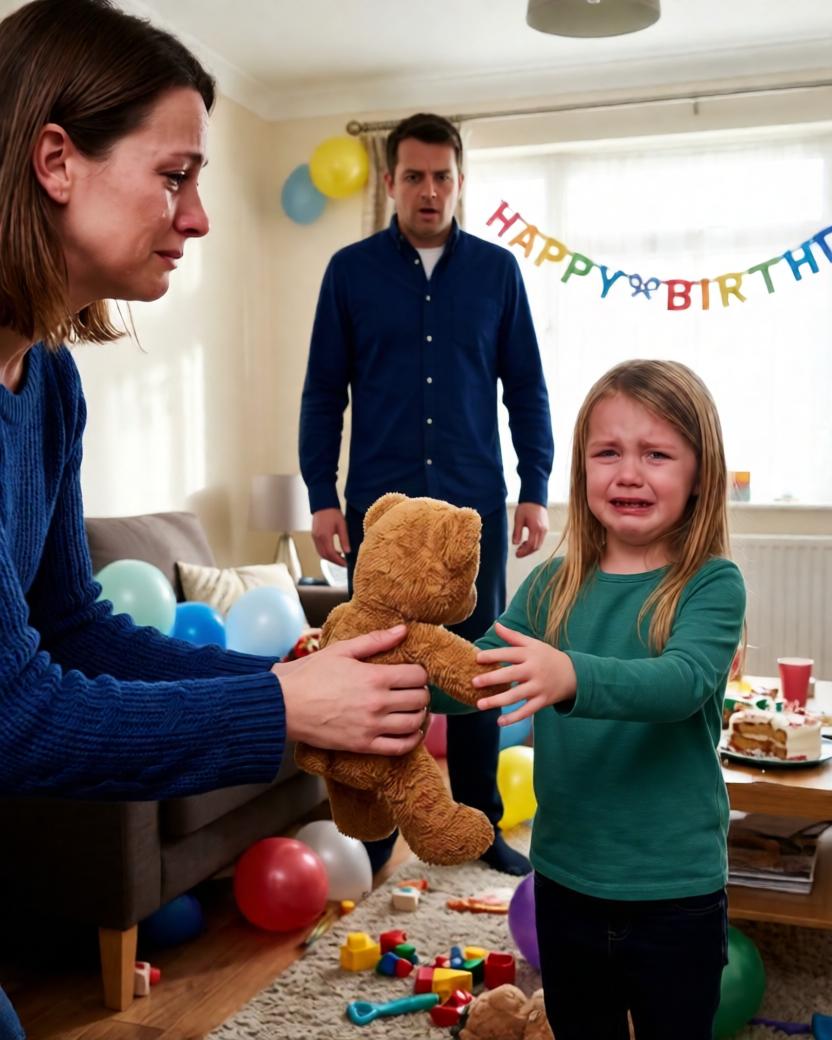
For my daughter Isabella’s sixth birthday, my husband’s parents sent her a gift.
It was a sweet chestnut-colored teddy bear wrapped in shiny gold paper and tied with a beautiful satin ribbon.
The package was waiting on our porch in our quiet neighborhood in Madison.
The second Isabella saw it, her whole face lit up.
“Grandma and Grandpa remembered!” she shouted happily.
She ran barefoot across the living room carpet, unable to contain her excitement.
I smiled because seeing her happy was everything to me.
But deep inside, I felt that familiar uncomfortable feeling I had learned to recognize.
A warning.
My husband Patrick had not spoken to his parents in almost eight months.
The silence between them started after a terrible argument about boundaries.
His parents had a habit of showing up at our house without warning. They acted like they could come and go whenever they wanted.
His mother, Helen, was the worst.
Whenever I told Isabella no about something small, Helen would whisper to her granddaughter that “Mommy is too strict.”
She made little comments that slowly damaged our relationship and made me feel like she was trying to turn Isabella against me.
Still, this was Isabella’s birthday.
I did not want my worries to ruin a day that was supposed to be magical.
“Go ahead,” I said, leaning against the doorway. “Open it.”
Isabella immediately started tearing through the wrapping paper with her small, excited hands.
A few seconds later, she pulled out the teddy bear.
It was adorable.
The bear had soft chestnut-brown fur, shiny black eyes, a stitched smile, and a small red bow tied around its neck.
For a moment, Isabella was completely happy.
She hugged the bear tightly.
Then something changed.
Her body suddenly became stiff.
Her arms slowly loosened around the toy.
The huge smile on her face disappeared.
She looked confused.
“Mommy,” she whispered.
She held the teddy bear away from her body.
“What is wrong with it?”
I immediately noticed the fear in her voice.
I walked closer.
At first, I thought maybe something was wrong with the gift tag attached beneath the bow.
But then I saw the bear’s left eye.
And my entire body went cold.
The right eye looked normal.
It was shiny, flat, and exactly what you would expect from a stuffed animal.
But the left eye was different.
There was a tiny dark circle in the center.
It was too deep.
Too perfect.
Almost like a tiny camera lens.
My mouth suddenly felt dry.
My heart started beating hard against my chest.
I carefully took the bear from Isabella’s hands, trying my best not to show how nervous I was.
“Sweetheart,” I said calmly, forcing my voice to stay steady, “why don’t you go help Daddy put the candles on your birthday cake?”
Isabella looked at me carefully.
She knew something was wrong.
“Is it broken, Mommy?” she asked.
“Maybe,” I lied softly. “I just need to check it and make sure it is safe for you.”
Patrick was standing in the kitchen.
The second he looked at my face, he knew something was wrong.
He walked toward me.
I turned the bear over in my hands and carefully examined every part of it.
The seams looked normal.
But near the battery compartment, I felt something hard.
Something solid.
It was not extra stuffing.
It was not a music box.
It was something else.
“Claire?” Patrick whispered.
I did not answer.
I was trying to understand what I was holding.
I carried the teddy bear into our bedroom and closed the door behind me.
I placed it on top of the dresser.
Then I turned off the lights.
In the darkness, the bear’s left eye gave off a faint reflection.
Patrick stood beside me.
His expression changed slowly.
First confusion.
Then disbelief.
Then horror.
“No,” he whispered.
He reached toward the bear but quickly pulled his hand back.
It was as if touching it suddenly felt dangerous.
I searched the teddy bear carefully.
Finally, hidden beneath the thick fabric near one of its legs, I found a tiny switch.
My fingers were shaking.
But I did not scream.
I did not call Helen.
I did not demand answers.
I knew I needed proof.
I took several clear pictures of the device with my phone.
Then I placed the teddy bear inside a locked drawer.
After that, I called my brother Scott.
Scott worked as a detective in a nearby county.
He listened carefully while I explained everything.
He did not interrupt me once.
When I finished, his voice changed.
It was no longer just my brother speaking.
It was the voice of someone trained to handle serious situations.
“Claire, listen to me,” Scott said. “Do not try to open it yourself.”
I stayed silent.
“Do not damage it,” he continued. “Put it in a paper bag, not plastic. I am calling someone who handles these situations immediately.”
Three days later, police officers were standing at the front door of my in-laws’ house in suburban Connecticut.
By then, I already knew the teddy bear was not a simple mistake.
It was not a defective toy.
Someone had placed something inside it on purpose.
The morning after Isabella’s birthday party, a technician arrived at our house.
He wore plain clothes and carried a large black case.
“My name is Grant,” he said. “I work in digital forensics.”
Scott stayed beside me the entire time.
He was not there as a detective.
He was there as my brother.
He was there to support me.
Grant placed the teddy bear on our dining room table carefully, almost like it was dangerous evidence.
Isabella was at school, which was a huge relief.
Patrick had called out of work.
He sat beside me with a cup of coffee in his hands.
But he had not taken a single sip.
He looked pale.
Quiet.
Almost broken.
Grant took out a small blade and carefully cut open the seam along the bear’s back.
Inside, hidden deep beneath the soft polyester stuffing, was the truth.
A small wireless camera.
A microphone.
A battery pack.
And a tiny microSD card.
The camera lens had been placed perfectly behind the bear’s left eye.
The same eye that had made Isabella uncomfortable.
Patrick suddenly stood up.
His wooden chair scraped loudly across the floor.
“My parents did not do this,” he said.
But even as he spoke, there was no confidence in his voice.
Grant continued examining the device.
“Someone definitely did,” he replied.
Then he removed the memory card.
He placed it into a reader and opened the files on his laptop.
There were recordings.
Short videos.
Each one had a specific date and time.
The first recording was created two weeks before the teddy bear ever arrived at our home.
That was the moment Patrick stopped defending them.
Because the truth was finally impossible to ignore.
PART 2:
Grant opened the first video file.
The screen showed Helen’s kitchen table.
For a few seconds, nothing happened.
Then Helen’s hands appeared.
Her thin, perfectly manicured fingers grabbed the teddy bear and slowly turned its head toward herself.
She examined it carefully.
Then Walter’s voice came from somewhere outside the camera’s view.
His voice sounded uncertain.
“Are you sure this is legal?” he asked.
Helen did not hesitate.
Her answer was cold and confident.
“It is our granddaughter,” she said. “We have a right to know what goes on in that house.”
Patrick covered his mouth.
He looked like he might be sick.
I felt something icy move through my entire body as I watched them plan this.
They had not sent Isabella a birthday gift.
They had sent a device to spy on us.
There were more recordings.
Many more.
One clip showed Helen testing the microphone.
Another showed Walter complaining that the battery would not last long enough.
“The battery is not going to record for very long,” Walter said. “What if it dies before we get anything useful?”
Helen answered without concern.
“Patrick has been poisoned against us by that woman,” she said. “If we can prove she screams at Isabella or neglects her, we will have exactly what we need.”
My voice cracked as I watched the video.
“What does she need for what?” I asked.
Grant looked away from the laptop for a moment.
His professional expression remained, but his eyes softened.
“Custody pressure,” he said. “Family court. Maybe even blackmail. Investigators will determine the exact purpose.”
Patrick sat frozen beside me.
He had spent months trying to convince himself that his parents were simply difficult.
Controlling.
Overbearing.
But this was different.
This was planned.
This was intentional.
The police did not immediately rush to Helen and Walter’s house.
They wanted to document everything properly first.
They took the teddy bear as evidence.
They interviewed Patrick and me separately.
They asked questions about our relationship with his parents.
They wanted to know if Helen and Walter had keys to our home.
They asked if they had ever threatened us.
If they had ever tried to interfere with our parenting.
Patrick told them about an incident that happened months earlier at Isabella’s school.
Helen had tried to sign Isabella out early without our permission.
She walked into the school expecting everyone to listen to her.
But I refused to let Isabella leave with her.
Helen became furious.
Later, she called Patrick and screamed at him.
“We are her grandparents!” she shouted. “You are keeping our own granddaughter away from us!”
Patrick told the officers everything.
Then he mentioned Walter.
Walter had not yelled.
He almost never did.
Instead, he stood quietly behind Helen and supported her.
“He always does that,” Patrick explained. “He lets her say the cruel things, but he never stops her.”
The officers wrote everything down.
Three days after Isabella’s birthday, the police arrived at Helen and Walter’s house with a signed search warrant.
Patrick and I were not there.
Later, Scott told me everything that happened.
Helen opened the door.
She had a practiced smile on her face, probably thinking they were neighbors or people from church.
But the moment the detective introduced himself, her expression changed.
Walter walked out from the den.
“What is this about?” he asked.
But everyone could tell he already knew.
The detective looked directly at them.
“We are here regarding electronic surveillance equipment sent to a minor child.”
Helen’s reaction was immediate.
She did not ask what equipment they were talking about.
She did not ask why the police were there.
Her first words were:
“Claire is behind this.”
That sentence alone told the investigators a lot.
She already knew exactly what they were talking about.
The detective later described the search as productive.
That sounded simple.
But what they actually discovered was disturbing.
Inside the house, police found the packaging for the camera module.
It had been hidden inside a drawer beneath old takeout menus.
They found printed instructions.
The instructions had highlighted sections about motion detection, night vision, and remote viewing.
They also found another camera device.
It was still unopened.
It was sitting inside Walter’s home office desk.
But the biggest discovery was Helen’s laptop.
It was the same laptop she used for normal things.
Church newsletters.
Recipes.
Long emails to relatives.
Emails where she often complained about how Patrick had “changed” after marrying me.
Investigators searched through the files.
Inside a folder called “Isabella Memories,” they found the truth.
There were multiple recordings from the teddy bear.
Luckily, there was no footage from inside our home.
I had noticed the camera before it was ever activated in Isabella’s room.
But there were test recordings.
Screenshots from our private social media accounts.
A scanned copy of Isabella’s school calendar.
And then they found a document.
The title was:
“Concerns About Claire.”
Two days later, police showed us the document.
We were sitting in a sterile interview room.
Patrick read the first page.
Then he pushed it away.
His face was full of disgust.
I continued reading.
Every single page.
My hands shook as I looked through the details.
It was not a simple list of complaints.
It was a plan.
Helen had written down dates.
Specific situations.
Accusations.
But most of them were twisted until they barely resembled reality.
One note claimed that I was isolating Isabella from her father’s family.
Another said Patrick was afraid to disagree with me.
A third claimed Helen needed proof of my emotional instability so she could take action.
There were even empty spaces underneath some accusations.
Spaces waiting to be filled later.
Waiting for fake evidence.
The teddy bear was supposed to provide that evidence.
“She was building a case against me,” I whispered.
The detective nodded.
“That appears to be the main purpose,” he said.
Patrick sat beside me, staring at the floor.
He looked like someone had taken away everything he believed.
He had always known his mother could be controlling.
He knew she could be cruel when someone challenged her.
But knowing someone is difficult is not the same as seeing proof that they planned to spy on your own child.
“Our child,” Patrick said quietly.
His voice broke.
“She put a camera in our child’s favorite toy.”
No one corrected him.
No one tried to make the situation sound less serious.
Because he was right.
This was not about a family disagreement anymore.
This was about Isabella’s safety.
The legal process moved slowly at first.
Then everything changed quickly once the evidence became impossible to ignore.
Helen and Walter were questioned separately.
Walter tried to make himself look less involved.
He claimed Helen had been the one who ordered the camera.
He said she was the one who placed it inside the bear.
He admitted he only helped with the technical side because she did not understand how to set it up.
But the financial records told a different story.
The camera was purchased using Walter’s credit card.
The software account was created using Walter’s email address.
And Walter’s phone was used to test the live camera feed.
Helen, meanwhile, tried a completely different approach.
She cried.
She shook.
She told investigators she was only a worried grandmother.
“I was just trying to protect Isabella,” she said.
She claimed she feared for her granddaughter’s safety.
Then she accused me of having a violent temper.
But when investigators asked for examples, she could not provide a single one that was not simply me setting normal boundaries.
She insisted Patrick was being controlled.
She insisted the teddy bear was created out of love.
The detective looked at her carefully.
“Protect her from what exactly?” he asked.
Helen paused.
Then she answered:
“From being taken away from us.”
That sentence stayed with me.
It followed me home.
It haunted me for weeks.
Because she was not talking about protecting Isabella from danger.
She was not talking about protecting her from abuse.
She was afraid of losing access to her.
As if Isabella belonged to her.
As if my daughter was something she owned.
Not a little girl with feelings.
Not a child who deserved privacy.
But something she believed she had a right to control.
PART 3:
After the charges were filed, life changed in ways I never expected.
Patrick stopped sleeping properly.
Almost every night, he woke up around two in the morning.
He would walk through the house checking the windows.
Then the back door.
Then the garage.
Sometimes I would find him standing quietly in the hallway outside Isabella’s bedroom.
His arms would be crossed over his chest as he stared at the small teddy bear nightlight she had chosen herself from a store after the police took away the other bear.
One night, I found him there again.
The house was completely silent.
He looked exhausted.
“I should have cut them off a long time ago,” he whispered.
I leaned against the wall beside him.
I could feel how much guilt he was carrying.
“You were raised to think their behavior was normal,” I said softly.
Patrick looked down.
“That is not an excuse for what they did.”
“No,” I agreed. “But it explains why it took so long for you to see them clearly.”
He nodded.
Understanding where his parents’ behavior came from did not make him feel better.
It only made him realize how many years he had spent accepting things he should never have accepted.
Isabella only knew part of the truth.
We did not tell her every horrible detail.
She was six years old.
She did not need to carry the weight of adult problems.
We explained that the teddy bear had a camera inside it.
We told her that adults were not allowed to hide things like that in children’s toys.
We told her Helen and Walter had made a very serious mistake.
And we told her we would not be seeing them for a very long time.
One evening, Isabella sat quietly on the couch.
Then she looked up at Patrick.
“Are they angry with me because of the bear?” she asked.
The question broke something inside both of us.
Patrick immediately dropped to his knees in front of her.
He held her small hands tightly.
“No, baby,” he said.
His voice was full of emotion.
“You did nothing wrong. Nothing at all.”
Isabella looked confused.
“Then why did they do it to me?”
Patrick looked at me.
He wanted to answer.
But the pain in his face told me he could not find the words.
So I answered for both of us.
“Sometimes grown-ups make selfish choices when they want control over things that do not belong to them,” I explained.
I brushed her hair away from her face.
“But that choice was theirs. It was never your fault.”
Isabella sat quietly, thinking about my words.
Finally, she nodded.
Then she said something that broke my heart.
“I don’t want any more surprise presents from them.”
My six-year-old daughter had learned a lesson no child should ever have to learn.
She had learned that sometimes gifts were not always safe.
The first court hearing happened in early October.
The air outside smelled like rain on pavement.
Patrick wore a navy suit.
I wore a gray dress because I wanted to feel calm and strong.
When we arrived, Helen and Walter were already there.
Helen had hired an expensive lawyer.
She looked smaller than usual.
But she did not look sorry.
Her hair was perfectly styled.
Her makeup was flawless.
Everything about her appearance was carefully controlled.
The moment she saw Patrick, her expression changed.
She created a face full of sadness.
“My son,” she whispered.
She reached one hand toward him.
Patrick did not move.
He did not step closer.
He did not say anything.
His expression remained completely firm.
For a brief second, Helen’s sadness disappeared.
Her face became harder.
Angrier.
But she quickly remembered where she was.
Then she started crying again.
The prosecutor presented the evidence.
He explained the hidden camera.
The illegal surveillance.
The invasion of privacy.
He also emphasized something important.
The target was not an adult.
It was a child.
A child inside the safety of her own home.
Helen’s lawyer tried to defend her actions.
He argued that no footage had actually been recorded inside our house.
He claimed Helen acted because she was worried about Isabella.
He called it “misguided concern.”
The judge looked over her glasses.
Her expression showed exactly what she thought.
“Misguided concern does not require hidden recording equipment,” the judge said.
I will never forget those words.
They stayed with me.
Because they perfectly explained everything.
This was not love.
This was control.
After the judge’s statement, Helen turned her head and looked directly at me.
It was almost like she believed I had somehow caused the judge to say those words.
As if the truth itself was my fault.
That day, a protective order was issued.
Helen and Walter were forbidden from contacting us directly or indirectly.
No phone calls.
No letters.
No gifts.
No messages through other family members.
They were also banned from showing up at:
- Isabella’s school.
- Our home.
- Patrick’s workplace.
- Any activities involving Isabella.
When the order was read aloud, Helen made a small sound.
It was almost like an injured animal.
Patrick closed his eyes.
For the first time in years, he released a breath that sounded like he had been holding it forever.
I thought I would feel victorious.
I thought I would feel relieved.
Instead, I only felt tired.
Completely exhausted.
The family reaction came quickly.
Patrick’s aunt Brenda was the first.
She left a voicemail saying Helen was devastated and that I needed to stop making the situation worse.
Patrick deleted the message before listening to the entire thing.
Then his cousin Gary sent him a text.
“Was it really necessary to involve the police?”
Patrick stared at the message.
Then he replied with one sentence.
“They hid a camera in my daughter’s teddy bear.”
Gary never answered.
For weeks, relatives tried to make Helen look like the victim.
They talked about how lonely she was.
How scared she was of losing Isabella.
They talked about forgiveness.
But they wanted forgiveness without accepting what she had done.
They acted like the evidence did not matter.
Like the camera did not exist.
Like Isabella was not the person who had been violated.
But Patrick refused to give in.
One evening, another cousin sent a message suggesting everyone should have a family meeting.
They wanted to “clear the air.”
Patrick typed a response.
Then he showed it to me before sending it.
“My daughter’s privacy and safety are not family discussion topics,” he wrote.
“Anyone who minimizes what happened will not have access to us.”
He looked at the screen for a long time.
“That sounded harsh,” he said.
I shook my head.
“No,” I replied.
“It sounded like a father protecting his child.”
Then he pressed send.
PART 4:
The case never became the dramatic trial everyone expected.
Before it reached that point, Helen and Walter accepted a plea agreement.
They avoided jail time, which was difficult for me to accept.
After everything they had done, part of me wanted them to face stronger consequences.
But the agreement still came with serious conditions.
They received probation.
They had to pay fines.
They were required to attend counseling.
And they now had a permanent criminal record.
The judge also extended the protective order indefinitely.
During the sentencing hearing, Helen asked to speak.
She stood there and tried once again to explain herself.
“I only wanted to make sure Isabella was safe,” she said.
Her voice was emotional.
She wanted everyone in the room to believe she was a loving grandmother who had gone too far out of concern.
But the judge did not accept that explanation.
She looked directly at Helen.
“Do you understand why hiding a camera inside a child’s toy is a violation of the law?” the judge asked.
Helen opened her mouth.
Then she stopped.
She hesitated.
And that hesitation said more than any apology ever could.
Because even then, she still did not seem to understand what she had done.
Walter spoke next.
His voice was quiet.
“I should have stopped it,” he admitted.
Patrick sat beside me.
Without looking at him, he whispered:
“Yes. You absolutely should have.”
Walter looked toward his son.
But Patrick kept his eyes forward.
He had spent years waiting for his father to stand up to Helen.
And he finally understood that his silence had always been a choice.
After court, Helen tried one final time to create a scene.
The hallway was crowded with people leaving the courtroom.
She walked toward us.
“Patrick, please,” she said.
Then she used the words she had used his entire life.
“I am your mother.”
The bailiff immediately stepped between them.
“Ma’am, step back,” he ordered.
Helen’s face turned red.
The sadness disappeared.
The anger returned.
“I just want to talk to my son,” she said.
Patrick looked at her.
For the first time, there was no fear in his eyes.
Only sadness.
“No,” he said.
His voice was calm.
“You wanted control and access.”
He paused.
“And those are two very different things.”
Helen stood there silently.
For once, she had no response.
Life did not become normal overnight.
It came back slowly.
Piece by piece.
We changed the locks on our doors.
We changed passwords.
We updated Isabella’s school pickup permissions.
We changed every emergency contact form we could find.
We checked smoke detectors.
We checked nightlights.
We checked every stuffed animal that entered our home.
I hated that we had to do it.
I hated that something as innocent as a toy could suddenly feel suspicious.
For a while, every stuffed animal made me nervous.
Every gift made me wonder what might be hidden inside.
And Isabella felt it too.
Whenever someone gave her something, she would stop and ask:
“Who sent it?”
Then:
“Did you check it?”
And sometimes:
“Can it see me?”
Every question hurt.
Because she should have been thinking about playing.
Not cameras.
Not safety checks.
Not whether a toy could hurt her.
But slowly, things started improving.
The fear became smaller.
One day, Isabella refused to sleep with any stuffed animals.
But a month later, she carried a purple rabbit everywhere.
She named it Waffles.
And little by little, she started trusting again.
Patrick also started therapy.
Not because he was broken.
But because he finally understood something important.
Growing up with Helen had taught him to ignore his own feelings.
It had taught him to question his boundaries.
It had made unhealthy behavior feel normal.
During therapy, he learned to say the things he had buried for years.
“My mother confuses love with possession,” he said.
“My father enables harm by staying quiet,” he admitted.
And finally:
“I do not owe access to people who hurt my family.”
Those words changed him.
Not instantly.
Not all at once.
But slowly.
He became more confident.
More protective.
More willing to trust his own judgment.
As for me, I eventually stopped replaying that birthday over and over.
For a long time, I kept seeing the bear’s left eye.
That tiny black circle.
That little camera hidden inside a toy that was supposed to bring my daughter joy.
I kept thinking about what could have happened if Isabella had not noticed something was wrong.
What if she had taken the bear into her room?
What if the camera had recorded everything?
What if we had never discovered it?
Those thoughts haunted me.
But I always came back to one thing.
Isabella noticed.
She saw what the adults tried to hide.
And because of that, we were able to protect her.
On Isabella’s seventh birthday, she asked for a simple backyard party.
She wanted cupcakes.
Bubbles.
And a bounce house shaped like a castle.
We invited her classmates.
Our neighbors.
And my brother Scott.
But we kept the guest list small.
Safe.
People we trusted.
Near the end of the party, Isabella sat at the picnic table opening presents.
Patrick and I stayed nearby.
She opened art supplies.
Books.
A glittery backpack.
Then she opened a box with a stuffed fox inside.
For a moment, she simply stared at it.
She looked at the fox’s face.
Then she looked at me.
“Mommy?” she asked.
I already knew what she meant.
I walked closer.
“Do you want me to check it?” I asked.
She nodded.
So I carefully examined the seams.
The eyes.
The tag.
The battery compartment.
Everything.
Then I smiled.
“All clear.”
Isabella hugged the fox.
And for the first time in a year, I saw her hold a stuffed animal without fear.
No hesitation.
No worry.
Just happiness.
Under the table, Patrick reached for my hand.
He squeezed it tightly.
Across the yard, children laughed.
Bubbles floated above the grass.
The late afternoon sunlight made everything look warm and golden.
Isabella ran toward the bounce house with the fox tucked under one arm.
Her ponytail bounced behind her as she disappeared into the castle among the other children.
Patrick watched her with a small smile.
“I think we are going to be okay,” he whispered.
I leaned my head against his shoulder.
“No,” I said softly.
“We are better than okay.”
Because the truth was, the teddy bear had not destroyed our family.
It had revealed the part of our family that had already become dangerous.
It showed us what we needed to see.
And once we finally saw the truth, we were able to lock the door behind us.
Then we moved forward.
Together.
THE END.
