
Part 1:
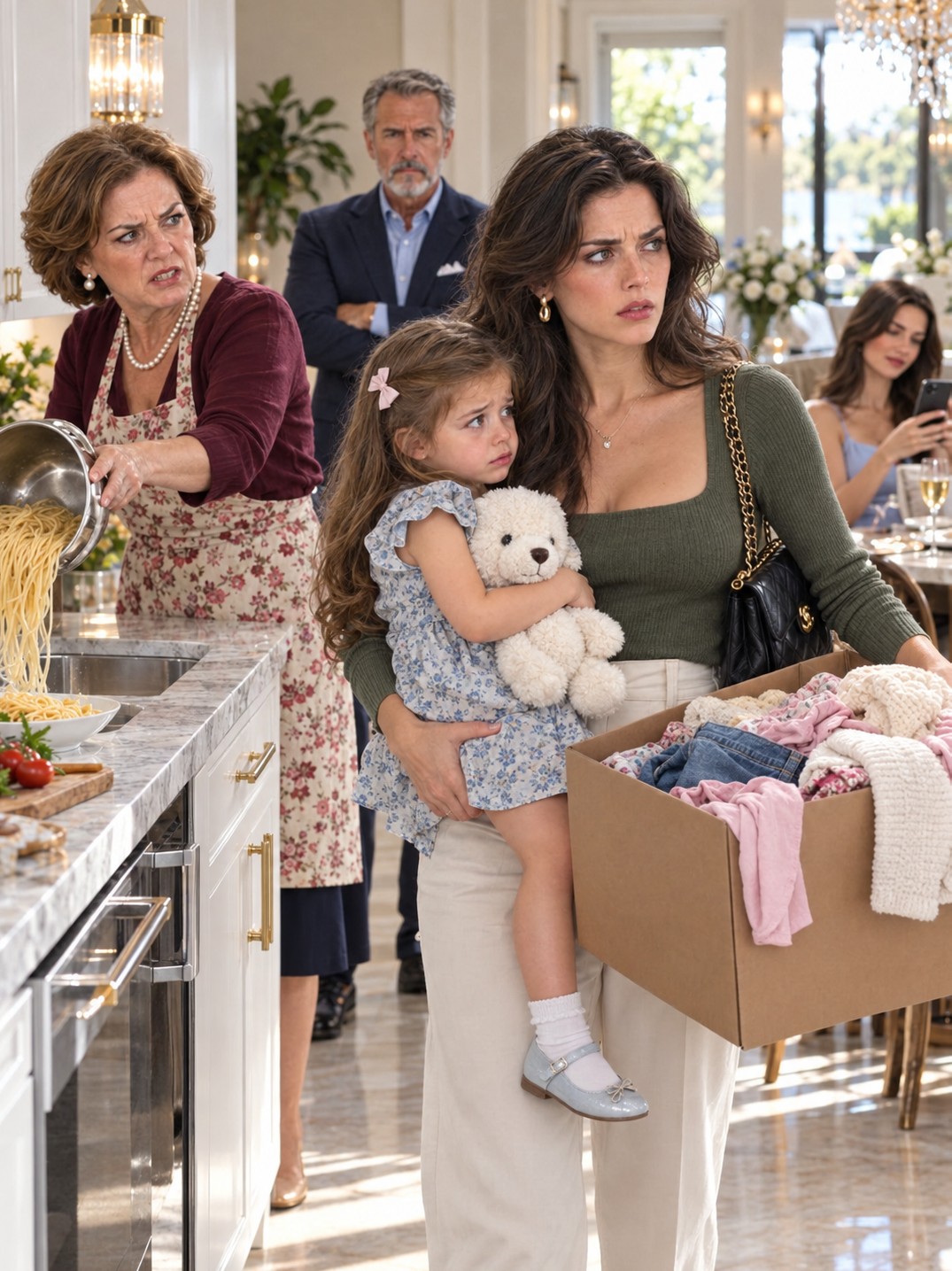
“That’s enough. You keep coming here and eating what’s ours! You’re an adult. At least rent a room and stop living like a queen!”
My mother snatched the plate right out of my hands.
It was the exact plate my two-year-old daughter, Gemma, was about to eat from.
Before I could stop her, my mother dumped the chicken noodle soup into the sink.
The noodles slid across the cold stainless steel and disappeared down the drain.
Gemma stared at her empty plate.
Then she looked up at her grandmother.
She was only two years old. She couldn’t understand why the food that had been placed in front of her had suddenly vanished.
“Mom, please,” I said softly, forcing myself to stay calm. “It’s not her fault.”
“Well, she should learn from a young age that food costs real money,” my mother snapped.
There wasn’t even a trace of regret in her voice.
My sister, Paige, didn’t even look up from her phone.
“Honestly, Mom is right,” she muttered. “You come here every weekend, you bring the kid, you use up everything, and you never give anything back.”
My father, Walter, did something that hurt even more than their words.
He said nothing.
He simply stood up, picked up Gemma’s stroller, carried it outside, and left it in the hallway.
Then he walked back inside, sat down, and opened his newspaper as if I didn’t exist.
As if my daughter and I were nothing more than a problem he had just removed from the room.
I didn’t argue.
I didn’t scream.
I didn’t beg.
I put Gemma’s jacket on her, lifted her into my arms, grabbed my purse, and walked toward the door.
Before leaving, I looked back at them.
“Thank you for the food, Mom,” I said quietly.
My mother gave a cold laugh.
“When you finally learn to stand on your own two feet, then you can come back.”
I closed the door behind me.
And then, for the first time that day, I smiled.
Nobody inside that apartment could possibly understand why.
For the past six months, I had been visiting my parents almost every weekend.
After my divorce, I had been saving every dollar I could so Gemma and I could move into a permanent home of our own.
I worked as a text editor for a publishing company downtown. Most of my work was done remotely, so people often assumed I wasn’t earning much simply because they didn’t see me leaving for an office every morning.
My mother had made the same mistake.
She had confused my quietness with helplessness.
My sister had done exactly the same thing.
Neither of them knew the full truth.
For five years, I had been paying a large portion of the monthly mortgage on the comfortable condo my sister Paige owned in Madison.
Every month, on the fifteenth, the money automatically left my bank account.
Paige told everyone she was completely independent.
I had never corrected her.
I had simply kept paying.
Until that Sunday.
That afternoon, I took Gemma to a small motel near the central bus station.
The room was tiny.
There was one twin bed, a single chair, a small sink, and a high window that looked down onto a narrow alley.
It wasn’t comfortable.
It wasn’t beautiful.
But nobody in that room was going to pull a plate of food away from my little girl.
Once Gemma finally fell asleep, I sat on the edge of the bed and took out my phone.
I opened a note I had created two years earlier.
The title was simple:
PLAN B.
I had created it the first time my mother complained that Gemma was becoming too expensive to feed.
For two years, I had never needed to use it.
Until now.
I added one new line.
Sunday. Plan activated.
The next morning, I opened my mobile banking app.
I went to my recurring payments and found the monthly transfer to Paige.
I stared at it for a few seconds.
Then I tapped:
Cancel recurring transfer.
A confirmation box appeared.
Are you sure you want to cancel this recurring transfer?
I selected Yes.
Within seconds, the screen refreshed.
The transfer had been canceled.
I then opened another hidden folder on my phone.
Inside were photographs of a property deed from five years earlier.
The document had been created when my parents were dealing with a messy inheritance dispute and wanted to organize the family’s property.
At the time, my mother had insisted on one particular arrangement.
“Let’s put it under Paige’s name,” she had said. “She would never betray us.”
The documents had been signed before an attorney and properly registered with the public land records.
Over the years, my parents had become so comfortable with the idea that the condo was still somehow theirs that they spoke about it as though they still owned it.
I had never corrected them.
I opened the photograph of the deed and zoomed in.
There it was.
The registered owner was clearly listed:
Paige Miller.
My mother had just thrown away our relationship over a bowl of chicken soup.
What she didn’t know was that she had also locked out the legal owner of the property she was living in.
And she had no idea what was coming next.
Part 2:
My mother called me at ten o’clock Tuesday morning.
“Have you gotten over your ridiculous little tantrum yet?” she demanded.
“It wasn’t a tantrum, Mom,” I answered calmly.
“Come home today. Bring milk and bread on your way. Apologize to me, and maybe I’ll consider letting you back inside.”
I looked across the motel room.
Gemma was sitting on the floor, happily playing with an empty cardboard box.
“No,” I said. “I’m not coming back.”
There was a long silence.
Then my mother’s voice changed.
“You have a young child to care for, and you have no idea who you’re dealing with,” she warned. “I can easily report that she’s living in unsafe conditions. I know people at the clinic.”
“Do whatever you think is necessary,” I replied.
“Are you honestly challenging me right now?” she sneered.
“No,” I said. “I’m simply ending this conversation.”
Then I hung up.
About thirty minutes later, three text messages from my sister appeared on my phone.
The first said:
Did you cancel my monthly deposit? The bank says the scheduled transfer no longer exists.
The second came almost immediately.
Paige, Mom went way too far, but this isn’t my fault!
I stared at the screen for a moment.
Then I typed:
You should discuss that directly with your bank.
I sent the message and put my phone down.
The next day, a work colleague suggested that I speak with a relative of hers named Samuel.
Samuel was a real estate attorney.
Before I could meet with him, however, I received an unexpected phone call from a neighbor at my parents’ building.
“Paige,” the neighbor said urgently, “your mother just changed the locks.”
My stomach tightened.
“She also threw two cardboard boxes of your belongings into the hallway.”
I drove there immediately.
I started recording with my phone before I even reached the apartment.
The video captured the new locks, the boxes sitting outside the door, Gemma’s clothes, and several of my reference books.
I walked up the stairs and knocked hard.
My mother’s voice came from inside.
“You don’t live here anymore!”
“Unlock the door so I can collect the rest of my personal belongings,” I said.
“Take what’s outside and leave,” she shouted back. “You’re never getting a key to this place again.”
I didn’t argue.
I simply kept recording.
That afternoon, I met Samuel.
He examined the deed carefully.
Then he searched the public property records.
After several minutes, he looked up at me.
“Paige, this apartment belongs entirely to you.”
“I know.”
“No,” he said. “I don’t think you fully understand what that means.”
He turned the document toward me.
“You aren’t simply an heir. You aren’t someone with a right to stay there. You are the registered owner.”
I nodded.
Samuel continued.
“However, because your parents are physically occupying the property, getting possession back isn’t as simple as calling the police and asking them to remove your mother.”
“So what happens?”
“We need to follow the proper civil process.”
He explained that my mother would probably try to challenge the original transfer.
“She may claim that the transfer wasn’t valid,” he said. “She could argue that your father didn’t understand what he was signing or that he was pressured.”
“Does she have a realistic chance?”
“Only if she can prove a serious legal problem with the original transfer.”
Then another problem appeared.
The attorney who had originally handled the property paperwork, Rebecca, had recently been admitted to the hospital for emergency surgery.
Some of her older paper files had never been scanned into the digital system.
One of those files contained my father’s written consent.
I had my own copy, but Samuel explained that my mother could still claim that Walter had never agreed to the transfer or had signed under pressure.
That could delay everything.
“There is a simple way to make that argument much weaker,” Samuel said.
“What is it?”
“Have your father appear before a notary and formally confirm that he signed the document voluntarily and understood what he was doing.”
My chest tightened.
The thought of approaching my father wasn’t easy.
He was the same man who had carried his granddaughter’s stroller into the hallway without saying a word when my mother threw us out.
But I had no choice.
While I was dealing with the property issue, my mother was already attacking me from other directions.
She contacted Gemma’s daycare and questioned her attendance.
She tried to obtain information about Gemma’s medical history.
My sister also threatened to post online that I was trying to make my elderly parents homeless.
When I returned to the building to show my mother the public land registry document, things became even worse.
I held up my phone with the official property record displayed on the screen.
“This proves that I’m the registered owner,” I said.
My mother lunged toward me and tried to grab the phone.
It slipped from my hand and hit the concrete floor.
The screen shattered.
“This home belongs to me!” she screamed.
“You are nothing but an ungrateful daughter!”
A neighbor had witnessed the entire confrontation.
I didn’t respond.
I called Samuel.
His advice was simple.
“Don’t argue with her anymore,” he told me. “Document everything. Save every message. Record what you legally can. And go speak with your father.”
So on Saturday morning, I went to the small auto repair shop where my father usually spent his early hours working on old vehicles.
I carried a manila folder.
Inside were two things.
A copy of my father’s signed consent form.
And five years of medical receipts.
They were receipts for his blood pressure medication, heart medication, and diabetes supplies.
I had paid for all of them with my own bank card.
He had never known.
I placed the folder on top of a tool chest.
My father opened it.
For several minutes, he silently studied the receipts.
Finally, he looked up.
“Were you paying for all of these medications yourself?”
“Yes.”
“Why didn’t you ever tell me?”
“Because helping someone shouldn’t become a way to collect favors later,” I answered. “I don’t want anything from you except the truth about your signature.”
He stared at the document.
Then his face changed.
“Your mother asked me earlier this week to say that I never signed it,” he admitted quietly.
My heart dropped.
“What did you tell her?”
He lowered his eyes.
For most of my life, my father’s way of dealing with conflict had been to stay silent.
But this time, his decision would affect whether Gemma and I could finally have a secure home.
He closed the folder.
Took a deep breath.
Then looked directly at me.
Part 3:
“I told her I wasn’t going to lie.”
I stood there for several seconds.
I wasn’t sure I had heard him correctly.
My father pointed toward the document.
“Yes, Paige. I signed it. Nobody forced me. I understood exactly what I was signing, and I understood that the apartment title was being placed in your name.”
I leaned against the vehicle behind me.
I expected to feel relieved.
Instead, I mostly felt exhausted.
“I need you to confirm that formally before a notary,” I said.
My father surprised me.
“Let’s go now.”
“Are you sure?”
“If we wait, your mother will keep trying to influence me,” he said. “I’ve spent too many years allowing her to speak for me.”
That was the closest thing to an apology I had ever heard from him.
Forty minutes later, we were sitting in a notary office in the commercial district.
My father signed a sworn statement confirming that he had understood the original property transfer, had consented freely, and recognized that I was the legal owner.
When we stepped outside, I carefully placed the notarized statement inside my bag.
My father stopped near the entrance.
“Paige,” he said hesitantly. “About what happened with the stroller…”
“You don’t have to explain.”
“No,” he said. “I do.”
He lowered his head.
“I shouldn’t have carried it outside.”
“You were the one who moved it.”
“Yes,” he admitted. “I was.”
He didn’t blame my mother.
He didn’t make an excuse.
He simply accepted responsibility.
And somehow, that mattered.
Two weeks later, Samuel filed the civil lawsuit.
By then, my mother had realized I wasn’t coming back to beg for forgiveness.
My sister, meanwhile, was facing a completely different problem.
Her mortgage payment was suddenly due without the money I had been sending every month.
She called me crying.
“The mortgage company is going to charge me late fees!”
“Then you need to pay the bill on time.”
“With what money?”
“With the salary you earn from your job.”
“My paycheck isn’t enough to cover the whole payment!”
“I didn’t have extra money either when I was paying part of your mortgage.”
“You promised you’d always support me!”
“I helped you temporarily,” I said. “That doesn’t mean I’m responsible for funding your adult life forever.”
“I’m going to lose my condo!”
“Call your lender and ask about a modified payment plan.”
Then I ended the call.
Four days later, Paige showed up at the motel.
When she walked inside and saw the tiny room where Gemma and I were living, she didn’t say anything at first.
She looked at the twin bed.
The single chair.
The tiny sink.
The bags of our belongings.
Finally, she spoke.
“My partner left me.”
I said nothing.
“He found out that I had been telling him for years that I was paying my mortgage myself.”
She swallowed.
“He discovered that a large part of it had actually been coming from your bank account.”
“What did he say?”
“He said I was dishonest.”
“People usually discover lies eventually,” I said.
Her eyes narrowed.
“You sent him those transaction records.”
“You showed them to him?”
“You’re being cruel.”
I looked toward Gemma.
She was sleeping peacefully on the bed.
“Last Sunday at Mom’s house,” I reminded her, “when Mom poured Gemma’s food down the sink, you said I was living like a queen.”
“Mom was the one who threw the soup,” Paige said defensively.
“And you sat beside her and laughed.”
“I didn’t touch the bowl.”
“No,” I said. “You simply watched and enjoyed it.”
She went quiet.
Then she used the same sentence that had worked on me countless times throughout our childhood.
“But we’re sisters, Paige.”
“Exactly,” I replied.
And that was the end of the conversation.
I didn’t restart the monthly transfers.
Not that month.
Not the next month.
Not ever again.
Paige eventually sold her luxury car, negotiated new payment terms with her lender, and began paying her bills from her own income.
Meanwhile, my mother started a campaign against me.
She called distant relatives and told them I was trying to make her homeless.
She showed neighbors photographs of me entering the building and claimed I was harassing her.
Two aunts and one cousin called me to lecture me.
I gave each of them exactly the same answer.
“The property has been registered in my name for five years. The matter is currently before the court, and I won’t discuss it over the phone.”
Eventually, they stopped calling.
My father also did not return to the apartment.
After signing his statement at the notary’s office, he temporarily moved into his brother’s home.
He sent me one short message:
Your mother needs to face reality. I will not give false testimony in court.
My mother called him a traitor.
She called me a monster.
She blamed my sister for being helpless.
For the first time, she was losing control over everyone around her.
And she didn’t know what to do with that.
Part 4:
The case continued through the fall.
In November, Rebecca recovered from her surgery and returned to work.
She located the original paper files that had never been scanned.
Then she produced certified copies of the documents showing that the property transfer had been properly executed, signed, and registered.
When Samuel received the records, he called me immediately.
“Their main defense has collapsed,” he said.
For the first time in months, I allowed myself to breathe.
By December, the court proceedings were nearing their end.
I had also been saving the money I was no longer sending to my sister.
I used part of it to lease a clean, bright apartment near my workplace.
It wasn’t the property my parents were living in.
It was simply a place for Gemma and me to live safely while the court case continued.
On our first evening there, Gemma ran around the empty living room.
Her laughter echoed against the bare walls.
We didn’t have a dining table yet.
So we sat on a blanket on the floor and ate a simple dinner.
Gemma looked around.
“Is this our real home now?”
“For now, sweetheart,” I said with a smile.
She thought about that.
“Does Grandma still stay in the other one?”
I paused.
“For now, she does.”
I didn’t want to teach my daughter to hate her grandmother.
But I also wanted her to understand something important.
Loving someone doesn’t mean allowing them to mistreat you.
By January, I had found another editing client.
I began working late after Gemma went to bed.
For the first time in years, my money was going toward my own life.
Rent.
Healthy groceries.
Daycare.
Medical savings.
Future investments.
I no longer paid my sister’s hidden expenses.
I no longer covered my mother’s random purchases.
There was only one recurring expense I continued paying.
My father’s prescriptions.
I wasn’t doing it because he had helped me with the court case.
I was doing it because he was an older man who genuinely needed medical support.
I could separate those two things.
Then came February.
The final court hearing.
My mother entered the courtroom looking confident.
She refused to acknowledge me.
My sister sat beside her.
My father sat quietly in a separate row.
My mother’s attorney argued that the residence had always been intended to remain a permanent family property.
Samuel presented the evidence.
The original deed.
The official land registry records.
My father’s sworn statement.
The video showing my mother changing the locks and denying me access.
Then my father was questioned under oath.
He was asked whether he had signed the original transfer voluntarily.
For a moment, he looked toward my mother.
Then he turned back toward the judge.
“Yes,” he said clearly. “I did.”
There was no screaming.
No dramatic confrontation.
No angry scene.
Just dates.
Documents.
Signatures.
Records.
Facts.
The court reviewed everything.
And then we waited.
The official ruling arrived in late March.
I was standing alone in my kitchen when I opened the document.
It confirmed my complete legal right to take possession of the property.
It also established a deadline for the current occupants to leave.
I didn’t scream with happiness.
I didn’t cry.
Instead, I took a slow sip of water.
Then I called Samuel.
We discussed the formal handover.
I decided to give my mother three weeks to pack her belongings peacefully.
I wasn’t going to behave the way she had behaved.
I wasn’t going to throw her belongings into a hallway.
I wasn’t going to humiliate her.
I simply wanted the property returned.
In April, I visited the apartment.
It was empty.
The furniture was gone.
The curtains were gone.
Even the wall mirrors had been removed.
But the kitchen counter was still there.
And so was the stainless steel sink.
I walked over and placed my hand against its edge.
I remembered the noodles.
The empty plate.
Gemma staring at her grandmother in confusion.
That moment had seemed so small at the time.
But it had changed everything.
I finally understood that the fight had never really been about an apartment.
It was about a family pattern that had existed for years.
A pattern where my boundaries were ignored.
Where my help was expected.
Where my silence was mistaken for weakness.
Where love was used as an excuse to demand more from me.
I wasn’t going to live that way anymore.
Part 5:
Over the next few weeks, I cleaned the apartment.
I painted Gemma’s bedroom.
I changed the locks.
I bought simple furniture.
Nothing extravagant.
Just enough to make the place feel like ours.
Then, on a rainy Wednesday evening, I cooked our first dinner in the newly refreshed kitchen.
Chicken noodle soup.
The same kind of soup my mother had dumped into the sink months earlier.
Gemma sat at the little table, swinging her legs beneath her chair.
She looked down at her bowl.
Then she looked up at me.
“Mom, can I eat the whole bowl?”
I smiled.
“You can eat as much as you’d like, my love.”
She picked up her spoon and began eating.
Then my phone rang.
I glanced at the screen.
It was my father.
“Hello, Dad.”
“Paige, I’m sorry to bother you,” he said hesitantly. “My doctor changed my blood pressure prescription. My pension check doesn’t arrive until next week. Could I borrow some money to cover it?”
“I’ll transfer it right away,” I told him.
“Thank you.”
There was a short silence.
Then he added, “Your mother asked about Gemma today.”
I looked across the table.
My daughter was happily eating her soup.
“When Mom is ready to speak to me without insults or threats, we can have a conversation,” I said calmly. “And any future visits with Gemma will depend on her treating us with respect.”
“I understand,” my father said quietly.
We said goodbye.
I placed the phone on the counter.
Then I sat down across from my daughter.
She continued eating, completely peaceful.
I looked at the bowl in front of her.
There was enough food.
More than enough.
And nobody was keeping score.
For the first time in a very long time, I felt completely at peace.
I hadn’t won because my mother lost her home.
I hadn’t won because my sister had to pay her own bills.
I had won because I had finally stopped confusing love with obligation.
I had learned that helping family can be generous.
But allowing family to hurt you is not the same thing as loving them.
And that night, as Gemma finished her chicken noodle soup, I knew one thing for certain:
This time, nobody was taking her food away.
THE END.
