
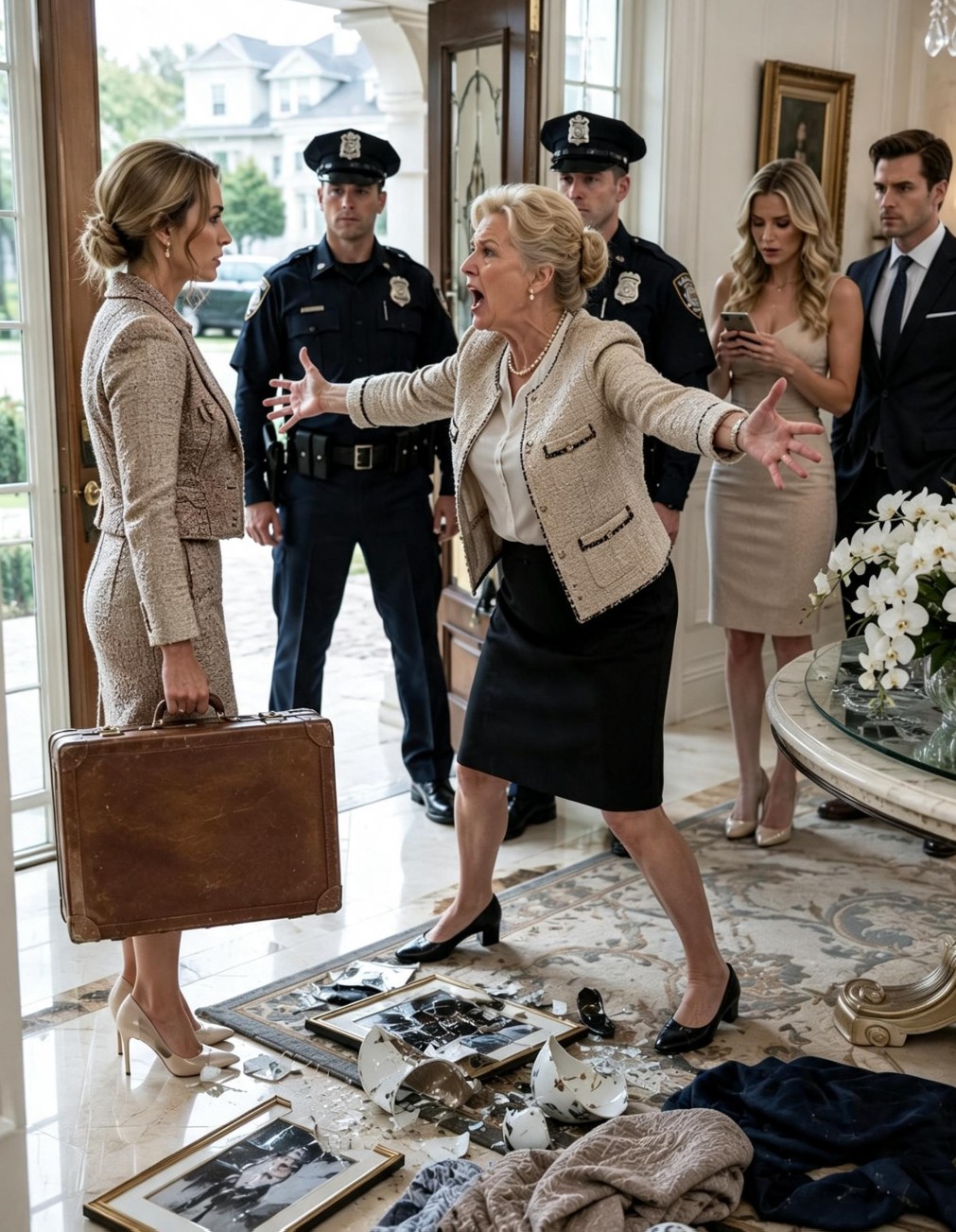
“Leave now, or I’ll call the police! My son bought this apartment for me!”
That was the shrill greeting I received before my second suitcase had even crossed the entryway.
For one confused moment, I wondered if exhaustion had finally made me lose touch with reality. I had just arrived on a long, delayed flight from Denver. My shoulder was throbbing from sleeping upright, and the zipper on my garment bag had completely broken between baggage claim and the parking garage. It was nearly eight on a gloomy Thursday evening in Phoenix, and all I wanted was to walk into my own home, kick off my shoes, drink cold water from a real glass, and collapse into bed for a full night of sleep.
Instead, Brenda Abernathy stood in the middle of my living room wearing a satin robe the color of curdled cream. Her hair was set in hot rollers, and she was holding a mug that had belonged to my late grandmother.
My grandmother’s mug.
It was white ceramic with delicate blue violets and a tiny chip on the handle. I had dropped it when I was twelve and cried because I thought I had ruined something precious. Grandma Beatrice had laughed, put a little adhesive over the crack, and told me, “Pretty things with chips still hold coffee, Faye. Don’t let anyone tell you different.”
Now Brenda had thick red lipstick smeared around the rim.
She stood there with the confidence of someone who truly believed the apartment belonged to her.
Behind her, my home had been turned into a horrible imitation of someone else’s taste. The framed photographs on my entry table were gone. The pictures of my parents at Lake Havasu, my sister Heidi laughing with powdered sugar on her face, and me standing outside the building on the day I bought the unit, holding my keys and a small grocery store bouquet, had all disappeared.
My cream linen pillows had been replaced by stiff, embroidered monstrosities that said things like Bless This Home and Family Is Everything. A lace cover had been draped over my dining room chandelier, as if Brenda had decided even my light fixtures needed to become respectable.
The entire apartment smelled like her perfume—a sickly mixture of stale roses and pure entitlement.
I lowered my suitcase handle.
“Brenda,” I said, keeping my voice dangerously calm.
“Do not Brenda me,” she snapped, tightening her white-knuckled grip on the porcelain mug. “You heard me. Get out of here right now, because this is my home.”
My name is Faye Tucker. I was thirty-one years old, in the middle of a separation from Brenda’s son, and standing inside the Phoenix apartment I had purchased three years before I ever met Dylan Abernathy.
I bought it with my own hard-earned money. The title was in my name. I renovated it using performance bonuses from the consulting firm Dylan constantly mocked until those same bonuses paid for our hardwood floors, upgraded kitchen appliances, built-in bookshelves, and the down payment he never contributed a single cent toward.
I had spent six weeks in a suburb of Minneapolis helping my younger sister recover from emergency surgery.
Apparently, six weeks was all Dylan and Brenda needed to turn my temporary absence into a hostile takeover.
“This is my apartment, not yours,” I said, trying to stop my voice from shaking.
Brenda laughed sharply.
“Oh, honey,” she said, stretching the word until it became an insult. “You really have no idea what is happening here, do you?”
I looked past her into the living room I barely recognized.
My linen curtains had been pulled back with ugly tassels I had never seen before. A framed needlepoint prayer hung where my favorite abstract painting had been. On the coffee table sat a pile of trashy gossip magazines, a half-eaten lemon cookie, and Dylan’s old law school mug, even though he had dropped out after one semester and still called it a “sabbatical from his destiny.”
“Where did you put my things?” I asked.
My blood had suddenly gone cold.
Brenda waved her manicured hand dismissively.
“They are in storage.”
“Where?”
“Somewhere safe enough for your clutter.”
“Brenda, answer me.”
Her eyes narrowed.
“You abandoned this place, Faye. You left my son all by himself, ran off to Minnesota, and expected the world to stop turning while you played nursemaid to your sister. Dylan made a logical decision. He decided it was time someone stable moved in and kept things in order.”
Stable.
That ridiculous word almost made me laugh.
Brenda Abernathy calling herself stable was like a forest fire claiming to be a fire-safety expert.
“Dylan made a decision about property he does not own,” I reminded her.
Her face flushed for a moment.
“My son bought this apartment for me,” she insisted, her voice getting louder. “He signed the papers. You have no right to come in here dragging luggage around like some common tenant. This is a family residence now, and you are no longer part of this family.”
I glanced toward the hallway.
No neighbors had appeared yet. But people in high-rise buildings have excellent hearing, especially on floors where everyone pretends to mind their own business while listening through the walls.
Brenda stepped closer, invading my space.
“You were never good enough for Dylan,” she sneered. “You know that, don’t you? All those spreadsheets, business suits, and little corporate trips. You thought earning a salary made you a wife. It didn’t. A wife is supposed to support her husband, not humiliate him by acting like she is the man of the house.”
There it was.
The ugly truth hiding beneath her expensive lipstick.
Dylan had been saying softer versions of the same thing for years.
At first, they were jokes.
“Faye is the CEO of our marriage,” he would say whenever I paid the mortgage. “She loves her little reports.”
Then the jokes became resentment.
“Not everything is a client presentation, Faye.”
Eventually, they became open mockery whenever one of his get-rich-quick schemes failed and my paycheck kept the lights on.
“Must be nice billing people six figures to tell them what color their charts should be.”
He never complained when my income paid off his credit card during one of his “temporary liquidity crises.” He never mocked my bonuses when they paid for the kitchen renovation he proudly called our upgrade in front of our friends. And he never complained about my spreadsheets when they organized our taxes, insurance, travel, and emergency fund—the same emergency fund he had tried to drain twice without telling me.
Brenda looked me up and down like I was a stain on her carpet.
“You are trash,” she said. “Expensive trash, perhaps, but still just trash.”
Something deep inside me suddenly went completely silent.
I had imagined my return differently.
I thought I might cry when I stepped back into the apartment. Even though Dylan and I were separated, the place still carried memories from the early years before our marriage became a constant struggle with a man determined to spend my security while resenting me for having it.
I had imagined touching the kitchen counter and remembering us painting cabinet samples at midnight, drinking cheap wine from coffee mugs and laughing because we truly believed adulthood would be difficult but fair.
I had not imagined his mother standing in my grandmother’s mug and calling me trash.
The strange thing about finally reaching the end of your patience is that it does not always feel like rage.
Sometimes it feels peaceful.
Like a final door clicking shut.
You stop searching for hidden kindness in people who have spent years showing you exactly who they are.
I placed my second suitcase beside the first.
Then I carefully laid my garment bag across both handles.
Brenda smirked.
She clearly thought my calm meant she had won.
“That’s right,” she said. “Take your little bags and get out.”
I opened the side pocket of my purse and took out my phone.
She kept talking.
She rambled about my ingratitude, about how Dylan was finally correcting the power imbalance, and about how women like me should not leave good men alone too long if we expected to return to the same arrangement.
Then she accused me of having “masculine energy,” which was her favorite way of insulting women who had the audacity to read legal contracts.
I let her talk.
Her words no longer had any power over me.
Then I pressed one button.
“Building security,” I said clearly when the front desk answered. “This is Faye Tucker in Unit 12B. There is an unauthorized occupant inside my apartment threatening me, and I need you to come up immediately with the building manager.”
Brenda froze.
Only for a second.
But that tiny hesitation told me everything.
She did not truly believe Dylan owned the apartment.
She had simply been gambling that I would panic before anyone looked at the paperwork.
For the first time that evening, I smiled.
“You have two minutes,” I told her, “to grab your purse and walk out on your own.”
She laughed directly in my face.
That was her biggest mistake.
One minute and forty-three seconds later, Brenda Abernathy stood in the hallway without my grandmother’s mug, shouting at security guards while my husband had no idea that the real disaster was only beginning.
That part would come next, after I opened Dylan’s file drawer.
But before I tell you what I found in that folder, you need to understand Dylan.
Dylan Abernathy did not look like a liar when we first met.
That was his greatest gift.
He looked like untapped potential—tall, charming, dark-haired, and quick with a self-deprecating joke. He was always slightly underprepared in a way that made competent women want to help him instead of running in the opposite direction.
We met at a charity finance panel where I was a featured speaker and he was supposedly between ventures.
I did not realize until much later that Dylan was always between ventures because his projects had a habit of collapsing the moment the bills arrived.
Afterward, he asked clever questions. Not the smartest questions in the room, but clever enough to catch my attention.
He told me he admired women who knew exactly what they wanted.
He said ambition looked good on me.
At thirty-one, I can tell you those words are dangerous when they come from a man who has not yet realized that he only admires ambition until it starts moving faster than he does.
In the beginning, Dylan praised the very things he later punished me for.
My discipline.
My savings.
My work ethic.
My independence.
And my apartment.
He especially loved the apartment.
I bought Unit 12B when I was twenty-seven. It was in a prime neighborhood with east-facing windows and two bedrooms, although the floors were covered in carpet so ugly that the listing photos should have come with a warning.
It was not glamorous when I bought it.
The kitchen had brown tile, and the bathroom mirror buzzed whenever the light was turned on.
But it was mine.
Every square foot belonged to me.
I had saved for years, taken on extra projects, skipped vacations, eaten far too many sad desk salads, and finally signed the closing documents with hands shaking so badly that the attorney asked if I needed water.
When those keys finally landed in my palm, I cried in the elevator like a woman who had just received citizenship in her own future.
My grandmother Beatrice had left me five thousand dollars when she died.
It was nowhere near enough for a down payment, but it covered the inspections and the first contractor deposit.
In her will, she had written:
“For Faye, who notices things. Use it to build something no one can take from you.”
I framed that sentence and kept it in my bedroom.
Dylan loved the apartment when he first saw it. He called it our future before we were even engaged.
I should have paid closer attention.
Men often reveal themselves through their pronouns.
Back then, I was too blinded by romance to notice the warning.
After we married, Dylan moved in with two suitcases, a record player, three boxes of business books, and enough confidence to fill closets faster than his clothes ever could.
I added him to the building’s resident access list because he was my husband.
But I did not add him to the deed.
I also refused to refinance with him because I had been raised by practical women and advised by a terrifying real estate attorney named Sheila Olson.
Before the wedding, Sheila tapped one red nail against the property acknowledgment form Dylan had already signed.
“Love your husband,” she told me. “Do not donate your premarital asset to the marriage just because he looks handsome in a linen suit.”
Dylan signed the acknowledgment easily.
Maybe too easily.
He was generous with signatures whenever he believed documents were nothing more than formalities and his charm was the only law that mattered.
For the first two years, we were mostly happy.
Mostly is a very important word in that sentence.
“Mostly happy” meant the bad parts were still small enough to explain away as stress.
Dylan’s reckless spending was just optimism.
His resentment was professional burnout.
His mother’s interference was misguided love.
His habit of making jokes about my career in public while asking me for money in private was simply insecurity that I could soothe if I was patient enough.
Brenda, however, was a problem from the beginning.
She never entered my home without looking for weaknesses.
She would run a finger along my shelves, rearrange my flowers, comment on the guest towels, and ask why I had not chosen warmer colors because “men like homes to feel soft.”
She treated Dylan like a misunderstood prince and me like a temporary administrator who had somehow been hired to manage his comfort badly.
At our first Thanksgiving as a married couple, she pulled me aside while Dylan watched football.
“You know,” she said, “men like Dylan need true admiration, not this cold management. You cannot treat him like a coworker.”
“I do not treat him like a coworker, Brenda.”
She gave me a sad smile.
“You do, dear. All these questions about budgets and timelines. You make him feel so small.”
Dylan had just used my personal credit card to pay for a business coach who taught him how to “activate his investor consciousness.”
I did not tell her that.
I simply smiled and refilled the gravy boat.
That was how Brenda worked.
She found a woman’s politeness and mistook it for weakness.
She mistook my silence for ignorance, my patience for permission, and my kindness for a door she could eventually push through with her luggage.
The separation began quietly.
Dylan’s latest investment idea involved private real estate syndication, although no actual real estate seemed to exist in any document he showed me.
He called it “community wealth architecture.”
Sheila called it “a fog machine filled with unpaid invoices.”
I asked questions.
Dylan became defensive.
I asked for bank statements.
That was when he accused me of not believing in his vision.
Eventually, I discovered a credit card he had opened in both our names without my knowledge. The signature looked like mine if viewed by someone with severe cataracts.
That was the first night I slept in the guest room.
Two months later, Dylan moved into a short-term rental nearby to give us space.
His idea of “space” seemed to mean he wanted the apartment’s comfort, the protection of my money, and none of my difficult questions.
Sheila drafted a separation agreement.
Dylan signed a property access acknowledgment confirming that he had vacated my premarital apartment and would enter only with written permission.
He rolled his eyes as he signed it.
“Faye,” he said, “you are so dramatic with this paperwork.”
“Yes,” Sheila replied before I could answer. “That is exactly why she still owns her home.”
A week later, my sister Heidi called from Minnesota.
Her emergency surgery had caused complications, and she needed help recovering.
I left for six weeks.
Before I left, I changed the guest-room sheets, unplugged the small appliances, gave a spare key to the building manager, Anita, for emergency access, and left Dylan off the entry list unless I gave written authorization.
Or so I thought.
I told Dylan I would be in Minnesota.
He said, “Of course. Family first,” using that particular voice he always used when saying something cost him absolutely nothing.
Then he and Brenda started making their move.
Getting Brenda out should have been harder than it was, but she certainly tried to make the whole thing dramatic.
By the time building security arrived, she had tied her satin robe tighter and lifted her chin into what I assumed was her courtroom face.
The closest Brenda had ever come to a real courtroom was watching daytime television at an unnecessarily high volume.
The first guard was a broad-shouldered man named Gary who had worked in the building for years and was rarely surprised by anything.
The second was a younger woman named Tasha. She kept one hand near her radio and her eyes fixed on Brenda.
Behind them came Anita, the building manager, wearing her usual navy blazer and carrying her tablet. Her expression was calm enough to cool hot soup.
“Ms. Tucker,” Anita said, turning toward me, “are you all right?”
“Yes, thank you.”
Brenda made an outraged sound.
“She is trespassing in my home!”
Anita calmly looked at her.
“And who are you exactly?”
“I am Brenda Abernathy. Dylan Abernathy’s mother. This is my residence.”
Anita raised one eyebrow by exactly one millimeter.
It was a devastating insult.
“I see,” she said.
Brenda pointed at me.
“She left! My son gave me permission to live here. He owns this apartment.”
“No,” I said clearly. “He does not.”
Brenda turned toward me with a hiss.
“You have no idea what papers have already been signed!”
That sentence immediately caught my attention.
No idea what papers have already been signed.
Interesting.
Brenda was not clever enough to lie smoothly.
When she became angry, she leaked the truth.
Anita tapped her tablet.
“Unit 12B is owned solely by Faye Tucker. It was purchased before your marriage, with no recorded transfer, no co-owner, and no lease or occupancy agreement for you, Mrs. Abernathy.”
Brenda’s face turned red.
“Dylan has rights! This is his marital home!”
“Dylan Abernathy is not listed as an owner, authorized resident, or approved occupant according to our most recent records,” Anita said firmly. “Ms. Tucker has requested the removal of an unauthorized person from her property.”
“I am his mother!”
Anita did not even blink.
“Mrs. Abernathy, your relationship to a man who does not own this property is irrelevant here.”
I almost applauded.
Brenda tried outrage first.
“This is elder abuse!”
“You are fifty-nine,” I said.
“This is harassment!”
“You are wearing my robe.”
“It is not your robe!”
“It is literally monogrammed with my initials.”
She looked down.
F.S.
She had not even noticed.
That was the problem with thieves who believed they were entitled to things.
They rarely bothered to read the labels.
Then came the inevitable tears.
Brenda covered her face and sobbed that she had nowhere to go. Her son had promised her the apartment. I was punishing her because my marriage had failed. Women like me were heartless. She had only wanted somewhere safe to stay. I was humiliating a mother.
Anita waited until the performance began to fade.
“Mrs. Abernathy,” she said, “you may collect your purse, phone, medication, and shoes. Any additional belongings can be retrieved later by appointment with Ms. Tucker or through your legal counsel. You will not remain in this unit tonight.”
Brenda’s eyes hardened.
“There are papers,” she hissed at me. “Dylan will fix this. You have no idea what you are interfering with.”
There it was again.
Not You have no idea how much this hurts.
Not You have no idea what Dylan promised me.
You have no idea what you are interfering with.
I stored the phrase in my memory.
Gary and Tasha escorted her toward the bedroom. Apparently, Brenda had placed two suitcases in my closet after shoving my clothes into garment bags and stacking them near the laundry room.
I did not follow.
I did not trust myself to remain calm if I saw my dresses treated like abandoned props.
Five minutes later, Brenda came out wearing her own clothes, although she had buttoned her cardigan incorrectly.
She carried a designer handbag, her phone, and a small cosmetics case.
She had left my grandmother’s mug on the coffee table.
Good.
If she had tried to take it, I might have discovered a temper I did not know I possessed.
At the door, she turned toward me one final time.
“You are trash,” she said again, but the venom was weaker now.
I looked at Gary.
“Please escort the trash out.”
Tasha coughed into her shoulder to hide a laugh.
Anita’s mouth twitched.
Brenda gasped as if I had slapped her.
Then the elevator doors closed on her fury.
The moment she was gone, I locked the door and leaned against it.
I was not crying.
I was not shaking.
I was simply listening.
The apartment was quiet again, but it did not feel peaceful.
It felt violated.
My home felt like a room after strangers had searched through every private drawer. The furniture was still in familiar places, but somehow it looked ashamed of everything that had happened around it.
Anita softened her expression.
“Faye,” she said, dropping the formal tone, “do you want us to stay while you look around?”
“Yes, please.”
I hated how quickly the answer came out.
She nodded.
“Of course we will.”
We walked through the apartment room by room.
In the bedroom, Brenda had moved into my side of the closet. My shoes had been shoved into laundry baskets. The framed line from Grandma Beatrice’s will was face down on the dresser.
My jewelry box had been opened, although nothing obvious was missing.
In the bathroom, Brenda’s creams and powders covered the counter.
She had even installed one of those horrible padded toilet-seat covers in the guest bathroom, which somehow offended me more than the possible fraud.
Then we entered the kitchen.
Brenda had completely rearranged my cabinets.
That almost broke me.
Not because cabinet placement matters in some great moral sense.
But because a home is made from small, unconscious certainties.
The mugs go here.
The knives go there.
The olive oil sits beside the stove.
After betrayal, even reaching for a glass and finding plates can make you feel like the world is telling you that you were gone too long and other people made decisions in your absence.
Anita photographed the condition of the apartment.
Security completed a full incident report.
I changed the locks through the building’s emergency locksmith while Anita stayed as a witness.
I revoked all visitor permissions connected to Dylan and Brenda.
Then I made tea in my own kitchen using a mug Brenda had not touched.
Anita stood near the island.
“Do you want to call someone?”
“I have someone.”
“An attorney?”
“Yes.”
“Good.”
After she left, I stood alone in the living room and looked at the evidence of what Brenda had done.
Her lace cover still hung from my chandelier.
I dragged a dining chair underneath it, climbed up, and pulled it down.
Then I threw it straight into a trash bag.
I did not destroy Brenda’s belongings because I am not reckless.
Her clothes, makeup, suitcase contents, and other items were photographed, inventoried, packed into clear storage bins, and moved into secure building storage under Anita’s supervision the next morning.
But the lace dust cover was mine to throw away.
No one could prove ownership of bad taste.
I took the trash outside.
Then I finally opened Dylan’s file drawer.
It was in what I had always refused to call his office.
The second bedroom had once been my guest room. Then it became his workspace. Then it became the place where dreams went to die under piles of unopened mail.
Dylan loved expensive pens, leather notebooks, and productivity systems with names like LegacyFlow and Executive Capture.
He believed stationery could give him competence simply by being nearby.
The bottom desk drawer was locked.
Dylan never locked anything unless he believed there was still time left to enjoy the lie.
I went to my bedroom safe and took out my envelope of backup keys.
I kept them because I had learned early in my career that “trust but verify” was too sentimental.
Verify first.
Trust when earned.
The third key opened the drawer.
Inside were folders, some labeled and some not. There were old bills, investor pitch decks, a half-finished loan application, and a copy of Dylan’s separation agreement covered in coffee stains.
Beneath a stack of glossy brochures for something called Abernathy Equity Partners, I found a blue folder.
The label read:
Transfer / Mother
I did not sit down immediately.
I stood there with the folder in my hands while the apartment seemed to shrink around me.
Then I opened it.
The first document was clumsy enough to insult my intelligence.
It was a Limited Property Authorization supposedly signed by me, giving Brenda Abernathy occupancy rights and access privileges to Unit 12B as a resident manager during my temporary relocation for work and personal reasons.
The signature at the bottom was mine.
Or rather, it was a forgery.
It had been scanned, lifted, and pasted from an old refinancing packet.
The ink density was wrong.
The angle was slightly off.
Dylan had never understood that a signature was not merely a shape.
It was pressure, hesitation, movement, and a human rhythm on paper.
The second page was a power-of-access letter giving Dylan authority to communicate with building management, utility companies, and insurers about family-controlled residential matters.
Family-controlled.
My apartment.
My throat went dry.
The third document made me sit down.
It was a business credit-line application.
The applicant was Dylan Abernathy, for Abernathy Equity Partners LLC.
The collateral and asset support listed was family-controlled residential property in Phoenix, with an estimated value much higher than the actual market value.
The property contact was Dylan Abernathy.
The secondary authorized resident was Brenda Abernathy.
The owner consent documentation was attached.
Attached.
My forged signature.
Dylan had not managed to transfer ownership because he was not that skilled.
But he had tried to create confusion.
A fog of occupancy and access.
Enough to make the apartment appear connected to him and his mother.
He wanted to create administrative chaos if I did not catch it immediately.
And that still was not the worst part.
Behind the application were emails.
They had been printed because Dylan trusted paper whenever he wanted to feel legitimate.
The emails referenced secured residential asset backing, family-held real estate leverage, and temporary capital bridges against his Midtown property position.
Not once did he mention that the property belonged entirely to his estranged wife, who had no idea her home was being used to support his collapsing private investment scheme.
I read every page.
Slowly.
Not because I needed time to understand them.
Because anger moves fast, and I wanted to be absolutely precise.
The apartment takeover had never been about Brenda needing somewhere to live.
That was only the performance.
The real plan was leverage.
Move Brenda in.
Establish apparent occupancy.
Use forged documents to make the property look jointly controlled.
Push the credit line through while I was in Minnesota.
If I discovered it afterward, Dylan could bury me under marital language, domestic confusion, and bureaucratic delays.
He thought I would spend days arguing with Brenda.
He thought I would focus on the insult and miss the structure underneath.
Dylan had always underestimated my profession.
He forgot that consultants are paid to walk into chaos, find the system, and identify where the money is leaking.
I photographed everything.
Every page.
Every email.
The folder label.
The locked drawer.
The forged signature beside the original signature from my saved refinancing packet.
The credit application.
The investor claims.
Then I called Sheila.
It was almost nine-thirty.
She answered on the fourth ring.
“Faye?”
“I need your litigation voice.”
“I have several, but I am listening.”
“The one that makes men regret paper.”
I explained everything.
She did not interrupt me once.
That was one of her greatest talents.
She listened the way surgeons cut—cleanly, without drama, but with total focus.
When I finished, she said, “Do not call Dylan yet.”
“I was about to.”
“I know. That is why I said it. Send me everything first.”
I did.
She reviewed the photographs while I walked through the apartment, trying to collect myself.
In my bedroom, I turned Grandma Beatrice’s framed sentence face up again.
Use it to build something no one can take from you.
I touched the frame.
Then my phone rang.
It was Sheila.
“Faye,” she said, “this is far worse than domestic stupidity.”
“I know.”
“This is potential fraud. Forgery, attempted unauthorized use of property, bank misrepresentation, and possible securities issues depending on what he told investors. Do you know whether the credit line was approved?”
“Not yet.”
“Good. We move before he corrects the lie. Do not let him inside.”
I looked toward the front door.
“He will not be coming in.”
Then I called Dylan.
He answered on the second ring, already sounding irritated.
“Did my mother calm down yet?”
I almost admired his confidence.
“No,” I said. “But security did.”
Silence.
Then he carefully asked, “What does that mean?”
“It means your mother is no longer in my apartment. It means the locks are changed. And it means I am holding the fake occupancy papers and your fraudulent credit application in my hand.”
The silence stretched.
Longer.
Much longer.
When he finally spoke again, his voice had changed.
It was not an apology.
Men like Dylan rarely began there.
It was fear.
“Faye,” he said, “do not overreact.”
I laughed.
“Too late. I am not reacting anymore. I am filing.”
“You went through my desk?”
“In my apartment.”
“That was private.”
“So was my signature.”
He inhaled sharply.
“Listen,” he said, dropping into the reasonable voice he used whenever he wanted a woman to feel irrational. “You do not understand what those documents are.”
“I understand them perfectly.”
“No, you don’t. The lender needed asset context. It was not a lien. It was not a transfer. It was just—”
“Fraud with formatting?”
“Stop using that word.”
“Fraud?”
“Faye.”
“Forgery?”
“Do not.”
“Unauthorized property misrepresentation?”
His breathing changed.
“Who have you told?”
There it was.
Not I am sorry.
Not I made a mistake.
Who have you told?
“My attorney.”
“Jesus Christ.”
“The bank is next.”
“You cannot do that.”
“I can.”
“You will destroy me.”
“No, Dylan. I am simply refusing to protect you from something you did.”
His voice dropped.
“We are still married.”
“Legally, yes.”
“You think that means nothing?”
“I think it means you had an even greater obligation not to forge my signature.”
He said nothing.
“Where are you?” I asked.
“On my way.”
“Do not come here.”
“This is my home.”
“No,” I said. “It was a place you lived because I allowed it. That permission is revoked.”
“You cannot lock me out of my marital residence.”
“You signed a separation and property access acknowledgment confirming that you vacated and had no ownership rights. Sheila has it. I have it. Building management has it.”
His silence became sharper.
He had forgotten the document.
Men like Dylan always forget the documents that work against them. They remember only the papers they think can be used as keys to get what they want.
“I will see you soon,” he said.
“No,” I replied. “You will see security.”
Then I hung up.
Dylan arrived at the apartment a little after nine.
I knew because Anita called from the front desk.
“Faye, Dylan Abernathy is in the lobby. Brenda is with him. He says he is coming up.”
“Let him up,” I said.
Anita paused.
“Are you sure?”
“Yes. With security. And please record the hallway camera.”
“Already saved.”
I almost smiled.
Anita was a woman after my own heart.
Before Dylan reached the twelfth floor, I called Sheila and put her on speakerphone.
Then I locked the deadbolt, the chain, and the secondary latch.
My suitcases remained near the foyer where I had dropped them.
The blue folder sat on the entry table.
My grandmother’s mug had been washed and placed safely on the top shelf, far away from Brenda’s lipstick.
The elevator dinged.
Footsteps.
Then Dylan knocked.
Not a normal knock.
A restrained pounding.
The kind a man uses when he wants to sound controlled while imagining the door splintering inward.
“Faye.”
I looked through the peephole.
Dylan stood in the hallway wearing his navy blazer, the one he used whenever he wanted to look respectable during a crisis.
His hair was slightly damp, probably from running his hands through it in the car.
Brenda stood near the elevator in a borrowed cardigan from the concierge, her face blotchy with humiliation and fury.
Gary stood several feet away with Tasha.
Good.
“Faye,” Dylan said again, this time more quietly. “Open the door.”
I stayed where I was.
“No.”
His jaw tightened.
“You are making this far worse than it needs to be.”
There it was.
Always.
Not I forged documents.
Not I moved my mother into your home.
Not I tried to use your property as financial scaffolding for my failing business.
Just my reaction.
My failure to quietly absorb his betrayal.
“I sent the documents to counsel,” I said through the door. “They are being sent to the bank’s fraud department and to your employer’s ethics address.”
That hit home.
His face changed so quickly that even through the peephole, I saw it.
“Why would you do that?”
It was such a Dylan question.
Why would the victim involve the institutions the liar depended on before they arrived too late?
“Because you forged my signature and tried to collateralize my property.”
“It was not collateralized. It was listed as support.”
“Explain that to the bank.”
He stepped closer.
“Open the door.”
“No.”
“Open the damn door!”
Sheila’s voice suddenly came from the speaker on the entry table.
Calm.
Lethal.
“Mr. Abernathy, this is Sheila Olson, counsel for Faye Tucker. You will not attempt entry. You will not contact the bank further. You will not represent any interest in Unit 12B to any lender, investor, insurer, resident, family member, or third party. If you continue, we escalate from civil fraud exposure to criminal referral before midnight.”
Dylan’s eyes flicked toward the door as if he could somehow see through the wood.
“You have your lawyer listening?”
“Yes,” I said.
Brenda finally found her voice.
“This is ridiculous! She is his wife!”
Sheila gave a soft laugh.
“No, Mrs. Abernathy. She is the sole owner of the apartment you were removed from earlier this evening. Your relationship to her estranged husband does not create property rights. It creates noise.”
Tasha looked down at her shoes to hide a smile.
Dylan tried another approach.
“That apartment is my marital residence,” he said.
Sheila answered immediately.
“No. It is her premarital property, solely titled, with documented ownership history, a signed property acknowledgment from you, and a separation agreement confirming you vacated voluntarily. You are standing outside a residence you have lost access to.”
Silence.
But this silence was different.
It was not strategic.
It was broken.
Because that was the real shock for Dylan.
Not his mother being removed.
Not the changed locks.
Not even the bank fraud report.
It was realizing that despite all his assumptions, all his posturing, and all those years of dismissing my caution as anxiety and my paperwork as obsession, I had built my life in ways he could not easily take over.
The home was mine.
The records were mine.
The proof was mine.
Even the timing was now mine.
Brenda began crying for real.
“Where are we supposed to go?”
I looked through the peephole at both of them.
One was furious.
The other was falling apart.
And I felt nothing uncertain.
“That,” I said, “is the first practical question either of you should have asked before trying to steal my apartment.”
Then I ended the call and walked away from the door.
Dylan remained in the hallway for another eleven minutes.
He tried knocking softly.
He called my phone.
He texted.
Faye, please.
You do not understand.
We need to talk privately.
My mother is humiliated.
I was under pressure.
This could ruin everything.
He never wrote:
I am sorry.
Not once.
Eventually, Gary told him he needed to leave the floor.
I heard Dylan argue.
Then Brenda sob.
Then the elevator doors opened and closed.
Only after the hallway became completely silent did I sit on the floor and shake.
That is another thing people misunderstand.
Calm does not mean you are not afraid.
Calm is what you do with fear when there is still work to finish.
I sat there shaking for exactly four minutes.
Then I stood, opened my laptop, and wrote the timeline Sheila had requested.
Dates.
Conversations.
Access permissions.
Separation agreement.
Minnesota trip.
Brenda in the apartment.
Security removal.
Folder discovery.
Dylan’s call.
Hallway confrontation.
Screenshots attached.
At two in the morning, I finally slept on top of my made bed in jeans and a sweater, with the blue folder inside my safe and my phone beneath my pillow like a weapon.
The next few weeks did not unfold like a movie.
There was no instant arrest.
No judge slamming a gavel the next morning.
No dramatic confession in a crowded lobby.
Real accountability moves through emails, certified letters, account freezes, legal filings, stern phone calls, and people suddenly discovering that paper matters after years of mocking it.
Sheila moved fast.
The bank froze Dylan’s credit application while it investigated.
His employer, a mid-sized investment advisory firm where he had recently been hired in a client-relations role, opened an ethics review after receiving the documents and investor emails.
His boss called him in for what Dylan later described as a “misunderstanding meeting.”
I know because he left me a voicemail using those exact words.
“Faye,” he said, his voice tight, “this has gotten completely out of hand. My firm thinks I misrepresented assets. You need to clarify that this is a marital dispute.”
I forwarded the voicemail to Sheila.
She replied with only three words:
“Helpful. Keep everything.”
Two days after the hallway confrontation, Brenda sent me a handwritten note.
It arrived without a return address, although her perfume announced her before I even opened the envelope.
Faye,
I know emotions ran high. I was told by my son that arrangements had been made. If there was confusion, that is between husband and wife. I should not have been embarrassed in front of strangers. A decent woman would have handled this privately.
Brenda
I sent it to Sheila too.
“Helpful,” she wrote again.
I began to understand how many people incriminate themselves because they believe manners matter more than accountability.
Dylan tried every door.
First came charm.
He left flowers with the concierge.
I refused delivery.
Then guilt.
My mother cried all night, he texted.
I replied through Sheila.
Then marital nostalgia.
He emailed me a photograph from our honeymoon in the islands.
The message said:
We were happy once.
Sheila asked whether I wanted to respond.
I said no.
Then came threats.
If you ruin my reputation, I will make the divorce hell.
Sheila replied formally:
“Mr. Abernathy, future threats will be attached as exhibits.”
He stopped threatening in writing after that.
The apartment took longer to reclaim than I expected.
I thought that once Brenda left and the locks changed, the place would immediately feel like mine again.
It did not.
Her presence lingered in tiny violations.
A drawer rearranged.
A missing spoon.
My linen closet smelling of her cheap sachets.
A lamp moved six inches.
My grandmother’s mug was clean, but somehow changed by memory.
I spent nights walking from room to room, putting everything back in its place.
Then I realized I was not simply restoring a home.
I was proving to myself that I still had the right to touch every object inside it.
Heidi came down from Minnesota as soon as she was cleared to travel.
She arrived with a cane, a duffel bag, and the expression of a woman ready to commit crimes on my behalf despite her recent abdominal surgery.
“I cannot lift anything over ten pounds,” she announced from the doorway. “But I can supervise vengeance.”
“No vengeance.”
“Fine. Strategic restoration.”
That was more accurate.
Together, we rebuilt the apartment.
Heidi sat on a barstool and directed me while I removed Brenda’s embroidered pillows and replaced mine.
We rehung my photographs.
We removed the needlepoint prayer.
We found my abstract print behind the washing machine because Brenda had apparently hated it enough to hide it but not destroy it.
Heidi held it in her lap like a rescued pet.
“Poor thing,” she said. “Kidnapped by beige people.”
I laughed for the first time since coming home.
We painted the guest room.
Not because it needed painting.
Because Dylan had spent too many years sitting in there pretending to build something while secretly dismantling mine.
I chose a deep green.
Heidi said it looked like “rich people’s moss.”
I accepted that.
One Saturday, Anita came over carrying a clipboard and a bottle of wine.
“I am off duty,” she said. “This is not from management. It is from me.”
She handed me copies of the updated resident-access logs, showing that all visitor permissions had been revoked, Dylan’s old keycard had been deactivated, and Brenda had been flagged for restricted entry unless accompanied by management and me.
“You did not have to do all this personally,” I said.
Anita looked around my apartment.
Then she looked back at me.
“I have worked in buildings like this for twenty years. Men who do not own units often speak with more confidence than women who do. It annoys me.”
We opened the wine.
I decided I liked her very much.
The divorce filing became official three weeks later.
Sheila filed for divorce, injunctive relief concerning the property representations, attorney’s fees, and preservation of financial records.
She attached Dylan’s property acknowledgment, the forged documents, the bank application, the investor emails, the hallway transcript from her speakerphone notes, and the building incident report.
Dylan’s attorney responded with the language I expected.
Marital misunderstanding.
No intent to defraud.
Temporary family housing arrangement.
Business application not finalized.
Wife acting vindictively due to separation.
Sheila read the response aloud in her office.
Then she removed her glasses.
“Do you know what weak men love calling women?”
“Crazy?”
“Besides that.”
“Vindictive?”
She smiled.
“Correct. It means you finally found the invoice.”
Sheila’s office was in a converted house near the city center, with creaking floors, framed diplomas, and a receptionist named Glen who looked like he could bench-press a refrigerator but knitted scarves at lunch.
I sat across from Sheila with a coffee and felt strangely calm.
“What happens next?” I asked.
“Discovery.”
“I thought that was a legal phase, not a threat.”
“With me, it is both.”
Discovery did what discovery always does.
It turned over rocks.
Dylan’s business was worse than I had imagined.
Abernathy Equity Partners was less a company than a collection of confident PDFs.
He had taken consulting retainers from acquaintances.
Borrowed money from Brenda’s retirement account.
Used the estimated value of my apartment in multiple pitch documents.
Claimed access to residential equity during investor calls.
Thankfully, he had not secured a lien.
But he had created enough false representations that several people now wanted explanations.
His employer terminated him within a month for ethics violations related to outside business activities and misrepresentation of personal assets.
He blamed me.
Of course he did.
“You did not have to send it to my job,” he said during our first mediation session.
We sat in a conference room with terrible lighting and a mediator who had clearly seen everything and been impressed by none of it.
Dylan looked tired.
Not dramatically.
His blazer hung loose.
His confidence had become something he had to consciously remember to perform.
Brenda was not there, but I could still feel her presence.
Sheila sat beside me with her pen ready.
I looked across the table at Dylan.
“You used my home to support a business lie,” I said.
“I was trying to fix things.”
“You were trying to use what I built without asking.”
“I was under pressure.”
“So was I. I did not forge your signature.”
His mouth tightened.
The mediator cleared her throat.
“Mr. Abernathy, this process will go more smoothly if we avoid minimizing language.”
Dylan turned toward her.
“I am not minimizing.”
Sheila slid a copy of the forged authorization across the table.
The mediator looked at it.
Dylan looked away.
That was when I realized something important.
He was not sorry.
Not really.
He was ashamed of being exposed.
He was frightened of the consequences.
He missed access.
He missed my competence, my home, my reputation, and my ability to make chaos manageable.
But he still did not understand that he had violated more than a legal boundary.
He had violated the most sacred thing I owned.
The life I had built before him.
During a break, Dylan approached me near the coffee station.
Sheila immediately stood.
“It is okay,” I said.
She did not sit.
Dylan held a paper cup he had not even filled.
“Faye,” he said quietly. “Did you ever love me?”
The question was so audacious that I almost answered too quickly.
Instead, I studied his face.
Once, I had loved that face.
Or at least the man I believed lived behind it.
I loved the man who danced with me in our half-renovated kitchen.
The man who brought me soup during a terrible flu.
The man who cried during our wedding vows.
The man who seemed proud of me before my strength became inconvenient.
I had loved him enough to excuse too much and explain away even more.
“Yes,” I said. “I loved you.”
His eyes softened.
For a moment, he probably thought he had found a door.
I closed it.
“But you loved what my life could do for you more than you loved me.”
He looked down.
“That is not fair.”
“It is exact.”
Sheila appeared beside me.
“Break is over,” she said, even though it wasn’t.
I loved her for that.
Brenda’s reckoning came from an unexpected place.
Not from me.
From Patricia Abernathy.
Dylan’s older sister.
Patricia lived in a neighboring state, taught high-school history, and had spent most of her life keeping a polite distance from her mother’s drama.
She called me one evening after Sheila forwarded a formal notice about Brenda’s attempted occupancy.
I considered ignoring the call.
Then I answered.
Curiosity is a flaw I have decided to keep.
“Faye,” Patricia said, “I owe you an apology.”
That surprised me enough to sit down.
“For what?”
“For believing my mother’s version too easily. She told me Dylan had bought her a condo and that you threw her out because you were bitter. I repeated some of it before asking questions.”
“Why are you calling now?”
“Because she asked me to store four boxes of her things from your apartment, and one of the boxes had your name on the inventory label. I am not a lawyer, but I can read.”
I closed my eyes briefly.
“She invaded my home.”
“I know that now.”
Patricia sighed.
“My mother has been making women pay for her disappointments since before Dylan was born. I should have recognized the pattern. I am sorry.”
An apology without a request attached is rare.
“Thank you,” I said.
“Dylan called too,” she added. “He wants money.”
“I am not surprised.”
“I told him no.”
That surprised me more.
“He said you ruined him.”
“What did you say?”
“That a man ruined by documents should have read them first.”
I smiled for the first time that day.
“Patricia, I think we would have gotten along if your family had allowed it.”
“I think so too.”
Later, Patricia provided a statement confirming that Brenda had admitted Dylan arranged the papers so she could move in before I returned.
Apparently, Brenda had said it proudly while drinking tea at Patricia’s kitchen table.
People like Brenda often confess to the wrong audience because they assume loyalty means complicity.
The divorce was finalized nine months after I found Brenda in my robe.
I kept the apartment.
That had never been seriously at risk once the records were clear, but hearing the judge confirm it still felt like air returning to a room.
Dylan accepted responsibility in a civil settlement for attorney’s fees, attempted unauthorized property representation, and financial misstatements.
The bank declined to pursue further action once the application was withdrawn and documented as fraudulent before approval, but they closed all pending business relationships with him.
His investors pursued their own remedies.
I did not follow every thread.
Some consequences were no longer my responsibility to monitor.
As part of the settlement, Dylan signed a permanent acknowledgment stating that he had no ownership, equity, access, or claim to Unit 12B.
Sheila called it “the paper version of changing the locks.”
I framed nothing from the divorce.
Not the order.
Not the settlement.
Not the acknowledgment.
Some victories belong in files, not on walls.
On the day everything became final, I came home alone.
The apartment was quiet.
My apartment.
The hardwood floors gleamed.
The deep-green guest room looked beautiful in the afternoon light.
My photographs were back on the console.
Grandma Beatrice’s mug sat on the shelf where it belonged.
The kitchen cabinets were arranged by my hand again.
The chandelier was blessedly free of lace.
On the island sat a small trash bag.
Inside were the last remnants of Brenda.
One forgotten embroidered pillow.
Two sachets.
A chipped decorative angel.
A lace doily I found under the guest bed.
And a wooden sign that said:
Home Is Where Mother Is.
I carried the bag downstairs myself.
Gary was at the front desk.
“All done?” he asked.
“All done.”
He nodded toward the trash room.
“Need help?”
“No,” I said. “This one is mine.”
I took the trash out.
Then I walked back upstairs feeling lighter than I had in years.
A few weeks later, Dylan asked to meet.
Sheila advised against it, which meant I considered it carefully before deciding.
We met at a public café near the park, crowded enough to be safe and quiet enough for final words.
Dylan looked older.
Not dramatically.
Consequences rarely make people unrecognizable all at once.
They sand off the shine first.
He stood when I arrived.
I did not hug him.
We sat.
For several minutes, he stirred his coffee without drinking it.
“My mother is staying with Patricia,” he said.
“Good.”
“Patricia is making her pay rent.”
“Excellent.”
His mouth twitched.
Almost a smile.
It disappeared quickly.
“I am working at a logistics company now,” he said. “Not finance.”
“That is probably healthier.”
He nodded.
“I wanted to say I am sorry.”
I waited.
He looked at me, then down.
“I am sorry I forged the documents,” he said. “I am sorry I moved my mother in. I am sorry I tried to use the apartment. I am sorry I made your home feel unsafe.”
It was a better apology than I expected.
Not complete.
But better.
“I believed,” he continued slowly, “that because we were married, what you had was somehow partly mine to use to solve my problems. Even after signing that it wasn’t. I thought the paperwork was just paperwork.”
“It was protection.”
“I know that now.”
“You should have known it then.”
“Yes.”
He swallowed.
“I was jealous of you.”
That surprised me.
“Of the apartment?”
“Of all of it. The apartment. Your career. Your certainty. The way people took you seriously. The way you always had records, plans, backups. I told myself you were cold because it was easier than admitting you were capable in ways I was not.”
I looked out the window at people crossing the street in the bright afternoon sun.
“Your jealousy almost cost me my home.”
“I know.”
“No,” I said. “You know it as a consequence. I need you to understand it as a violation.”
He nodded.
“I violated your life.”
There it was.
Not enough to undo anything.
But enough to end honestly.
“I hope you become someone who never needs to shrink a woman to feel like a man,” I said.
His face tightened.
“I am trying.”
“Then keep trying when it stops getting you sympathy.”
We parted outside the café.
He looked like he wanted to say more.
I walked away before he could.
I did not need more.
That evening, I hosted dinner in Unit 12B.
Not for Dylan.
Not for Brenda.
Not for anyone who believed my home was a resource they could simply reassign.
Heidi came.
Anita came.
Sheila arrived with a bottle of wine so expensive that I accused her of billing me for it.
Patricia Abernathy came too.
It might sound strange, but sometimes the people connected to your pain are also the ones who help confirm the truth of it.
She brought a homemade cobbler and apologized for being related to Brenda.
I accepted the apology as both unnecessary and reasonable.
We ate around my dining table beneath the chandelier.
The chandelier held only light.
No lace.
No dust cover.
No insult.
At one point, Heidi lifted Grandma Beatrice’s mug.
“To pretty things with chips,” she said.
I stared at her.
She smiled.
“You told me the story when I was sixteen.”
I had forgotten.
Everyone raised a glass.
I did not cry then.
I came close.
Later, after everyone left, I stood by the windows overlooking the city.
Lights spread across the horizon like proof of other lives continuing in every direction.
Cars moved below.
Elevators hummed inside the walls.
Somewhere, someone laughed on a balcony.
I thought about how people like Dylan and Brenda do not take your life all at once.
They move in through assumptions first.
A key.
A joke.
A drawer.
A bill.
A mother in your robe.
A signature copied from one page to another.
They depend on confusion, guilt, and domestic pressure to keep you focused on the insult while they take the structure underneath.
They count on the fact that most decent people would rather argue than document.
Rather explain than escalate.
Rather be seen as reasonable than be safe.
But I had been raised by a grandmother who glued chipped mugs and told me never to let anyone question what still held.
I had built my life carefully.
And when they tried to take it, I did not scream.
I did not beg.
I did not debate ownership with a woman wearing my initials on my robe.
I called security.
I called my lawyer.
I opened the drawer.
I kept the proof.
And when Brenda called me trash, I took the trash out.
THE END.
