
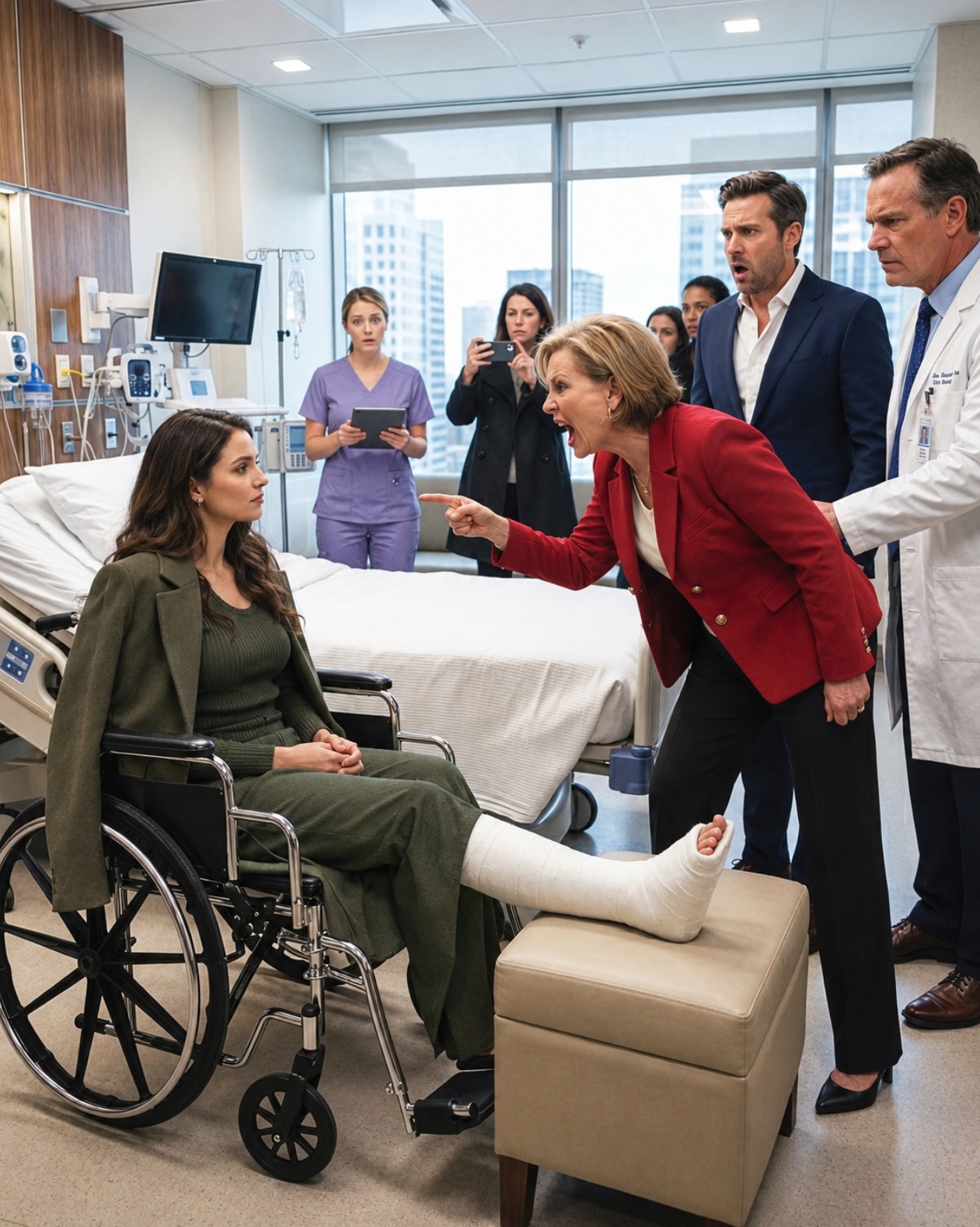
Part 1: The Night My Mother-in-Law Broke My Leg
My name is Elena Harper, and I was twenty-nine years old when my mother-in-law shattered my leg with a rolling pin.
But the broken bone wasn’t what destroyed me the most. It was hearing my own husband calmly say that I deserved it.
I fell sideways onto the cold kitchen floor, my palm landing in the avocado salsa we’d had with dinner. A burst of pain shot through my lower leg and up into my chest. It was so intense that I couldn’t even scream. I could only gasp for air as Linda Carter stood over me, gripping the rolling pin as if I were an intruder in her home instead of her own son’s wife.
“Maybe now you’ll learn not to embarrass me in front of my son,” she said coldly.
All I’d done was mention that the soup was too salty and that Frank, my father-in-law, shouldn’t be eating so much salt because of his blood pressure.
In most families, that would have been considered a simple expression of concern. In the Carter household in San Antonio, Texas, it was treated like an act of betrayal.
Linda had always believed that nobody had the right to question her. Not her husband, not her son, and certainly not me. I had learned that lesson many times during the three years I’d been married to Ethan.
But that evening, her anger crossed a line I never imagined she would cross.
I lay on the floor, shaking and struggling to breathe. My lower leg was twisted at a terrible angle, and every small movement sent another wave of pain through my body.
Frank stood near the refrigerator with his arms folded tightly across his chest. He stared at my injured leg, but he didn’t move to help me.
He didn’t even ask if I was all right.
“Ethan,” I whispered, my voice trembling. Cold sweat ran down the back of my neck. “Please… take me to the hospital.”
My husband appeared in the kitchen doorway, holding his phone. He was still wearing his office clothes, including his neatly pressed white shirt and dark slacks. His expression was the same tired, irritated look he always wore whenever I needed something from him.
Over the previous three years, I’d watched him change from a loving partner into a man who judged almost everything I did. The way I spoke, the clothes I wore, the friends I contacted, and even the way I spent my own money had become reasons for arguments.
I’d spent months convincing myself that he was simply stressed about work. I told myself that his mother’s behavior was the real problem and that, eventually, Ethan would stand up for me.
That night, the last of those excuses disappeared.
He looked at me lying on the kitchen floor.
“What did you do this time?”
I stared at him in disbelief.
“Your mother broke my leg!”
Ethan lowered his eyes toward my injury.
There was no panic in his face. No urgency. No concern.
He looked annoyed, as though my pain had interrupted his evening.
“You always overreact,” he said.
“I can’t move it!” I cried. “Ethan, please. It hurts so much!”
He finally crouched beside me.
For one brief moment, I thought he was going to help me. I thought he might put an arm around me, call an ambulance, or at least show some sign that he cared whether I lived or died.
Instead, he grabbed my chin between his fingers and forced me to look at him.
“Claire, how many times have I told you?” he demanded. “In this house, you obey.”
My name was Elena Harper.
Hearing him call me Claire in that moment was so strange that, even through the pain, I noticed it. He had been angry enough to stop using my name correctly, as if I were just another person he could order around.
I was twenty-nine years old. I was educated, successful, and earning more money than my husband. Before marrying Ethan, I’d been independent and confident. I’d made my own decisions, paid my own bills, and never needed anyone’s permission to live my life.
Yet, on that kitchen floor, I felt like a helpless child being punished for daring to speak.
Linda let out a sharp laugh.
“Did you hear her?” she asked Ethan. “She still acts like she’s the saint here. Ever since she married into this family, she’s thought she’s better than us because she went to college.”
“That’s not true,” I whispered. “I was only trying to help Frank.”
“Don’t you dare tell me what you’re doing!” Linda snapped.
Ethan stood up and wiped his fingers on his pants.
“Mom, that’s enough. She got the message.”
For one brief second, I grabbed onto those words like a lifeline.
Maybe he was finally going to stop her. Maybe he had realized how badly she had hurt me. Perhaps he would help me get medical attention, and we could deal with everything else later.
Then he spoke again.
“She can stay there tonight and think about what she did. We’ll deal with the hospital tomorrow.”
I stared at him.
“Ethan, my leg is broken!”
“Maybe you should’ve thought about that before disrespecting my mother.”
Linda nodded as if he had delivered a perfectly reasonable answer.
Then they walked out of the kitchen and returned to the living room.
I heard the television playing a football game. Dishes clattered together, and their voices mixed with the sound of laughter drifting through the house.
They were carrying on with their evening as though nothing unusual had happened.
As though a broken woman on the kitchen floor were simply another inconvenience they had decided to ignore.
My purse was in the dining room. My phone, debit cards, and identification were all inside it.
Linda had been keeping those things from me for months, claiming she was protecting me from making irrational decisions. She would take my cards and put them somewhere I couldn’t reach. Ethan always supported her, insisting that it was for my own good.
At first, I’d thought their behavior was temporary. I believed that if I stayed calm, avoided arguments, and tried harder to please them, things would eventually improve.
But I had already learned how dangerous that belief could be.
Several months earlier, I had lost a pregnancy at ten weeks.
I’d started experiencing pain and bleeding, and I’d begged Ethan to take me to a doctor. Instead of getting help immediately, he and Linda had spent hours arguing with me, accusing me of exaggerating my symptoms and making a scene.
By the time I finally received medical attention, the pregnancy was lost.
I still remembered sitting in the hospital afterward, staring at the empty space beside me where Ethan should have been holding my hand.
He had blamed me for that, too.
Linda said I was too emotional. Ethan said I needed to stop making everything about myself.
And now, with my leg shattered on their kitchen floor, I understood something I had tried desperately to deny.
In that family, my suffering would always come last.
I was expected to obey, remain quiet, and accept whatever they decided to do to me.
Even if it destroyed me.
Time became strange and heavy.
I couldn’t tell how many minutes passed. Sometimes the pain became so overwhelming that everything went dark. When I regained consciousness, I could hear voices coming from the living room.
At one point, I heard Ethan laugh.
Then he said something that made my blood run cold.
“You have to put women in their place early, or eventually they walk all over you.”
I lay motionless, staring at the kitchen cabinets.
For years, I’d been trying to become the wife he wanted. I’d changed how I dressed, watched what I said, stopped seeing certain friends, and learned to keep my opinions to myself.
I’d convinced myself that love meant compromise. That marriage required patience. That if I endured enough, the man I’d fallen in love with would eventually return.
But listening to him that night, I realized he had never been waiting for me to become a better wife.
He had been waiting for me to become easier to control.
Something inside me snapped.
Or perhaps it finally woke up.
I stopped waiting for someone to save me.
If I wanted to survive, I would have to save myself.
I turned my head toward the lower kitchen cabinets and began dragging myself across the floor.
Every inch felt like fire tearing through my body. I bit down on my lip to keep from screaming, terrified that Ethan or Linda might return and discover what I was doing.
I knew I couldn’t reach the front door. They were in the living room, and my purse was too far away. Even if I somehow managed to get outside, I had no phone to call for help.
Then I remembered the old back door.
There was a metal grate near the bottom of the door, an outdated security feature that had never been properly maintained. Some of its screws were already loose, and the frame had begun to rust.
I had noticed it months earlier while helping clean the kitchen.
At the time, it had seemed like an ordinary household problem.
Now, it might be my only chance.
I pulled open a drawer and searched through the utensils until I found an old, rusted can opener. My hands trembled so badly that I nearly dropped it.
I dragged myself toward the back door and began working at the loose screws.
It was slow, painful work. My injured leg throbbed with every movement, and my arms shook from exhaustion. The metal scraped against my fingers, cutting the skin as I struggled to loosen the old fasteners.
I kept stopping to listen.
Each time I heard a sound from the living room, I froze.
Once, I heard footsteps approaching the kitchen. I pressed myself against the cabinets and held my breath until the footsteps moved away.
Then I continued.
At last, the grate came loose enough to create a narrow opening. It was far too small for most people to fit through, but I had lost so much weight during my years in that house that I could squeeze through if I turned my body carefully.
I pushed my upper body through first, then pulled with my arms until I was outside.
When I dropped into the backyard, pain exploded through my leg so violently that my vision turned white.
For several seconds, I couldn’t see anything.
I lay in the damp grass, gasping, with tears running down my face.
Part of me wanted to stay there forever. I had no strength left, and every movement seemed impossible.
But I knew that if I stayed where I was, Ethan or Linda might find me.
I had to keep moving.
Mrs. Greene lived next door. She was an older woman who had always treated me kindly. Whenever we met outside, she asked how I was doing and seemed to notice the sadness I tried so hard to hide.
I’d never told her the full truth about my marriage. I’d been too embarrassed, too frightened, and too convinced that nobody would believe me.
Now, she was my only hope.
Her house was only a short distance away, but getting there felt like crossing an entire city.
I dragged myself across the wet ground using my elbows and hands. My injured leg trailed behind me, sending waves of pain through my body.
The grass scraped my skin. Dirt stuck to my palms. My fingers began to bleed.
I kept going.
Every time I wanted to stop, I pictured Ethan standing in the kitchen doorway, looking down at me with that cold expression.
I pictured Linda holding the rolling pin.
And I remembered what Ethan had said.
I deserved it.
No.
I would not die in that backyard because those people believed they had the right to destroy me.
By the time I reached Mrs. Greene’s porch, I could barely lift my hand.
I knocked once.
Then again.
The door opened, revealing Mrs. Greene in a pale blue sweater wrapped around her shoulders.
She looked down at me.
For a moment, she seemed unable to understand what she was seeing. Then her hand flew to her chest.
“Oh, my God! Elena!”
“Help me,” I whispered.
Her face changed instantly.
“Don’t move, sweetheart. Don’t you dare try to move.”
She dropped to her knees beside me, careful not to touch my injured leg.
“What happened to you? Who did this?”
I tried to answer, but the darkness was already closing in.
The last thing I heard before I lost consciousness was Mrs. Greene shouting for help while reaching for her phone.
Then she muttered furiously, almost as if she were speaking to herself.
“That family again. But this time, somebody’s finally going to stop them.”
And then everything went black.
Part 2: The Hospital Room They Couldn’t Find
When I woke up, I was beneath bright fluorescent lights.
For a few seconds, I had no idea where I was. My mouth was dry, my head felt heavy, and my injured leg was wrapped in a thick immobilizing splint.
A nurse sat beside my bed, gently squeezing my hand.
“Elena? Can you hear me?”
I blinked several times.
“Where am I?”
“You’re in the hospital, sweetheart. You’re safe right now.”
Safe.
The word felt unfamiliar.
I looked down at my leg, but the splint and blankets prevented me from seeing much.
Then the memories came rushing back.
The kitchen floor. The rolling pin. Ethan’s face. Linda’s laughter.
I tried to sit up, but the pain immediately forced me back against the pillow.
“Easy,” the nurse said. “Don’t try to move your leg.”
“Who brought me here?”
“Your neighbor, Mrs. Greene. She called 911 and stayed with you until the ambulance arrived.”
I closed my eyes in relief.
Mrs. Greene had saved my life.
A little later, Dr. Reynolds entered the room. He was a middle-aged man with tired eyes and a calm voice. He pulled a chair beside my bed and reviewed my medical records before speaking.
“Elena, you have fractures in both the tibia and fibula in your lower leg. Those are the two bones between your knee and ankle. The injuries are serious, and you’ll need surgery to stabilize them.”
I swallowed nervously.
“Will I walk again?”
“We’ll do everything we can to help you recover. But I want you to understand that this is a significant injury. Recovery will take time, and you may need physical therapy for several months.”
I nodded, trying to process his words.
Then he became more serious.
“We also need to discuss how this happened. Based on your injuries and what we’ve been told, we may need to notify law enforcement.”
My heart began pounding.
“Not yet,” I whispered.
Dr. Reynolds looked at me carefully.
“Elena, I understand that this is frightening. But you deserve protection.”
“I know. I just need a little time.”
I took a shaky breath.
“First, I need them looking for me.”
He frowned slightly.
“Who?”
“My husband and his family. They think I’m still in that house, or they might think I’ve run away. I need them to believe they don’t know where I am.”
The nurse, Emily, exchanged a concerned glance with the doctor.
I could see that they didn’t fully understand my plan. How could they? They had only just met me.
But I knew Ethan.
If he discovered where I was before I had protection in place, he would come looking for me. He would tell the hospital that I was unstable, that I’d injured myself, or that I was making up stories to punish his mother.
He had spent years teaching me to doubt myself.
I wasn’t going to let him do it again.
Dr. Reynolds didn’t promise to keep everything secret, but he agreed to discuss the safest way to handle my situation with the hospital’s appropriate staff. Emily also explained that they could restrict information about my location and take steps to protect my privacy.
For the first time since the attack, I felt a small measure of control returning to my life.
Then I asked for a phone.
Mrs. Greene had brought an old spare phone for me, and the hospital staff helped me use it. My hands were shaking as I dialed my parents’ number in North Carolina.
My mother answered.
“Hello?”
“Mom?”
There was a brief silence.
Then I heard her gasp.
“Elena? Sweetheart? Is that you?”
I tried to speak, but my voice broke.
“Mom, I need you.”
She burst into tears.
“Oh, my God! What’s happened? Are you hurt? Where are you?”
“I’m in the hospital.”
“Which hospital? We’re coming right now!”
I closed my eyes.
I wanted nothing more than to hear my mother holding me, telling me that everything would be all right. But I also knew that I needed to be careful.
I explained what I could, telling her that Ethan and Linda had hurt me and that I needed help getting away from them permanently.
My mother kept crying as I spoke.
When I finished, she passed the phone to my father.
His voice was different. It was quiet, controlled, and steady.
“Tell me what you need, sweetheart.”
That simple question nearly broke me.
For three years, I’d been told that my needs were unreasonable. That I was too sensitive, too demanding, too difficult to please.
My father wasn’t asking me to justify myself.
He was asking how he could help.
“I need a lawyer,” I told him. “I need copies of my bank records. I need the medical files from when I lost the pregnancy. And I need somewhere safe to live when I leave the hospital. Somewhere Ethan can’t reach me.”
“You’ll have all of that,” he promised. “Your mother and I are coming. You don’t have to face this alone.”
For the first time in years, I allowed myself to cry without feeling ashamed.
Over the next several hours, my parents began making arrangements. My father contacted an attorney, while my mother gathered the documents I had requested from their home records and helped organize the information I needed to establish what had happened during my marriage.
They also worked on finding a safe apartment where Ethan wouldn’t know my address.
I had spent so long believing that I was trapped that it was difficult to accept how quickly things could begin to change once someone finally stood beside me.
Later that day, Attorney Collins arrived at the hospital carrying a black leather folder.
He was a serious-looking man with gray hair, a neat suit, and the kind of calm expression that made me feel he was listening to every word.
He introduced himself, pulled a chair beside my bed, and asked me to tell him what had happened.
So I did.
I told him about Linda controlling my debit cards and identification documents. I explained how my salary had been drained into the family household, even though I had earned more than Ethan. I described the threats, the isolation, and the way my husband had gradually turned every disagreement into a reason to punish me.
Then I told him about the miscarriage.
I explained how I’d begged for medical attention and how hours had passed before I received it. I described the loneliness I’d felt afterward, when the people who should have supported me instead blamed me for what had happened.
Finally, I told him about the kitchen.
I described the soup, the rolling pin, the pain, and Ethan standing over me while I begged him to take me to the hospital.
I told him how his mother had walked away, how Frank had watched without helping, and how I’d been left on the floor while they continued their evening.
I explained how I’d crawled through the backyard and dragged myself to Mrs. Greene’s house.
When I finished, Collins remained silent for several seconds.
Then he closed his folder.
“What you’re considering is dangerous,” he said.
“I know.”
“If we move forward, your husband and mother-in-law may try to discredit you. They may claim you are unstable, that the injury was an accident, or that you’re inventing allegations because you want a divorce.”
“They’ll say whatever they need to say.”
“That’s likely. We need evidence, and we need to protect you before confronting them any further.”
I looked down at my injured leg.
“Staying there was more dangerous.”
Collins held my gaze for a moment before nodding.
“Then we’ll proceed carefully. First, we’ll secure the records and preserve every piece of evidence we can. We’ll also make sure the hospital understands that your safety is a priority.”
For the first time, I had a plan.
Not a desperate hope that Ethan would change. Not another promise to myself that I would try harder.
A real plan.
And it began on the third day after the attack.
By then, I had undergone the necessary initial treatment, and the medical team was preparing for the next stage of my care. With the hospital’s assistance, I was moved to another room, and arrangements were made to keep my location confidential.
Only a small number of people knew where I had been moved.
Ethan, Linda, and Frank were not among them.
That afternoon, I was sitting in a wheelchair behind a partially open door when I heard familiar voices approaching the nurses’ station.
My stomach tightened.
Ethan had arrived.
He wasn’t alone. Linda and Frank were with him, carrying a basket of fruit as if they were visiting a relative after a minor illness.
I could see them through the narrow opening.
Ethan walked up to the nurses’ station with an impatient expression.
“Where’s my wife?”
Emily was standing behind the counter.
“May I ask your name?”
“Ethan Harper. I’m her husband.”
Emily checked the information available to her, then looked up.
“The patient has requested privacy.”
Ethan stared at her.
“Privacy? I’m her husband!”
“I’m sorry, but I can’t disclose information about a patient whose location is being kept confidential.”
Linda slammed her hand onto the counter.
“Privacy? She’s my daughter-in-law! What kind of hospital refuses to tell a husband where his wife is?”
Emily remained calm.
“Ma’am, I understand you’re upset, but I can’t discuss her location with you.”
Linda turned toward the people sitting nearby.
“She’s probably run off to make herself look like a victim! That’s what she does. She creates problems and then blames everyone else!”
Several people began looking in their direction.
Frank shifted uncomfortably, glancing around as though he wanted to disappear.
Ethan lowered his voice, trying to sound reasonable.
“Look, there must be some misunderstanding. My wife is emotional. She’s been under a lot of stress. We just want to make sure she’s all right.”
Emily didn’t move.
“If you have concerns, you can speak with the appropriate hospital representative. I still can’t tell you where she is.”
Linda opened her mouth to argue again, but Dr. Reynolds stepped out of his office before she could continue.
He looked at the three of them with a serious expression.
“Mrs. Harper was moved for her protection,” he said. “Her injuries are consistent with significant blunt-force trauma, and she has expressed fear of returning home because of domestic abuse.”
Ethan went pale.
“Doctor, this is all a misunderstanding.”
“It doesn’t appear that way,” Dr. Reynolds replied. “The pattern and severity of her fractures are not consistent with an ordinary minor fall. We are documenting her injuries carefully.”
Linda’s face darkened.
“She’s insane! She’s always been dramatic. She probably did something to herself and decided to blame me!”
Dr. Reynolds didn’t raise his voice.
“Your allegations don’t change the medical evidence. If you have further questions, please direct them through the proper channels.”
People nearby had begun whispering.
“Isn’t that the family who left her injured?”
“I heard she had to crawl to a neighbor’s house.”
“They look so respectable. That’s disgusting.”
Ethan heard them.
For the first time, he seemed less concerned about finding me than about the possibility that other people might discover what he had done.
His eyes darted toward the people watching him. His jaw tightened, and his confident expression began to crack.
Frank grabbed Linda’s arm.
“Come on,” he muttered. “Let’s go.”
Linda tried to pull away.
“I’m not leaving until I see her!”
“Linda, enough,” Frank whispered.
He finally managed to steer her toward the elevator. Ethan followed, casting one last furious look at the nurses’ station.
As soon as they were gone, I quietly closed the door.
I didn’t feel victorious.
I felt focused.
For years, I had been forced to react to whatever they did. Every argument, every insult, every threat had kept me trapped in a cycle of fear.
Now, for the first time, they were the ones facing questions they couldn’t control.
And I wasn’t going to waste that opportunity.
Part 3: The Call That Exposed Everything
That afternoon, my phone rang.
The number was blocked, but I already knew who it was.
I answered and pressed the record button before speaking.
“Hello?”
“Ethan’s voice came through immediately.
“Where are you?”
I stared at the wall.
“So your mother can finish the job?”
“Stop being dramatic,” he snapped. “It was an accident. You caused this by provoking her.”
I felt my fingers tighten around the phone.
“My leg is broken, Ethan.”
“And because of you, I’m having problems at work!”
For a moment, I couldn’t believe what I was hearing.
His wife had been left with two fractured bones. He had abandoned me on a kitchen floor and refused to get me medical attention. Yet somehow, in his mind, he was the victim because his workplace might find out what had happened.
“You left me there,” I said quietly.
“You need to stop exaggerating. Mom didn’t mean for this to happen.”
“She hit me with a rolling pin.”
“Because you wouldn’t stop disrespecting her!”
I closed my eyes.
There it was again. The same excuse. The same twisted logic that had kept me silent for years.
In Ethan’s world, his mother’s anger was always my fault. Her actions were always justified. And my pain was simply the price I had to pay for failing to obey.
Then his voice changed.
“If you talk about this, your parents will suffer too.”
I felt a chill run down my spine.
“What does that mean?”
“Don’t play dumb, Elena. I know where your parents live. I know how to make their lives difficult. You don’t want to find out what happens when you turn this into a public fight.”
I said nothing.
He continued, growing more confident with every second.
“I’ll find you. You can’t hide from me forever. And don’t forget that your money is still tied up in everything we’ve built together. You won’t get a cent if you decide to destroy this family.”
He paused, then lowered his voice.
“I can tell everyone you’re mentally unstable. People already know how emotional you are. Who do you think they’ll believe? You, with your dramatic stories? Or me, with my job and my reputation?”
I let him talk.
Every threat was another piece of evidence.
Finally, his tone softened, as if he had decided that kindness might work better than intimidation.
“Come home, Elena. We can fix this. Mom will apologize.”
I almost laughed.
After everything that had happened, he still believed he could order me back into the house and pretend nothing had changed.
“My attorney will contact you regarding the divorce,” I replied.
“What?”
“You heard me.”
“Elena, don’t you dare—”
I ended the call.
For several seconds, I sat completely still, listening to my own breathing.
Then I sent the recording to Collins.
His response came shortly afterward.
“Keep the original recording and don’t edit it. We’ll preserve it as evidence and discuss the proper steps for using it.”
I looked at the phone in my hand.
For the first time, I had something Ethan couldn’t take away simply by telling me I was lying.
His own words had exposed him.
That evening, the situation escalated far beyond anything I had expected.
An anonymous post began spreading online. It described a technology manager in San Antonio who allegedly abused his wife, controlled her finances, and left her with a broken leg after an attack by his mother.
The post included a photograph of an X-ray showing my fractures. My face wasn’t visible, but Ethan’s name was included.
I hadn’t written the post myself, and I didn’t know who had published it. By the time I learned about it, people were already sharing it and demanding answers.
Collins immediately warned me not to respond to online accusations or publish private information without reviewing it with him. We had a legal case to build, and I couldn’t allow an online argument to distract from the evidence.
But the story was already spreading.
Ethan’s employer learned about the allegations and called him into an emergency meeting. His company handled sensitive technology projects and held government contracts, so allegations involving threats, possible financial misconduct, and domestic violence created a serious problem for its management.
Meanwhile, Linda returned to the hospital.
This time, she arrived shouting that I was being kidnapped.
“Where is she?” she demanded. “What have you done with my daughter-in-law?”
The hospital staff refused to reveal my location.
Linda became increasingly aggressive, accusing the nurses of hiding me and claiming that Collins had manipulated everyone against her family.
Emily documented the incident according to the hospital’s procedures.
“Ma’am, you need to lower your voice,” she told Linda. “You cannot threaten or harass our staff.”
Linda pointed a finger at her.
“You have no idea who you’re dealing with! If my son loses his job because of that woman, I’ll kill her myself!”
The words were loud enough for several people nearby to hear.
When security intervened, Linda dramatically collapsed onto the floor, closing her eyes and pretending to faint.
For a moment, people stepped toward her, unsure what to do.
Then she opened one eye to see whether anyone was paying attention.
A hospital employee called for assistance, and staff followed the appropriate procedure to make sure she wasn’t experiencing a medical emergency. When it became clear that she was responsive, security continued managing the disturbance.
Nobody was fooled by the performance.
When the police arrived, the hospital staff provided their accounts of what had happened. Emily also explained the earlier confrontations and the attempts to locate me despite my privacy request.
I remained in my protected room, listening as the commotion gradually faded.
Then my phone buzzed.
It was Collins.
“We have recordings, witnesses, medical evidence, and documentation of the hospital incidents. His employer is also taking the allegations seriously. We can now move to the next phase, but we’ll do it through the proper legal channels.”
I stared at the cast wrapped around my leg.
For years, the Carters had controlled the story of my life. They had decided what I was allowed to say, how I was supposed to behave, and which version of events other people were permitted to hear.
Now, the truth was finally reaching people outside their home.
I typed a reply.
“Destroy the lie they built.”
Collins called me a few minutes later.
“We aren’t going to destroy anything through threats or revenge,” he said firmly. “We’re going to expose the truth with evidence. That’s how we protect you and build a case that can stand up in court.”
I understood what he meant.
I didn’t need to become like them.
I only needed to stop protecting them.
The next phase began inside a small conference room at the hospital.
With Collins’s help, a meeting was arranged to address the allegations and explain the evidence that could be shared responsibly. Four local reporters attended, along with Dr. Reynolds, Emily, and Mrs. Greene.
Mrs. Greene sat proudly in the front row, still wearing her pale blue sweater.
When I wheeled myself into the room, she reached out and squeezed my hand.
“You made it, sweetheart,” she whispered.
I nodded, fighting back tears.
My leg throbbed constantly, and every movement reminded me of what had happened. But I kept my head high.
I was no longer the woman lying helplessly on a kitchen floor, begging her husband to help her.
I was a survivor who had finally found the courage to speak.
Collins placed several folders on the table.
Inside were medical records, payroll transfers, threatening messages, the recording of Ethan’s phone call, and documentation of Linda’s behavior at the hospital.
He addressed the reporters first.
“My client is not asking for sympathy,” he said firmly. “She is asking for justice. We are presenting evidence of serious allegations, and we will allow the appropriate authorities and courts to determine the legal consequences.”
Then he turned toward me.
“Elena, whenever you’re ready.”
I looked directly into the nearest camera.
“For three years, I believed silence protected the family,” I began. “I thought that if I stayed quiet, avoided arguments, and tried harder to make everyone happy, things would get better.”
I paused, gathering my thoughts.
“What I finally learned is that silence doesn’t protect everyone. Sometimes, it only protects the people who are hurting you.”
The room was completely quiet.
“I was told that I was too sensitive. I was told that I was ungrateful. I was told that I had to respect my husband’s family, even when they treated me as though I had no rights of my own.”
I glanced down at my leg.
“On the night I was injured, I asked my mother-in-law to stop putting so much salt in the food because my father-in-law had high blood pressure. She became angry, hit me with a rolling pin, and broke my leg.”
My voice shook, but I continued.
“I begged my husband to take me to the hospital. He refused. He told me I deserved what had happened because I’d disrespected his mother.”
I took a slow breath.
“I was left on that floor while they continued their evening. I had to drag myself out of the house and crawl through the backyard to get help from my neighbor.”
I looked back at the reporters.
“I am not here because I want revenge. I’m here because I don’t want another woman to believe she has to accept this kind of treatment to keep her marriage together.”
Collins then played the recording of Ethan’s phone call.
His voice filled the room.
“If you talk, your parents will suffer too.”
The reporters exchanged looks.
Then they heard Linda’s recorded outburst at the hospital.
“If my son loses his job because of that woman, I’ll kill her myself!”
One of the reporters leaned forward, writing quickly.
Mrs. Greene was invited to describe what she had witnessed.
She stood, adjusted her blue sweater, and spoke with a firmness that surprised no one who knew her.
“I opened my door and found Elena lying on my porch. Her hands were covered in dirt and blood, and her leg was in a terrible position. She could barely speak.”
Mrs. Greene swallowed hard.
“I’ve lived next door to that family long enough to know that something wasn’t right. I’ve seen Elena become quieter and quieter over the years. But I never imagined she’d be left in that condition.”
She looked directly at the reporters.
“When I saw her that night, I knew she needed help. I also knew that if we didn’t do something, somebody might eventually die.”
Dr. Reynolds explained the medical findings, carefully distinguishing what the injuries showed from what would need to be established through an investigation.
He confirmed that my fractures were serious and required medical treatment. He also explained why the pattern and severity of the injuries raised concerns about a violent incident rather than an ordinary minor accident.
Emily described the repeated attempts by my husband’s family to locate me despite my request for privacy. She also explained what she had personally witnessed when Linda became aggressive toward hospital staff.
Collins then explained that he had submitted the available evidence to the appropriate authorities and that formal complaints and requests for investigation had been made regarding the alleged assault, threats, financial control, and withholding of personal documents.
The exact criminal charges and any resulting penalties would be determined by the authorities and the courts, but there was no longer any question that the allegations were being taken seriously.
The story spread rapidly across social media that night.
People shared my account, discussed the recordings, and demanded answers. Some women wrote about their own experiences with controlling partners and families. Others thanked me for speaking publicly about abuse that often remained hidden behind closed doors.
I read some of their messages, but I couldn’t bring myself to answer most of them.
I was exhausted.
For so long, I had imagined that exposing the truth would bring immediate relief. I thought that once people knew what had happened, the fear would disappear.
Instead, I discovered that telling the truth was only the beginning.
There would still be investigations, legal proceedings, medical appointments, and nights when I woke up believing I was back on that kitchen floor.
But there was one thing I no longer had to do.
I no longer had to pretend that everything was fine.
Part 4: The Secret That Brought Ethan Down
The first major crack in Ethan’s life didn’t come directly from me.
It came from inside his own company.
While the allegations about my injuries were spreading, an anonymous coworker leaked documents that appeared to show fraudulent invoices, hidden commissions, and questionable financial dealings connected to Ethan’s work.
Among the documents were emails in which Ethan had bragged about his ability to control people.
In one message, he wrote that “at home, he was the one in control.”
The phrase was chilling, especially when I read it after everything that had happened.
For years, Ethan had treated control as though it were proof of strength. He believed that a husband should be able to dictate what his wife did, what she said, and how she spent her money.
Now, his own words suggested that he had carried that attitude into his professional life.
I didn’t know who had leaked the documents, and I didn’t involve myself in the source’s identity. Collins made it clear that any suspected financial misconduct would need to be investigated separately from my domestic abuse allegations.
Still, the timing was devastating for Ethan.
His employer placed him on immediate administrative suspension while it reviewed the allegations and protected its business interests, including its government contracts.
The man who had repeatedly told me I could never survive without him had suddenly lost access to the office where he’d spent years building his reputation.
For the first time, he had to face uncertainty without being able to order me around.
But his professional troubles were only the beginning.
The second major collapse happened that same evening.
Ethan, Linda, and Frank returned to their home believing that, at the very least, their house and belongings remained beyond my reach.
Instead, they found two investigators, Attorney Collins, and my father sitting in the living room.
On the table were my passport, identification cards, debit cards, and a notebook Linda had used to record every cent of my salary.
She had treated my earnings as though they belonged to her family. She recorded deposits and expenses with the confidence of someone who believed she had every right to control my money.
My father sat quietly, his hands resting on his knees.
He had never been a man who needed to shout to make himself heard.
Linda walked into the living room, saw the documents, and immediately began screaming.
“What is all this? Who gave you permission to go through my things?”
One of the investigators explained that they were there to address the concerns raised in the case and that the documents would be handled according to the appropriate legal procedures.
Linda ignored him.
She pointed at the notebook.
“That money belongs to this family!”
My father slowly rose from his chair.
“No,” he said. “It belongs to my daughter.”
Linda turned toward him.
“Your daughter is married! She has responsibilities!”
“Being married doesn’t give you the right to take her identification, control her bank cards, or decide what happens to her paycheck.”
Ethan stepped forward.
“This is private family business,” he snapped.
One of the investigators moved between him and my father.
“Breaking your wife’s leg stopped being private a long time ago,” the investigator replied.
Ethan’s face tightened.
“You have no idea what really happened!”
“Then you’ll have an opportunity to explain your account through the proper process,” the investigator said. “But you won’t intimidate anyone here.”
Frank stood near the doorway, looking uncomfortable.
He kept repeating that he had never physically hurt me.
“I never hit her,” he insisted. “I never laid a hand on Elena.”
My father looked at him.
“Maybe you didn’t.”
Frank seemed relieved for half a second.
Then my father continued.
“But you stood there while she begged for help. You watched her lie on that floor, and you did nothing.”
Frank lowered his eyes.
He had never struck me.
That part was true.
But he had watched while Linda attacked me. He had heard me beg Ethan to take me to the hospital. He had seen my leg twisted at a terrible angle, and he had chosen to do nothing.
His hands might have been clean of the physical attack, but his silence had helped leave me trapped.
Cowardice leaves bruises too.
I watched the footage of the confrontation later, after Collins explained what had happened.
I didn’t cry.
For the first time, I saw Linda speechless. I saw Ethan struggling to find words that could make everyone obey him again. And I saw Frank standing in the background, unable to escape the truth of what he had witnessed.
I had spent years believing that they were powerful because they controlled my life.
Now I understood that much of their power had come from my fear of challenging them.
Once I began speaking, the walls they had built around me started to crumble.
The legal process moved forward over the following weeks.
Investigators reviewed the medical evidence, witness accounts, recordings, financial records, and the documents recovered from the house. My attorney continued helping me pursue the divorce and recover money that had been wrongfully taken from me.
Ethan and Linda denied responsibility for what had happened. They continued to claim that I was exaggerating, that the incident had been misunderstood, and that I was trying to ruin their lives.
But I no longer felt the need to convince them of anything.
I had spent three years trying to make them understand my pain.
Now, I was allowing the evidence to speak for itself.
Two months later, the divorce was finalized.
I regained control of the apartment I had paid for, recovered part of the money I had lost, and received compensation through the legal process.
The exact amount mattered less to me than the freedom it represented.
For the first time in years, I could look at my bank account without wondering whether someone else would take my money or tell me I wasn’t allowed to spend it.
I could keep my identification documents in my own drawer.
I could answer a phone call without worrying that Ethan might demand to know who had contacted me.
I could make plans without asking anyone’s permission.
But I refused to drop the criminal complaints simply because the marriage was over.
Collins asked me more than once whether I was sure.
He reminded me that continuing the case would require time, emotional strength, and patience.
I understood all of that.
Still, I knew I couldn’t simply walk away and pretend that the attack had been a private disagreement between a husband and wife.
Linda had broken my leg.
Ethan had refused to help me.
And Frank had watched.
I wanted the authorities to determine what responsibility each person bore for what had happened.
I wanted the truth documented, not buried beneath another family’s reputation.
When the matter reached a hearing, Ethan sat across from me.
He looked nothing like the confident man I’d married. His eyes were hollow, and deep shadows rested beneath them. His clothes were still expensive, but he seemed to have lost the certainty that had once made him so intimidating.
He stared at me as though I had stolen something from him.
“You ruined my life,” he said bitterly.
I rested my hands calmly on the arms of my wheelchair.
For a moment, I remembered the woman I had been before I married him. She would have apologized immediately. She would have tried to explain herself, soften her words, and make sure he wasn’t angry.
But I was no longer that woman.
“No,” I replied. “I stopped protecting the lie that kept your life standing.”
He looked away.
I didn’t feel the urge to follow him with my eyes or demand that he understand.
His opinion no longer controlled my future.
The legal proceedings continued separately from the divorce, and the appropriate authorities would determine the outcome of the criminal allegations. I knew there were no guarantees about what the final consequences would be.
But whatever happened, I was no longer going to sacrifice my safety to protect the people who had hurt me.
A few weeks later, a letter arrived at my apartment.
The handwriting on the envelope was unmistakable.
Linda.
I stared at it for several minutes before opening it.
Inside was a handwritten apology.
She wrote that she had lost control because she loved her son so much. She claimed that mothers sometimes did irrational things when they believed their children were being disrespected. She admitted that she had gone too far, but her words were filled with excuses.
She never truly acknowledged the fear she had caused me.
She never mentioned the hours I had spent lying on the kitchen floor.
She never explained why she had been willing to leave me injured without medical attention.
And she never asked what it had been like to drag myself across the dirt with two broken bones because the people inside the house refused to help me.
I folded the letter and placed it in a drawer.
I never answered.
Some apologies come from fear, not regret.
And I had finally learned that I didn’t owe anyone forgiveness simply because they were afraid of the consequences of their actions.
Part 5: Every Step Belonged to Me
Recovery took much longer than I had expected.
When the doctors first explained the damage to my leg, I imagined that I would spend a few weeks resting and then return to my normal life.
I soon discovered how wrong I was.
There were follow-up appointments, physical therapy sessions, exercises that left my muscles trembling, and days when even getting from the bed to the bathroom felt like climbing a mountain.
At first, I needed help with almost everything.
I hated that feeling.
For three years, Ethan and his family had made me feel helpless. Now, even though I was finally free of them, my injured leg made it difficult to perform the simplest tasks.
I couldn’t move around my apartment as quickly as I wanted. I couldn’t stand in the kitchen for long periods. Some mornings, I needed help getting dressed.
There were moments when I became frustrated enough to cry.
Then I would remind myself that needing help didn’t make me weak.
It made me human.
My parents stayed with me until I could sleep through the night without waking in panic.
My mother helped prepare meals, organize my medications, and keep the apartment comfortable while I learned how to move around safely. My father handled errands and accompanied me to appointments when I needed someone beside me.
Neither of them made me feel guilty for needing their support.
If I had a difficult day, my mother would sit beside me and hold my hand.
If I became angry because I couldn’t do something I had once taken for granted, my father would remind me that recovery wasn’t a race.
“You don’t have to prove anything to anyone,” he told me one afternoon. “You just have to keep going at your own pace.”
I carried those words with me.
Mrs. Greene also became a regular part of my life.
Every Sunday, she brought homemade soup to my apartment. She would knock on the door with a container in her hands and a smile on her face.
“Now, don’t argue with me,” she would say. “You need a proper meal, and I’m making sure you get one.”
The first time she brought soup, I started crying.
She immediately looked worried.
“What’s wrong, sweetheart? Is it too salty?”
I laughed through my tears.
“No. It’s perfect.”
She sat beside me while I ate, telling me stories about her garden and the neighbors. She never demanded that I talk about the attack, and she never treated me as though I were broken beyond repair.
She simply showed up.
Sometimes, that was the kindest thing anyone could do.
Emily, the nurse who had helped protect my privacy in the hospital, also became one of my closest friends.
We stayed in touch after I was discharged. She checked on my recovery, listened when I needed to talk, and reminded me that what had happened to me was not my fault.
There were things I had never been able to say aloud before meeting her.
I told her about the shame I had felt after the miscarriage. I admitted that part of me still wondered whether I could have prevented the attack by keeping quiet about the soup.
Emily listened patiently.
Then she said something I have never forgotten.
“Elena, you didn’t cause someone else to hurt you by expressing concern. You didn’t deserve to be attacked. And you didn’t deserve to be abandoned afterward.”
I had heard similar words from my parents and Collins, but hearing them from someone who had seen my injuries and understood the seriousness of what had happened helped me begin to believe them.
Dr. Reynolds continued monitoring my recovery.
At one appointment, he warned me that I might limp for the rest of my life.
The bones were healing, but the damage had been severe. Even with treatment and physical therapy, he couldn’t promise that my leg would return to exactly the way it had been before.
I listened carefully.
Then I nodded.
“I understand.”
He looked at me with sympathy.
“I know this isn’t the outcome you hoped for.”
“It isn’t,” I admitted. “But I’ll manage.”
I didn’t say that I was grateful for the injury. I would never pretend that being attacked had somehow been a gift.
I would have given anything to avoid what happened that night.
But I also understood that my life wasn’t over because my body had changed.
I might walk differently.
I might have pain on certain days.
I might need a cane for longer than I wanted.
None of those things meant Ethan had won.
Every uneven step still belonged to me.
As the months passed, I slowly regained my independence.
I learned to move through my apartment without constantly reaching for support. I began preparing simple meals again. I went outside for short walks, first with help and then on my own with my cane.
The first time I walked from my apartment building to the corner and back without stopping, I returned home exhausted.
But I was smiling.
It had taken months to accomplish something that would once have seemed ordinary.
That day, it felt like a victory.
I stood in front of the mirror that evening and looked at the scar on my leg.
For a long time, I had avoided looking at it.
The scar reminded me of the kitchen floor, the rolling pin, and the terrible realization that my husband had been willing to leave me there.
But now, when I touched it, I tried to remember something else.
I remembered crawling toward the back door.
I remembered forcing myself through the narrow opening.
I remembered dragging my body across the wet ground because I refused to give up.
And I remembered Mrs. Greene opening her door.
For the first time, I no longer saw myself as the helpless woman lying on that kitchen floor.
I saw the woman who had escaped.
The woman who had asked for help when she needed it.
The woman who had finally chosen herself without apologizing.
It took time to understand that survival didn’t mean I would never feel afraid again.
There were nights when I woke suddenly, convinced that I could hear footsteps approaching the kitchen. Sometimes, a sharp sound made me tense before I could remind myself that I was no longer living in the Carter house.
I continued seeking support as I worked through those memories.
Healing wasn’t a straight line. Some days were better than others, and I learned not to judge myself for the difficult ones.
I also began rebuilding the parts of my life I had abandoned during my marriage.
I contacted old friends. I returned to hobbies I had stopped enjoying. I began making plans for the future without wondering whether Ethan would approve.
At first, even small decisions felt strange.
What should I cook for dinner?
Where should I go on the weekend?
What should I spend my money on?
For years, I had learned to consider how every choice might affect someone else’s mood.
Now, I was learning to ask a different question.
What did I want?
The answer wasn’t always obvious, but I had time to discover it.
I also began to understand that freedom wasn’t simply the absence of someone controlling me.
It was the ability to live without constantly anticipating punishment.
It was being able to disagree without fearing violence.
It was knowing that my money, my documents, my body, and my future belonged to me.
And it was the right to say no without having to defend myself for hours afterward.
A year after the attack, I returned to work.
My first day back was difficult. I stood in front of my wardrobe for nearly an hour, trying to decide what to wear.
Eventually, I chose a navy suit.
I fastened the buttons, adjusted my sleeves, and picked up my black cane.
When I looked in the mirror, I saw a woman who had changed in ways she never would have chosen.
My leg was still healing, and I knew that I would probably never walk exactly as I had before.
But my eyes were different.
I no longer looked as though I were waiting for someone to tell me whether I was allowed to take up space.
I left my apartment and made my way to the office.
The walk was slower than it used to be. I had to pay attention to every step, and by the time I reached the building, my leg was aching.
Still, I kept going.
When I entered the office, a few people glanced at my cane. Others looked at my leg before quickly turning away.
I didn’t blame them for being curious.
I simply refused to let their attention determine how I felt about myself.
I greeted my colleagues, settled into my workspace, and opened my computer.
For the first time in a long time, I felt that I was returning to a life that belonged to me.
Not the life Ethan had planned for me.
Not the life Linda believed I owed her family.
My life.
I didn’t know what the future would bring. I wasn’t suddenly fearless, and I hadn’t forgotten what had happened. The pain and memories were still part of my story.
But they no longer controlled every page.
I was never the perfect woman the Carter family had tried to beat into existence.
I was not the silent wife who accepted every insult.
I was not the helpless daughter-in-law who could be frightened into obedience.
I was the woman who had crawled out of a kitchen with shattered bones, dragged herself through the dirt, and kept moving until someone opened a door.
I was the woman who had found the courage to tell the truth, even when the people who hurt her threatened to destroy everything she loved.
And I was the woman who had learned that being loved should never require surrendering her dignity.
Sometimes, I still thought about the moment Ethan looked down at me and said I deserved what had happened.
I used to wonder how a man who had once promised to love me could become someone who treated my suffering as an inconvenience.
I no longer wasted my life searching for an answer that might never come.
His choices belonged to him.
My future belonged to me.
I could not change the night Linda broke my leg. I could not undo the hours I spent on that floor or recover the time I had lost trying to make an abusive marriage work.
But I could decide what happened next.
And that was exactly what I did.
Every morning, I woke up in my own apartment, made my own decisions, and moved through a world where nobody had the right to command me into silence.
Some days, I walked with a limp.
Some days, my leg hurt.
Some days, the memories still followed me.
But every day, I was free to keep going.
And every uneven step reminded me of the same truth.
They had broken my leg.
They had tried to break my spirit.
But they had never managed to take away the part of me that knew I deserved to be free.
The end.
