
PART 1:
My name is Mabel.
I got married when I was twenty-six, and by marrying my husband, I also entered a family that was already broken in many ways.
My father-in-law had died when he was still very young, leaving my mother-in-law, Fiona, alone to raise her four children. She had very little money and survived by working the farmland in rural Ohio. She had spent her entire life farming corn and soybeans. She never had insurance. She never had a real break from work. And she certainly never had a pension waiting for her.
By the time I came into the family, almost all of her children had moved away and started lives of their own. They rarely visited. Sometimes they called.
Sometimes they didn’t even do that.
Eventually, Fiona came to live with us.
And even though she was surrounded by people, she became more and more alone.
The neighbors noticed.
They whispered whenever they saw me helping Fiona.
“Poor Mabel,” one of them said. “She seems more like a full-time nurse than a daughter-in-law.”
Another neighbor shook her head and added, “Let’s see if the other kids actually show up when the old woman passes.”
I heard those comments, but I pretended not to.
Because to me, Fiona wasn’t simply “my husband’s mother.”
She was a woman who had spent her entire life working until her knuckles were rough and worn for the sake of her children. And now, in the final years of her life, her hands trembled so badly that she couldn’t even pour herself a glass of water.
There were days when I broke down, too.
My husband often worked long shifts in Chicago, which meant I was left at home with my young son and Fiona. I cooked. I cleaned. I bathed her. I changed her clothes. I made her warm oatmeal. I gave her medicine.
And in the middle of the night, I would wake up just to make sure her frail chest was still moving.
Twelve years.
I lived like that for twelve years.
Twelve years of watching a woman who had once been strong slowly become smaller, weaker, and more fragile.
One day, after months and years of exhaustion finally caught up with me, I broke down beside her bed.
Tears streamed down my face as I whispered, “Mom, I’m only your daughter-in-law. Sometimes I feel like I just can’t do this anymore.”
Fiona didn’t say much.
She had never been a woman of many words.
Instead, she reached for my hand. Her fingers were cold and rough from years of hard work. She squeezed my hand gently and looked at me.
Then she whispered:
“That’s exactly why, honey. That’s why God is going to look at you differently.”
I don’t know why those words stayed with me.
But they did.
From that day forward, I cared for her with even more tenderness.
When her stomach hurt, I made her rice soup.
When she was cold, I covered her with two heavy wool blankets and sat beside her, rubbing her feet until they warmed up.
When she couldn’t sleep, I stayed by her side, even when I knew I would be completely exhausted the next morning.
I never expected anything in return.
I never thought Fiona would leave me money.
I never imagined she would leave me land.
I didn’t even expect a formal thank-you.
I cared for her because I truly loved her. It came from my heart.
But her other children didn’t see things the same way.
Whenever they visited, they usually stayed only a few minutes. They would ask how she was doing, bring a small basket of fruit, and then say the same things before getting back into their cars.
“Oh, Mabel, it’s so good that you have so much patience.”
“We just couldn’t do it.”
“You know how Mom is. She’s so stubborn.”
I would smile politely.
But inside, their words hurt.
Because they all knew I was taking care of Fiona.
What they didn’t know—or didn’t want to know—was what those twelve years actually looked like.
None of them stayed through the terrible nights.
None of them heard Fiona calling for her late husband while she dreamed.
None of them saw her silently cry because she could no longer walk to the front porch by herself.
None of them knew what it was like to watch someone you loved slowly lose her strength.
Then came the last winter.
It was the hardest winter of all.
Fiona stopped eating properly. Even speaking a few words seemed to exhaust her. Sometimes she would simply stare at the bedroom door for long periods, almost as if she were waiting for someone who never came.
One afternoon, she asked me to help her sit up in bed.
I carefully adjusted the old, worn pillow behind her back.
Fiona sat there quietly, running her fingers along its frayed edges.
She seemed lost in thought.
“What is it, Mom?” I asked gently.
She looked at me.
“Nothing, Mabel,” she whispered. Then, after a pause, she added, “Not yet.”
I didn’t understand what she meant.
That night, her breathing became worse than ever.
I wiped her forehead. I moistened her dry lips. Then I stayed beside her while the freezing winter wind rattled against the window.
My son was already asleep.
The entire house was silent.
The only sounds were the steady ticking of the clock in the hallway and Fiona’s heavy, shallow breathing.
Then, suddenly, Fiona opened her eyes.
She looked around until she found me.
I immediately leaned closer.
“I’m right here, Mom.”
Very slowly, Fiona lifted one hand.
Her arm trembled with the effort.
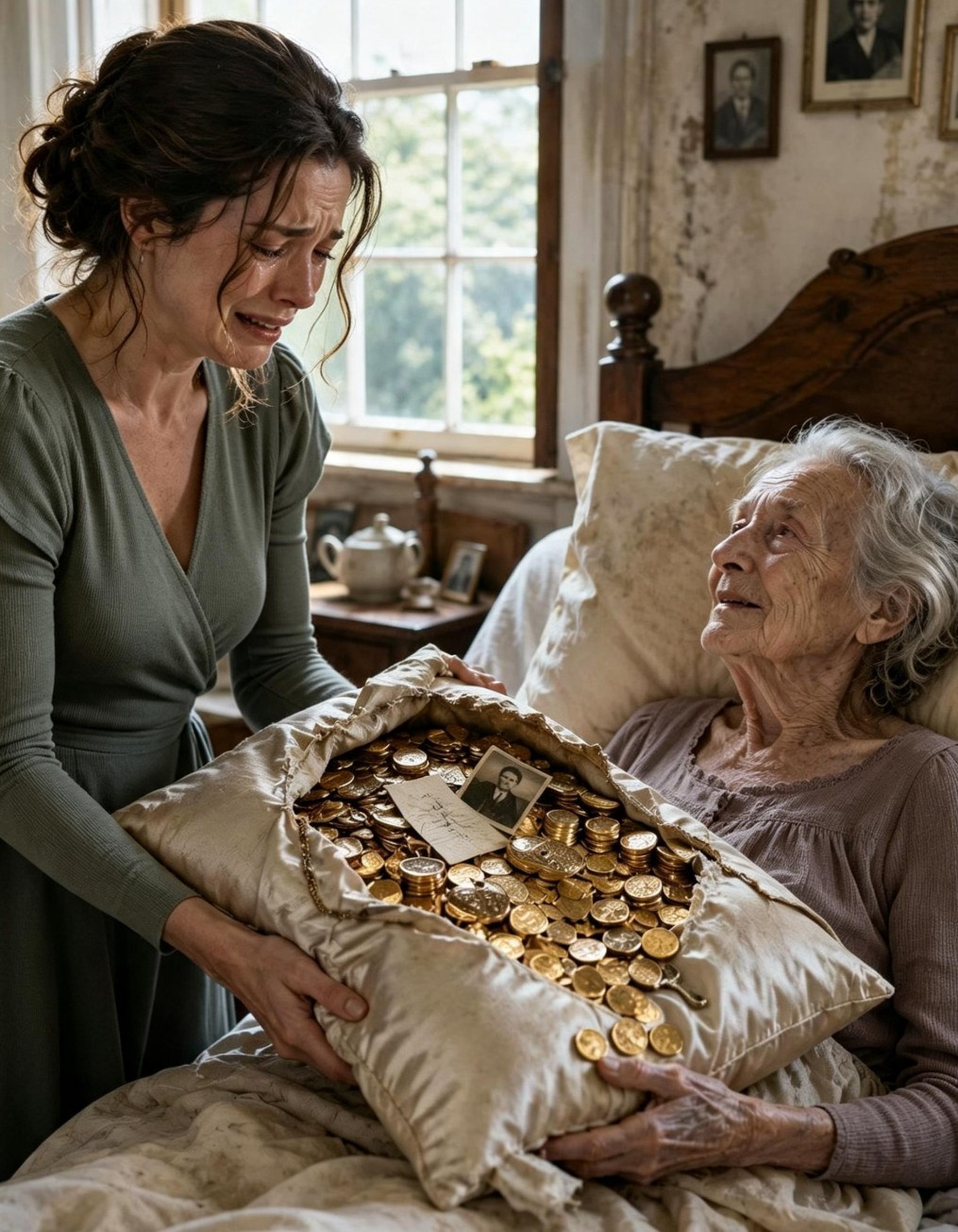
She pointed toward the old, torn pillow she had slept on for so many years.
Then, with a faint and raspy whisper, she said:
“For you, Mabel. Only for you.”
She tried to say something else.
But no words came.
Her hand suddenly went limp in mine.
And her chest…
stopped moving.
My entire world came crashing down.
I cried beside that bed, holding on to her until dawn.
A while later, her other children arrived.
There was shouting. Crying. Phone calls. Neighbors coming and going.
The house that had been so quiet during Fiona’s final moments suddenly became filled with noise.
While everyone was clearing out her room, one of my brothers-in-law picked up the old pillow.
He was about to throw it into a trash bag.
Without even thinking, I rushed forward and grabbed it from his hands.
“Not that one.”
My sister-in-law looked at me like I had lost my mind.
“What do you want that old thing for?” she scoffed. “It’s torn and filthy.”
I didn’t know how to explain it.
I simply hugged the pillow tightly against my chest.
Those were the last words Fiona had spoken to me.
She had given that pillow to me.
And even though it was old, stained, torn, and almost falling apart, Fiona had used what little strength she had left to name it just before she died.
That night, after everyone had gone, I sat alone in the kitchen.
I placed the pillow on the table.
The fabric was split open along one side.
Old goose feathers poked through the tear.
It smelled like mothballs, lavender salve, and something else I couldn’t describe.
It smelled like time.
I stared at it for a long while.
Maybe Fiona had simply been confused.
Maybe her final words had been nothing more than a meaningless goodbye.
I was about to put the pillow away in a closet when I decided to smooth out the cotton stuffing inside the torn seam.
I reached my hand into the opening.
Then my fingers touched something.
It wasn’t a feather.
It was hard.
Small.
And tightly wrapped.
PART 2:
My heart suddenly began pounding against my ribs.
I froze.
For a moment, I didn’t move at all.
Then, slowly and carefully, I pulled my hand out through the torn seam of the pillow.
Something was resting in my palm.
It was a small, heavy velvet pouch.
It had been tied shut with a piece of old, discolored twine.
My hands began to shake.
I took a kitchen knife and carefully cut through the string.
Then I tipped the pouch over the wooden kitchen table.
Two things fell out.
The first was a tarnished brass key.
It was small, but the bow of the key was beautifully carved with an intricate antique design.
The second item was a small piece of thick parchment paper, folded several times and yellowed with age.
I picked it up with trembling fingers.
Then I unfolded it.
The handwriting immediately caught my attention.
It was Fiona’s.
She had written it in the sharp, precise handwriting she had possessed many years earlier, before arthritis had twisted her fingers and made writing painful.
At the top was a date.
Fifteen years earlier.
I stared at it for several seconds before beginning to read.
“My dearest Mabel,” the letter began.
My eyes moved slowly across the page.
“If you are reading this, I have finally gone to rest beside my beloved husband. For years, my own children believed I had nothing left to my name after the farm failed. They assumed I was a burden, a woman relying entirely on their pity, which is why they left me in the dark.”
I stopped reading for a moment.
My hands were trembling.
Then I continued.
“They did not know that my grandfather left me a private safety deposit box at the Old National Bank in downtown Columbus—box number 412. Inside, you will find the original land deeds to forty acres of prime commercial real estate along the highway bypass, purchased decades ago before the developers came.”
I stared at those words.
Forty acres.
Commercial real estate.
A private safety deposit box.
I could hardly breathe.
But there was more.
“My children never asked about my past, nor did they care to stay when I had nothing to offer them. But you, Mabel—you held my hand when I was frightened. You wiped my tears when I missed my home. You loved me not as an obligation, but as a daughter.”
Tears filled my eyes.
I kept reading.
“The key in your hand belongs to Box 412. The property is yours, legally transferred to a private trust in your name. Do not let them take from you what you earned with your pure heart.”
The tears finally spilled over.
They landed on the yellowed paper.
I couldn’t believe what I was reading.
Fiona hadn’t been confused during her final moments.
She hadn’t given me an old, worthless pillow.
She had planned everything.
For twelve years, I had watched her own children slowly abandon her.
And all that time, Fiona had quietly made sure that the one person who treated her with dignity would be protected for the rest of her life.
I looked at the old pillow sitting on the table.
Suddenly, it didn’t look old and worthless anymore.
It felt like the most important thing in the entire house.
PART 3:
The next morning, the atmosphere inside our house was tense.
My brothers-in-law and sister-in-law were sitting around the dining table.
They were drinking coffee while going through Fiona’s minimal bank statements.
As they looked over the papers, they also complained about the funeral expenses.
My eldest brother-in-law shook his head.
“She barely had eight hundred dollars in her checking account,” he grumbled. “We’re going to have to split the burial costs four ways. Mabel, you and my brother need to cover your share.”
I stood quietly near the doorway.
In my hands was a warm cup of tea.
I was completely calm.
Then I said, “Mom left something behind.”
My sister-in-law gave a sharp, dismissive laugh.
“What? That torn pillow you were hugging like a child last night?”
“No,” I said.
I reached into my apron pocket.
Then I pulled out the antique brass key and the certified trust document.
“She left the deeds to forty acres of commercial land near the Columbus highway bypass.”
The entire room went silent.
Not one person spoke.
My eldest brother-in-law froze.
His coffee cup was still halfway to his mouth.
Finally, he lowered it slowly.
“What are you talking about?” he demanded. “Mom didn’t own any commercial land! The family farm was liquidated twenty years ago!”
“She owned it before she ever met your father,” I explained.
I placed the notarized trust papers flat on the table in front of them.
“She bought the property decades ago. It’s worth nearly two million dollars today. And three years ago, while all of you were ‘too busy’ to visit her for Christmas, she placed the entire holding into a private trust.”
My sister-in-law immediately grabbed the papers.
Her eyes raced over the legal documents.
Then her face changed.
Her eyes widened in disbelief.
“This…” she stammered. “This says you are the sole trustee and beneficiary!”
She looked up at me.
“That’s impossible! She was confused! You manipulated her!”
I looked directly at her.
“I didn’t ask her for a single penny,” I said.
My voice was steady.
“I didn’t even know this existed until last night.”
I paused.
“For twelve years, I bathed her, fed her, and held her hand while she cried in the dark. Meanwhile, the four of you couldn’t even be bothered to call her once a month.”
My brother-in-law suddenly stood up.
His face turned dark red with anger.
“She was our mother!” he shouted. “You have no right to take our inheritance!”
I looked him straight in the eye.
Then I answered quietly.
“She wasn’t an inheritance to you.”
The room went silent again.
“She was an inconvenience,” I continued. “You left her alone when she was alive, and she chose who stood beside her when she died.”
They were furious.
They threatened to hire lawyers.
They threatened to challenge the trust.
They insisted that Fiona could not possibly have understood what she was doing.
But they didn’t know what Fiona had prepared.
Her estate attorney had meticulously documented her mental soundness.
There were even video affidavits recorded years earlier.
Those recordings confirmed that Fiona had knowingly made her decisions. They also documented that her children had voluntarily neglected her and that Mabel was the person she truly intended to receive her estate.
The legal battle continued.
But it didn’t last forever.
Within six months, every legal challenge was thrown out of court.
The trust remained intact.
The forty acres remained mine.
I could have used the money however I wanted.
Instead, I thought about Fiona.
I thought about all the years she had spent working.
I thought about her lonely nights.
I thought about how many times she had needed someone and found only an empty room.
So I used part of the commercial property’s value to pay off our mortgage.
I also established an untouchable college fund for my son.
But that wasn’t all.
I created a local senior care foundation in Fiona’s memory.
Its purpose was simple.
I wanted to make sure that no elderly person in our county would ever have to spend their final days alone, uncared for, or forgotten.
Sometimes, late at night, I sit on the front porch with a warm cup of tea.
I listen to the quiet rustling of the wind through the Ohio trees.
The house is peaceful.
My husband’s siblings no longer speak to us.
They remain bitter about the fortune they lost.
But I don’t regret what happened.
And I don’t carry anger toward them.
Fiona had been right all along.
God—and a loving mother-in-law—had looked at me differently.
Not because I had ever asked for a reward.
Not because I had cared for Fiona expecting to inherit anything.
I had simply loved her.
And in the end, I learned that true love isn’t proven through grand promises or dramatic declarations.
It is proven through the quiet, faithful care we give when nobody else is watching.
And Fiona had seen every single moment.
The End.
