
I drove 190 miles to bring her back with me. She clicked her seatbelt into place, looked straight at me, and said, “Don’t call them. I’ll tell you exactly where we’re going.”
Part 1:
My parents told Grandma Eleanor they were taking her out to lunch.
Three hours later, a nursing facility in Ohio called me.
“Is this Ivan Sterling?” the woman asked. “Your grandmother listed you as her emergency contact. Her suitcase is still here in our lobby, but the family members who brought her left before the admission paperwork was finished.”
I was standing in the kitchen of my apartment, holding a cup of coffee that I suddenly had no interest in drinking.
“What do you mean, they left?”
The administrator hesitated.
“They told us they had to get some paperwork from their car. They said they would be right back. But they never returned.”
I immediately called my father, Arthur.
Straight to voicemail.
Then I called my mother, Wendy.
Same thing.
I grabbed my keys and drove 190 miles with both hands locked tightly around the steering wheel.
By the time I reached the nursing facility, my jaw ached from clenching it.
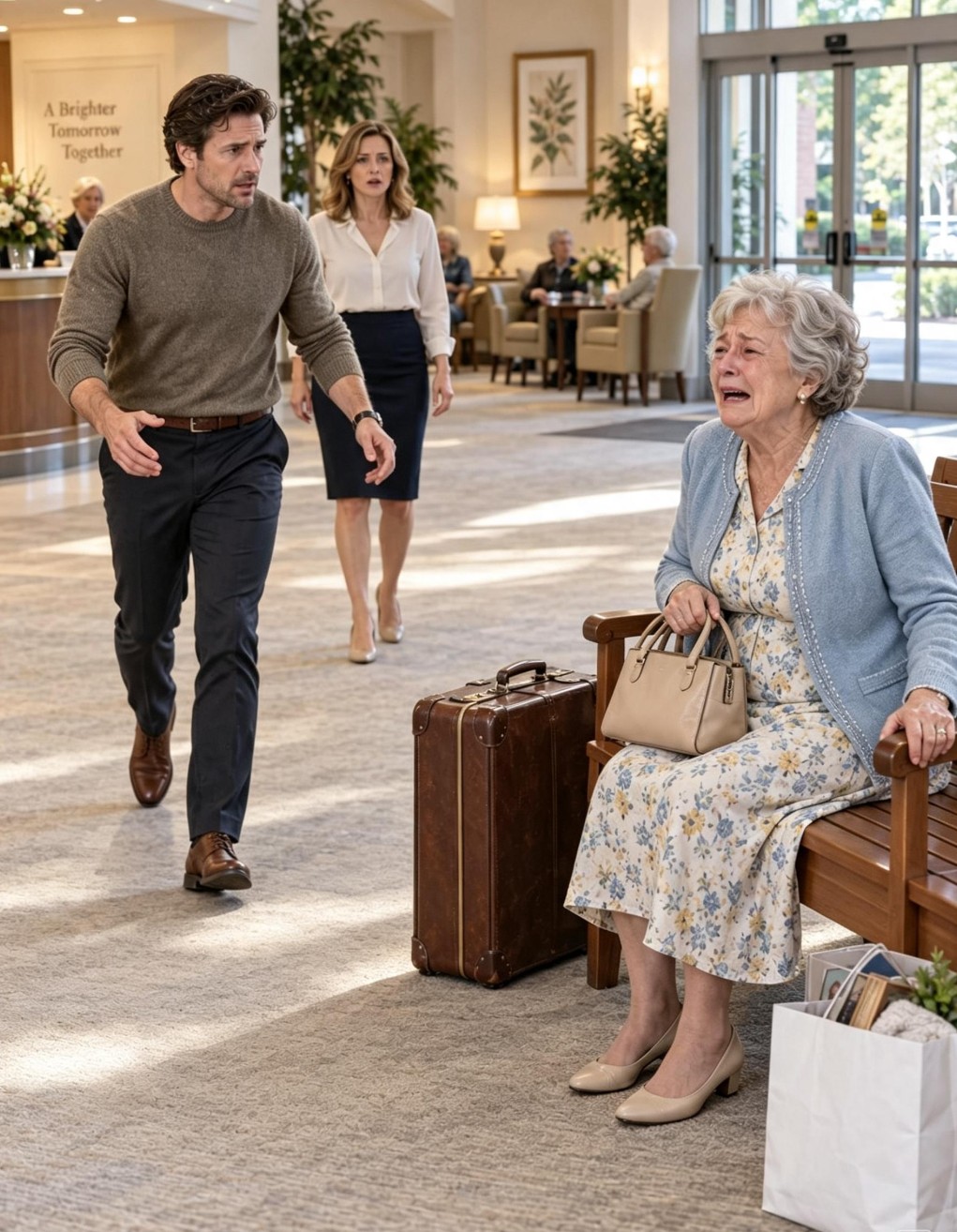
Grandma was sitting alone in the lobby beside one brown suitcase and a grocery bag filled with her medications. She was still wearing her church coat, even though the lobby was warm. Her gray hair was carefully pinned in place, just as it always was.
But her face told me everything.
She had that calm, stone-cold expression she always wore when she was truly furious.
I crouched beside her.
“Grandma.”
She stared at me for several long seconds.
Then she slowly stood.
There were no tears.
No questions.
No complaints.
She simply picked up her purse, walked toward my car, climbed into the passenger seat, and buckled herself in.
As I started the engine, she looked straight ahead.
“Don’t call them,” she said.
I looked at her.
“What?”
“Don’t call your parents.”
Her voice was quiet but firm.
“I’ll tell you where to drive.”
I tightened my grip on the steering wheel.
“Where?”
“First, the county courthouse.”
That got my attention immediately.
Once we were back on the highway, Grandma opened her purse and pulled out a folded bank statement.
She handed it to me.
Three withdrawals had been circled in red.
$12,000.
$18,000.
$25,000.
All three withdrawals had been made within six weeks.
My stomach tightened.
“Grandma, what is this?”
“Your father has power of attorney,” she said. “Temporary power of attorney. I signed it after my knee surgery because I trusted him.”
I stared at the numbers.
“That’s $55,000.”
She nodded.
“He told me I was becoming forgetful. He said I needed help managing my bills and making sure everything was paid on time.”
She turned her face toward the passenger window.
“Then yesterday, I found this.”
“Did you confront him?”
“I did.”
“And?”
“He said the money was being used to pay for my care.”
I glanced into the rearview mirror at the lone brown suitcase sitting in the back seat.
Something about it made my chest feel tight.
Grandma gave a bitter, humorless laugh.
“At lunch today, your mother told me we were stopping somewhere with a lovely garden. She said it would be peaceful.”
She paused.
“Instead, they drove me to that facility.”
I looked at her in disbelief.
“They actually left you there?”
“They finished none of the admission paperwork,” she said. “They simply walked out.”
Her voice became colder.
“Then they disappeared.”
My phone suddenly buzzed.
Dad.
Before I could reach for it, Grandma leaned over and turned the phone face down on the center console.
“Courthouse first,” she repeated.
“Then the bank.”
I looked at her.
“You said there was one more place.”
“There is.”
“What place?”
She finally turned and looked directly into my eyes.
“My house.”
I swallowed.
“Why?”
Her expression hardened.
“Because if they’ve done what I think they’ve done, your parents didn’t just leave me at that facility today.”
She reached inside her coat and pulled out a small envelope.
Across the front, written in my grandfather’s familiar handwriting, were two words:
HOUSE DEED
“I hid this before they came to pick me up,” she said.
“Why?”
“I wanted to know whether they would go looking for it.”
She held the envelope tightly in her hand.
Then her voice dropped to a whisper.
“They wanted me out of the way.”
Part 2:
Grandma kept the envelope pressed tightly against her coat as we pulled into the county courthouse parking lot.
For the first time since I had picked her up, she hesitated before opening the car door.
She looked toward the courthouse entrance as if she already knew we were about to uncover something terrible.
Inside, the clerk carefully examined the house deed.
Then she looked at Grandma.
Something about the clerk’s expression immediately made me nervous.
She turned toward her computer and began searching through the county property records.
Her fingers suddenly stopped over the keyboard.
“Mrs. Sterling,” she said slowly, “has anyone asked you to sign another property document recently?”
Grandma looked at me.
“No,” she answered quietly. “But my son brought some papers to my house last week.”
The clerk’s expression changed.
She turned the monitor slightly away from us and reached for the phone.
I stepped closer.
“What did you find?”
For a moment, she said nothing.
Then she looked directly at Grandma.
“There’s a quitclaim deed attached to your property record. It was filed three days ago.”
Grandma’s face went still.
The clerk continued.
“It transfers full ownership of the Sterling estate to Arthur and Wendy Sterling.”
Grandma did not move.
She barely seemed to breathe.
Someone had filed a deed transferring her home to her son and his wife.
And apparently, someone had signed it using her name.
Before the clerk could explain anything else, my phone began ringing again.
Dad.
I stared at the screen.
Then I answered and tapped the speakerphone.
“Where are you, Dad?”
Arthur’s voice came through the phone sounding strained and desperate.
“Ivan! Thank God you picked up! Your mother and I are frantic. Your grandmother wandered off during lunch! We went to the restroom for a few minutes, and when we came back, she was gone. We’ve been searching for hours!”
I felt my anger rise.
“Stop lying, Dad.”
My voice became low and sharp.
“I’m sitting right next to Grandma Eleanor. I picked her up from the nursing facility where you abandoned her three hours ago.”
Silence.
Absolute silence.
I could hear my father breathing on the other end.
“Ivan…” he finally stammered. “You don’t understand the situation.”
Grandma leaned toward the phone.
“You’re right about one thing,” she said.
Her voice was calm, strong, and completely without fear.
“You have created a situation, Arthur.”
My father stopped speaking.
Grandma continued.
“We’re at the county courthouse. I am standing in front of the land records desk looking at a quitclaim deed that transfers my property to you and Wendy.”
She paused.
“And it has my signature on it.”
Arthur’s breath caught.
“You have one hour to meet us at my house,” Grandma said. “If you are not there, the next call my grandson makes will be to the state authorities responsible for investigating elder financial abuse and fraud.”
She hung up before he could answer.
I stared at her.
“You really mean it.”
Grandma placed the phone back on the console.
“I do.”
Forty minutes later, we pulled into the driveway of Grandma Eleanor’s brick home.
My father’s luxury SUV was already there.
So were my parents.
Arthur and Wendy stood near the front porch looking pale, disheveled, and completely panicked.
But that wasn’t the worst part.
Through the front window, I could see cardboard boxes stacked along the hallway.
They had already started packing Grandma’s belongings.
They had been preparing the house to sell.
The moment Grandma stepped out of the car, Wendy rushed toward her.
Her hands fluttered nervously.
“Eleanor! Please, it was a misunderstanding! We were only trying to protect your assets. We wanted to make sure you wouldn’t have to worry about managing the house anymore.”
Grandma lifted one hand.
Wendy immediately stopped.
“Save your breath, Wendy.”
Grandma’s voice was flat and cold.
“The temporary power of attorney is revoked.”
Wendy’s face went pale.
“The county clerk has already flagged the quitclaim deed for investigation,” Grandma continued. “And my bank has been notified that you and Arthur no longer have authority to access my accounts.”
Arthur stepped forward.
“Mom, please!”
His voice cracked.
“My business was facing a temporary cash-flow crisis. I was going to put the money back. We both were. Once the property sold, everything would have been repaid.”
Grandma stared at him.
“You put a price tag on my life, Arthur.”
My father lowered his eyes.
“You left me sitting in a nursing home lobby like an unwanted piece of luggage,” Grandma continued. “You did it because you wanted me out of the way so you could take the home your father built with his own hands.”
Arthur opened his mouth.
Nothing came out.
Grandma reached inside her coat and pulled out her spare set of house keys.
She placed them in my hand.
“Ivan,” she said quietly, “help your parents carry their things out to the car.”
I looked at her.
“They have ten minutes,” she added, “before the sheriff’s deputy I called arrives to make sure they leave my property.”
Arthur stared at his mother.
For the first time in his life, he seemed to understand that his arrogance had finally cost him everything.
He tried to speak.
But the finality in Eleanor’s eyes stopped him.
Without another word, my parents picked up their empty packing boxes and carried them back toward their SUV.
They left the house in silence.
Part 3:
The autumn wind moved through the oak trees in Grandma Eleanor’s front yard, carrying the smell of dry leaves and damp earth.
Inside the house, the old grandfather clock in the hallway chimed three times.
The sound seemed strangely solemn after everything that had happened.
Arthur and Wendy had spent their ten minutes loading the empty cardboard boxes back into their SUV.
My father’s hands had been shaking so badly that he dropped several rolls of packing tape onto the gravel.
My mother kept staring toward the driveway, terrified that the sheriff’s cruiser would arrive before they managed to leave.
They never said goodbye.
They never asked where Grandma would sleep that night.
They never apologized.
They simply closed the trunk, climbed into the front seats, and drove down the long driveway.
Neither of them looked back.
I stood on the porch and watched their red taillights disappear around the bend.
A few moments later, Grandma walked through the front door.
She was wrapped in the warm wool shawl I had taken from her bedroom.
She came to stand beside me at the porch railing.
Together, we watched the empty road.
“He was seven years old when his father built this porch,” she said softly.
I turned toward her.
“He used to sit right there on those wooden steps with a little toy hammer, pretending he was helping his father nail down the floorboards.”
Her voice carried a sadness that anger couldn’t completely hide.
I looked at her.
“Do you regret calling the clerk, Grandma?”
She did not answer immediately.
Instead, she looked down at her hands.
They were worn from decades of gardening, cooking, working, and raising a family.
Finally, she spoke.
“I regret that I raised a son who eventually looked at his mother and saw nothing but a line item on a ledger.”
She lifted her eyes toward me.
“But I do not regret protecting what your grandfather built.”
Twenty minutes later, the local sheriff’s deputy arrived.
His name was Sheriff Miller, a tall, soft-spoken man who had known my grandfather for nearly twenty years.
He sat at the kitchen table while Grandma laid out the evidence.
The forged quitclaim deed.
The certified bank statements.
The records showing the $55,000 in withdrawals.
Sheriff Miller studied everything carefully before setting his pen down.
“Mrs. Sterling,” he said quietly, “this is more than a civil dispute between family members.”
He tapped the deed.
“Forging a signature on a county property document is a serious felony. If we move forward with the warrant, Arthur could face formal arrest.”
Grandma looked across the table at him.
There was no anger in her expression.
No desire for revenge.
No satisfaction.
Only the calm determination of a woman who had finally decided where she stood.
“He has thirty days to return the $55,000 he withdrew from my accounts,” she said.
Sheriff Miller nodded.
“And?”
“He also has thirty days to sign a formal legal relinquishment of any future claim to this trust and estate.”
She paused.
“If he fulfills those terms, I will not ask the prosecutor to pursue criminal charges for the forgery.”
Sheriff Miller studied her face.
“And if he refuses?”
Grandma did not hesitate.
“Then you may execute the warrant.”
Arthur did not refuse.
Faced with the possibility of a public trial, a felony conviction, and the destruction of his business reputation, my father liquidated his private investment portfolio within two weeks.
The wire transfer returned every stolen dollar to Grandma’s account.
His corporate attorney also delivered the signed and notarized relinquishment documents to our lawyer’s office on a rainy Tuesday morning.
Those documents officially severed my parents’ legal claim to the Sterling estate.
When everything was finally signed and filed, the house became quiet again.
Not the frightening kind of quiet we had experienced when my parents were inside.
This was peaceful.
I spent the following month removing the last traces of my parents’ brief attempt to take over the home.
We carried the boxes into the garage.
We returned the living room furniture to its proper places.
We rehung the old family photographs my father had taken down from the hallway walls.
Slowly, the house began to feel like Grandma’s home again.
One quiet Sunday afternoon, I found Grandma sitting in her favorite armchair beside the sunlit window in the study.
On the small table beside her was my grandfather’s old leather-bound journal.
Beside it lay a brass fountain pen.
Grandma was writing carefully in the back pages.
I walked into the room and placed a fresh cup of tea on the table.
“What are you working on, Grandma?”
She looked up and gave me a faint smile.
“I’m updating my final estate directives, Ivan.”
I stopped.
“You don’t need to rush into that.”
“I’m not rushing,” she said softly.
She capped the fountain pen and rested her hand on the journal.
“I’m simply putting things where they belong.”
Then she turned the journal toward me.
I read the instructions she had written in her careful, elegant handwriting.
They directed that the entire Sterling property—the house, the surrounding thirty acres of land, and the remaining family trust—would be placed under an independent, irrevocable foundation managed exclusively by me.
I stared at the page.
“Grandma…”
She looked directly into my eyes.
“Your father believed loyalty was something you inherited automatically,” she said. “He thought blood gave him the right to take my dignity away while I was still alive.”
She reached across the table and took my hand.
Her grip was surprisingly firm.
“You drove 190 miles without asking a single question,” she whispered, her eyes shining with quiet emotion.
“You stood between me and the people who tried to make me feel small.”
She squeezed my hand.
“That isn’t just blood, Ivan.”
Her voice softened.
“That is love.”
I squeezed her hand back.
For a moment, I couldn’t speak.
Over the months that followed, the house on the hill came alive again.
The garden beds were cleared and replanted with fresh winter perennials.
The kitchen once again smelled of roasted chicken, fresh bread, and hot tea.
Neighbors began stopping by on weekends.
They brought fruit pies.
They sat on the porch.
They talked with Grandma about the ordinary things that had once made the house feel warm and full of life.
My parents never returned to the driveway.
Six months later, they moved out of town, unable to face the quiet judgment of a community that knew what they had tried to do.
Almost a year after the day I had picked Grandma up from that nursing home lobby, winter settled over the property.
On a cold, clear December evening, Grandma and I walked onto the front porch.
The first snow of the season had begun falling over the garden.
The air was crisp and still.
Snowflakes drifted gently through the pine trees, covering the porch railing with a layer of white.
Grandma leaned against my arm.
She was wrapped in her warm wool shawl, looking out over the land her husband had cleared with his own hands fifty years earlier.
She took a long, peaceful breath.
Then she called softly, “Ivan?”
“Yes, Grandma?”
“Look at the garden.”
I looked toward the quiet lawn.
The snow-covered garden was glowing beneath the warm yellow light of the porch lamps.
“It’s beautiful,” I said.
Grandma smiled.
It was a real smile.
A complete, unburdened smile.
There was no fear in it.
No anger.
No regret.
She looked across the land that had almost been stolen from her.
Then she whispered the words that seemed to bring the entire story to an end.
“It’s ours.”
She rested her head gently against my arm.
“And it’s home.”
The End.
