
Part 1: The Daughter They Tried to Erase
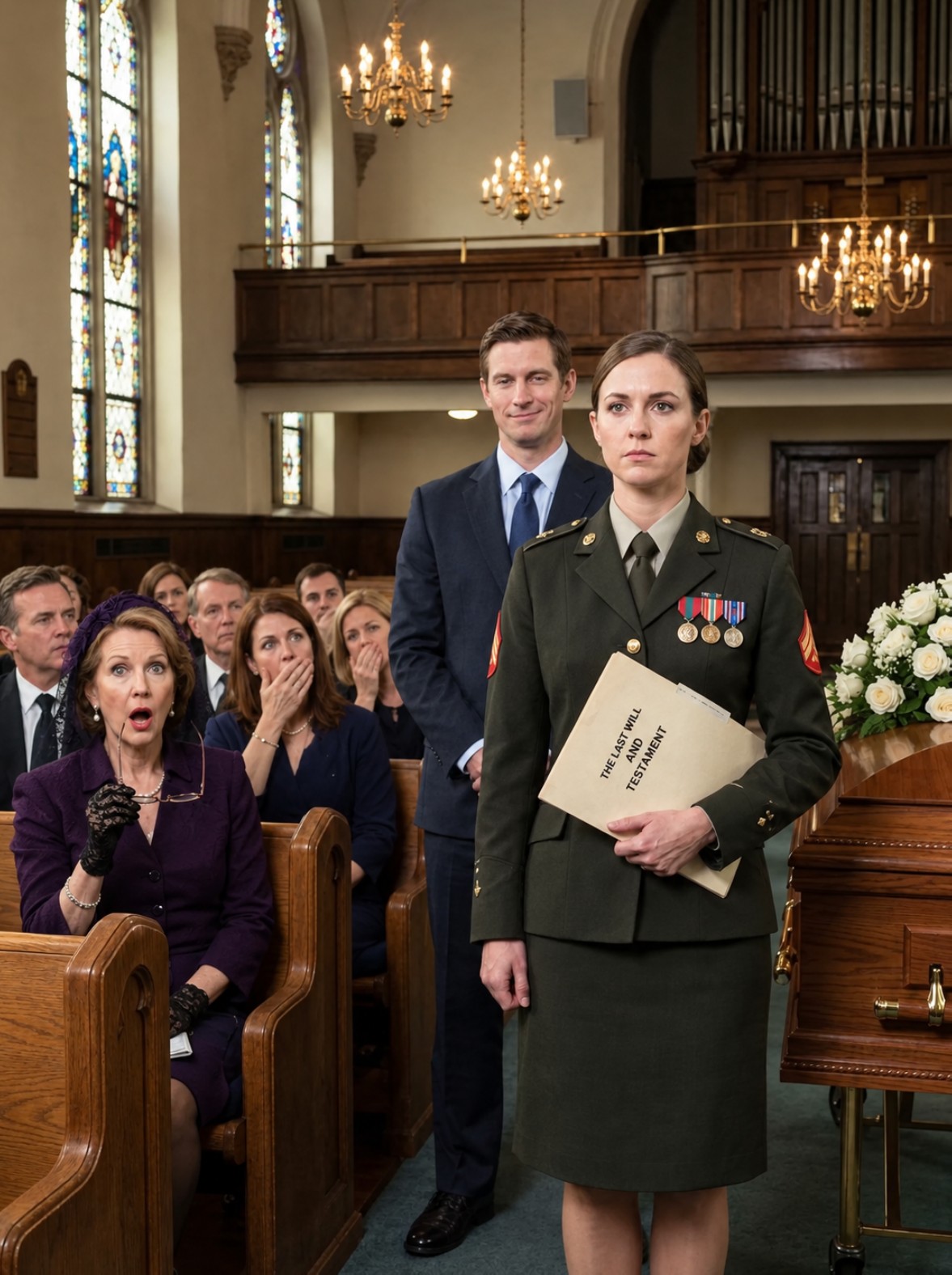
The first time I saw my father in sixteen years, the ushers standing at the entrance of Saint Jude’s Cathedral in Oak Creek, Montana, told me I was not allowed to approach his coffin.
I stood in the center aisle wearing my United States Army dress blues. Every medal was perfectly aligned on my chest, and my white gloves were folded neatly in my left hand.
The entire town watched me in heavy silence, as though I had returned from the dead instead of simply driving home from my station at Fort Carson.
Six rows ahead of me lay my father, Thomas Jennings, inside a polished mahogany casket surrounded by hundreds of white roses.
The funeral director had powdered his face until it looked peaceful, but I knew better. He had spent the last half of his life fighting a war against his own silence, and no amount of makeup could hide the pain that had lived inside him.
From where I stood, I could see only the thin edge of his gray hair. Even that small glimpse was enough to tighten something deep inside my chest.
I had imagined this moment many times over the years. I had wondered what I would say if I ever saw my father again. I had even rehearsed the words I might whisper beside his hospital bed if I arrived before it was too late.
But I had never imagined that someone would prevent me from saying goodbye at his funeral.
Then Logan Walsh stepped into the aisle and blocked my path.
He moved with the deliberate confidence of a man who enjoyed having power over others. He was much bigger than I remembered from my childhood, with broad shoulders and a heavier face. His expensive black suit made him look important, although I suspected someone else had paid for it.
He planted his feet between me and the coffin like a guard dog protecting a gate he had no right to guard.
“You need to find a seat in the back row, Sarah,” he said.
His voice was low enough to avoid causing a scene, but there was a sharp threat beneath every word.
The organ continued playing a soft, mournful melody. People sitting in the pews began whispering to one another, their eyes moving between Logan and me.
Outside, rain tapped against the stained-glass windows in an uneven rhythm, like fingers drumming against a locked door.
I looked past Logan toward the front pew.
His mother, Brenda, sat there beneath a heavy black lace veil. My stepmother did not turn around to acknowledge me.
She didn’t need to.
Brenda had always known how to control a room without raising her voice above a whisper. She had stolen my mother’s house through a carefully planned series of casseroles, false sympathy, and perfectly timed visits. Then she had taken my father by offering him the kind of gentle attention that a grieving man, too broken to think clearly, was desperate to receive.
Over time, she had stolen sixteen years of my life by making herself the only person anyone had to pass through if they wanted to see Thomas Jennings.
“I am here to say a final goodbye to my father,” I told Logan.
I met his eyes with the same steady expression I had used in military command rooms, where men twice my age had waited for me to make decisions that could determine whether their soldiers came home alive.
Logan smiled.
It was not a happy smile. It was the dull, practiced cruelty of a boy who had grown into a man without ever being taught that other people mattered.
“This is family only up front,” he whispered. “You should probably move along before things get embarrassing for you.”
His words struck harder than any physical blow could have.
For a moment, I was no longer a major in the United States Army. I was fourteen years old again, standing in a house that no longer felt like home, listening to people who should have loved me explain why I didn’t belong.
I had walked through blinding sandstorms. I had signed official death notifications for families whose lives would never be the same again. I had stood in rooms covered with maps and red markings while experienced soldiers waited for my next order.
Yet two words spoken inside a small-town church had found the part of me that I had spent years trying to bury.
Family only.
That was the lie they had used to erase me from the history of Oak Creek.
But I had been family when my mother, Grace, lay dying in a hospital room that smelled of bleach and wilted flowers.
I had been family when she gripped my wrist with fingers made thin by rounds of chemotherapy and whispered that I must never let anyone erase our memories.
I had been family when my father collapsed into a hard plastic chair after the heart monitor went flat. He had cried so violently that he could barely hold his own daughter.
And I had been family long before Brenda arrived at our front door carrying a dish of lasagna and wearing a smile that never quite reached her cold eyes.
She had entered our lives slowly, taking up one drawer and one shelf at a time until the house no longer felt like ours.
At first, she brought meals to help a grieving widower.
Then she stayed for coffee.
Soon, she was there when the sun went down, and before long, she was there every morning.
Her son, Logan, began leaving his muddy sneakers in our front hallway as though he owned the floorboards beneath them.
Her daughter, Cassidy, started sitting quietly at our kitchen table every afternoon. She looked like a frightened little animal waiting for permission to breathe in a house that wasn’t hers.
Within eighteen months of my mother’s death, Brenda was wearing my mother’s favorite silk robe and sleeping in the bed my parents had shared for twenty years.
She called my father “Tommy” in the same sweet, cloying voice she used when she told me to move my belongings into the basement.
Logan got my old bedroom because Brenda claimed it was the only practical arrangement for a growing boy.
My father said nothing.
He simply stared at the wall with eyes that had lost their light.
That basement became the place where I learned what it felt like to disappear while I was still alive.
It smelled of cold concrete, furnace oil, and surrender.
At night, I lay awake listening to Logan walk directly above me. His heavy boots thudded across the floorboards where I had once slept, dreamed, and imagined my future.
Every step carried the same message.
I had been replaced.
I had been forgotten.
And no one was going to stop it.
The people of Oak Creek never saw what happened behind the closed doors of the Stone Ridge Estate.
They saw Brenda attending Sunday services. They saw her at local bake sales and charity auctions, holding my father’s arm as though she had always belonged beside him.
They saw me leave town at eighteen with a single suitcase.
And they assumed I was a cold, ungrateful daughter who had been too difficult to love.
They never saw the small note I left on my father’s pillow the morning I walked away from that house forever.
I wrote that I could no longer stay in a place where I didn’t belong.
I wrote that I needed to find a life of my own.
And I wrote that I hoped he would understand someday.
I never received an answer.
Even now, sixteen years later, I suspected Brenda had found that note before my father ever had the chance to read it.
Standing in the church, with Logan blocking my path to the coffin, I understood that nothing had changed as much as I had hoped.
The house had been taken from me.
My childhood had been taken from me.
And now, even my final goodbye was being denied.
“You need to move out of my way right now,” I said.
My voice had the controlled firmness I usually reserved for the firing range.
Logan leaned closer. I could smell stale coffee and old tobacco on his breath.
“Go ahead and make a scene, Major,” he sneered. “I’d love for everyone to see what the Army did to poor little Sarah.”
Behind him, Brenda raised one gloved hand and dabbed at the corner of her eye beneath her veil.
She performed her grief with the perfect precision of a stage actress.
Every eye in the church was fixed on us.
Some people looked uncomfortable. Others seemed eager to see whether the daughter who had run away would finally lose control.
I knew I could put Logan on the floor in seconds if I wanted to. Military training had taught me how to defend myself against a larger opponent without necessarily causing serious injury.
But I also knew that a physical confrontation was exactly what Brenda wanted.
For years, she had carefully presented me as the bitter, angry runaway who had abandoned her grieving father.
If I fought Logan at the funeral, she would have the perfect story to tell.
She could tell everyone that I was unstable, violent, and ungrateful.
She could use that moment to bury the truth about me forever.
So I took a slow breath.
Then I stepped back.
It was not because I was weak. It was not because I feared Logan.
I stepped back because I had learned the difference between a temporary retreat and a permanent defeat.
I walked to the very last pew in the church and stood there throughout the service, my back straight and my hands perfectly still.
My eyes remained fixed on the mahogany coffin.
The preacher spoke about Thomas Jennings as a devoted husband, a respected businessman, and a pillar of the Oak Creek community.
He praised my father’s generosity and described the many people whose lives he had supposedly touched.
But he said nothing about the daughter who had been pushed into the basement of her own childhood home.
He said nothing about the house on Stone Ridge Hill, where my mother’s beautiful lavender garden had been ripped out and replaced with gray gravel.
He said nothing about the piano that had been shoved into a dark corner until silence became the only music left in our home.
And he said nothing about the little girl who had watched her family disappear while everyone around her pretended nothing was wrong.
When the service ended, people passed me in the aisle without meeting my eyes.
Some looked embarrassed by what they had witnessed. Others seemed relieved that the social order of Oak Creek had been preserved.
Brenda walked past me with Logan at her side.
Her black veil turned slightly in my direction as she paused.
“The reading of the will is tomorrow morning at nine o’clock,” she whispered. “Don’t embarrass yourself by showing up at the office. You weren’t named as an heir.”
She gave me a small, triumphant smile.
She expected those words to destroy me.
Instead, something inside me grew colder and clearer.
For sixteen years, Brenda had believed she could control my life by keeping me away from my father.
She had mistaken my distance for ignorance and my silence for weakness.
She had no idea what the Army had taught me.
I knew how to wait.
I knew how to gather information.
And I knew never to assume that the person standing in front of me was telling the whole truth.
Outside the cathedral, the cemetery grass glistened beneath the recent rain. The air smelled of wet earth and cold stone.
I stood beside my rental car and watched Brenda leave in a long black limousine.
It should have been carrying my father’s only daughter, or at least someone who had been allowed to say goodbye to him.
Instead, I stood alone in the parking lot, watching its red taillights disappear around the corner.
My phone buzzed in my pocket before the car had even vanished from sight.
An email had arrived from Thompson and Associates, the law firm my father had used for as long as I could remember.
I opened it.
The message stated that, at Mrs. Brenda Jennings’s instruction, the reading of the last will and testament would be limited to named heirs only.
It concluded by informing me that my presence was neither required nor permitted during the proceedings.
I read the message twice.
Then I laughed quietly.
Brenda had just made a catastrophic mistake.
She believed that because I had been absent for sixteen years, I knew nothing about the world beyond Oak Creek.
She believed that the girl she had banished to the basement had spent her entire life hiding in the shadows.
She had forgotten that the Army had taught me how to remain patient, how to study a situation, and how to recognize an opportunity when it appeared.
Most importantly, she had forgotten that I was still Thomas Jennings’s daughter.
And I had no intention of letting her decide what that meant.
Part 2: The Secret My Father Left Behind
That night, I checked into the Oak Creek Motor Lodge, a low building just off Route 16.
The neon signs hummed outside my window, and the carpet smelled of rainwater and old cleaning products.
I had been in the small room for less than ten minutes when someone knocked softly on the door.
It was not the confident, impatient knock of someone who expected to be welcomed.
It was hesitant, almost fearful.
I opened the door and found an older woman standing in the walkway. She wore a heavy gray wool coat, and her silver hair was tucked beneath a hood dotted with raindrops.
For a moment, I didn’t recognize her.
Then I saw her eyes, and the memory came rushing back.
It was Mrs. Higgins, the head nurse on duty the night my mother died.
She had been the one who silenced the hospital monitor while my father broke down beside my mother’s bed. I could still remember the sound of that monitor stopping, followed by the terrible silence that had changed my life forever.
“Sarah,” she said.
There was fear in her voice, but there was relief, too.
“It is Major Jennings now,” I corrected automatically.
Then I saw how nervous she looked, and my expression softened.
“Please, come inside, Mrs. Higgins.”
She glanced down the empty walkway before stepping into the room. After I closed the door, she stood near the small table and looked at me as though she had been carrying a heavy burden for years.
Her hands trembled as she opened her leather purse and removed a thick, sealed envelope.
“Your father tried to reach you, Sarah,” she said.
Her voice broke on the last word.
“He tried more than once over the past few years.”
I stared at her.
My heart began pounding against my ribs like a trapped bird.
For sixteen years, I had believed that my father had accepted my disappearance without a second thought. I had imagined him reading my note, shrugging, and returning to the life Brenda had built around him.
The thought had hurt me for years, but eventually I had learned to live with it.
Now Mrs. Higgins was standing in front of me, suggesting that the truth was very different.
“Why didn’t he contact me?” I asked.
She lowered her eyes.
“Brenda blocked every single call,” she whispered. “Toward the end, when your father became seriously ill, she controlled the phone, the visitors, and even the nurses we hired to care for him.”
I felt my hands tighten at my sides.
Mrs. Higgins continued.
“She told everyone in town that you wanted nothing to do with your father. She said you had moved on with your life and didn’t want to hear from him.”
“Did he believe her?”
My voice sounded calmer than I felt.
Mrs. Higgins shook her head.
“No. Not at the very end, he didn’t.”
She placed the envelope in my hands.
“He knew something was wrong. He knew he’d made mistakes, and he wanted you to know the truth.”
I stared at the envelope for several seconds before carefully breaking the seal.
Inside was a professional business card belonging to Sandra Quinn, an attorney in the nearby town of Clearwater.
Behind the card was a folded sheet of paper covered in my father’s unmistakable handwriting.
His letters were shakier than I remembered, but I knew them immediately.
I unfolded the note.
It began with a simple sentence.
Sarah, if you are reading this, Mrs. Higgins has managed to find you.
I stopped reading for a moment.
My throat had tightened so much that swallowing hurt.
The letter continued.
My father wrote that he had been too weak when he should have been strong for me. He admitted that he had allowed our home to become a battlefield and had left me to fight that war alone.
He wrote that he could never undo the years we had lost.
But he could still give me the truth.
He told me to visit Sandra Quinn in Clearwater and to trust Mrs. Higgins, because they were among the few people who knew what had really happened.
He urged me to take back what he and my mother had built together before it was too late.
I read the letter again.
Then a third time.
For sixteen years, I had trained myself not to imagine that my father regretted what he had done.
Regret was a dangerous emotion for a soldier. Hope could be even more dangerous.
I had turned my father into a coward in my mind because anger was easier to carry than the longing for a father who might never have wanted me.
But now I held his words in my hands.
They were proof that he had thought about me.
That he had tried to reach me.
That somewhere beneath the years of silence, he had understood how badly he had failed me.
It felt like a flare fired too late by a man who had been trapped behind enemy lines for far too long.
I looked up at Mrs. Higgins.
“Why are you bringing this to me now?”
She took a slow breath.
“Because your father asked me to make sure you received it. He knew Brenda would try to keep you away from the truth, especially after his death.”
“Did he tell you what was in the will?”
“He told me that Sandra Quinn had helped him protect what belonged to you and your mother. He wanted you to hear the rest from the attorney herself.”
She paused before adding, “I should have come to you sooner. I was afraid of Brenda, and I knew how much influence she had in this town. That doesn’t excuse my silence, Sarah. I know that.”
I looked down at the letter.
Part of me wanted to be angry with Mrs. Higgins. She had known that my father was trying to reach me, and she had waited until after his death to come forward.
But another part of me understood that fear could make people remain silent even when they knew something was wrong.
“I can’t change what happened,” I told her. “But I can find out the truth now.”
She nodded.
“That is what your father wanted.”
After she left, I sat on the edge of the bed with the letter resting in my hands.
Sleep did not come easily that night.
Every time I closed my eyes, I saw my father standing at the hospital window after my mother died. I remembered how he had held my hand in the first few weeks of grief, before Brenda began appearing at our door.
I remembered the man he had been before he let his fear and loneliness destroy the family we had left.
And I wondered whether I had spent sixteen years punishing myself for a rejection that had never been as simple as I believed.
At eight o’clock the next morning, I drove to Clearwater.
The sky was the color of wet steel, and rain clouds hung low over the road.
Sandra Quinn’s office stood in a modest building between a laundromat and a hardware store. There was nothing impressive about the place from the outside, but the moment I walked through the door, I sensed that the woman inside did not waste time on appearances.
Sandra was small, with sharp, intelligent eyes and a direct manner.
She looked up from her desk when I entered.
“You look exactly like him,” she said.
“That is quite unfortunate for both of us,” I replied.
For the first time, her serious expression softened into something close to a smile.
“Your father would probably have appreciated that answer.”
She gestured toward the chair across from her desk and placed a thick manila folder between us.
“Your father came to see me fourteen months ago,” she explained. “He was frightened, but he was still very clear about what he wanted.”
“Frightened of Brenda?”
“Of what might happen after his death. He believed she would try to control his estate and keep you from receiving anything that belonged to you.”
Sandra opened the folder.
“Because he knew she might challenge his decisions, he wanted to make sure his wishes were properly documented. He insisted on being examined by an independent psychiatrist before signing the new will.”
She removed a document from the front of the file.
“The doctor evaluated him and confirmed that he understood what he was doing. His assessment and affidavit were attached to the will so that there would be independent evidence of his mental capacity.”
I looked down at the paperwork.
The language was formal and full of legal terms, but Sandra patiently explained the important parts.
Then I found the paragraph that changed everything.
It stated that my father was leaving the Stone Ridge Estate to his daughter, Sarah Jennings, in full.
The inheritance included the land, the buildings, the personal property, and the bank accounts specifically attached to the estate’s maintenance.
I read the paragraph once.
Then again.
Finally, I looked up at Sandra.
“The house is mine?”
“According to this will, yes. Your father made that decision himself, and the document appears to have been properly executed. The court will still need to address any challenge, but the evidence supporting his wishes is strong.”
My mother’s house was coming back to me.
The place where I had grown up, where I had celebrated birthdays and listened to my mother play the piano, was no longer simply Brenda’s kingdom.
For the first time in sixteen years, I had a chance to reclaim it.
But Sandra was not finished.
She slid another set of papers toward me.
“These are medication logs and related records that Mrs. Higgins preserved. They document several occasions when your father’s medication appeared inconsistent with the prescribed schedule.”
I studied the dates.
Sandra continued carefully.
“Your father suspected that Brenda and Logan had pressured him into signing an earlier will while he was medically impaired. The records raise serious questions about his care. We would need to establish exactly what happened before making any final legal conclusions, but this evidence is important.”
The office fell silent.
I thought about the letter in my pocket, the years of unanswered calls, and the woman who had spent sixteen years telling everyone that I had abandoned my father.
I finally understood why she had been so desperate to keep me away.
This was no longer just a family dispute.
It was a battle over the truth.
“Is this enough to stand up in court?” I asked.
Sandra’s eyes sharpened.
“It gives us a strong basis to defend your father’s final will. And if Brenda challenges it, we will have evidence to present. The medication records may also justify a closer investigation into what happened during his final illness.”
I closed the folder.
“Then let’s go to the reading.”
Sandra checked the time.
“We have less than an hour.”
“That is plenty.”
For the first time since arriving in Oak Creek, I smiled.
Brenda had spent sixteen years believing she could control every part of my life.
She was about to learn that some doors could still be opened, even after someone had spent years trying to lock them.
Part 3: The Will That Destroyed Brenda’s Plans
At exactly nine o’clock, I walked into the offices of Thompson and Associates.
I did not bother knocking on the conference room door.
The moment I entered, every conversation stopped.
Brenda sat at the head of a polished oak table. Logan was beside her, his tie loosened and his expression full of confidence, as though he had already begun celebrating his new fortune.
Cassidy sat near the window.
She looked pale and withdrawn, twisting a tissue between her trembling fingers. Unlike her brother, she did not seem eager to celebrate anything.
At the opposite end of the table sat Mr. Thompson, the family attorney.
He looked up at me with professional annoyance.
“Major Jennings,” he said, clearing his throat. “As my email clearly stated, this meeting is for named heirs only.”
I walked toward the table without answering.
Then I dropped Sandra Quinn’s folder onto the polished wood.
The heavy thud echoed through the room.
Logan jumped slightly in his chair.
Brenda’s smile faded for a fraction of a second before she forced it back into place.
“The will you are about to read is no longer the controlling document,” I said, looking directly at her. “This folder contains what appears to be my father’s valid final testament.”
Logan scoffed and leaned back.
“Here we go with the drama,” he muttered.
Mr. Thompson opened the folder.
At first, he seemed irritated by the interruption. But as he turned the pages, his expression changed.
He read the will.
Then he examined the notarization and witness information.
Finally, he reached the psychiatrist’s affidavit and the medication records.
Brenda’s smug smile remained frozen on her face until she realized that he was no longer looking at the papers with casual interest.
He was reading them carefully.
Her smile disappeared.
“What exactly is that supposed to be?” she demanded.
Mr. Thompson did not answer immediately.
His silence told everyone at the table that the situation was far more serious than Brenda had expected.
“This document appears to have been properly executed and notarized fourteen months ago,” he said at last. “It also includes a medical competency report and supporting documentation.”
Brenda shot to her feet so quickly that her chair scraped loudly across the floor.
“Thomas was confused! He didn’t know what he was doing!”
“No,” I replied calmly. “According to the independent doctor’s assessment, he understood exactly what he was signing when he made this will in Clearwater.”
Brenda’s face tightened.
I continued before she could interrupt.
“And according to Mrs. Higgins, there were serious concerns about the medication he received during his final illness. Those concerns are supported by records that we are prepared to present if necessary.”
I did not claim that the records alone proved a crime. That was for the appropriate authorities and the court to determine.
But Brenda understood what the evidence could mean.
Logan slammed his fist onto the table.
The water glasses rattled, and Cassidy flinched so violently that she pulled her chair farther away from him.
“You are a lying parasite!” Brenda hissed.
There she was.
The grieving widow’s mask had fallen away. The kind church lady who had spent years winning sympathy from the people of Oak Creek was suddenly nowhere to be seen.
In her place stood a furious woman who had just discovered that she might lose the control she had worked so hard to maintain.
I leaned forward.
“You locked a fourteen-year-old girl in a basement emotionally, even if you didn’t do it legally,” I said. “You took my mother’s room. You took my father’s voice. You took my place in that house, and you spent years convincing everyone that I was the one who abandoned my family.”
Brenda opened her mouth, but I continued.
“You don’t get to take the truth away from me, too.”
For a moment, no one spoke.
Mr. Thompson slowly closed the folder and turned toward Brenda.
“Mrs. Jennings, I strongly advise you not to make any further statements until you have obtained independent legal advice,” he warned.
Logan’s face turned deep red.
“We’ll sue you for every dime you have!” he shouted.
“You are certainly welcome to try,” Sandra Quinn said.
Everyone turned toward the doorway.
She had entered quietly and now stood there with her briefcase firmly in one hand.
“But if you choose to challenge the will, we will present the medical competency assessment, the witness information, and the records concerning your father’s care. We will also call witnesses who can explain what they observed.”
She placed her briefcase beside my folder.
“And if the evidence supports further investigation into possible elder abuse or improper medication, we will refer those concerns to the appropriate authorities.”
Brenda slowly sank back into her chair.
For the first time since I had returned to Oak Creek, she looked small.
Not because she had suddenly become a different person, but because the power she had used to intimidate everyone around her was finally being challenged.
I looked at her and thought of the fourteen-year-old girl I had once been.
That girl had spent years hoping someone would stand up for her.
Now I was the one standing there.
I had no intention of letting Brenda silence me again.
But the confrontation was only the beginning.
The legal battle that followed lasted eleven long and exhausting weeks.
Brenda hired attorneys and challenged the will. She argued that she had been a devoted wife and that I had abandoned the family when my father needed me most.
She insisted that my father’s final decisions were unreliable, despite the independent medical assessment and the other evidence supporting the document.
Her lawyers questioned the circumstances surrounding the signing and tried to suggest that I had returned only because I wanted the estate.
Logan made everything worse.
He shouted in the courtroom so frequently that the judge eventually warned him that another outburst would result in his removal.
He glared at me whenever we crossed paths in the courthouse hallway. Sometimes he muttered insults under his breath, as though he still believed that intimidating me would somehow change the outcome.
It didn’t.
I had faced far more frightening situations than Logan Walsh.
And I had no intention of allowing him to frighten me out of my inheritance.
Cassidy remained quiet throughout most of the proceedings.
One afternoon, I saw her standing alone in the courthouse hallway.
Her eyes were red and swollen, and she looked as though she had barely slept.
When she noticed me, she hesitated before approaching.
“I didn’t know,” she whispered.
I said nothing.
“I swear I didn’t know what Mom was doing. I knew things were wrong, but I didn’t understand how bad they were. I was scared of her, too.”
She looked down at her hands.
“I should have done something. I should have said something when you were still living there.”
For a moment, I saw the frightened girl who had once sat at our kitchen table, waiting for permission to breathe.
I believed that she might be telling the truth.
But believing someone and forgiving them were two different things.
“I can’t answer for what you knew or what you didn’t know,” I told her. “But I know what happened to me, Cassidy. I lived through it.”
She nodded, tears gathering in her eyes.
“I know.”
I walked away without promising anything.
I was not ready to forgive her, and I refused to pretend otherwise just to make the moment easier.
The final hearing took place on a gray, rainy Thursday morning.
I sat beside Sandra while the judge reviewed the evidence and considered the arguments made by both sides.
The courtroom smelled of damp coats and old wood.
Brenda sat across the aisle, her expression carefully controlled. Logan stared at the floor, occasionally glancing toward his attorneys.
When the judge finally delivered the decision, I felt as though the entire room had stopped breathing.
The court upheld my father’s final will.
The document would stand.
The Stone Ridge Estate was legally mine, subject to the terms and property interests established by the will.
I did not cheer.
I did not smile at Brenda.
I simply closed my eyes for a moment and let myself breathe.
For sixteen years, I had believed that I had lost my home forever.
Now, at last, I had the chance to decide what would happen to it.
Brenda had lost the legal battle.
But Logan was not prepared to accept defeat.
And before the week was over, he would do something that changed the way I saw the entire house.
Part 4: The Night Logan Destroyed the House
The night after the court upheld my father’s will, Logan broke into the Stone Ridge Estate.
I was staying at the Oak Creek Motor Lodge while I arranged the next steps for taking possession of the property.
At nearly three o’clock in the morning, my phone rang.
The caller was the county sheriff.
“Major Jennings, you need to get up here right away,” he said. “We’ve had a break-in at the estate.”
I was out of bed in seconds.
Within minutes, I was dressed and driving toward Stone Ridge Hill.
The roads were nearly empty, and the darkness seemed to press against my windshield. My headlights swept across wet trees and the occasional mailbox as I climbed toward the house where I had spent my childhood.
When I finally reached the estate, blue and red police lights flashed across the old cedar siding.
The front door hung crookedly from its hinges.
I parked behind a patrol car and hurried inside.
The parlor looked as though a violent storm had learned how to hate.
Furniture lay overturned across the floor. Broken picture frames were scattered beneath the windows. Several sections of drywall had been ripped open, leaving ugly holes in the walls.
Someone had smashed lamps, overturned tables, and torn through the rooms with deliberate anger.
Then I saw the piano.
My mother’s piano.
It had stood in that parlor for as long as I could remember. When I was little, she used to sit at it in the evenings and play while I did my homework nearby.
Sometimes, when she finished, she would pat the seat beside her and let me try a few notes.
The music had been one of the last things that made our house feel safe.
Now the piano had been attacked with a crowbar.
Its wooden casing was split, and ivory keys lay scattered across the hardwood floor like broken teeth.
I stopped walking.
For a moment, I couldn’t hear anything except the sound of my own breathing.
A deputy approached me.
“Major, we’ve secured the scene,” he said. “The suspect is in custody.”
He pointed toward the center of the room.
Logan was kneeling on the floor in handcuffs.
His expensive suit was dirty, his hair was disheveled, and tears ran down his face.
“It was supposed to be mine,” he kept repeating.
“It was supposed to be mine!”
He looked up when he saw me.
“You stole everything from me!”
I stared at him.
“No, Logan,” I said quietly. “I came back for what was already mine.”
He tried to rise, but the deputy told him to stay where he was.
Logan began sobbing again.
I stepped around him without another word.
Near the fireplace, I noticed something strange.
A section of the wall had been broken open, exposing a narrow cavity behind the plaster. Logan had driven his crowbar through what appeared to be a false wall that Brenda had installed years earlier.
Something metallic glinted in the dust.
I moved closer.
“Deputy, what’s that behind the wall?”
He examined the opening.
“Looks like a metal box.”
Once the deputies had finished securing the scene and Logan had been taken away, I asked permission to retrieve it. The officers documented what they found, and I carefully reached into the cavity.
The box was heavy, made of thick steel, and covered in dust.
Across the top, written in my father’s distinctive handwriting, was my name.
Sarah Jennings.
My fingers trembled as I carried it into the kitchen and placed it on the counter.
I had no idea what I was about to find.
But something told me that my father had hidden it there for a reason.
The lid resisted at first, then opened with a dull metallic creak.
Inside were dozens of birthday cards that had never been mailed.
There were Christmas letters, photographs, and small notes written over the years.
Some cards had dates from the first few years after I left. Others were from much later, when I had already begun building my career in the Army.
At the bottom lay a photograph of me in my basic training uniform. The edges were worn, and the image had faded slightly from years of handling.
My father had kept it.
He had kept all of it.
I lifted the photograph and studied his handwriting on the envelope beneath it.
Then I found the final letter.
The paper smelled faintly of age, and the ink had begun to fade in places.
I unfolded it carefully.
My father wrote that he had driven to the bus station on the morning I left Oak Creek.
He had wanted to stop me.
He had wanted to tell me that he was sorry, that I was his daughter, and that no one had the right to make me feel like a stranger in my own home.
But he had arrived twenty minutes too late.
He had stood there watching the empty road, realizing that he had failed me in a way no apology could ever fully repair.
He wrote that Brenda had told him I hated him.
She had insisted that I wanted nothing to do with him and that contacting me would only make things worse.
He admitted that he had never truly believed her.
But he had been too weak to challenge her.
He had let his fear and shame keep him silent, and as the years passed, the silence became harder to break.
Then came the words that finally shattered the last of my defenses.
I have hated myself enough for both of us, Sarah.
I stopped reading.
My vision blurred.
For sixteen years, I had imagined my father living comfortably without me. I had imagined him enjoying his home, his new family, and his life with Brenda while I struggled to make peace with being unwanted.
But he had been keeping my photographs.
He had been writing letters.
He had been trying, however imperfectly, to reach me.
The final lines were simple.
He wrote that he loved me every single day.
He admitted that he had loved me weakly, quietly, and far too late.
But he had loved me.
I sat down on the ruined floor of my childhood home and finally allowed myself to cry.
There was no audience to impress and no one to convince that I was strong.
I was simply a daughter reading the words she had waited sixteen years to hear.
One tear fell onto the paper.
Then another.
I held the letter against my chest and let the grief come.
I cried for my mother, who had died too soon.
I cried for the little girl who had been pushed into the basement and told, in a hundred different ways, that she no longer belonged.
I cried for the father who had loved me but had been too afraid to protect me.
And I cried for all the years we had lost because neither of us had known how to cross the distance between us.
The house around me was damaged, the piano was broken, and the walls were full of holes.
But for the first time, I had the truth.
My father had not forgotten me.
He had failed me, and that failure had shaped my entire life.
But he had never stopped loving me.
I stayed on the floor for a long time, holding his letter while the deputies finished their work in the other rooms.
Eventually, I wiped my face and stood.
The damage to the house could be repaired.
The piano might be saved.
And the letters, at least, were still intact.
I placed them carefully back into the steel box.
Then I looked around the ruined parlor and made myself a promise.
Brenda had spent years turning my childhood home into a place of fear.
Logan had tried to destroy it because he could not bear the thought of losing control.
Neither of them would decide what the house became next.
That decision belonged to me.
Part 5: Turning a House of Pain Into a Place of Hope
By the end of the summer, Brenda had left Oak Creek for good.
She had lost the legal fight over the estate, and the evidence concerning my father’s care had raised questions she could no longer dismiss with a smile and a quiet voice.
I did not follow her departure or try to discover where she had gone.
For the first time in my life, I no longer needed to know what Brenda was doing.
She had spent sixteen years occupying my thoughts, even when she was nowhere near me.
I was finished giving her that much power.
Logan accepted a plea deal related to the burglary and vandalism at the estate. The damage he had caused was documented, and the legal consequences followed through the proper process.
He had broken into a house that no longer belonged to him, destroyed property, and attacked the very place he had spent years treating as his own.
His anger had finally cost him something he could not simply demand back.
Cassidy moved to Oregon.
Before leaving, she sent me a long letter.
I left it unopened for two weeks because I wasn’t ready to deal with another person’s feelings.
Eventually, I sat down at the kitchen table and read it.
She wrote about growing up under Brenda’s control. She admitted that she had often been afraid to disagree with her mother and that she had watched things happen without finding the courage to intervene.
She did not pretend that her fear erased the pain I had suffered.
She apologized for the times she had remained silent.
She also wrote that she hoped one day we might find a way to speak to each other without the past standing between us.
I read the letter twice.
Then I wrote back.
I told her that the door was open, but that no one could pretend the fire had never happened.
If she wanted to be part of my life, she would have to accept that rebuilding trust would take time.
I did not promise forgiveness.
I did not promise that we would become sisters.
I simply left room for the possibility that we might someday become something different from what our parents had made us.
As for the house on Stone Ridge Hill, I decided not to move back into it.
The place held too many memories, and I knew that living there as though nothing had happened would never work.
Some houses are too full of ghosts to become ordinary homes again.
But that did not mean they had to remain haunted forever.
I spent the next year restoring the property to its former beauty.
The work was difficult and expensive, but I approached it the way I approached every difficult mission in the Army: one task at a time, with a clear plan and no expectation that everything would be fixed overnight.
The false walls came down.
The heavy gray curtains Brenda had installed were thrown into a dumpster.
We repaired the damaged plaster, replaced broken windows, refinished the floors, and restored the rooms that had been left in ruins.
The photographs that had once been hidden or removed were returned to their proper places.
I found old family albums in storage and carefully arranged them in the library.
Some pictures made me smile.
Others hurt so much that I had to put them away for a while.
I learned to accept that both reactions could exist at the same time.
Then came the piano.
I hired a professional piano technician who specialized in restoring damaged instruments.
When he first examined it, he warned me that the work would be complicated. The crowbar had damaged the casing and internal components, and some of the keys needed extensive repairs.
I told him to do whatever he could.
Weeks passed before he finally called to say that he was ready to test it.
I stood in the parlor while he sat down and pressed the first key.
A clear note rang through the room.
Then he played another.
And another.
The piano was not perfect, but the music was real.
The technician looked up at me with tears in his eyes.
“I’m glad we could save it,” he said softly.
I couldn’t answer immediately.
I had not realized how much I needed to hear that sound until it filled the room again.
For years, silence had been one of the defining features of the Stone Ridge Estate.
Now, for the first time in a long while, the house had music.
Next, I turned my attention to my mother’s garden.
Brenda had ripped out Grace’s lavender plants and replaced them with gray gravel. I had hated that change since the first day I saw it, because the garden had been one of my mother’s favorite places.
She used to kneel in the soil with her gardening gloves on, carefully tending the plants while she told me stories about her own childhood.
She taught me how to recognize the first signs of new growth and how to cut back damaged stems without harming the roots.
“Be patient with living things,” she used to tell me. “They don’t always grow on your schedule.”
I had remembered those words during some of the hardest years of my military career.
Now I returned to the garden with a shovel, a pair of gloves, and boxes of new lavender plants.
I removed the gravel and prepared the soil.
I worked through the spring and into the summer, planting row after row until the hillside began to resemble the garden I remembered.
By the time September arrived, the entire slope was vibrant purple once again.
The scent of lavender drifted through the open windows and across the porch.
It was the first time in sixteen years that the house smelled like my childhood.
But I did not want to restore the estate simply to preserve my own memories.
I wanted to give the property a new purpose.
I had spent much of my military career working alongside people who carried invisible wounds. Some had survived combat. Others had endured loss, abuse, or years of hardship that no uniform could explain.
I had also learned that many young people were living in homes where they felt unsafe, unwanted, or completely alone.
They needed somewhere to go.
Somewhere they could sit without being judged.
Somewhere they could breathe without having to explain themselves.
The Stone Ridge Estate had once been a place where I learned what it meant to feel unwanted.
I decided it would become a place where other people could discover that they still mattered.
I established the Grace Jennings Center for Veterans and Displaced Youth.
The name honored my mother, whose kindness had stayed with me long after her death.
The restoration took time, and opening the center required planning, funding, and the help of people who believed in the mission.
I worked through the practical details, arranged the necessary support, and gradually transformed the estate into a welcoming place.
The large rooms that had once been used to intimidate and control people became spaces for conversation, support, and rest.
The library became a quiet room where teenagers could read or study.
The parlor became a gathering space.
The kitchen, which had once been the center of so many painful memories, became a place where people could share meals and talk without fear.
Every Saturday, former soldiers gathered on the porch to drink coffee and talk about their lives.
Some shared stories about their service. Others preferred to discuss ordinary things, such as their grandchildren, their gardens, or the football games they planned to watch.
No one was forced to speak about anything they weren’t ready to discuss.
The teenagers who came to the center were given the same freedom.
Some arrived angry.
Some arrived frightened.
Others seemed determined to convince everyone that they didn’t need help.
I recognized that look.
I had worn it myself.
They could sit in the sunlight without being asked to explain why their own homes hurt them.
They could read, draw, work in the garden, or simply rest.
They could learn that being treated badly by the people who were supposed to love them did not mean they were difficult to love.
That lesson had taken me years to understand.
I hoped the center could help them learn it sooner.
In the front hallway, I hung a photograph of my parents on their wedding day.
It was the same picture Brenda had hidden.
My mother was laughing, her head tilted slightly toward my father. He looked young, happy, and unbroken.
The glass had a long diagonal crack running through its center.
I could have replaced it.
Instead, I left it exactly as it was.
I had learned that broken glass could still protect a beautiful picture.
The photograph reminded me that my parents’ story had not begun with grief, fear, or betrayal.
They had once been two young people who loved each other and believed they could build a life together.
My mother’s death had broken something in my father, but it had not erased everything good that had existed before.
And the years that followed, painful as they were, did not have to define every year that came after them.
I wanted the people who visited the center to understand that, too.
A painful past could shape a person without deciding their entire future.
Part 6: The Family We Choose
One Saturday afternoon, Cassidy walked up the long driveway to the estate.
I was sitting on the porch when I saw her approaching.
She carried a paper bag filled with grocery-store muffins, holding it in both hands as though it were a peace offering.
She stopped near the edge of the lavender garden and looked toward the house.
For a moment, neither of us spoke.
She looked older than she had during the court proceedings. There was less fear in her expression, but uncertainty remained.
“Hi, Sarah,” she said.
“Hi, Cassidy.”
She glanced at the house.
“It’s beautiful,” she said quietly.
“Thank you.”
She looked down at the bag in her hands.
“I brought muffins. I wasn’t sure whether you’d want them, but I didn’t want to arrive empty-handed.”
I almost smiled.
“You didn’t have to bring anything.”
“I know.”
She took a breath.
“I’ve been thinking about what you said in your letter. I know I can’t change what happened. And I know saying I’m sorry doesn’t make everything better.”
She paused, looking toward the lavender plants.
“But I’d like to help with the center, if you’ll let me.”
I studied her face.
I remembered her sitting at our kitchen table as a little girl, looking so small and frightened that I sometimes wondered whether she was as trapped in Brenda’s world as I was.
But I also remembered the years when she had watched me struggle without speaking up.
Both memories were true.
I could not erase one simply because I wanted to believe in the other.
“Why do you want to help?” I asked.
She looked at me.
“Because I know what it’s like to grow up afraid of someone in your own family. And because I know I didn’t do enough when you were there.”
Her voice trembled.
“I can’t change that. But maybe I can do something useful now.”
I considered her words.
For a long time, I had believed that forgiveness had to be immediate and complete. Either you forgave someone, or you held on to your anger forever.
But life had taught me that people were more complicated than that.
Trust could be rebuilt slowly.
Boundaries could exist alongside kindness.
And opening a door did not mean pretending that nothing had happened.
I stood up and walked toward the garden shed.
When I returned, I was carrying a pair of sturdy gardening gloves.
I handed them to Cassidy.
“If you want to help, we could use another person in the garden.”
She stared at the gloves for a moment.
Then she nodded.
“Thank you.”
We worked together for an hour, pulling weeds from the soil and clearing away dead leaves from between the lavender plants.
At first, neither of us said much.
The silence felt awkward, but it was not cruel.
It was simply the silence of two people who had a great deal to think about and no easy way to begin.
After a while, Cassidy began crying quietly.
I heard her sniffle, but I kept working.
I did not reach out to comfort her.
I was not ready to offer that kind of closeness, and I knew that pretending otherwise would help neither of us.
But I did not send her away.
We continued working until the sun began to lower over the hillside.
When we finally put away the gardening tools, Cassidy thanked me for letting her stay.
I told her she was welcome to come back if she wanted to help again.
It wasn’t forgiveness.
Not yet.
But it was a beginning.
And sometimes, a beginning is enough.
As the weeks passed, the center grew busier.
More veterans began coming on Saturdays. Some brought their spouses or children. Others came alone, carrying the weight of experiences they had never found the right words to describe.
The young people who visited began to settle into the house.
They learned where the books were kept, which chairs received the afternoon sunlight, and how to find snacks in the kitchen.
One teenager started helping me care for the lavender.
Another discovered the old piano and asked whether he could learn to play.
I told him that the piano had survived worse things than a few wrong notes.
He laughed.
It was a small sound, but it filled the parlor in a way I had never expected.
I watched him sit at the bench and place his fingers on the keys.
The first notes were uneven and hesitant.
Then he tried again.
And again.
Soon, the room was filled with the familiar sound of music.
I thought about my mother.
I thought about my father.
And I thought about the girl I had been, sitting in the basement and listening to someone else’s footsteps overhead.
I wished I could go back and tell her that one day she would stand in that same house and hear laughter again.
I wished I could tell her that she would survive the years when she believed no one wanted her.
I wished I could tell her that the house would one day belong to her again, not because she had defeated every person who had hurt her, but because she had refused to let their cruelty decide what she would become.
But I couldn’t go back.
All I could do was make sure that someone else did not have to face the same loneliness without help.
At sunset, I often stood alone on the porch and looked out over Oak Creek.
The town that had watched me disappear now watched the lights come back on in the house on the hill.
Some people came to visit the center out of curiosity.
Others came because they wanted to help.
A few offered quiet apologies for the way they had treated me when I was young. Some admitted that they had believed Brenda’s version of events without ever asking for mine.
I listened, but I did not feel obligated to make everyone feel better about their past choices.
Their regret belonged to them.
My future belonged to me.
For years, I had imagined that reclaiming the Stone Ridge Estate would feel like a grand military victory.
I had pictured myself standing in front of the house, looking down at the town, and finally feeling that I had won.
But victory did not feel like that at all.
Victory sounded like the piano being tuned to perfection.
It smelled like fresh lavender carried on the wind.
It looked like a frightened teenager falling asleep in the parlor because, for the first time in a long while, that teenager had found a safe place to rest.
It sounded like former soldiers laughing over coffee on the porch.
It felt like walking through the house without fear of hearing Brenda’s footsteps behind me.
My father had been a weak man.
Brenda had been a cruel woman.
And Logan had been a thief dressed in the clothes of a son.
I had spent sixteen years believing that survival meant becoming completely untouchable.
I thought that if I became strong enough, disciplined enough, and independent enough, no one would ever be able to hurt me again.
I was wrong.
Strength did not mean never feeling pain.
It did not mean refusing to trust anyone.
And it did not mean pretending that the past had never happened.
Real survival meant learning how to carry the truth without allowing it to destroy everything that came after.
It meant recognizing that my father’s love had been real, even though his failure to protect me had been real, too.
It meant accepting that I could miss my mother, feel anger toward my father, and still choose to build something good from the life they had left behind.
It meant understanding that forgiveness, if it ever came, would have to be my choice.
And it meant opening rooms that had been locked for decades.
The estate had once been a place where grief had stolen everything I loved.
Now it was a place where people could begin to heal.
I had taken the territory that pain had claimed and turned it into a shelter for someone else.
That was a victory no one could take away from me.
My name is Major Sarah Jennings.
I was the daughter who was blocked from her own father’s funeral.
I was the girl who was told she no longer belonged to her family.
I was the soldier who returned home after sixteen years and discovered that the truth had been hidden behind locked doors, false stories, and years of silence.
But blood is not something that can be erased by a church aisle, a cruel whisper, or a document designed to keep someone out.
And a family is not defined only by the people who share your name.
Sometimes, family is the person who finally tells you the truth.
Sometimes, it is the person who gives you a safe place to sleep.
And sometimes, it is the person who stands beside you in a garden and helps you pull the weeds from the soil, even when neither of you knows how to repair everything that has been broken.
The house on Stone Ridge Hill stands again.
The lavender blooms every September.
The piano plays.
The lights come on every evening, and the front door remains open to those who need a place to rest.
My father’s mistakes will always be part of my story.
So will my mother’s love.
So will the sixteen years I spent believing I had been forgotten.
But those years no longer get to decide who I am.
I returned to Oak Creek as a daughter who had been rejected.
I stayed as a soldier who had reclaimed her home.
And I built something that my younger self could never have imagined.
I built a place where no child would have to earn the right to feel safe.
A place where no veteran would have to pretend to be fine.
A place where people could begin again without being told that their pain made them unworthy of love.
Brenda tried to erase me.
Logan tried to destroy my home.
But neither of them succeeded.
Because the house on Stone Ridge Hill was never just a collection of walls, rooms, and possessions.
It was the place where my mother had planted her lavender.
It was the place where my father had kept his letters.
It was the place where I had once been a little girl who believed she had lost everything.
And it was the place where I finally learned that I could lose years, lose trust, and lose the family I thought I knew without losing the right to build a new life.
I am Major Sarah Jennings.
I was told I was no longer family.
I was told to stand at the back of the church.
I was told that my father had left me nothing.
But I stood my ground, uncovered the truth, and turned the house that had broken my heart into a place that could help heal others.
The house on Stone Ridge Hill stands again.
And so do I.
THE END.
