
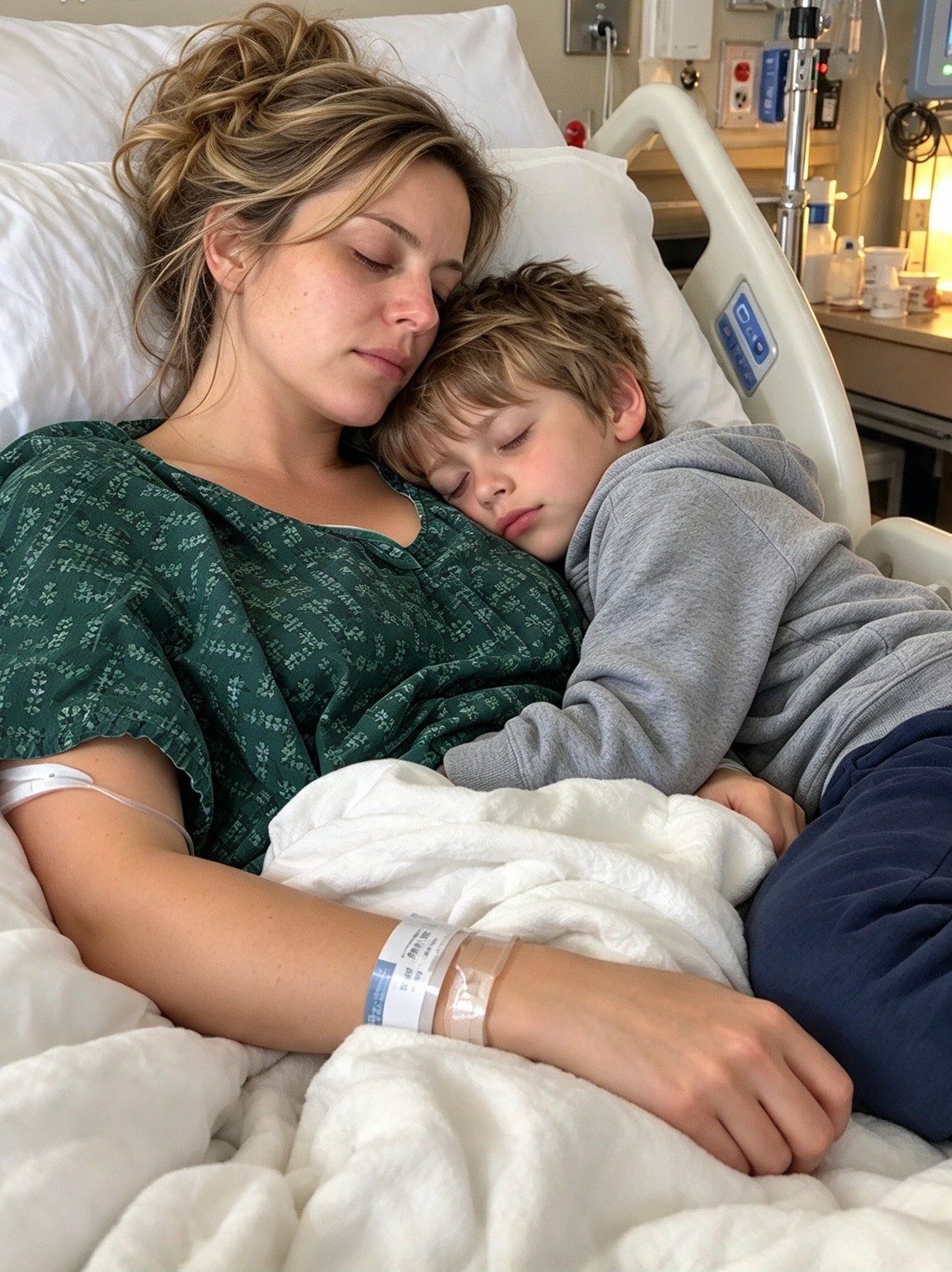
Every afternoon after school, he sits by her bed, holds her hand, and tells her everything about his day. Tonight, I finally tried to get him to come home and rest. But when I mentioned leaving, he looked at me and said: “Dad, I can’t leave Mom on Saturdays.”
“Why not?”
“Because that’s when she talks to me.”
I thought he was imagining things.
Then he asked me one question that left me speechless.
Part 1:
“Dad, why are you afraid to stay here with me?”
My seven-year-old son’s question stopped me cold.
I stared at him, unable to answer. He was sitting beside his mother’s hospital bed, holding a Marvel comic in his small hands. His eyes were fixed on mine, and for the first time, I realized that my little boy might understand something I had been too afraid to face.
Something about my wife.
Something about me.
And something that had been happening in that hospital room while I kept finding excuses to leave.
Two months earlier, I had been away on a business trip when my mother called me.
I still remember standing outside a conference room, frustrated because my meeting had run late. I had been checking my phone, thinking about the work I still needed to finish, when I saw my mother’s name on the screen.
I answered immediately.
“Mom, is everything okay?”
“Daniel, you need to come home.”
There was something in her voice that made my stomach tighten.
“What’s wrong? What happened?”
“It’s Sarah. She’s in the hospital.”
For a moment, I couldn’t move.
“What do you mean she’s in the hospital? What happened to my wife?”
My mother took a shaky breath.
“Daniel, she’s in a coma. Toby is here with her, and he refuses to leave her side. You need to come home immediately.”
I didn’t ask any more questions.
I grabbed my belongings, informed my colleagues that I had an emergency, and left as quickly as I could. I arranged the journey home and spent every minute wondering what I would find when I arrived.
I had never felt so helpless in my life.
When I finally reached the hospital, I hurried through the corridors until I found Sarah’s room.
And there she was.
My wife lay motionless in the hospital bed, surrounded by medical equipment. Her eyes were closed, and her face looked peaceful, almost as if she were sleeping.
But I knew she wasn’t sleeping.
She was in a coma.
Beside her sat our seven-year-old son, Toby. He was holding his mother’s hand with both of his little hands, as if he could somehow keep her connected to the world simply by refusing to let go.
When he saw me, he jumped out of his chair and ran into my arms.
“Daddy, when is Mommy going to wake up?”
I knelt down and hugged him tightly.
“I don’t know, buddy,” I whispered. “But the doctors are taking good care of her. We’re going to stay strong for Mom, okay?”
He nodded against my shoulder.
But I could feel him trembling.
I wanted to promise him that everything would be fine. I wanted to tell him his mother would open her eyes the next morning, smile at us, and ask why we were making such a fuss.
But I couldn’t make that promise.
The doctors explained Sarah’s condition as carefully as they could. They were monitoring her closely and doing everything necessary to understand what had happened. They couldn’t tell us when, or even whether, she would regain consciousness.
All we could do was wait.
And waiting became our entire life.
That was two months ago.
Sixty days without hearing my wife’s voice.
Sixty days of walking into a hospital room and hoping to see her open her eyes.
Sixty days of looking at the woman I loved and wondering whether she could hear us.
Every morning, I woke up hoping that day would bring good news. Every evening, I went to bed carrying the same unanswered questions.
Yet somehow, the days continued to pass.
Our son, Toby, was only seven years old. He should have been worrying about homework, playground games, superheroes, and what he wanted for his birthday.
Instead, he was worrying about his mother.
We insisted that he continue attending school because we wanted him to maintain some kind of normal routine. My mother, whom Toby called Grandma, helped with his daily schedule. She picked him up after school and took him straight to the hospital.
He rarely wanted to go anywhere else.
He did his homework beside Sarah’s bed.
He read her favorite stories.
He told her about his teachers, his classmates, and the little things that made him laugh.
Sometimes, he brought his Marvel comics and explained every character to her as if she were sitting up and listening with a smile.
He even told her about the arguments he had with his friends over which superhero was the strongest.
Every day, he behaved as though his mother might wake up at any moment and ask him to tell her everything she had missed.
Sometimes, he fell asleep in the chair beside her bed.
When the nurses suggested that he should go home and get some proper rest, he would shake his head.
“I’m staying with Mommy.”
And when it was time to leave, he would look at me or Grandma with pleading eyes.
“Can I stay just a little longer?”
More often than I should have allowed, I said yes.
My mother and I had become increasingly worried about him.
He was sleeping badly. He was spending almost all his free time in the hospital. He rarely talked about anything other than his mother.
He needed rest.
He needed to play with his friends.
He needed time away from the hospital, where he could simply be a little boy again.
Most importantly, he needed to understand that keeping his mother company was not his responsibility alone.
His father was there, too.
At least, that was what I kept telling myself.
Because the truth was that I had been struggling in ways I didn’t know how to explain.
I visited Sarah every day. I spoke to the doctors, asked the nurses for updates, handled the bills, and tried to keep our lives from falling apart.
But I rarely sat still beside her for very long.
There was always something to do.
A work call to answer.
A cup of coffee to get.
A question to ask a nurse.
An errand to run.
Anything that allowed me to step outside that room and escape the silence.
I told myself I was being responsible.
I told myself I was taking care of everything.
But deep down, I knew I was running away from something.
I just wasn’t ready to admit what it was.
Then came that Saturday evening.
Toby was sitting beside Sarah’s bed, completely absorbed in a Marvel comic. He was reading about one of his favorite superheroes, moving his lips silently as he followed the story.
I pulled a chair beside him.
“Hey, buddy. Can we talk for a minute?”
He looked up.
“Sure, Dad.”
I glanced at Sarah before turning back to him.
“I know you’ve been taking care of Mom, and I want you to know how proud I am of you. You’ve been incredibly brave.”
He smiled faintly, then looked at his mother.
“But even superheroes need to rest,” I continued. “They can’t help anyone if they’re exhausted. Remember that?”
He nodded slowly.
“How about we go home tonight? You can sleep in your own bed, and we’ll come back tomorrow morning.”
Toby didn’t answer immediately.
Instead, he slowly closed his comic and placed it on his lap.
Then he asked me a strange question.
“What day is it, Dad?”
I glanced at the clock.
“It’s Saturday.”
His expression changed immediately.
“Then I can’t leave.”
I frowned.
“Why not? What’s different about Saturday?”
He looked toward his mother and then back at me.
“Because Mom won’t have anyone to talk to.”
I tried to smile, hoping to reassure him.
“Buddy, you can talk to her again tomorrow. Mom knows we love her, and we’re going to keep visiting her.”
He shook his head.
“No, Dad. You don’t understand.”
I leaned closer.
“Then help me understand.”
He lowered his voice, almost as if he were afraid someone might overhear him.
“Mom talks to me on Saturdays.”
I stared at him.
For a second, I thought I had misunderstood.
“What did you just say?”
“She answers me.”
My heart sank.
I knew how desperately Toby wanted his mother to wake up. I had watched him spend countless hours beside her bed, talking to her as if nothing had changed.
Children sometimes searched for signs of hope when someone they loved was seriously ill. I had worried that Toby might begin imagining things because he couldn’t bear the uncertainty.
So I tried to remain calm.
“Toby, sweetheart, please don’t joke about something like that.”
His face became serious.
“I’m not joking, Dad.”
He turned toward Sarah.
“She only talks to me. It’s our secret.”
My throat tightened.
I reached for his hand.
“Listen to me, buddy. Mom isn’t able to speak right now. The doctors have explained that she’s unconscious. I hope she can hear us when we talk to her, and I hope she knows how much we love her. But we don’t know whether she can answer us.”
Toby listened without interrupting.
Then he asked a question that made me uncomfortable.
“Have you ever stayed long enough to find out?”
I opened my mouth, but no words came out.
He continued.
“You always come here, Dad. But you’re always leaving to get coffee or answer your phone. Sometimes you go downstairs, and sometimes you talk to the nurses for a long time.”
I looked away.
Because he was right.
I came to the hospital every day, but I rarely gave myself permission to sit quietly beside Sarah and simply be with her.
There was always something that needed my attention.
Or something I pretended needed my attention.
Then Toby asked the question I had been dreading.
“Why are you scared to stay in Mom’s room with me?”
I froze.
Because I was scared.
I was scared of the silence.
I was scared of sitting beside the woman I loved without knowing whether she could hear me.
I was scared of looking into her closed eyes and realizing that I couldn’t do anything to make her open them.
And perhaps most of all, I was scared of the memories that came back whenever I sat beside her for too long.
Memories of the last evening we had spent together before my business trip.
Memories of the argument we had never resolved.
Memories of the words I wished I could take back.
I looked at my seven-year-old son.
He wasn’t angry.
He wasn’t trying to hurt me.
He was simply waiting for an honest answer from his father.
But I couldn’t give him one.
Then he reached for my hand and squeezed it.
“Stay tonight, Dad.”
I looked toward Sarah.
Her eyes were closed, and the room was quiet except for the steady sounds of the medical equipment.
Toby squeezed my fingers again.
“Just stay with me. Then you’ll see.”
I stared at him for a long moment.
Finally, I nodded.
“Okay, buddy. I’m staying.”
A small smile appeared on his face.
He moved his chair closer to his mother’s bed and opened his comic again, as though he had been waiting all evening for me to agree.
I settled into the chair beside him.
For the first time in weeks, I didn’t reach for my phone.
I didn’t glance toward the door.
I didn’t start thinking about what I needed to do next.
I simply watched my wife’s face.
I had no idea what Toby expected to happen. Perhaps he had misunderstood an involuntary movement. Perhaps he had noticed something the rest of us had missed.
I didn’t know.
But I had promised him I would stay, and I intended to keep that promise.
As the evening grew quieter, Toby put his comic aside.
He gently took his mother’s hand and looked at me.
Then he leaned toward her and whispered:
“Okay, Mom. Dad’s here this time.”
What happened next would change the way I understood my son, my wife, and the fear I had been carrying for two long months.
Part 2:
For nearly an hour, nothing happened.
Toby continued talking to Sarah as though she were sitting beside him at home rather than lying unconscious in a hospital bed.
He told her about his spelling test at school, explained what had happened during recess, and described a superhero adventure he had been reading about.
Then he remembered something that made him giggle.
“Mom, Grandma burned the pancakes again this morning.”
From the corner of the room, my mother immediately protested.
“They were not burned!”
Toby turned toward her with an innocent expression.
“They were black, Grandma.”
“They were a little too crispy,” she admitted.
Toby laughed.
For a moment, the hospital room felt almost normal.
My mother smiled at him, but I could see the sadness behind her eyes. She was trying just as hard as I was to keep Toby’s world from falling apart.
Eventually, she decided to go home and prepare for the next day.
Before leaving, she bent down and kissed Toby on the forehead.
“Are you sure you’ll be okay, sweetheart?”
He nodded.
“Dad’s staying tonight.”
She looked at me.
I gave her a small nod, silently confirming that I would keep my promise.
After she left, the room became quiet again.
I sat beside Toby, watching the machines and trying not to think too far ahead.
Around seven o’clock, I started to stand.
“I’ll go get some coffee. Do you want anything?”
Toby immediately looked up.
“You promised you’d stay.”
I stopped.
“I’m only going to get coffee, buddy. I’ll be back in a minute.”
He glanced toward the door.
“There’s coffee down the hall. Why do you need to leave the room?”
His question caught me off guard.
I had no good reason.
I could have asked a nurse to bring me some water. I could have waited. I could have gone without coffee altogether.
Instead, I had automatically started looking for an excuse to leave.
I slowly sat back down.
“You’re right,” I said. “I promised I’d stay, and I’m going to keep that promise.”
Toby studied me for a moment, apparently making sure I meant it.
Then he turned back toward his mother.
We sat together for another twenty minutes.
Finally, Toby moved his chair closer to the bed.
“Okay, Mom,” he whispered. “Dad’s here.”
He gently slipped his hand beneath hers.
Then he asked a question in a voice so soft I almost didn’t hear it.
“Mom, are you happy Dad is here with us?”
I leaned forward.
At first, nothing happened.
The machines continued their steady rhythm. Sarah’s face remained still.
I watched her hand, unsure what I was supposed to be looking for.
Then, suddenly, her index finger moved.
Just once.
It was a small movement, so slight that I might have missed it if I hadn’t been watching closely.
My breath caught in my throat.
“Sarah?”
I leaned closer.
“Sweetheart, can you hear me?”
Nothing happened again.
I looked at Toby.
He was watching me with wide eyes.
“See, Dad?” he whispered. “She said yes.”
I stared at him.
“What do you mean?”
Toby looked down at his mother’s hand.
“One movement means yes. Two movements mean no.”
For a moment, I couldn’t speak.
I wanted to believe him. I wanted so badly to believe that Sarah had just answered us.
But I also knew that unconscious patients could make involuntary movements. A single movement wasn’t enough to prove that she understood a question or intended to respond.
I had to be careful.
I couldn’t allow my hope to turn a reflex into something it might not be.
So I took a slow breath.
“Okay, buddy. Let’s see what happens. But remember, we need to be careful. Sometimes people’s bodies move without them meaning to.”
Toby nodded.
“I know, Dad. That’s why I ask her questions.”
I looked at him in surprise.
He had clearly thought about this far more carefully than I had imagined.
“Can you show me what you mean?”
He nodded again.
“Mom, is my name Toby?”
We waited.
Several seconds passed.
Then Sarah’s index finger moved once.
My heart began pounding.
Toby looked at me.
“One means yes.”
I swallowed.
“Let’s try another question.”
Toby thought for a moment.
“Mom, am I nine years old?”
Her finger moved twice.
Once.
Twice.
I stared at her hand.
Toby was only seven, so the answer was no.
But I still couldn’t be certain what the movement meant.
I needed to understand how long this had been happening and whether the medical team knew about it.
I gently asked Toby to move his hand away from his mother’s.
“Just for a second, buddy. I want to try something.”
He obeyed.
I leaned closer to Sarah and took her hand carefully.
“Sarah, sweetheart, can you hear me?”
Nothing happened.
I waited a little longer.
Then I asked a simple question.
“Is Toby seven years old?”
For several seconds, there was no response.
I began to wonder whether I had imagined what I had seen.
Then her index finger moved once.
My entire body went still.
I looked at Toby.
He was watching his mother’s hand, his eyes shining with hope.
“See, Dad?” he whispered. “She knows.”
I didn’t know what to say.
I couldn’t explain what had happened, and I wasn’t ready to declare that Sarah was communicating with us.
But I knew one thing.
We needed to tell her doctors exactly what we had observed.
Before I could say anything else, another question came to my mind.
“How long has this been happening, Toby?”
His smile faded.
He lowered his eyes toward his comic.
“About four Saturdays.”
I stared at him.
“Four Saturdays?”
He nodded.
“Every Saturday, I come here and talk to Mom. Sometimes she moves her finger when I ask her something.”
I felt a mixture of amazement, confusion, and guilt.
“Why didn’t you tell me?”
Toby looked down at his hands.
“I tried.”
“What do you mean you tried?”
“I told Grandma once that Mom moved her finger. She said people in comas sometimes move without knowing what they’re doing.”
My mother had probably been trying to protect him from disappointment.
And medically, she wasn’t wrong. A movement by itself didn’t prove that Sarah was responding intentionally.
But Toby had interpreted her answer differently.
He thought nobody believed him.
I reached for his hand.
“Buddy, you should have told me again. I would have listened.”
He looked up at me, and his expression hurt more than any accusation could have.
“You wouldn’t have believed me either.”
I opened my mouth to deny it.
Then I stopped.
Would I have believed him?
Honestly, I didn’t know.
I had spent weeks trying to make sense of Sarah’s condition. I had read medical information, spoken to doctors, and searched for anything that might help us understand what was happening.
But I had also become so frightened of disappointment that I had stopped allowing myself to hope.
If Toby had told me that Sarah was answering his questions, I might have explained it away without giving him the chance to show me what he had seen.
He continued speaking.
“I heard you and Grandma talking about keeping me away from Mom for a while.”
My stomach tightened.
I remembered that conversation.
We had been standing in the hospital corridor several days earlier, discussing how exhausted Toby seemed.
My mother had worried that he wasn’t sleeping enough. I had agreed that he needed more time at home, away from the hospital.
We hadn’t meant to keep him from Sarah forever.
We had simply wanted him to rest.
But Toby had heard enough to misunderstand.
“I thought you were going to stop bringing me here,” he whispered.
I felt something twist inside my chest.
“Oh, buddy.”
I pulled him into a gentle hug.
“We weren’t trying to keep you away from Mom. We were worried about you. You’re only seven, and we want you to have time to sleep, play, and be with your friends.”
He rested his head against my shoulder.
“But Mom needs me.”
I closed my eyes.
“She needs all of us, sweetheart. Not just you.”
He didn’t answer immediately.
Then he pulled back and looked at me.
“Dad, why are you always scared to stay with Mom?”
The question returned so suddenly that I felt as if the air had been knocked out of my lungs.
I stared at him.
“Scared? Toby, I’m here every day.”
“I know,” he replied. “But you’re always leaving.”
He began counting on his fingers.
“You get coffee. You take work calls. You talk to Grandma. You ask the nurses questions. You go downstairs.”
I tried to explain.
“I have things I need to take care of, buddy.”
“I know.”
His voice was quiet.
“But when everything gets quiet, you leave.”
I looked toward Sarah.
He was right again.
I had been so busy managing everything around her that I had avoided the one thing I couldn’t manage.
The uncertainty.
The silence.
The possibility that the woman I loved might never wake up.
Then Toby said something that made my chest tighten.
“I think you’re scared Mom will remember.”
I turned toward him.
“Remember what?”
He looked at me carefully.
“You and Mom fighting before your trip.”
For a moment, the hospital room seemed to disappear.
I was no longer sitting beside my son.
I was back in our kitchen, two months earlier, standing beside my suitcase while Sarah looked at me with tears in her eyes.
And I remembered everything.
Part 3:
The evening before my business trip, Sarah and I had argued.
It hadn’t started as a terrible fight. At first, it was just another disagreement about work.
I had been traveling more often, taking calls late at night, and spending too much time worrying about deadlines.
I kept telling myself it was temporary.
I kept promising that things would slow down soon.
But Sarah had heard those promises before.
That evening, she stood in the kitchen while I packed my suitcase.
“Daniel, please don’t go this time.”
I looked up from my clothes.
“Sarah, it’s only three days.”
She shook her head.
“It’s never just three days. You’re always working. Even when you’re home, you’re thinking about work.”
I sighed.
“It’s an important meeting. I can’t cancel at the last minute.”
“And what about us?”
Her voice broke slightly.
“What about Toby? What about the time we’re supposed to spend together as a family?”
I felt defensive.
I thought I was doing everything for them. I was working to provide for our family, pay our bills, and give our son a comfortable life.
I didn’t understand why Sarah couldn’t see that.
“I’m doing this for us,” I told her. “You know how important my job is.”
She looked at me sadly.
“I know your job is important, Daniel. I’m not asking you to stop working. I’m asking you to be here sometimes.”
I turned back to my suitcase.
“I don’t want to have this argument tonight.”
“Neither do I,” she replied. “But we keep having it because nothing changes.”
I zipped my suitcase shut.
“Sarah, we’ll talk when I get back.”
She stared at me.
“You always say that.”
I picked up my suitcase.
“We’ll work it out. I promise.”
Then I kissed her quickly, told Toby goodnight, and left.
I thought I would be home three days later.
I thought we would sit down, talk through our problems, and find a way to make things better.
I thought there would be time.
But Sarah never got that conversation.
Her medical emergency wasn’t caused by my trip, and I knew that. The doctors had never suggested that my absence had anything to do with her condition.
Still, guilt doesn’t always listen to reason.
For two months, I had replayed that final argument in my mind.
I remembered Sarah asking me to stay.
I remembered the disappointment in her eyes.
And I remembered how easily I had walked out the door.
Every time I sat beside her hospital bed, those memories returned.
I was terrified that if Sarah ever woke up, she would remember our last conversation and wonder why I hadn’t listened to her.
Perhaps she would be angry.
Perhaps she would tell me she had been trying to save our marriage while I had been too busy to notice.
Perhaps she would look at me and ask why it had taken something so terrible to make me understand what she had been saying all along.
I didn’t know.
And because I didn’t know, I kept myself busy.
It was easier to answer emails than to sit beside my wife and think about the future.
It was easier to talk to the doctors than to tell Sarah how sorry I was.
It was easier to leave the room than to face the possibility that I might never get another chance to make things right.
Now, my seven-year-old son was sitting beside me, seeing through every excuse I had made.
“Was Mom angry when you left?” Toby asked.
I took a slow breath.
“Yes, buddy. She was upset.”
“Is that why you don’t want to stay with her?”
I looked down at my hands.
“Partly.”
He frowned.
“But you love Mom.”
“More than anything in the world.”
“Then why are you scared?”
I struggled to find words a child could understand.
“Sometimes, when you love someone, you realize you’ve made mistakes. And when something bad happens, you start thinking about all the things you wish you had done differently.”
Toby listened carefully.
“Like what?”
“Like listening better. Spending more time together. Not always putting work first.”
He looked at Sarah.
“Mom just wanted you here.”
I nodded.
“I know that now.”
He was quiet for a moment.
Then he looked at me with a thoughtful expression.
“Let’s ask her something.”
I felt my heart begin to pound.
“What do you want to ask?”
He glanced toward Sarah.
“If she’s still mad at you.”
I swallowed.
“Toby, sweetheart, maybe we shouldn’t ask her that right now.”
“Why not?”
I didn’t have an easy answer.
Part of me wanted to know.
Another part of me was terrified of what I might see.
Toby turned toward his mother.
“Mom, are you mad at Dad?”
We waited.
Nothing happened.
He asked again, a little more softly.
“Mom, are you still mad at Dad?”
The room remained quiet.
I looked at Sarah’s hand, but there was no movement.
For a moment, I felt foolish for hoping.
Perhaps the movements we had seen earlier really had been involuntary. Perhaps Toby had spent four Saturdays looking for a pattern because he desperately wanted to believe his mother was responding.
I didn’t want him to be hurt.
I gently touched his shoulder.
“Maybe she’s tired, buddy.”
He frowned.
“Maybe that’s too hard to answer.”
He thought for a moment.
Then he leaned closer to Sarah.
“Mom, do you want Dad to stay with you?”
My chest tightened.
I watched her hand.
One second passed.
Then another.
I was almost ready to look away when her index finger moved.
Once.
I stopped breathing.
Toby turned toward me with the biggest smile I had seen on his face in weeks.
“See, Dad? She wants you here.”
I couldn’t speak.
I looked at Sarah’s hand, then at her face.
Nothing else changed. Her eyes remained closed, and she didn’t speak.
I still couldn’t be certain that the movement was an intentional answer.
But I couldn’t ignore what we had observed, either.
I gently took her hand.
“I’m here, sweetheart,” I whispered.
My voice broke.
“I’m here, and I’m sorry.”
For two months, I had imagined Sarah waking up and remembering our argument.
I had been so afraid that she would blame me for leaving that I had forgotten something important.
I could not change the past.
I could not undo our argument or recover the time I had spent putting work first.
And I could not make her wake up simply because I wanted another chance.
But I could choose what I did now.
I could stay beside her.
I could talk to her without expecting an answer.
I could stop treating the hospital room like a place I had to escape from.
I could be the husband I had promised her I would be, even when being there hurt.
I turned toward Toby.
“Buddy, you don’t have to do this alone anymore.”
He looked confused.
“But Mom needs someone.”
“I know. And I’m here.”
“What if she wakes up?”
“I’ll be here.”
“What if she tries to talk?”
“I’ll listen.”
“What if work calls?”
I gave him a small smile.
“Then I’ll let someone else handle it whenever I can. And if something really needs my attention, I’ll take care of it without forgetting why I’m here.”
He studied my face.
“What about coffee?”
Despite everything, I laughed softly.
“Coffee can wait.”
He smiled.
Then his expression became serious again.
“Promise?”
I held out my little finger.
“I promise.”
He hooked his finger around mine.
And for the first time in two months, I felt as though I had made a promise that mattered more than anything on my calendar.
I had told my son that he no longer needed to carry the responsibility of staying beside his mother.
But as I looked at him, I realized something else.
He had been doing far more than keeping Sarah company.
He had been trying to keep our family together.
He had been afraid that if he went home, his mother would be alone.
He had been afraid that if he stopped talking to her, she might never hear his voice again.
And he had been afraid that if he told us what he believed was happening, we would take away the one thing that gave him hope.
He was only seven years old.
He should never have had to carry those fears by himself.
I pulled him close and kissed the top of his head.
“You’ve been so brave, Toby. But you don’t have to be brave every minute of every day. You can be sad. You can be scared. You can go home and play with your friends. Taking care of Mom is my job, too.”
His chin began to tremble.
“I just want her to wake up.”
I held him tighter.
“I know, buddy. I want that more than anything.”
For a while, we sat quietly together.
Then I made a decision.
I was going to tell Sarah’s medical team exactly what we had seen.
I wasn’t going to claim that she had definitely answered us. I wasn’t going to tell Toby that his mother had awakened when she clearly hadn’t.
But I was going to make sure the doctors knew about the movements and the pattern he had noticed.
Because even if the explanation turned out to be different from what we hoped, Toby deserved to be taken seriously.
And Sarah deserved to have every possible response carefully evaluated.
Part 4:
Later that evening, I stepped into the corridor and spoke with Sarah’s nurse.
I explained that Toby had noticed occasional finger movements during their Saturday visits. I told her that we had seen several movements that evening and that Toby believed they sometimes followed simple questions.
The nurse listened without interrupting.
Then she asked me a few questions.
“When did you first notice the movement?”
“Tonight,” I explained. “But my son says he’s noticed similar movements on several Saturdays over the past month.”
“Have you noticed any other changes?”
“Not that I can be certain of. We don’t want to assume anything, but we’d like someone to evaluate her responses.”
The nurse nodded.
“Thank you for telling me. I’ll pass this information on to the medical team.”
I returned to Sarah’s room and sat beside Toby.
He looked at me anxiously.
“Are the doctors going to check Mom?”
“Yes, buddy. I told them what we saw.”
“Are they going to believe us?”
“They’re going to look into it. That’s what matters.”
He seemed relieved.
Over the following days, Sarah’s doctors and nurses monitored her closely. They paid attention to her movements and continued evaluating her level of consciousness.
Sometimes, Sarah moved a finger.
Other times, she remained completely still.
The doctors explained that patients with impaired consciousness could show movements for different reasons. Some movements were reflexive, while others might be responses to voices or stimulation.
It wasn’t always easy to tell the difference.
A single movement couldn’t prove that a patient understood a question, and we needed to be careful not to interpret every small change as a sign of recovery.
Still, the medical team took our observations seriously.
They continued assessing Sarah and watching for any consistent, meaningful responses.
That was enough to give Toby some comfort.
For the first time, he felt that the adults around him were listening rather than simply telling him not to get his hopes up.
But the biggest change wasn’t happening in the hospital’s medical records.
It was happening in our family.
That night, my mother returned to the hospital to take Toby home.
When she saw me gathering his schoolbag and comic books, he immediately became worried.
“I’m not leaving Mom,” he announced.
I knelt in front of him.
“I’m staying tonight.”
He stared at me.
“But it’s Saturday.”
“I know.”
“Mom needs someone.”
I gently placed my hands on his shoulders.
“And she has me.”
He looked uncertain.
“You’re not going to leave?”
“No, buddy.”
“Not even to get coffee?”
I smiled.
“Not even to get coffee.”
He glanced toward Sarah, then back at me.
“Right here?”
“Right here.”
He watched my face for several seconds, as if he were searching for any sign that I might change my mind.
Then he slowly nodded.
He walked to his mother’s bedside and gently touched her hand.
“Good night, Mom,” he whispered. “I’m going home to sleep tonight.”
He paused.
Then he added, “Dad’s staying with you.”
Those words nearly broke my heart.
My son wasn’t simply saying goodnight to his mother.
He was reassuring himself that she wouldn’t be alone.
He needed to hear that someone else would stay behind.
I stood beside him and gently rubbed his back.
“Your mom is in good hands, sweetheart. The nurses are here, the doctors are taking care of her, and I’ll be right beside her tonight.”
Toby finally turned toward me.
Then he wrapped his arms around my waist and hugged me tightly.
“I love you, Dad.”
I bent down and held him.
“I love you too, buddy. More than you know.”
My mother took his hand, and they headed toward the door.
Just before leaving, Toby turned around one last time.
“Don’t forget your promise!”
I smiled.
“I won’t.”
Then he left.
That night, Toby slept in his own bed for the first time in weeks.
He didn’t have to wake up in a hospital chair with his neck aching.
He didn’t have to wonder whether his mother was alone.
He could simply close his eyes and rest, knowing that the adults who loved him were taking care of things.
And I stayed beside Sarah.
For the first time in two months, I didn’t make unnecessary phone calls.
I didn’t wander through the corridors looking for excuses to leave.
I didn’t spend the evening checking emails or thinking about deadlines.
I held my wife’s hand and talked to her.
“I don’t know if you can hear me, sweetheart,” I whispered. “But if you can, I want you to know that I’m here.”
I looked at her face.
“I’ve been thinking about our last conversation. I keep remembering how you asked me to stay, and how I told you we’d talk when I got back.”
My throat tightened.
“I wish I had listened better. I wish I had put my suitcase down and sat beside you. I wish I had understood that you weren’t asking me to stop working forever. You were asking me to make more room for you in my life.”
I paused, trying to control my emotions.
“I thought taking care of everything meant I was being a good husband. I thought that if I worked hard enough, solved enough problems, and made enough money, I was doing what our family needed.”
I gently brushed a strand of hair away from her forehead.
“But I forgot that sometimes people don’t need you to fix anything. Sometimes they just need you to sit beside them and listen.”
I squeezed her hand.
“I’m sorry, Sarah. I can’t change what happened before my trip. But I can change what I do now.”
The room remained quiet.
Her fingers didn’t move.
Her eyes stayed closed.
I didn’t know whether she could hear me.
But for once, I didn’t need an answer to keep talking.
I told her about Toby’s day.
I told her about the pancakes my mother had defended so passionately.
I told her that our son was growing up far too quickly and that I hoped she would be there to see all the things he would do.
I told her I loved her.
And then I stayed.
I stayed through the long hours of the night.
I stayed when the hospital became quiet.
I stayed when my thoughts grew dark and my fear returned.
And when morning finally arrived, I was still there.
Part 5:
Over the following weeks, Sarah began showing small signs of change.
At first, the changes were so slight that we weren’t sure what to make of them.
An occasional movement.
A brief response during an examination.
A moment when her eyes opened.
Sometimes, she seemed to react to familiar voices.
Other times, there was no noticeable response at all.
The doctors continued evaluating her condition and monitoring her progress. They reminded us that recovery from a coma or another prolonged state of impaired consciousness could be unpredictable.
There were no guarantees.
We couldn’t assume that every movement meant she understood us, and we couldn’t know when she might regain consciousness.
But we learned to appreciate each small development without demanding that it become something bigger.
For the first time in weeks, I was able to hold on to hope without letting it control every moment of my life.
And Toby began to change, too.
He still visited his mother after school.
He still brought his comics and told her stories about his day.
He still held her hand and spoke to her as though she might answer at any moment.
But he no longer felt that he had to stay until bedtime every single night.
He began going home for dinner.
He spent more time playing with his friends.
He started talking about school again without immediately turning every conversation back to his mother’s condition.
Sometimes, he even complained when it was time to leave a playdate to visit the hospital.
One afternoon, I heard him telling my mother about a game he had played with his classmates.
He was laughing so hard that he could barely finish the story.
I stood in the doorway and watched him.
For weeks, I had been terrified that my son was losing his childhood.
He had become so focused on protecting his mother that he had forgotten he was allowed to be a child himself.
Now, slowly, he was finding his way back.
And I understood that this was part of taking care of him, too.
He didn’t need me to promise that everything would be fine.
He needed me to be honest with him.
He needed me to listen when he was frightened.
He needed me to remind him that he wasn’t responsible for keeping his mother alive or making her wake up.
And he needed to know that his father would be there, even when there was nothing useful to do.
I started making changes outside the hospital as well.
I spoke with my colleagues about delegating more of my work. I stopped answering every message the moment it arrived. When something could wait until the next morning, I let it wait.
I began making time for Toby instead of assuming that my mother could handle everything.
We ate dinner together.
We played board games.
We talked about his friends, his favorite superheroes, and the things he wanted to do when his mother came home.
Sometimes, he asked difficult questions.
“Dad, what if Mom never wakes up?”
I never lied to him.
“I don’t know, buddy. The doctors are doing everything they can, and we’re hoping she gets better. But we can’t know exactly what will happen.”
He would become quiet.
Then he might ask another question.
“Will you still be here if I’m sad?”
I would pull him close.
“Always. You can talk to me about anything.”
I wanted him to understand that he didn’t need to hide his feelings to protect mine.
He could be angry.
He could be frightened.
He could cry.
And he could laugh without feeling guilty.
Because loving someone who is seriously ill doesn’t mean you have to stop living your own life.
It means finding a way to keep loving them while allowing yourself to be cared for, too.
Saturdays remained special.
Only now, I stayed beside Sarah, too.
I stopped treating those visits as another task to complete.
I began looking forward to them.
Toby would sit beside his mother and tell her about his week. Sometimes I would bring a book and read aloud. Other times, we would simply sit together, holding her hand and talking about our family.
We didn’t always see a response.
We didn’t always know whether she could hear us.
But we no longer felt that we had to fill every second with activity.
We were there because we loved her.
And that was enough.
Several weeks later, something happened that I will never forget.
Toby was sitting beside Sarah’s bed, telling her about a spelling test at school.
He had been struggling with one particular word, and his teacher had encouraged him to practice it at home.
He was explaining the whole story to his mother when he suddenly stopped and looked at me.
“Dad, you ask her today.”
I smiled.
“Ask her what?”
He shrugged.
“Anything.”
I moved my chair closer to Sarah’s bed and took her hand.
Her fingers were warm beneath mine.
I thought for a moment, trying to come up with a question that would make Toby smile.
Then I remembered the word he had been struggling to spell.
I looked at my son.
“Sarah, sweetheart, do you think Toby will ever learn how to spell the word ‘separate’?”
Toby immediately groaned.
“Dad! That’s not funny!”
I laughed softly.
“I’m just asking your mother for her opinion.”
He folded his arms.
“You’re both going to laugh at me if I get it wrong.”
I shook my head.
“No, buddy. We’ll help you practice.”
Then I turned back toward Sarah.
I watched her hand, not expecting anything.
Several seconds passed.
Then her index finger moved.
Once.
I stared at it.
Toby stared, too.
Then he burst into laughter.
“She said yes!”
I laughed with him.
For the first time in months, the hospital room was filled with joy instead of constant fear.
We were still worried about Sarah.
We still didn’t know what the future would bring.
But for a few precious moments, we were simply a family sharing a laugh.
And I realized how much I had missed that feeling.
Part 6:
As I watched Toby laugh beside his mother’s bed, I thought about everything that had happened over the previous two months.
At first, I had believed my son refused to leave the hospital because he couldn’t accept his mother’s condition.
I thought he was clinging to her because he was frightened.
I thought he needed me to explain that staying beside her every night wouldn’t make her recover any faster.
And while he did need rest and reassurance, I had misunderstood the most important part.
Toby stayed because he believed somebody had to.
He thought his mother needed him to be there.
He believed that if he went home, she might be left without the person who could hear her.
And because he was only seven, he didn’t know how to explain that fear in a way the adults around him would understand.
So he kept coming back.
Every afternoon.
Every Saturday.
Every time he had a chance to sit beside her.
He told her stories.
He read her comics.
He asked her questions.
And when he believed she answered, he kept that discovery to himself because he was afraid we would stop bringing him to the hospital.
He had been carrying a responsibility that should never have belonged to him.
And without realizing it, I had made him feel that he was the only person willing to carry it.
I had been visiting Sarah every day.
I had been speaking to doctors, paying bills, managing schedules, and doing everything I believed a responsible husband and father should do.
But my son had noticed something I had missed.
There is a difference between visiting someone you love and truly being present for them.
I had been physically present in that hospital almost every day, but my mind was always somewhere else.
I was thinking about work.
I was worrying about the future.
I was replaying the argument with Sarah.
I was searching for answers to questions nobody could answer.
And whenever the silence became too difficult to bear, I found a reason to leave.
Toby had seen all of it.
He had noticed that I could sit beside his mother for an hour while still looking for an excuse to walk out.
He had noticed that I could ask the doctors a hundred questions but struggled to tell Sarah how much I missed her.
And he had noticed that whenever I was forced to sit quietly with my own fear, I tried to escape.
My seven-year-old son had understood something that I had spent months avoiding.
Sometimes, love isn’t about finding the right words or fixing a problem.
Sometimes, love is simply staying.
It’s sitting beside someone when you don’t know what to say.
It’s holding their hand when you can’t change what is happening.
It’s admitting that you’re frightened instead of pretending you have everything under control.
And it’s allowing the people you love to see that you are hurting, too.
That Saturday evening, Toby had asked me why I was afraid to stay with him and his mother.
I hadn’t been able to answer him.
But now I understood.
I was afraid because staying meant facing everything I couldn’t control.
It meant admitting that I couldn’t guarantee Sarah would wake up.
It meant accepting that I might never get the chance to resolve our final argument.
And it meant recognizing that all the work I had done, all the bills I had paid, and all the problems I had tried to solve could not change the one thing I wanted most.
I wanted my wife back.
I wanted to hear her voice.
I wanted to see her smile.
I wanted to sit across from her at our kitchen table and talk about the ordinary things we had once taken for granted.
I wanted another chance to listen when she told me she needed me.
But I couldn’t force any of those things to happen.
All I could do was be there.
So I made a promise to myself.
I would stop waiting for the perfect moment to tell the people I loved how much they mattered.
I would stop assuming there would always be another day to make things right.
And I would stop confusing being busy with being present.
I couldn’t change the evening I had left for my business trip.
But I could make sure my son never again believed that he had to protect our family all by himself.
I could show him that adults were allowed to be frightened, too, but that fear didn’t have to make us disappear.
And I could remind him that even when life became painful and uncertain, we would face it together.
That evening, after Toby finished telling Sarah about his spelling test, he leaned over and kissed her forehead.
“Good night, Mom,” he whispered.
Then he turned to me.
“Dad, are you staying?”
I smiled.
“Yes, buddy. I’m staying.”
He nodded, satisfied.
“Okay.”
He picked up his comic and gathered his schoolbag.
Before leaving with Grandma, he walked back to his mother’s bedside and touched her hand one last time.
“I’ll see you tomorrow, Mom.”
Then he looked at me.
“Don’t forget. You promised.”
I gently squeezed his shoulder.
“I remember.”
He smiled and walked toward the door.
This time, he didn’t look frightened.
He didn’t turn around to check whether I was following him.
He didn’t beg me to stay.
He simply trusted me.
And that meant more to me than I could ever explain.
After Toby left, I pulled my chair closer to Sarah’s bed.
I took her hand and looked at the woman I loved.
“I don’t know when you’ll wake up, sweetheart,” I whispered. “And I don’t know what you’ll remember when you do.”
I paused, feeling tears gather in my eyes.
“But I want you to know something. I’m here. I’m not running away anymore.”
The room was quiet.
Her eyes remained closed.
I didn’t know whether she could hear me, and I didn’t pretend to know what her finger movements meant.
But I didn’t need to be certain of anything to keep my promise.
I stayed beside her.
And for the first time in a very long time, I wasn’t waiting for a reason to leave.
I was exactly where I needed to be.
With my wife.
With my family.
And with the people I loved most in the world.
I had spent two months believing that I needed to be strong enough to fix everything.
My son taught me that I didn’t.
I only needed to stop running from the things I couldn’t fix.
Because sometimes, the greatest gift you can give someone isn’t an answer, a solution, or a promise that everything will be all right.
Sometimes, it’s your presence.
It’s your hand in theirs.
It’s your voice telling them they are not alone.
And it’s the decision to stay, even when staying is the hardest thing you have ever done.
My seven-year-old son taught me that lesson with a simple question and a tiny movement of his mother’s finger.
I will never forget it.
And this time, I wasn’t going anywhere.
The End.
