
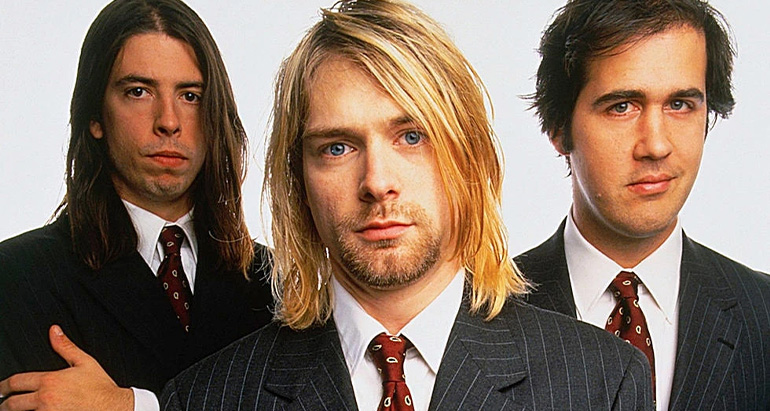
Nirvana was an American grunge band from Aberdeen, Washington. The band was formed in 1987 and achieved great popularity by the end of 1991 with the song “Smells Like Teen Spirit” and the album “Nevermind.”
Seven years after its founding, the band disbanded in the spring of 1994 in connection with the death of singer and songwriter Kurt Cobain. The band sold approximately 75 million records.
History
Beginnings (1987–1989)
Nirvana was founded in 1987 by Kurt Cobain and Krist Novoselić.
The two met in 1984 at school and especially in the environment of the band The Melvins. In the winter of 1985, Cobain, along with the later The Melvins drummer Dale Crover as bassist, founded the band Fecal Matter. After the group recorded two demos at Cobain’s aunt Mari’s and played a few concerts, including as an opening act for The Melvins, it disbanded. The Fecal Matter demo from December 1985 convinced Novoselić to form a band with Cobain. That same month, the two formed a Creedence Clearwater Revival cover band called the Sellouts, with Cobain on vocals and Novoselic on bass, along with drummer Steve Newman. In the same month, Cobain and Novoselić formed another band with drummer Bob McFadden, but both bands disbanded that same winter.
In March 1986, Krist Novoselic moved to Phoenix, Arizona, with his girlfriend Shelli. After Novoselić moved back to Aberdeen in the fall of 1986, he and Cobain immediately began looking for a new drummer.
In January 1987, they finally formed a band with Aaron Burckhard, which played under the names Ted Ed Fred and The Stiff Woodies. Soon, initial differences emerged – while Burckhard mainly listened to metal, Novoselić and Cobain were inspired by Gang of Four, Scratch Acid, and Butthole Surfers. Moreover, Burckhard showed significantly less commitment than the two. Later, Kurt Cobain, whose work ethic initially overwhelmed Novoselić, said:
“I wanted to put out a record or do a few shows and stop the project from going down the drain like all the others in the past six years.”
– Kurt Cobain, quoted in Come As You Are
In March, the band finally performed their first concert at a private party in Raymond. At that time, Ted Ed Fred was already predominantly playing their own songs. In the same month, the band also gave their first public concert at the GESCCO Hall in Olympia in front of around ten spectators. On April 17, 1987, a performance for the campus radio station Kaos FM of Evergreen State College took place.
In the fall of 1987, Cobain moved to Olympia, with Burckhard remaining the only band member in Aberdeen. Burckhard’s lack of commitment and the geographical distance led to the band being inactive until Cobain and Novoselić started rehearsing with Dale Crover as the new drummer in December 1987.
On January 23, 1988, the band recorded their first demo with ten tracks with producer Jack Endino. The session in the well-known recording studio Reciprocal Recordings in Seattle cost the band 52.44, which Cobain paid. In the spring, Cobain had initial talks with Jonathan Poneman of the Seattle underground label Sub Pop, in which the release of a single was planned. As a replacement for Crover, who moved to San Francisco, Dave Foster joined the band as the drummer.
On March 19, 1988, the band played for the first time under the name Nirvana. Before that, the group was called Ted Ed Fred, Bliss, Throat Oyster, Pen Cap Chew and Windowpane. Regarding the choice of the name, Kurt Cobain later said: “I wanted a name that was somehow beautiful, nice, and pretty, not a disgusting punk rock name like Angry Samoans,” while at the same time he expressed little happiness in hindsight: “It’s too esoteric and serious.” As early as May 29, Foster was replaced by Chad Channing because he rarely showed up for rehearsals. Meanwhile, the January 1988 demo had convinced Sub Pop to release the single “Love Buzz”/”Big Cheese” in November 1988, in a run of 1,000 copies. The title track is a cover of the Dutch pop band Shocking Blue, which Kurt Cobain was persuaded to do by Krist Novoselic.
After the release of Love Buzz/Big Cheese, Sub Pop faced some financial problems at the end of 1988, so Nirvana couldn’t initially hope for an album release. Nevertheless, the band went back into the studio with Endino in December 1988 and January 1989. The 30 hours over three days would cost the band $606.17. The amount was paid by Jason Everman, a friend and fan of the band, who shortly thereafter in the summer of 1989 became the second guitarist, as Kurt did not have enough practice to sing, play guitar, and memorize the lyrics at the same time.
However, before that, Nirvana embarked on their first two-week tour on the West Coast in February 1989. Since Nirvana were still almost unknown at that time, they often played in front of only ten visitors, who also appeared mainly because of the label. Overall, the band had over 100 performances in 1989.
On August 8, 1989, the debut album Bleach was finally released. In advance, the band undertook their first US tour thru small clubs and bars, which ended a bit earlier than planned in New York on July 18 with Everman’s expulsion from the band. In August, Nirvana recorded five tracks with Steve Fisk at Music Source Studio, intended for an EP. In September, the canceled dates from the July tour were made up, with up to 200 fans attending the concerts, and the band made money for the first time.
On October 23, 1989, a 42-day European tour began in Newcastle upon Tyne, England, with the Sub-Pop band Tad, during which Nirvana gave their first concert in Germany on November 7 at the B-52 in Mönchengladbach. Since the two bands had to drive thru the nite almost every nite to the next performance with their equipment in the ten-seater Fiat minibus provided by Sub Pop, the atmosphere during the tour was very tense. Even the fact that the small venues and clubs were mostly sold out and the audience was enthusiastic could not change that, so Nirvana distanced themselves further from Sub Pop after the tour.
Nevermind (1990–1992)
At the beginning of 1990, Sub Pop was once again on the brink of financial collapse, and the release of a second album seemed unlikely. The band continued to tour the United States until they began recording with Butch Vig at Smart Studios on April 2, 1990. The seven songs recorded over the course of a week were sent to Sub Pop, but they were actually the demo for negotiations with major labels.
In September 1990, the band’s only release featuring Dan Peters from Mudhoney on drums was released: the single “Sliver.” Chad Channing was subsequently thrown out of the band during the first demo recordings for the second album. In Kurt Cobain’s journals, he described Channing’s drumming as “sloppy.” For a short tour, Dale Crover of The Melvins was borrowed again, until in August Dave Grohl of Scream was hired as the new permanent drummer. With the demo tape, the band entered into negotiations with the Geffen Records sublabel DGC.
On April 30, 1991, the band signed their record deal and received an advance of 87,000. Sub Pop received $75,000 to include Geffen in the contract and transfer the necessary rights to them. The idea of producing the album with Scott Litt and Don Dixon was dropped, and they stayed with Butch Vig. In August 1991, Nirvana toured Europe on “The-Year-That-Punk-Broke” tour with Sonic Youth and Ramones and played at the Reading Festival in Reading, England.
On September 10, 1991, the song “Smells Like Teen Spirit” was released as a single. The associated album Nevermind was released on September 24, 1991, and entered the US charts three weeks later, on October 12. The pre-sale expectations of Geffen proved to be a miscalculation with a production of 50,000 copies, and it had to be repressed very quickly. Just a few weeks later, the American Recording Industry Association (RIAA) awarded the platinum record for one million copies sold of Nevermind.
The band went on another European tour from November 4 to December 7, which took them to Germany for 4 concerts starting on November 10. On December 6, the band performed on the popular British show Tonight With Jonathan Ross on Channel 4. Just one day later, on December 7, Smells Like Teen Spirit entered the UK Singles Chart at number 7. The BBC Two (TV) show Rapido featured an extensive report on Nirvana. The rest of the tour was canceled due to Cobain’s viral infection, which he contracted after the Transmusicales festival in Rennes, France. The year ended on December 31, 1991, with a New Year’s concert at the Cow Palace in San Francisco, California.
On January 11, 1992, Nevermind reached the top of the US album charts, displacing Michael Jackson’s album Dangerous. Smells Like Teen Spirit had already peaked at number 6 on the US singles chart and was certified platinum on April 1, 1992. Nirvana soon appeared on NBC’s Saturday Nite Live.
For the tour in Australia (January), Japan, and New Zealand (February), the EP Hormoaning was also released there. During the tour, Nevermind also climbed to number 7 in the UK charts (February 1, 1992), while the album had already sold three million copies in the USA. The re-released debut album Bleach (1989) also entered the US charts for the first time at number 89 on February 22, 1992. On March 7, 1992, Bleach also debuted at number 33 in the UK charts.
On March 2, 1992, the single “Come As You Are” was released in the UK, while it was released in the USA on May 2, 1992. Because the song’s guitar riff was stolen from the Killing Joke single “Eighties” (1985), the band unsuccessfully sued Nirvana.
The song Lithium was released as the third single on July 13, 1992. While “In Bloom” was released as the fourth and final single from the album “Nevermind,” the band began working on a new album in October with Jack Endino, the producer of the album “Bleach.”
After these lightning-fast successes, the music industry also honored the band’s artistic achievements. For “Smells Like Teen Spirit,” Nirvana was honored at the 9th MTV Video Music Awards on September 9, 1992, in Los Angeles for “Best Alternative Music Video” and “Best New Artist Video.” However, the award for “Best Alternative Music Video” was engraved “Smells Like Team Spirit” instead of “Smells Like Teen Spirit.” Nirvana played Lithium live and then destroyed their equipment. In the process, Krist Novoselić got hit in the head by the bass when it fell awkwardly from the throw under the ceiling lights. Cobain then spat on a piano as he left the stage, which he thot belonged to Axl Rose, but which, as it turned out, belonged to Elton John, prompting a horrified reaction from the music world.
In Utero (1993)
On December 14, 1992, Incesticide, a hastily assembled compilation of B-sides and unreleased material, was released to satisfy the rapidly increasing demand for a follow-up album. The album also included a cover version of the song “Turnaround.” A video for the long out-of-print single “Sliver” from 1990 will be released from the album. The video showed the band in a totally run-down apartment with greasy hair, a cheap production that was completed in two takes. On March 6, “Oh, the Guilt” was released as a split single with the Jesus Lizard’s “Puss” in the UK, where it reached number 12. In a limited edition of 100,000 copies, the split single was later released in the USA thru the label Touch and Go Records.
The band was awarded Best International Act at the Brit Awards at Alexandra Palace in London on February 16. Nirvana played alongside Pearl Jam at a rally for Pro Choice, an organization campaigning for women’s right to abortion.
In February 1993, the band, along with producer Steve Albini, continued recording the new album (then working title I Hate Myself and I Want to Die) in Minnesota. The result drew the ire of the DGC record label, which called the recordings “shit.” Later, Albini explained to the Village Voice newspaper that the label and management did not want Albini as the band’s producer; however, the band insisted. In the following period, Nirvana made headlines solely due to numerous drug-related arrests, prison sentences, and rehabilitation attempts of Kurt Cobain, who was addicted to heroin. At the 10th MTV Video Music Awards in Universal City (California), In Bloom (1992, Nevermind) was awarded Best Alternative Video. The band, who smashed their instruments at the end, appeared in suits and with serious expressions.
After the single “Heart-Shaped Box” was released on August 30, 1993, the third album “In Utero” followed on September 13 and debuted at number 1 on the UK charts. The band appeared again on NBC Saturday Nite Live before In Utero was released in the US and also immediately topped the charts. In the fall, the band went on a world tour with Pat Smear, who had previously played with The Germs, on second guitar.
On November 18, the band performed an acoustic concert for the MTV Unplugged series at the Sony Music Studios in New York City. On November 23, the song “I Hate Myself and I Want to Die” was released on the Beavis and Butt-Head Experience compilation, followed by the release of the double A-side “All Apologies”/”Rape Me” in the UK on December 6. Shortly before the end of the year, on December 13, the band played a sold-out concert broadcast on MTV (“Live and Loud”) with The Breeders and Cypress Hill at Pier 48 in Seattle, Washington.
Dissolution (1994)
On January 8, 1994, Nirvana played their last concert in the United States at the Center Arena in Seattle. At the end of January, Rolling Stone awarded the band Best Band and the album In Utero Best Album in the Music Awards Critics Picks. On February 6, Nirvana began their European tour in Cascais. The end of this tour was originally planned for April 8 in Dublin, but the band played their last concert on March 1 at Terminal 1 of the former Munich-Riem airport. The Munich concert was broadcast in excerpts on the TV channel VIVA.
After a hospital stay, Kurt Cobain fled the Exodus Recovery Center in Marina del Rey, Los Angeles on April 1 and abandoned his last attempt at drug rehabilitation. A week later, on April 8, Kurt Cobain was found dead. The band’s musical legacy has since been managed by a partnership between his widow, Courtney Love, and the two surviving band members, Dave Grohl and Krist Novoselić.
On September 8, at the 11th MTV Video Music Awards at Radio City Music Hall in New York City, Nirvana won the awards for Best Alternative Video and Best Art Direction for the video to Heart-Shaped Box (1993, In Utero). The live album Verse Chorus Verse, announced in early August for November, was not released. Instead, Geffen released the acoustic album MTV Unplugged in New York, which was released on October 31, 1994, and debuted at the top of the charts. Within two months, it sold over 3 million copies.
Further Awards and Records (1995–2009)
Despite the band’s sudden end, they continued to receive awards. Thus, they won the Favorite Artist/Heavy Metal – Hard Rock category at the 22nd American Music Awards in 1995. On February 28, 1996, at the 38th Grammy Awards ceremony, MTV Unplugged in New York was awarded Best Alternative Music Album.
The interest in their music also continued. The unplugged version of the song “All Apologies” (1993, In Utero) was played most frequently on college radios in 1995 and received the BMI Award Pop in Los Angeles for it. The two albums Bleach (1989) and Incesticide (1992) were awarded platinum status for one million sales each in 1995. By October 1995, In Utero (1993) had sold 9 million copies in the USA alone, and by autumn 1997 MTV Unplugged in New York had sold 5 million copies. The hundred-thousandth copy of the 1994 video Live! Tonight! Sold Out! was already sold in January 1995.
As a result, there were further releases. The live compilation From the Muddy Banks of the Wishkah, released in October 1996, contained excerpts from concerts between 1988 and 1994 and reached the top of the US charts.
In October 2002, a greatest hits collection followed with the new song “You Know You’re Right,” and in November 2004, the box set “With the Lights Out,” consisting of three CDs and a DVD, was released, containing many unreleased songs by the band from 1987 to 1994.
Dave Grohl, Pat Smear, and Krist Novoselić initially stayed in the music business. Dave Grohl founded the Foo Fighters with Pat Smear in March 1995. While Dave Grohl played there permanently, Pat Smear is back after a long break and is also working as a music producer. Krist Novoselić first formed the band Sweet 75 and in 2001, together with Curt Kirkwood and Bud Gaugh, the now disbanded Eyes Adrift. In 2003, he announced his withdrawal from the music business and in the meantime became involved in local politics in Seattle. In December 2006, Novoselić supported the band Flipper on a tour, thus returning to music. He recorded an album with Flipper, but left the band again at the end of September 2008.
Present day
For the first time in over 18 years, the chords of “Smells Like Teen Spirit” were also played in June 2011 by the remaining band members. Dave Grohl, Krist Novoselić and Pat Smear played the song without vocals as they rehearsed together in California for a Foo Fighters gig. Dave Grohl replied to the question of how it felt: “It was like… a ghost. Es war schwer.”
On December 12, 2012, the remaining band members of Nirvana played together live on stage for the first time again – at Madison Square Garden in New York City with the support of Paul McCartney. The occasion was 121212, a benefit concert for the victims of Hurricane Sandy. They played the song Cut Me Some Slack, which is also featured on the soundtrack of Dave Grohl’s Sound City Movie, released in spring 2013.
On April 10, 2014, the band was inducted into the Rock and Roll Hall of Fame. The eulogy was given by Michael Stipe of R.E.M. Dave Grohl, Krist Novoselic and Pat Smear also performed. Guest singers included Joan Jett, Lorde, Kim Gordon (Sonic Youth) and St. Vincent.
Style Lyrics
Content-wise, Cobain left most of his songs open, allowing room for interpretations. In Nirvana’s career, however, there were a number of themes that Cobain addressed in his lyrics. Many Nirvana lyrics are quite short, and individual parts are often repeated frequently. On Bleach, many lyrics consist of just one verse, which is repeated multiple times. Kurt Cobain initially wrote many lyrics spontaneously in the studio or on the way to the studio, later he assembled them just as spontaneously from existing poems of his own. About the lyrics to Bleach, Cobain later said: “Lyrics weren’t important to me back then.” […] Not a single song – by anyone – was important to me back then because of its lyrics.”
Music
Characteristic of Nirvana’s music, as is generally the case in grunge, is the combination of punk with elements of metal and hard rock. Among the early influences, in addition to The Melvins, were New Wave bands like Gang of Four, Scratch Acid, and Butthole Surfers.
At the end of 1988, the band members, along with the entire alternative Seattle rock scene, began to take an interest in the major glam rock bands of the 1970s. Already on Bleach, alongside these grunge-typical influences, the interest in pop music like The Beatles is evident in the song “About a Girl.” Cobain later expressed his disappointment that he was stylistically restricted by the influence of the label and could neither pursue the influence of experimental New Wave nor his interest in catchy pop melodies. He summed up the expectations of Nirvana to Michael Azerrad with the words “Reduce it to the essentials and make it sound like Aerosmith.” However, Azerrad considers these limitations significant for the band’s stylistic development, as they “[accepted] that their development into musical maturity had a lot to do with Aerosmith and Black Sabbath.” (Michael Azerrad in Come As You Are) Particularly significant for the stylistic development was the album Surfer Rosa by the Pixies. This album represented for him the mixture of pop and alternative punk that corresponded to his own sound ideal. Later he said, “I was listening to Surfer Rosa songs that I had written but had thrown away because I was afraid to play them for anybody.” The success of the Pixies, Azerrad says, encouraged Cobain to pursue that ideal.
Another special feature of Nirvana is Kurt Cobain’s voice. Both producer Jack Endino and Sub Pop head Jonathan Poneman were already enthusiastic about Cobain’s singing after the first demo in January 1988, describing it as “fascinating” and “powerful.”
Appearance
The band not only moved musically in the tension between punk and rock, but their attitude, especially toward the music industry, was also marked by a certain ambivalence. Cobain had a clear goal in mind, especially at the beginning and before his career, to become a rock star. Nevertheless, he often took the opportunity to express his contempt for the music industry and his audience. This ambivalence was expressed by Cobain in 1989 with the following ironic words:
“Nirvana notice a stagnation in the underground scene and tendencies to sell out to the big greedy capitalist major labels.” But do we feel a moral obligation to fight this cancerous growth? NOT AT ALL! We want to cash in just like the big shots.
– Cobain in a band biography for Sub Pop from 1989
Nirvana often tried to break with the prevailing conventions in the music business and present themselves as anti-heroes. At the 1992 MTV Video Music Awards, Kurt Cobain spat on Elton John’s piano as he left the stage, thinking that Guns N’ Roses’ Axl Rose, with whom he had previously had a spat, would be playing it. On the chart show Top of the Pops on 27 November 1991 at the BBC studios in London, the band performed their Smells Like Teen Spirit despite a half playback to a long-winded version. The drummer and bassist obviously played out of sync with the music of their hit that was played in the studio, Cobain almost never touched his guitar, but rather clutched his microphone or spread his arms. During numerous public performances, the trio smashed their equipment, including at the MTV Video Music Awards and Saturday Nite Live. During TV appearances, the three often did not play the songs agreed upon with the production team, which led to the song titles displayed on the screen not matching the songs being played.
However, Nirvana’s performances became increasingly staged with each repetition of certain show elements (such as destruction), making the band appear self-staged. The conflict triggered by this effect can be cited as a reason for Cobain’s decision to commit suicide, which he previously wrote in his farewell letter as follows:
“For example, when we are backstage and the lights go out and the manic roar of the crowd begins, it doesn’t touch me in the way it seemed to touch Freddie Mercury.” He seemed to love and enjoy the mania and adoration of the fans. That’s something I totally admire and envy.”
– Kurt Cobain, April 1994, from his farewell letter
A glaring difference from the aforementioned bands thus lies solely in the internal attitude toward music and entertainment, as well as a different fundamental understanding of how the structures of the culture industry were approached. The emergence of Nirvana itself, on the other hand, led to a shared multiplicity and thus immensely increased Cobain’s dissatisfaction, which he expressed in his farewell letter.
Significance
In addition to their commercial success, the band had a significant impact on the music scene and industry and is partly seen as the voice of a generation.
The band has sold over 75 million albums. Nirvana made indie rock mainstream and ushered in the brief flowering of grunge. In 2002, Tommy Udo attested Nirvana in his nu-metal history Harte Brocken “a combination of enormous record sales, critical acclaim and broad recognition by the mainstream audience,” with which Nirvana managed to “breathe new life into rock ‘n’ roll […], when it was generally considered to be washed up.” Accordingly, the death of Kurt Cobain marked the end of grunge and a turning point for rock in general, as nu metal took the place of grunge with the debut album of Korn. Tommy Udo further claims that Nirvana reestablished the United States as the center of rock music.
The Rock Hard editorial team calls Nirvana “[the] most important rock band of the 90s” and speaks of a “musical legacy that no band has been able to inherit so far.” The All Music Guide writes:
“Nirvana popularized punk, post-punk, and indie rock, unintentionally bringing it into the American mainstream like no other band before it.”
“Nirvana made punk, post-punk, and indie rock popular by unintentionally bringing it into the American mainstream like no other band before.”
– Stephen Thomas Erlewine & Greg Prato for the All Music Guide
Michael Azerrad even speaks of “a new era” that began with the number-one placement of Nevermind in the Billboard charts for the music industry: “Everything from now on was either pre- or post-Nirvana.” (Michael Azerrad in Come As You Are) He further claims that after Nirvana, the major music labels focused on bands with “long-term potential” and their own fan base, and less on trying to boost sales thru advertising.
Rolling Stone ranked Nirvana 30th on their list of the 100 greatest musicians of all time.
