
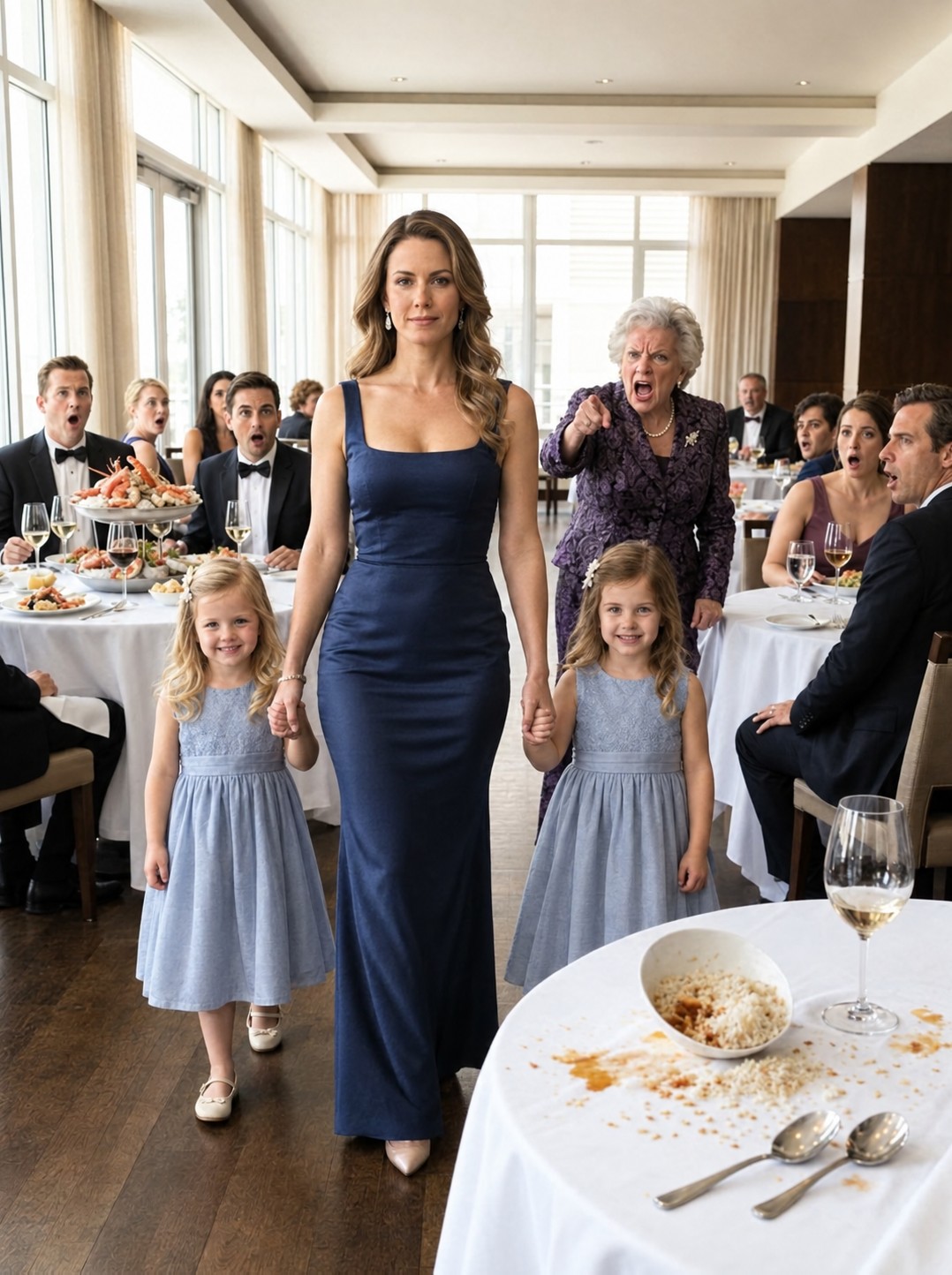
Part 1:
“Do not serve those girls the shrimp. They are not heirs to anything of value!”
Mrs. Margaret’s voice exploded across the private dining room like a thunderclap.
The waiter carrying a huge silver platter of garlic-buttered shrimp stopped in the middle of the room. His hands trembled slightly as he looked toward the table where Catherine sat with her two daughters.
For a moment, it seemed as if the entire restaurant had gone silent.
Guests in the expensive seafood restaurant in Charleston turned their heads toward the private dining area.
Eight-year-old Hazel pressed her lips together, fighting back tears.
Five-year-old Sophie immediately buried her face against her mother’s dress.
This was supposed to be a celebration.
It was Mr. Walter’s sixty-eighth birthday, and his wife, Margaret, had spent weeks planning an evening that would impress everyone they knew.
The family had reserved an entire private wing of one of the most expensive seafood restaurants in the city.
A live jazz band played near the far end of the room.
Vintage champagne sat in silver buckets.
Huge platters of lobster, grilled sea bass, shrimp, and other expensive seafood covered the tables.
Large floral arrangements stood beneath the chandeliers.
The entire room looked more like a royal wedding than a birthday dinner.
Bennett moved through the guests with a confident smile.
He wore an expensive shirt, polished shoes, and a gold watch that flashed whenever he raised his hand.
“My father deserves the very best tonight,” Bennett announced proudly.
“I am more than happy to cover every expense. This is exactly what I work so hard for as a regional sales director.”
Several relatives smiled at him.
Catherine remained seated.
She looked down at her lap.
She knew the truth.
Bennett had not paid for this party.
In fact, he did not currently have enough money to pay the full restaurant bill.
Yet he had spent the entire evening allowing everyone to believe he was the generous man who had arranged everything.
Catherine had known about the financial problem from the beginning.
Three weeks earlier, Margaret had announced that Walter’s birthday had to be unforgettable.
She wanted the finest seafood.
She wanted an open bar.
She wanted live music.
She wanted champagne.
And she wanted a massive three-tiered cake.
Bennett had immediately complained about the price.
But Margaret knew exactly how to push him.
“What is the point of constantly telling everyone you are the top regional manager,” she had asked, “if you cannot even give your own father the birthday celebration he deserves?”
Bennett’s pride had taken over.
He agreed.
Then the restaurant required a large deposit and a signed event agreement.
Bennett told Catherine that she needed to find the money.
“You are going to ask your mother,” he had ordered.
“Your mother just sold that small piece of land in the countryside. She can help us with this.”
Catherine had refused.
“My mother is not giving us money for your father’s birthday,” she told him.
“She won’t do it without a formal agreement, and she has already said she does not want to become involved in your family’s expenses.”
Bennett had become angry.
“Then figure something out.”
Catherine had stayed quiet.
She could have paid.
But she had made a decision months earlier.
She would not spend the money she had secretly saved on people who treated her and her daughters with contempt.
For four years, Catherine had been running a small catering business.
Every morning at four o’clock, she quietly got out of bed while the rest of the house slept.
She prepared breakfast boxes, sandwiches, hot meals, desserts, and lunches for local office workers.
Then she delivered them before most people had even started their workday.
Every dollar she earned went into a private bank account.
She had never told Bennett how much she had saved.
At first, the account had been an emergency fund.
Then it became a future escape fund.
Catherine had quietly built enough savings to rent an apartment, buy necessities, keep her children in school, and give herself time to rebuild her business.
She had no intention of using that money to pay for Margaret’s champagne, seafood, band, and birthday cake.
So when Bennett insisted that the party had to happen, Catherine simply told him that she could not pay for it.
Bennett refused to listen.
He and Margaret went to the restaurant themselves.
They reviewed the actual event agreement.
The document clearly listed the payment schedule, the cancellation rules, and the people responsible for the final bill.
Bennett signed it.
Margaret signed it too.
They knew the celebration would cost a great deal of money.
But they both believed Catherine would eventually find a way to rescue them.
Catherine never promised that she would.
She simply stopped arguing.
Now, three weeks later, she sat at the birthday dinner and watched Bennett proudly pretend that he had everything under control.
Then Margaret marched toward her.
In her hands was a cheap plastic plate.
It was chipped around the edges.
On it sat dry rice, cold beans, and two pieces of overcooked chicken.
Margaret slammed the plate onto the table.
“This is exactly what you and your daughters deserve,” she whispered.
Her face carried a cruel smile.
“Do not get confused by all the expensive food around you. The good food is for the real members of this family.”
Catherine stared at the plate.
She had experienced this kind of humiliation many times.
But tonight felt different.
Hazel looked toward the neighboring table.
Her cousins were happily eating breaded shrimp.
She swallowed.
“Grandma,” Hazel said softly, “I really wanted some shrimp too.”
Margaret gave a harsh laugh.
Several people turned toward them.
“Well, you had better ask your mother for some,” Margaret replied.
Then she looked directly at Catherine.
“Let us see if she can manage to bring in any money. Especially since she has failed to produce anything but girls for this family.”
A few relatives chuckled.
Others looked away.
Catherine felt her face grow hot.
But it was not embarrassment anymore.
It was anger.
For nine years, she had heard the same insults.
She had been told she was not a real woman because she had never given Bennett a son.
She had been told her daughters were financial burdens.
She had been treated like someone who should be grateful simply for being allowed to live in Bennett’s house.
Bennett gave her a small allowance.
It was barely enough to cover school supplies, uniforms, food, transportation, and unexpected medical costs.
Whenever Catherine complained, he reminded her that she did not earn enough money to have an opinion.
What they did not know was that Catherine had been earning money for years.
Quietly.
Patiently.
And she had saved it for exactly the day she would finally need it.
Bennett eventually returned to their table.
He was holding his wine glass and swaying slightly.
The confident smile he had shown the guests was gone.
“What did you manage to mess up now, Catherine?” he hissed.
He leaned close to her.
“Do not start making those miserable faces. You came here to keep me company, not to make a scene or make my guests feel sorry for you.”
Catherine looked directly at him.
“Your daughters are hungry,” she said. “And your mother has ignored them all evening.”
Bennett sneered.
“My daughters would not be facing this embarrassment if you had been capable of giving me a son to carry on my legacy.”
His words were loud enough for Hazel to hear.
He did not even seem to notice.
Hazel’s little hand trembled beneath the table.
Catherine reached down and held it.
Then Margaret suddenly grabbed the plastic plate.
She shoved it across the table with such force that some of the food spilled onto Sophie’s legs.
Sophie screamed.
The entire room turned toward them.
Margaret rolled her eyes.
“Shut your mouth and stop that noise!”
Sophie froze.
“It is not as if I fed you poison. Sit there and be grateful for what you have.”
Catherine stared at her mother-in-law.
Nobody moved.
Nobody spoke.
The jazz band had even stopped playing.
Catherine slowly stood.
She did not scream.
She did not cry.
She picked up a napkin and carefully wiped the food from Sophie’s legs.
Then she checked Hazel.
“Are you okay, sweetheart?”
Hazel nodded.
Catherine picked up her handbag.
She smoothed her dress.
Then she looked at Bennett.
“You are absolutely right about one thing,” she said calmly.
Bennett frowned.
“I did not come here today to be pitied by this family or by your mother.”
Something changed in his expression.
“What exactly are you trying to imply?”
Catherine took Hazel’s hand.
Then she took Sophie’s.
“I came here to say goodbye to all of you.”
Bennett immediately reached out and grabbed her arm.
“Do not you dare make a complete fool of yourself in front of my family tonight,” he warned.
Catherine looked at his hand.
Then she looked into his eyes.
She pulled her arm free.
“I am not going to make a fool of myself,” she said.
“But you have done a fine job of that yourself.”
She turned around.
Hazel and Sophie followed her.
Catherine walked out of the restaurant.
Behind her, the birthday celebration had collapsed into an uncomfortable silence.
The band tried to start playing again.
Nobody listened.
Outside, the cool Charleston air hit Catherine’s face.
She walked to the street and climbed into a taxi with her daughters.
The moment the door closed, her phone began buzzing.
Bennett.
Margaret.
A cousin.
An uncle.
Then another relative.
The calls came one after another.
Within fifteen minutes, Catherine had forty-three missed calls.
She looked at Hazel.
Then at Sophie.
She took a deep breath.
And turned her phone off.
For the first time in years, the noise disappeared.
She had no idea exactly what would happen next.
But she knew one thing.
She was not going back.
And the birthday party was not really over.
The real consequences were only beginning.
Part 2:
Catherine eventually turned her phone back on when she and the girls reached a small diner a few streets away.
She did not want to speak to Bennett.
She only wanted to make sure her daughters had something warm to eat.
She ordered three large bowls of corn stew and two glasses of chilled fruit water.
The diner was simple.
There were no chandeliers.
No expensive flowers.
No live jazz band.
No one cared about family names or social status.
And for the first time that evening, Hazel and Sophie were smiling.
Sophie was telling Hazel about something that had happened at school.
Hazel laughed.
Catherine watched them and felt something loosen inside her chest.
Then her phone rang.
The number was unfamiliar.
She almost ignored it.
But she answered.
“Is this Mrs. Catherine?”
“Yes.”
“This is the manager of the harbor restaurant.”
His voice sounded tense.
“We need to know if you are returning to finalize payment for the banquet.”
Catherine sat up straight.
“No,” she replied calmly. “I will not be returning.”
There was a short pause.
“And I did not sign the restaurant agreement.”
The manager sounded confused.
“Your husband is telling us that you are responsible for the payment.”
“My husband says many things that are not true,” Catherine replied.
“You should check the agreement carefully. The people who signed it are the people you need to speak with.”
Before the manager could answer, Catherine heard Bennett’s voice.
“Give me that phone!”
The manager apparently handed it over.
“Catherine!” Bennett shouted.
Hazel immediately stopped eating.
Catherine reached across the table and gently touched her daughter’s hand.
“Do not you dare play these childish games with me!” Bennett yelled.
“The bill is over sixteen thousand dollars! They are telling us the entire amount is due, and they will not close the event until the payment issue is resolved!”
Catherine remained calm.
“Then you should pay it.”
“You were supposed to have the money ready!”
“No,” Catherine said. “You were supposed to have the money ready.”
“I thought your mother was paying!”
“You knew my mother refused.”
“You said you would figure it out!”
“I never said I would pay your father’s birthday bill.”
Bennett went silent.
Catherine continued.
“You and your mother signed the actual restaurant agreement. You chose the menu. You approved the guest count. You approved the entertainment. You agreed to the payment terms.”
“You cannot do this to me!”
“I am not doing anything to you, Bennett. I am simply refusing to take responsibility for a contract I did not sign.”
His voice became desperate.
“Catherine, please. My entire family is here.”
“That is not my responsibility.”
“They are going to think I am a failure.”
Catherine looked at her daughters.
“Your family is going to have to decide what they think of you based on your own actions.”
Then Bennett’s voice disappeared.
Margaret had taken the phone.
“You ungrateful woman!” she shouted.
“Is this how you repay us for everything we have given you?”
Catherine let out a short, bitter laugh.
“Everything you have given me?”
She looked at her daughters.
“Leftovers? Insults? Or a home where my children were made to feel unwanted?”
“They are little girls!” Margaret snapped.
“Stop exaggerating everything!”
“That is exactly why I left,” Catherine replied.
“They are children, and I still have a chance to protect them from your behavior.”
The restaurant manager took the phone back.
“Mrs. Catherine, I need to clarify one thing,” he said.
“We have reviewed the event agreement. Your name is not listed as a contracting party.”
Catherine closed her eyes.
“Thank you.”
“But Mr. Bennett and Mrs. Margaret are both listed as responsible parties.”
“I understand.”
The manager hesitated.
“If they cannot resolve the balance, we may have to involve the appropriate authorities and document the unpaid bill.”
Catherine looked down at the table.
“That is between the restaurant and the people who signed the agreement.”
Bennett suddenly returned to the phone.
“Catherine, please.”
His voice had completely changed.
“Come back. We can talk. I promise my mother will apologize.”
Catherine shook her head.
“I have no interest in an apology that only appears because you are afraid of the consequences.”
Then she ended the call.
A few minutes later, the food arrived.
Three large bowls of hot corn stew.
Steam rose from them.
Fresh toppings covered the surface.
Sophie stared at her bowl.
“Is this really just for me, Mommy?”
Catherine smiled.
“Yes, my love.”
She pushed the bowl toward her.
“It is all yours.”
Sophie smiled.
Hazel began eating too.
Catherine watched them.
They were eating simple food.
But they were eating with dignity.
Inside her handbag was a thick folder.
It contained years of bank statements from her catering business.
It contained receipts showing household expenses she had quietly paid.
It contained copies of messages in which Bennett demanded money from her.
It contained photographs documenting injuries she had suffered during the marriage.
And it contained a copy of the restaurant’s confirmation showing exactly who had signed the event agreement.
Catherine had been preparing for this moment long before tonight.
She had not planned to humiliate Bennett.
She had planned to leave safely.
Her financial plan was simple.
She would use her catering savings to rent a modest apartment, pay the security deposit, buy food and school necessities, and keep enough money aside to continue operating her business.
She would not touch that money to rescue Bennett from a party he had chosen to finance.
She had spent four years building that savings account.
It was not revenge money.
It was survival money.
And now it would give her and her daughters a fresh start.
But Catherine had one final thing to reveal.
Before she left the restaurant, she had placed a burgundy envelope underneath the large floral arrangement at the head table.
She had written Margaret’s name on the front.
It contained copies of the documents showing the money Catherine had contributed to the household over the years.
It also contained a copy of the restaurant agreement.
Most importantly, Catherine had written a short statement explaining exactly what had happened.
She wanted everyone at that table to understand one thing.
She had never promised to pay for the birthday party.
Bennett and Margaret had signed the agreement themselves.
They had simply assumed that Catherine would rescue them when the bill arrived.
They were about to discover what happened when she stopped doing that.
Part 3:
Back at the restaurant, Margaret was desperately trying to convince the manager that the entire situation was nothing more than a family misunderstanding.
“We have always paid our bills,” she insisted.
“This is simply a disagreement between Catherine and my son.”
The manager remained professional.
“I understand, ma’am, but the agreement is very clear.”
Margaret looked toward Bennett.
He was standing near the table with his face pale.
“We will resolve this,” he said.
But he had no idea how.
Then Margaret noticed something underneath the huge floral arrangement.
A burgundy envelope.
Her name was written across the front.
“MARGARET.”
She grabbed it.
For a moment, she smiled.
She assumed Catherine had left some kind of apology.
Perhaps she had finally realized that she had gone too far.
Margaret tore open the envelope.
Her smile disappeared.
Inside were several documents.
The first was the restaurant agreement.
Margaret’s own signature was on it.
So was Bennett’s.
The document clearly showed that they had approved the event and accepted responsibility for the final payment.
The next pages were financial records.
Margaret began reading.
Monthly household expenses.
School costs.
Uniforms.
Medical bills.
Groceries.
Transportation.
Utility payments.
Other household expenses.
Again and again, Catherine’s private catering account had paid for things the family had accused her of being too useless to afford.
Then Margaret found the summary page.
For four years, Catherine had quietly contributed a substantial amount of her own earnings to the household.
Money she had earned before dawn.
Money she had earned while everyone else slept.
Money she had earned while being told she contributed nothing.
One of Bennett’s cousins picked up the papers.
He had laughed at Hazel earlier.
He had also laughed when Margaret insulted Catherine.
Now he began reading the statement aloud.
“For four years, Catherine has quietly supported this household with money she earned through her own catering business.”
His voice became quieter.
“She was repeatedly described as a dependent even though these records show that she paid for a significant portion of the family’s expenses.”
Nobody spoke.
He continued.
“The birthday celebration was not paid for by Catherine. The restaurant agreement was signed by Bennett and Margaret.”
The room became completely silent.
Mr. Walter slowly stood.
His face had gone pale.
He looked at his son.
“Bennett,” he said, “is this true?”
Bennett grabbed the papers.
“That woman is completely insane!”
“She planned all of this to destroy me!”
His cousin pulled the papers away.
“Then explain your signature.”
Bennett stared at the page.
An aunt who had laughed earlier lowered her head.
“But you signed this,” she said.
“And so did Margaret.”
Margaret immediately pointed toward Catherine’s financial records.
“She had money!”
“She could have paid!”
Bennett’s sister finally spoke.
“That does not mean she agreed to pay.”
Margaret looked at her.
“But she is part of this family!”
His sister shook her head.
“She was treated like she wasn’t.”
Nobody answered.
The restaurant manager stepped forward.
“Mr. Bennett, Mrs. Margaret, we need to settle the outstanding balance.”
Bennett reached for his wallet.
He pulled out a credit card.
He swiped it.
The machine beeped.
Declined.
His face turned red.
He pulled out another card.
He swiped it.
Declined again.
Margaret’s breathing became faster.
She looked around the room.
The guests who had been smiling earlier were now avoiding her eyes.
“The bank must have made a mistake,” she whispered.
The manager shook his head.
“We can try another form of payment.”
Bennett pulled out his phone.
He began calling people.
Friends.
Coworkers.
Anyone he thought might lend him money.
The man who had proudly announced that he could pay for everything was now desperately asking others for help.
Margaret began crying.
“She set a trap for us!”
Bennett’s sister looked at her.
“No, Mother.”
Her voice was calm.
“The trap was believing that Catherine would always rescue us.”
Margaret stared at her.
Her daughter continued.
“We humiliated those girls in front of everyone.”
“We treated Catherine like she was worthless.”
“And we still expected her to pay our bills.”
That sentence silenced the room.
The band began packing its instruments.
The giant birthday cake remained untouched.
Guests slowly started leaving.
Nobody wanted to stay for the rest of the humiliation.
Eventually, Bennett had no choice but to negotiate a payment plan with the restaurant.
He also borrowed money from coworkers he had spent years impressing with stories about his financial success.
The birthday celebration that was supposed to prove how successful the family was had become the night everyone discovered the truth.
Part 4:
Catherine never returned to the family home.
The next morning, she used part of her savings to rent a modest apartment in a quiet, tree-lined neighborhood.
She did not spend money on expensive furniture.
She bought only what they needed.
Beds.
School supplies.
Food.
Basic kitchen items.
A small table.
It was nothing like the enormous house she had shared with Bennett.
But it felt different the moment she opened the door.
It was peaceful.
There were no insults.
No shouting.
No one telling Hazel and Sophie that they were less important than their cousins.
No one deciding which food they were allowed to eat.
The girls could finally laugh.
They could finally relax.
And Catherine still had money left in her account.
That mattered.
Her catering business continued.
She had already built a small group of regular customers.
Now that she no longer had to hide everything she did, she could expand.
She rented a small commercial kitchen for part of the week and began accepting larger orders.
Her financial plan was not to become rich overnight.
It was to become independent.
She would keep her business running.
She would protect her savings.
She would cover the children’s needs.
And she would never again depend on Bennett for permission to buy something her daughters needed.
Meanwhile, Bennett’s life became increasingly difficult.
He kept calling.
He kept sending messages.
“Catherine, please forgive me.”
“My mother didn’t mean it that way.”
“We can fix this.”
“The girls need their father.”
But Catherine understood the difference between regret and fear.
Bennett had not apologized when he insulted her.
He had not apologized when he blamed her for having daughters.
He had not apologized when his mother gave the girls inferior food.
He had not apologized when Sophie was frightened and crying.
He had apologized only after the consequences arrived.
Catherine no longer confused that with love.
Several weeks later, the custody case moved forward.
Catherine’s lawyer presented the evidence she had collected.
There were recordings of Bennett’s insults.
There were photographs documenting injuries Catherine had suffered during the marriage.
There was evidence of the way the children had been treated.
There was also the video from the birthday celebration.
The court considered the evidence presented by both sides.
Catherine was awarded full custody of Hazel and Sophie, and Bennett was ordered to pay child support.
The financial dispute over the restaurant was handled separately.
Because Bennett and Margaret had signed the restaurant agreement, they were responsible for resolving the balance with the restaurant.
They eventually had to sell valuable personal belongings to help cover the debt.
Margaret sold some of her jewelry.
Walter’s vintage car was eventually sold as well.
The luxury birthday celebration had cost them far more than they ever expected.
But the most important thing Catherine had gained could not be measured in dollars.
She had her daughters.
And they were safe.
Part 5:
Months later, Catherine took Hazel and Sophie out for seafood.
It was not the expensive restaurant where everything had fallen apart.
It was a small, friendly place.
There were no chandeliers.
No private dining room.
No giant floral arrangements.
Nobody cared about their family name.
They ordered fresh broth and a plate of shrimp to share.
When the food arrived, Hazel carefully picked up one of the shrimp.
She looked at her mother.
“Mommy?”
“Yes, sweetheart?”
Hazel hesitated.
Then she asked the question that had clearly stayed in her mind.
“Are we really worth a lot of money?”
Catherine’s heart tightened.
She reached across the table and took both girls’ hands.
“You are worth more than any amount of money,” she said.
“You are worth more than a family name.”
“You are worth more than a title, a house, a car, or anything else people use to make themselves feel important.”
Hazel looked at her mother.
Catherine continued.
“And you should never let anyone convince you that you are worth less because you are a girl.”
Sophie lifted her glass of lemonade.
“Then let’s make a toast!”
Catherine smiled.
“To what?”
Sophie thought for a second.
“To us!”
Hazel laughed.
Catherine raised her glass.
“To us.”
They gently clinked their glasses together.
Catherine looked at her daughters.
For nine years, she had believed that keeping the family together was the same thing as protecting her children.
Now she understood the truth.
Sometimes protecting your children means leaving.
Sometimes starting over is not failure.
Sometimes the quiet life you are afraid to build is much better than the miserable life you are afraid to leave.
Catherine had spent four years quietly building her catering business.
Those early mornings had seemed exhausting at the time.
But every breakfast box she prepared had been another step toward independence.
Every dollar she saved had been another brick in the foundation of her future.
She had not known exactly when she would need that money.
She only knew she needed to have it.
Now she did.
Her daughters would grow up knowing that they mattered.
They would never again have to sit at a table and wonder why everyone else was allowed to eat something they were denied.
They would never again hear that being girls made them less valuable.
And they would never have to watch their mother accept cruelty just to keep a family together.
Catherine had not destroyed the family.
She had simply stopped destroying herself to protect it.
The cold plate Margaret had placed in front of Hazel and Sophie was meant to make them feel small.
Instead, it became the final moment that showed Catherine she could not stay.
She walked away with her daughters.
She protected the savings she had worked so hard to build.
She continued her business.
And she built a home where her children could finally feel safe.
She had risen from the ashes of her old life.
And she had done it before her daughters learned to mistake misery for love.
THE END.
