
Part 1:
“We went to Hawaii. Don’t worry, Mrs. Margaret. At your age, it’s better for you to stay home and rest.”
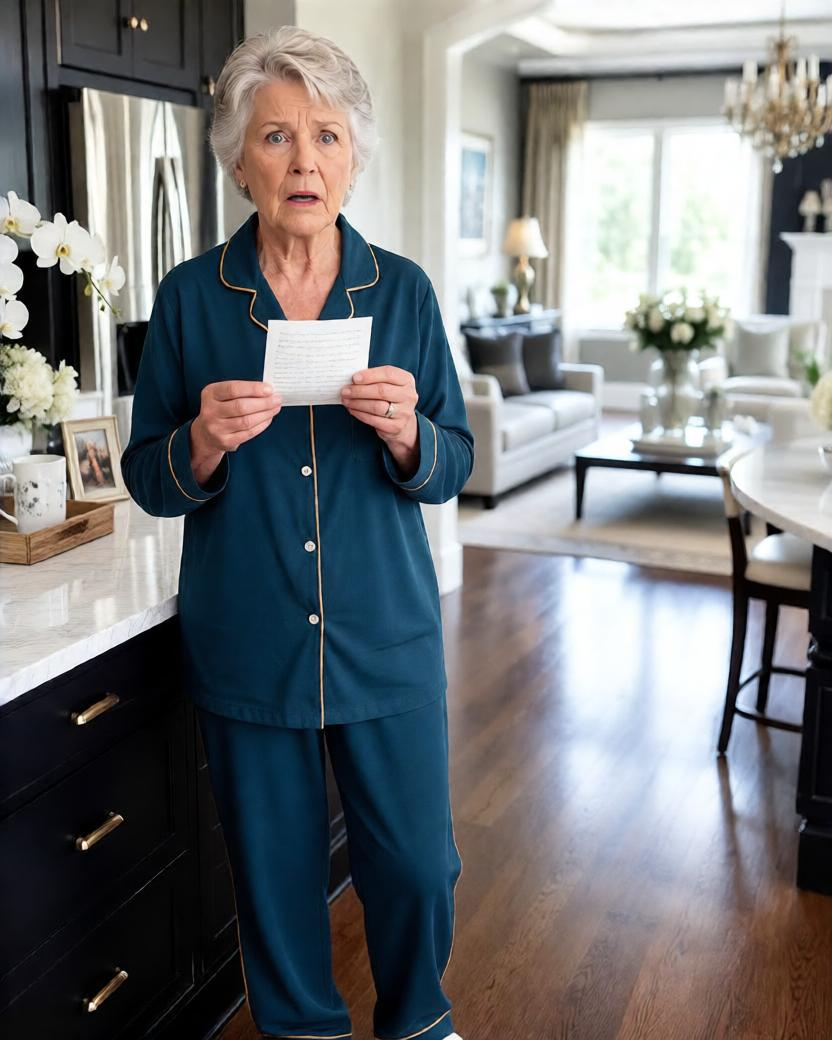
Those were the words written on the small note stuck to the refrigerator with a turkey-shaped magnet.
Margaret Collins stood in the kitchen and stared at it.
She read it once.
Then again.
Then a third time.
She was standing completely alone in her son Daniel’s house in Scottsdale, Arizona.
Usually, Thanksgiving morning felt warm and alive. The house was normally filled with the smell of cinnamon, fresh coffee, and melted butter. There were always sounds everywhere—the grandchildren laughing, cartoons playing on the television, little feet running across the hallway.
But that Thursday morning, there was nothing.
No voices.
No laughter.
No footsteps.
Just silence.
“Emily?” Margaret called.
Her voice disappeared into the empty house.
No answer.
“Jack?”
Again, nothing.
A strange feeling settled in her stomach.
She slowly walked upstairs.
The children’s bedrooms were perfectly clean.
Too clean.
Their beds were made.
Their toys were organized.
But something was missing.
Their backpacks were gone.
Their jackets were gone.
She walked farther down the hallway and opened the master bedroom door.
Daniel’s suitcase was missing.
Rebecca’s suitcase was missing too.
Margaret stood there quietly.
She did not panic.
She did not scream.
Instead, a strange calm came over her.
It was the kind of calm that appears before the pain finally finds a place to land.
She walked back downstairs.
Then she looked through the window toward the garage.
The SUV was gone.
Rebecca’s car was gone too.
There was no mistake.
Everyone had left.
Everyone except her.
And the note.
She picked it up again.
The handwriting was Rebecca’s.
“We decided to spend Thanksgiving in Hawaii this year. We didn’t tell you sooner because we knew you would insist on coming. The flight is long, and you get tired too easily now. We’ll be back in a week. There’s soup in the freezer.”
Margaret slowly placed the note on the kitchen table.
She was seventy-three years old.
But she was not helpless.
She was not a child.
She could decide for herself whether she wanted to get on a plane.
She could decide whether she could walk through an airport.
She could decide whether she wanted to sit beside the ocean in Hawaii.
Nobody had the right to make those decisions for her.
But the worst part was not that they had gone without her.
The worst part was how they had done it.
They had not talked to her.
They had not asked her.
They had simply left her behind.
Like someone leaving a plant at home before going on vacation.
Water it.
Keep it alive.
Then forget about it.
Margaret sat down slowly.
And suddenly, she remembered the day four years earlier when everything had changed.
After her husband Arthur passed away, Daniel had called her.
“Mom, you should come live with us,” he had said.
“I don’t want you being alone anymore. And honestly, the kids would love having their grandma nearby.”
At the time, Margaret believed him.
She believed it came from love.
She had lived in a small apartment in Oak Park for many years. It was not fancy, but it was hers.
It held memories.
It held pieces of her life with Arthur.
But Daniel was her son.
She trusted him.
So she sold the apartment.
She packed her belongings.
And she moved to Arizona.
She even used part of the money from the sale to help with the house.
She paid for the down payment.
Then she bought almost everything inside.
The refrigerator.
The living room furniture.
The washer.
The dryer.
The curtains.
The dining table.
The television.
The lamps.
The dishes.
Even the Italian coffee maker that Rebecca proudly showed to her friends whenever they visited.
At the beginning, they treated her like she was a gift.
A blessing.
“Mom, we don’t know what we would do without you,” Daniel often said.
Rebecca used to smile and say,
“You’re such a help, Margaret. The kids are so lucky to have you.”
And Margaret believed them.
She loved being needed.
She loved waking up and hearing her grandchildren call for her.
She loved making breakfast.
She loved helping with homework.
She loved being part of their lives.
But slowly, something changed.
The blessing became an expectation.
The help became a responsibility.
And the gratitude disappeared.
If Margaret mentioned meeting an old friend downtown, Rebecca would immediately tighten her lips.
“And who is picking the kids up from swim practice?”
The question always sounded innocent.
But Margaret understood what it really meant.
You cannot leave.
You are needed here.
If Margaret complained about her back hurting after a long day, Daniel would sigh.
“Mom, we’re only asking you to help with dinner. It’s not a big deal.”
But it was never just dinner.
It was dinner.
And laundry.
And cleaning.
And watching the children.
And buying groceries.
And paying for things around the house.
If Margaret bought herself something small, Rebecca always had a comment ready.
“Well, it’s good that you can still afford little things. Expenses around here are getting brutal.”
Margaret would force a smile.
She would say nothing.
Because she did not want conflict.
Because she loved her family.
Because she kept telling herself that families helped each other.
But six months earlier, she heard something she was never supposed to hear.
It happened on the patio.
Rebecca was talking on the phone.
She thought nobody was nearby.
Margaret had been walking past the kitchen when she heard her voice.
“We can’t ask her to leave,” Rebecca said.
A pause.
Then she continued.
“She watches the kids, pays for things, and still buys groceries. It isn’t really her that’s helping us.”
Margaret froze.
Then came the sentence that stayed with her.
“It’s her money that’s saving us.”
Margaret stood there silently.
Rebecca never knew she heard.
Margaret never confronted her.
She simply walked away.
She carried the pain quietly.
Like a sharp needle hidden inside a piece of clothing.
Nobody could see it.
But she felt it every day.
And now, standing alone in the empty kitchen on Thanksgiving morning, everything finally became clear.
They had not asked her to move in because they wanted her close.
They had asked her because she was useful.
Margaret looked around the house.
The house she helped create.
The house she paid for.
The house where she had slowly disappeared.
She walked to the kitchen counter and made herself a cup of coffee.
Then she sat at the dining table.
Her dining table.
She looked at the curtains she had ordered.
The blender she had bought after Rebecca said:
“A nice house shouldn’t have old appliances.”
The refrigerator she had paid for.
The coffee maker she loved.
Everything around her carried a memory.
But now those memories felt different.
She finished her coffee.
Then she stood up.
She walked upstairs to her bedroom.
She opened the bottom drawer of her nightstand.
Inside was a blue folder.
She pulled it out.
Inside were receipts.
Hundreds of receipts.
Every purchase.
Every payment.
Every item she had bought.
Arthur had always teased her about keeping everything.
“Maggie, you keep receipts for bread,” he used to joke.
For the first time that morning, Margaret smiled.
A small smile.
A painful smile.
“Thank you, my love,” she whispered.
She placed the folder on the bed.
Then she grabbed a notebook.
On the first page, she wrote:
Things that belong to me.
Then she began writing.
Refrigerator.
Living room set.
Dining table.
Washer.
Dryer.
Television.
Coffee maker.
Guest beds.
Curtains.
Lamps.
Dinnerware.
Patio furniture.
With every word, Margaret felt something inside her return.
She could breathe again.
She picked up her phone.
She searched for a moving company.
The first company that answered sounded surprised when she explained what she needed.
“Ma’am, it’s a holiday weekend,” the man said. “We charge extra on weekends like this.”
“That’s fine,” Margaret replied.
“When do you need us?”
Margaret looked back at the note on the refrigerator.
The note that had changed everything.
“Tomorrow morning,” she said.
“What time?”
“Eight o’clock.”
That night, Margaret did not cry.
Not once.
Instead, she packed two suitcases.
She collected her important documents.
She wrapped Arthur’s picture carefully in a towel.
She placed the blue folder inside her handbag.
Then she went back downstairs.
She picked up Rebecca’s note.
She placed it exactly where she had found it.
Then she took a black pen.
Above the note, she wrote:
Thank you for showing me who was really family.
She stepped back and looked at the refrigerator.
For the first time in years, Margaret felt something she had almost forgotten.
Control.
Because when Daniel and Rebecca returned from Hawaii, they would not come back to the same house.
And they would not come back to the same mother.
Part 2:
The movers arrived Friday morning exactly at eight o’clock.
Margaret was already awake.
She had barely slept, but she did not feel tired.
For the first time in a long time, she felt certain.
A white moving truck stopped in front of Daniel’s house.
Three men stepped out.
The leader of the crew was a man named Frank.
He wore a gray cap, carried a clipboard, and had the expression of someone who had seen enough family situations to know when to stay quiet.
He walked toward the front door and smiled politely.
“Good morning, Mrs. Margaret,” he said. “What are we moving today?”
Margaret handed him a piece of paper.
“Everything on this list.”
Frank looked down.
Then he looked back at the house.
His eyebrows lifted slightly.
“Are you sure about this?”
Margaret did not hesitate.
“Yes.”
She opened her handbag and pulled out the blue folder.
“The receipts are here,” she said. “Everything is in my name.”
Frank carefully opened the folder.
He looked through several documents.
He checked the names.
He checked the dates.
After a few moments, he nodded.
“Then we’ll get started.”
The first thing they carried out was the ivory living room set.
The same furniture where Daniel watched football every Sunday.
The same couch where Margaret had sat with her grandchildren watching movies.
The same furniture that she had purchased with her own money.
Next came the coffee table.
Then the lamps.
Then the huge television.
Then the eight-chair dining table.
Then the refrigerator.
The washer.
The dryer.
The coffee maker.
The expensive dishes.
The entryway cabinet.
The linen curtains.
One by one, everything that belonged to Margaret left the house.
And with every item that disappeared, something strange happened.
The house became quieter.
Not just physically.
Emotionally.
It felt like the walls were finally admitting the truth.
This had never truly been her home.
It had only been a place where she had been useful.
By noon, the rooms were almost empty.
The sounds of footsteps echoed through the walls.
The kitchen looked completely different.
No refrigerator.
No blender.
No coffee maker.
No dining table.
Only empty cabinets remained.
And Rebecca’s note still sitting on the refrigerator door.
Margaret looked around.
Then she turned to Frank.
“Could you wait five minutes?”
Frank nodded.
“Of course.”
Margaret walked upstairs one last time.
She entered every room slowly.
She looked around.
The children’s rooms.
The hallway.
Her bedroom.
She did not take anything that was not hers.
Not the children’s toys.
Not their clothes.
Not their belongings.
She was not there to punish anyone.
She was simply taking back what belonged to her.
In her bedroom, she opened the closet.
She checked the shelves.
Nothing else.
She picked up her handbag.
The blue folder was safely inside.
Then she walked downstairs.
At the front door, she placed the house keys inside a white envelope.
Next to them, she placed the bills.
The electric bill.
The water bill.
The internet bill.
The gas bill.
Each one had a note attached.
She had canceled the automatic payments from her account.
No more.
Not this time.
Then she wrote one final message.
She placed it beside Rebecca’s note.
It said:
Daniel, starting today, your expenses belong to you again.
Margaret looked at the empty house one last time.
There were no tears.
No anger.
No shouting.
She simply walked outside.
And she did not look back.
Her new apartment was located in a retirement community in Santa Fe.
It was smaller than Daniel’s house.
But it felt different.
It felt peaceful.
It had bright windows.
Clean floors.
A small kitchen.
A comfortable balcony.
And outside the window was a beautiful blooming bougainvillea.
When Margaret arrived, the building manager greeted her warmly.
She handed Margaret the keys.
“Welcome home, Mrs. Margaret.”
Home.
The word touched her deeply.
She had almost forgotten what that word felt like.
Not a place where she worked.
Not a place where she was needed.
A place where she belonged.
That afternoon, Frank and his team arranged her furniture.
Arthur’s picture went onto a small shelf.
She placed the blue teapot he had given her beside the stove.
The ivory sofa was placed near the window.
And for the first time in years, the sofa looked beautiful again.
Not because it was expensive.
Not because it was new.
But because it was surrounded by peace.
That evening, someone knocked on Margaret’s door.
She opened it and saw an older woman holding a plate.
The woman smiled.
“Hi, I’m Helen. I heard you arrived today.”
She lifted the plate.
“I brought cornbread.”
Margaret smiled politely.
“That’s very kind, but you didn’t have to do that.”
Helen shook her head.
“Oh, I know. But around here, nobody eats dinner alone on their first day.”
Before Margaret could argue, Helen walked inside with two plates.
For the next hour, they talked.
They talked about flowers.
Old television shows.
Neighbors.
And even their aching knees.
Margaret laughed.
A real laugh.
The first one she had had in weeks.
She realized something.
Being alone was not the same as being unwanted.
On Monday night, her phone started vibrating.
First, it was Daniel.
Then Rebecca.
Then again.
And again.
When Margaret finally looked at her screen, she saw eighteen missed calls.
She did not answer.
She sat quietly.
Then she opened the security camera app on her phone.
Years earlier, Daniel had installed cameras around the house.
He had given Margaret access so she could help delivery drivers when they dropped off packages.
Apparently, nobody had remembered to remove her access.
The video loaded.
Margaret watched.
The front door opened.
Daniel and Rebecca walked inside.
They were smiling.
Rebecca looked different.
She had a tan from Hawaii and was holding a beach hat.
“Finally home,” she said, laughing.
Then she stopped.
Her smile disappeared.
She looked around.
The living room was empty.
No couch.
No television.
No furniture.
“What happened?” she whispered.
Daniel walked in behind her with a suitcase.
He looked toward the living room.
“Where’s the living room set?”
His voice became louder.
He rushed toward the kitchen.
“And the refrigerator?”
He opened the empty space where it had been.
Then he turned around.
Rebecca followed him.
Her face became pale.
“This can’t be real.”
She looked around the empty house.
Then she screamed:
“The old woman emptied the house!”
Margaret watched silently.
Then she turned off the phone.
She picked up her tea.
And she continued drinking.
For the first time in years, she did not feel guilty.
She felt free.
Two days later, someone knocked on her apartment door.
Margaret opened it.
Two police officers were standing outside.
The older officer stepped forward.
“Mrs. Margaret Collins?”
“Yes?”
“We received a theft report.”
Margaret looked at them calmly.
Then she opened the door wider.
“Please come in.”
She invited them to sit.
She offered them coffee.
Then she placed the blue folder on the table.
The older officer opened it.
He reviewed the receipts carefully.
One by one.
After several minutes, he looked up.
“Everything is in your name.”
Margaret nodded.
“That’s right.”
The officer closed the folder.
“Your son says you abandoned the house and took family property.”
Margaret took a slow breath.
Then she answered.
“They went to Hawaii without telling me.”
Her voice remained calm.
“They left a note saying I was too old to handle the flight.”
She looked at the officer.
“I did not steal anything. I left a house where I was no longer treated like a mother.”
She paused.
“I was treated like a live-in employee with a pension.”
The younger officer lowered his eyes.
Before anyone could say more, a familiar voice came from the hallway.
“Mom!”
Margaret froze.
Daniel was outside her door.
“Open up! We need to talk!”
Behind him was Rebecca.
She hit the door with her hand.
“Thief! Give us our things back!”
The older officer stood up.
He looked at Margaret.
Then he walked toward the door.
When Margaret opened it, Daniel was standing there.
His face was pale.
Rebecca looked furious.
“How could you do this to us?” Rebecca shouted.
Margaret looked at her.
She did not raise her voice.
“I asked myself the same thing when I read your note.”
Daniel tried to step inside.
The officer blocked him.
“There is no crime here.”
He pointed toward the folder.
“The property belongs to Mrs. Margaret.”
Rebecca laughed bitterly.
“So now you think you’re independent?”
Margaret looked at her.
She took the envelope containing copies of the receipts.
Then she placed it in Daniel’s hands.
“No,” she said quietly.
“I’m only remembering that I always was.”
Then she closed the door.
Outside, Daniel continued calling.
“Mom!”
But Margaret did not open it.
For the first time, she chose herself.
Part 3:
Three weeks passed.
Margaret thought the worst was behind her.
She had settled into her new apartment.
She had started learning the names of her neighbors.
She had planted flowers on her balcony.
She had begun building a life that belonged to her.
Then one afternoon, a letter arrived.
She opened it slowly.
At first, she did not understand what she was reading.
Then she saw the names.
Daniel Collins and Rebecca Collins versus Margaret Collins.
Her son and daughter-in-law had decided to sue her.
Margaret sat down at her kitchen table.
The same table where she now drank her morning coffee in peace.
The lawsuit claimed that she had caused them emotional distress.
They claimed she had damaged the family.
They demanded compensation for the “loss of essential household property.”
Margaret read the papers again.
And again.
But she was not scared.
She looked out the window.
The bougainvillea outside moved gently in the cold December wind.
She thought about how different her life was now.
A few months earlier, she had been standing alone in an empty house, reading a cruel note on a refrigerator.
Now she was sitting in her own apartment.
Her own chair.
Her own quiet.
She got up and walked to the kitchen.
She filled the blue teapot Arthur had given her with water.
As the water heated, she returned to her bedroom.
She opened the drawer where she kept her documents.
The blue folder was still there.
The receipts.
The bank statements.
The proof.
She placed the lawsuit papers at the back of the folder.
Just another document.
Just another unpleasant receipt from a painful chapter of her life.
The day of the hearing arrived under gray skies.
Margaret woke early.
She dressed carefully.
She wore a gray coat with pearl buttons.
It had been Arthur’s favorite.
“You look beautiful in that coat, Maggie,” he used to tell her.
She smiled when she remembered his voice.
She fixed her hair.
She applied a little lipstick.
Then she placed her documents inside a black handbag.
Before leaving, Helen knocked on her door.
“I’ll walk with you,” she said.
Margaret smiled.
“You don’t have to.”
Helen shook her head.
“I know. I want to.”
The two women walked together toward the entrance.
Before Margaret stepped inside, Helen squeezed her hand.
“Don’t let them bend you, neighbor.”
Margaret looked at her friend.
For years, she had bent.
She had adjusted.
She had stayed quiet.
She had swallowed hurt to keep everyone else comfortable.
But not today.
She smiled.
“I bent for too many years.”
She looked toward the courthouse doors.
“Not today.”
Inside the courtroom, Daniel and Rebecca were already sitting.
Daniel avoided looking at her.
He kept his eyes on the floor.
Rebecca was different.
She stared directly at Margaret.
Her expression was cold.
Almost as if Margaret was the person who had done something wrong.
As if Margaret was the stranger.
The judge entered.
Everyone stood.
Then the hearing began.
Rebecca was the first to speak.
She stood up and faced the judge.
“Your Honor,” she said.
“My mother-in-law took advantage of our absence. She entered our home and removed furniture, appliances, and things my children need.”
She pointed toward Margaret.
“She left us without a refrigerator, without a washer, without a living room.”
Rebecca shook her head.
“It was cruel and vindictive.”
The judge listened carefully.
Then he looked at Daniel.
“Did Mrs. Margaret live with you?”
Daniel swallowed.
“Yes.”
“Did she pay rent?”
A long silence followed.
Daniel looked uncomfortable.
“No.”
The judge raised his eyebrows.
“No?”
Daniel shook his head.
“No, but she helped around the house.”
Margaret almost smiled.
Helped.
Such a simple word.
A word that erased four years of her life.
Four years of cooking.
Four years of cleaning.
Four years of taking care of children.
Four years of buying groceries.
Four years of paying for things.
Four years of making their lives easier.
But according to Daniel, she had simply “helped.”
The judge turned toward Margaret.
“Mrs. Collins, you may respond.”
Margaret stood.
She held her handbag firmly.
Her voice was calm.
“I do not deny that I moved out.”
She looked at the judge.
“I do not deny that I removed items from the house.”
She paused.
“But I deny that I stole anything.”
She opened her bag.
“These items were purchased with my money.”
She pulled out the blue folder.
“Here are the receipts, bank statements, and proof of purchase.”
She handed the folder to the judge.
The courtroom became silent.
The judge opened the folder.
He began reading.
A few seconds passed.
Then a minute.
Then another.
Finally, he spoke.
“Refrigerator purchased by Margaret Collins.”
He turned another page.
“Washer and dryer purchased by Margaret Collins.”
Another page.
“Dining table purchased by Margaret Collins.”
Another.
“Living room set purchased by Margaret Collins.”
Another.
“Television purchased by Margaret Collins.”
With every item, Rebecca’s expression changed.
She shifted in her seat.
Her confidence slowly disappeared.
The judge looked up.
“Mr. Collins.”
Daniel looked at him.
“Do you have receipts proving that these items were purchased by you or your wife?”
Daniel opened his mouth.
Then closed it.
“They were for the house,” he said.
The judge looked at him.
“That was not my question.”
Daniel looked down.
“I don’t have receipts.”
The judge turned toward Rebecca.
“Mrs. Collins?”
Rebecca crossed her arms.
“She bought them because she wanted to.”
Her voice became defensive.
“Nobody forced her.”
Margaret sat quietly.
Those words felt strangely familiar.
Nobody forced her.
And that was true.
Nobody forced her to give so much.
Nobody forced her to stay silent.
Nobody forced her to confuse sacrifice with love.
But that did not mean others had the right to take advantage of her kindness forever.
The judge placed the folder on the desk.
“The property belongs to the person who purchased it.”
He looked through the papers one more time.
“There is no evidence of theft.”
He looked toward Daniel and Rebecca.
“The claim for compensation is dismissed.”
Rebecca immediately stood.
“But she left us with nothing!”
The judge looked at her calmly.
“No.”
His voice was firm.
“Mrs. Margaret took what belonged to her.”
The room went quiet.
Daniel closed his eyes.
And for the first time, Margaret saw him differently.
She did not see the little boy who used to hide under the table during thunderstorms.
She did not see the child she held when he had a fever.
She saw an adult man.
A man who had allowed his own mother to become invisible.
A man who had watched her give everything.
And never asked what she needed.
Outside the courthouse, rain began falling softly.
Margaret stepped onto the sidewalk.
She thought it was over.
But then she heard him.
“Mom.”
She stopped.
Daniel hurried toward her.
Rebecca followed several steps behind.
Her arms were crossed.
Daniel looked tired.
Defeated.
“Mom,” he said again.
“I didn’t want this to go this far.”
Margaret turned around.
She looked at him.
“How far did you want it to go, Daniel?”
Her voice was quiet.
“Until I kept watching the children?”
She paused.
“Until I kept paying bills?”
Another pause.
“Until I kept warming soup while you went to the beach?”
Daniel lowered his eyes.
“I thought it was better for you not to come.”
Margaret stared at him.
“Why?”
He hesitated.
“The flight was long.”
She shook her head.
“You didn’t let me choose.”
Daniel looked away.
Then he whispered:
“Rebecca said you would ruin the trip.”
The words fell into the silence like a stone.
Rebecca’s face changed.
She had not expected him to say that.
Margaret did not even look at her.
She looked only at her son.
“And you believed her.”
Daniel’s eyes filled with regret.
“I was wrong.”
For a moment, Margaret felt the old pain.
Because no matter what happened, he was still her son.
She remembered holding him as a baby.
Waiting for him when he came home late.
Protecting him.
Loving him.
A part of her wanted to hug him.
A part of her always would.
But another part—the part that had been ignored for years—kept her standing tall.
“Yes,” she said softly.
“You were.”
Daniel wiped his eyes.
“Mom, I miss you. The kids miss you.”
Margaret’s voice became softer.
“I miss them too.”
She took a breath.
“But I will not return to a house where I am treated like old furniture.”
She looked directly at him.
“Something people ignore until they need it.”
Daniel said nothing.
Margaret continued.
“When you want me to see my grandchildren, bring them to my apartment.”
She held his gaze.
“With respect.”
“No shouting.”
“No asking for money.”
“And no using my love as a wallet.”
Behind him, Rebecca rolled her eyes.
“So dramatic.”
Margaret finally looked at her.
Her expression remained calm.
“No, Rebecca.”
She shook her head.
“Dramatic was leaving a seventy-three-year-old woman alone on Thanksgiving with a note on the refrigerator.”
She stepped back.
“This is called consequence.”
Then she walked toward the waiting taxi.
And this time, she did not look back.
Part 4:
The months after the court hearing were not easy.
Margaret wished she could say that walking away from Daniel and Rebecca erased all the pain.
But it did not.
Freedom did not magically remove years of memories.
It did not erase the sound of her grandchildren laughing.
It did not erase the mornings when Emily and Jack would run into the kitchen looking for breakfast.
It did not erase the years she had spent loving a family that slowly stopped seeing her.
Some nights, Margaret sat alone on her balcony.
She wrapped herself in a soft blanket and looked at the city lights.
Sometimes she thought about Emily.
Sometimes she thought about Jack.
Sometimes she wondered if she had done the right thing.
A mother’s heart does not stop loving just because it has been hurt.
That was the hardest truth.
She still loved her son.
She still loved her grandchildren.
But she was finally learning something important.
Love did not mean allowing people to hurt her.
Love did not mean disappearing so others could be comfortable.
Love did not mean giving everything until nothing was left.
So Margaret started rebuilding her life.
Slowly.
One day at a time.
On Tuesdays, she joined a book club with Helen.
At first, Margaret sat quietly.
She listened more than she spoke.
She was used to being the person who helped everyone else.
She was not used to having people ask about her thoughts.
But over time, she began sharing.
She laughed.
She debated.
She recommended books.
She realized that people actually wanted to hear what she had to say.
Her voice mattered.
On Wednesdays, she helped other women in the community learn how to use video calls.
Many of them had children or grandchildren who lived far away.
Margaret showed them how to connect.
How to press the right buttons.
How to send messages.
How to share pictures.
The same woman who had spent years feeling invisible was now helping others feel close to the people they loved.
On Thursdays, she painted watercolors in the community room.
She had always wanted to paint.
But there was never enough time.
There was always something else to do.
Someone else to help.
Someone else’s needs that came first.
Now, she painted flowers.
Trees.
Landscapes.
Small moments of beauty.
She painted because she wanted to.
Not because anyone asked her to.
On Sundays, she walked to the local market.
She bought fresh flowers.
Not because they were necessary.
Not because someone else wanted them.
Simply because she liked them.
That was something she had forgotten.
She was allowed to do things just because they made her happy.
Her apartment slowly became a reflection of who she was.
Not who someone needed her to be.
A lavender plant sat near the window.
A new tablecloth covered her small dining table.
A painting she created herself hung on the wall.
Arthur’s photo rested beside the television.
Every corner of the apartment carried a piece of her.
One morning, Margaret took a small card and wrote something on it.
Then she placed it on her refrigerator.
The words were simple:
My love is not to be used to abuse me.
She read it every day.
Not because she was angry.
Because she needed to remember.
Spring arrived.
The days became warmer.
Flowers began appearing everywhere.
And then, one afternoon, there was a knock at her door.
Margaret opened it.
Standing there were Daniel, Emily, and Jack.
For a moment, she could not move.
Then the children ran toward her.
“Grandma!”
They wrapped their arms around her.
Margaret closed her eyes.
She held them tightly.
She had missed this.
She had missed them more than words could explain.
After a moment, Jack looked up at her.
“Grandma, why don’t you live with us anymore?”
The question was innocent.
Children did not understand adult mistakes.
They only understood that someone they loved was no longer there.
Margaret gently touched his hair.
“Because sometimes adults need to learn how to take care of themselves too.”
Jack thought about that.
Then he nodded.
Emily looked around the apartment.
She smiled.
“Your house is pretty, Grandma.”
Margaret looked around too.
Her home.
Her peaceful little home.
“Thank you,” she said.
“Everything here is peaceful.”
Daniel stood near the doorway.
He listened.
This time, he did not interrupt.
He did not ask for money.
He did not complain about bills.
He did not walk inside without permission.
It was small.
Almost invisible.
But Margaret noticed.
It was a beginning.
A real beginning.
The next Thanksgiving morning arrived.
And this time, Margaret woke up early.
But the silence was different.
It was not painful.
It was peaceful.
There was no empty house.
No cruel note.
No feeling of being abandoned.
She walked into her kitchen and smiled.
She prepared a small Thanksgiving meal.
A turkey.
Mashed potatoes.
Apple salad.
Punch.
Nothing extravagant.
Nothing meant to impress anyone.
Just food made with love.
She invited Helen.
She invited Mr. Walter from apartment 3B.
She invited Rose, a widow who always claimed she was not hungry but somehow always accepted a second helping.
The apartment filled with voices.
With laughter.
With stories.
With warmth.
Margaret set six places at the table.
Then she placed one more plate.
For Arthur.
Not because she believed he would walk through the door.
Not because she expected him to sit down.
But because some people leave this world and still deserve a place in our hearts.
Some love never takes up space.
It simply remains.
After dinner, Margaret stepped onto her balcony.
She held her cup of tea.
The night air was cool.
She looked out over the quiet neighborhood.
And she thought about everything that had happened.
The refrigerator note.
The empty house.
The moving truck.
The blue folder.
The courtroom.
Daniel standing in the rain.
She thought about the woman she had been before.
A woman who gave and gave.
A woman who stayed silent.
A woman who believed keeping peace meant accepting pain.
And she thought about the woman she had become.
A woman who finally understood her own value.
Margaret did not hate Daniel.
She realized hatred was another burden.
Another thing she would have to carry.
And she had carried enough.
But she was not sorry.
Because sometimes leaving is not about hurting someone else.
Sometimes leaving is about saving yourself.
That night, before going to bed, Margaret turned off the lights.
She checked the door.
She looked around her apartment.
Everything belonged to her.
Not just the furniture.
Not just the decorations.
Everything.
Her peace.
Her time.
Her choices.
Her voice.
She climbed into bed beneath her own roof.
And for the first time in many years, she felt completely free.
She no longer needed permission to exist.
They had left her behind because they believed her silence meant weakness.
They were wrong.
Because sometimes silence is not surrender.
Sometimes silence is the first sound of a new life.
The End.
