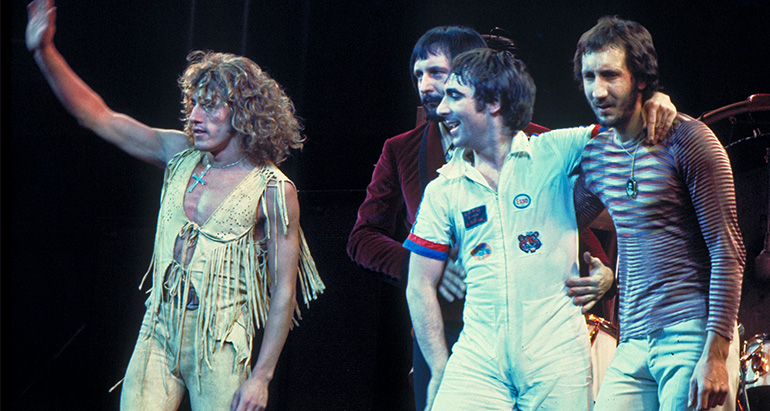
The Who is one of the most significant British rock bands of the 1960s and 1970s. Initially, it was considered a “racket combo,” found at the “hard” end of the “British Invasion” as part of the mod movement. In their music and their appearance, the four Englishmen represented a more aggressive variant of British rock music in the early years compared to the Beatles and the Rolling Stones.
Later, they achieved high recognition thru the release of the concept albums Tommy and Quadrophenia and are now considered one of the most influential rock bands in music history. The band is still musically active today and tours regularly. After the deaths of Keith Moon (1978) and John Entwistle (2002), only the guitarist Pete Townshend and the singer Roger Daltrey from the original lineup remain today.
History
Foundation and Success with My Generation
Around 1959, Roger Daltrey – then still the lead guitarist – founded the school band The Detours in northwest London. Between 1961 and 1962, bassist John Entwistle and then guitarist Pete Townshend joined. All three originally attended the same school in the Acton district. Due to a rival group of the same name, the band changed its name to The Who in February 1964. Shortly thereafter, drummer Keith Moon replaced the significantly older Doug Sandom, and the PR manager Peter Meaden, heavily influenced by the mod culture, changed the band name again. Under the name The High Numbers, the first single written by Meaden, I’m the Face / Zoot Suit, was released in July 1964. However, the band remained unsuccessful until Kit Lambert and Chris Stamp took over management. The group, which now called itself The Who again, first gained major attention in the press thru their first television appearance, in which they destroyed their instruments. According to Daltrey, the band initially received only around £100 per performance, but destroyed equipment worth more than that. As early as 1964, the band coined the term “Maximum R&B” for their own music style.
The first single the band released under the new name was already a chart success. Initially, the successful Shel Talmy, who had worked with the Kinks, served as producer. “I Can’t Explain” reached number eight on the British singles chart in early 1965, and the subsequent single “Anyway, Anyhow, Anywhere” reached number ten. The first album titled My Generation was released in December of the same year. The songs received a positive response from the young beat audience. On extensive club tours, The Who played My Generation at that time, so this piece became a kind of anthem for a large part of the English youth. After a series of successful singles (My Generation, Substitute, I’m a Boy, The Kids Are Alright, Happy Jack), the band released the album The Who Sell Out in 1967. The commercial success was modest, and the group – also due to their costly destruction orgies during live performances – ran into financial problems. In 1966 and 1967, the band performed several times in Germany, for example in Cologne in November 1966 with the Lords, where the band, as usual, destroyed the instruments on stage after five pieces.
Around the same time, rumors circulated that Moon and Entwistle wanted to join a band with Jimmy Page. After a few rehearsals, however, the collaboration was called off. The name of his band with other musicians was chosen by Page after Moon’s statement that a band with Page “would crash like a lead zeppelin.” To clarify the name, the “a” was dropped, resulting in the name Led Zeppelin – the band later became one of the most successful rock bands.
Tommy, Woodstock, and the Creative Peak
In 1969, Pete Townshend wrote the rock opera Tommy, which became a major commercial success. With these recordings, The Who were inspired by the Pretty Things, who had released the first rock opera ever with S. F. Sorrow in 1968, but remained commercially unsuccessful with it. The opera’s content was influenced by Townshend’s Indian guru, Meher Baba. In 1974, a film adaptation followed with Roger Daltrey as Tommy, the other band members, as well as musicians Tina Turner, Elton John, Eric Clapton, and actors Ann-Margret, Oliver Reed, and Jack Nicholson. In addition to this feature film by director Ken Russell, the content of Tommy was also adapted as a ballet and a musical. After the early recordings were rather simple, the complexity increased significantly with Tommy. The extensive tour with ecstatic stage shows and a mostly complete performance of the opera made the group one of the hottest live bands of the time.
Another success was their performance at the Woodstock Festival in August 1969, for which the band received 11,200 US dollars, significantly improving their financial situation. Due to the impending financial bankruptcy, the band demanded to be paid in cash, otherwise they would not perform. When Abbie Hoffman, leader of the so-called Yippie movement, tried to get on stage during the Tommy section of the performance to make a speech against the arrest of John Sinclair, Townshend violently threw him off the stage. The band played in the dead of nite, finishing their set at dawn. Their popularity continued to grow thru the Woodstock film, which was released in theaters worldwide and included excerpts from Tommy.
As a contrast to Tommy, Live at Leeds was released in 1970. The original LP contained only six tracks, including three cover versions of songs that were part of the Who’s repertoire (including “Summertime Blues”). In terms of sound and presentation, Live at Leeds was deliberately reminiscent of a bootleg recording. The LP is still considered one of the best live albums today. The almost complete concert was, however, only released as a double CD in 2001.
After another performance at the “Isle of Wight Festival” in 1970, Townshend conceived the “Lifehouse Project,” another rock opera as a successor to Tommy. Conceived as a kind of multimedia project about the power of music and loudly announced by Townshend in the press, “Lifehouse” was received with skepticism by the other band members. As a result, Townshend suffered a nervous breakdown. The songs were not released as a double concept album as originally planned, but were gradually released as singles, on subsequent albums, or on Townshend’s solo albums. 1971’s Who’s Next contains most of the Lifehouse compositions, including some of the Who’s best-known songs, such as “Won’t Get Fooled Again”, “Behind Blue Eyes” and “Baba O’Riley”, which are played at almost every concert to this day. The “Lifehouse” project was only completed in 1999 with a radio play and a concert performance in 2000 – with Townshend, but without The Who.
In 1973, the double LP Quadrophenia was released, marking yet another rock opera. Without achieving the commercial success of Tommy, the concept album, for many, along with the predecessor album Who’s Next, represents the peak of The Who’s artistic output. The album was accompanied by a picture book with an introduction that explained the storyline. The theme of Quadrophenia is the coming of age of Jimmy, an English mod. In 1979, the story was made into a film of the same name, featuring the street battles between the Mods, Rockers and the police, and is regarded as an accurate depiction of the youth situation in mid-1960s England. The tour for the album proved to be disastrous. The backing tapes, which were supposed to allow the album’s multi-layered sound to be reproduced on stage, did not work properly and interfered with the improvisational and anarchic nature of a Who concert, so the band began to perform only a few tracks live. A complete performance of Quadrophenia – with several guest musicians – did not take place until 1996/1997.
After the Quadrophenia tour, there was a creative break. As early as the 1970s, all members had released various solo projects. Townshend returned to Tommy, first as an orchestral version, then in the form of the film soundtrack, in which, alongside Daltrey in the title role, the band also makes a brief appearance. Entwistle compiled Odds & Sods, a collection of rarities and B-sides by The Who.
In 1975, the band recorded the album The Who by Numbers together. Townshend turned 30, addressed his midlife crisis, and the album became accordingly autobiographical and introspective. The band toured again, but with a greatest-hits set that contained few to no new pieces.
The Death of Moon, the Band’s Breakup, and First New Beginnings
It wasn’t until 1978 that the next LP, Who Are You, followed, featuring a title track of the same name, which would become the band’s last major critical success and a classic. Townshend, as the main songwriter, tried to musically develop The Who in the face of the energy of punk, experimenting with new sounds and synthesizers. However, the recordings were accompanied by the increasingly deteriorating health of the alcoholic Keith Moon: On one of the tracks, he is not present at all. For the first time, Daltrey sang a piece composed by John Entwistle, who is unusually well represented on this album with three songs. However, critics complained that the band could not compete with the emerging punk and new wave over the length of an album, as the quality of the song material varied too much.
On September 7, 1978, the drummer Keith Moon unexpectedly died of an overdose of the medication Heminevrin, which had been used to treat his high alcohol consumption.
As a replacement for Moon, Kenney Jones was hired, who had previously played with the Small Faces and the Faces and came from the same background. In addition, from now on, John Bundrick was part of the performances on keyboards. In 1979, the first tour with the new line-up was carried out. Before a concert at the Riverfront Coliseum in Cincinnati, eleven people were crushed when a large number of concertgoers tried to squeeze thru a few entrances. Fearing a further panic, neither the band nor the other fans present were informed of the incident, and the concert went ahead as planned.
While the concerts in 1979 and 1980 were enthusiastically received and ended in sometimes excessive jam sessions where new material was tried out, Townshend’s interest in the band had increasingly waned since Moon’s death. In addition to a new record deal for The Who, he had signed a solo contract, which increasingly put him under pressure. Not least because of this, Townshend’s drug use had increased significantly. In 1981, he almost died of an overdose. He addressed his alcohol problems in 1980 in his first “real” solo album, Empty Glass, even before The Who recorded new pieces, including for the McVicar soundtrack.
In 1981, the album Face Dances was released, which, apart from the single hit “You Better You Bet” and the elaborately designed cover featuring portraits of the four band members by twelve contemporary artists, contained little that was noteworthy. The tour had to be cut short due to Townshend’s health. Only one performance in the Rockpalast Nite, which was broadcast on television across Europe, took place outside of England.
In 1982, they toured almost exclusively. Between the performances and the recordings for Townshend’s solo album “All the Best Cowboys Have Chinese Eyes,” “It’s Hard” was created. Due to the constant touring, especially in the USA, and the announcement that this would be the band’s last tour, it was commercially quite successful, although critics believed that the songs on Townshend’s solo albums were better and, above all, the late drummer Moon was missed, which was clearly evident in the music. After an extensive and sold-out farewell tour—during which Daltrey played guitar for the first time since the “Detours”—through the sports stadiums of the USA (including with The Clash as the opening act), the group gave their final concert for the time being on December 17, 1982, in Toronto.
Although it was initially planned to record more material, give occasional concerts, and demo recordings had already been made, the band officially disbanded in 1983. The live album Who’s Last was released “posthumously.” In the following period, the individual members dedicated themselves to their solo activities.
In July 1985, the band briefly reunited at the request of Bob Geldof for the Live Aid benefit concert and played four songs at Wembley Stadium in London: My Generation, Pinball Wizard, Love Reign o’er Me, and Won’t Get Fooled Again. However, the performance was not meant to be. They had hardly rehearsed, so the piece After the Fire, which had been written especially for the event, was not played, they ran over time and the satellite transmission broke down. The next time they performed together was in 1988, when they were awarded the British Phonographic Industry’s Lifetime Achievement Award. This was the last performance with Kenney Jones on drums. Jones had to leave the band under pressure from Daltrey, but he was able to negotiate a transfer fee due to the ongoing contract.
In 1989, two new Who tracks were released on Pete Townshend’s musical album Iron Man. To celebrate the 20th anniversary of the rock opera Tommy, Townshend, Daltrey, and Entwistle went on tour that same year with numerous guest musicians (but without Jones), including Simon Phillips on drums. Townshend played almost exclusively acoustic guitar, with few exceptions. The band played the Tommy album almost in its entirety, Townshend solo pieces and other rarely played pieces, which were released on the live double CD Join Together. The musicians earned around 30 million dollars from the tour.
In 1991, Townshend, Daltrey, and Entwistle reunited for recordings for the Elton John tribute album Two Rooms and recorded “Saturday Night’s Alright for Fighting.”
Roger Daltrey celebrated his 50th birthday in 1994 over two evenings at New York’s Carnegie Hall under the name “Daltrey Sings Townshend” with the band from the 1989 tour. Special guests included John Entwistle and Pete Townshend for one song. However, he was not persuaded to join the following tour, which became a financial disaster due to high production costs and Townshend’s absence.
Officially without using the name The Who, Quadrophenia was performed live in Hyde Park in 1996 with numerous guests (including David Gilmour). They decided to go on an extensive tour of the USA and the following year of Europe. The group performed in Germany for the first time since their 1981 Rockpalast appearance. In addition to the complete Quadrophenia album, only a few greatest hits were played. On drums was Ringo Starr’s son Zak Starkey and on second guitar was Pete Townshend’s brother Simon.
The Reunion as a Live Band
After having mostly toured with a big band and corresponding “orchestral” sound in the previous years, The Who returned in 1999 to a “smaller” lineup, with Zak Starkey, John Bundrick, and a significantly rougher musical style. The focus of the performances was no longer the concept albums, but the biggest hits.
In the fall of 1999, the group initially played a few small charity performances in the USA and England, including an unreleased unplugged performance at Neil Young’s “Bridge School Benefit,” before a lengthy “Greatest Hits” tour followed in 2000. The highlight was a performance at the Royal Albert Hall, where numerous guests paid their respects, including Noel Gallagher, Paul Weller, Bryan Adams, Nigel Kennedy, Stereophonics, and Eddie Vedder. This performance was released on DVD and CD in 2002. In addition, concerts have been regularly recorded and distributed since 2002, initially as double albums, and since 2006 also as DVDs. The proceeds were donated, among other things, to the “Teenage Cancer Trust.”
On October 20, 2001, The Who performed at the “Concert for New York City,” a benefit concert for the victims and survivors of the September 11, 2001 terrorist attacks. This performance, amidst a rather subdued atmosphere until then, is considered one of the best and most energetic of the reunited band.
On June 27, 2002, bassist John Entwistle unexpectedly died in his hotel room in Las Vegas after suffering a heart attack due to cocaine use. To avoid a pilgrimage of fans, the hotel kept the exact room number secret. As with Keith Moon’s death, the decision was made to carry on. The three-month US tour was delayed by two days, with Italian-British bassist Pino Palladino, who had played with Tears for Fears, Eric Clapton, Phil Collins, Elton John and Paul Young, stepping in. The band was also bolstered by Simon Townshend.
In May 2004, two new tracks were released on another best-of album, Then And Now, and in a “Singles Box”: Real Good Looking Boy and the Entwistle tribute Old Red Wine. In July 2004, they headlined the Isle of Wight Festival again. In the same year, the nu-metal band Limp Bizkit successfully released a cover version of the 1971 track “Behind Blue Eyes.” At the beginning of the 21st century, the Who songs “Who Are You,” “Won’t Get Fooled Again,” “Baba O’Riley,” and “I Can See for Miles” became popular again thru their use as theme songs for the CSI series.
For 2005, after Zak Starkey returned from his duties as Oasis’ touring drummer, a studio album with new pieces was planned. This was then postponed. In July 2005, Townshend, Daltrey, along with John Bundrick, Simon Townshend, and Paul Weller’s band, performed at the Live 8 concert in London, right before Pink Floyd. In the second half of 2005, Roger Daltrey sang at 49 concerts of the “Night of the Proms.” He played four Who songs with orchestral accompaniment (Who Are You, Behind Blue Eyes, Pinball Wizard, See Me, Feel Me). Pete Townshend played some solo concerts with his partner Rachel Fuller and published his project “The Boy Who Heard Music” on the Internet.
“Endless Wire”: The Comeback
In the summer of 2006, The Who went on an extensive world tour once again. The touring band, as in previous years, consisted of Townshend and Daltrey, along with Zak Starkey, Pino Palladino, Simon Townshend, and John Bundrick. On 17 June 2006, the tour began in Leeds, the location of their legendary live recording from 1970. Among other things, the band performed three concerts in Germany, two in Switzerland and one in Austria.
At the end of July 2006, an EP featuring excerpts from the mini rock opera “Wire & Glass” was released, which was to form the centerpiece of the album following on October 30, 2006. Endless Wire, on which Zak Starkey only plays on one track contrary to the announcement, was the first studio album in 23 years. Although the album was received with mixed feelings, the 2007 tour for the album, which also included five concerts in Germany, was a great success.
Most recently, Daltrey and Townshend played their first full concert as a duo in the spring of 2008, as part of the annual concerts at the Royal Albert Hall in aid of the “Teenage Cancer Trust.” In October and November, the band toured the USA and Japan for the second time. In December, The Who ended the year with three concerts at London’s indigO2.
On February 7, 2010, The Who performed at the halftime show of Super Bowl XLIV in Miami Gardens (Miami). The Who played a medley of Pinball Wizard, Baba O’Riley, Who Are You, See Me, Feel Me, and Won’t Get Fooled Again.
The Who gave a Quadrophenia concert at the Royal Albert Hall on March 30, 2010, for the organization Teenage Cancer Trust.
On August 12, 2012, The Who performed at the closing ceremony of the 2012 Summer Olympics in London. The group closed the closing ceremony, performing the songs Baba O’Riley, See Me, Feel Me, and My Generation in a shortened medley.
On December 12, 2012, The Who performed at the Concert for Sandy Relief. In 2013, they toured Europe again with Quadrophenia.
After the release of the best-of album The Who Hits 50! with the new song Be Lucky in October 2014, The Who embarked on an extensive tour starting in November 2014 to celebrate the band’s 50th anniversary. After performances in Abu Dhabi and Great Britain, they first went to the USA and since June 2015 back to Europe. The tour was referred to by Roger Daltrey as a “long goodbye.” After Roger Daltrey contracted a viral infection, some dates of the North American tour had to be canceled.
In November 2019, a new album titled “Who” was released, containing eleven songs, with the title track “Ball and Chain” released as a single in advance. Tour dates for March and April in Great Britain have been announced.
Music
Role Models
Like most rock bands, The Who also played pieces by other groups at concerts or recorded their own versions. The Who were influenced by the songs of rock ‘n’ roll and blues musicians, such as Bo Diddley, whose songs I’m a Man and Roadrunner they played, James Brown (Please Please Please, I Don’t Mind) or Marvin Gaye. Particularly Eddie Cochran’s “Summertime Blues” became well-known in The Who’s version, so the original version is often attributed to the band.
Style and Instruments
The songs were usually written by Pete Townshend. According to his own statements, he was influenced in his youth by rock songs such as Rock Around the Clock. Due to the conception of the first rock operas, he is credited with a role as a significant pop composer and guitarist. Compared to many other guitarists of the 1960s, Townshend has relatively few blues influences. He developed his own style, which was even partly copied by Jimi Hendrix. Townshend is known for his special way of strumming the strings, where he swings his arm in a wide arc, often referred to as “windmilling.” According to his own statements, he learned this technique from the Stones guitarist Keith Richards.
Roger Daltrey is, according to his own statements, a fan of Elvis Presley. The song Real Good Looking Boy, recorded in 2003, is said to be a tribute to him. Critics have said that while Daltrey’s voice is not outstanding, it is distinguished by its power and “unadorned vocal style.” There have been occasional disputes between Daltrey and Townshend, for example when Daltrey was in the public eye for his starring role in the film Tommy.
John Entwistle, longtime bassist, significantly contributed to the typical sound with his playing. He played both with and without a pick. He often accompanied Townshend’s guitar with pentatonic runs, as can be heard in My Generation, for example. His bass solo in this piece is considered one of the first electric bass solos ever released on a record. Entwistle’s qualities as a bassist are generally praised by the music press; in 2000, Guitar Magazine named him “Bassist of the Millennium.” Entwistle was considered the calm in the band and received the nickname The Ox. At concerts, he continued to stand out until the end with his bass solos, particularly his improvisations in the piece 5:15 from the album Quadrophenia, which could reach several minutes in length.
Keith Moon is considered one of the best drummers with his playing. He claimed to have been influenced by jazz drummer Gene Krupa. Moon usually played Premier drums.
At the beginning of their career, the band used Marshall amplifiers. At Townshend’s request, Marshall developed the first 100-watt head, the so-called 1959, with an 8×12″ box in 1965. For better transport, the box was divided, creating the famous Marshall stack, which Townshend and Entwistle then used. In 1967, the musicians switched to the British manufacturer Sound City. On the 2007 European tour, Townshend played Fender Stratocaster guitars and amplifiers.
Destruction as an artistic element
Especially in the early years, the musicians were known for destroying their instruments at the end of each performance. Townshend alone is said to have destroyed more than 3,000 guitars in total. While this happened regularly in the early years, the frequency later decreased. The last guitar was smashed by Townshend in 2004 on the occasion of the group’s first performance in Japan. According to Townshend, these destructions were influenced by the concept of self-destructive art by Gustav Metzger, who taught at the Ealing Art College attended by Townshend and Entwistle.
Awards
On May 31, 1976, they earned a place in the Guinness Book of Records at the Charlton Football Ground for the loudest rock show in the world with 120 dB, measured 50 meters from the stage. This record was later surpassed by heavy metal band Manowar.
In 1990, the induction into the “Rock and Roll Hall of Fame” took place. In 1993, the Recording Industry Association of America (RIAA) published the sales figures of some albums in the USA. Accordingly, Hooligans, Who’s Better and Who’s Best received Gold for half a million sales, Meaty Beaty Big and Bouncy, Quadrophenia and The Who by Numbers Platinum for a million, Greatest Hits, Live at Leeds, Tommy and Who Are You double Platinum and Who’s Next triple Platinum. Despite this, the band has never had a single reach number one in either the UK or the US.
Rolling Stone ranked The Who 29th on its list of the 100 Greatest Artists of All Time. In the autumn of 2003, the critics of the German edition of the music magazine placed Who’s Next at number 28 and the predecessor album Tommy at number 96 in the list of the 500 greatest albums of all time. In the April 2005 Rolling Stone compilation of the 500 greatest songs of all time, My Generation from the album of the same name was placed at number 11. The Who’s Next songs “Won’t Get Fooled Again” and “Baba O’Riley” were listed at numbers 121 and 394 respectively. In the corresponding US poll, the songs landed in 133rd and 340th place.
Musical influence
The Who is one of the early and most influential rock bands. In the early years, they were considered a model and an important representative of the Mod movement. Punk and new wave bands, such as The Clash and The Jam, were influenced. In the 1990s, many Britpop bands oriented themselves toward the music of the Mods and incorporated their elements, such as Oasis, Blur, Suede, and Pulp.
The release of Tommy had a significant influence on subsequent rock musicals and concept albums and was imitated in a similar manner by David Bowie with The Rise and Fall of Ziggy Stardust, Jethro Tull’s Thick as a Brick, and Pink Floyd with albums such as The Dark Side of the Moon, Animals, and The Wall.
The songs by The Who have been covered by many other bands. In particular, My Generation was covered by many musicians in their own versions, including Alice Cooper, Green Day, Helge Schneider, Iron Maiden, Manfred Mann, Oasis, Patti Smith, Pearl Jam, and The Sweet. Other artists who have covered Who songs include David Bowie (Anyway, Anyhow, Anywhere, I Can’t Explain), Styx and Tina Turner (I Can See for Miles), and the Scorpions (I Can’t Explain), punk bands like the Ramones and Sex Pistols (Substitute), as well as Rush (The Seeker), Queensrÿche, and Van Halen (Won’t Get Fooled Again).
In 2001, Substitute – The Songs of The Who was released, a tribute album featuring British and American musicians; among those involved were David Bowie and Sheryl Crow.
One of the most famous versions in recent years is Behind Blue Eyes, which was reinterpreted by Limp Bizkit in 2003. In 2007, the English group The Zimmers covered the song My Generation. The band, whose members have an average age of 78, wanted to draw attention to their generation and protest against being simply sidelined and marginalized in society.
