
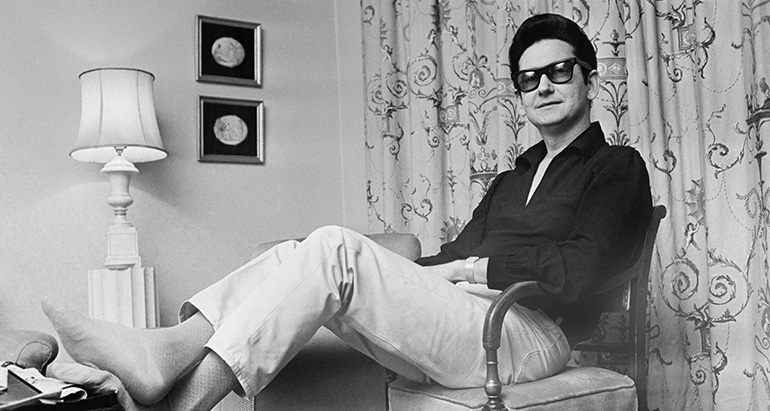
Roy Kelton Orbison (April 23, 1936, in Vernon, Texas; December 6, 1988, in Hendersonville, Tennessee) was an American pop, country, and rock singer as well as a songwriter. In the 1960s, he achieved numerous hits with songs like “Oh, Pretty Woman,” “Only the Lonely,” “Crying,” and “In Dreams.” His trademarks were the sunglasses and dark love ballads. In the years before his death, Orbison made a much-publicised comeback. The magazine Rolling Stone ranked him 37th among the greatest musicians and 13th among the greatest singers of all time.
Life
Childhood and Youth
Orbison was the son of nurse Nadine Vesta Shults (July 25, 1913 – May 28, 1992) and auto mechanic Orbie Lee Orbison (1913–1984). Roy Orbison got his first guitar at the age of six. His father, Orbie, taught him to play. In 1942, the family moved to Fort Worth because Orbison’s father had gotten a job at an ammunition factory there. With his older brother Grady, the young Orbison returned to his hometown in 1944, where his grandmother still lived. There he also wrote his first song, “A Vow of Love.” In 1945, he won a talent competition at the local radio station KVWC and received a weekly Saturday nite show.
Around 1953, he had his first public performance in front of an audience with his band “The Wink Westerners.” He performed at a school event at Wink High School. In 1954, he graduated from high school and transferred to North Texas State College to study geology. While he only played country music at his first performances, he now also included rockabilly and rock ‘n’ roll pieces in his repertoire.
Career
Beginnings as a Rockabilly
In 1955, Orbison traveled with his band to Dallas to audition the song Ooby Dooby, written by his college friends Wade and Dick, at Columbia Records. Columbia liked the song, but they had Sid King and the Five Strings record it. After Orbison and his band appeared on several radio shows, they renamed themselves “The Teen Kings.” They consisted of Orbison (vocals/guitar), James Morrow (mandolin), Jack Kennelly (bass/fiddle), and Billy Pat Ellis (drums). With financial assistance, they managed to release the title recorded on March 4, 1956, in Norman Petty’s studio, along with “Trying to Get to You,” on Weldon Rogers’ record label Je-Wel Records on March 19, 1956. However, the contract was annulled shortly after the single was released because Orbison was still a minor and needed his parents’ signature. However, Sam Phillips, owner of Sun Records, heard the record and offered Orbison a recording contract, which Orbison signed. On March 27, 1956, Roy Orbison then recorded a remake of “Ooby Dooby” at the Sun Records studio, which was released with “Go Go Go” on Sun #242 on May 1, 1956, and subsequently sold 350,000 copies.
The title only reached number 59 on the national charts. To capitalize on the success, Orbison toured with Johnny Cash, Carl Perkins, Warren Smith, Sonny Burgess and Faron Young, reaching as far as Canada. In September of the same year, they recorded their second single: You’re My Baby, a piece written by Johnny Cash, and the title Rockhouse, which came from Orbison and Harold Jenkins, better known as Conway Twitty. Orbison’s success at Sun Records was very limited because he could not agree with label head Phillips on either the material to be used or the style of his music. By 1958, Orbison was under contract with Sun, after which he moved to RCA Records, where Elvis Presley was also under contract. He released two singles. When these remained unsuccessful, the contract was not renewed.
Meanwhile, Roy Orbison had written a song for his wife Claudette, which he sang to the Everly Brothers during a break in their performance. The brothers liked the song and recorded Claudette. The song was released as the B-side of the hit single “All I Have to Do Is Dream” and earned Orbison some royalties. Jerry Lee Lewis also recorded Orbison’s “Down the Line” in 1958, which was released as the B-side of his hit “Breathless.” It seemed as if Orbison was destined to spend his life as a songwriter when he finally signed with Fred Foster’s independent label Monument Records in 1959. He recognized the potential of the young singer, and his second single, Uptown, made the charts, albeit only to number 72.
The 1960s
At Monument Records, Orbison achieved national and international breakthrough on May 9, 1960, with “Only the Lonely (Know the Way I Feel).” With rock, pop, and country titles, he reached the top positions on the charts. Orbison had become an international star. The songs from this time show off his tenor and falsetto, which he knew how to combine with a certain drama. A particular characteristic of his singing was a roll of the R lasting about a bar, comparable to the growl of a dog, which he inserted at key points in some songs. His singles were released not only in the USA, but also in Germany, France and Great Britain. Most of his hits he wrote alone or with his co-writers Bill Dees and Joe Melson.
In 1962, Roy Orbison performed in Great Britain for the first time, and in 1963 he toured there with the Beatles and Gerry & the Pacemakers. On the plane, the very far-sighted Orbison forgot his glasses and had to perform that evening in his sunglasses (which also had lenses of the appropriate strength). The images from the tour went around the world, and from then on Orbison only appeared with dark glasses. Without glasses, he is only seen in a few photos and in the film The Fastest Guitar.
In 1963, Orbison recorded two songs in German, “Mama” and “San Fernando,” with Ralph Siegel in Hamburg, but the songs did not reach the charts. In 1965, he toured Australia, among other places, with the Rolling Stones. Mick Jagger and Keith Richards were inspired by the guitar intro of Pretty Woman to compose a similar intro for their hit (I Can’t Get No) Satisfaction.
Around this time, the German pop singer Roy Black adopted the first name of his idol Roy for his stage name; later, Black recorded German versions of Orbison’s “Only the Lonely” and “California Blue.” Also part of the touring band in the early 1960s was Bobby Goldsboro, who had his own hits starting in 1963 and successfully launched a solo career.
After the successful singles “Only the Lonely,” “Running Scared,” “Crying,” “In Dreams,” “Blue Bayou,” and his biggest hit “Pretty Woman,” which was released in 1964, Orbison was plagued by personal tragedies. His first wife, Claudette, died in a motorcycle accident in 1966. Two of his three sons from this marriage, Roy Jr. (* 1958) and Anthony (* 1962), died in a fire at his country house on September 14, 1968. The third son, Wesley (* 1965), was saved by Orbison’s parents at the last moment.
On May 25, 1969, Orbison married the German Barbara Anne Marie Wellhöner Jakobs (* January 10, 1950, in Bielefeld) in his second marriage. From this union came the sons Roy Kelton Orbison Jr. (born October 18, 1970) and Alex Orbison (born 1975). His wife died of cancer on December 6, 2011, the 23rd anniversary of Roy Orbison’s death.
The single “Pretty Woman” was for a long time Orbison’s last worldwide hit and also the last major success at the record label Monument Records. A one-million-dollar contract lured him to the major label MGM in 1965, which guarantyd him a feature film (The Fastest Guitar) and various television appearances. However, the sound quality and the quality of the music production of the Monument recordings were rarely matched at MGM, and he was also contractually obliged to produce a certain number of songs, which suffered in quality. Although Roy Orbison continued to write good songs, the major successes eluded him.
Another reason for the lack of commercial success from the mid-1960s was also the dominance of beat groups in the international charts.
The 1970s
In 1973, the contract with MGM ended, and subsequently, he signed with Mercury Records, releasing three singles and the album I’m Still in Love with You. Here, too, success eluded him, and in 1976 he was briefly signed to Monument again, resulting in the album Regeneration.
In the meantime, Linda Ronstadt recorded a cover version of Orbison’s “Blue Bayou” and reached number 3 on the US charts in 1977. Ronstadt’s record company then recorded the unsuccessful disko album Laminar Flow with Roy Orbison. Successful cover versions were subsequently released by Paola Felix in 1978 with “Blue Bayou” (in German), Don McLean in 1980 with “Crying,” and Van Halen in 1982 with “Oh, Pretty Woman.”
At an Elvis Presley concert in late 1976, Orbison was in the audience. Presley introduced him to the other audience members as “…the greatest singer in the world.” In 1978, Orbison recorded the film score for A Living Legend, a movie about the life of Elvis Presley. The film only ran for a short time in a few theaters in the USA.
The 1980s
In 1980, Orbison achieved a country hit in duet with Emmylou Harris with “That Lovin’ You Feeling Again,” for which the performers received a Grammy for Best Duet.
Also in 1980, Orbison completed his only performance in the then Eastern Bloc in Bulgaria. In this live performance broadcast on Bulgarian television, he was accompanied by a full orchestra.
In 1985, his wife Barbara, who was now his manager, a re-recording of the 1963 hit “In Dreams” became popular in David Lynch’s film “Blue Velvet.” In the same year, Orbison, Johnny Cash, Jerry Lee Lewis, and Carl Perkins came together in the Sun Studios in Memphis to record the album “Class of ’55.” In 1987, Orbison re-recorded his old hits with Virgin Records, as they had not been available to his fans since Monument Records went bankrupt in the early 1980s. That year he appeared on the television special Roy Orbison and Friends, along with Elvis Costello, Bruce Springsteen, and James Burton, which led to the live video Black and White Nite. In 1987, Orbison was also inducted into the “Rock and Roll Hall of Fame,” with Bruce Springsteen giving the speech of praise.
At the end of 1988, he made a comeback with the single “You Got It” and the album “Mystery Girl.” Additionally, he teamed up with Bob Dylan, George Harrison, Jeff Lynne, and Tom Petty to form the supergroup Traveling Wilburys, whose album “Traveling Wilburys Vol. 1” sold millions of copies.
Roy Orbison did not experience this success anymore. At a young age, he already suffered from heart problems and had to undergo bypass surgery in the late 1970s. He died on December 6, 1988, of a heart attack, even before the album was released. The burial took place at the Westwood Village Memorial Park Cemetery in Los Angeles, California.
After his death
In the following years, compilations and reproduced albums were regularly released by Orbison Records. In 1992, the album King of Hearts was released posthumously, which Jeff Lynne compiled from demos and already completed master tracks. In 1990, he posthumously received a Grammy for “Pretty Woman.” In 2004, Orbison’s “Blue Bayou” served as film music in the feature film “Dreamcatcher.” In 2015, a complete and long-lost album recorded in 1969 unexpectedly surfaced among Orbison’s sons, which was digitally salvaged with great effort and released in December 2015 under the name One of the Lonely Ones. In 1969, Orbison fell out with MGM because they did not release the album and for a time withheld payments from Orbison’s record sales.
More than 20 years after his death, Roy Orbison was posthumously honored with a star on the Hollywood Walk of Fame in January 2010.
