
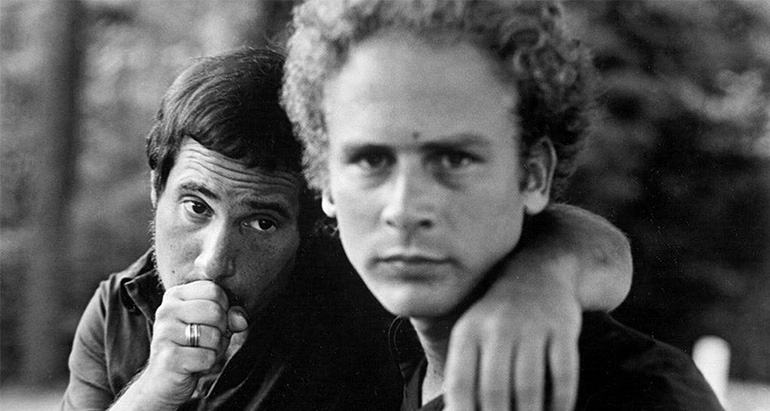
Simon & Garfunkel was a US folk-rock duo formed in 1957 by schoolmates Paul Simon and Art Garfunkel.
History
The early years
Their first single, “Hey, Schoolgirl,” was released in 1957 under the name Tom and Jerry. The following year, they released an album named after the band, which was re-released in 1967. These early works were more in the style of Everly Brothers rock ‘n’ roll, while the duo only focused on folk rock in the 1960s.
In the following period, Paul Simon released various singles under the pseudonym Jerry Landis and worked briefly with Carole King. As a composer, he was active during this time under the name Paul Kane.
First successes
In 1964, Paul Simon and Art Garfunkel found themselves back in the studio to record the album Wednesday Morning, 3 A.M. In contrast to the following albums, the composers were more widely spread here, with a cover version of Bob Dylan’s song The Times They Are a-Changin’ and two traditional songs, for example. The cover was predominantly black, featuring the title in the upper half and a picture of Simon and Garfunkel in the 5th Avenue Station of the New York subway in the lower half. The entire album was recorded exclusively with acoustic instruments and included the first released version of the later hit “The Sound of Silence” (which initially bore the title “The Sounds of Silence”). Although this album sold significantly better than its predecessor, the commercial breakthrough was still delayed. However, with this album, the “division of roles” was already established: Paul Simon was responsible for the music, Art Garfunkel for the vocals. His voice gives many Simon and Garfunkel pieces their distinctive character.
Paul Simon spent the next few months in England, where, among other things, he recorded the album The Paul Simon Songbook for the BBC in just over an hour, which contained many songs that were later re-recorded by Simon and Garfunkel. The album was only moderately successful in Britain, but Simon made a name for himself in the English folk scene, earning up to £20 a nite (around £200 today). During this time, Simon wrote some songs that were later recorded by Simon and Garfunkel.
The Breakthrough
During this time, under the direction of Tom Wilson, who had also produced Wednesday Morning, 3 A.M., a revised version of the song “The Sounds of Silence” was created: the existing acoustic version was supplemented with electric guitars and drums. This version was released as a single in September 1965 and marked the final breakthrough for Simon and Garfunkel.
In December of the same year, the recordings for the album “Sounds of Silence” took place. This includes, in addition to the revised version of The Sounds of Silence, a new version of the song Wednesday Morning, 3 A.M., which was already included on the first album – albeit with minor changes to the lyrics and to the melody of Davey Graham’s instrumental piece Anji. This reworking is called “Somewhere They Can’t Find Me.” The album was released in the USA in March 1966. Also included is the song Richard Cory, based on a poem by Edwin Arlington Robinson. The UK version also included the song Homeward Bound, which had been released as a single in the US in May 1966. Homeward Bound became Simon and Garfunkel’s first top ten hit in England.
The peak of the career
Due to their great success, Simon & Garfunkel went back into the studio right away, and in November 1966, the album Parsley, Sage, Rosemary and Thyme was released. This line comes from the English traditional “Scarborough Fair,” which was re-recorded by Simon & Garfunkel for this album and set to the song “Canticle.” This was based on a piece by Simon already published on The Paul Simon Songbook titled The Side of a Hill. The song Scarborough Fair/Canticle, which emerged from this synthesis, is considered one of the most significant and interesting folk songs ever, among other reasons, due to its vocal parts. The second extraordinary piece on this album was 7 O’Clock News/Silent Nite. Here, a version of the Christmas song Silent Nite, Holy Nite, performed by Simon & Garfunkel, was mixed with a recording of a news broadcast. Both songs were intended by Simon & Garfunkel as an artistic protest against the Vietnam War that was taking place at the time.
During this time, Simon & Garfunkel gave many concerts, including at various universities across the country. From this time, there are various concert recordings, so-called bootlegs, some of which have very poor sound quality. However, a concert from 1966 at Tufts University in Boston was officially released, and some pieces, such as “You Don’t Know Where Your Interest Lies,” were long available only on this album until many old recordings were reissued in the late 1990s.
In the spring of 1968, the soundtrack to the film The Graduate (German title: Die Reifeprüfung) with Dustin Hoffman in the lead role was released. The title song Mrs. Robinson – which has little in common with the film’s eponymous protagonist – is still one of Simon & Garfunkel’s most popular pieces. Other songs on the album were alternative versions of well-known recordings, as well as some of the original music by Dave Grusin. Both the song Mrs. Robinson and the entire soundtrack album won a Grammy.
In May 1968, the duo’s fourth “official” album was released under the title Bookends. In addition to Mrs. Robinson and the piece America, this album also featured the title Save the Life of My Child, which incorporated a sequence from the 1966 version of The Sound of Silence. With this album, Roy Halee also joined the band, who in the following years repeatedly served as the producer for the duo’s releases and later often collaborated with Simon.
The End of the Duo
In 1969, only the single “The Boxer” was released. At the end of January 1970, the song “Bridge over Troubled Water” was released, followed a week later by the album of the same name, of which 1.7 million copies were shipped in the USA in the first three weeks. Shortly after the album was released, Simon & Garfunkel announced their separation. At the time, the reasons given were that, on the one hand, Art Garfunkel wanted to devote more time to his acting career – although he initially only appeared in three films: Catch-22, Carnal Knowledge, and Bad Timing – and that Paul Simon wanted to pursue a different musical style. The duo received six Grammys for the album, including for “Best Contemporary Song” and “Best Album.”
Later joint projects
1971 to 1980
The final end was not yet there for Simon & Garfunkel, however. Initially, a best-of album titled Simon and Garfunkel’s Greatest Hits was released in June 1972. The two occasionally appeared together on television shows, and in 1975 a new joint single entitled My Little Town was finally released. The fans were hoping for a reunion, but it was just this one single. In 1978, they finally recorded another single, this time with singer James Taylor. It was a cover version of the piece (What a) Wonderful World by Sam Cooke.
1981 to 1990
The most successful reunion of the two singers took place in front of a large audience on September 19, 1981: As the New York City administration and its mayor Ed Koch planned to close Central Park for cost reasons, some artists gathered there at the time and gave benefit concerts. The Simon & Garfunkel concert was attended by over 500,000 people, and since the fireworks originally planned for that evening were banned, the final piece, The Sounds of Silence, was accompanied by a sea of burning lighters. Paul Simon thanked Ed Koch, among others, for the concert, which initially led to a few whistles, but when the irony in Simon’s speech was recognized, it turned into great applause. The recording was released as a double LP. A short world tour followed, which brought the duo to Germany for a few performances in 1982.
Shortly thereafter, Simon & Garfunkel began producing a joint album, but they quickly abandoned the project (the songs were used by Paul Simon on his album Hearts and Bones, but without Art Garfunkel’s contributions).
1991 to 2000
In the 1990s, there were occasional joint concerts that resulted from the duo’s induction into the Rock and Roll Hall of Fame.
2001 to present
In 2003, Simon and Garfunkel were awarded the Lifetime Achievement Award by the Recording Academy. On the occasion of the award, the duo performed at the Grammy Awards and played an acoustic version of their first major hit, “The Sound of Silence.”
From the rehearsals for this performance, plans for a joint tour emerged, to bid farewell to the audience appropriately and to conclude the Simon and Garfunkel chapter on a reconciliatory note. The Old Friends Tour was initially scheduled for three months, from October to December 2003, and took place exclusively in the USA. Due to the great success, it was decided to continue the tour in 2004. It lasted from May to July 2004, with half of the concerts taking place in European cities. The double CD and DVD documenting these concerts also include a new studio recording, Citizen of the Planet, as a bonus. The song was written by Paul Simon for the 1983 album Hearts and Bones, but was never released. Garfunkel pushed for the song’s release in 2004, with only him needing to record his part, which was then mixed with Simon’s 1984 recording.
After the end of the 2004 tour, Paul Simon and Art Garfunkel went on solo tours again. However, they sporadically came together for some occasions, for example in 2006 at a benefit concert for the victims of Hurricane Katrina, where they sang some songs together. In addition, on 13 February 2009 they appeared as a duo on the stage of the Beacon Theater, which Paul Simon reopened with a concert. They sang The Sound of Silence, The Boxer and Old Friends together. After this performance, a new joint tour was announced. This took place in June and July in New Zealand, Australia and Japan, as these regions had been omitted from the last tour. The duo also reunited on October 29, 2009, to celebrate the 25th anniversary of the Rock and Roll Hall of Fame, performing some songs on stage at the 25th Anniversary Rock and Roll Hall of Fame Concert alongside other artists. On April 24, 2010, they performed at the annual New Orleans Jazz Festival. Further concerts planned for 2010 had to be canceled due to Garfunkel’s vocal cord problems.
In 2015, Art Garfunkel attracted attention with an interview for the British newspaper Telegraph. In it, he called the duo’s split at the time a mistake and Simon an “idiot” for his decision to do so. When asked about the height difference between him and Simon, Garfunkel speculated that it might be the case that in the 1950s he felt pity for Simon’s shorter stature and therefore began making music with him. In retrospect, he had probably created a “monster” in the process. German daily newspapers subsequently distorted the interview.
Awards
- 10 Grammys
- 1969 for Mrs. Robinson (Single, two categories) and The Graduate (Album)
- 1971 for Bridge over Troubled Water (for the single in five categories as well as for the best album)
- 2003 for their lifetime achievement
- The albums by Simon & Garfunkel were often awarded gold, platinum, and multi-platinum. In total, over 50 million units were sold. Their 1972 album Greatest Hits even reached diamond status with 14 million sales.
- Rolling Stone ranked Simon & Garfunkel at number 40 on its list of the 100 greatest musicians of all time.
