
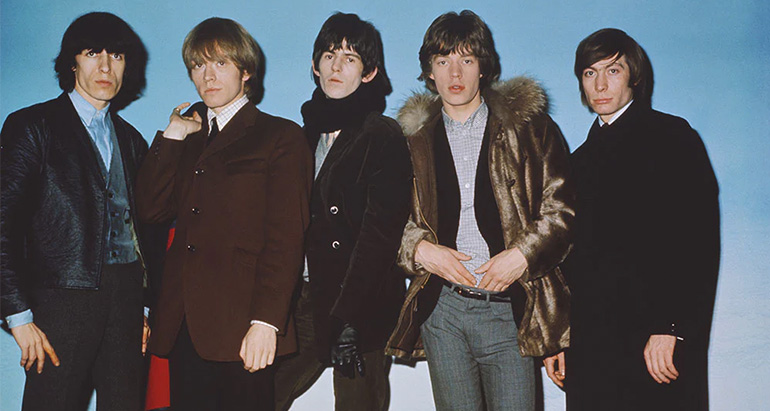
The Rolling Stones are an English rock band formed in 1962. They are among the longest-lasting and most commercially successful groups in rock history. In 1989, they were inducted into the Rock and Roll Hall of Fame. The music magazine Rolling Stone ranked them fourth among the 100 greatest musicians of all time.
Band history
Formation (1962)
On the morning of October 17, 1961, eighteen-year-old Mick Jagger and his peer Keith Richards randomly met at the train station in their hometown of Dartford (Kent). Jagger was on his way to the London School of Economics and was waiting on the platform for his train, while Richards was also heading to London, about 30 kilometers away, to attend Sidcup Art College. The two teenagers knew each other from their years at primary school, but had lost contact over time. As Jagger was carrying records by the American blues musicians Chuck Berry and Muddy Waters, and Richards was also enthusiastic about the music, which was relatively unknown in Britain at the time, a conversation developed. They arranged to listen to blues and rock ‘n’ roll records. The shared interest in this music subsequently led to the resumption and intensification of their friendship. In their free time, Jagger, his former classmate Dick Taylor, and Bob Beckwith got together to make music under the name Little Boy Blue and the Blue Boys. Taylor also attended Sidcup Art College and happened to know Keith Richards. After Jagger renewed his acquaintance with Richards and learned that he played guitar, he and Taylor decided to include their mutual friend. The four of them rehearsed the songs of their American idols in their parents’ homes, but they did not perform in public.
To see live performances by popular blues bands, they visited London clubs on weekends and were at the Ealing Jazz Club on April 7, 1962, for a concert by Blues Incorporated, led by Alexis Korner, the country’s first electric blues combo. Since it was a completely open formation, Jagger and Richards jammed with the musicians on stage before the performance. In the process, a certain Brian Jones, who called himself Elmo Lewis at the time, drew attention to himself with his slide guitar playing and the bottleneck technique, which was little known in Europe at the time. In contrast to the three suburban schoolboys who still lived with their parents, the enterprising Jones, as the father of three illegitimate children, was already on his own and had caused a social scandal in his hometown of Cheltenham thru his paternity. In May/June 1962, Jones decided to leave Blues Incorporated and worked hard to form his own rhythm and blues band. In search of like-minded individuals, he placed an ad in the magazine Jazz Weekly, to which boogie-woogie pianist Ian Stewart, with whom he had already played, responded. Jones offered Mick Jagger, whom he knew from their sessions with Blues Incorporated, the chance to join the band as a singer. Jagger expressed interest, provided that his friends Keith Richards and Dick Taylor could join, to which Jones agreed. Taylor switched from guitar to bass guitar, and in the back rooms of London pubs they set about rehearsing a repertoire of rhythm and blues songs.
First performance and band name
In the meantime, Blues Incorporated played twice a week at the Marquee Club on London’s Oxford Street. Due to radio recordings at the BBC, they had to cancel a scheduled performance, and Alexis Korner arranged for the band around Brian Jones to step in as a replacement. With the lineup of Mick Jagger (vocals), Brian Jones (guitar), Keith Richards (guitar), Dick Taylor (bass), Ian Stewart (piano), and – presumably – Tony Chapman (drums), they first performed under the name The Rollin’ Stones on July 12, 1962. As the opening act for blues singer Long John Baldry, they played five cover songs in front of about 100 spectators.
There are inconsistencies regarding the drummer’s lineup. While Bill Wyman states that Mick Avory (later a founding member of The Kinks) was the drummer at the Marquee and Keith Richards even explicitly points out in his autobiography that Avory, and not Tony Chapman as is often claimed, took on this role, and the band also names Avory as the drummer on their official website, Avory himself has repeatedly stated that he never performed with the Rolling Stones, but only rehearsed with them twice before the concert at the Marquee. The group, according to Avory, was looking for a drummer, but since he had no interest in joining the band at that time, he ultimately did not play at the Marquee. Chapman, at least, was one of several drummers who played with the Stones in 1962, and Keith Richards later described him as their first permanent but bad drummer, who had great difficulty keeping time.
There is disagreement regarding the choice of the band name The Rolling Stones (literally translated: ‘The Rolling Stones’, figuratively ‘The Tramps/Drifters’). According to the later bassist Bill Wyman, Brian Jones was inspired by the line “I’m a rollin’ stone” from the song Mannish Boy by Muddy Waters from 1956. Keith Richards and Dick Taylor, on the other hand, attribute the choice to the song Rollin’ Stone (or Rollin’ Stone Blues, as it is called on British records from the 1950s) also recorded by Muddy Waters. The allegory “rolling stone” used in both songs, which can have both a positive and negative connotation depending on the context, comes from the English proverb “A rolling stone gathers no moss” and refers to a person with an unsettled lifestyle. At the beginning, the group (dropping the g) was called “The Rollin’ Stones,” according to Dick Taylor, because of the spelling of the Waters title Rollin’ Stone Blues.
Around the time of their first performance, Brian Jones, Mick Jagger, and Keith Richards, along with their mutual friend James Phelge, moved into a shabby, run-down apartment at 102 Edith Grove in the Chelsea district. While Mick Jagger initially continued to attend the London School of Economics, Richards and Jones made no serious attempts to enter a bourgeois life: Richards dropped out of school, Jones quit his job at a department store. The musicians devoted themselves exclusively to developing the band and their skills on the instruments. Jones taught Jagger to play the harmonica, which he now preferred to the guitar. Financially, they were so poorly off that they sometimes stole food from supermarkets.
Early Lineup Changes and Initial Successes (1963/64)
Since Dick Taylor did not want to be confined to a role as a bassist, he left the Rolling Stones in November 1962. He continued his studies, but in 1963 he founded the band The Pretty Things. Before drummer Tony Chapman also left the band, he introduced 26-year-old Bill Wyman as the new bassist, who officially joined the Stones on December 7, 1962. With his self-modified Vox AC30 guitar amplifier, he took the band’s sound to a new level. After Chapman left, the band courted jazz drummer Charlie Watts, who had recently left Blues Incorporated, feeling he was not good enough to play with such excellent musicians. Despite his musical reservations, the hesitant Watts, who initially continued to work as a graphic designer, was persuaded to join the band. On January 12, 1963, they performed for the first time with their new drummer at the Ealing Jazz Club.
Between February and September 1963, impresario Giorgio Gomelsky secured a permanent engagement for the Rolling Stones as the house band at the Crawdaddy Club in Richmond, which he managed. The fee was initially one pound sterling per member. The band covered songs by Chuck Berry, Muddy Waters, Jimmy Reed, Bo Diddley, and Howlin’ Wolf, and with their wild stage performances, they became one of the most interesting live bands in the London music scene. On April 14, 1963, the Beatles, who had already achieved nationwide chart success, attended a Stones performance at the Crawdaddy Club, and a friendly relationship developed between the band members. During their engagement, the Stones developed their own “black” and aggressive sound, which was clearly different from the beat music that dominated the British charts at the time. Rhythm and lead guitar, harmonica, and vocals were not clearly separated from each other; the rhythm section around Charlie Watts and Bill Wyman formed the stable foundation of the band.
On April 28, 1963, Andrew Loog Oldham, who had briefly worked for the Beatles’ manager Brian Epstein, attended a performance by the Rolling Stones. He was impressed and offered to become their manager after the concert. Jagger and Richards, for their part, were impressed by Oldham’s performance and signed a contract. It was stipulated that Oldham should take care of the band’s image, and he suggested to Ian Stewart, who appeared somewhat staid compared to the other band members, that he should leave the band. His appearance did not fit the image he had in mind for the Stones. Stewart remained with the band as a tour manager, live and studio musician until his death in 1985. Oldham managed to stage the Rolling Stones as the “evil” version of the Beatles: In photographs, they looked grim, wore longer hair and gave off an aura of danger and unapproachability. This impression was reinforced by their loud, vulgar stage show, which was charged with sexual innuendos.
Oldham secured a record deal for the Rolling Stones with Decca Records, which had recently turned down the Beatles, and on June 7, 1963, their first single, “Come On,” a cover of Chuck Berry, was released. The song reached number 21 in the UK Singles Chart. Thru their friendship with the Beatles, John Lennon and Paul McCartney gave the Stones their composition I Wanna Be Your Man, which was released on 1 November 1963. The Rolling Stones’ second single reached number twelve in the charts.
Due to their growing success, the Rolling Stones ended their engagement as the house band and embarked on their first UK tour (The Rolling Stones British Tour) between September 29 and November 3, 1963, with 60 nationwide performances.
Not Fade Away, a composition by Norman Petty and Buddy Holly, was the next single. It was released in the UK on 21 February 1964 and was the first release in the United States (9 March 1964). With The Rolling Stones, the first LP was released on April 16, 1964, which appeared in the USA under the title England’s Newest Hitmakers on May 30, 1964.
June 1963 to June 1969: The Years with Brian Jones
On April 20, 1964, the Rolling Stones made their first appearance on the European mainland at the Rose d’Or Festival at the Casino in Montreux. Alongside Petula Clark and other musicians, they were guests on a special edition of the British television series Ready Steady Go, which was recorded there. From June 5 to 20, 1964, the Stones completed their first USA tour and also recorded songs for the first time at the Chess Studios in Chicago. At the start of the tour, the self-composed song Tell Me was released as a single in the USA. Jagger and Richards used the pseudonym Nanker Phelge for the first time as authors.
With the single “It’s All Over Now,” released on June 26, 1964, the Stones reached the top of the charts in the UK for the first time. Another EP, Five by Five, was released on 14 August 1964, containing the tracks If You Need Me, Empty Heart, 2120 South Michigan Avenue (named after the address of Chess Records in Chicago), Confessin’ the Blues and Around and Around. In the UK, the EP had 200,000 advance orders.
At the beginning of their career, the Rolling Stones focused their musical activities mainly on live performances to increase their popularity. For this, they primarily drew from the repertoire of American blues musicians such as Muddy Waters, Howlin’ Wolf, Willie Dixon, Robert Johnson, John Lee Hooker, and Chuck Berry. For marketing reasons, Jagger and Richards were encouraged by Oldham to write more of their own songs. Initially, Jagger and Richards wrote almost exclusively ballads, such as “As Tears Go By,” which, sung by Marianne Faithfull, became a top 10 hit in the UK in mid-1964. In 1965, the Stones also recorded the piece in Italian under the title Con le mie lacrime and released it in Italy.
The next single, the blues piece “Little Red Rooster,” was a cover version and originally by Willie Dixon. It is characterized by Brian Jones’s slide guitar playing and Mick Jagger’s harmonica.
Their first self-penned number one in the UK was the single The Last Time (written by Jagger and Richards) released on 26 February 1965, which was based on the gospel This May Be the Last Time, first recorded by The Staple Singers in 1954 and later (1957) a big hit for the Blind Boys of Alabama. With this title, the Stones emerged with their distinctive rhythm, underscoring their ability to merge R&B and pop in an attractive way. Then came (I Can’t Get No) Satisfaction. With that, the Stones achieved worldwide success (number 1 in the UK and the USA). With Satisfaction, they created the quintessential pop text, the unmistakable guitar riff is one of the most famous in pop history. In the same year, another piece reached the first place in the British and US charts with “Get Off of My Cloud” (October 22, 1965).
The band performed at the Olympia in Paris on April 17, 1965, March 29, 1966, and April 11, 1967. During a stay in Ireland and Northern Ireland, where the Rolling Stones performed on September 3 and 4, 1965, in Dublin and Belfast, Peter Whitehead filmed the documentary Charlie Is My Darling, produced by Andrew Loog Oldham, which premiered in the spring of 1966. On 11 September 1965, the Rolling Stones began their first tour of Germany and Austria. To conclude this tour, on 15 September 1965, 22,000 fans came to the Waldbühne in Berlin. After the peaceful concert, a fierce battle broke out between the music fans and the police, during which the Waldbühne was heavily devastated and numerous S-Bahn carriages were demolished.
While the Rolling Stones were primarily considered a better live band compared to the Beatles (and conversely, a worse studio band), they have since been credited with a similar quality in lyrics and composition as the Liverpudlians. The album Aftermath from 1966 contained exclusively original compositions.
The singles of 1966 were “19th Nervous Breakdown” (released on February 4, 1966), “Paint It Black” (released on May 7, 1966), and “Have You Seen Your Mother, Baby, Standing in the Shadow?” (released on September 23, 1966). In 1966, the band received the Silver Bravo Otto from the German youth magazine Bravo.
The Rolling Stones had been on tour continuously since 1963, spending many days and even more nites in recording studios, and by the end of 1966, they were quite burned out; especially the health-impaired Brian Jones found it hard to keep up with the pace.
The years from 1963 to 1967 mark the period during which the Stones, alongside the Beatles, established themselves as the most successful and influential British pop band with hits like (I Can’t Get No) Satisfaction and Paint it Black.
On January 13, 1967, “Let’s Spend the Nite Together” was released with the B-side “Ruby Tuesday.” The album Between the Buttons, released on 20 January 1967, reached number 3 in the UK and number 2 in the US. The European version did not include the two tracks, but instead included “Backstreet Girl” and “Please Go Home.” When the Stones appeared on the Ed Sullivan Show in 1967, they had to change the lyrics of the single to “Let’s spend some time together” to accommodate the moral sensibilities of Americans.
More serious problems were to come later in the year. On the weekend of February 11/12, 1967, a party was held at Keith Richards’ country house Redlands in Sussex, attended by, among others, photographer Michael Cooper, art dealer Robert Fraser, antique dealer Christopher Gibbs, George Harrison and Pattie Boyd, as well as Mick Jagger and Marianne Faithfull. After George Harrison and Pattie Boyd left the party, a raid took place. Jagger was found in possession of banned amphetamines in England, which a doctor had prescribed to his girlfriend, Marianne Faithfull, during a stay in Italy. Richards was charged with allowing drug use in his house. Both faced lengthy prison sentences. Public opinion turned, following a newspaper article by the Times editor William Rees-Mogg (“Who breaks a butterfly on a wheel?”) and the pair were fined. Mick Jagger spent a nite in jail at the start of the investigation. The rock band The Who showed solidarity by recording the Stones songs The Last Time and Under My Thumb and releasing them as a single. In May 1967, Brian Jones was arrested; the police found pills, marijuana and traces of cocaine on him. He was released on bail on the condition that he seek professional help.
Between the arrests and court hearings, the Stones went on another European tour (March 25 to April 17, 1967), during which they performed in Germany and Austria for the second time, as well as in Switzerland for the first time as part of a tour. At the concert in Switzerland (Zurich), vandals smashed the furniture.
Tracks that were not included in the US releases of Aftermath and Between the Buttons, three new songs (My Girl, Ride on Baby, and Sittin’ on a Fence), as well as some singles, were included on the album Flowers, which was released on July 15, 1967.
On August 20, 1967, the Stones released We Love You. The song opens with footsteps and the slamming of a cell door, and features a piano intro by Nicky Hopkins, who would be a regular member of the band’s line-up until 1981. John Lennon and Paul McCartney can be heard in the background chorus. It was officially announced that the song was a thank you from the Stones to their fans. However, with “We Love You,” they were probably mocking the tabloid press, which reveled in the raids and arrests.
Influenced by the Beatles’ Sgt. Pepper’s Lonely Hearts Club Band and in tune with the spirit of the times, the Stones recorded a psychedelic album: Their Satanic Majesties Request (December 8, 1967).
Jumpin’ Jack Flash, released on May 24, 1968, became another hit for the Stones. At the end of 1968, Beggars Banquet was released. The LP contains country blues, rhythm and blues, and rock.
On December 11, 1968, the “Rolling Stones Rock and Roll Circus” took place in London. It was a show that was recorded for television. The Stones invited John Lennon, Eric Clapton, The Who, Jethro Tull and Taj Mahal to the R&R Circus. The show was complemented by fire-eaters and acrobats. The Rolling Stones decided against broadcasting the show because they were not satisfied with their own performance. Only in 1995 was the project released on CD and DVD.
Due to the personal problems of Jagger, Richards, and especially Brian Jones, who had not been in good physical condition for a long time due to his heavy drug use, the Stones had not given a concert since 1967. The previously convicted Jones left the band on 8 June 1969 at the urging of Jagger and Richards. He planned to form a new band, but due to his unexpected death a few weeks later, this was not to be.
July 1969 to 1974: The Years with Mick Taylor
On July 3, 1969, Brian Jones drowned under still unexplained circumstances in his swimming pool. The official cause of death, according to the investigations at the time, was “death by accident.” Since then, rumors of a violent death have repeatedly surfaced; among other things, various publications cite alleged evidence suggesting that the construction manager Frank Thorogood, employed by Brian Jones, is suspected of having killed Jones.
The free concert planned two days later to introduce the new guitarist Mick Taylor – he came from John Mayall’s Bluesbreakers – became a memorial event for Jones. In front of around 250,000 people, Jagger read a poem by Percy Bysshe Shelley in tribute to him, released hundreds of butterflies into the afternoon sun and sang live for the first time the Stones’ new number one hit, Honky Tonk Women. The concert was organized by Blackhill Enterprises, with Sam Cutler as stage manager, who introduced the Stones as “the greatest rock & roll band in the world”, a phrase that was retained during the subsequent 1969 US tour and has stuck with the band ever since.
In November 1969, Let It Bleed was released as the follow-up album to Beggars Banquet. In the same month, a successful US tour began after a two-and-a-half-year absence from the stage. The album Get Yer Ya-Ya’s Out! contains live recordings from this tour in New York. The tour was marred by events at the Altamont Free Concert in Northern California on December 6, 1969. The hastily arranged concert, which was attended by around 300,000 people and featured Jefferson Airplane, Santana, Crosby, Stills, Nash & Young and the Flying Burrito Brothers, saw four people die. The 18-year-old Meredith Hunter was stabbed to death by one of the Hells Angels hired as a steward, right in front of the stage, allegedly in self-defense. He was said to have aimed a gun toward the stage. In retrospect, the incident is seen as a turning point in the history of the largely peaceful love-and-peace generation. A film about the US tour was made by Albert and David Maysles and released as Gimme Shelter.
At the beginning of the 1970s, the band’s record contract with Decca Records expired, and at the same time, they parted ways with their manager Allen Klein. The legal disputes over the termination of the contract with him dragged on for many years. In fact, during this time, the Rolling Stones were in a poor financial position, as Decca owned the rights to all the pieces published up to that point. Due to high tax burdens in Britain, the musicians moved to the south of France and founded their own record label: Rolling Stones Records – with the now world-famous red tongue as a trademark, which, contrary to popular belief, was not designed by Andy Warhol, but by John Pasche. The Stones tongue was first released in 1971 on the inner sleeve of the critically acclaimed album Sticky Fingers. Over the years, various adaptations of the original design were used. Thru their own record label, greater independence from the major record companies was achieved, and the rights to all subsequent releases were held by the band themselves, which quickly improved the financial situation of the five musicians, especially the two songwriters Jagger and Richards.
Mick Taylor, who is now firmly integrated into the band, provided new impulses. The five years during which he was a member of the band are often considered today to be the musically best phase of the Rolling Stones.
In the basement of the villa Nellcôte rented by Keith Richards in Villefranche-sur-Mer in southern France, the recordings for the double album Exile on Main St. began shortly thereafter, which was completed and released in Los Angeles the following year. Initially underestimated by critics, this album later gained general recognition as one of the best Rolling Stones albums. The American music magazine Rolling Stone ranks it seventh on its list of the 500 greatest albums in music history. Reports about the album’s creation in exile, the recording conditions, and rumors surrounding life in Nellcôte contributed to the band’s mythos.
The tours of 1972 (North America) and 1973 (Europe, Australia, Asia) built on the success of the double album. During the North American tour, the concert film “Ladies and Gentlemen, the Rolling Stones” was filmed in the Texas cities of Fort Worth and Houston. It was released in cinemas on 1 March 1974. Another film commissioned by Mick Jagger, Robert Frank’s documentary Cocksucker Blues, was not released to the general public because it depicts the unvarnished life on the road with sex and drug scenes, and the band feared it could jeopardize future entry into the United States. Jagger took the film to court, resulting in a ruling that the film could only be screened a few times a year in the presence of the director.
On January 18, 1973, the Stones held a benefit concert at the Forum in Inglewood (California) for the victims of the 1972 earthquake in Nicaragua.
Since Keith Richards had run into legal trouble due to drugs, the French government banned the Rolling Stones from entering France during their European tour. The band then gave one of two concerts in Brussels on 17 October 1973 specifically for the French fans. They were able to travel to the Belgian capital on special trains rented by RTL Radio. Recordings of the two performances were officially released for a live album in November 2011 under the title The Brussels Affair ’73. Prior to that, recordings of it were only circulated as a widely distributed bootleg.
For the 1973 tour, the album Goats Head Soup was released. The follow-up album, It’s Only Rock ‘n’ Roll (1974), was the first album that Mick Jagger and Keith Richards produced under the pseudonym The Glimmer Twins. Ron Wood, a member of the Faces, was involved in the idea for the title track, and the first version of the piece was recorded in his house, where he also contributed acoustic guitar and backing vocals to the ultimately released version.
Ron Wood was soon to play an even more significant role in the band’s history, as Mick Taylor left the group in December 1974 and Wood became his successor.
1975–1982: The Early Years with Ron Wood
For the first time, Ron Wood took the stage with the Rolling Stones in 1975 during an elaborate USA tour, where he initially supported them as a guest guitarist. The Rolling Stones’ performance, which was perceived by listeners as uninspired, fueled rumors about the band’s dissolution.
The last of five concerts at the Forum in Inglewood near Los Angeles, which took place on July 13, 1975, was released in April 2012 as the download album L.A. Friday (Live 1975). The 2014 concert film L.A. Forum (Live in 1975) also features one of those five performances.
Ron Woods’ integration went well:
“With Mick (Taylor), the lines were drawn in the sense that he was responsible for the solos and I played the rhythm guitar. With Ronnie, it’s different; we can play off each other.”
– Keith Richards
On the album Black and Blue (1976), Wood participated for the first time as a band member.
Since the late sixties, the Stones have stood out not only for their music but also for their scandals. Keith Richards, in particular, made headlines with his drug use. At that time, he was in a relationship with the model Anita Pallenberg, who, like him, was addicted to heroin. In 1977 Richards was arrested in Toronto, Canada, for drug possession. In connection with the subsequent trial, where he faced up to seven years in prison, he kicked his heroin habit. He was fined and, in 1979, under a court order, gave a free concert in Oshawa for the Canadian National Institute for the Blind (CNIB) with his band the New Barbarians and the Rolling Stones.
Following Black and Blue were the studio albums Some Girls (1978), Emotional Rescue (1980), and Tattoo You (1981), accompanied by subsequent tours. The concerts mostly took place only in stadiums.
In 1978, the Stones toured the USA from June 10 to July 26. A concert that took place on July 18 at the Will Rogers Memorial Center in Fort Worth (Texas) was filmed under the direction of Lynn Lenau Calmes. However, the film was not released in theaters and on DVD and Blu-ray until 2011 under the title Some Girls – Live In Texas ’78, the latter also together with the eponymous live album or soundtrack.
From September 25 to December 19, 1981, the Rolling Stones completed the largest and most successful tour in the music industry to date; over 2 million visitors brought the Stones earnings of about 50 million dollars. The album Still Life, released in June 1982, contains recordings from this tour. The concert event was also documented for the cinema: Hal Ashby had concerts from the tour filmed. The film was released in Germany under the title Rocks Off; in the USA under the title Let’s Spend the Nite Together. It contains footage of concerts at the Sun Devil Stadium in Tempe (Arizona) and the Brendan Byrne Arena in the Meadowlands Sports Complex in East Rutherford (New Jersey).
A stadium concert at the Coliseum in Hampton, Virginia, on Keith Richards’ 38th birthday on December 18, 1981, was broadcast live on television as one of the first pay-per-view shows. The footage includes a scene where a young male concertgoer runs across the stage during the song (I Can’t Get No) Satisfaction, coming within a few steps of Mick Jagger and Keith Richards. Richards stops playing guitar to hit the man with the Fender Telecaster he is using. The guitar may hit the man, although it is not clear in the footage, on the top of the head as he tries to dodge the instrument. After a brief scuffle, Richards continued the concert with the same Telecaster, and the fleeing man was caught by the stage or security personnel. Keith Richards later justified his intervention by saying that he had seen the concertgoer approaching Mick Jagger with unclear intentions, which is why he wanted to protect the singer from a possible physical attack. The 1981 current studio album Tattoo You is represented with the titles Start Me Up, Hang Fire, Little T&A, Black Limousine, Neighbors, and Waiting On a Friend. In February 2012, a recording of the concert was released as a download music album titled Hampton Coliseum (Live 1981). The television recording itself was released for the first time on DVD and Blu-ray in October 2014.
In the summer of 1982, for the first time since 1976, the band performed in Europe again. The concerts now also took place in Europe for the first time, with the exception of the concerts in Frankfurt am Main and Berlin, exclusively in football stadiums. The tour was extremely successful (tickets for the six concerts in Germany were sold out within a day, leading to additional concerts) and also set new records in terms of audience numbers.
An audio recording of the last concert of the tour, which the rock band gave on July 25, 1982, in Leeds, was released in November 2012 as a download album Live at Leeds – Roundhay Park 1982.
1983–1988: Differences between Mick Jagger and Keith Richards
In the 1980s, there were massive tensions within the band due to differences between Richards and Jagger, who absolutely did not want to tour with the Stones (neither for the 1983 LP Undercover nor for the 1986 release Dirty Work), as he wanted to focus on his solo career. Thus, Jagger released the albums She’s the Boss (February 1985) and Primitive Cool (September 1987) and also went on tour, but he played mainly Stones songs, which made Keith Richards furious. Jagger’s obvious intention to become a superstar as a solo artist could not be realized.
Perhaps out of spite, Keith Richards went into the studio to record his first solo album, Talk Is Cheap, with some musician friends (including Steve Jordan and Ivan Neville), which was released on October 3, 1988. With the X-Pensive Winos, he went on a tour in November/December 1988 thru eleven cities in the USA, where he played almost exclusively his solo songs (exceptions include Happy and Before They Make Me Run).
Before the release of the album Dirty Work (March 1986), the Stones signed a new contract with CBS Records, which brought them 25 million dollars. Most of the songs on Dirty Work sound rough and some are deliberately unfinished. Richards sings on two songs (Sleep Tonight and Too Rude) for the first time on an album.
In memory of Ian Stewart, who died in 1985, a 30-second recording of him playing his characteristic boogie-woogie piano can be heard at the end of the second side. The single Harlem Shuffle reached the top ten in both the UK and the US.
1989–1993: From the End of the Disputes to Bill Wyman’s Departure
In January 1989, Mick Jagger and Keith Richards met up with a few guitars and keyboards for drinks in Barbados; they ended their quarrels and wrote songs for a new album. They interrupted their island stay to attend the band’s induction – including Mick Taylor, Ronnie Wood and Ian Stewart – into the Rock and Roll Hall of Fame on January 18, 1989.
The Stones recorded the album Steel Wheels (released on August 29, 1989) in June and July. The pre-released single “Mixed Emotions” reached the top ten in both the UK and the USA. On August 31, 1989, the Stones began a tour for the first time in seven years. They were supported by keyboardists Chuck Leavell and Matt Clifford, saxophonist Bobby Keys, Lisa Fischer, Cindi Mizelle and Bernard Fowler as backing singers, as well as the Uptown Horns. The organizers guarantyd the Stones a revenue of 70 million dollars for the US tour, which was called Steel Wheels.
The European tour in 1990 was titled Urban Jungle. Two concerts with the Steel Wheels stage from the USA tour took place in Berlin-Weißensee. Two Boeing 747s were needed to bring the stage to Europe. The Stones presented their fans for the first time in a long time with several songs from the 1960s, such as Paint It, Black, Ruby Tuesday and 2000 Light Years from Home. The staging of the concerts, with set pieces, inflatable dolls, video screens and lighting effects, reached new dimensions and was at least as important as the music. The live album Flashpoint, released in April 1991, included recordings from this tour as well as the two new studio tracks “Sex Drive” and “Highwire,” in which they took a critical stance on the Gulf War, expanding the list of songs banned from the BBC’s radio programming.
After the contract with CBS Records ended, the Stones found a new distribution partner in Virgin Records in 1991 (for a fee equivalent to 38.1 million euros).
In 1993, Bill Wyman left the band for personal reasons. On the subsequent albums and tours, the bassist Darryl Jones played, although he is not considered an official band member.
The Stones continued their world tours, during which they performed in huge stadiums. The grandiosity and perfectionism of these fully organized mega-tours, however, stifled any spontaneity, according to critics. The extremely far-reaching marketing of these tours (e.g. sponsorship by Volkswagen or American Express) also met with criticism.
1994–1999: Voodoo Lounge and Bridges to Babylon
“Love is Strong” announced the new LP and another world tour as a single release on July 4, 1994. Voodoo Lounge was released on July 11, 1994, and became one of the best-selling albums by the Stones; the Voodoo Lounge Tour became the most successful tour in music history up to that point. The stage presentation set new standards: The centerpiece of the stage was a chrome, fire-breathing column, modeled on the neck and head of a cobra. During the concerts, various giant inflatable dolls were blown up to full stage height, including the Hindu goddess Durga, a Dominican monk, the voodoo figure Baron Samedi, a goat’s head, an alarm clock, Elvis Presley, a cobra, the Virgin Mary, and a one-armed baby. On oversized video screens, not only the musicians were shown, but also computer-animated depictions, such as a scantily clad woman riding a “Stones tongue.” For the song “Honky Tonk Women,” old black-and-white footage of women who, for the time, were quite frivolously showing off was shown. In early 1995, the band received the newly created Grammy Award for Best Rock Album for Voodoo Lounge.
During the Voodoo Lounge tour, the Stones also gave a few concerts in clubs, such as the Paradiso in Amsterdam. The album Stripped, released on 13 November 1995, contains recordings of these concerts, as well as new studio recordings of well-known Stones songs, based on acoustic guitars.
On September 22, 1997, the Stones released “Anybody Seen My Baby” from the album “Bridges to Babylon,” which was released on September 27, 1997. The tour began on September 23, 1997 – as usual – in the USA and took the Stones to Europe in 1998, although the start of the tour was delayed because Keith Richards had allegedly fallen off a ladder in his library. The stage was dominated by a huge, circular video screen, as well as golden busts and statues. At the beginning of the show, a thundering explosion was simulated, at the end of which Keith Richards (with lizard sunglasses and a leopard coat imitation) played his distinctive riffs to the opening song (I Can’t Get No) Satisfaction.
Live recordings from the Bridges to Babylon tour were released on the album No Security on November 2, 1998. For the first time, a tour followed a live album: The No Security Tour took place in North America from January 25 to April 20, 1999.
To make up for the concerts that were canceled in 1998 (including some additional performances), the Stones continued the Bridges to Babylon tour in Europe from May 29 to June 20, 1999.
2000–2003: 40th Anniversary
To celebrate their 40th anniversary, the Rolling Stones began the Forty Licks Tour in Boston on September 3, 2002, which took them around the world once again. On 30 September 2002, the double CD Forty Licks was released. The album contains songs by the Stones from all periods (including the Decca period) for the first time; it thus offers a comprehensive overview of their greatest hits. In addition, the album includes four new songs.
For the first time since the early 70s, the Rolling Stones played not only in stadiums but also in selected clubs and smaller venues on the Forty Licks Tour, such as the Kronebau of the Circus Krone in Munich. Excerpts from these concerts are included in the box set “Four Flicks,” which was released on November 3, 2003, and contains three DVDs, each featuring one of the different stadium, arena, and theater shows. The fourth DVD documents the preparation for the tour (including band rehearsals), and also includes some stops of the tour in Licks around the World.
Between two performances in Europe, the Stones flew to Canada at the end of July 2003 to participate in an open-air concert in Toronto, the proceeds of which were used to combat the SARS epidemic. This is documented on the DVD “SARStock.” AC/DC and Justin Timberlake also took part in the event. Due to the SARS epidemic, the concerts planned for the spring of 2003 in Hong Kong were canceled; they were rescheduled for November 7 and 9, 2003.
2004–2008: A Bigger Bang and Shine a Light
On May 10, 2005, the Stones announced a new world tour during a mini-concert in front of hundreds of fans and journalists in the square in front of the Juilliard School of Music in New York. They also presented the title Oh No, Not You Again from the new album. A Bigger Bang, the group’s first studio album since Bridges to Babylon (1997), was released on September 5. To coincide with the start of the tour, the single “Streets of Love” was released on 22 August. The tour thru America started on August 21 in Boston.
The recording of a surprise club concert preceding the tour on August 10 at the Phoenix Concert Theater in Toronto was released in October 2012 as a download album titled Light the Fuse – A Bigger Bang Tour, Toronto Live 2005.
The largest concert by the Rolling Stones took place on February 18, 2006, in the Brazilian city of Rio de Janeiro. Around 1.2 million spectators crowded the beach of the Copacabana district in front of a monstrous stage. The concert was free to attend; however, the city paid 750,000 dollars for the performance, which was also funded by sponsorship money.
As part of the A Bigger Bang Tour, the Stones performed in Shanghai (Grand Stage) for the first time on April 8, 2006. In front of 8,000 spectators, the group, at the request of the Chinese government, refrained from playing songs with sexual content (Honky Tonk Women, Brown Sugar, Let’s Spend the Nite Together). The start of the Bigger Bang European tour was delayed due to a head injury sustained by Keith Richards when he fell from a tree in Fiji. On 11 July 2006, the European tour began in Milan, and ended on 6 September 2006 with a concert in Horsens (Denmark). On 20 September 2006, the Stones went on tour in North America again.
The last leg of their A Bigger Bang tour, which began in 2005, started on June 5, 2007, in Belgium and ended on August 26, 2007, in London. The tour grossed more than half a billion dollars.
On June 27, 2007, the four-DVD box set The Biggest Bang was released, including recordings of the concerts in Rio de Janeiro and Austin (Texas).
New chart rules from Media Control brought their number-one hit “Paint It, Black” back into the single charts at number 49 at the end of July 2007 after 38 years. The top 100 now also includes titles that are only available as downloads, not as maxi CDs.
According to press reports, the Rolling Stones paid only 7.2 million dollars in taxes on earnings of 450 million dollars over the past twenty years – a rate of around 1.5 percent.
Martin Scorsese’s concert film Shine a Light about the Rolling Stones opened the Berlinale on February 7, 2008, in the presence of the band and the director. It was released in cinemas on 4 April. The film shows footage taken during two concerts by the band on 29 October and 1 November 2006 at the Beacon Theater in New York. The first performance was part of a benefit event by Bill Clinton on the occasion of his sixtieth birthday. During the preparations for this concert, Ahmet Ertegün, the founder of the record label Atlantic Records, suffered a brain hemorrhage in a fall and died after a long coma on December 14, 2006. The film is dedicated to him in the credits.
Also on April 4, 2008, the eponymous live album was released as the soundtrack to the film. It was released by Universal Music Group, with whom the Rolling Stones had initially entered into a contract limited to this album. Shortly thereafter, when their contract with EMI Music ended, the band decided to choose Universal Music as their long-term record label for future releases.
2009–2011
Expansions of Get Yer Ya-Ya’s Out!, Exile on Main St., and Some Girls
During the following years, the Rolling Stones dedicated themselves to various audio and visual materials from their past, which they released for the first time. The band did not get back together until the end of 2011. Thus, on November 27, 2009, the live album Get Yer Ya-Ya’s Out! from 1970 was released to commemorate the fortieth anniversary of the Rolling Stones concerts documented on it at Madison Square Garden, as part of a box set that also includes five concert recordings that had not been officially released until then.
Another reissued album, the 1972 studio album Exile on Main St., was released in an expanded edition in German stores on May 14, 2010. The album includes ten additional songs and alternative recordings that had not been officially released up to that point, for which archival material was used and partially revised. Plundered My Soul was already released on 16 April as a vinyl single and as a download. The documentary Stones in Exile by Stephen Kijak about the production phase of the album in 1971/72 premiered on May 11 in the presence of executive producers Mick Jagger, Keith Richards, and Charlie Watts at the Museum of Modern Art in New York. It was also screened at the Directors’ Fortnight at the Cannes Film Festival. In June, it was released on DVD.
A restored and revised version of the concert film Ladies & Gentlemen: The Rolling Stones by Rollin Binzer from 1974 was screened worldwide in September 2010 in one-time showings at select cinemas, including on September 23 at German and Austrian locations of UCI Kinowelt. The film features concert footage from the 1972 tour that followed the release of Exile on Main St. It was released on DVD and Blu-ray on 8 October.
In November 2011, the concert film Some Girls – Live In Texas ’78 was released on DVD and Blu-ray. The film, which features footage of a concert from July 18, 1978 at the Will Rogers Memorial Center in Fort Worth, Texas, had previously been screened in some cinemas. The live album of the same name was released on CD along with the DVD or Blu-ray and contains the soundtrack. The film and live album feature, among others, the songs When the Whip Comes Down, Beast of Burden, Miss You, Shattered, Respectable, Far Away Eyes, and the cover song Just My Imagination (Running Away with Me) from the 1978 studio album Some Girls. The release was part of a reissue of this studio album, which was released as an expanded edition with additional tracks based on unused studio recordings on CD in German stores on November 18. With the exception of the song So Young, which had already appeared in another version on the CD maxi single Love Is Strong for the 1994 album Voodoo Lounge, the twelve new titles were officially unreleased works up to that point. This repeated the concept that had already been applied the previous year with the re-release of Exile on Main St.
For the Bootleg Series, whose first album The Brussels Affair ’73 was also released in November 2011, see the section Bootleg Series • Restoration of Charlie Is My Darling • From the Vault.
Keith Richards’ autobiography Life
Keith Richards’ autobiography Life, published on October 26, 2010, sparked months of media interest in Richards’ critical and sometimes crude remarks about Mick Jagger, as well as speculation about a resulting renewed tense relationship between the two. In addition to the statement that Mick Jagger had become increasingly unbearable in the 1980s, the remark that Jagger had a tiny todger, with which Richards’ girlfriend Anita Pallenberg had “no fun,” when she, as Richards assumes, had a brief affair with the singer during the filming of Performance, made headlines. In a March 2012 interview excerpt published by Rolling Stone, Keith Richards confirmed that Mick Jagger had indeed been upset by certain sections of his book and their media presence, which he regretted. Richards was pleased to have had important conversations with the singer during the previous year. “He apologized to me personally,” Jagger later said, welcoming this, as otherwise the matter would have remained unspoken between them. However, Richards later distanced himself from the apology in the press, saying his words were only intended to get Mick Jagger to resume working with the band. He is not retracting any of the statements in his book.
Resumption of band activities
Not an actual work of the Rolling Stones, but a song produced with the participation of all band members and Bill Wyman was released in April 2011 on the boogie and blues album Boogie 4 Stu by British pianist Ben Waters, which he initiated in honor of the ‘sixth Rolling Stone’ Ian Stewart, who passed away in 1985. The piece, a cover of Bob Dylan’s “Watching the River Flow,” is the first song that Ron Wood, Keith Richards, Charlie Watts, and Mick Jagger recorded with Bill Wyman since 1991. However, their contributions were recorded separately at different locations. Other musicians also contributed to the title, including Ben Waters on piano. Charlie Watts, Ron Wood, Bill Wyman, and Keith Richards can be heard on other tracks of the album.
In light of the upcoming 50th anniversary of the Rolling Stones in July 2012 (referring to the band’s first performance under their name at the Marquee Club), questions about planned concerts for the anniversary began to increase in the press and among fans starting in 2011. However, until 2012, the Rolling Stones had not made any concrete plans in this regard. A first resumption of the band’s work took place in December 2011 when Keith Richards arranged a casual jam session with Charlie Watts and Ron Wood in London. He had speculated that Mick Jagger, whom he welcomed to the jam in the press, would also join them in the studio – which he ultimately did. During this multi-day meeting, the four of them made music together live for the first time since the end of the A Bigger Bang Tour in 2007. Before the session, Ron Wood had announced that he wanted to support the “healing process” in the relationship between Jagger and Richards together with Charlie Watts: “Something has to be clarified there. They have to agree to work together again, and Charlie and I will help them do that.” Also in attendance was Bill Wyman, who has not played with the Rolling Stones since leaving the band in 1992. As early as November, Richards had hinted at the jam and considered inviting former members Bill Wyman and Mick Taylor to join in the anniversary plans.
2012–2018
Bootleg Series • Restaurierung von Charlie Is My Darling • From the Vault
In 2012, alongside publications and events to celebrate the band’s anniversary, the Rolling Stones Bootleg Series, which had begun in late 2011, was continued. The Brussels Affair ’73, the first album in a series of six previously unofficially released recordings of Rolling Stones concerts, had been available since November 2011 on the newly launched American music internet service Google Music. The albums in the series, released as downloads, were available exclusively thru Google Play, which was integrated into Google Music in March 2012, or previously thru Android Market. For customers in countries where Google Play is not available, the Rolling Stones Archive, a website launched in November 2011, offers the concerts for purchase in collaboration with Google Music. The Rolling Stones announced that this site “opens the door to their archive.” It is run by Bravado, the merchandising company of Universal Music. The Brussels Affair ’73 contains recordings of two concerts from October 17, 1973, at the Forest National in Brussels.
The second download album, Hampton Coliseum (Live 1981), was released in February 2012, featuring the recording of a concert given on December 18, 1981, in Hampton (Virginia) and broadcast live on television (see above).
L.A. Friday (Live 1975) followed in April. The album documents a performance from July 13, 1975, at the Forum in Inglewood, Los Angeles. The album title comes from a bootleg recording of the concert, which, although July 13 was a Sunday and not a Friday, has been erroneously circulated under that name since the 1970s. The songs If You Can’t Rock Me, It’s Only Rock ‘n’ Roll, Fingerprint File and the cover Ain’t Too Proud To Beg are tracks from the 1974 album It’s Only Rock ‘n’ Roll. Keyboardist Billy Preston sings two of his own songs, “Outta Space” and “That’s Life,” as a guest musician.
In July, the fourth episode of the series was released. Live at the Tokyo Dome features a recording of a concert from February 26, 1990, at the Tokyo Dome in Tokyo, including Sad Sad Sad, Almost Hear You Sigh, Rock and a Hard Place, Mixed Emotions, and Can’t Be Seen from the 1989 album Steel Wheels.
The most recent concert recording in the series, Light the Fuse – A Bigger Bang Tour, Toronto Live 2005, was available from mid-October. It is a recording of a surprise concert on August 10, 2005 at the Phoenix Concert Theater in Toronto, prior to the start of the A Bigger Bang tour. The band played songs from the new album A Bigger Bang (Rough Justice, Back of My Hand, Infamy and Oh No, Not You Again) and covers of Otis Redding’s Mr. Pitiful and Bob Marley’s Get Up, Stand Up.
The sixth part and conclusion of the Bootleg Series was Live at Leeds – Roundhay Park 1982, released in November. The album features a recording of the last performance of the 1982 European tour on July 25 in Leeds, the very last concert with the pianist Ian Stewart, who died in 1985.
The Brian Jones era was dealt with elsewhere. A restored and expanded version of the documentary Charlie Is My Darling (directed by Peter Whitehead, 1966) directed by Mick Gochanour premiered at the New York Film Festival on September 29, 2012, as Charlie Is My Darling – Ireland 1965. On 2 November 2012, it was released on DVD and Blu-ray, along with the soundtrack and additional live recordings from 1965, as part of a box set.
In 2014, a series of concert film releases called From the Vault was launched. As the first part of the series, Hampton Coliseum (Live in 1981) was released on October 31, featuring the television recording of the concert in Hampton from December 18, 1981 (see above). This performance was also included as a music download in the Bootleg Series of 2011/12. Optionally, the music was sold together with the film on CD or LP.
Part two of From the Vault followed shortly after on November 14. The concert film L.A. Forum (Live in 1975) features one of the five performances at the Forum in Inglewood in 1975. Officially, the recordings are from July 12, but fans who know their bootlegs date them to July 11. The live album that comes with the film, however, is different in content from the 2012 Bootleg Series episode L.A. Friday (concert from 13 July).
On June 19, 2015, the third release in the series, The Marquee Club – Live In 1971, was made available. Once again available in combination with a sound recording, this concert film is dedicated to a short performance by the Rolling Stones at the London Marquee Club on March 26, 1971.
In the same year, two more concert films were released. First, Live in Leeds 1982, the conclusion of the then-current European tour. This open-air concert on July 25, 1982, from Roundhay Park in Leeds was also to be the Stones’ last live performance for the next seven years. It was not until the Steel Wheels World Tour of 1989 and 1990 that they performed in public again. As part of this tour, one of ten shows that took place between 14 and 27 February 1990 at the Tokyo Dome was recorded. This concert in Japan’s capital was released on 6 November 2015 under the title Live at the Tokyo Dome and, like the Leeds performance, consists of a DVD and two CDs.
The 6th part of the From-the-Vault series was released on September 29, 2017. This is a concert that the Rolling Stones gave on 20 May 2015 at the Fonda Theater in Los Angeles as the unofficial start of their North American tour. In front of 1,300 listeners, they played all ten tracks from their legendary 1971 Sticky Fingers album live for the first time, in addition to six other pieces. The album contains a DVD and a CD.
Releases for the 50th Anniversary: The Rolling Stones: 50, Crossfire Hurricane, and Grrr!
To celebrate the band’s 50th anniversary, “The Rolling Stones: 50,” a commemorative photo book created with the participation of the Rolling Stones, was released on July 9, 2012. It contains photographs from the band’s history as well as accompanying texts by the band members. For the first time worldwide, the book was presented on July 6 at the Stones Fan Museum in Lüchow (Wendland). To mark the book’s release, a retrospective photo exhibition was held at Somerset House in London from July 13 to September 2. At the opening ceremony on 12 July, the 50th anniversary of the Rolling Stones’ first performance, all band members appeared together in public for the first time since 2008. Bill Wyman and Mick Taylor were also guests.
In September 2012, the Rolling Stones announced a new hits compilation titled Grrr! for November as part of a large-scale advertising campaign that used augmented reality. The album cover revealed during the campaign featured a gorilla painted by Walton Ford with a Rolling Stones tongue sticking out, which could be ‘brought to life’ as a 3D animation using the free mobile app uView. The band’s website commented on the app’s use: “Using one of the most cutting-edge forms of mobile technology reinforces the Rolling Stones’ status as one of the most innovative bands in the world, as relevant as ever.” Under the name “GRRRegory,” the gorilla received its own Twitter account, thru which news about the band was spread starting in October.
Brett Morgen’s documentary about the band’s history titled Crossfire Hurricane – The Rise of the Stones (after a lyric from the song Jumpin’ Jack Flash) premiered worldwide at the London Film Festival on October 18, 2012. It was broadcast live to selected digital cinemas across Europe, including footage of the band members on the red carpet. Bill Wyman posed for photographs on the carpet alongside his former bandmates, while Mick Taylor was among the guests. Jagger was a producer on the film, Richards, Watts and Wood were executive producers, Wyman was a historical consultant. On January 4, 2013, Crossfire Hurricane was released on DVD and Blu-ray.
Doom and Gloom, a new song from the new hits album Grrr!, was released as a download single on October 11, 2012. The compilation, released on 9 November, contains a second song, One More Shot, recorded in August of that year. These are the first new compositions by the Rolling Stones since A Bigger Bang (2005), apart from the 2010 and 2011 releases, partly completed titles for the extended editions of already released albums. The music video for Doom and Gloom, starring Noomi Rapace, was released in mid-November.
50 & Counting Tour
In the autumn of 2012, the Rolling Stones announced five anniversary concerts in the UK and the USA for the end of the year. To warm up, they gave a surprise club concert at Le Trabendo in Paris on 25 October – their first concert since 2007. There they played their new song Doom and Gloom for the first time in front of an audience. On 29 October, a private concert followed at the Parisian Théâtre Mogador, exclusively for the French investment house Carmignac Gestion and its invited guests.
Under the motto “50 & Counting…”, the first two of the five concerts took place on November 25 and 29 at the London O₂ Arena. This was followed by a performance at the Barclays Center in New York on December 8, and two concerts at the Prudential Center in Newark (New Jersey) on December 13 and 15. As guest musicians, Mick Taylor and Bill Wyman were invited to the shows in London, joining their former bandmates for individual songs (Taylor: Midnight Rambler, Wyman: Honky Tonk Women and It’s Only Rock ’n’ Roll). While Mick Taylor also played in Newark, Bill Wyman had expected a greater involvement in the shows and declined to travel to the USA for just two songs per concert. Accordingly, they also rated their experience of playing with the Rolling Stones again differently:
“I was there for five minutes and then gone.” I was a bit disappointed about that. […] I realized that you can’t really go back to something from the past years later because it’s not the same.
– Bill Wyman
“I didn’t realize how much I missed being with them until we played together again.” […] As soon as I stepped onto the stage, I felt completely at home and totally in my element.
Playing with them for eleven minutes every evening has given me a whole new energy as a person and as an artist.– Mick Taylor
Throughout the events, Jeff Beck, Mary J. Blige, Eric Clapton, Florence Welch, Gary Clark Jr., John Mayer, Bruce Springsteen, Lady Gaga, and The Black Keys also appeared as guests on stage. For the song “You Can’t Always Get What You Want,” various local choirs were used, marking the first time the band incorporated this element of the original song arrangement from the studio album “Let It Bleed” live. For the stage design, Mark Fisher was inspired by the band’s logo: The stage backdrop was taken up at the beginning of each concert by inflatable, metallic-looking lips, while a walkway, which mimicked the outline of a tongue, led from the stage into the audience, creating a VIP viewing area within this ‘tongue’. A similar idea by Fisher was used in 2005 for the Rolling Stones’ performance at the Super Bowl. The last concert on 15 December was broadcast live internationally on television and the Internet via pay-per-view. Between their own performances, the Rolling Stones took part in the 12-12-12 benefit concert in New York on December 12, in aid of the victims of Hurricane Sandy. The concerts earned the Rolling Stones the award for Best Live Band at the NME Awards in February 2013.
In May and June 2013, the group continued their 50 & Counting performances with a tour thru North America, accompanied by Mick Taylor as a regular guest guitarist. Aside from Midnight Rambler, Taylor occasionally performed on (I Can’t Get No) Satisfaction, Can’t You Hear Me Knocking and Sway, and at the Echoplex warm-up club show in Los Angeles, Love in Vain. Other guest musicians at individual concerts included Tom Waits, Katy Perry, Dave Grohl, Taylor Swift and Aaron Neville, as well as local choirs for performances of You Can’t Always Get What You Want.
The conclusion of the 50 & Counting tour was marked in June/July 2013 by three open-air concerts in Great Britain, starting with the Rolling Stones’ debut at the Glastonbury Festival on June 29. On this occasion, the band played a variation of their song Factory Girl from the album Beggars Banquet, which they performed under the title Glastonbury Girl with a new text tailored to the festival. They followed this with two concerts at London’s Hyde Park on 6 and 13 July as part of the British Summer Time festival, 44 years after their first and until then only concert on the site in July 1969, which Mick Jagger referenced with a few nods. So he wore a white tunic for Honky Tonk Women, similar to the one he wore in 1969, and a butterfly-embroidered jacket in memory of the butterflies released at the time, while he sang Miss You and butterfly animations were shown on the screens. These and other stage outfits worn by Mick Jagger during the tour – including a cape covered in ostrich feathers that was meant to mimic the gorilla’s fur from the Grrr! album cover – were based on designs by his partner, designer L’Wren Scott. Mick Taylor made his established short guest appearance with the band during all three festival performances. On 22 July, a download album called Hyde Park Live was released, featuring a compilation of live recordings from the two previous London concerts. The concert film Sweet Summer Sun – Hyde Park Live, based on the performances, was released on DVD and Blu-ray on 8 November, having previously been shown in a limited number of cinemas worldwide, including Germany (from 23 October), Austria (from 30 October) and German-speaking Switzerland (4 November). The music was also released on CD and LP, packaged with the film. On January 1, 2014, a download single for Sweet Summer Sun was also released on iTunes, which includes, among other things, the previously unreleased performance of Beast of Burden from the Hyde Park concerts.
4-on-Fire Tour
The Rolling Stones went on tour again on February 21, 2014. As on the previous tour, Mick Taylor was a guest guitarist on the “14 on Fire” concerts. After a tour of Asia, during which the band performed in Abu Dhabi, Tokyo, China and Singapore, performances in Australia and New Zealand were planned. However, following the suicide of Mick Jagger’s partner L’Wren Scott on 17 March 2014, the Rolling Stones postponed their concerts there, which were scheduled for mid-March to early April, to October and November.
Previously, they toured Europe, where from May to July 14 events took place: performances in Oslo, Stockholm, Roskilde, Tel Aviv, Paris, Lisbon, Madrid, Rome, at the Dutch Pinkpop Festival, the Belgian TW Classic Festival, the Vienna Ernst Happel Stadium, the Zurich Letzigrund, as well as the Waldbühne Berlin and the ESPRIT arena in Düsseldorf.
A throat infection that Mick Jagger picked up during the rescheduled Australian tour forced the band to cancel their Hanging Rock concert for a second time, this time without a replacement. With Bobby Keys, who had been a mainstay of the touring band for decades, unable to make the leg due to health issues, the Rolling Stones enlisted saxophonist Karl Denson. Keys died a few days after the band finished their concerts in Australia, as a result of his serious illness.
Zip Code Tour
From May 24 to July 15, the Rolling Stones embarked on a North American stadium tour. The tour name “Zip Code” plays on the ZIP code of the United States Postal Service and a detail from the cover of the 1971 album Sticky Fingers, which was released in an expanded edition in June 2015. Its original cover features a pair of jeans with a working zipper (eng.: ‘zip’).
The public announcement of the tour name raised the question of the extent to which the band would play songs from the album on their tour and whether they would even play all the tracks at every concert. Mick Jagger, however, expressed concern that the large number of slow songs on the album might not be suitable for stadium concerts. On May 20, 2015, the band kicked off the tour with a last-minute and surprise club concert at the Henry Fonda Theater in (ZIP code) 90028 Hollywood (Los Angeles). There, among other things, they actually played the entire track list of Sticky Fingers, which was not repeated during the rest of the tour. After an additional private performance at the Belly Up Club in Solana Beach and concerts in fourteen U.S. cities, the tour ended on July 15, 2015, at the Festival d’été de Québec in Quebec, Canada. The tour had a total attendance of approximately 880,000. Mick Taylor, who had participated as a guest guitarist during the previous two concert tours, was no longer involved.
América-Latina-Olé Tour and performances in the USA
On February 3, 2016, the Rolling Stones began their América-Latina-Olé tour thru South America in Santiago de Chile. To conclude, they gave a free open-air concert on 25 March 2016 at the Ciudad Deportivo sports park in Havana, Cuba. 200,000 people were admitted, and over 300,000 more listened from outside. This was not only the Rolling Stones’ first performance in the country, but also the first open-air concert by a British rock band there and the largest rock concert in the history of Cuba up to that point.
In 2016, the documentary The Rolling Stones Olé, Olé, Olé!: A Trip Across Latin America was created about this tour. Directed by Paul Dugdale.
On October 7 and 14, 2016, the band participated in the Desert Trip Festival, where, alongside the Rolling Stones, Paul McCartney, The Who, Bob Dylan, Neil Young, and Roger Waters also performed over two weekends. After the festival, two concerts in Las Vegas were scheduled, but the first one was canceled due to Jagger’s laryngitis.
Blue & Lonesome
On December 2, 2016, the band released their 23rd studio album, Blue & Lonesome, which for the first time contains exclusively cover versions. The songs are all decades old and partly blues standards. In addition to Mick Jagger, who plays blues harp on numerous tracks, Keith Richards, Ronnie Wood, and Charlie Watts, Eric Clapton, Darryl Jones, Matt Clifford, Chuck Leavell, and Jim Keltner were also involved in the creation. It is the first album since Dirty Work (1986) on which Jagger does not also play guitar, and the first since It’s Only Rock ‘n’ Roll (1974) on which Richards does not contribute lead vocals. The album won a Grammy Award for Best Traditional Blues Album.
