
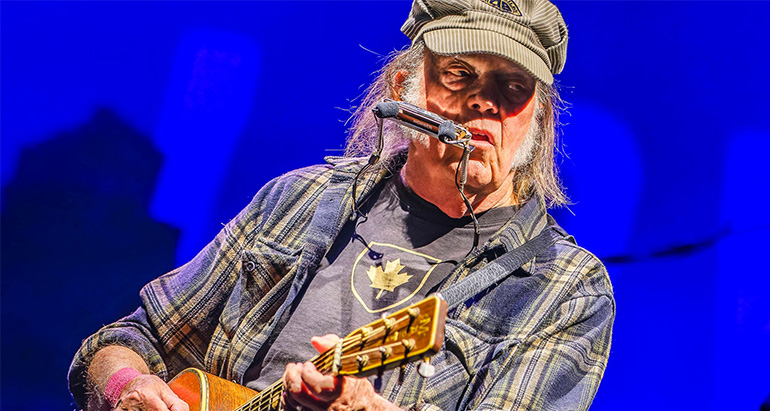
Neil Percival Young, OC, OM, (born November 12, 1945, in Toronto) is a Canadian musician, singer-songwriter, and filmmaker. Since January 2020, he has also held U.S. citizenship.
His career began in 1966 with the band Buffalo Springfield, and his music encompasses numerous genres such as rock, country, and folk music. In his more than 50 years of work, he won the Grammy twice and was inducted into the Rock and Roll Hall of Fame twice (solo and with Buffalo Springfield). Thus, on the one hand, he is revered as a significant folk musician, and on the other, as the “Godfather of Grunge.”
Neil Young performs, among others, with the band Crazy Horse, but also as a solo artist and with many other artists, especially with Crosby, Stills, Nash & Young. His most commercially successful title is “Heart of Gold.”
Life
Childhood
Neil Young was born in 1945 in Toronto as the son of Scott Young (1918–2005) and his wife Rassy Ragland Young. His father was a respected sports journalist and author of several books, including Neil & Me (1984) about his relationship with his son. Neil spent his early years in Omemee, a rural community in Kawartha Lakes in the province of Ontario.
In 1951, there was a polio epidemic, and Neil Young contracted polio at the age of five. His left side was permanently damaged, which still gives him a slight limp today. He later processed the memories of that time in the song “Helpless.” From the mid-1960s onward, he also suffered from epilepsy and diabetes. He spent a year in New Smyrna Beach, Florida, to recover.
When he was twelve years old, his parents divorced. He then moved with his mother to Winnipeg, Manitoba, the original home of her family. Scott Young had five more daughters from two other marriages, including singer-songwriter Astrid Young (*1962), who sang on the 1992 album Harvest Moon and at various live performances.
Until 1968: Early Years and with Buffalo Springfield
In the early 1960s, Neil Young played in various local bands (e.g., The Jades) in Winnipeg. During this time, he also recorded some songs – for example, in 1963, the single “The Sultan/Aurora” was released with the group The Squires. Both songs were, like most of the songs that the teenage Neil Young wrote at that time, instrumentals and oriented toward the sound of his then idol The Shadows. In the following years up to 1966, he slowly developed into a folk interpreter, and there were repeated studio recordings with The Squires in Canada, as well as solo and with the Mynah Birds (with Rick James) in the USA, all of which remained unreleased at the time.
After his performances and recordings were not successful, he moved to Los Angeles in 1966 after a brief stint as a solo artist in Toronto, where he soon co-founded the band Buffalo Springfield with Stephen Stills and Richie Furay, for whom he wrote well-known songs like Mr. Soul, Broken Arrow, and On The Way Home. Buffalo Springfield quickly became a leading band in the burgeoning folk scene in California in the mid-1960s and recorded the successful albums Buffalo Springfield (1966) and Buffalo Springfield Again (1967). After the third album, Last Time Around (1968), the band disbanded due to ongoing disputes among the band members. Neil Young preferred to pursue a solo career from then on. In 1997, Buffalo Springfield, including Neil Young, was inducted into the Rock & Roll Hall of Fame.
1968–1981: Solo, with Crazy Horse, and with CSNY
At the end of 1968, he recorded his first solo album, “Neil Young,” and toured North America with his songs in 1969. Shortly thereafter, he formed the group Neil Young & Crazy Horse with the three musicians Danny Whitten, Billy Talbot, and Ralph Molina from the band The Rockets. Their first joint album, “Everybody Knows This Is Nowhere,” was released. The album performed exceptionally well on the US Billboard 200 charts. In addition to the successful single “Cinnamon Girl,” it also included the rock classics “Down By The River” and “Cowgirl In The Sand,” with which he made his long, sprawling guitar solos famous. Today, it is celebrated by many as the first grunge rock album in history. Neil Young wrote the three songs mentioned on a day when he was bedridden with a fever of 39°C.
He also played with Crosby, Stills & Nash, including their second joint performance in front of an estimated 400,000 people at the legendary Woodstock Festival. He first joined the trio for a short time and released the successful album Déjà Vu with them in 1970, followed by the live album 4 Way Street a year later. For CSNY, he wrote, among other things, the classic “Helpless,” as well as “Country Girl” and the protest song “Ohio,” which deals with the killing of four unarmed students by the National Guard and was released as a single just a few weeks after the event. Young allegedly wrote the lyrics in a few hours after seeing a photo of the massacre. Almost simultaneously, he recorded another solo album with After The Gold Rush (1970), which became his first album to be successful in Europe as well. With a selection of songs ranging from gentle, such as the title track After The Gold Rush, to the rockier Southern Man, the album was stylistically very mixed.
In 1971, Neil Young had to undergo back surgery, which was necessary as a late consequence of his polio infection from 1951. Since he couldn’t stand for long periods and play electric guitar, he used acoustic guitars. During this time, he wrote his biggest hit, “Heart of Gold.” The song was released on his best-selling album Harvest (1972), which also includes the folk classics Old Man and The Needle And The Damage Done.
Over the years, Neil Young has demonstrated great musical versatility, which is also reflected in the multitude of his releases. He played folk and country in constant alternation with rock music or with experimental albums. Thus, the soundtrack album Journey Thru The Past to his somewhat convoluted feature film of the same name was released in the same year as Harvest. At that time, he also founded his film production company Shakey Pictures, with which he continues to make his films to this day. A year later, the rock-heavy album Time Fades Away (1973) was released, featuring concert recordings. The album, in turn, shows another side of Neil Young and is far less commercially oriented, although Harvest and Time Fades Away were recorded with the same backing band, The Stray Gators.
The depressive mood that dominated his music in the following years was largely due to the deaths of roadie Bruce Berry and Crazy Horse guitarist and singer Danny Whitten. The album “Tonight’s The Night,” which was completed in 1973 but released only in 1975, dealt with these experiences. Most of the songs were created when Neil Young, Ben Keith, Nils Lofgren, Billy Talbot, and Ralph Molina retreated to a recording studio for several days and recorded the songs while heavily intoxicated. In between (1974), On The Beach was released, an equally gloomy album. However, there was a cheerful, extremely successful tour with Crosby, Stills, Nash & Young in the same year. A live box set was only released 40 years later under the title CSNY 1974.
In 1975, the second album with Crazy Horse was released. On Zuma, which became particularly known for the piece Cortez The Killer, Frank “Poncho” Sampedro replaced the deceased Danny Whitten on the second guitar. After the joint album Long May You Run (1976) with Stephen Stills under the name The Stills-Young Band, American Stars ‘n Bars was released in 1977, which includes his perhaps most famous rock song, Like A Hurricane, which he still performs at many concerts with long guitar improvisations. He then closed the first 10 years of his work (1966–1976) with the release of the compilation Decade.
The album Comes A Time offered the Harvest sound again in 1978. He ended the 1970s in 1979 with the acclaimed album Rust Never Sleeps, on which the A-side was recorded acoustically and the B-side distorted and crashing with Crazy Horse – it begins quietly with My My, Hey Hey (Out Of The Blue) and ends with the anthem Hey Hey, My My (Into The Black). Rust Never Sleeps was voted album of the year by Rolling Stone. In addition, the same year saw the release of the live double album “Live Rust” and the film “Rust Never Sleeps,” recorded at the Cow Palace in San Francisco. In this concert film, Neil Young directed himself as Bernard Shakey. He has since used this pseudonym for many other films.
After he was allowed to compile the soundtrack for the film satire Where The Buffalo Roam (1980, German: Blast – Wo die Büffel röhren) with Bill Murray and also added a few of his own sound compositions, a phase of experimentation began for him, heralded by the album Hawks and Doves (1980), which many fans viewed as patriotic, in which he again recorded one side acoustically and the other rockily, this time in the style of country rock, in reference to Bob Dylan’s Bringing It All Back Home. In 1981, another Crazy Horse album, Re·ac·tor, followed, which was less successful with its futuristic design and partly crude lyrics (Got mashed potatoes/ain’t got no T-Bone).
1982–1987: Years of Crisis – the “Geffen Era”
In 1982, Neil Young switched to Geffen Records, for which he recorded five albums by 1987, causing much discontent among critics and fans. Initially, in 1982, the album Trans was released, which is said to be one of his favorite works, but it irritated many of his followers. He created a synthesizer sound that was deliberately influenced by the sound of the German electronic band Kraftwerk. He had his voice distorted in part by a vocoder. In his autobiography, Young explains that he produced the album without commercial interests for his son, who suffers from infantile cerebral palsy with communication disorders. In the same year, he was inducted into the Canadian Music Hall of Fame.
In 1983, Young released Everybody’s Rockin’, a rockabilly album in the style of the 1950s, recorded with a backing band called The Shocking Pinks, which finally earned him the accusation of aimlessness. In 1985, the country album Old Ways followed, and in 1986, with Landing On Water, another synthesizer album. In 1985, he, together with John Mellencamp and Willie Nelson, founded the Farm Aid festival to support farmers in distress, which has since been held regularly with a large lineup of stars.
Young’s last album recorded for Geffen Records, Life – again with Crazy Horse – was released in 1987 and was predominantly perceived by critics and fans as an upward trend, mainly because the tracks Inca Queen and When Your Lonely Heart Breaks were reminiscent of Young’s style from before 1982. Financially, however, the decade was a failure for Neil Young. Geffen Records accused him of producing “uncharacteristic music” starting in 1982, which led to a protracted legal battle between Geffen Records and the artist, resulting in Young returning to Reprise Records.
1988–1997: “Godfather of Grunge”
The first album on the new old label (Reprise), the rhythm-and-blues album This Note’s For You (1988), brought Neil Young back to a successful path, despite yet another expansion of his stylistic repertoire. The album’s title track, “This Note’s for You,” was released as a single. The video was banned by the MTV Network because it contained parodies of commercials featuring Michael Jackson, Whitney Houston, and others. The decision was later reversed. Nevertheless, it was a surprise when the video won the event’s top prize at the 1989 MTV Video Music Awards. Later that year, he fulfilled a promise that if David Crosby got off drugs, he would record an album with Crosby, Stills, Nash & Young. Thus, American Dream was born. The first second studio album by CSNY after 19 years.
With the successful album Freedom (1989), he connected back to the times of Rust Never Sleeps. Some songs had already been released earlier that year on the EP Eldorado. Freedom mixed folk-country songs with hard rock songs. The song Rockin’ In The Free World, which was presented acoustically at the beginning and electrically at the end of the album, became the anthem of the time because it masterfully addressed the social injustices in the USA. At the beginning of an alternative rock scene in the USA, Neil Young thus became a role model for many bands, including Sonic Youth.
Later also dubbed the “Godfather of Grunge,” he released the straightforwardly rocking Ragged Glory with his house band Crazy Horse in 1990, where the musicians returned to their old form. In addition, the album was equipped with two newly recorded compositions from the mid-1970s (Country Home, White Line). The successor was the no less rock-heavy live album Weld (1991), which was also available with a CD called Arc with feedback, guitar noise and song fragments, Young’s reference to experimental rock music, comparable to Lou Reed’s Metal Machine Music. With Weld, Neil Young protested against the second Gulf War. He let the original sounds of war thunder and presented a video of an oil-smeared bird on the video wall.
In October 1992, the release of Harvest Moon followed, where Neil Young turned back to calmer country-folk. The album was declared part 2 of the so-called Harvest trilogy, which began in 1972 with Harvest. He has also reactivated the band he used to play with, The Stray Gators. The title song Harvest Moon was also successfully released as a single. On this album, his half-sister Astrid Young also sang. In early 1993, Neil Young released the compilation “Lucky Thirteen” for his old label Geffen Records. He was contractually obliged to do so as a result of the legal proceedings. Nevertheless, he made every effort to compile an extraordinary selection of songs with released and unreleased tracks, alternative versions, and previously unknown live versions from the Geffen era.
Musically similar to Harvest Moon, the album Unplugged (1993) features one of his many acoustic concerts, which he has been doing since the beginning of his career, released as part of an MTV series. In 1994, Young was nominated for an Oscar for his contribution to the film Philadelphia (1993), but Bruce Springsteen won it for the song Streets Of Philadelphia from the same film.
Kurt Cobain was a great admirer of Neil Young and had quoted him in his suicide note with the line “It’s better to burn out than to fade away,” which originally comes from the acoustic song “My My, Hey Hey (Out Of The Blue)” and is occasionally sung live in the rock version of the same song “Hey Hey, My My (Into The Black).” Young then processed Cobain’s death in the Crazy Horse album Sleeps With Angels (1994) and dedicated the title track to him. For the next album Mirror Ball (1995), he teamed up with the grunge rock band Pearl Jam. The result was a powerful rock epic with a fresh sound that made him interesting to a younger generation (the band name Pearl Jam could not be mentioned on the CD for legal reasons). In return, Neil Young was then heard on the Pearl Jam single Merkinball on guitar and organ. The songs I Got Id and Long Road were created in the same recording session as Mirror Ball. In 1995, Neil Young was also inducted into the Rock & Roll Hall of Fame.
In the same year, a collaboration with independent filmmaker Jim Jarmusch also took place, for whose film Dead Man Neil Young contributed the soundtrack in the form of electric guitar improvisations. The album of the same name followed in early 1996. In the following years, two more Crazy Horse albums were released. The studio album Broken Arrow (1996) and the live album Year Of The Horse (1997), which is considered a kind of part 2 of Weld because it is musically similar and yet does not include a single song from Weld. However, classics such as “When You Dance I Can Really Love” and “Danger Bird” found their way onto the album. The film Year Of The Horse by Jim Jarmusch, which was made around the same time, portrays Neil Young and Crazy Horse and shows various concert recordings.
1999–2010: CSNY Reunion and Alternative Projects
In 1999, another CSNY album, “Looking Forward,” was released. Some of the songs Young wrote for it were originally intended for his quiet solo folk album Silver & Gold (2000). Another live album from 2000, Road Rock V. I, features an 18-minute version of the classic Cowgirl In The Sand and an adaptation of Dylan’s classic All Along The Watchtower (with guest singer Chrissie Hynde).
September 11, 2001 also influenced Neil Young: at the concert America: A Tribute To Heroes, he played the John Lennon piece Imagine solo on the piano and accompanied Pearl Jam’s Eddie Vedder and Mike McCready in their interpretation of the song Long Road. On his album Are You Passionate? (2002), he also dealt with the events on the fourth 9/11 terrorist flight, United Airlines Flight 93, which was presumably supposed to crash into the White House or the Capitol, in the song Let’s Roll, which he had already written shortly after the attack. Several passengers attacked the kidnappers and brought it down in an open field.
In 2003, the Crazy Horse album Greendale was released, a concept album that had previously been played live in its entirety on a solo tour in Europe and a Crazy Horse tour in North America. The story is set in a fictional small town where the Green family gets embroiled in all sorts of turmoil. It deals with crime from corruption to murder, from intrusive tabloid media to environmental issues. Initially released as a double CD with a live solo concert from Dublin, the album was reissued a year later in a second edition with a making-of and recordings with Crazy Horse. The story was also released as a feature film, in which the musicians and Neil Young himself are the actors. In 2004, as with Greendale, the compilation album Greatest Hits was released in this increasingly popular format at the request of vinyl fan Neil Young. It sold extremely well, even achieving platinum status in Germany.
In April 2005, Neil Young was treated for a brain aneurysm. The folk-country album Prairie Wind, recorded shortly before his surgery in Nashville, was released at the end of September 2005, along with a DVD about the album’s production. Prairie Wind is stylistically and thematically similar to Harvest and Harvest Moon, and thus completes the Harvest trilogy. In the following August, songs from the album were performed live at the Ryman Auditorium in Nashville, along with older songs. The recordings were made into the film Neil Young: Heart of Gold by Jonathan Demme. With Prairie Wind, the collaboration with musicians Chad Cromwell and Rick Rosas began again (as in 1988 with This Note’s For You and in 1989 with Eldorado and Freedom), who then, together with Anthony Crawford, Larry Cragg, Pegi Young and Ben Keith, with whom he had already worked on many albums since Harvest, formed his Electric Band, which accompanied him for the next tours and albums, i.e. between 2005 and 2009.
In May 2006, Neil Young released the rock-heavy protest album Living With War, which critically and aggressively addresses the U.S. government’s Iraq policy in its lyrics. This album was available for free on the internet beforehand. With the album, he harshly criticized the policies of US President George W. Bush, particularly regarding the then-current Iraq War. With the song Let’s Impeach the President, Neil Young even called for his impeachment. The song was supported by the trumpet of Tommy Bray, which comes across like a fanfare, blown to signal an attack. Neil Young became a real protest singer with this album. Living With War also formed the core of the Freedom Of Speech tour, which Young undertook together with his old companions Crosby, Stills & Nash. Young processed the controversial reactions to the album and the tour in his 2008 film CSNY/Déjà Vu, which also included the live album Déjà Vu Live. He was more political on stage than he had been for a long time. In the film, he gives a voice to war veterans and their families.
With Live at the Fillmore East, a recording made in March 1970 in New York City with Crazy Horse (in its original lineup) as the backing band, the long-awaited Neil Young Archives Performance Series was launched in November 2006. Since then, Neil Young has been releasing live recordings of his entire career at irregular intervals, which could previously only be purchased on the market as bootlegs. These have been edited in the best sound quality. By 2019, 11 live recordings had been released as part of this series.
In 2007, Neil Young released the album Chrome Dreams II again with his Electric Band, a reminiscence of the never-released Chrome Dreams, which was supposed to be released in the mid-1970s and is now only available as a bootleg. Chrome Dreams II consists partly of re-recorded, unreleased classics such as the 18-minute Ordinary People. Narratively conceived as an ode to the “little people” and an allusion to Reaganomics, the song became relevant again 20 years later under the Bush administration (Bushonomics) and recalls Cortez The Killer or Thrasher. Also included is a new version of Boxcar, as well as more catchy new rock compositions like No Hidden Path and Spirit Road.
In 2009, another album followed, Fork In The Road, again with the Electric Band. The concept album is about the conversion and modification of his Lincoln Continental into a hybrid electric vehicle, the so-called “LincVolt Project,” which Neil Young financed himself and which he also discusses in his autobiography. In the same year, he released the box set Neil Young Archives Vol. I, a retrospective of the years 1963–1972, which he had worked on for about twenty years. For the design of the box set cover, he finally received his first Grammy in the category “Best Boxed or Special Limited Edition Package.” Whether the long-announced second part will ever be released is highly unlikely. Because since 2017, he has been publishing his entire body of work piece by piece on a website on the internet.
Neil Young began 2010 with a special honor. He played his old song Long May You Run at the closing ceremony of the Vancouver Winter Olympics, as the flame slowly went out. In September of the year, the album Le Noise produced by Daniel Lanois, which Young recorded without a backing band, was released. For the single Angry World he received a Grammy, this time in the category “Best Rock Song”.
From 2011: “A Hippie Dream” and with Promise Of The Real
In 2011, Neil Young worked on his memoirs, Waging Heavy Peace, which were published in German in 2012 under the title Ein Hippie-Traum. Here he reports associatively, alternating between the present and the past, about his life and his current projects. His “LincVolt project” and work on the new sound format “PureTone” or “Pono,” which is supposed to have studio quality, take up a lot of space. He reports that for the first time in his life he has stopped consuming alcohol and marijuana: “My doctor doesn’t think that would be good for my brain.” At the same time, he says that although he was unable to write any new songs at the time of writing the book, he is still looking forward to new projects.
In 2012, Crazy Horse released the albums Americana and Psychedelic Pill. Americana consists exclusively of American folk classics such as Oh Susannah, Tom Dula or Woody Guthrie’s This Land Is Your Land in the typical, guitar-heavy Crazy Horse style. The double album Psychedelic Pill, on the other hand, contains eight new original compositions, including pieces of more than 16 minutes duration such as Walk Like A Giant, Driftin’ Back and Ramada Inn. Rolling Stone rated the album by the “unrefined, 43-year-old garage band” and the “last hippie” four out of five stars. A European tour in 2013 was cut short after guitarist Frank “Poncho” Sampedro broke a finger. The tour continued in 2014 and was well received.
But once again, Neil Young was at a completely different point in his career at that time. In the spring of 2014, he released A Letter Home, the most unusual work of his career since Arc. He used a so-called Voice-O-Graph from 1947 to record 11 cover songs, including those by Bob Dylan and Bruce Springsteen, with which it was possible to record mono records directly at the time. The telephone box-like box belonged to the label Third Man Records of Jack White, who also appeared as the only guest musician and co-produced the album.
In the summer of the same year, Neil Young filed for divorce from his wife Pegi Young after 36 years of marriage. His new girlfriend was the actress and activist Daryl Hannah. With the album Storytone (2014), he processed both the breakup with coping songs and the new love with new love songs. Nevertheless, there was also a political protest song with Who’s Gonna Stand Up? Neil Young has recorded the songs with a big band or orchestra in addition to his piano or guitar playing, which made many songs sound like swing music or film music. In a second sales option as a double album, the songs can also be heard without the big band and orchestra, which gives these songs a clear folk song character.
In 2014, the collaboration began with Lukas and Micah Nelson, the two sons of country star Willie Nelson, and Lukas’ backing band Promise Of The Real. With The Monsanto Years (2015), Neil Young & Promise Of The Real released an album that once again brought his political commitment to a peak in musical form. He is now openly opposing the agricultural company Monsanto, which is under criticism for its pesticides and GMOs (genetically modified organisms). But other companies are also clearly criticized, for example in the song A Rock Star Bucks A Coffee Shop. In 2016, Neil Young released the live album Earth, in which he had reworked the 2015 world tour with Promise Of The Real in the studio by adding sounds from nature and civilization to the songs.
Later that same year (2016), he released the solo album Peace Trail, which was a somewhat less ecstatic album, lyrically oscillating between private and political themes, but which also took up the fight against big corporations with the song Indian Givers, which in this case was about an oil pipeline, the Dakota Access Pipeline, being built in Sioux territory. He is still engaged in this matter today, refusing to accept sponsorship from companies and banks that supported the construction of the pipeline. The following year saw the launch of a new album series called Neil Young Archives Special Release Series. These are previously unreleased albums from his career and special albums that will be produced alongside his regular work in the future. He started with Hitchhiker (2017). This work was recorded solo in 1976. It was recorded at the time by his longtime producer David Briggs.
The Visitor is the name of a new album with Promise Of The Real, which Neil Young also released in 2017. In this, he again takes a stronger stance against political powers. In particular, with the songs “Already Great” and “Stand Tall,” he addresses hate, fascism, and incitement to hatred in the world, especially in the USA. And yet this album also has an experimental side, such as the carnival-like Carnival. But in March 2018, Neil Young released the Netflix feature film Paradox, which followed another curve in his work. This time, the musicians of Promise Of The Real, Willie Nelson and Neil Young himself are the actors, while Daryl Hannah is the director. It is a Western that combines past and present. The soundtrack Paradox was released almost simultaneously.
50 years after their founding and 7 years after their last joint album, Neil Young reactivated his house band Crazy Horse in 2019. Although without Frank ‘Poncho’ Sampedro, but with his old companion Nils Lofgren on the second guitar, who was a Crazy Horse member for a while in the early 1970s. The rhythm is again provided by Billy Talbot (bass) and Ralph Molina (drums). The album Colorado comes in the typical Crazy Horse sound. With the hard Shut It Down and the quiet Green Is Blue, he also lyrically returns to the protest song direction, addressing climate change here.
Private life
From 1968 to 1970, Young was married to the owner of the Canyon Country Kitchen restaurant, Susan Acevedo. With actress Carrie Snodgress (1945–2004), he had a relationship from 1971 to 1975, which resulted in a son. In 1978, he married Pegi Morton (1952–2019). He also has a son (*1978) and a daughter (*1984) with her. In July 2014, after 36 years of marriage, Neil Young filed for divorce from Pegi Young. Since then, he has been in a relationship with actress Daryl Hannah. On August 25, 2018, they got married, as confirmed in November 2018.
Both sons suffered from infantile cerebral palsy. In 1986, Neil and Pegi Young founded the Bridge School, where disabled children can receive an education. For this foundation, an annual concert was held from 1986 to 2016 in October, featuring renowned artists such as Bob Dylan, Bruce Springsteen, Tom Petty, Elvis Costello, Metallica, and many others. The musicians and bands played almost exclusively with acoustic instruments.
In March 2005, Young underwent surgery for a life-threatening brain aneurysm after he had noticed vision problems during recording sessions. After the operation he had to be resuscitated because the blood vessel that had been operated on burst again, which probably caused a heart attack. The following April, he was able to perform again at the Canadian Live 8 concert.
Since 2006, Neil Young has been a recipient of the Order of Manitoba, the highest honor of the Canadian province of Manitoba.
Neil Young has supported several projects to improve the situation of Indigenous peoples in North America.
Young’s daughter Amber Jean Young works as a visual artist.
Both in 1978 and again in November 2018, his respective house in Malibu near Zuma Beach burned down due to wildfires in California.
Since January 2020, Neil Young has held both Canadian and U.S. citizenship. He applied for it so that he could vote against the then President Donald Trump in the presidential election in November 2020.
Style
Neil Young played different musical styles throughout his career. Starting with typical The Shadows instrumentals as a teenager, he initially developed into a folk singer, who, influenced by Buffalo Springfield, moved into folk rock and folk-country rock.
Finally, he developed his own style, which, detached from rigid arrangements, gave him the freedom for folk, folk rock, and country rock, but quickly led him to hard garage rock, later referred to as grunge rock. Long guitar improvisations became his trademark, which – especially during live performances – can sometimes last up to 30 minutes and often end with him breaking his guitar strings, with intentional feedback noises on top. It should be noted that he taught himself to play the guitar.
In the studio, rock songs are usually played only a few times, and then the best take is simply chosen. In contrast, the intention of perfection in the recording of quieter folk-country albums, which should simply come across as flawless in harmony. Not infrequently, a whole day is needed for such recordings for a single song.
He presents all of the aforementioned styles using both electric and acoustic instruments. In addition to his main instrument, the guitar, he also regularly plays the piano, organ, and harmonica, as well as occasionally the harmonium, banjo, or ukulele. When playing the acoustic guitar, he mostly plays flatpicking and riffs (My My, Hey Hey (Out Of The Blue), The Needle And The Damage Done, Old Man). Especially at concerts, since his approach to grunge, he has been known for his extravagant solo passages.
Since the 1960s and 70s, Young has also been known for playing his originally acoustic songs live in electric versions – and vise versa.
Limited to the 1980s, there are occasionally experimental albums where he has used other music styles, such as synth-pop, rockabilly, country music, and rhythm & blues.
Instruments and Equipment
Neil Young has used numerous electric guitars, acoustic guitars including ukuleles and banjos, as well as various keyboard instruments and harmonicas throughout his career. A complete list is therefore difficult to compile.
In the days of Buffalo Springfield, he mainly played a 1960s Gretsch 6120 Chet Atkins. With Crosby, Stills, Nash & Young, but also with other bands, a White Falcon from the same company is often used.
Since 1968, Neil Young has often played a 1953 Gibson Les Paul. This instrument, which he named “Old Black,” is still his main electric guitar today. It is a Goldtop that was spray-painted black by a previous owner and later equipped with a Bigsby vibrato by Young. The neck pickup on “Old Black” is a P90 single coil. The bridge pickup, which he mostly plays, is a mini-humbucker from a Gibson Firebird and is prone to microphonics. He usually uses it when aggressive feedback sounds are required. Notably, the frets on this guitar are very flat. After Young’s guitar technician Larry Cragg replaced the heavily worn old frets, he had to file the new ones down as far as possible to make Young happy again. Additionally, the action is set very low, so that the strings buzz against the fretboard when played hard.
Neil Young mainly uses a 20-watt Fender Tweed Deluxe as an amplifier, which has a C12N Jensen speaker built into it. He bought the 1959 amp in 1967. In addition, Young owns “a whole shed full” of old Fender amplifiers, which he mainly uses as a parts warehouse.
The amplifier is remotely controlled by a device invented by Young called “Whizzer,” which operates the amplifier’s potentiometers via electric motors, allowing for pre-set adjustments. He uses effects such as an MXR Analog Delay, a Mu-Tron Octave Divider, a Boss BF-1 Flanger, a Tube-Echoplex tape echo and an Alesis MicroVerb. The effects are hardwired to avoid losses in the signal path.
Among Neil Young’s acoustic guitars, a Martin D-28 from the 1940s is particularly noteworthy. The guitar was previously owned by Hank Williams, who played it at his last performance in 1951 at the Grand Ole Opry. This guitar is featured in the film Heart of Gold (2006). In addition, Young uses a very old Martin D-18. He recorded the albums Harvest and Comes A Time with a Martin D-45, which he received from Stephen Stills in 1969. Young used to play Guild 12-string guitars, but has since switched to Taylor (model 855).
As a keyboard instrument, an old upright piano is essentially used. He is also often seen at a baby grand piano, which was painted by his daughter Amber. Also well-known is his harmonium, an Estey Pump Organ from 1885, which he uses to bring a church sound into his music. He uses classic blues harps as harmonicas.
Neil Young uses a “Flying Keyboard” in his band for the song “Like A Hurricane,” which is adorned with artificial wings and lowered to the stage on wires. It is played floating by one of his musicians, often by Frank “Poncho” Sampedro in Crazy Horse. The instrument is a 1974 Crumar Univox Stringman synthesizer.
Some stage decorations also have tradition with Neil Young. His life-size wooden Indian, which is almost always on stage with him, is well-known. Equally ubiquitous is the wind machine, which makes his concerts appear as if they are in a storm.
Miscellaneous
In 1974, the band Lynyrd Skynyrd made a clear reference to Neil Young and his earlier statements about the American South in their song “Sweet Home Alabama.” The song is a direct response to Neil Young’s songs Southern Man and Alabama, with which he heavily criticized the Southern states and especially the state of Alabama for their racial policies. Lynyrd Skynyrd wanted to counter this with their lyrics, by also pointing out the good sides of Alabama.
In the 2002 novel “The Book of the Killed by Neil Young,” the later winner of the Peace Prize of the German Book Trade, Navid Kermani, describes in detail the effect that Young’s music has on him and his daughter when she couldn’t fall asleep as a baby due to colic. Since 2019, the Thalia Theater in Hamburg has been performing the novel in its own production under the title “The Nite of the Killed by Neil Young.”
In 2007, biologists Jason Bond and Norman Platnick named a spider species they had newly described in the United States, native to the state of Alabama, from the mygalomorph family Cyrtaucheniidae after Neil Young: Myrmekiaphila neilyoungi. They honored him for his social commitment to peace throughout his musical career.
In 2009, Neil Young was voted as “The Last Hippie Who’s Still Different” at number 79 in Rolling Stone magazine’s list of the 100 People Who Are Changing America.
In 2009, Neil Young was mentioned several times in the song “Canada” by Belgian singer Milow. Milow tells in the song about a young singer who emigrates to Canada and wins Young as his best friend.
On February 28, 2010, Young performed the song “Long May You Run” at the closing ceremony of the XXI Olympic Winter Games 2010 in Vancouver during the extinguishing of the Olympic flame.
In 2015, in the run-up to the US presidential election, a song by Young was played during Donald Trump’s announcement of his candidacy. Young, who supported Bernie Sanders, publicly objected to this playback, to which Trump called him a “hypocrite.”
Rolling Stone ranked Young 34th on its list of the 100 greatest musicians, 37th on its list of the 100 greatest singers, and 17th on its lists of the 100 greatest songwriters and 100 greatest guitarists of all time. This makes him one of eight artists to be featured on all four lists.
Neil Young Archives
Since December 1, 2017, the musician has made all his released and even several unreleased songs available for streaming on the Neil Young Archives homepage. Until the end of June 2018, the service was available free of charge. Since 2019, a small fee has been charged. The two oldest songs in the archive are his first two recordings from July 23, 1963, the B-side Aurora and the A-side The Sultan of his first single with The Squires.
On March 28, 2020, Young announced that his archive site would be accessible for free for the duration of the COVID-19 pandemic. He stated that the reason was that people are so isolated during the Corona crisis. For the same reason, the musician also offers a few concert recordings with the “Fireside Sessions,” where he gives live short concerts in front of his home fireplace.
