
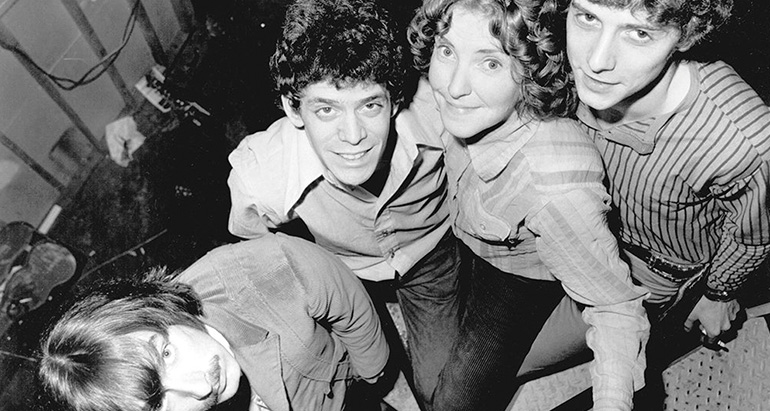
The Velvet Underground was an experimental rock band that was formed in 1964 in New York City. In their original formation, it consisted of Lou Reed (guitar, vocals), John Cale (bass, viola, keyboard, and vocals), Angus MacLise (drums, bongos, hand drums), and Sterling Morrison (guitar). From 1965 onward, Maureen Tucker played drums instead of Angus MacLise, and this lineup was joined in 1966 for the debut album by the German singer Nico.
The band became known as a group of protégés of Andy Warhol, who also produced their first album. With their provocative lyrics about sadomasochism, transvestitism, and drug addiction, the band remained commercially unsuccessful during their existence, but today they are considered one of the most influential rock bands in music history.
Band history
Prehistory (1964–1965)
The founding history of the band dates back to 1964. The singer, songwriter and guitarist Lou Reed had just formed a garage band called The Primitives and was working as a lyricist for Pickwick Records. Reed described the job as “a poor man’s Carole King.”
Soon, Reed met John Cale, a young Welshman who had moved to the USA to study classical music. Cale had a classical composition background, had worked with avant-garde musicians such as John Cage and La Monte Young, and was interested in rock music, as was Reed. The influence of La Monte Young and his so-called “drones” on the sound of the Velvet Underground, as well as on Cale’s and Reed’s later solo careers, was significant. Cale was surprised to find in Reed someone who, like him, had an open ear for experimentation: Reed often tuned all his guitar strings to the same note (“ostrich tuning”) and achieved the “drone” effect. The two jammed together more and more often, and a creative partnership emerged that already set the direction for the later band project The Velvet Underground.
Formation
John Cale soon began working with Lou Reed after Tony Conrad had brought The Primitives to his attention. In 1965, he replaced Jimmie Sims in the band, which had by then changed its name to The All-Night Workers. Reed and Cale left this band shortly thereafter and, together with percussionist Angus MacLise, whom they had met thru Pickwick Records, and Sterling Morrison, a classmate of Reed’s, formed a new lineup. The quartet initially played in small New York clubs and bars and was initially called The Warlocks and The Falling Spikes. The style of the group was initially more in the rock ‘n’ roll category. John Cale described this prehistory and genesis phase of the later VU as “a reminiscence of Beatnik poetry with Angus MacLise as a loose rhythm drummer behind all the guitar and bass attacks.” Reed, Cale and Morrison recorded a demo tape, which Cale gave to Marianne Faithfull during a trip to England, hoping she would pass it on to Mick Jagger. However, nothing came of it, and the entire unreleased tape was put in the vault, only to be released on a compilation thirty years later.
Angus MacLise only played with this formation for a short time; when the band accepted an offer for their first paid performance in the summer of 1965, mediated by Al Aronowitz, their then-manager, he announced his departure because he feared the commercialization of the band.
MacLise’s successor on drums, Maureen Tucker, joined the band thru Sterling Morrison, with whom she was friends, and impressed with her unusual drumming style: She played standing up, did not use a foot pedal for the bass drum, and had her own arrangement of the percussion instruments; moreover, she liked to place a tambourine on her snare drum. Tucker was also one of the first female drummers in rock history. Angus MacLise returned for a short time in the summer of 1966 as a substitute for The Velvet Underground when Reed was ill with hepatitis; Tucker took over the bass during this time.
Origin of the band name
“The Velvet Underground” is a book by Michael Leigh that deals with sadomasochism and the deviant sex life of the American middle class. Reed and Cale found it in the trash of their former landlord when they moved into Tony Conrad’s former New York apartment. However, when choosing the name of the group, Reed and Morrison thot less about the theme of the book and more about the underground films that were in vogue at the time, and the name also matched Reed’s already completed song Venus in Furs (in reference to the sadomasochistic novel Venus in Furs by Leopold von Sacher-Masoch). All band members agreed with the name, and so the book title immediately became the new name for the band project. The guitarist Sterling Morrison on this:
“Whenever I hear the word ‘underground,’ I am reminded of that time in the early sixties when the term first took on a special meaning.” It meant underground films and the people who made and supported that art form. And the one who introduced me to this scene was Piero Heliczer, a pure ‘underground filmmaker,’ the first one I met […] Finally, we had a name! And we adopted and approved it not only because of the sadomasochistic theme, but because the term referred to our activities in underground film and the art scene.
Their first concert under the name The Velvet Underground, with Maureen Tucker on drums for the first time, took place on December 11, 1965, at Summit High School in New York.
Career
The band’s rise began when filmmaker Barbara Rubin noticed the group at Café Bizarre in Greenwich Village just before Christmas 1965 and told pop artist Andy Warhol about them. Warhol was looking for a band for his newly opened club, Andy Warhol’s Up. Shortly thereafter, Rubin and Warhol, accompanied by Gerard Malanga, Paul Morrissey, and Edie Sedgwick, visited the venue to see the group. Warhol was immediately taken with the eccentric band, who had made a habit of playing with their backs to the audience. “We were definitely out to offend, there was a certain line, we didn’t care about the audience, we turned our backs on them,” John Cale said in a later interview. Fascinated by curiosities, Warhol hired the Velvets, who, with all their lyricism woven into cacophony, appeared as a dark nemesis, as the band for his new multimedia project, Exploding Plastic Inevitable (E.P.I.).
Andy Warhol and the Factory
The collaboration with Andy Warhol can be dated to the entire year of 1966 and the first half of 1967. In January 1966, the group made a joint appearance with Warhol at Delmonico’s Hotel on Park Avenue, where Warhol was invited as a guest speaker at the gala banquet of the New York Society for Clinical Psychiatry. Warhol, who refused to speak to the audience, entertained guests instead with the music of the Velvet Underground, to which he screened his films Harlot and Henry Geldzahler. During the performance, Gerard Malanga performed a whip dance, to which model Edie Sedgwick, Warhol’s muse at the time, danced in circular movements. Meanwhile, filmmakers Jonas Mekas and Barbara Rubin walked thru the audience with a spotlight, asking the disturbed psychiatrists embarrassing questions about their sexual practices. The International Herald Tribune headlined the next day: “Psychiatrists Flee Before Warhol.”
In April 1966, the opening of a series of multimedia shows took place at the New York club The Dom, which Warhol had conceived together with the Velvet Underground. The club, located in the bustling East Village, had a large dance hall that Warhol rented for the entire month of April. The band then briefly joined Warhol’s “Factory,” where he, as manager and producer, now significantly promoted the group’s career, providing them with the Factory as a rehearsal space and integrating them as a draw in his provocative performance shows. He also designed the cover for the debut album “The Velvet Underground & Nico,” featuring the banana (which could be peeled off in the first edition as a silkscreen) and conceived an extensive promotion for “his” new product.
In return, Warhol demanded that the attractive blonde Cologne model Nico, who had now succeeded Edie Sedgwick in the “Factory,” be included in the band, which the other band members reluctantly accepted, as Reed and Cale believed she had a strong erotic presence but had significant intonation problems when singing. However, for the record company, Nico’s presence was crucial in giving the band a record deal at all, which particularly troubled Reed. He did have a liaison with her on the side, but that didn’t stop him from scheming against her. Moreover, there had been conflicts between Nico and Maureen Tucker. The two women could not get along. Later, Tucker said in the ZDF documentary Nico Icon about Nico: “To me, she was just a great pain in the ass.” (German: “For me, she was just a pain in the ass.”) Nico left the band after a final joint performance on May 27, 1967, and began her solo career.
Starting from May 3, 1966, the E.P.I. was in Los Angeles, where the show was prematurely ended after the third nite due to noise disturbances. In the following days, the band also met Steve Sesnick there.
Toward the end of 1966, Warhol increasingly lost interest in the E.P.I. and the group; finally, The Velvet Underground performed in this context in May 1967. When Andy Warhol brought Nico to another performance by the band, Lou Reed denied her access to the stage. Nico later suspected that Reed was hurt because the newspapers were only interested in her:
“Everybody wanted to be the star.” Of course, Lou always was. Mais les journaux venaient toujours vers moi. That’s how I got fired – he couldn’t take that anymore.”
“Everyone wanted to be the star.” Of course, Lou was always that. But the papers were coming to me all the time. So I got fired – he couldn’t take it anymore.”
After a subsequent conversation between Lou Reed and Andy Warhol, Warhol was also let go.
After the Factory era
After their split from Andy Warhol, the band tried to find their own venue in New York where they could continue performing the E.P.I.; however, there were fewer and fewer opportunities for the costly show. However, their attempts to establish their own club failed. The Velvet Underground did not give a single concert in their hometown between April 1967 and June 1970. An appearance at the Boston Tea Party club on May 26/27, 1967, was their first attempt to establish themselves as an independent rock band.
In 1967, Steve Sesnick, who was more interested in the band’s success than their artistic ambitions, eventually took over management. With Tom Wilson, a friend of Nico, as producer, the band recorded the experimental album White Light/White Heat from September 1967 to January 1968. After its release, John Cale and Lou Reed had a falling out, and Cale eventually left the band after a final performance on September 28, 1968. He then produced several songs and recordings for Nico (including the albums The Marble Index, Desertshore, and The End) and then focused on his own solo projects.
Steve Sesnick was able to convince Reed to write songs for the band that were more in line with general public taste. The three remaining members of the band, augmented by new recruit Doug Yule, recorded two more accessible studio albums, The Velvet Underground and Loaded. The last concert in this lineup was given by the band on August 23, 1970. Shortly thereafter, Lou Reed left, and after a concert on August 21, 1971, Sterling Morrison followed him, accepting a literature scholarship at the University of Texas at Austin.
Final performances
Doug Yule, who had taken over the leadership of the band with Reed’s departure, and Maureen Tucker continued to perform as The Velvet Underground with changing musicians until November 1971. After the end of this tour, the musicians wanted to start working on a new studio album, but Steve Sesnick fired all the band members except Doug Yule before that could happen, probably also to maintain control over the band’s fate. After Tucker retired from the music business to devote himself to family life following a final band performance in January 1972, Yule also saw no future in rock music and began working as a carpenter.
Despite the de facto dissolution of the band, Sesnick held on to their name. He was able to organize some concerts for The Velvet Underground in England and asked Doug Yule to go on tour again as The Velvet Underground; Sterling Morrison and Maureen Tucker were also asked, but they declined. Members of the band The Red Rockets, in which Doug’s brother Billy Yule played, were hastily assembled into a new touring band, which also included Mark Nauseef.
In October 1972, Doug Yule, along with Ian Paice, recorded the album Squeeze, and the last concert of the accompanying tour took place on December 9, 1972, in Northampton. By this time, manager Sesnick had already lost interest in the band.
The last concerts under the name The Velvet Underground took place from the end of May 1973, when Doug Yule played in a band that had both cover versions of The Velvet Underground songs and their own songs in the repertoire:
“We met someone who started booking us around New England. He was supposed to promote us as with me from The Velvet Underground, but he wasn’t supposed to say it was The Velvet Underground. […] The last gig was in some ski resort in Vermont, we went there, saw The Velvet Underground and said, ‘That’s it!’
– Doug Yule
After a three-day engagement in Roslyn (New York) ended on June 3, 1973, the last lineup of The Velvet Underground disbanded for good.
Renewed collaboration and reunion
In 1989, Lou Reed and John Cale recorded the song cycle “Songs for Drella” in memory of their former mentor Andy Warhol, who had passed away two years earlier. At the last performance on 3 December 1989, Maureen Tucker took over the drums for the song Pale Blue Eyes. On June 15, 1990, a spontaneous performance took place at an Andy Warhol exhibition in Jouy-en-Josas near Paris; using the instruments of another band, Reed, Cale, Morrison and Tucker played the song Heroin. Recordings of this performance were later released on bootlegs.
In 1991, Reed, Cale, Morrison, and Tucker recorded new studio material together for the first time since 1968 for Maureen Tucker’s solo album I Spent a Week There the Other Nite, with all four musicians featured on the track I’m Not. The song would be their last studio collaboration. In 1992, there was a brief reunion of The Velvet Underground in the “classic” lineup, which toured Europe for the first time since their founding; however, this reunion did not last long. The last concert under the name The Velvet Underground was given by the band in July 1993 as the opening act for U2. A live album recorded during this tour was later released as Live MCMXCIII.
Reed, Cale, and Tucker last performed together on January 17, 1996, on the occasion of their induction into the Rock and Roll Hall of Fame. They dedicated the song Last Nite I Said Goodbye To My Friend to Sterling Morrison, who had died the previous year.
Lawsuit against the Andy Warhol Foundation
On January 11, 2012, Lou Reed and John Cale sued the Andy Warhol Foundation for Visual Arts because it used the cover banana from their debut album on its merchandise products, and demanded the foundation’s previous profits. The symbol was marked as the band’s trademark in the booklet of a CD collection in 1995. Warhol never applied for copyright for the image. The legal dispute was settled in May 2013.
Studio Productions
The Velvet Underground & Nico (1967)
The debut album by Velvet Underground, known as the “banana album” because of the cover, was completely produced, designed, and marketed by Andy Warhol, with the exception of the first track “Sunday Morning,” which was produced by Tom Wilson. The album is considered a classic of rock music.
On this album, the style of the subsequent album was already emerging: In addition to quiet pieces (including “Sunday Morning” and “I’ll Be Your Mirror,” sung by Nico), there was also more experimental material such as “Heroin,” which was later covered by Billy Idol, among others. The lyrics of these experimental pieces deal with drug abuse (I’m Waiting for the Man, Heroin) and sadomasochism (Venus In Furs), among other things.
“European Son” was dedicated to Lou Reed’s mentor Delmore Schwartz on the first pressing.
White Light/White Heat (1968)
The second album, White Light/White Heat, which was no longer under the influence of Andy Warhol, is in many ways significantly more radical than its predecessor. It is particularly notable for the excessive use of distortion and feedback, for example in “I Heard Her Call My Name” and the 17-minute “Sister Ray” (among others, covered in 1980 by the English group Joy Division on the live album Still).
The Velvet Underground began as one of the first rock groups to consciously elevate “noise” – that is, the sound or cacophony considered “ugly” according to traditional esthetic standards – to a distinctive feature of their esthetics. Vehement guitar feedback and a driving, often metronomic drum set define the sound of the album. Moreover, the band experimented with stereo technology on this album, letting various acoustic elements wander from the left to the right channel. In The Gift, the story of a bizarre death was told over guitar feedback.
The Velvet Underground went far beyond the contemporary musical experiments of Jimi Hendrix (e.g., Star Bangled Banner), the Beatles (e.g., Tomorrow Never Knows on the album Revolver), the Rolling Stones (on the album Their Satanic Majesties Request), and the psychedelic group The United States of America with this radical break in style. This, however, meant that White Light/White Heat almost completely lacked the lyrical moments that the first album had with songs and ballads like Sunday Morning or I’ll Be Your Mirror. As a more experimental album, White Light/White Heat was not a commercial success.
The Velvet Underground (1969)
In stark contrast to White Light/White Heat, the group’s third album, simply titled “The Velvet Underground,” is revealed. After Lou Reed had pushed his rival John Cale out of the band, he was now its only creative head. This meant that the band’s experimental character was largely lost. Reed now placed particular emphasis on the lyrics. However, he faced internal competition again with the up-and-coming talent Doug Yule: As a “jack of all trades,” Yule played the bass, was the second lead guitarist, and took on background vocals.
Despite or precisely because of the departure from the experimental, raw sound of earlier works, “The Velvet Underground” received positive feedback, sometimes even enthusiastic praise, from the American music press. Nevertheless, sales figures fell short of expectations.
Loaded (1970)
After the release of a fourth album at MGM did not materialize, the band switched to Atlantic Records. There, in 1970, the album Loaded was released, which became the group’s greatest financial success. The title refers to the pressure from the record company to release a commercially successful album (loaded with hits). With many comparatively catchy songs (Rock and Roll, Sweet Jane, Who Loves the Sun), Loaded does not have the characteristic Velvet Underground sound. This is mainly due to the fact that Maureen Tucker had become pregnant and was replaced during the recordings by Billy Yule, Doug Yule’s brother, and Doug Yule himself, and that Lou Reed left the band before the album was released, meaning that almost half of the songs had to be completed without him.
Squeeze (1973)
After Lou Reed, the last original creative member, left the band, the group lost its identity. Regardless, manager Steve Sesnick wanted to milk the name “Velvet Underground” until the end.
In 1973, the band finally disbanded. The last album, Squeeze, recorded by Doug Yule and Ian Paice, is considered a particularly weak album. By the time Squeeze was released, Nico, John Cale, and Lou Reed were all well into successful solo careers.
VU / Another View (1984/85)
Already after the release of White Light/White Heat, but especially after the appearance of the third album The Velvet Underground, the band recorded additional tracks that were not released by the record company MGM because commercial success had initially eluded them. The material was not published until 1984 and 1985 on the two albums VU and Another View. In the wake of the New Wave, The Velvet Underground had by now become a cult band, with artists like David Bowie, the Sex Pistols, Siouxsie and the Banshees, and Bauhaus considering them their most important role model.
Live Productions
1969 Velvet Underground Live With Lou Reed (Volume 1)
A compilation of various live performances by Velvet Underground in Texas and San Francisco from 1969. The album consists of two records and outlines the entire creative live spectrum of the group before their dissolution for the last time; here, there are extended versions of Heroin, Ocean and Rock and Roll. Notable is the almost nine-minute long, enervatingly driving version of What Goes On, which is supported by a metronome-like guitar and drum playing.
Bootleg series vol. 1: The Quine tapes
hese live recordings, which were only released in 2001, were the first official bootleg by Velvet Underground. With the band’s official blessing – a rarity for bootlegs – Robert Quine recorded some concerts in San Francisco in 1969. Among other things, it includes three versions of Sister Ray, a piece that was rarely played live.
The Velvet Underground Live At Max’s Kansas City (1972)
This live recording was made on August 23, 1970, at a concert in the nightclub and restaurant Max’s Kansas City in New York. It was made by Factory employe Brigid Berlin, aka Brigid Polk, with a cassette recorder. It was the last concert with Lou Reed before he left. On drums, Doug Yule’s brother Billy can be heard as a replacement for Maureen Tucker, who had become pregnant.
Live MCMXCIII (1993)
In 1993, there was a brief reunion of the band with a tour featuring the lineup from the first studio albums (without Nico, who had died in 1988). Recordings from this tour, during which some new pieces were also played, can be found on the live album Live MCMXCIII. There were no more studio recordings; Sterling Morrison died of cancer in 1995.
Pop cultural influence
The music of Velvet Underground only became popular more than a decade after its initial release. Around the time of the release of their debut album, the hippie movement, with bands like the Beatles, was moving from niche to mass culture. The nonconformist Velvets represented the antithesis to the ideals of this movement.
Due to their experimental, raw music and provocative lyrics on taboo subjects such as violence, sadomasochism, trans and homosexuality, or drug addiction, the band, especially as part of the Exploding Plastic Inevitable, had a disturbing, shocking effect on the public and was a curiosity in conservative America. Until John Cale’s departure, it rarely catered to the general public taste and was not interested in chart positions. With the shift toward the mainstream driven by Steve Sesnick, this changed, but successes continued to elude them. Sterling Morrison said in an interview in 1969:
“I would love to see it if we had a hit single.” It’s really important to have one. “Our previous singles are a joke.”
Although the less experimental albums The Velvet Underground and Loaded were positively reviewed by prominent critics such as Lester Bangs, general interest in the band was not sparked until later, when artists like David Bowie cited them as an early influence. To this day, numerous bands, from Sonic Youth to The Strokes, from punk, gothic rock, new wave, industrial and alternative, cite The Velvet Underground as one of their musical influences. Today, their influence can also be found in the black metal of newer bands.
Rolling Stone ranked the band 19th on the list of the 100 greatest musicians of all time.
Film and Television
The approximately 70-minute 16mm black-and-white film The Velvet Underground And Nico (A Symphony of Sound), shot by Andy Warhol in January 1966, which shows the group rehearsing in the Factory, is considered the most famous film document. The filming was interrupted by the New York police due to noise disturbance. The film was later shown as a silent film backdrop at some performances.
Apart from the Warhol production, four other films are known to exist, but are rarely seen: Rosalind Stevenson made some primitive film footage of the band in her apartment in 1965; Jonas Mekas and Barbara Rubin filmed the Psychiatrists’ Convention at New York’s Delmonico’s Hotel on January 8, 1966, where the group made their first appearance with Andy Warhol; Ron Nemeth filmed a performance at Poor Richards in Chicago in June 1966; and a film crew shot a performance at New York’s Balloon Farm (formerly the Dom) in October 1966. Some of this footage was later released on video bootlegs.
The Velvet Underground made their first television appearance on New Year’s Eve 1965 on CBS’s news program with Walter Cronkite, which featured a report on underground filmmaker Piero Heliczer, who in turn filmed the band playing heroin.
