
Part 1:
The first lie my mother told under oath erased twelve years of my life.
The second one was meant to put me in prison for good.
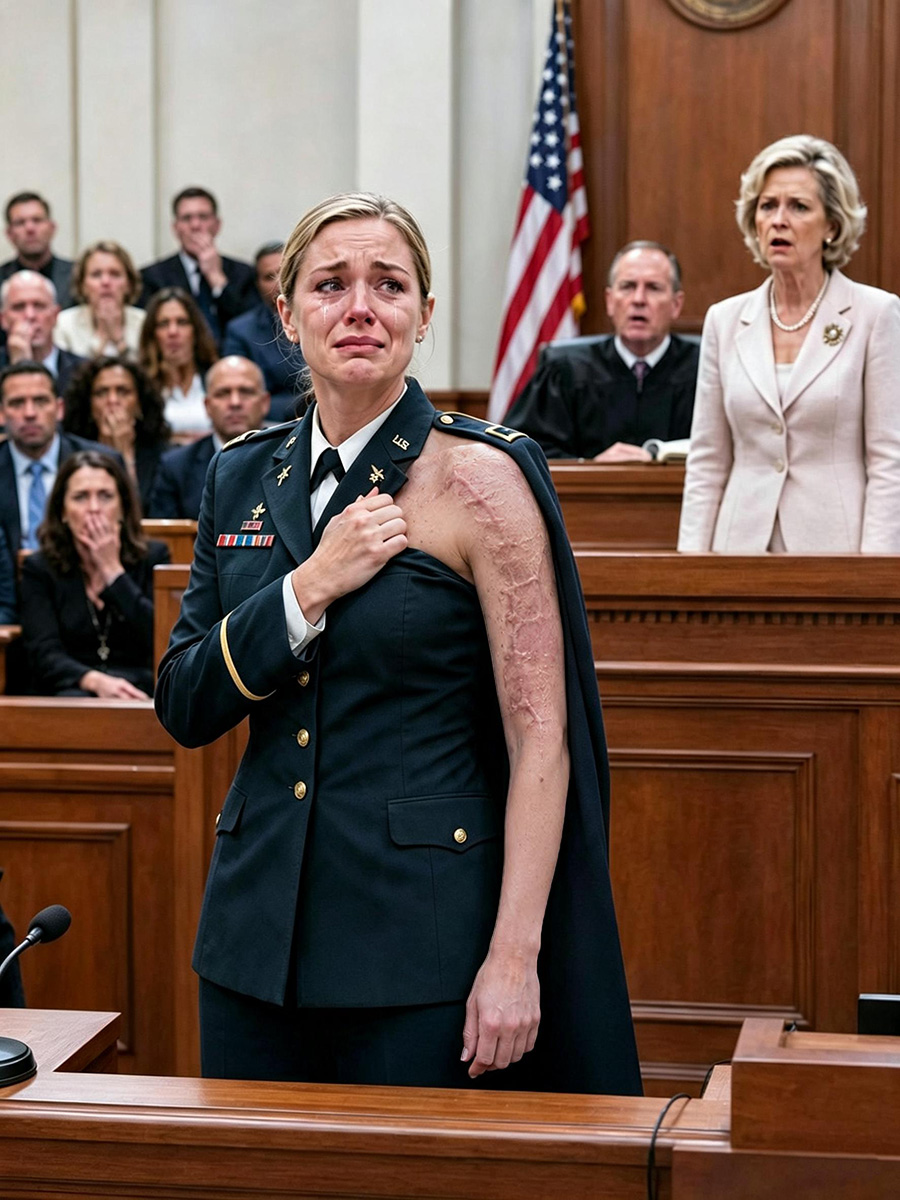
“She was never a soldier,” Elaine Wright said, one hand resting on the Bible as she testified. Her voice was calm and steady, almost holy. “She faked the scars, the medals, all of it.”
A restless murmur moved through the packed federal courtroom.
I tightened my grip around my pen and kept my eyes forward.
My mother never looked at me. She was too busy performing for the jury, giving them the wounded, ashamed expression she had practiced for weeks. She wanted them to believe she was a loving mother who had been forced to expose her own daughter.
Across the aisle, my younger brother Curtis lowered his eyes to hide a smug smile.
The case before the court was a federal criminal trial. I had been charged with fraud, falsifying federal documents, and falsely claiming military service. The charges had grown out of a bitter fight over my late father’s defense company, Titan Tactical Systems.
Dad had left me controlling shares in the company and named me executor of his estate.
Three days after his funeral, Curtis suddenly produced a new will that gave him control of everything.
I challenged the document.
Curtis responded by claiming that I had manipulated our father and invented a military career to make myself look more trustworthy. His lawyers pushed the allegations toward federal investigators, and eventually I found myself sitting at the defense table accused of crimes I had never committed.
The forged will was not itself the criminal charge being tried that day.
It was part of the larger scheme.
If Curtis could convince the court that I was a fraud, he could destroy my credibility, gain control of Dad’s company, and eventually have the estate dispute decided in his favor.
My own lawyer leaned toward me.
“Do not react to anything she says,” she whispered.
“I am not going to,” I replied.
My calm answer worried her more than anger would have.
The prosecutor stood and approached the evidence table.
He lifted a shadow box containing my Silver Star, my Purple Heart, and the scorched unit patch I had carried home from the desert conflict in Kandar Province.
He placed it where the jury could see it.
Elaine looked at the medals with theatrical disgust.
“She bought those online,” she said. “She wanted everyone to believe she was a hero.”
Several jurors turned toward me.
For a moment, I could almost see what they saw.
A woman sitting silently at the defense table, wearing medals that supposedly belonged to a life she had never lived.
The old burn along my ribs tightened beneath my blouse.
The memories returned.
Dust.
The deafening roar of helicopter blades.
Blood soaking through a medic’s gloves.
Commander Duane Carney dragging me away from a burning wreck while bullets cracked against the helicopter’s metal frame.
But none of that could be explained publicly.
Not yet.
My military records were not simply missing.
They were classified.
Years earlier, I had served as an Army captain assigned to a Special Activities Detachment. The operation in Kandar Province had been classified, and many of the normal personnel databases contained no ordinary deployment entry for it.
That did not mean my service record had disappeared.
It meant access to the relevant portions was restricted.
The government had already provided the court with a sealed filing confirming that classified records existed.
Because this was a criminal case involving potentially classified information, the judge had held closed proceedings with the government and defense counsel to determine what could legally be disclosed to the jury.
Under the court’s order, only a limited portion of my service could eventually be confirmed in open court.
The classified mission itself would remain secret.
Curtis knew the ordinary databases would not show my deployment.
That was exactly why he had chosen this attack.
Only my father had known the truth about where I had been and what I had done.
Before cancer took away his ability to speak, Dad had warned me that Elaine and Curtis were moving company money through illegal vendors.
I had promised him I would protect the company.
But I had also promised I would never expose the unit that had saved my life.
Now that promise was being used against me.
The prosecutor returned to his table.
Elaine’s attorney was not questioning her because this was a federal criminal trial. Instead, she had been called as a government witness after agreeing to testify about my alleged deception.
Her testimony continued.
“Mrs. Wright,” the prosecutor asked, “did your daughter ever deploy overseas?”
Elaine looked toward the jury.
“No. She never did.”
“Did she ever serve in the United States Army?”
“No,” she answered. “Absolutely not.”
The courtroom doors remained closed.
The judge had ordered that no one enter or leave while the classified-information issue was being resolved.
Elaine finally turned toward me.
A tiny smile appeared on her lips.
It was private.
Cold.
Vicious.
She believed I had nowhere left to hide.
I placed both hands flat on the defense table and looked at the clock above the judge’s bench.
11:47.
Thirteen minutes remained.
Thirteen minutes until the government’s limited disclosure authorization became effective.
Thirteen minutes until the truth could finally enter the courtroom.
Part 2:
Curtis’s attorney was sitting behind the prosecution table as part of the legal team representing the family interests connected to the estate.
He had spent weeks trying to make my sealed records look like an excuse.
Now he rose with permission from the judge to question me about the evidence.
“Ms. Wright, you claim your military records are classified.”
“They are,” I said.
“Convenient, isn’t it?”
“No.”
He gave the jury a knowing smile.
“You expect them to believe that the government somehow forgot to put you in its own databases?”
“I never said that.”
He walked toward the evidence monitor.
Enlarged copies of Army database searches appeared on the screen.
“No deployment history,” he said. “No combat assignment. No commendation order. No record of medical evacuation.”
He turned toward me.
“Is every federal system lying to this court?”
“No,” I answered firmly.
The courtroom became quiet.
“Then explain why those searches show nothing.”
“Because those searches were performed in systems that were not authorized to access the classified records.”
His expression changed slightly.
“That sounds very convenient.”
“It is inconvenient,” I said. “Especially when someone deliberately uses restricted records to make it look as though I never served.”
A few spectators shifted in their seats.
The judge leaned forward.
“Ms. Wright, be careful. You may answer only within the boundaries of the court’s disclosure order.”
“Yes, Your Honor.”
The prosecutor stood.
“Your Honor, the government maintains that the defense should not be permitted to make claims about classified material that the defendant cannot substantiate.”
My lawyer immediately responded.
“We are not asking her to reveal classified information. We are asking the court to recognize the government’s own sealed certification that relevant records exist.”
Judge Halpern looked toward the government table.
The prosecutor nodded.
“Your Honor, the government has already submitted a classified declaration and supporting records for the court’s review. The court has ruled that a limited portion may be disclosed once the authorization becomes effective.”
The judge looked at the clock.
“Then we will follow that order.”
My mother sighed loudly from the witness stand.
“This is exactly what she does,” Elaine said. “She makes herself sound important so people will believe her.”
The judge looked at her sharply.
“Mrs. Wright, you will address the court only when asked.”
Elaine lowered her eyes.
Curtis leaned toward his attorney.
They whispered for several seconds.
Then the attorney produced another document.
“This is a notarized statement from the defendant’s father, executed six months before his death.”
The document was handed to the clerk.
According to the statement, I had fabricated my military service, exploited my father’s declining health, and pressured him into changing his estate plan.
The signature looked perfect.
It was supposed to.
Curtis had paid my father’s former executive assistant, Delwyn Johnson, to reproduce it from signatures on old procurement documents.
What Curtis did not know was that Delwyn had contacted me before taking his money.
She had agreed to wear a recording device during three separate meetings.
The hesitation Curtis and Elaine had mistaken for fear had actually been careful timing.
For six weeks, my lawyer and I had coordinated with military counsel and federal investigators.
We needed Curtis to authenticate the forged statement himself.
And we needed him to do it under oath.
The judge allowed the document to be marked as an exhibit, but ruled that its authenticity and evidentiary weight would be determined after testimony.
Reporters began typing rapidly.
My mother relaxed.
She believed the document had finally done what all their other lies had failed to do.
Then Curtis made his fatal mistake.
He asked to testify.
His lawyer warned him that he did not have to take the witness stand.
Curtis insisted.
“I want to tell the jury what I found,” he said.
The judge confirmed that he understood his rights and the consequences of testifying.
Curtis swore an oath.
He claimed he had discovered the statement inside Dad’s private wall safe on March 9.
He described the safe’s brass dial.
He described a blue folder.
He even mentioned a coffee stain on the document.
He sounded completely certain.
My lawyer stood for cross-examination.
“You personally opened that safe?”
“Yes.”
“No one gave you the document?”
“No.”
“You found it yourself?”
“Yes.”
“You are absolutely certain?”
“I am completely certain.”
I looked at the clock.
11:56.
Four minutes.
My lawyer turned toward the digital monitor.
A large photograph appeared.
It showed Dad’s office after a fire-suppression accident had destroyed much of the room.
The wall safe stood open.
Inside were warped metal shelves and blackened pieces of paper.
Nothing else.
My lawyer faced Curtis.
“Mr. Wright, this photograph was taken on February 22.”
Curtis’s face tightened.
She continued.
“The safe’s contents were destroyed sixteen days before you claim you opened it on March 9.”
Curtis went pale.
His attorney objected.
“Objection!”
“Overruled,” Judge Halpern said.
My lawyer walked closer to Curtis.
“You could not have found that document inside the safe on March 9, could you?”
Curtis stared at her.
“I—I must have remembered the date incorrectly.”
“You testified under oath that you were completely certain.”
“I was mistaken.”
“Were you also mistaken when you described the blue folder?”
Curtis said nothing.
“Or the coffee stain?”
Still nothing.
My lawyer returned to her table.
Then she asked the questions we had been waiting to ask.
“Mr. Wright, did you bribe Delwyn Johnson to create this statement?”
“No.”
“Did you promise her two hundred thousand dollars?”
“No.”
“Did your mother help you rehearse her affidavit?”
“No.”
Three lies.
Three confident answers.
Three statements now preserved in the official court record.
I looked toward Elaine.
For the first time all day, she was no longer smiling.
Then I heard something outside the courtroom.
Boots.
Heavy boots moving down the hallway.
The clock changed.
11:59.
The courtroom became completely silent.
Part 3:
At 11:59, the clerk received an electronic notice from the Department of Defense confirming that the previously approved limited disclosure authorization had become effective.
The judge reviewed the notice.
This was not a release of my entire military record.
It did not make the classified operation public.
Instead, the authorization allowed the government to disclose specific facts that had already been verified during the court’s closed classified-information proceedings.
My name.
My rank.
My Army service.
My assignment to the Special Activities Detachment.
The existence of my combat deployment.
The awards connected to that service.
The rest remained classified.
Judge Halpern looked toward the courtroom doors.
“Bring in the government witness.”
Both doors opened.
A tall man in a crisp dress uniform entered beside two Justice Department investigators.
A pale, jagged scar crossed his temple.
Lieutenant General Duane Carney stopped in the center aisle.
My mother gripped the witness rail.
She knew him.
She knew him very well.
Years earlier, while Dad was still alive, Carney had visited our house after midnight.
Elaine had watched from the staircase as he handed my father a folded American flag.
Then he had said something Dad never forgot.
“Your daughter saved thirty-one lives.”
Dad had protected my secret for years.
Mother had protected only her access to his money.
General Carney approached the witness stand.
After the required preliminary questions, the prosecutor began.
“General Carney, do you know the defendant?”
“Yes.”
“Was she ever an officer in the United States Army?”
“Yes.”
“State her rank.”
“Captain Mara Wright.”
Curtis stared at the witness stand.
“Was she ever assigned to a Special Activities Detachment?”
Carney looked toward the judge.
The judge gave a brief nod.
“Yes,” Carney answered.
The prosecutor held up the government’s certified summary.
“Does this document accurately reflect the portions of Captain Wright’s service record that the Department of Defense has authorized for disclosure?”
“Yes.”
The prosecutor turned toward the jury.
“Was Captain Wright deployed overseas?”
“Yes.”
“Was she involved in a combat incident in Kandar Province?”
“Yes.”
The judge immediately interrupted.
“General, do not discuss the operational purpose of the mission or any information designated classified.”
“Understood, Your Honor.”
Carney continued.
He described only what the court had authorized him to reveal.
I had crossed open ground while under heavy fire.
I had pulled two wounded officers from a burning wreck.
I had organized the defense of the landing zone.
And when evacuation was ordered, I had refused to leave until every survivor was safely aboard.
Then Carney looked directly at the jury.
“The scars are real,” he said. “The medals are real. Her silence was a direct order from her command.”
A stunned silence filled the courtroom.
My mother finally broke.
“Duane, please don’t do this.”
Carney turned toward her.
There was no sympathy in his expression.
“You used her obedience as evidence against her in a court of law.”
Elaine looked away.
The prosecutor requested a short recess to review the newly admissible evidence.
Judge Halpern denied the request.
“We will continue.”
My lawyer stood.
“Your Honor, the defense has additional evidence that directly affects the credibility of the government’s witnesses and the authenticity of the documents submitted in this case.”
She nodded toward the monitors.
“Proceed,” the judge said.
Delwyn’s recordings began playing.
Curtis’s voice filled the courtroom.
“Make the statement sound like Dad hated her. Mom will handle the testimony.”
A wave of shock moved through the spectators.
Then Elaine’s recorded voice followed.
“Once Mara is convicted, the shares become vulnerable. We sell the company before she can appeal.”
My mother’s face went white.
But there was more.
A final recording captured Curtis offering Delwyn money to manipulate federal personnel searches and plant counterfeit medal receipts inside my apartment.
The prosecutor turned toward the judge.
“Your Honor, in light of this evidence, the government requests that the court issue immediate warrants for Curtis Wright and Elaine Wright on the newly supported charges.”
Curtis’s lawyer protested.
“Your Honor, my client is entitled to—”
Judge Halpern raised a hand.
“I have heard enough to find probable cause for the requested warrants. The marshals will execute them immediately.”
Curtis suddenly looked toward the side door.
Then he ran.
He made it only a few steps before a federal marshal intercepted him and forced him to stop.
“Don’t move!”
Curtis struggled for a moment before realizing there was nowhere to go.
Elaine remained frozen in her chair.
A marshal approached her.
“Mrs. Wright, you are under arrest pursuant to the court’s order.”
She looked at me.
“You cannot do this to me,” she whispered.
Hatred filled her voice.
“I am your mother.”
I stood slowly.
For the first time, I faced her without fear.
“You remembered that detail far too late.”
Part 4:
The rest of the trial moved quickly.
Once the government confirmed my military service and the defense demonstrated that the key accusations had been built around forged evidence, the prosecution withdrew the charges against me.
Judge Halpern entered a judgment of acquittal on the remaining counts.
The allegations concerning my military service were finished.
They had never been true.
The forged statement from my father was referred for a separate criminal investigation.
The evidence gathered during the trial was also turned over to federal prosecutors for charges involving perjury, conspiracy, evidence tampering, attempted fraud, and obstruction.
Curtis’s escape attempt had only made his situation worse.
The recordings, the forged statement, the destroyed safe, and Delwyn’s cooperation gave investigators evidence far beyond what I had expected to have when the trial began.
As the marshal led Elaine away, she twisted around one last time.
“Mara,” she pleaded, “tell them this was just a family misunderstanding.”
I shook my head.
“No. It was a family operation, and it failed completely.”
Eight months later, Curtis pleaded guilty and received nine years in federal prison.
Elaine received five years.
Delwyn entered a cooperation agreement with the government and returned every dollar she had been paid.
The estate dispute was finally resolved.
The forged will was rejected.
I kept control of Titan Tactical Systems.
But I changed the company’s purpose entirely.
One division became a nonprofit dedicated to helping veterans correct missing military records, fight unfair benefit denials, and defend themselves against fraudulent claims.
I knew exactly how dangerous missing records could be.
I knew what it felt like to have the truth sitting inside a government file that you were legally forbidden to open.
And I knew how easily someone could twist that silence into a weapon.
On the morning the nonprofit officially opened, General Carney came to my office.
In his hands was Dad’s restored shadow box.
He placed it carefully on my desk.
I looked at the Silver Star.
Then the Purple Heart.
Then the scorched unit patch.
For years, those things had been proof I could not publicly explain.
Now they were different.
I hung the shadow box behind my desk.
Not to prove anything to strangers.
Not to defend myself against another accusation.
I hung it there as a promise to myself.
My father had believed me.
Carney had remembered what I had done.
And finally, the truth had spoken without requiring me to break the promise I had made to protect it.
For twelve years, silence had been my duty.
Now truth was my peace.
THE END.
