
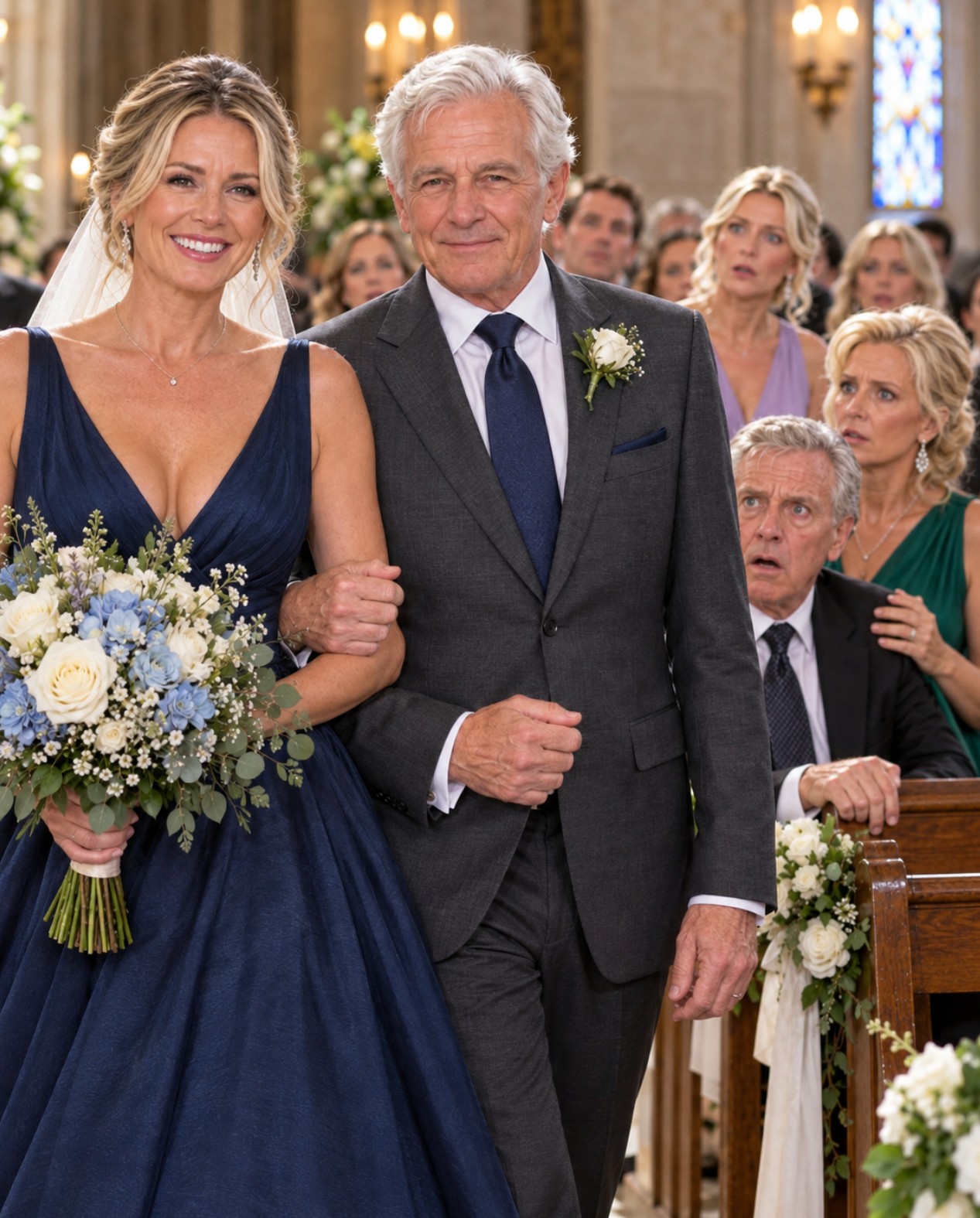
They were convinced I would walk into that stone barn with no one by my side. What they didn’t know was that another father was already waiting to take my arm—and he was about to change everything.
Part 1:
I was standing in my workshop when Dad called me. Around me stood fourteen copper vases filled with lavender, rosemary, and white dahlias that I had grown myself. My pruning shears were still in my hand when he delivered his news as calmly as if he were canceling a lunch appointment.
“Clara, I need to talk to you about the wedding,” he said.
I already had a bad feeling.
“What is it, Dad?”
He sighed before answering. “Vanessa is going through a difficult time. Watching me walk you down the aisle would be painful for her.”
I stared at the flowers on my workbench, trying to understand what he had just said.
Vanessa was my older sister, the woman my parents had protected from consequences since childhood. Her marriage was falling apart, and somehow, that meant my wedding had to shrink to make room for her feelings.
“She isn’t getting married, Dad,” I replied. “I am.”
“I know that, Clara.”
“Then why are we having this conversation? You promised me a year ago that you would walk me down the aisle.”
“I remember what I promised.”
“Then what’s changed?”
His answer came quietly.
“She said she won’t bring Lily and Owen to Christmas if I walk you.”
There it was.
My sister had used her own children as bargaining chips, and my father had given in without even asking her to reconsider.
For a moment, I couldn’t speak.
“So you chose her,” I finally said.
“Please don’t make this sound cruel, Clara.”
That was my father’s greatest talent. He could abandon me and still act offended when I named what he was doing.
I looked at the oak shelves behind my workbench. Marcus’s father, Frank, had built them for me two years earlier. Inside the left panel, he had carved my initials so deeply that they would survive every coat of paint.
My own father had forgotten my birthday that same year.
Frank had remembered it.
He had shown up with a small cake, a bag of gardening supplies, and a handwritten card. He had spent the afternoon helping me repair a broken shelf because he knew I had been struggling to finish a large order for a local florist.
My father hadn’t even called.
And now he was telling me he couldn’t walk me down the aisle because my sister might be upset.
“Okay,” I said.
“Clara, I’m sorry.”
“No. You’re uncomfortable. That isn’t the same thing.”
Before he could answer, I ended the call.
I stood there for a few minutes, holding my pruning shears without moving. The flowers that had made me happy just moments earlier suddenly seemed like decorations for a celebration I no longer wanted to attend.
Ten minutes later, Mom called.
“Your father told you,” she said without even greeting me. “So let’s not drag this out.”
I closed my eyes.
“Go ahead, Mom. Tell me how this is somehow my fault.”
“Don’t start with that attitude. Plenty of brides walk alone nowadays. It’s empowering.”
I almost laughed.
“He promised me a year ago.”
“Things change. Vanessa is hurting. You have Marcus.”
“And that means I don’t get to be hurt?”
There was a long silence.
It wasn’t the silence of someone feeling guilty. It was the silence of someone irritated that I wasn’t accepting the explanation she had prepared for me.
Finally, she spoke again.
“Just walk by yourself. Smile and don’t embarrass anyone.”
I stared at my phone.
My mother had just told me that I was responsible for protecting everyone’s feelings, including the feelings of the people who had hurt me.
I ended the call before she could turn my humiliation into another family duty.
Twenty minutes later, Marcus found me sitting on the back step of our house, staring at the garden without really seeing it.
He sat beside me and wrapped an arm around my shoulders.
He didn’t tell me to forgive my parents.
He didn’t tell me to keep the peace.
He didn’t remind me that family was family.
He simply waited until I was ready to speak.
When I finally explained what had happened, he listened without interrupting. His expression grew darker with every sentence, but he never once made me feel as though my pain was an inconvenience.
When I finished, he looked toward the workshop.
“You don’t have to walk alone,” he said.
I knew who he meant before he even said the name.
“Frank?”
Marcus nodded.
“My dad has treated you like a daughter since the first day I brought you home. He knows what an honor it would be.”
I lowered my eyes.
“Would he really want to do that?”
Marcus looked almost offended by the question.
“Clara, he loves you. Of course he would.”
For the first time since my father’s call, I felt a little hope.
The next morning, I drove to Frank’s house.
He was in the driveway wearing his familiar denim apron, feeding a length of cherry wood through his table saw. When he saw my truck, he switched off the machine and removed his safety glasses.
“Everything all right, kiddo?”
I climbed out of the truck, but the words seemed to disappear from my mind.
Frank noticed immediately.
“Come here,” he said gently. “Let’s sit down.”
We sat on the wooden bench beside his workshop. The smell of freshly cut wood filled the air, and a light breeze moved through the trees at the edge of his property.
Then I told him everything.
I explained what my father had said, how Vanessa had threatened to keep Lily and Owen away from Christmas, and how my mother had told me to walk alone and smile so I wouldn’t embarrass the family.
Frank listened without interrupting.
His jaw tightened when I repeated Vanessa’s threat. His hands curled into fists when I told him how casually my mother had dismissed my feelings.
When I finished, I looked down at my boots.
“Mom says walking alone would be empowering,” I whispered. “But I don’t want to prove I can survive being abandoned. I want to walk with someone who is proud to be there.”
Frank slowly removed his work gloves.
“Are you asking me?”
I nodded.
His eyes filled with tears almost immediately.
This broad-shouldered man, who usually showed his love through repaired engines, carefully sanded wood, and small acts of kindness, pulled me into a hug so steady that something inside me finally stopped shaking.
“Clara,” he said, his voice thick with emotion, “it would be the greatest privilege of my life.”
I buried my face against his shoulder and cried.
For the first time in days, they were tears of relief.
I hadn’t lost everyone.
I had simply discovered who was willing to stand beside me.
—
On Saturday, the converted stone barn glowed beneath the autumn sun.
Nearly two hundred guests filled the wooden pews while a string quartet played near the altar. White flowers decorated the beams, candles flickered along the stone walls, and the fourteen copper vases I had prepared stood at the entrance, filled with lavender, rosemary, and white dahlias.
Everything was exactly as I had imagined it.
Almost everything.
My parents arrived late enough for several guests to notice.
Dad sat on the aisle in the third row, looking relaxed and smiling as if nothing unusual had happened. Mom settled beside him in a dark blue dress.
Vanessa took the next seat, with her children, Lily and Owen, beside her.
She wore the satisfied expression of someone waiting to inspect the damage she had caused.
They expected me to enter alone.
They expected lowered eyes, trembling hands, and a brave little smile that would protect their reputation.
They expected me to accept their decision without making them face the consequences.
Instead, I stood behind the closed oak doors with my bouquet in one hand and Frank’s arm beneath the other.
Frank wore a charcoal suit. His silver hair was neatly combed, but I could still see a faint line of sawdust near one cuff.
I smiled when I noticed it.
Even on my wedding day, he was still the man who would rather be working in his shop than worrying about appearances.
“Ready, kiddo?” he asked.
I tightened my hand around his arm.
“I am now.”
The music changed.
The oak doors opened.
Every guest rose to their feet.
At first, the room filled with warm smiles. Then people recognized the man beside me, and understanding moved through the barn in a sudden, electric wave.
Frank walked with his shoulders back, every step calm and deliberate.
We passed the fifth row.
Then the fourth.
My father turned toward us.
The smile disappeared from his face.
He saw Frank’s hand covering mine. He saw the pride in Frank’s expression. And he saw nearly two hundred witnesses realizing that another man was doing the job he had abandoned three days earlier.
The color drained from Dad’s face.
He gripped the pew in front of him and began to stand.
Mom seized his sleeve and dragged him back down, stopping him with the same command she had given me.
Don’t embarrass anyone.
Vanessa’s smug expression collapsed.
For once, she had no clever remark, no demand, and no threat ready to use.
But Frank never looked away from the altar.
He kept walking beside me until we reached Marcus.
My future husband stood waiting in a dark suit, his eyes shining as he watched us approach.
The officiant smiled at us and asked the traditional question.
“Who presents Clara to be married?”
Frank placed his calloused hand over mine.
Behind us, my father whispered his name.
“Frank…”
But Frank drew one steady breath and turned toward the silent room.
“I do,” he said. “With all my heart.”
His voice filled the stone barn so completely that, for a moment, even the quartet seemed silent.
Then Marcus reached for me.
Frank placed my hand in his son’s, gave my fingers one last reassuring squeeze, and stepped back.
His eyes were wet, but his shoulders remained straight.
He looked less like a substitute standing in for someone else and more like the man who had always belonged there.
Behind us, my father sat frozen in the third row.
I didn’t turn around.
I didn’t need to.
I could feel the shock traveling through the room, carried by the small sounds people made when they understood something painful without anyone having to explain it.
The officiant began the ceremony, but before he could reach our vows, Frank touched my elbow.
“One moment,” he said quietly.
He reached inside his charcoal jacket and removed a small blue velvet box.
Marcus looked surprised.
So did I.
Frank opened it just enough for us to see a narrow silver bracelet resting against the satin lining.
My initials were engraved on the clasp: C.I.
My breath caught.
“Your grandmother gave this to me before she died,” Frank whispered. “She asked me to keep it until your wedding day.”
Grandma Evelyn had been gone for six months.
She was my mother’s mother, although she and Mom had rarely agreed on anything. Grandma had been the one person in my family who never treated Vanessa’s needs as sacred and mine as optional.
She had noticed the difference between us long before I was old enough to understand it.
She remembered my school achievements, asked about my flower business, and listened when I spoke. When Vanessa demanded attention, Grandma didn’t automatically expect everyone else to step aside.
After her funeral, Mom had told me there was nothing personal left for me.
Apparently, Grandma had left instructions of her own.
“She said the bracelet belonged to the granddaughter who understood that love is something you do,” Frank continued. “There’s a letter too. She wanted you to read it after the ceremony.”
I stared at the bracelet, unable to find the right words.
A program fell to the floor behind us.
I glanced toward the third row.
Vanessa was staring at the box. Mom’s face had gone pale beneath her makeup.
“That letter is private,” Vanessa said sharply.
Her voice carried farther than she intended, and several guests turned toward her.
Frank closed the box and placed it in Marcus’s hand.
“It was Evelyn’s letter,” he replied calmly. “She decided who should read it.”
Vanessa rose halfway from her seat.
Mom grabbed her wrist and pulled her back down.
The gesture was almost identical to the way she had dragged Dad into his seat moments earlier.
For the first time that day, all three of them were being controlled by the very rule they had spent years using against me.
Don’t make a scene.
The officiant waited until the room settled.
Then Marcus and I exchanged our vows.
I had imagined that moment for months. I expected nervous laughter, trembling hands, and the ordinary blur people describe when they talk about their wedding ceremonies.
Instead, everything felt astonishingly clear.
I saw the little scar on Marcus’s thumb from the summer he repaired my greenhouse door. I saw the faint crease near his eyes when he tried not to cry. I saw Frank standing beside his wife, Ellen, with one hand pressed to his chest.
And I understood something I had never fully understood before.
The empty place my father had created wasn’t empty at all.
It had simply revealed who had already been standing beside me.
When the officiant pronounced us husband and wife, the barn erupted in applause.
Marcus kissed me, and I heard laughter, cheers, and the happy sound of people clapping all around us.
For the first time that day, I wasn’t thinking about my parents.
I was thinking about the life Marcus and I were beginning together.
And I couldn’t wait to see what came next.
Part 2:
The applause followed us out of the stone barn and into the crisp autumn air.
For a fleeting hour, as guests mingled beneath string lights suspended between old oak trees, the world felt whole. Marcus kept his arm firmly around my waist, his thumb gently caressing my hip whenever another guest approached to congratulate us.
Friends hugged me. Relatives told me how beautiful the ceremony had been. Several guests stopped to praise Frank for walking me down the aisle.
He accepted every compliment with his usual modest smile, as if he hadn’t just given me one of the most meaningful moments of my life.
Yet I could feel the inevitable storm gathering near the bar.
My parents and Vanessa had refused to join the family photographs near the arbor. Instead, they stood together in a sharp, defensive circle near the edge of the terrace, their wine glasses clutched in their hands.
Every time Frank walked past them, my father’s expression grew darker.
Frank was receiving compliments from old friends who remembered how he had helped transform the abandoned stone barn into a beautiful event space. He knew several of the guests through his woodworking projects and community work, and people genuinely enjoyed talking to him.
Dad, meanwhile, seemed to grow angrier with every passing minute.
His jaw tightened until the skin over his cheekbones turned white.
Vanessa was already on her third glass of prosecco.
“They aren’t going to let this go,” Marcus murmured against my hair as we watched her take another sip.
“Let them,” I whispered.
I slipped my hand into my jacket pocket and felt the small velvet box resting there.
“They chose their role today.”
Marcus kissed my forehead.
“You don’t owe them an explanation for loving someone who showed up for you.”
His words settled something inside me.
When the doors opened for the reception dinner, the atmosphere shifted from celebration to a tense, expectant hush.
The seating arrangements had been carefully planned months earlier. Frank and his wife, Ellen, were seated comfortably near us, surrounded by friends. My parents and Vanessa had been assigned seats across the room, away from the head table and the attention they usually seemed to demand.
For a while, everyone tried to enjoy the evening.
The waiters served the first course. Glasses were filled. Guests exchanged stories about the ceremony, and the string quartet played softly in the background.
I was beginning to hope that my family might at least have the decency to remain quiet until the reception ended.
Then the main course arrived.
My father pushed back his chair.
The scrape of its wooden legs against the floorboards silenced the tables nearest to him.
He didn’t use a microphone, but he didn’t need one. The room was quiet enough that everyone could hear him as he crossed the floor toward our table.
His face was flushed, and he held a half-empty glass of scotch.
“Clara,” he said, his voice tight with anger. “A word outside. Now.”
Marcus immediately began to rise.
Frank gently placed a hand on his son’s arm and shook his head.
“This isn’t the place, Arthur,” Frank said calmly.
It was the first time in years that he had called my father by his first name rather than addressing him as a fellow parent or relative.
Arthur’s eyes flashed.
“I wasn’t speaking to you, Frank.”
“No,” Frank replied. “You were speaking to Clara. And she’s sitting right here.”
“You had no right to do what you did!”
The nearby tables fell silent.
Dad raised his voice.
“You humiliated me in front of two hundred people. You took a moment that belonged to a father and turned it into a circus.”
The clinking of silverware stopped.
Guests began turning in their seats.
I set my cloth napkin down and stood.
For years, I had imagined confronting my father about the way he treated me. In those imagined conversations, I had always been furious, crying, or desperately trying to make him understand.
But standing there in my wedding dress, looking directly into his eyes, I felt something different.
I felt calm.
“You surrendered that right three days ago, Dad,” I said. “You gave it away so Vanessa wouldn’t throw a fit about Christmas.”
His face darkened.
“That was a private family matter!”
“We were trying to protect your sister!” he snapped, leaning closer. “She’s going through a divorce, Clara! You have everything. You have Marcus, you have your business, you have a life that works! Vanessa has nothing right now, and you couldn’t make one sacrifice for your own blood?”
I stared at him.
“You didn’t ask me for a sacrifice. You demanded my erasure.”
His mouth opened, but I continued.
“You asked me to pretend your decision didn’t hurt so you could feel good about being a coward. You wanted me to smile, walk alone, and make sure nobody noticed what you had done.”
“Clara!”
My mother’s voice cut through the air.
Helen hurried to Arthur’s side, her eyes wide with anger.
“How dare you speak to your father like that after everything he’s done for you?”
I almost laughed at the familiar words.
Everything he’s done for you.
As though I owed them endless obedience because they had raised me.
Mom pointed toward Frank.
“This is all because of him! He manipulated you into doing this. He’s been trying to replace your father since the day you started dating Marcus!”
I shook my head.
“No, Mom. Frank showed up. That’s the difference.”
The words landed harder than I expected.
My mother stared at me as if I had slapped her.
Before she could respond, Vanessa appeared behind them. Her arms were crossed tightly over her chest, and tears had smeared the eyeliner beneath her eyes.
“You always do this!” she sobbed.
Her voice carried across the barn.
“You always make yourself the victim! I told Dad it would be hard for me to watch him walk you when my own life is falling apart! If you had an ounce of empathy, you would have understood!”
I looked at my sister.
For most of my life, I had been expected to understand Vanessa.
I was supposed to understand why she needed more attention, why her problems mattered more, why her mistakes had to be forgiven, and why everyone else had to adjust their lives whenever she was unhappy.
I had spent years making excuses for her.
I was finished.
“Your life falling apart doesn’t give you the right to tear down mine,” I said.
Vanessa’s mouth trembled.
“She is your sister!” Mom barked, stepping forward. “Family supports each other! You brought an outsider into our private affairs and made us the laughingstock of this county!”
Frank slowly stood beside me.
He was a tall man, and his presence commanded attention even when he wasn’t trying to draw it. But his voice remained low and steady.
“No, Helen,” he said. “You did that yourselves.”
Mom turned toward him.
Frank continued.
“You put a price tag on your presence at your own daughter’s wedding. You made your support conditional on whether Clara was willing to give up something that mattered to her. And when she refused to beg you to stay, you got angry because she found someone who valued her.”
Dad took a step toward Frank, his fists clenching.
“You keep out of this, Frank!”
Then his gaze fell on the small blue velvet box near my place setting.
His expression changed.
“That bracelet,” he said. “Where did you get it? Evelyn was my mother-in-law. You had no right taking her property!”
Frank didn’t raise his voice.
“Evelyn brought it to my workshop six weeks before she passed away. She knew she didn’t have much time left. She asked me to keep it safe because she knew what would happen to her things the moment she was gone.”
Dad shook his head.
“She wouldn’t have given you anything like that.”
“She asked me to protect it,” Frank replied. “And she explicitly told me not to hand it over until today.”
Vanessa let out a bitter laugh.
“She was senile! She didn’t know what she was doing!”
A quiet voice spoke from the adjacent table.
“She knew exactly what she was doing.”
Everyone turned.
It was Aunt Sarah, Grandma Evelyn’s younger sister.
She had been sitting silently until then, listening to the argument unfold. Now she stood, adjusted her glasses, and looked directly at Vanessa.
“Evelyn was sharper than all of us until the day she closed her eyes. She knew how you three treated Clara. She talked to me about it every week.”
Mom’s jaw dropped.
“Sarah, stay out of this!”
“No, Helen,” Aunt Sarah replied.
Her voice carried the weight of decades of quiet observation.
“You’ve spent thirty years sacrificing Clara on the altar of Vanessa’s feelings. Every holiday, every accomplishment, every milestone. Clara always had to yield so Vanessa wouldn’t throw a tantrum.”
Aunt Sarah paused, looking around the room.
“Evelyn saw it. We all saw it. You just thought everyone was too polite to say it out loud.”
The room fell completely silent.
Even the staff standing near the kitchen doors had stopped moving.
I looked at Aunt Sarah, hardly believing what I was hearing.
All those years, I had wondered whether I was imagining things. I had questioned myself after every argument, every forgotten birthday, and every occasion when my achievements had been pushed aside because Vanessa needed attention.
Now, in front of nearly two hundred people, someone else was finally saying what I had been afraid to say for years.
I hadn’t imagined it.
Arthur looked around the room.
For the first time, he seemed to notice the expressions on the guests’ faces.
They weren’t shocked by my behavior.
They were disgusted by his.
The public image he had relied on for decades to hide his neglect was falling apart in front of him.
“We are leaving,” he announced.
His voice trembled with humiliation and anger.
“Come on, Helen. Vanessa, get the kids.”
Vanessa grabbed Lily’s hand. Arthur reached for his jacket, and Mom began gathering her purse.
I watched them prepare to leave the celebration they had helped turn into a battlefield.
For a moment, I felt the old instinct to stop them.
The little girl inside me wanted to ask them to stay. She wanted to fix everything before it became worse. She wanted to remind them that we were a family and that we were supposed to love one another.
But I was no longer that little girl.
“If you walk out that door now,” I said quietly, “don’t bother calling me when you decide you’re ready to pretend this never happened.”
Dad stopped with his back to me.
For one second, I thought he might turn around.
I thought he might finally look at me, not as the daughter who was supposed to understand, but as the woman he had hurt.
I thought he might apologize.
He didn’t.
He kept walking, clutching Mom’s arm, while Vanessa followed behind them, pulling her confused children toward the exit.
The heavy oak doors opened.
Then they closed.
And just like that, my parents and sister were gone from my wedding.
But the celebration wasn’t over.
Not even close.
Part 3:
For several seconds after the doors closed, nobody spoke.
The silence felt enormous.
I stood beside our table, still wearing my wedding dress, trying to understand what had just happened. Part of me was relieved that the confrontation was over. Another part felt the familiar ache of watching my family walk away without choosing me.
Marcus took my hand and pulled me close.
“Are you okay?” he asked softly.
I took a deep, trembling breath.
For the first time in my life, the weight of my family’s disapproval didn’t crush me.
It felt surprisingly light, like stepping out of a suffocating coat I had been forced to wear since childhood.
“I am,” I said.
Then I looked into his eyes.
“I really am.”
Frank reached into his inner jacket pocket and produced a small, folded linen envelope. It was sealed with red wax bearing the impression of a wild rose, Grandma Evelyn’s signature stamp.
He handed it to me gently.
“You should read this now,” he said. “She wanted you to have it before the night was over.”
I took the envelope with both hands.
My fingers trembled.
Marcus and I stepped away from the reception and walked toward a quiet corner of the garden. We sat on the stone wall overlooking the moonlit valley while the faint sound of the string quartet playing a slow dance floated through the air behind us.
For a moment, neither of us spoke.
Then I carefully broke the wax seal.
Inside was a sheet of thick cream paper covered in Grandma Evelyn’s sharp, elegant handwriting.
I unfolded it.
And began to read.
**Dearest Clara,**
If you are reading this, then Frank has done what I asked of him, and you are officially married to a wonderful man.
Congratulations, my sweet girl.
I wish I could be there to see your face when you read these words. I would give anything to watch you walk toward your future with your head held high and your heart full of hope.
But since I cannot be there in person, I want you to hear something from me that I should have told you more often.
I am proud of you.
I have always been proud of you.
I am writing this letter because I know my daughter and her husband. I know how they operate, and I know the burdens they have forced you to carry for your sister’s sake.
By the time you read this, I expect they will have tried, or will be trying, to make your wedding day about someone else’s comfort.
I want you to hear this from me: You were never meant to be the cushion that catches everyone else’s falls.
You were meant to build your own life, strong and beautiful, just like the flowers you tend in your greenhouse.
Do not confuse being a good daughter with allowing people to hurt you.
Do not confuse kindness with surrender.
And never believe that you must make yourself smaller to keep the people around you comfortable.
The silver bracelet in the box belonged to my grandmother. It was passed down through generations and traditionally given to the eldest daughter.
I am breaking that tradition.
I am giving it to you because you are the only one in this family who understands that love is not an obligation or a bargaining chip.
Love is an action.
It is showing up.
It is remembering the things that matter to another person. It is standing beside them when doing so is inconvenient. It is being proud of their happiness even when life has been unkind to you.
You have shown me that kind of love again and again.
You showed it when you visited me on days when everyone else was too busy. You showed it when you brought flowers to the cottage and sat with me for hours, even when I had nothing cheerful to say.
You showed it in the way you listened, the way you worked, and the way you kept your heart open despite the disappointments you faced.
You deserved the same love in return.
Your mother will tell you that I left nothing behind for you.
She took the house, the furniture, and the accounts, thinking that was what mattered.
But I have left my true legacy elsewhere.
The family heirlooms and the deed to the acre of land behind my old cottage have been placed in a trust. The trust is managed by Frank and the family’s attorney, and you are its sole beneficiary.
I made these arrangements while I was still able to make my own decisions, and I made them carefully.
I want you to have that land because I know what you can do with it.
I can picture rows of flowers stretching across the property. I can imagine you opening the gates to people who want to learn from you, creating something beautiful with your own hands, and building a business that reflects who you are.
You have always had the ability to make things grow.
Now you have the space to do it.
Do not feel guilty for standing up for yourself, Clara.
Do not let anyone convince you that peace requires your silence.
True peace is built on truth.
You cannot force people to love you properly, and you cannot make them choose you by sacrificing more and more of yourself.
But you can choose what you accept.
You can choose where you spend your time.
You can choose to build a life where love is freely given, not used as a reward for obedience.
Walk tall, my darling.
You are loved, not for what you can give up, but for who you are.
With all my love,
**Grandma Evelyn**
By the time I reached the final line, tears were spilling onto the parchment.
I pressed the letter against my chest and began to cry.
Marcus wrapped his arms around me from behind, burying his face in my neck as I wept.
But these weren’t tears of sorrow alone.
They were tears of relief, love, and vindication.
Grandma had seen everything.
She had noticed the things I had tried to explain for years. She had understood how exhausting it was to live in a family where I was always expected to give way.
And she had prepared for this moment long before I even knew I would need it.
“She knew,” I whispered.
Marcus kissed my cheek.
“She knew you deserved better.”
I looked down at the letter again.
The words seemed to reach across the years, reminding me that I had never been as invisible as I had believed.
My grandmother had seen me.
She had believed in me.
And she had made sure that even after her death, I would have something of my own to build upon.
For the first time that day, I felt completely free.
Not because my parents had left.
Not because they had been embarrassed.
But because I no longer needed them to admit what they had done before I could move forward.
When Marcus and I returned to the barn, the energy in the room had completely transformed.
The awkwardness was gone, replaced by a warm, protective sense of togetherness.
Guests approached us to offer hugs, congratulations, and kind words. Aunt Sarah wrapped me in a long embrace and whispered that Grandma would have been proud.
Several people asked me about the bracelet, and I explained a little of its history.
Nobody asked me to apologize for what had happened.
Nobody told me to call my parents.
Nobody suggested that I should have stayed quiet for the sake of the family.
Instead, people celebrated with us.
They danced, laughed, and filled the room with the kind of warmth I had always hoped my wedding would hold.
Frank stood near the edge of the dance floor, watching the crowd with a soft smile.
I walked over to him, slipped my arm through his, and rested my head against his shoulder.
“She knew, didn’t she?” I asked.
Frank looked down at me.
“Evelyn was the smartest woman I ever met,” he replied.
He paused, glancing toward the garden.
“She spent two hours in my shop six months ago, sipping tea and telling me stories about you when you were little. She talked about your flowers, your business, and how you always tried to make everyone happy.”
I smiled sadly.
“That sounds like Grandma.”
Frank nodded.
“Then she looked me straight in the eye and said, ‘Frank, if Arthur falters—and he will—you make sure my girl knows she has a real father standing in the wings.’”
My eyes filled again.
“She really said that?”
“Every word.”
Frank put his arm around my shoulders.
“I promised her I’d look after you. But I want you to understand something, Clara. I didn’t walk you down that aisle because Evelyn asked me to. I did it because I wanted to. You have been part of my family for years.”
I leaned against him.
“Thank you, Frank,” I whispered. “For everything.”
He squeezed my shoulder.
“You don’t ever have to thank family for being family, Clara.”
Those words stayed with me long after the music stopped.
That night, Marcus and I danced beneath the string lights while Frank and Ellen watched from a nearby table. Aunt Sarah joined us for a while, laughing when Marcus accidentally stepped on the hem of my dress.
For the first time, I wasn’t trying to make everyone happy.
I was simply happy.
And that was enough.
Part 4:
Six months later, the spring sun warmed the valley.
The story of my wedding had long since settled into local legend. People still talked about the moment Frank walked me down the aisle, the confrontation at the reception, and the letter Grandma Evelyn had left behind.
But the most important changes happened away from the gossip.
They happened in my life.
My parents had tried to call two weeks after the wedding.
At first, they sent brief, stiff text messages asking about Grandma’s estate papers. There was no real apology, no acknowledgment of what had happened, and no question about how I was doing.
They seemed to believe that enough time had passed for everyone to return to normal.
They were wrong.
When they discovered that the trust had already completed the transfer of the cottage land into my name, their messages changed.
The polite questions became angry demands.
Dad wanted to know why he hadn’t been consulted.
Mom accused me of keeping family property from them.
Vanessa insisted that Grandma had never intended to leave anything to me and that someone must have influenced her decision.
I reminded them that Grandma had made her arrangements while she was still able to do so, with the family’s attorney involved.
The trust documents spoke for themselves.
There was nothing for me to negotiate.
The calls became increasingly furious, then gradually grew quieter, until they stopped altogether.
I hadn’t spoken to Vanessa since the wedding.
I heard through Aunt Sarah that her divorce had proceeded. Without me there to absorb the tension or smooth over every disagreement, my parents were now facing the full force of Vanessa’s demands.
For years, they had protected her from the consequences of her behavior by asking me to compromise.
Now they had no one else to turn to.
They were learning what it meant to live in the environment they had created.
I didn’t celebrate their difficulties.
I didn’t wish them harm.
And I didn’t spend my days waiting for them to regret what they had done.
I simply stopped organizing my life around their feelings.
That was the greatest change of all.
I no longer woke up wondering whether I had upset Vanessa. I no longer felt guilty when I said no. I no longer measured my worth by how much inconvenience I was willing to endure for other people.
I had work to do, a husband I loved, and a future I was excited to build.
My energy belonged to me again.
Marcus and I spent the spring clearing the acre of land behind Grandma Evelyn’s old cottage.
The property had been quiet for months, its grass growing tall and wild beneath the trees. The cottage stood at the edge of the lot, its weathered windows reflecting the morning light.
When I first walked across the land after the transfer was complete, I could almost imagine Grandma beside me.
I could picture her pointing toward the sunny patches where she would have planted roses and the shaded corners where she would have tucked away delicate flowers.
The land was not enormous, but it was enough.
Enough room to grow.
Enough room to build.
Enough room to create something that belonged entirely to me.
We began planning an expanded flower nursery where I could grow heritage blooms, cultivate unusual varieties, and host workshops for local florists.
I wanted it to be more than a place where people bought flowers.
I wanted it to be somewhere people could learn, share ideas, and discover the satisfaction of making something beautiful with their own hands.
Grandma had believed I could do it.
Now I intended to prove her right.
One warm Saturday afternoon, the sound of a table saw echoed across the lot.
Frank was there, wearing his familiar denim apron, helping Marcus frame the foundations of the new glass greenhouse.
Sweat glinted on Frank’s brow, and his silver hair was dusted with pine shavings.
Marcus was measuring a support beam while Frank checked the alignment with the careful eye of a man who had spent decades working with wood.
I walked over carrying a tray of lemonade and set it down on a stack of fresh timber.
“Take a break, you two!” I called.
Marcus straightened and stretched his back.
“Your timing is perfect.”
Frank wiped his forehead with the back of his sleeve and walked over, taking a glass with an appreciative nod.
He looked around the sunny lot, at the rows of emerging tulips and the sturdy timber frame rising against the blue sky.
“It’s coming together nicely, kiddo,” he said, surveying our work with a carpenter’s critical eye.
I smiled.
“It wouldn’t be happening without you.”
I looked toward the shed, where a carved wooden sign rested against the wall.
Marcus had spent the previous evening working on it. He had carved the name of our new business into a slab of cherry wood that Frank had given us.
**Evelyn’s Garden.**
The name felt perfect.
It honored the woman who had believed in me, the land she had left me, and the future I was building with Marcus.
Frank followed my gaze and smiled.
“She would have loved that sign,” he said.
“I hope so.”
“She would have loved all of this.”
For a few moments, we stood together, looking at the greenhouse frame.
Then Frank set his empty glass down.
“I have one more thing to do.”
He reached into his pocket and pulled out his pocketknife before walking toward the main corner post of the greenhouse frame.
He crouched near the base, where the wood met the concrete foundation.
I watched him curiously.
“What are you doing?”
Marcus stepped beside me, wiping his hands on a cloth.
Frank didn’t answer immediately.
He opened the knife and carefully began carving into the dense timber. His hand was steady and precise, and he worked with the same patience he brought to every piece of furniture he made.
When he finally stepped back, I walked closer.
Fresh, pale wood showed beneath the blade marks.
Right beside the initials C.I. and M.I., Frank had carved a tiny, perfect wild rose.
It was the exact emblem that had appeared on Grandma Evelyn’s wax seal.
And beneath it, in clear, deep strokes, he had added his own initials.
F.I.
I stared at the carving.
Frank closed his knife with a soft click.
“Just making sure this building knows who stands behind it,” he said quietly.
For a moment, I couldn’t speak.
The initials were simple. The rose was small. Anyone who visited the nursery might never even notice them.
But I knew what they meant.
C.I. for me.
M.I. for Marcus.
F.I. for Frank.
Three people, joined not merely by marriage or circumstance, but by love, loyalty, and the choice to show up for one another.
I looked up at Frank.
He was smiling as if he had done nothing special.
Then I turned toward Marcus, whose arm was warm against my back.
He kissed the top of my head.
“Looks like our family has a permanent place here,” he said.
I laughed softly, wiping away the tears that had gathered in my eyes.
“Yes,” I whispered. “It does.”
I looked around the property.
The tulips were beginning to bloom. The greenhouse frame stood strong against the sky. The cottage waited quietly beneath the trees, and the wooden sign promised the beginning of something new.
For so long, I had believed that family was something you had to earn.
I had thought that if I worked hard enough, gave enough, forgave enough, and stayed quiet enough, my parents would finally see me.
I had believed that love meant making myself smaller whenever someone else demanded more space.
But I had been wrong.
The family I was born into had treated love like a debt—a currency to be withheld, manipulated, and traded for compliance.
They had believed that by withholding their presence, they could leave me standing alone in an empty barn.
They had never understood that love cannot be forced, purchased, or demanded.
It must be given freely.
And it must be shown.
Sitting there in the spring sunshine, surrounded by the smell of fresh cedar and blooming earth, I finally understood the truth.
Love was not a bloodline.
It was not a seat in the third row.
It was not a bitter command to smile for the sake of appearances.
Love was the sawdust on a suit cuff.
It was a silver bracelet saved for the right moment.
It was a grandmother who saw the truth and made sure her granddaughter would never have to face it alone.
It was a man who took your arm when the doors opened and walked beside you, step by step, all the way to the altar.
And it was the quiet promise carved into the wood of a greenhouse, where a new family was building something that would last.
I had once feared that my father’s refusal to walk me down the aisle would be the memory that ruined my wedding day.
Instead, it became the moment that changed my life.
Because the man who refused to stand beside me showed me exactly where I stood in his priorities.
And the man who did stand beside me showed me what love was supposed to look like.
I turned toward Frank and wrapped my arms around him.
He hugged me back without hesitation.
“You know I love you, right?” I whispered.
He patted my back.
“I know, kiddo.”
Then he leaned away just enough to look at me.
“And I hope you know you’re never going to have to earn your place with us.”
My throat tightened.
For the first time, I believed those words completely.
I didn’t need to chase love anymore.
I had found it in the people who had chosen me all along.
And as I stood between my husband and the man who had walked me down the aisle, looking out at the garden my grandmother had made possible, I knew one thing for certain.
My future would not be built on the approval of the people who had hurt me.
It would be built on the love of the people who stayed.
The End.
