
Part 1:
Two months after my divorce, I saw my ex-wife sitting alone in a hospital hallway.
The moment I realized it was her, a hollow ache spread through my chest. Suddenly, breathing felt harder.
The hallway smelled of sharp antiseptic, old coffee, and the faint plastic smell of thin hospital blankets. Cold air flowed constantly from the ceiling vents. Even so, many of the people waiting had thick sweaters wrapped around their shoulders or their arms folded tightly across their chests.
Somewhere behind the nurses’ station, a heart monitor beeped with steady, mechanical calm. In the quiet waiting area, that sound felt almost cruel.
I had not come to the hospital because of Claire.
I had come to visit my best friend, Oliver, who had undergone a minor surgery earlier that morning.
At 1:17 p.m. on Thursday, June 13, Oliver had texted me.
“Still alive. Bring coffee if you’re coming.”
That was Oliver.
Even when he was hurting, he made a joke first.
His surgery had been scheduled for that morning, and he had told me before going in that he would probably be awake and recovering by early afternoon. I had promised I would stop by after work.
I left my office shortly after Oliver’s message and drove straight to the hospital.
I stopped in the lobby and bought what was probably the worst paper cup of coffee I had ever tasted. Then I signed in at the front desk and followed the visitor signs toward the recovery wing.
A small American flag stood beside the visitor badge machine. The receptionist barely looked up before telling me, “Take the elevator to the third floor.”
I remember that flag clearly because I was trying to focus on anything except the anxious families sitting around me.
Hospitals have a strange way of making people honest.
They reveal who is hurting and who is still holding on to hope.
You notice the person sitting alone and staring at a blank wall. You notice the person who keeps looking toward the door as if expecting a miracle to walk through it.
You notice the person carrying a wilted bouquet of flowers because they do not know what else to bring into such a cold and frightening place.
I stepped out of the elevator on the third floor and followed the blue signs toward the recovery wing.
Oliver was supposed to be there.
But before I reached it, I noticed another set of signs pointing toward the internal medicine area.
I was about to walk past when I saw her.
For the first few seconds, my mind could not understand what my eyes were seeing.
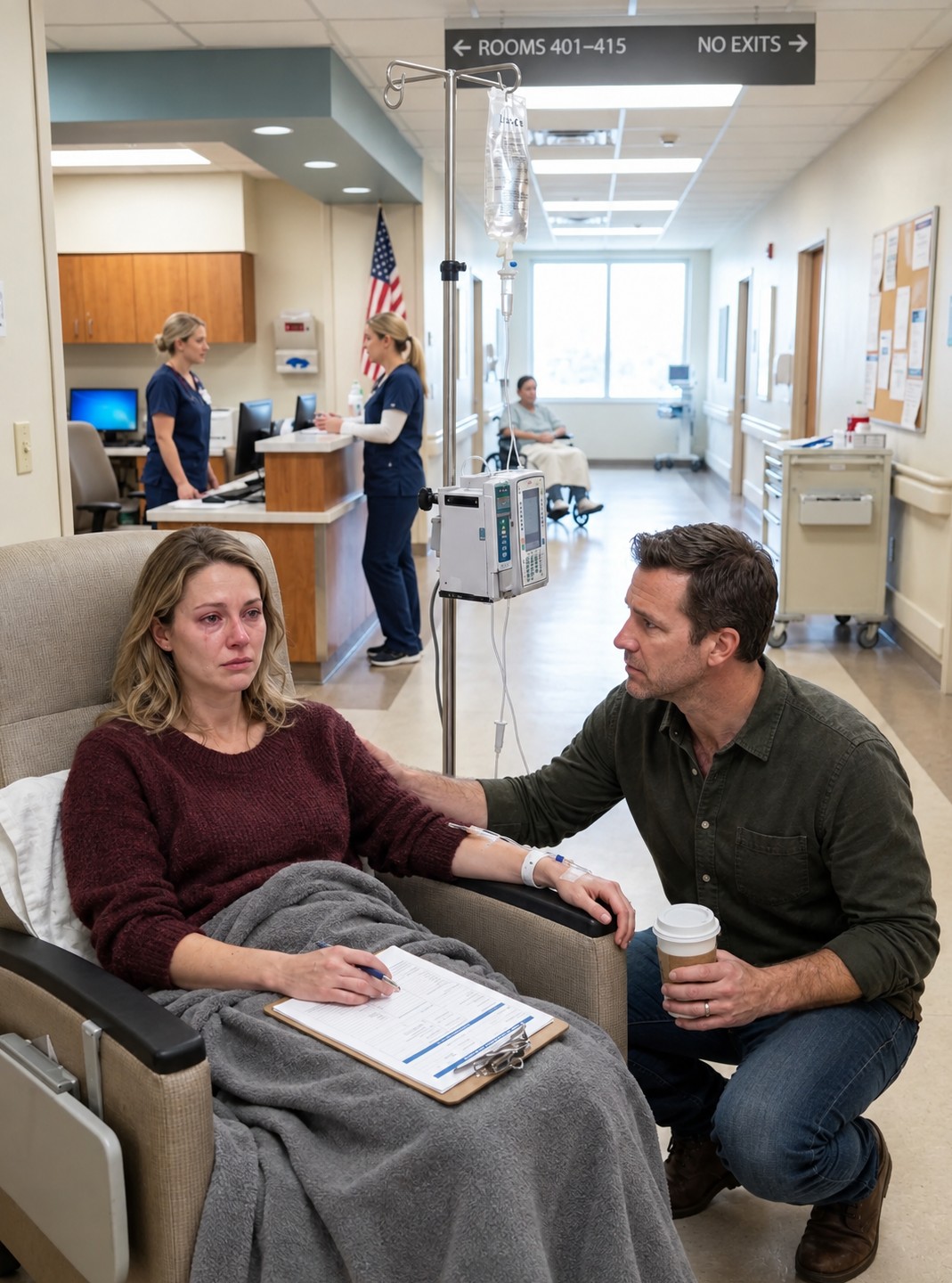
A woman sat alone near the corner of the hallway. A folded blanket rested across her lap, and an IV stand stood beside her.
A clear IV bag hung from the stand, connected to tubing running into her arm.
A clipboard was partly hidden beneath the blanket, as if she had tried to keep it out of sight from everyone walking past.
She wore a pale, washed-out blue hospital gown. Her shoulders looked small and fragile inside the oversized fabric.
Her hair had been cut very short.
Then she moved slightly.
The harsh light from the ceiling touched the side of her face.
And I knew.
It was Claire.
My ex-wife.
The woman I had divorced only two months earlier.
The woman whose suitcase wheels had scraped across the doorway of our apartment at midnight on the night she left.
I had stood in the kitchen that night and said almost nothing.
Not because I had nothing to say.
Because I had already said far too much during the years that had led us there.
My name is Thomas Miller. I was thirty-four years old, although at that point in my life, I felt decades older.
I was an ordinary office worker who had convinced himself that being exhausted gave him an excuse to become a coward.
I worked too many hours because it gave me a reason to avoid going home.
I paid the utility bills late, although I always paid them eventually.
I even knew which grocery store marked down its rotisserie chickens after 8 p.m.
I knew exactly how long I could avoid a difficult conversation with Claire before that silence became a wall between us.
Claire and I had been married for five years.
For a long time, everyone described us as a steady couple.
That was the word people liked.
“Steady.”
It sounded respectable.
Safe.
Grounded.
It made us sound like two people who had figured out how to keep the rent paid and dinner on the table without making a scene.
For a while, maybe that was true.
Claire was kind in ways I did not fully appreciate until her presence was gone.
She made fresh coffee before I woke up.
When the dryer finished, she often placed clean socks on my side of the bed.
And almost every day, she asked me the same simple question.
“Have you eaten?”
She said it as if a meal could somehow repair whatever the day had damaged inside me.
When we first married, we talked about buying a small house.
Nothing huge.
Just a house with a driveway, a mailbox with our shared last name on it, a sturdy chair on the porch, and a backyard where a child could leave plastic toys scattered across the grass.
We wanted children more than anything.
But that dream eventually changed everything between us.
The first miscarriage came after weeks of careful happiness.
Claire had bought a tiny pair of yellow socks and hidden them in the top drawer of our dresser.
She had told me, “Buying baby things too soon feels like tempting fate.”
After the hospital confirmed that we had lost the baby, Claire held those tiny socks in both hands for almost an hour.
She did not scream.
She did not sob loudly.
Claire never did anything loudly.
Instead, she sat on the bathroom floor and pressed the socks against her chest.
It was as if they were the only proof that she had not imagined the future we had planned.
The second miscarriage happened the following year.
By then, everyone knew what to say.
They offered the same soft, empty phrases.
“You’re still young.”
“These things happen.”
“Try again when you’re ready.”
But readiness was never the problem.
Something inside our home had gone silent.
Neither of us knew how to make that sound return.
Claire pulled away first.
I told myself she simply needed space.
Then I pulled away too.
I used my job as an excuse.
I stayed late even when there was no urgent work waiting for me.
I answered emails at nine at night simply because it filled the hours.
I took extra projects because spreadsheets did not stare at me across the kitchen table with tired, knowing eyes.
Grief does not always burst through the front door screaming.
Sometimes it sits beside you at dinner.
Sometimes it quietly moves the salt shaker two inches to the left because it cannot say what it really wants.
By April, Claire and I were not even fighting properly anymore.
We were simply wearing each other down with our own versions of silence.
Small things became huge arguments.
Laundry.
Money.
Who was supposed to call the insurance company about a billing mistake.
I would ask why she was so quiet.
She would ask why I came home so late.
And neither of us knew how to ask the real question.
Why had we stopped being us?
Then came Tuesday, April 9.
At 10:42 p.m., we stood in our kitchen beneath the weak yellow light above the stove.
The sink was full of dirty dishes.
A pot sat on the burner, already cold.
I remember looking at Claire’s wrist as she gripped the kitchen counter.
It looked incredibly thin.
I should have said something else.
I should have asked her to sit down.
I should have asked her how much she was hurting.
Instead, I said the sentence that ended our marriage.
“Claire, maybe we should just get divorced.”
The words did not sound dramatic.
They sounded tired.
That somehow made them worse.
Claire looked at me for a long time.
Then she asked quietly, “You had already decided before you said that, hadn’t you?”
I had no defense.
No noble explanation.
No excuse that could make those words disappear.
I simply nodded.
Claire blinked once.
Then she lowered her eyes and walked toward the bedroom.
I heard the closet door slide open.
I heard the wire hangers scrape against the metal rod.
Then I heard our old gray suitcase land on the bed with a heavy thud.
Some sounds do not seem important when they happen.
Later, they become the entire memory.
That suitcase became one of those sounds for me.
The divorce moved quickly after that.
There were county clerk forms, scanned signatures, and a final packet that reduced five years of marriage to filing dates and case numbers.
By early June, everything was legally finished.
One morning, we stood in a family court hallway like strangers who had forgotten the language we once shared.
Claire wore a soft gray sweater.
I wore a shirt she had ironed for me months earlier.
It still carried the faint scent of our old home.
When everything was finally finished, Claire looked at me.
“Take care of yourself, Thomas.”
I swallowed.
“You too.”
Then we walked away in opposite directions.
After the divorce, I rented a small apartment on the other side of town.
It had beige carpet and a refrigerator that hummed louder than it should have.
I bought one plate.
One mug.
One fork.
And a folding chair that always pinched the backs of my legs.
At first, I told myself the emptiness was peace.
There were no difficult conversations.
No grief waiting in the bedroom.
No silent dinners.
No one looking at me as if they were hoping I would finally say something honest.
But peace does not make you wake up covered in cold sweat because you dreamed your ex-wife was calling your name from another room.
By the second month, I knew exactly what my mistake had been.
I still refused to call it that out loud.
I missed the way Claire tucked her feet beneath herself on the couch.
I missed her grocery lists, written in her small, slanted handwriting.
I missed hearing her rinse her coffee mug before I left for work.
Most of all, I missed someone asking me if I had eaten.
Still, I did nothing.
Regret can stay lazy when pride is still paying the rent on a lonely apartment.
Then Oliver texted me.
I went to the hospital.
And I found Claire sitting alone in that hallway.
I had only intended to visit Oliver, but the recovery wing was just a short distance from internal medicine.
I stopped when I saw her.
For several seconds, I stood completely frozen.
The paper coffee cup in my hand bent and crinkled under my fingers.
Claire’s face looked thinner than I remembered.
The skin beneath her eyes looked dark and exhausted.
Her short hair changed the shape of her face, making her look younger and older at the same time.
A hospital wristband circled her left wrist.
IV tubing ran from her arm to a clear bag hanging beside her.
She looked fragile.
She looked ashamed.
And somehow, she looked almost completely invisible to everyone walking past her.
I started moving toward her.
Slowly.
My shoes squeaked against the polished floor.
Claire lifted her head.
Our eyes met.
Shock crossed her face.
Then something else appeared.
It was not happiness.
It was not anger.
It was pure surprise.
“Claire?” I said. “What happened to you? Why are you sitting here by yourself?”
She immediately looked away.
“It’s nothing. Just some tests.”
The lie was so weak that it almost collapsed between us.
I reached for her hand.
It was freezing.
“Claire, please don’t lie to me. I can see you’re not okay.”
A nurse pushed a rolling cart past us.
Someone laughed behind a closed door.
The hospital continued moving around us as if nothing had changed.
But my entire past was sitting in that chair.
My former wife was wearing a gown that was too large for her, trying to hide a clipboard beneath a blanket.
For several seconds, Claire said nothing.
Then she whispered, “I didn’t want you to see me like this.”
Those were her first words to me.
And somehow, they broke my heart.
She was apologizing for being seen.
She was not asking for help.
I asked, “How long have you been here?”
She lowered her eyes.
“Since this morning.”
“What happened this morning?”
She hesitated.
“I wasn’t feeling right when I woke up. I got worse, so I came here.”
She had arrived at the hospital shortly after sunrise, around 6:18 a.m., after her symptoms became difficult enough that she could no longer manage them at home.
The intake form I would later see confirmed that arrival time.
She had been checked in, examined, and placed in a hospital bed while the doctors ordered blood tests and other examinations. Because she was weak and dehydrated, they started an IV and kept her under observation.
By early afternoon, the doctors had finished the first round of tests and believed she was stable enough to continue her recovery at home, provided she followed the care plan and returned for follow-up appointments.
That was why she was sitting in the hallway when I found her.
She had already been moved out of the examination area and was waiting for the final discharge instructions.
But she was alone.
And I had no idea how close I had come to walking past her.
I looked at her.
“What morning?”
She did not answer.
“Claire, look at me.”
She tried to pull her hand away, but there was barely any strength behind the movement.
The clipboard slipped farther out from under the blanket.
I saw the top page.
It was a hospital intake form.
The date was June 13.
Then I saw my name.
Emergency contact.
My phone number was still listed.
Her old apartment address had been crossed out in blue ink.
I stared at the form until the words blurred.
“You still listed me?”
Claire closed her eyes.
“I never changed it.”
Before I could respond, a nurse wearing navy scrubs stepped out from the nurses’ station.
She carried a sealed envelope and a small plastic bag containing Claire’s belongings.
“Claire?” the nurse asked. “The doctor has finished reviewing your results. He wants to go over the next steps before you leave, but we need someone with you for the discharge conversation.”
Claire’s face changed.
Her expression seemed to collapse, as if the final support holding her together had suddenly disappeared.
She whispered, “Thomas, please don’t make this harder.”
I looked at the nurse.
Then I looked at Claire.
And in that moment, I understood something I had spent two months trying not to understand.
The paperwork had ended our marriage.
It had not erased the promise I had once made to her.
The nurse looked between us.
“Are you the emergency contact, sir?”
I slowly stood.
“Yes,” I said. “I am.”
Claire turned her face away.
But I saw the tears gathering in her eyes before she could hide them.
The nurse nodded.
There was quiet relief in her expression, as if she had been afraid Claire would have to face the conversation completely alone.
I followed them into a small consultation room.
There were two chairs and a tissue box on a little table.
The room felt strangely airless, even though a bright window filled one wall.
Claire lowered herself into one chair carefully, as if every movement had to be negotiated with her body first.
I sat beside her.
A few minutes later, the doctor entered.
He carried a folder and spoke in the calm, practiced way doctors often do when they know panic will not make a difficult situation easier.
He explained that Claire had been ill for several weeks, possibly longer, and that she had tried to handle much of it alone.
The tests had not required an overnight hospital stay at that point, but the doctor made it clear that Claire could not simply ignore what was happening.
She needed medication, rest, follow-up care, and another appointment within a few days.
He went over the warning signs that would mean she needed to return to the hospital immediately.
I listened carefully.
So did Claire.
I do not remember every medical term he used.
What I remember is Claire’s fingers twisting the edge of the blanket.
I remember the doctor sliding a printed care plan across the desk.
I remember the nurse placing a pen beside it.
“Take your time,” she told us.
Then the doctor left the room.
Silence filled the space.
I looked at Claire.
“Why didn’t you call me when you first got sick?”
She gave a small, exhausted laugh.
There was no humor in it.
“We’re divorced.”
“I know.”
She looked directly at me.
“You made sure of that.”
The words were not sharp.
That made them hurt even more.
I stared down at my hands.
“I thought leaving would stop hurting us.”
Claire’s red eyes remained on me.
“Did it?”
“No.”
She nodded slowly, as if that was the only answer she needed.
Then she looked down at the care plan.
“I didn’t want to be someone you felt responsible for.”
I swallowed.
“That was never what you were.”
Her lips trembled.
“You stopped coming home, Thomas.”
“I know.”
“You stopped asking.”
She took a slow breath.
“And when I got tired of being the sad thing in the room, you called it peace.”
I looked at her.
I owed her enough respect not to look away.
“I was a coward.”
Claire held my gaze.
“Yes.”
There was no anger in the word.
Just truth.
And somehow, that truth hurt more than anger would have.
The nurse returned with the discharge instructions.
Claire reached for the papers, but her hand trembled too badly.
I took them instead.
I read through the medication schedule.
I checked the follow-up appointment date.
Then I asked the nurse, “Which number should we call if her symptoms get worse?”
She gave me the number and explained when it should be used.
Claire watched me.
I could not understand the expression in her eyes.
Maybe it was distrust.
Maybe it was fear.
Or maybe it was the smallest beginning of hope, the kind people are afraid to name because naming it makes it easier to lose.
When the paperwork was complete, the nurse removed Claire’s IV and helped her gather the few belongings she had brought with her.
Claire insisted she could walk.
She made it five steps.
Then I saw her sway.
I offered my arm.
She stared at it for a moment.
Then she held on.
Together, we slowly walked down the corridor, past the vending machines and the reception desk.
We passed the recovery wing on the way toward the elevators.
I suddenly remembered Oliver.
He was still waiting for me.
I stopped briefly at the nurses’ station and sent him a message explaining that I had run into Claire and would come see him as soon as I could.
He replied almost immediately.
“Go. I’m fine.”
I knew Oliver well enough to understand that he meant it.
Outside, the afternoon light was bright enough to make both of us squint.
My car was parked near the far edge of the lot.
I opened the passenger door.
Claire looked at me.
“I can get a rideshare.”
“You don’t have to.”
She paused.
“This doesn’t fix anything.”
“I know.”
She looked away.
“I’m not pretending April didn’t happen.”
“I’m not asking you to.”
She got into the car.
I closed the door carefully.
Then I walked around to the driver’s side.
For the first time in two months, I was driving Claire somewhere.
But this time, I was not driving away from her.
I was taking her home.
Part 2:
Claire’s apartment was small and far too tidy.
It was the kind of tidy that comes from having very little strength left to make a mess.
I carried her discharge papers inside and placed them on the kitchen table.
Then I made her tea.
It was something Claire had always done whenever the world felt too big.
She sat at the table and watched the steam rise from the cup.
After a while, she looked at me.
“You don’t have to stay, you know.”
I turned off the stove.
“I know.”
She studied me.
“Then why are you still here?”
“Because you have an appointment on Monday, and somebody needs to drive you.”
Claire covered her face with one hand.
Her shoulders shook once.
I stayed where I was.
I wanted to move toward her.
I wanted to tell her everything would be okay.
But I had learned that wanting to help did not mean I had the right to take control.
Eventually, she lowered her hand.
“Don’t do this because you feel guilty.”
“I won’t.”
“Don’t do it because you think it makes you a good man.”
“I’m not confused about that either.”
For the first time that day, the corner of her mouth almost moved into a smile.
I pointed toward the chair across from her.
“May I sit?”
She studied me for a long moment.
Then she nodded.
So I sat.
I did not try to repair five years of marriage in one afternoon.
I simply stayed.
Over the next several weeks, I drove Claire to her appointments.
I learned where to park.
I learned which elevator was the fastest way to reach the clinics.
I learned that Claire hated grape-flavored medicine.
I also learned that she pretended hospital pudding was fine because she did not want to trouble the nurses.
I kept a folder in my car.
Inside it were her care plan, appointment papers, medication list, and insurance notes.
When something was unclear, I called the medical office and asked for an explanation.
I showed up.
Not perfectly.
Not heroically.
Just steadily.
That was exactly what I had failed to do when we were still married.
Love is not always a speech made while everyone is watching.
Sometimes it is the ordinary thing you do on a day when nobody claps.
One evening, after an appointment that had completely drained her, Claire fell asleep on the couch.
An old cooking show played softly on the television.
I stood in the doorway with my keys in my hand, ready to leave before she woke up and felt crowded by my presence.
Then I noticed something.
The gray suitcase was still sitting in the corner of her bedroom.
The same suitcase.
The one I had heard hit the bed on April 9.
It remained there like a silent monument to the night I had allowed Claire to leave.
I looked at it for a long moment.
Then I heard Claire move.
When she woke up, she found me in the kitchen washing the mug I had used.
She rubbed her eyes.
“You always rinse it twice.”
I turned around.
“So did you.”
She stared at me.
Then she said, “I was angry at you for remembering that.”
“I understand.”
She looked down.
“And I was even angrier when I realized I was glad you did.”
I said nothing.
Some doors should not be forced open simply because they have finally cracked after months of being locked.
The weeks became months.
They were not easy.
There were good test results.
There were also painful mornings that tested both of us.
There were appointments where Claire quietly squeezed my hand beneath the table and then pretended she had not done it.
There were other days when she told me to go home.
There were days when she asked me to stay.
When she did, I sat in the chair by the window with a blanket over my knees and listened to her breathing.
We talked about April.
Not all at once.
Piece by piece.
I apologized more than once.
But I stopped expecting my apologies to fix everything.
An apology was not a receipt.
Claire did not owe me forgiveness simply because I had finally found the right words after wasting years of our lives.
She told me about the nights after the divorce when she sat on the floor because the bed felt too large.
I told her about my folding chair.
She laughed.
The sound surprised both of us.
It was a real laugh.
A beautiful one.
And suddenly, the room felt warmer.
One Saturday, I brought her soup.
I placed the container on the kitchen counter.
Claire looked at it.
“Did you make this?”
“Yes.”
She opened the lid, took one taste, and looked at me.
“It needs salt.”
I laughed.
That tiny complaint felt more intimate than any grand speech about forgiveness could ever have been.
Eventually, Oliver found out that I had missed his post-surgery visit because I had run into Claire.
He called me.
“You’re an idiot,” he said.
“I know.”
“You could have told me.”
“I know.”
There was a pause.
Then his voice became softer.
“But maybe that was where you were supposed to be all along.”
I stopped wondering whether I believed in fate.
I believed in June 13.
I believed in the 6:18 a.m. time printed on Claire’s intake form.
And I believed in my name written on the emergency-contact line.
I believed in the fact that Claire had never changed it.
By fall, Claire’s health had become stable enough that hospital corridors were no longer a regular part of our lives.
They had not disappeared completely.
But there were fewer of them.
The June 13 hospital visit had been the beginning of her follow-up care, not the end of it. There were several clinic appointments over the following months, along with additional tests and difficult days at home.
I continued driving her when she needed me.
Sometimes she asked me to wait outside.
Sometimes she wanted me beside her.
I learned not to assume which one it would be.
One afternoon in the fall, after another follow-up appointment, we sat in my car in the parking lot.
The windows were slightly open.
Rain had begun falling, and the smell of wet pavement drifted through the car.
Claire held the appointment sheet in her lap.
After a long silence, she said, “I don’t want to go back to what we were before.”
My stomach tightened.
“Neither do I.”
She looked at me.
“The old marriage was lonely.”
“I know.”
She watched the rain through the windshield.
“If there is ever anything again, it cannot be built on silence.”
I nodded.
“It won’t be.”
She gave me a cautious look.
“You say that like promises are easy now.”
I shook my head.
“I say it because I know they aren’t.”
For a while, neither of us spoke.
Rain tapped softly against the windshield.
Then Claire reached over and adjusted the air vent on my side.
She remembered that cold air bothered my shoulder.
The gesture was so familiar that I had to look away.
Not because it hurt.
Because it felt like being trusted with something small.
Small things had always been where Claire kept her love.
And finally, I understood that.
Two months after my divorce, I found my ex-wife sitting alone in a hospital corridor.
At first, I thought seeing her there would break me because she was sick.
I was wrong.
It broke me because, for the first time, I truly saw what my absence had done to the woman I loved.
An entire marriage had taught her to become quiet so I would not have to feel uncomfortable in my own home.
I could not undo that in one hospital hallway.
I could not undo it with one ride home.
And I could not repair five years of damage with a few apologies.
But I could stop leaving.
That was where the real story began.
Not with a dramatic apology.
Not with divorce papers being torn apart.
Not with some perfect declaration that suddenly erased the past.
It began with a folder on a kitchen table.
It began with a cup of tea cooling between us.
It began with Claire looking at me with exhausted eyes while I finally understood something I should have understood years earlier.
Love is not proven by how deeply you regret walking away.
It is proven by what you do when you are given one more chance to stay.
And I had been given that chance.
I was going to stay for as long as Claire would have me.
THE END.
