
Part 1:
For four years, my husband refused to let me give away a box in our garage.
It was filled with newborn things.
Swaddles. Two tiny sleepers. A little hat no bigger than an orange.
The box sat on a shelf above Marcus’s tools, untouched and covered in a thin layer of dust. Every few months, I would look at it and tell him we should finally give everything away to someone who needed it.
He always gave me the same answer.
“Next month.”
We had three boys. Nine, seven, and four.
They were loud, messy, exhausting, and absolutely wonderful.
After our third son was born, my doctor sat both of us down. She had asked Marcus to come into the appointment because she wanted him to hear the truth directly from her instead of hearing it from me later.
She chose her words carefully.
But the message was still devastating.
She said a fourth pregnancy would probably kill me.
And if it didn’t, I would likely spend most of the pregnancy in a hospital bed, separated from the three children I already had.
I stared at her.
“Is there any way it could be safe?” I asked.
She shook her head.
“No. I can’t tell you there is a safe way.”
I asked her again.
Then again, over the next two years, I asked the same question in different ways, hoping maybe I had misunderstood something.
I hadn’t.
The answer never changed.
A fourth pregnancy was too dangerous.
We wanted a daughter.
God, we wanted one.
I had even chosen a girl’s name when I was nineteen, long before I met Marcus.
But Marcus rarely talked about it.
He just kept that box.
The last time I brought up the possibility of another baby, Marcus took my hand and looked directly into my eyes.
“Our boys need their mother more than we need a daughter,” he told me.
He meant it.
And I believed him.
So we stopped talking about having another child.
But stopping a conversation doesn’t always mean the feelings disappear.
Sometimes it just means everyone learns to keep them quiet.
Then, eleven years into our marriage, Marcus called me on a Tuesday afternoon.
His voice sounded strange.
“I need you to come,” he said.
“Come where?”
“There’s a baby here.”
My heart immediately started racing.
“Marcus—whose baby?”
“Please. Just come.”
He gave me the name of a hospital.
I drove there in the same shirt I had been wearing while cleaning the kitchen.
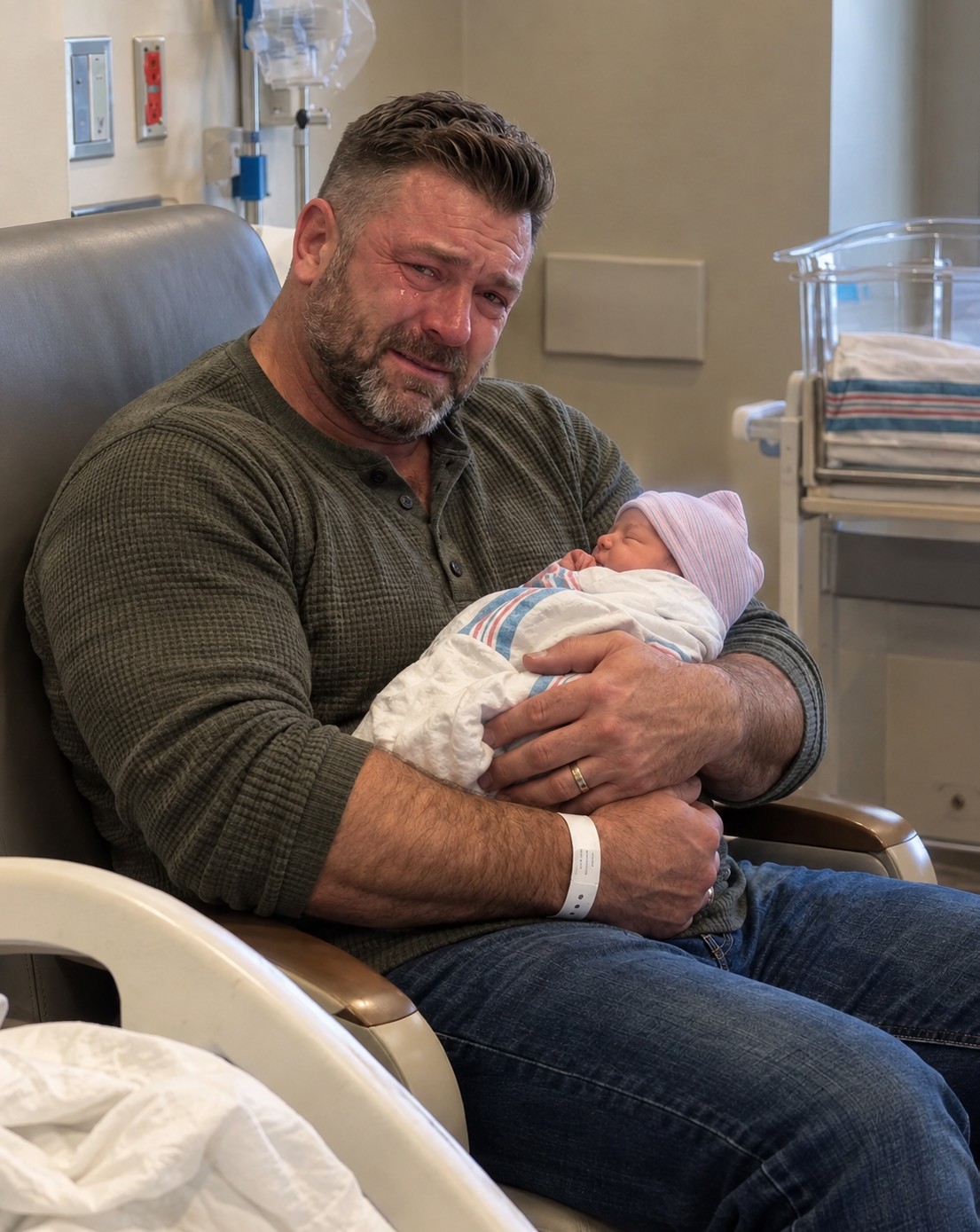
When I reached the maternity floor, Marcus was standing at the end of the corridor.
He still had his coat on.
His face was pale.
His eyes were red.
I had been with this man for eleven years, and I had never once seen him cry.
Behind him was a hospital room with a plastic bassinet inside. Through the glass, I could see the corner of it.
I took a step toward him.
“What happened?”
Marcus swallowed hard.
“I need you to sit down.”
Part 2:
I didn’t sit down.
The hallway was lined with pale yellow vinyl chairs bolted to the floor. The fluorescent lights above us made everything look cold and lifeless.
Marcus reached for my shoulders.
His fingers dug into the soft cotton of my cleaning shirt as if he needed something solid to hold on to.
“Marcus, tell me what is going on,” I demanded, lowering my voice to a harsh whisper. “Whose baby is in that room?”
He couldn’t look me in the eyes.
His gaze moved from my face to my collarbone, then down to the floor.
Finally, he looked toward the window.
Outside, the sky was gray.
“Do you remember my sister’s daughter?” he asked quietly.
I frowned.
“Clara?”
The moment he said her name, something inside me went cold.
Clara was Marcus’s niece.
She had been twenty-one.
She was quiet and troubled, and over the years she had drifted in and out of the family’s life.
Her mother, Brenda, had died five years earlier.
After that, Clara’s life seemed to fall apart.
She moved between temporary apartments, worked dead-end jobs, and became involved with men who always seemed to leave her worse off than before.
Marcus had tried to help her.
Twice, he had paid her rent.
He had bought her groceries.
Six months earlier, Clara had disappeared completely. She changed her phone number and blocked the entire family.
I stared at Marcus.
“Clara?”
He nodded.
“Did Clara have a baby?”
“She came into the emergency room four hours ago,” he whispered.
His eyes filled with tears again.
“She was thirty-six weeks pregnant.”
My mouth fell open.
“She didn’t know?”
Marcus shook his head.
“We don’t know whether she truly didn’t know or whether she was hiding it. But she came in with severe complications.”
His voice broke.
“Severe eclampsia. Placental abruption.”
He pressed the heel of his hand against his mouth, trying to stop himself from crying.
“Where is she?” I asked.
My heart was pounding so hard I could feel it in my throat.
“Where’s Clara?”
Marcus looked at me.
“She’s in the ICU.”
Then his face crumpled.
“They tried to stabilize her after the emergency C-section. They did everything they could.”
He took a shaky breath.
“She died twenty minutes ago.”
For several seconds, I couldn’t understand the words.
The hallway seemed to disappear around me.
The hum of a vending machine somewhere down the corridor suddenly sounded deafening.
“Clara is gone?” I whispered.
Marcus nodded.
His shoulders shook.
“Brenda is gone. Now Clara is gone.”
He wiped his face.
“There’s no one left on that side of the family, Sarah. No one.”
I pulled him into my arms.
He buried his face against my shoulder and cried.
I thought about Clara as a little girl.
I remembered her sitting quietly on our living room carpet during Thanksgiving, drawing pictures beside our oldest son when he was still a toddler.
Now she was dead at twenty-one.
And her baby was lying alone in a hospital room.
After a long moment, Marcus pulled away.
He wiped his face with the sleeve of his coat.
Then he looked toward the glass window.
I followed his gaze.
“The baby,” I whispered.
“Is she okay?”
“She’s small,” Marcus said.
His voice had become soft and fragile.
“Four pounds, eleven ounces.”
He swallowed.
“But she’s breathing on her own. She’s strong.”
Then he looked at me.
Really looked at me.
And something in his expression made my stomach drop.
It wasn’t only grief.
It was fear.
Desperation.
And underneath both of those things was a terrifying kind of hope.
“Marcus,” I said slowly, stepping away from him. “What aren’t you telling me?”
He took a deep breath.
“The social worker came down about twenty minutes before you arrived.”
“Why?”
“Because Clara died before she could make any formal arrangements for the baby. She wasn’t married, there was no other legal parent present, and there wasn’t anyone already authorized to take the baby home.”
My pulse started pounding in my ears.
“CPS was called,” he continued. “They’re treating her as an emergency placement.”
I stared at him.
“What does that mean?”
“They need someone who is legally able and willing to take responsibility for her immediately. If no suitable relative steps forward, she could be placed in emergency foster care.”
My eyes moved toward the maternity room.
“And you’re her uncle.”
Marcus nodded.
“They said I can be evaluated for emergency kinship placement. But I have to step forward now.”
I froze.
“Marcus…”
He walked toward me.
Then he dropped to his knees right there on the hospital floor.
He grabbed both of my hands.
“Sarah.”
His voice broke.
He squeezed my fingers so tightly they began to hurt.
“Please.”
Tears ran down his face.
“Help me bring our daughter home.”
Part 3:
The words hung between us.
Our daughter.
I stared at him.
“Marcus, get up,” I whispered.
I looked around the hallway, terrified someone would see him kneeling there.
“Please. Get up.”
“No.”
He shook his head.
“Not until you look at her.”
His voice cracked.
“Just look at her once, Sarah.”
“Marcus, we have three boys!”
My voice finally broke.
“Nine, seven, and four! Our house is already chaotic. Our finances are tight. I spent two years trying to accept the fact that my body can’t handle another pregnancy!”
Tears streamed down my face.
“We closed that door.”
Marcus slowly stood.
He was still holding my hands.
“Your body didn’t have to carry her,” he whispered.
“She’s already here.”
His eyes were red and swollen.
“She’s blood, Sarah. She’s Brenda’s granddaughter. She’s Clara’s baby.”
He looked toward the room.
“If we don’t take her, she may go into emergency foster care. How do we go home and live normally knowing Clara’s daughter is somewhere with strangers?”
“It’s not that simple!” I cried.
I pulled my hands away and began pacing the narrow hallway.
“Taking in a newborn isn’t like bringing home a puppy. She just lost her mother. Adoption, fostering, legal custody—it’s all complicated. It’s emotional chaos. We aren’t prepared for an infant!”
I stopped.
“We don’t have a crib.”
I took a breath.
“We don’t have formula. We don’t have diapers. We don’t have—”
I stopped speaking.
The thought hit me so suddenly that my entire body went still.
The garage.
The box.
The shelf above Marcus’s workbench.
The swaddles.
The two sleepers.
The tiny hat.
For four years, Marcus had refused to give those things away.
Every time I asked, he said the same thing.
“Next month.”
I had always thought he was grieving the daughter we couldn’t have.
I thought the box represented his inability to let go of the dream.
But suddenly, I wondered if there had been something deeper.
I slowly turned toward him.
“You kept that box.”
Marcus’s face crumpled.
“I kept it because I couldn’t let go of the dream.”
His voice was barely above a whisper.
“I loved you too much to ever ask you to risk your life again.”
He wiped another tear from his cheek.
“But I couldn’t throw away the thought of having a little girl in our family.”
He looked toward the room.
“And now she’s there.”
His voice shook.
“Thirty feet away from us.”
He swallowed.
“She has no mother. She doesn’t even have a name yet. And right now, she has no one except the family that can still step forward for her.”
Marcus walked to the maternity room door.
He pushed it open a few inches.
Then he looked back at me.
“Just look at her.”
His voice became softer.
“If you look at her and tell me no, I will respect it. I will tell the social worker we aren’t able to take her, and I’ll never ask you to do this again.”
He took a shaky breath.
“But please, Sarah.”
He held the door open.
“Just look at her.”
My legs felt like lead.
Every practical thought in my head screamed at me to leave.
Go home.
Get back to our loud, safe, predictable life.
Go back to my three boys.
But I didn’t leave.
I walked toward the door.
I pushed it open.
And stepped inside.
The room was dim.
A small yellow lamp glowed in the corner.
The plastic bassinet stood beside the empty hospital bed.
I slowly walked toward it.
Then I looked down.
She was tiny.
Impossibly tiny.
She was wrapped tightly in a white hospital blanket with pink and blue stripes.
A tiny knitted cap covered her head.
Her skin was soft and pink.
Her little chest rose and fell in quick, delicate breaths.
As I leaned closer, one tiny fist escaped from the swaddle.
Her miniature fingers opened and closed against the cool air.
Then her eyes opened.
Dark, slate-gray eyes.
They reminded me immediately of Marcus.
And of Clara.
And somehow, they reminded me of my three boys.
Something crashed over me.
It wasn’t the feeling I had imagined motherhood would be like.
It wasn’t the chemical rush of giving birth.
It wasn’t even the fulfillment of the old dream I had carried since I was nineteen.
It was something stronger.
Something immediate.
Something terrifying.
The instinct to protect her.
This tiny baby had lost her mother.
She had no one.
I reached down with one trembling finger.
I touched her tiny palm.
Her little hand immediately closed around my finger.
She held on with surprising strength.
A shaky laugh escaped me through my tears.
Behind me, Marcus stepped into the room.
“Sarah?” he whispered.
I didn’t look at him.
I kept staring at the baby.
Then I wiped my tears.
“Call the social worker.”
Marcus went completely still.
I continued softly.
“Tell her we want to begin the emergency kinship custody process.”
Marcus made a loud, shaking gasp.
Then he covered his face with both hands.
His entire body trembled with relief.
He stepped toward me and wrapped his arms around my waist from behind.
He rested his wet cheek against mine.
Together, we looked down at the tiny girl holding my finger.
“What do we name her?” he whispered.
I smiled through my tears.
I looked into her dark gray eyes.
“Maya.”
Marcus let out another shaky breath.
“The name you picked when you were nineteen?”
I nodded.
“The same one.”
Part 4:
The next seventy-two hours became a blur of fluorescent hospital lights, legal paperwork, background checks, and sleepless trips to the twenty-four-hour department store.
While Marcus stayed at the hospital working with the state social worker and completing the temporary kinship guardianship paperwork, I drove home.
When I opened the front door, our house looked exactly as it always did.
Chaotic.
Loud.
Alive.
My mother had rushed over to watch the boys after Marcus called me.
She was in the living room trying to stop our four-year-old from jumping off the back of the sofa.
The older two were arguing loudly over a video game controller.
“Sarah!” my mother called.
She immediately stood up.
“What on earth is going on? Marcus sounded hysterical on the phone.”
I stood in the doorway.
I looked at my three boys.
My nine-year-old, Leo.
My seven-year-old.
And my four-year-old, Sam.
My three loud, filthy, wonderful boys.
“Mom,” I said quietly.
My voice shook.
“I need you to take the boys to your house tonight.”
My mother stared at me.
“Why?”
Leo stopped playing.
He looked up.
“Mom? Is Dad okay?”
I walked over and knelt in front of all three boys.
I pulled them into my arms.
“Dad is okay, sweetheart.”
I took a shaky breath.
“But something happened today.”
I looked at Leo.
“Your cousin Clara died at the hospital.”
My mother gasped and covered her mouth.
The boys became completely silent.
“And…” I continued, wiping a tear from my cheek, “Clara had a baby girl right before she died.”
Leo blinked.
“A baby girl?”
I nodded.
“She’s very tiny. And she doesn’t have anyone to take care of her.”
Leo looked confused.
“Like… a sister?”
I smiled through my tears.
“Not exactly.”
I gently touched his hair.
“She’s your cousin. But she’s going to live with us.”
His eyes widened.
“She’s coming here?”
“Tomorrow.”
Sam tilted his head.
“Does she know how to play trucks?”
I laughed.
It was the first real laugh I’d managed all day.
“Not yet, Sammy.”
I hugged him.
“We’re going to have to teach her.”
After my mother packed the boys’ things and took them home with her for the night, the house became strangely quiet.
For the first time, I could hear how empty it was without them.
I walked out to the garage.
I turned on the overhead light.
The familiar smell of motor oil, lawn fertilizer, and old pine wood filled the room.
I walked over to Marcus’s workbench.
Then I pulled out the aluminum stepladder.
I climbed up and reached for the cardboard box sitting on the top shelf.
I carried it down and sat on the concrete floor.
For a moment, I just stared at it.
Then I opened the tape.
Inside were the newborn swaddles.
The two cotton sleepers.
And the tiny hat the size of an orange.
I picked up the hat.
I pressed it against my face.
It smelled like clean cotton and four years of quiet, unspoken hope.
And suddenly, I understood.
Marcus hadn’t kept that box because he was bitter.
He hadn’t kept it because he refused to accept our reality.
He had kept it because some part of him still believed in our family.
And now, against every expectation we had ever had, the things inside that box were finally going to be used.
Part 5:
Two weeks later, sunlight poured through the living room windows in warm golden streaks.
The house was anything but quiet.
The dishwasher hummed in the kitchen.
A mountain of clean laundry waited to be folded on the armchair.
Outside, our three boys were shouting as they kicked a soccer ball against the wooden fence.
In the middle of all that noise, Marcus sat on the sofa.
He was still wearing his work clothes, although his tie had been loosened around his neck.
And in his arms was Maya.
She was fast asleep.
She was wearing the tiny cotton sleeper from the box in our garage.
The sleeves had been rolled slightly over her little wrists.
She weighed five pounds, two ounces now.
Her cheeks were beginning to fill out.
A tiny piece of dark hair curled across her forehead.
I walked into the room carrying two mugs of tea.
I placed one on the coffee table and sat beside Marcus.
“The state caseworker called,” I whispered.
I leaned my head against his shoulder.
“The preliminary home visit went through without a single issue.”
Marcus smiled.
“The permanent adoption filing is set for next month.”
For a moment, neither of us said anything.
Marcus looked down at Maya.
His large, calloused thumb gently traced the soft curve of her cheek.
Then he spoke.
“I still think about that hallway.”
I looked at him.
“I still remember standing there,” he continued quietly, “terrified that you were going to tell me we couldn’t do it.”
I leaned over and kissed his jaw.
I could feel the roughness of his evening stubble against my lips.
“I was terrified,” I admitted.
I looked down at Maya.
“I was terrified that bringing her into our family would change everything.”
My voice softened.
“I was scared for my body. I was scared for our boys. I was scared for our marriage.”
Marcus turned toward me.
“And now?”
I looked at Maya.
As if she could hear us, she made a tiny squeaking sound in her sleep.
Then she buried her little nose deeper into Marcus’s shirt.
Through the back window, I heard our boys laughing.
Leo shouted that he had scored a goal.
Sam ran after him, trying to steal the ball.
I reached over and took Maya’s tiny hand.
Her fingers curled naturally around my thumb.
I smiled.
Tears filled my eyes.
“Now,” I whispered, “I realize something.”
Marcus waited.
“Our family wasn’t missing a daughter because my body couldn’t carry her.”
I looked down at the tiny girl sleeping peacefully in his arms.
“She was just waiting for us to bring her home.”
And for the first time in years, the little box in our garage no longer represented something we had lost.
It represented something we had found.
The end.
