
Part 1:
I had spent decades convincing myself that some people belonged in my past, no matter how badly I had once wanted them to be part of my future. Then, one day, a voice I had not heard in forty-one years spoke my name over a crackling telephone line. In that instant, the quiet life I had built around my memories began to fall apart.
The hospital room was at the very end of a brightly lit corridor. I stood outside its heavy door with my palm pressed against the cool wood, trying to understand how I had ended up there.
Forty-one long years had passed since I had last seen Douglas face-to-face.
More than four decades had passed since his final handwritten letter arrived. In it, he had begged me never to contact him again because he wanted to give his new life a fair chance.
Now his grown son, Lucas, stood beside me in the hallway. He adjusted his jacket nervously before leaning closer and whispering, “He has been asking if you are here yet.”
I turned to look at the young man standing beneath the dim hallway lights. Lucas had inherited his father’s striking blue eyes. They were the kind of eyes that could hold your attention without a single word.
I swallowed hard.
“Is he awake right now?” I asked.
Lucas gave a tired nod.
“He has been fighting to stay awake just to see you.”
Those simple words nearly made me turn around and walk away.
I was sixty years old. I had spent most of my adult life learning how to survive without Douglas. And now, after all those years, I was about to face the man who had broken my heart.
Only forty minutes earlier, the forgotten landline telephone in my childhood kitchen had started ringing. I had never imagined that answering it would lead me here, standing outside a hospital room, preparing to see the person I had once loved more than anyone else.
I took a deep breath, gently pushed open the door, and stepped inside.
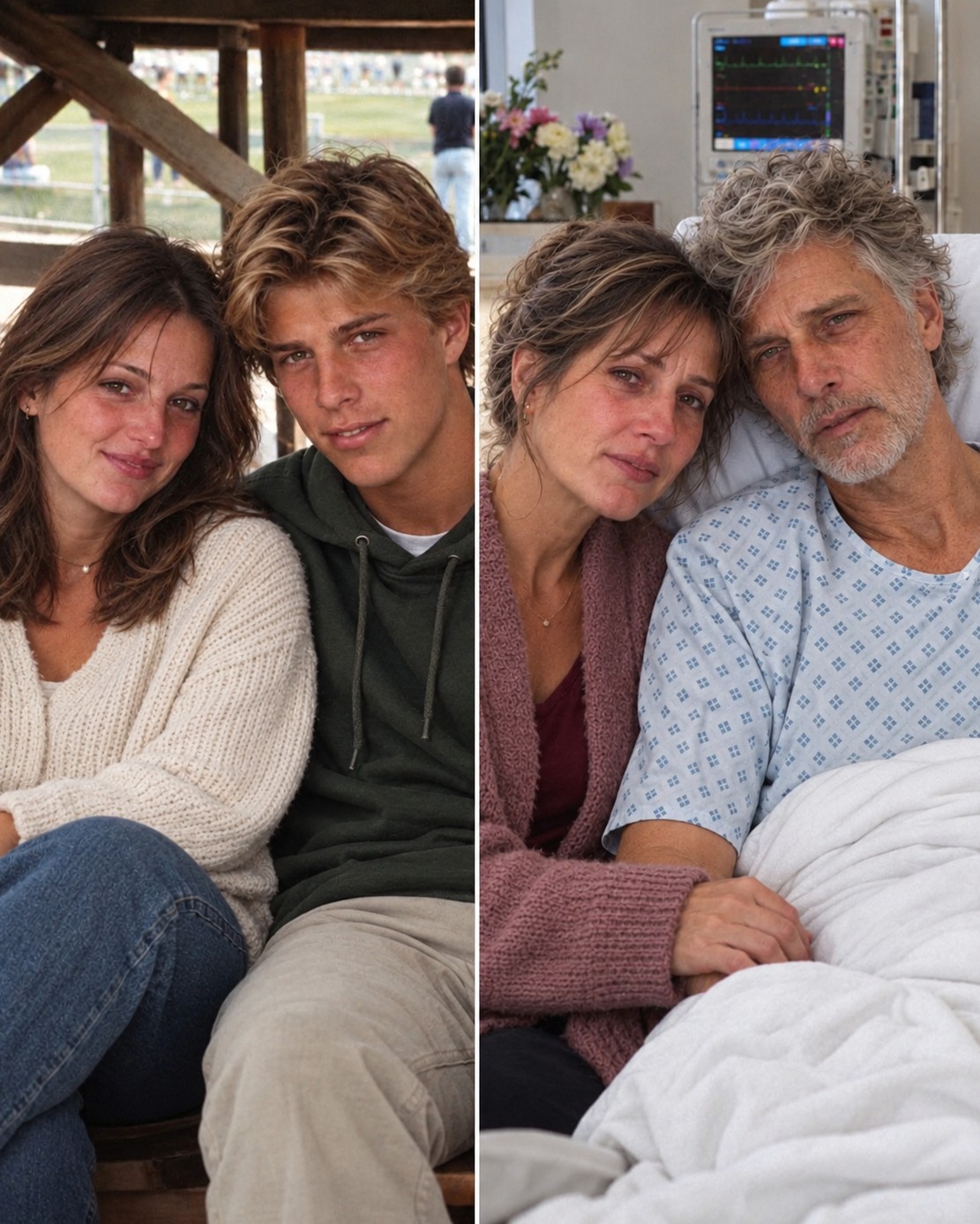
Douglas lay in a narrow hospital bed. He looked much thinner and more fragile than the confident boy I remembered from our youth. His once-dark hair had turned completely silver, and deep lines marked the familiar face I had carried in my memories for so many years.
Yet, despite his age and illness, there was no mistaking him.
He was still Douglas.
His tired eyes moved slowly around the room until they finally found me.
“Hannah,” he whispered, his voice trembling with emotion.
My throat tightened so badly that I could barely breathe, let alone speak.
I took another step toward his bed. That was when I noticed a small wooden chair beside him.
Something familiar rested on its cushion.
The moment I recognized the object sitting there, I gasped.
For several seconds, I could do nothing but stare.
I had not seen that object in decades. I had spent years wondering where it had gone, never imagining that I would find it here, beside the hospital bed of the man I had once promised to marry if we were both still single at sixty.
But before I explain what I found on that chair, you need to understand how Douglas and I ended up separated for forty-one years.
Douglas and I became inseparable best friends when we were both seventeen.
We were never officially boyfriend and girlfriend. Back then, it was simply Douglas and Hannah against the rest of the world.
I went on casual dates with other boys, and he took local girls to the movies. I even attended my senior prom with a boy from my biology class. When his old car broke down in our driveway, Douglas ended up driving us both to the dance.
Everyone in our small town thought we were being ridiculous.
They were convinced we would eventually stop pretending and admit that we belonged together.
My mother, Brenda, was among the people who believed it.
She often watched Douglas and me sitting across from each other at our oak kitchen table, arguing over history homework. She would wipe her hands on her apron, shake her head, and smile.
“One day, you two are going to figure this whole thing out,” she would say.
Douglas would look up from his textbook with a wide grin.
“Figure what out, Brenda?”
My mother would give him a knowing look.
“You know exactly what I am talking about.”
Then Douglas would turn toward me, clearly enjoying himself, while I rolled my eyes and let out an exaggerated sigh.
“We are just good friends, Mom,” I would insist.
That was the truth back then, or at least the only truth we were willing to admit.
The thought of losing my best friend frightened me far more than the idea of dating him excited me. I suspect Douglas felt the same way. We were both terrified that admitting our feelings might destroy the friendship we already had.
So we kept things simple.
We stayed close, laughed together, shared our secrets, and pretended there was nothing more between us.
That all changed one warm summer evening when we were nineteen.
We had both endured terrible dates earlier that night. My date had spent two solid hours talking about his car collection, barely allowing me to say a word. Meanwhile, the girl Douglas had taken out had left early after getting into a bitter argument with him over the price of a movie ticket.
Later that evening, we met at our old high school football stadium.
The iron gates were unlocked, so we slipped inside, crawled beneath the wooden bleachers, and settled onto the damp grass.
Douglas leaned against a metal support beam and let out a long sigh.
“We are completely terrible at this.”
“At dating in general?” I asked with a quiet laugh.
“At choosing the right people,” he corrected, staring up at the dark sky.
I laughed and rested my chin on my knees.
For a while, neither of us said anything. We simply sat together beneath the bleachers, enjoying the kind of silence that never felt uncomfortable between us.
Then Douglas turned toward me.
“What if we never manage to get it right, Hannah?”
“We will survive either way,” I assured him.
He shook his head slightly.
“What if we both end up completely single forever?”
Something about the seriousness in his voice made me stop smiling.
I turned to face him. Under the faint moonlight, I watched as he slowly raised his right hand and extended his little finger toward me.
“If we are both still single at sixty, we will stop being complete idiots and find each other,” he declared.
I stared at him in disbelief.
“Douglas, you are being ridiculous.”
“I am entirely serious right now.”
“Why specifically sixty?” I asked, fighting a smile.
He shrugged.
“Because if we have not figured our lives out by then, we obviously need all the help we can get.”
I laughed, but I held out my own hand and wrapped my little finger around his.
“It is a deal,” I whispered.
Douglas smiled.
“It is a deal.”
For one quiet moment, neither of us moved. Our little fingers remained hooked together, and I remember thinking that I should tell him how I truly felt.
I should have told him that I was already falling in love with him.
But fear held me back.
I said nothing.
Two short months later, Douglas packed his bags and left for a university three states away.
I watched him drive out of town, telling myself that distance would not change anything between us.
For the first semester, it seemed I was right.
We exchanged long, handwritten letters almost every week. He wrote about his messy roommate, who apparently believed washing dishes was beneath him. I wrote about my part-time job at the downtown library and the challenges of keeping up with my college courses.
I complained about the terrible cafeteria food, while Douglas described the pretentious students in his political science classes.
Those letters became the most important part of my week.
For that entire first year, I knew more about Douglas’s daily life than I knew about the people living just down the hallway from me.
But slowly, things began to change.
The blue envelopes that once arrived every week became less frequent.
First, a week passed between letters. Then two weeks. Before long, I was receiving one letter a month.
I told myself that university life was keeping him busy. He had new friends, difficult classes, and a whole new world to explore.
I tried to be understanding.
After all, my life was changing, too.
I was training to become an elementary school teacher, making new friends, and occasionally accepting invitations to dinner with other young men.
Still, whenever something important happened to me, Douglas was the first person I wanted to tell.
No matter how many people I met, nobody understood me the way he did.
During his second year away, his letters began mentioning a girl named Theresa, who was studying nursing at his university.
He described her as quick-witted, intelligent, and unafraid to challenge his opinions. He even wrote that he was certain I would adore her if we ever met.
That was the moment I finally admitted the truth I should have recognized years earlier.
I was deeply, hopelessly, undeniably in love with Douglas.
I sat on my bedroom floor with his latest letter resting in my lap and cried until my eyes hurt. I had waited so long to understand my own heart that the person I loved was now building a life with someone else.
That night, I grabbed a pen and began writing a response.
I filled several pages with everything I had been too frightened to say. I told him that I loved him. I admitted that I thought I always had. I wrote that I could not imagine my life without him and that I wished I had been brave enough to tell him sooner.
When I finally finished, I read the pages again.
Then I slowly tore them into tiny pieces.
If Douglas had truly found happiness with someone else, I refused to destroy it simply because I had been too afraid to speak up.
I would remain his supportive friend.
At least, that was what I told myself.
In the middle of the summer of 1986, a final letter arrived in my mailbox.
I knew something was wrong before I even opened it.
Douglas always began his letters with a silly joke or some ridiculous greeting. Even when he had serious news to share, he usually found a way to make me laugh first.
This letter had no greeting at all.
I opened the envelope and began reading.
“Ruthie,” it started, using the old nickname he had given me years earlier. “Theresa and I are getting married this coming August.”
I sat rigidly at the kitchen table, reading those words again and again until they blurred before my eyes.
He explained that the wedding would be small and that Theresa’s family was helping them settle into a quiet neighborhood.
I tried to keep reading calmly, but my heart was already breaking.
Then I reached the bottom of the page.
That was where everything changed.
Douglas asked me never to write to him or call him again.
He explained that Theresa knew how close we had been and that he wanted to give his marriage a fair start. He did not want our friendship to become a source of pain or jealousy in his new life.
He insisted that our long friendship meant too much to him to allow it to turn into something that hurt another person.
Then he ended the letter with three lines that I would never forget.
“I hope you have a truly wonderful life, Hannah. I am so sorry. Douglas.”
I read those words until I could no longer see the paper through my tears.
For weeks, I cried whenever I was alone.
But I respected his wishes.
I never wrote back. I never called his old number. I never showed up at his family home or tried to find him at the university.
He had asked me to stay out of his life, and I forced myself to accept that decision.
Over the following decades, occasional updates reached me through mutual acquaintances in town.
I learned that Douglas and Theresa had welcomed a son. Later, I heard that he had built a successful career in municipal planning.
Eventually, even those distant updates stopped coming.
Life continued, as it always does.
I never married.
I dated several kind men over the years and had relationships that mattered to me. I made friends, built my career, and spent decades teaching young children in our hometown.
Whenever curious neighbors asked why I had never settled down, I gave them the simplest explanation I could.
“I just never happened to meet the right man,” I would say with a warm smile.
It was not entirely honest.
I had met the right man when I was seventeen.
I had simply never found the courage to tell him.
Then, last Tuesday, I turned sixty.
By that point, I was living alone in my childhood home. After my parents passed away years earlier, I had purchased the property and moved back in. The familiar rooms gave me a sense of comfort that I had struggled to find elsewhere.
On my birthday evening, I ate a simple dinner by myself and cut a small piece of store-bought vanilla cake.
It was a quiet celebration, much like many of my birthdays had been over the years.
At exactly 9:17 p.m., the old wall telephone in the kitchen suddenly began to ring.
Almost nobody used that number anymore.
I nearly let it ring until the call ended. But something made me wipe my hands on a napkin and pick up the heavy receiver.
“Hello?” I answered.
A deep male voice came through the line.
“Is this Hannah?”
“Yes, this is Hannah,” I replied, feeling confused.
“My name is Lucas,” the man said carefully. “I am Douglas’s son.”
I sat down in the nearest kitchen chair, suddenly struggling to catch my breath.
“Douglas’s son?”
“Yes,” he confirmed softly.
“Has something happened?” I asked, my voice growing unsteady.
There was a pause.
Then Lucas answered.
“My father desperately wants to speak with you. He does not have much time left.”
My fingers tightened around the plastic receiver until my knuckles turned white.
Before I could find the words to respond, I heard movement on the other end of the line.
Then a faint, raspy voice reached my ears.
“Hannah.”
Tears sprang into my eyes.
“Douglas? Is that really you?”
A tiny, weak laugh came through the telephone.
“You actually remembered my voice after all these years.”
“Of course I remembered,” I whispered, wiping my cheeks. “I remember every detail.”
For a moment, it felt as though the forty-one years between us had disappeared.
Then his voice faltered.
“Hannah, I need you to listen to me carefully before I die.”
I squeezed my eyes shut.
“What is it?”
“I was completely in love with you on the night we made that silly promise under the bleachers,” he confessed.
I froze.
“Douglas…”
“And I had already bought the engagement ring,” he added, his voice breaking.
My eyes flew open.
“What ring are you talking about?”
“The ring I was planning to give you before I left for college.”
The kitchen seemed to tilt around me.
I pushed myself to my feet, gripping the edge of the table.
“Then why on earth did you marry someone else?”
On the other end of the line, I heard him weeping quietly.
“That is the truth I have spent forty miserable years wishing I could explain to you.”
His breathing became heavier, and his voice grew weaker.
“I need you to come here right now, Hannah.”
I stared at the telephone, overwhelmed by everything he had just told me.
“Douglas, I do not know if I can do this.”
“Please,” he begged. “Come to the community hospital. There is something you need to see with your own eyes. Once you see it, you will finally understand why I walked away from you.”
I did not ask another question.
I grabbed my coat from the rack by the front door and hurried outside.
“Tell me where you are,” I said.
Lucas gave me the hospital’s name and room number. I wrote them down with shaking hands, grabbed my keys, and left.
Forty minutes later, I was standing outside Douglas’s hospital room.
Now, as I gently pushed open the door and stepped inside, I watched him lift his head from the pillows.
A fragile smile appeared on his face.
“Hey there, Ruthie,” he whispered, using the pet name he had given me when we were young.
I began crying before I could stop myself.
“Hey, you big idiot.”
Then my gaze drifted toward the wooden chair beside his bed.
My heart stopped.
Resting on the cushion was something I had spent decades trying to find.
And the moment I recognized it, I realized that the truth about our separation had been waiting for me all along.
Part 2:
The object resting on the chair was a worn mahogany box.
I recognized it instantly.
It had belonged to my late father, Samuel. He used to keep his most treasured military documents inside it, and he had always treated it as something precious.
After my father died, I searched every corner of the attic, hoping to find that particular box. I opened old trunks, moved dusty furniture, and checked places I had not visited in years.
But the box had vanished.
I had eventually accepted that I would never know what had happened to it.
Now it was sitting beside Douglas’s hospital bed.
I stared at him, unable to hide my shock.
“Why do you have my father’s private wooden box?”
Douglas looked at me with tired eyes.
“Open it, Hannah.”
My hands began to tremble as I reached for the box. I lifted the heavy latch and slowly opened the lid.
Inside were dozens of neatly folded letters.
Every single one was written in my father’s unmistakable handwriting. The pages had yellowed with age, and some of the envelopes looked as though they had been handled many times.
I carefully lifted the stack and looked beneath it.
There, at the bottom of the box, sat a small velvet ring case.
My heart began to pound.
I picked it up with shaking fingers and pressed the clasp.
Inside lay a delicate diamond ring.
It was simple and beautiful, with a small diamond set in a classic band.
I stared at it, unable to believe what I was seeing.
Then I looked up at Douglas.
“You actually bought this for me?”
He nodded slowly.
“I bought it with every cent I had saved that summer.”
I looked back at the ring, and tears filled my eyes.
“Why did you never give it to me?”
Douglas moved his hand weakly toward another envelope resting beside the velvet case.
“That letter explains part of it.”
I picked up the envelope.
My father’s name was written nowhere on the front. Instead, the paper bore Douglas’s name in my father’s heavy handwriting.
With trembling fingers, I unfolded it.
The letter had been written more than forty years earlier, shortly before Douglas left for university.
I began to read.
“Douglas,
“Hannah will soon be accepted into the state teaching program here in town. She has a bright future ahead of her. If you ask her to pack up and follow you across the country, she will do it without hesitation.
“Please do not force her to choose between her feelings for you and the independent life she can build here. If you truly care about her long-term happiness, give her the space she needs to become her own person.
“Samuel.”
I read the letter twice.
Then I lowered it into my lap and stared at Douglas through my tears.
“My father actually sent this to you?”
“He wrote it right before I left for university,” Douglas explained softly. “He knew I had bought the ring because I went to your house and asked for his blessing.”
I sank into the wooden chair beside his bed.
My mind was racing.
I had spent forty-one years believing Douglas had chosen another woman over me. I had thought he had fallen in love with Theresa, decided our friendship belonged in the past, and cut me out of his life without looking back.
But the truth was far more complicated.
My father had known about the ring.
He had known Douglas wanted to marry me.
And he had intervened before Douglas ever had the chance to ask me.
“What else did he tell you?” I asked.
Douglas looked toward the window. For a moment, he seemed to be looking at something far beyond the hospital walls.
“He told me we were far too young to make a lifelong commitment,” he recalled. “He said you were fiercely loyal and that you would sacrifice your own dreams just to keep me happy.”
I shook my head slowly.
“So you decided to pull away and build a separate life.”
“I tried not to,” Douglas admitted. “At first, I kept writing to you because I couldn’t imagine going without you completely. But as time passed, I convinced myself that stepping back was the greatest act of love I could offer you.”
I looked down at the old letters in the box.
“You never even bothered to ask me what I wanted for my own life.”
His eyes filled with regret.
“I know. I realize now how foolish I was.”
His answer only made my heart ache more.
I had spent so many years wondering why he had never given us a chance. Now I was discovering that he had made a decision about my future without ever allowing me to take part in it.
Douglas continued.
“When your letters started arriving less frequently, I assumed your father had been right all along. I thought you were naturally moving on with your life.”
I shook my head.
“My letters slowed down because yours did first.”
My voice cracked as I spoke.
“I thought you were getting tired of hearing from me. I thought you were making new friends and finding a life where I no longer belonged.”
Douglas closed his eyes.
“I understand that now.”
For a moment, neither of us spoke.
Then he opened his eyes again.
“The truth is, I realized I had made a terrible mistake before I even walked down the aisle with Theresa.”
I turned toward him sharply.
“What do you mean?”
“Your father came to visit me at my apartment.”
I stared at him.
“My father traveled all that way to see you?”
Douglas nodded.
“He came to tell me in person that he had made a terrible mistake.”
I could hardly believe what I was hearing.
My father had died the following year from a sudden heart condition. He had left behind so many unanswered questions, and I had never imagined that one of those secrets involved the man I had loved all my life.
Douglas explained that my father had begun to regret his interference after watching me throw myself into my work while appearing increasingly unhappy.
He had seen how much I was hurting, even though I tried to hide it.
Eventually, he could no longer live with the knowledge that his attempt to protect me had helped destroy something precious.
He traveled to see Douglas and admitted that he had been wrong.
Then he handed him the mahogany box.
Inside were the letters my father had written to my mother before they married.
I looked at Douglas in confusion.
“Why did he give you his own love letters?”
“Because he wanted me to understand something about him,” Douglas answered.
He explained that my father had once been in love with a woman whose parents had tried to keep them apart. Despite their objections, Samuel had fought for the woman he loved and eventually married her.
He had built his life with my mother because he had refused to let other people decide whom he should love.
Yet, when it came to me, he had done exactly what he had once resented.
He had allowed his fears to make the decision for his daughter.
My father had believed he was protecting me from a painful mistake. He had worried that I would abandon my education, sacrifice my independence, and follow Douglas wherever he went.
He had wanted me to have a future of my own.
But instead of trusting me to make my own choices, he had taken that choice away.
And by the time he understood the damage he had caused, years had already passed.
I wiped the tears from my cheeks.
“If he admitted he was wrong, why didn’t you come straight back to me?”
Douglas took a slow breath.
“Because I had already proposed to Theresa, and she was planning our wedding.”
He paused, gathering his strength.
“I had made a commitment to her. And over time, I had grown to love her deeply, Hannah. I couldn’t bring myself to destroy her heart.”
I looked at him carefully.
Somehow, hearing him speak about his love for Theresa did not hurt the way I had expected it to.
Perhaps it was because I was finally beginning to understand that our story had never been as simple as I had once believed.
“What you shared with Theresa was real?” I asked quietly.
Douglas met my gaze.
“It was completely real.”
I nodded slowly.
“Then I am genuinely glad.”
He looked surprised.
I gave him a small smile.
“I would never want another woman’s entire life to be reduced to a mistake just because we were two frightened teenagers who failed to speak honestly about our feelings.”
Douglas reached across the white bedsheet and took my hand.
His fingers were thin and weak, but they were still warm.
“I wrote that final letter asking you never to contact me because I knew what would happen if we kept writing,” he confessed. “Eventually, I would have abandoned everything and run back to you.”
I looked down at our joined hands.
“And you thought cutting me out of your life completely was the kinder choice?”
A faint, sad smile appeared on his face.
“I convinced myself it was the responsible thing to do.”
He paused.
“I was completely wrong.”
I squeezed his hand.
For years, I had wondered whether I had somehow failed him. I had questioned whether I should have written one more letter, called him one more time, or found the courage to fight for him.
Now I understood that we had both been trapped by decisions made in fear.
But I still had one question.
“Did Theresa ever find out about us?”
Douglas nodded.
“She found out years later.”
I leaned closer.
“What did she say when you told her?”
A weak laugh escaped his lips.
“She shook her head and told me we were two of the most foolish people she had ever encountered.”
Despite my tears, I laughed.
Douglas laughed with me, although the effort made him cough. Lucas, who had been standing quietly in the corner of the room, smiled at us.
“She sounds like a remarkably wise woman,” I said.
“She truly was,” Douglas replied.
There was no bitterness in his voice. Only love and the sadness of someone who had lost a person who mattered deeply to him.
He went on to tell me that Theresa had passed away from an illness several years earlier. After her death, he had been left alone in their family home, surrounded by memories of the life they had built together.
“After she passed, I picked up the telephone dozens of times to call your house,” he admitted. “I would dial part of your number, then put the receiver down. I never knew if I had any right to come back into your life after everything I had done.”
I looked into his eyes.
“You always had the right to try.”
He lowered his gaze.
“I know that now.”
I shook my head, overwhelmed by the weight of our shared history.
“So we lost more than four decades simply because everyone was busy deciding what was best for everyone else.”
Douglas gave a tired nod.
“Pretty much.”
“That is profoundly stupid,” I said bluntly.
A small smile appeared on his face.
“It is also completely true.”
We sat together in silence for a while, listening to the gentle beeping of the monitor beside his bed.
Then a thought suddenly struck me.
I turned toward him.
“Douglas.”
“What is it, Hannah?”
“I turned sixty last Tuesday.”
His eyes widened slightly.
Then a bright, genuine smile spread across his face.
“So you did.”
I leaned closer.
“We made a specific deal under the football bleachers.”
Douglas slowly raised his right hand. His fingers trembled with the effort, but he managed to extend his little finger toward me.
“If we are both still single at sixty…” he began.
I hooked my little finger around his, completing the promise we had made so many years earlier.
“We stop being complete idiots and find each other,” I finished.
Tears rolled down his lined cheeks.
“Are you still single, Ruthie?” he whispered.
“I am,” I answered honestly. “Are you?”
He smiled faintly.
“I am.”
My gaze drifted toward the simple diamond ring resting in its velvet box beside us.
For the first time in forty-one years, I felt that the past was no longer something I had to keep running from.
I stayed beside Douglas throughout the night and into the following day.
We talked for hours, sharing more meaningful conversations in those short moments than I had thought possible after a lifetime apart.
He told me about Lucas and his young daughter, Chloe. I told him about my decades spent teaching children in our hometown, the students I still remembered, and the little moments that had made my work worthwhile.
We talked about my mother, Brenda, and about Theresa. We even spoke about my father, Samuel, whose decisions had shaped our lives in ways I had never fully understood.
I still felt anger toward my father for hiding the truth and interfering in my future. But as I listened to Douglas explain what had happened, I began to understand my father’s motives more clearly.
He had been terrified that I would make a sacrifice I could never take back.
He wanted to protect me from the same kind of heartbreak his own parents had once tried to prevent.
His intentions may have been loving, but his decision had been wrong.
Douglas had made a similar mistake. He had convinced himself that sacrificing our happiness was the best way to protect me.
And I had stayed silent because I did not want to interfere with the life he had chosen.
All of us had made decisions based on fear.
All of us had believed silence was kinder than an honest conversation.
But silence had never protected anyone.
It had only taken away our chance to choose for ourselves.
Two days later, Douglas was discharged from the hospital.
Lucas arranged for him to stay at his comfortable family home nearby, where he could receive home hospice care and remain as comfortable as possible.
The doctors could not say exactly how much time he had left.
It might be weeks. It might be longer.
Whatever the answer, I refused to spend the time we had left counting the days.
I had already lost too many years to that kind of thinking.
Yesterday afternoon, Lucas drove Douglas to my house.
We settled together on the front porch, sitting on the old swinging bench where Douglas and I used to cram for chemistry exams as teenagers.
The autumn breeze moved gently through the trees.
Douglas held my hand in his lap. Beside us sat the mahogany box, still filled with the letters that had kept our past hidden for so long.
He picked it up, looked at me, and gave me a playful smile.
“I never actually got to ask you properly back then,” he said. “Hannah, would nineteen-year-old you have said yes to this ring?”
I looked at the little diamond resting in its velvet case.
Then I thought about the young girl I had once been, sitting on her bedroom floor and crying over a letter from the boy she loved.
I thought about all the words I had written and torn apart, all the chances I had allowed fear to steal from me, and all the years I had spent pretending that I had never met the right man.
Finally, I looked into Douglas’s eyes.
“Yes,” I whispered. “She absolutely would have.”
His smile widened, and he squeezed my fingers.
“And what about sixty-year-old Hannah?”
I held his gaze and smiled warmly.
“She is much wiser now.”
Douglas let out a soft laugh.
“Does that mean a no?”
I shook my head.
“It means she knows we do not need another forty years to prove what our hearts already know.”
For a moment, he simply looked at me.
Then he carefully picked up the diamond ring from the velvet lining.
His fingers trembled as he slid it onto my left ring finger.
It fitted perfectly.
I stared at the little diamond, watching it catch the afternoon light. Then I looked back at the man sitting beside me.
Douglas leaned his head gently against mine, resting his shoulder against mine on the porch swing.
And for the first time in decades, I felt no need to wonder what might have been.
For most of my adult life, I had believed our love story had come to a tragic end in 1986.
I had thought that the final letter Douglas sent me was the last page of our story.
But I had been wrong.
We had not reached the end.
We had simply stopped writing the chapters.
Now Douglas and I speak every morning, either over the telephone or across my kitchen table. Lucas visits often to help his father, and little Chloe has already started calling me Aunt Hannah, even though I reminded her that she does not have to call me that if she does not want to.
She only smiles and keeps doing it.
I know Douglas and I will never recover the decades we lost to misunderstanding and silence.
We cannot go back to being nineteen. We cannot return to the football stadium or relive the summer when everything could have been different.
I have made peace with that.
But I refuse to waste another second of the time we have left by grieving over a past we can no longer change.
For years, I believed that meeting the right person at the wrong time meant losing your chance at happiness forever.
Now I understand that timing is only one part of the story.
Sometimes, life gives you another opportunity when you least expect it.
Sometimes, the person you thought you had lost forever finds his way back to you.
And sometimes, the greatest mistake is not loving someone too much.
It is allowing fear to convince you that you should never tell them.
If there is one thing Douglas and I have learned, it is this: do not let other people decide what your heart can handle. Do not assume you know what someone else wants without asking. And do not mistake silence for kindness when the truth deserves to be spoken.
Because years can pass, lives can change, and opportunities can disappear before you realize what you have lost.
But as long as there is still time, there may be a chance to begin again.
You simply have to stop being afraid.
And turn the handle.
THE END.

Beautiful story