
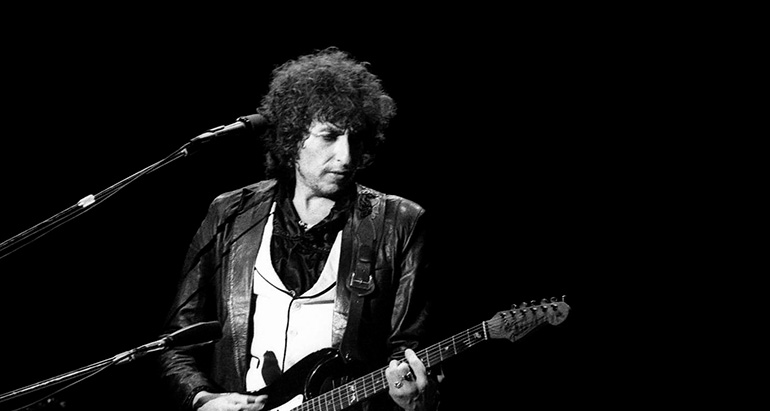
Among the most famous American musicians, without a doubt, is Bob Dylan. He was the first musician in the world to receive the Nobel Prize for Literature. He is one of the most influential musicians of the past century.
Bob Dylan began his career as a folk musician. Over time, his music was shaped by many influences, including gospel, country, and blues. He plays various instruments.
Bob Dylan is still successful today, but over the course of his career, he had to endure some severe defeats. He suffered a serious motorcycle accident, withdrew into private life and went thru a crisis. He has returned to music and gives several concerts each year.
Profile: Bob Dylan
- Full name: Robert Allen Zimmerman
- Date of birth: May 24, 1941
- Place of birth: Duluth, Minnesota, USA
- Parents: Abraham Zimmerman (washing machine dealer) and Beatrice Stone (housewife)
- Origin: Descendant of Turkish-Lithuanian and Ukrainian-Jewish immigrants, middle class
- Education: Hibbing High School
- Further education: Studied Art Sciences at the University of Minnesota, without a degree
- Music genre: Folk, Country, Blues, Rock
- Instruments: Guitar, harmonica, piano, organ
- Wives: Sara Lownds, divorced, married from 1965 to 1977; Carolyn Dennis, divorced, married from 1986 to 1992
- Marital status: divorced Children: Maria Dylan, born 1961, Jesse Byron Dylan, born 1966, Anna Lee Dylan, born 1967, Samuel Isaac Abraham Dylan, born 1968, Jacob Luke Dylan, born 1969, Desiree Gabrielle Dylan, born 1986
- Highest award: Nobel Prize in Literature 2016
Childhood and Youth
Bob Dylan was born on May 24, 1941, as Robert Allen Zimmerman. His family came from the Midwest and was part of the liberal Jewish middle class. His father, Abraham Zimmerman, and his mother, Beatrice Stone, were descendants of Turkish-Lithuanian and Ukrainian-Jewish immigrants who came from Odessa and immigrated to the USA in 1902 and 1905, respectively.
Bob Dylan’s family fell into financial difficulties when his father lost his job as an executive at the Standard Oil Company due to his polio illness. The second son, David Benjamin, was born in 1946.
After the birth of their second son, the family was threatened with poverty, so they left Duluth and moved to Hibbing in northern Minnesota to live with Bob’s mother’s parents in 1947. Bob was shaped by the stark landscape of Hibbing, speaking of hallucinogenic experiences he had when looking out the window.
After the father recovered, he joined the electronics and household goods business of his two brothers. The family could afford a single-family home in a quiet area.
Bob was tasked by his father to retrieve goods from customers who couldn’t repay their debts. Bob had a normal childhood, but he was considered an outsider.
Bob was a passionate radio listener and discovered his love for music at an early age. He was shaped by rhythm and blues and, as a teenager, by rock ‘n’ roll. His parents encouraged their son’s enthusiasm for music. They enabled him to learn to play the piano when he was ten years old.
Later, he switched to guitar and taught himself to play the harmonica. He was influenced by Hank Williams, Howlin’ Wolf, Muddy Waters, Chuck Berry, and Elvis Presley. Bob Dylan was interested not only in music, but also in literature. He was already fascinated by the works of John Steinbeck as a teenager.
As a student, Bob Dylan met like-minded individuals at Hibbing High School and joined the vocal group The Jokers. With two school friends, he played in the band The Golden Chords, which he had founded with two school friends, covering songs by well-known musicians in his parents’ garage.
Bob gained his first live experiences at talent competitions and school festivals. He describes seeing Buddy Holly in concert at 17 in Duluth as life-changing. His desire to become a rock ‘n’ roll musician grew stronger and stronger.
Transformation into Bob Dylan

Bob Dylan wrote in the yearbook after graduating high school that he wanted to leave school and follow Little Richard. He did not want to go into his father’s business and worked as a waiter for a few weeks in Fargo, North Dakota, in the summer of 1959. There he met rock’n’roll musician Bobby Vee and performed several gigs as a pianist.
He began studying art history at the University of Minnesota, but he did not complete it. He hardly attended classes and was more interested in the folk scene.
Bob Dylan increasingly engaged with Woody Guthrie during his college years, a civil rights activist and singer who became an idol of the labor movement during the Great Depression. Bob Dylan was inspired by Woody Guthrie and began writing his own ballads. He began to dedicate himself to folk singing as Bobby Zimmerman and performed in local clubs.
Inspired by other artists such as Cisco Houston, Leadbelly, Odetta, and Pete Seeger, he wrote new songs and adopted the stage name Bob Dylan. He was probably inspired to choose this stage name by Matt Dillon, a character from the television series Gunsmoke.
Another version could be the reference to the Welsh poet Dylan Thomas, whom he revered. Since 1962, the name Bob Dylan has been official. His true origins mystified Bob Dylan as he began to develop a legend around himself.
Folk Singer (1961)
Bob Dylan arrived in New York City in January 1961 at the age of 19, where he took a room in Greenwich Village, Manhattan. Representatives of the Beat Generation, the Beatniks, were active in this district. They performed in coffeehouses and enjoyed well-attended shows.
Bob Dylan was indeed influenced by this genre of music, but he did not lose sight of his original goal of becoming a folk musician. He visited the bedridden Woody Guthrie, who suffered from the nerve disease Huntington’s chorea and was bedridden, in the hospital.
A friendship developed between the two musicians. Bob Dylan played Guthrie’s songs on the guitar for him, as it became increasingly difficult for Guthrie to communicate. Bob Dylan processed his impressions and admiration in his first own composition, the “Song to Woody.” He also wrote the poem “Last Thoughts on Woody Guthrie.”
Bob Dylan was able to establish himself in the folk scene in New York and became a regular at various clubs, where he met some well-known folk singers like Dave Van Ronk, Odetta, Pete Seeger, and the Clancy Brothers.
Bob Dylan concealed his true origins. He built up an image as a proletarian drifter. As a harmonica player, Bob Dylan even made records for Harry Belafonte. In newspapers, including the New York Times, he read favorable reviews about himself.
In October 1961, Bob Dylan received a five-year contract from Columbia Records. He received five percent of the revenue from record sales and additionally a small advance. He recorded his first album, “Bob Dylan,” in November 1961. Commercially and artistically, this album was hardly satisfying, but it was an important contribution to Bob Dylan’s fame.
Idol of the Protest Movement (1962-1964)
In his years in New York, Suze Rotolo, Bob Dylan’s girlfriend, was his most important reference person. He had met her in Greenwich Village. She inspired him for his music, but she also made him sensitive to social issues.
Suze Rotolo was a secretary for the civil rights organization CORE. Thru her, Bob Dylan got to know many personalities of the civil rights movement. He was inspired to write songs like
- Don’t Think Twice
- Boots of Spanish Leather
- It’s All Right
- Ballad in Plain D
inspire. He expanded romantic love songs to include a bitter variant.
Albert Grossman managed Bob Dylan starting in May 1962 and was another guiding figure for him. He pulled the strings in the background to help Bob Dylan achieve fame and recognition.
Over the years, Bob Dylan was engaged for numerous performances together with Pete Seeger outside of New York. Bob Dylan is perhaps the first singer-songwriter in the world. He combined poetry with political realism.
Bob Dylan also made a good impression in London in 1962 and was considered a new hope for folk music. He released his second album, “The Freewheelin’ Bob Dylan,” in May 1963. It was a milestone and contributed to his breakthrough. It contained many socially critical songs, referring to current political events. The album sold well and received exclusively positive reviews.
He cemented his reputation as a political folk singer and songwriter primarily with the song “Blowin’ in the Wind.” He cursed the military-industrial complex with the song “Masters of War.” He proved his literary talent with the song “A Hard Rain’s A-Gonna Fall.”
Bob Dylan became the highlight of the Newport Folk Festival on July 26, 1963. He was able to establish himself as a leading folk singer. Since he also played some songs with Joan Baez, the two were considered the King and Queen of folk music.
His then-girlfriend Suze Rotolo spoke of how Bob Dylan became an egocentric due to his success. She criticized the artist’s personality change with growing success. The relationship was strained as a result.
Joan Baez was able to quickly fill larger venues with Bob Dylan as a guest singer. Bob Dylan began his first major tour of the USA in August 1963. In March 1964, Suze Rotolo and Bob Dylan broke up. After the split, he appeared publicly as a couple with Joan Baez. Thru their joint appearances, he was able to increase his level of fame.
Under the influence of Joan Baez, Bob Dylan also became politically engaged. When Martin Luther King gave his famous speech at the closing rally of the Civil Rights March on Washington in August 1963, Bob Dylan also performed.
With his LP “The Times They Are a-Changin’,” he declared himself an opponent of racial discrimination. One song of the anti-war movement was “With God on Our Side.”
After the assassination of US President John F. Kennedy, Bob Dylan provided protest songs and an obligatory battle hymn for the critics. He became the mouthpiece and voice of an entire generation.
At the age of just 23, Bob Dylan was elevated to the forefront of the civil rights movement by the folk magazine “Sing Out!” Bob Dylan himself, however, did not want to become an idol. He built an increasing distance from the protest scene.
Musically, Bob Dylan was increasingly inspired by the Beatles. His new LP revolved around the theme of relationships and no longer contained clear messages. Bob Dylan concluded this phase of the folk movement with this LP titled “Another Side of Bob Dylan” and turned to poetic song forms.
Rock musician (1965 – 1966)
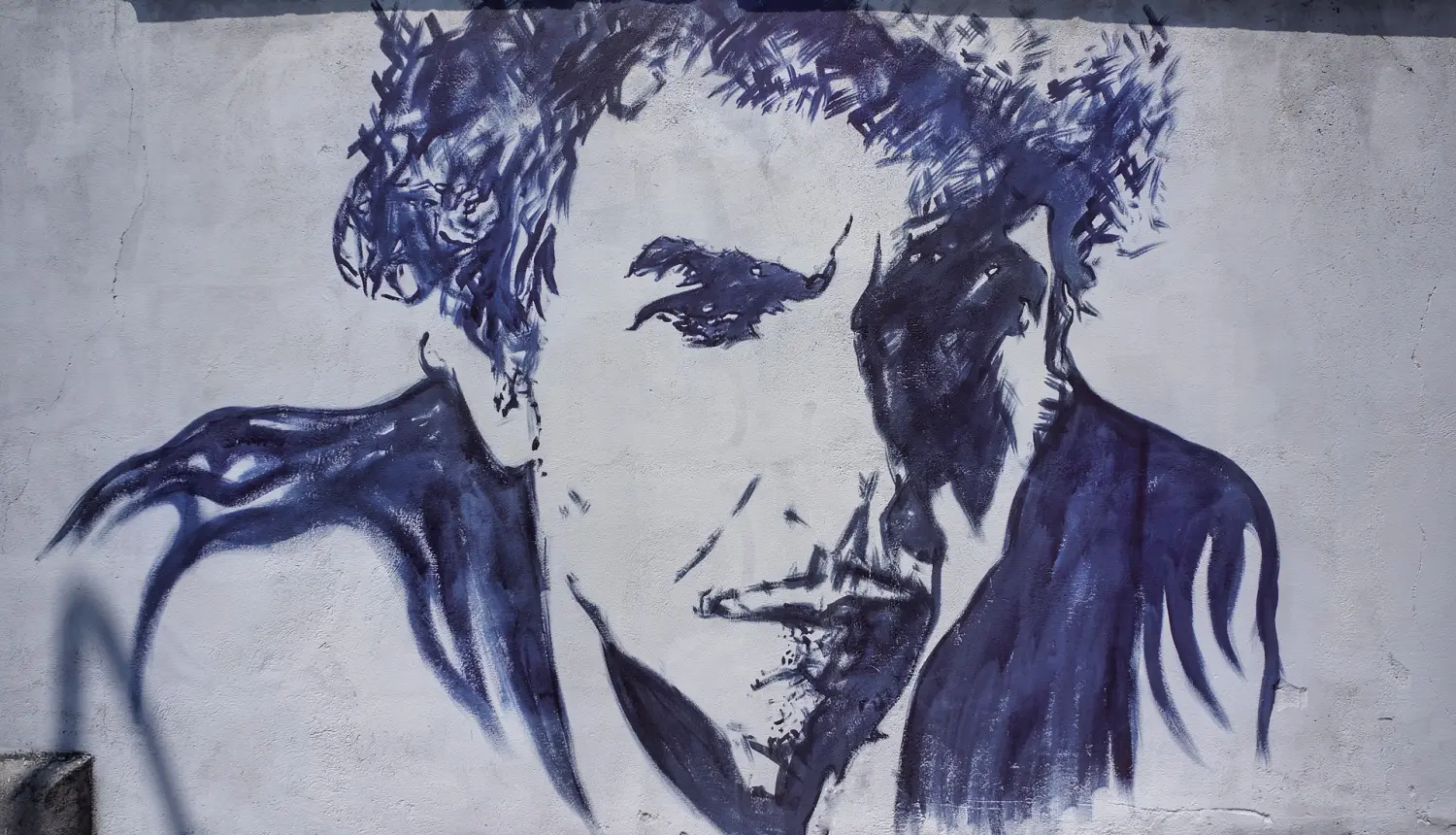
Bob Dylan began to amplify his music, which he had almost always played solo, with electric instruments starting in the mid-1960s. He had his own backing band. He sparked fierce criticism among the purists of folk music when he performed at the Newport Folk Festival in 1965 alongside musicians from the Paul Butterfield Blues Band.
He also faced some rejection during the subsequent European tour, accompanied by musicians under the name “The Band.” At a concert in 1966, he was called Judas, as he had supposedly betrayed folk music. Bob Dylan was booed by the audience with his band, which prompted him to play really loud.
Even as a rock star, Bob Dylan was able to sell millions of records. He became the voice of the politicizing counter-culture, but suffered under the pressure of success. Some old fans reacted with hostility as Bob Dylan devoted himself more and more to rock music.
From the mid-1960s, Bob Dylan released three albums that marked his transition to a rock musician. The albums are now considered classics of rock music. He achieved great success with the song “Like a Rolling Stone.”
Bob Dylan demonstrated his literary talent with his lyrics, which contained many literary references and metaphors. He also alluded to drug experiences. Bob Dylan himself consumed heroin in the early 1960s.
Bob Dylan married the model Sara Lowndes at the end of 1965, but he kept the wedding a secret from the public. Sara brought a daughter from a previous relationship into the marriage. At the age of 24, Bob Dylan became a family man thru marriage. He kept his private life away from the public eye. Bob Dylan separated from Sara in 1975.
Motorcycle Accident (1966)
Bob Dylan suffered a serious fall on his Triumph Tiger on July 29, 1966, on the country road near his home in Woodstock. He was seriously injured, but not immediately life-threatening. He broke several cervical vertebrae and suffered several minor head injuries.
Rumors about Bob Dylan’s death didn’t take long to surface. Some media reported that he was just vegetating, others that he had a pulverized brain or that he could no longer appear in public because he was badly disfigured. There was even talk of a CIA plot to assassinate Bob Dylan.
Due to his lifestyle and the effects of drug use, the healing process was slow. For a full recovery, he retreated to Woodstock more than half a year after Woodstock. He received only Allen Ginsberg, D. A. Pennebaker, and a few other close friends there.
The accident almost cost Bob Dylan his life. It was an opportunity for him to escape from his star life and radically turn away from his lifestyle. Because of his busy schedule and his extraordinary artistic productivity, Bob Dylan was suffering from mental and physical exhaustion. He was able to rethink his life and break his bridges with the public.
Withdrawal from the public eye (1966-1973)
Bob Dylan withdrew from the public eye for almost two years after his motorcycle accident, which, however, could further enhance his fame. There was hardly any information about him and his work.
In the artist colony of Woodstock, where Bob Dylan now lived, he devoted himself more to his wife Sara and the children. He wrote in his autobiography that he wanted to lead a simple life and work a 9-to-5 job.
In an interview, he did not talk about his plans. This was fodder for speculation about his final withdrawal from music. In the summer of 1967, his record contract with Columbia was extended. Bob Dylan began to play music again with The Band. This music achieved cult status as the Bootleg Series.
Bob Dylan wrote new songs again, in which he also dealt with the death of Woody Guthrie. He released his album “John Wesley Harding” in December 1967.
Bob Dylan performed only sporadically in the following years. He first returned to the stage in January 1968, contributing four songs to the Woody Guthrie Memorial Concert. In 1969, he was a backing musician for The Band. He did not want to perform at the legendary Woodstock Festival.
Bob Dylan, however, headlined the Isle of Wight Festival in August 1969. He supported George Harrison, the former Beatles guitarist, at a concert for Bangladesh at Madison Square Garden in August 1971.
Bob Dylan also worked together with the country musician Johnny Cash. The LP released with him became Bob Dylan’s biggest commercial success to date.
His double album Self Portrait, which was released in 1970, is considered one of Bob Dylan’s worst records. However, he himself speaks of a liberation blow, because he wanted to destroy the expectations of his audience, which he found oppressive.
In the western “Pat Garrett and Billy the Kid,” Bob Dylan took on a small role. He contributed the music for the film, which includes “Knockin’ on Heaven’s Door.”
Divorce (1974-1982)
Bob Dylan’s marriage to Sara fell into crisis in the mid-1970s. His spectacular comeback tour was a great success. Accordingly, his double album “Before the Flood” sold very well in early 1974. In this album, he probably dealt with his separation from his wife Sara. However, he himself denied any direct connection.
With the Rolling Thunder Revue project in 1975/76, Bob Dylan, along with other musicians, started a musical traveling circus. These performances are among the best of his career. Bob Dylan divorced Sara in 1977.
Bob Dylan went on a world tour in 1978 and also performed in Nuremberg. He was very successful. After his divorce, he converted to Christianity.
In the early 1980s, Bob Dylan went thru a crisis. He also suffered from a drinking problem at the time. He married his former background singer Carolyn Dennis in June 1986, but they divorced in 1992.
Return (1994 to present)
At the revival of the legendary Woodstock Festival of 1969, Woodstock II in August 1994, Bob Dylan performed again. For many observers, his performance was a surprise.
Bob Dylan recorded a live album with his greatest hits in November 1994. The album was a financial success. Bob Dylan also turned to art and published a picture book with drawings, with which he wanted to relax from everyday life.
For the first time in seven years, Bob Dylan released his own songs again in 1997. He made a comeback with his album “Time Out of Mind.” He received several Grammys for the album.
He received the Oscar for Best Original Song and the Golden Globe Award in 2001 for the song “Things Have Changed,” which he wrote for the film “Wonder Boys.” In 2000, he was honored with the Polar Music Prize, the unofficial Nobel Prize for music.
Bob Dylan’s lyrics were published in the book “Lyrics 1962 – 2001.” The lyrics were also offered in Germany as a translation by Gisbert Haefs. Bob Dylan gave his first television interview in 19 years for the release in December 2004.
Over time, Bob Dylan released numerous other albums and gave concerts. He achieved great success and was also socially engaged, as he raised money for charitable causes and distributed meals to the homeless, for example.
With the album Rough and Rowdy Ways, Bob Dylan was able to reach number one in the German Media Control Charts in June 2020.
Never Ending Tour
The critic Adrian Deevoy coined the term “Never Ending Tour” in 1989. This tour, which began in 1988, continues to this day. Bob Dylan has played more than 100 concerts a year all over the world. He is said to have held the 2,000th concert of this tour in October 2007.
Unlike in previous years, Bob Dylan has been playing a similar setlist since October 2013. On December 8, 2019, he gave his last concert for the time being. He had to cancel already planned tours due to the COVID-19 pandemic.
Influence on pop culture
Since the 1960s, Bob Dylan has significantly shaped pop culture. He is influenced by numerous musical genres such as blues, gospel, rock ‘n’ roll, and country. With his lyrics, he has given modern rock music linguistic complexity.
Bob Dylan made rock music political with his lyrics by addressing socially critical themes and processing individual experiences. His lyrics are considered works of the highest literary rank. It is no coincidence that he was honored with the Nobel Prize in Literature by the Nobel Committee.
Since 1996, Bob Dylan has been considered a candidate for the Nobel Prize in Literature several times. He was first nominated for the Nobel Prize in Literature in a campaign led by writers John Bauldie and Allen Ginsberg. Literature professor Gordon Ball supported the campaign.
Bob Dylan does not have a trained singing voice that corresponds to the classical ideal of beauty. He polarizes critics, some of whom appreciate his expressive and deliberately ugly way of singing, while others are bothered by his, so to speak, affected voice.
Numerous musicians, including Joan Baez, Jimi Hendrix, Rod Stewart, and Joe Cocker, have recorded songs by Bob Dylan. It was only the recordings by other musicians that made some of Bob Dylan’s songs popular.
Bob Dylan had a formative influence on many musicians, including Nick Cave, Jimi Hendrix, Bruce Springsteen, and the Beatles. The German musician Wolfgang Niedecken was also inspired by Bob Dylan.
Works
Due to the multitude of albums and songs, it is not possible to name all of Bob Dylan’s works. He released a variety of studio and live albums, including several compilations of his greatest hits.
Among Bob Dylan’s works are also film scores with well-known titles. One of the best-known titles is “Knockin’ on Heaven’s Door.” “Blowin’ in the Wind” is also one of his most famous works.
Bob Dylan also briefly appeared as an actor. He also drew and published a picture book with his drawings.
Honors
Bob Dylan holds two honorary doctorates: He received his first in 1970 from Princeton University. He received the second in 2004 in Scotland at the University of St Andrews. He was honored by the university as an icon of the 20th century. He received an Oscar and a Golden Globe Award in 2002 for the best film song with “Things have changed.” He received the Pulitzer Special Prize in 2008 for his influence on pop culture with his lyrical compositions.
In his absence, he received the National Medal of Arts from U.S. President Barack Obama in 2009. He was elected to the American Academy of Arts and Sciences in 2011. In the American Academy of Arts and Letters, he has been an honorary lifetime member since 2013.
The highest honor in his life was awarded to him in 2016 with the Nobel Prize in Literature. However, he did not accept the Nobel Prize himself. The artist Patti Smith accepted the award on his behalf in Stockholm.
According to Rolling Stone, Bob Dylan was ranked second among the 100 greatest musicians, after the Beatles. He is ranked seventh among the 100 greatest singers and first among the 100 greatest songwriters. An asteroid is also named after Bob Dylan.
