
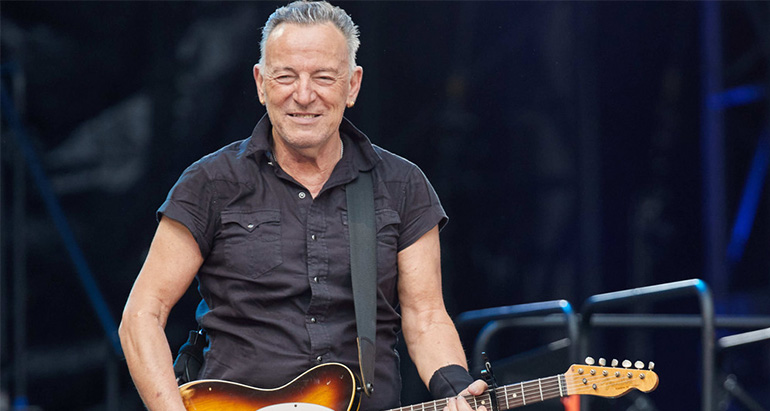
Bruce Frederick Joseph Springsteen (* September 23, 1949, in Long Branch, New Jersey) is an American rock musician. The bandleader of the E Street Band is an Oscar and Tony Award winner as well as a 20-time Grammy winner.
Springsteen is extremely popular worldwide and one of the most commercially successful rock musicians of all time. In the United States alone, he has sold more than 60 million albums, and worldwide, including DVDs, around 130 million. His songs are mostly about American everyday life. His nickname “The Boss” originated in the 1970s when he used to pay his band members in cash after performances.
Life
Childhood and Youth
Bruce Springsteen grew up in a Catholic household in Freehold, New Jersey, along with his two younger sisters, Virginia and Pamela Springsteen, in modest circumstances. The parents – especially the mother Adele – were very religious and tried to instill this in the children.
His father, Douglas Springsteen, was of Irish-Dutch descent. Bruce describes him as a choleric, brusque person who found it difficult to establish an emotional connection with the children. Douglas was not very successful in various jobs, such as in a carpet factory, as a taxi driver and as a prison guard. Bruce Springsteen remembers his father as a frustrated man who often sat drunk in the kitchen in the evenings. His mother, Adele Zerilli, is of Italian descent. He describes her as a warm-hearted, active woman who organized family life. Additionally, she worked as a secretary. The economic circumstances of the Springsteen family were modest. Due to financial difficulties, a social decline followed in the mid-1950s, forcing the family to move to a neighborhood mainly inhabited by immigrants and Marines.
On the one hand, Springsteen rebelled against his father and tried to be as little like him as possible; on the other hand, he adopted his father’s values from the working world (including distrust of intellectuals) as well as his enthusiasm for cars. This ambivalence also characterizes his relationship with his hometown and New Jersey, as well as organized religion.
Neighbors described the boy as a carefree, active child. This situation changed upon entering the St. Rose of Lima School, run by Franciscan nuns. Springsteen became the problem child, constantly at odds with the teachers and increasingly withdrawing into himself. He developed a sense of isolation that would accompany him well into adulthood. He later expressed it as follows: “I had many plans, but I was always the one standing outside, looking in with longing.” I felt lonely very early on. Everyone in my father’s family were outsiders.” Even in his youth, Springsteen found the future prospects offered to him as a working-class child to be oppressive. The life of his parents seemed to him a dead end.
At the age of ten, his enthusiasm for rock music developed, initially for Elvis Presley, later also for the Rolling Stones and the Beatles, and he received his first guitar as a gift. At the age of 14, he transferred to the regional high school of Freehold and discovered rock music as a way to escape the narrowness of his previous life. The cultural life in the Springsteen household was mainly determined by the television, and Bruce had almost no access to literature. Thru Bob Dylan, he learned about the possibilities of expression in song lyrics. Later, he wrote the song “No Surrender” about that time for the 1984 album “Born in the U.S.A.”: “We learned more from a three-minute record than we ever learned in school,” and in 1988, on the occasion of Dylan’s induction into the Rock and Roll Hall of Fame: “He was the brother that I never had.” […] Like Elvis freed your body, Bob freed your mind.” He began to seriously practice guitar and played in local bands. In 1967, he left high school and attended nearby Ocean County College for a year.
In 1966, his parents moved to California, where his father found work as a bus driver in San Mateo. Bruce stayed in New Jersey at his parents’ house and later in a room in Asbury Park. He didn’t have a regular job, spending his time instead on music, softball, surfing, girls and cars. In 1968, Springsteen, who later so aptly described situations and feelings of the working class, had his only job outside the music scene, a few weeks’ employment as a gardener.
His origins have strongly influenced him. In the process, he developed a distinctly ambivalent relationship with his roots. He once said that as a teenager he found his hometown narrow-minded and miserable. He now lives near Freehold again. The bleakness of working-class life and the predetermined life paths of the working class, as well as their attempts to break out of their circumstances, would become the defining themes of many of his songs. His conflict-ridden relationship with authorities – especially with his father – has also been a recurring theme.
Bruce Springsteen is married for the second time to singer Patti Scialfa, and they have three children together: two sons and a daughter, Jessica Rae, who is an equestrian.
1965–1974: Musical Beginnings
His first musical influences were country and western hits by Gene Autry, Roy Rogers, and Hank Williams, which were often heard at home and at his grandmother’s house. They are clearly audible on albums such as Nebraska and The Ghost of Tom Joad. In 1965, he joined the band ‘Castiles’ – the name came from a soap – and played quite successfully in small clubs like the famous New York ‘Cafe Wha’. Under the management of Tex Vineyard, the Castiles gained local fame and recorded two singles, “Baby I” and “That’s What You Get.” Springsteen’s musical ambitions were not well received by his parents. If you believe his stories, there were two things that were unpopular in the Springsteen family: first, himself, and second, his guitar. At least, that’s what he said in his announcement to Growin’ up (Live 1975–1985): “There were two things that were unpopular in my house: one was me. Das andere war meine Gitarre.”
In 1968, he formed a new band called ‘Earth,’ a trio with the “classic” lineup of guitar, bass, and drums. The band probably existed only from August 1968 to February 1969, but during that time had more than a dozen performances. In March 1969, Springsteen formed the band ‘Child’ with people he had met at the “Upstage Club.” In November of the same year, they changed their name to ‘Steel Mill’. Their hard rock brought Springsteen further small successes. Three singles were recorded: The Train Song, He’s Guilty and Going Back to Georgia. The recordings regularly appear at CD fairs today.
In January 1971, Springsteen left ‘Steel Mill’ because he wanted to pursue a different musical direction. He bridged the time until the formation of a new band with guest appearances, for example with Steven Van Zandt & The Big Bad Bobby Williams Band, whose bandleader was the later guitarist of the E Street Band. During this time, various jam sessions with different musicians and solo acoustic performances took place. From these jam sessions, the band ‘Dr. Zoom and the Sonic Boom’ eventually emerged, involving all the tangible people. This went so far that four members joined the band as Monopoly players and did exactly that on stage: play Monopoly.
In addition to Van Zandt, who was also part of the band, the later E-Street-Band members Garry Tallent, David Sancious, Vini Lopez, and Danny Federici were also part of “Dr. Zoom.” A member of Southside Johnny, for whose band Southside Johnny & the Asbury Jukes Springsteen and Van Zandt would later write and produce many songs (It’s been a long time), was also a member of Dr. Zoom.
After their end, Springsteen temporarily played with Van Zandt and Southside Johnny, Garry Tallent, and Vini Lopez in the ‘Sundance Blues Band’ before founding the ‘Bruce Springsteen Band’ in July 1971. It can be seen as a stripped-down version of “Dr. Zoom” and is considered a precursor to the “E Street Band.”
The band with which Springsteen played from October 1972 and recorded his first studio album Greetings from Asbury Park, N.J. at the end of 1972 had no name, but is considered the early E Street Band. It was not until 1974 that it was officially announced under that name. It refers to the address of the band’s then-keyboardist, David Sancious.
The Springsteen of these “early years” is described by contemporaries as a bustling, manically driven person, yet shy and particularly naive in business matters, who only came alive on stage and showed leadership qualities.
After the impresario John Hammond became aware of Springsteen, he signed the musician to Columbia Records. Contrary to his manager’s plans, who had intended to record a folk album, Springsteen took his band into the studio. In January 1973, the debut album Greetings From Asbury Park, N.J. was released. The album is considered a good, albeit not outstanding, rock record. Musically, it was still quite conventional in many parts and bore clear folk influences. It already showed Springsteen’s narrative talent. His lyrics were rich in imagery, sprawling descriptions of the life of a teenager in New Jersey. The title of the album refers to a seaside resort on the Atlantic coast of New Jersey, which, with its many clubs in the 1960s, was a mecca for aspiring musicians. Asbury Park, with its vibrant nightlife, was a popular attraction for young people and offered many bands performance opportunities.
Springsteen’s debut LP, however, was – even tho it was praised by critics – just like the second, The Wild, the Innocent & the E Street Shuffle, which followed in the autumn of the same year, initially a flop. The Wild … is now considered not only one of his best albums, but also an unjustly little noticed gem of the early 1970s, due to its musically and lyrically dense, lively and multi-layered depiction of life in New Jersey and New York from the perspective of a teenager.
1975–1981: The Breakthrough with Born to Run
It was only with the third album, Born to Run, that the commercial breakthrough was achieved in 1975. The album reached the top five of the charts, and the title song “Born to Run” also became a top-20 single hit. The album was elaborately produced, and Springsteen used a rich array of instruments; in addition to the usual rock lineup, piano, Fender Rhodes electric piano, glockenspiel, harpsichord, saxophone, trumpet (Randy Brecker), flugelhorn, and Hammond organ were employed. This created a very dense and full sound, reminiscent of Phil Spector’s so-called “Wall of Sound.” In particular, the saxophone and the piano in the style of Billy Joel or Meat Loaf stand out. Max Weinberg and Roy Bittan, who later also participated in Meat Loaf’s greatest success, Bat out of Hell, played drums and piano, respectively. However, the music is not always free from bombast and pathos. In the following example from the title “Born to Run,” the piano alternates between powerfully played chord blocks and broken chords in sixteenth-note values (see sheet music and audio example?).
Some tracks from the first three albums, such as Jungleland, are structured in multiple parts and clearly exceed the usual 4-minute limit in rock music. For example, the song “Jungleland” on Born to Run begins with a “classically influenced” piano introduction (see audio example?), to which strings are added. The middle section is equipped with the “usual rock instrumentation.” This is followed by an intimate jazz section (see sheet music and audio example?) with saxophone, bass, piano, and jazz-typical drumming, before it becomes “rockier” again, and the song ends with the piano introduction.
Due to the success of the album, Springsteen appeared on the cover of both Time and Newsweek in the same week – a new star was born. This was observed with some skepticism by the audience, fellow musicians, and critics. Many suspected a media hype behind it. A year earlier, a music critic had written on the occasion of a Springsteen concert in Cambridge: “I have seen the future of rock’n’roll, and its name is Bruce Springsteen.” The name of the music critic: Jon Landau, who shortly afterward became Springsteen’s manager, after the latter had separated from his previous manager Mike Appel following a lengthy legal dispute. This dispute also delayed the release of his next album, Darkness on the Edge of Town, until 1978.
On this album, the principle of the “Wall of Sound” is no longer used. The pieces are more simply structured and the individual instruments are more clearly distinguished from one another. In particular, the organ played by Danny Federici and even more so the electric guitar come to the fore. You can hear the influences of Duane Eddy, Jimmy Page and Roy Buchanan. Springsteen’s singing sounds much more compressed and emphasizes the masculine. His music evolves on this and the following albums toward a simple and powerful rock sound.
While Born to Run was still characterized by an euphoric mood, Darkness is significantly more pessimistic. This is already evident in the title of the album. Springsteen himself commented on this album as follows: “There’s less of a sense of a free ride in ‘Darkness’ than in ‘Born to Run’.” There’s more a sense of: if you wanna ride, you’re gonna pay, and you better keep riding. There’s just a little more world awareness.” (“There is less of the free-spirited vibe on ‘Darkness’ than on ‘Born to Run’.”) The mood is more: If you want to play, you have to pay for it. And you prefer to keep playing. It’s just a bit more reflective.
In 1978, he collaborated with Patti Smith, who had a hit with the Springsteen composition “Because The Night.” In 1979, Springsteen participated in the No Nukes concert, where he joined other artists in opposing the use of nuclear power.
The double album The River (1980) showcased his musical abilities in their full range, from the ballad – like in the title track (see sheet music and audio example?), which begins with acoustic guitar and harmonica, to which piano, drums, and bass join in the chorus – to the rocker.
With “Hungry Heart,” the album also included his first top-ten hit, thru which he became known to a wider audience in Europe. This was evident during the subsequent tour, where he played in Frankfurt, Munich, Berlin, and Hamburg in April 1981 to sold-out houses, marking his first performances in Germany.
1982–1983: Minimalistic Arrangements: Nebraska
That Springsteen is always full of surprises was proven by the release of his next album, Nebraska (1982). Instead of continuing the successful path of The River, he created a dark atmosphere on Nebraska, accompanied only by guitar, harmonica and glockenspiel, which served as the background for his stories about the outsiders of American society. After several unsuccessful attempts to arrange the songs with the E Street Band, Springsteen finally decided to release the demo recordings he had made in his home studio, as a kind of last resort (the raw sound is also a giveaway). Compared to The River, the album was a flop. Today, however, with its intimate and haunting, often depressingly sounding songs, it is considered one of his best albums.
1984–1991: Stadium Rock – Born in the U.S.A.
Springsteen became a superstar with Born in the U.S.A. (1984), an album that produced seven top-ten hits in the USA. The songs are even more simply structured compared to the previous albums, that is, reduced to the essentials. They are characterized by simple, typical rock riffs on the guitar or keyboards, as well as catchy “sing-along choruses,” for example, in the title track “Born in the U.S.A.” or in “Glory Days” (see sheet music and audio sample?).
The keyboard sound is adapted to the taste of the 1980s. Subsequently, the powerful drum sound of the title track, with the emphasized snare drum recorded with a lot of reverb on the 2nd and 4th beats (see sheet music and audio example?), was often copied.
The year 1984 also brought significant changes for Springsteen: Steve Van Zandt, a longtime companion, left the E Street Band after completing work on the album to pursue a solo career. As a replacement, Nils Lofgren was hired for the tour. As another change, there was for the first time a background singer on stage, Patti Scialfa. Born in the U.S.A. is one of the best-selling records in rock history, and for Springsteen, a world tour followed, which brought him back to Germany in June 1985 for two major concerts at the Frankfurt Waldstadion and the Munich Olympic Stadium. The title song was not only frequently misunderstood in the USA as a patriotic anthem, as more attention was paid to the rousing refrain than to the socially critical lyrics. Ronald Reagan used the song in his election campaign, but Springsteen put a stop to it. Springsteen had initially recorded a purely acoustic version of the song, but then preferred the harder rock version with a full band. On his live recording of the concerts from the 1999/2000 reunion tour at Madison Square Garden, he played the song solo and purely acoustic again. “I had a brother at Khe Sahn, / fightin’ off the Vietcong, / they’re still there, but he’s all gone …” With a single verse, more precisely: with a few musically elongated syllables “he’s all gone …”, Springsteen manages to poetically capture the impact of an entire war in a focal point, without obviously taking sides.
On May 13, 1985, Springsteen married Julianne Phillips, an actress and model whom he had met just a few months earlier in Los Angeles.
After years of refusing to release concert recordings because he feared the atmosphere of his concerts could not be conveyed on record, Springsteen changed his mind. Under the title Live/1975-85, a collection of 40 songs was released in November 1986 on five LPs or three CDs. A recording of a concert in London in 1975 (Hammersmith Odeon, London ’75), which was only released in 2006, is a lively document that shows Springsteen and his band full of the joy of playing. Bootlegs of other performances are coveted collector’s items among fans and are widely circulated.
In 1987, the album Tunnel of Love was released. It treads a middle ground between the martial, “sweaty” stadium rock of Born in the U.S.A. and the intimate mood of Nebraska. The songs seem “more relaxed” and are more in the direction of modern-sounding pop music. Keyboard sounds dominate over electric guitars, and the drum sound no longer sounds as powerful as on the previous album. The members of the E Street Band were only used when the individual song required it. On the subsequent tour, Springsteen played for the first time in the eastern part of Berlin, which was still divided at the time. 160,000 tickets were officially sold for the concert on 19 July 1988 at the Radrennbahn Weißensee. It was also Springsteen’s biggest live performance he has ever given.
Bruce Springsteen delivered the eulogy when Bob Dylan was inducted into the Rock and Roll Hall of Fame in 1988.
Even during the Tunnel of Love tour, rumors had emerged that Springsteen was having an affair with his backup singer Patti Scialfa. In 1988, Julianne Phillips finally filed for divorce, which was finalized in March 1989. On July 25, 1990, Springsteen and Scialfa’s first son, Evan James, was born in Los Angeles, and they married on June 8, 1991. On December 30, 1991, their daughter Jessica Rae was born, and in 1994, they had another child, Sam Ryan.
1992–1997: New Directions
Subsequently, Springsteen put his collaboration with the musicians of the E Street Band on hold, without officially disbanding the band. He followed this with two simultaneous albums in 1992, Human Touch (sample of the title track) and Lucky Town, which he recorded with various world-famous session musicians from the Los Angeles scene, such as Toto drummer Jeff Porcaro, trumpeter Mark Isham, and singers Bobby King and Sam Moore, who also accompanied him on the subsequent tour. The two albums were considered by die-hard Springsteen fans to be the low point of his career musically, in part because fans and critics complained that they were trying to emulate the sales strategy of Guns N’ Roses, who had released their two albums Use Your Illusion I & II simultaneously a few weeks earlier. Springsteen explained that both albums were fundamentally independent and different. In retrospect, this seems credible, especially since Lucky Town contains very self-critical and personal lyrics that are missing from Human Touch. Sales declined significantly compared to the two preceding studio albums.
On November 11, 1992, Springsteen gave a concert in Los Angeles as part of the MTV Unplugged series, in which he played only the opener “Red Headed Woman” unplugged. The album was titled In Concert/MTV Plugged.
In 1995, his second solo album, The Ghost of Tom Joad, was released, inspired by the character of the same name from John Steinbeck’s novel The Grapes of Wrath. Here, he translates the fate of the Okies fleeing economic and climatic catastrophes during the Depression, as described by Steinbeck, to the fate of Latin American immigrants in today’s USA. On the album, Springsteen plays almost all the instruments himself. Acoustic guitar and harmonica dominate (audio sample from the title track?) and are only occasionally supported by drums, bass, and keyboards. He presented the album with a solo tour. Shortly thereafter, the politically active band Rage Against the Machine covered his song “The Ghost of Tom Joad” and reinterpreted it musically. They often played it live before it appeared on their 2000 album Renegades.
Numerous Springsteen songs found their way into movie soundtracks. For “Streets of Philadelphia” from the film Philadelphia, he received an Oscar for Best Original Song, and for the title song to the death penalty drama Dead Man Walking, Springsteen was nominated for the Oscar for the second time. At the request of Mickey Rourke, Springsteen wrote “The Wrestler” in early 2008 as the title song for the film of the same name, which was released in December 2008. Springsteen did not charge the production company any royalties for this and released the song himself at the end of January 2009 as a bonus track on Working on a Dream. For the Harry Potter film series, he submitted the song “I’ll Stand by You Always,” which, however, was not used in any of the films.
1998–2000: Reunion
In November 1998, Tracks was released, a four-CD set with numerous recordings from Springsteen’s entire body of work, most of which had not been officially released until then. For example, the original version of Born in the U.S.A., which sounds much closer to the Nebraska album. Springsteen then decided to go on tour again with the E Street Band. They celebrated a grand comeback: From April to June 1999, they initially played in large halls and stadiums in Europe, before an extensive US tour began in July 1999, which lasted (with interruptions) almost a year and ended with a series of ten concerts at New York’s Madison Square Garden.
With the song “American Skin (41 Shots),” Springsteen addressed the case of immigrant Amadou Diallo in 2000, who had been the victim of an incident with the New York police the year before. Four white police officers had fired a total of 41 shots at the innocent and unarmed Diallo during a night-time police check, 19 of which hit him and ultimately killed him. The case, which was made public by Springsteen’s song, sparked a fierce controversy in the USA about racially motivated police attacks. New York police officers then initiated a boycott campaign against Springsteen, but it did not harm him.
2001–2004: The Rising
In July 2002, the album The Rising was released, which was created under the impression of the events of September 11, 2001. The critics were initially divided, and there were also some scathing reviews in the media. However, the tone of the reviewers soon changed, and some, such as Der Spiegel, published a positive review shortly after a negative one. The Rising also features the cello and violin, instruments not often used in rock. Asif Ali Khan and his group contribute Arabic sounds. Springsteen received three Grammys for The Rising, one of which was for “Best Rock Album of the Year.” The Rising is a superficially apolitical reflection of the emotional state after the attacks of September 11, 2001. Once again, an extensive tour followed, this time thru Europe, Australia, New Zealand, and the United States. Even during this tour, Springsteen became significantly more political. He openly criticized George W. Bush for the Iraq War and, in the autumn of 2004, together with other musicians such as R.E.M., John Mellencamp, Pearl Jam and Bright Eyes, he campaigned for John Kerry’s election as US president with the “Vote for Change Tour.” In addition, Springsteen’s song “No Surrender” was used by Kerry as a campaign song.
2005: Devils & Dust
On April 25, 2005, Springsteen’s album Devils & Dust was released, which was well received by critics but divided the fan base, much like The Ghost of Tom Joad, released ten years earlier. The rather quiet album consists of songs that had accumulated over the years, but which he had held back because he thot they did not fit on releases such as The Rising. The title song, Devils & Dust, was inspired by the Iraq War.
Textually, Springsteen tried to cautiously explore new paths. In the title Reno, which describes oral sex with a prostitute: “She slipped me out of her mouth.” ‘You’re ready,’ she said …”, and Long time comin openly addresses sexual matters, unlike before. The result was an “Adult advisory warning sticker” on the CDs in the USA.
The subsequent world tour, which also took him to Germany in June 2005, was performed without a band, solely with an acoustic guitar, piano, and harmonium, in the calm atmosphere of the album. The reviews were extremely positive, although the ticket prices, perceived as excessively high at nearly 100 €, caused considerable discontent among the fans.
2006–2007: The Seeger Sessions
Another return to the folk roots that have always influenced Springsteen is the album We Shall Overcome: The Seeger Sessions, released in April 2006, which refers to the folk musician Pete Seeger, who passed away in early 2014 at the age of 94. Seeger recorded numerous traditional folk pieces, both unchanged and altered, thereby archiving them for future generations. In 1997, Springsteen first came into contact with Seeger’s work when he recorded the song We Shall Overcome for the Seeger tribute CD Where have all the flowers gone. Together with musicians from New York City, whom he had met thru E Street violinist Soozie Tyrell and who played at a party on his farm, he spontaneously recorded an album in 1997, 2005, and 2006 in just three one-day recording sessions in the living room and hallway of his farmhouse, featuring the old folk pieces and traditional songs that became known thru Seeger. The album was recorded live with predominantly acoustic instruments (banjo, fiddles, guitars, brass, washboard, etc.) and sounds lively and natural. The accompanying DVD features the recording sessions as a film.
Although the announcement that Springsteen would release an album exclusively with cover songs and without the E Street Band caused some irritation among many fans, the CD was praised by critics and has also been commercially successful.
The selection of pieces was intended, on the one hand, to bring traditional American songs to life, after the city of New Orleans, considered the cradle of American music, was largely destroyed by Hurricane Katrina in August 2005. But it can also be interpreted as a criticism of American politics. “We Shall Overcome” is an example of a protest song – as it was in Seeger’s version in the 1960s; also on the album is Bring ’em Home, a song by Pete Seeger from the 1960s written for the campaign against the Vietnam War, which Springsteen now related to the Iraq War.
In the spring, Springsteen presented the album live with a 17-member band. The official start of the tour was at the Jazzfest in New Orleans. Apart from Springsteen, his wife Patti Scialfa and violinist Soozie Tyrell, no member of the E Street Band was on stage. His only concert in Germany on this tour took place on 17 May 2006 in the Festhalle in Frankfurt. The program mainly consisted of the Seeger pieces, with only a few of his own songs – completely newly arranged – appearing in the two-and-a-half-hour set.
On his second European tour with the Seeger Sessions Band (October 1 – November 21, 2006), Springsteen performed at the Color Line Arena in Hamburg and the Kölnarena in Cologne. Both concerts were sold out within 20 minutes.
The final concert was recorded and released in 2007 as an album and DVD under the name Live in Dublin.
2007–2008: Magic
On September 28, 2007, Springsteen’s album Magic was released, the first with the E Street Band since The Rising in 2002 and Springsteen’s return to guitar-driven rock music. The album was once again produced by former Pearl Jam producer Brendan O’Brien. A first advance single, Radio Nowhere, celebrated its world radio premiere on August 26, 2007. With this single, Springsteen not only musically but also lyrically connects to the first decade of his career. Loneliness, longing and the search for redemption are the main themes. Other singles for which videos were also made include “Long Walk Home” and “Girls in Their Summer Clothes.”
The album contains eleven songs documented on the cover as well as a twelfth piece, Terry’s Song, which is dedicated to Springsteen’s deceased former bodyguard and friend.
In October 2007, Springsteen began the Magic World Tour in the USA with the E Street Band, which initially brought him to Germany for two concerts (Mannheim and Cologne) in December 2007. In June 2008, two more concerts (in Düsseldorf and Hamburg) followed as part of this tour, with the Hamburg concert already sold out by mid-January 2008. When the Magic Tour was continued in 2008, Springsteen collected signs from the audience on which song requests were written. For example, in Hamburg, the song “Held Up Without a Gun,” which had only been played once before at this concert on New Year’s Eve 1980/1981, was performed. This song was released on the third CD of the Essential Bruce Springsteen Box. In later concerts, more rarities and/or oldies followed.
The Magic Tour officially ended on August 24, 2008, at the Sprint Center in Kansas City. On August 30, 2008, another show took place—officially outside the Magic Tour—at the Roadhouse at the Lakefront (Milwaukee, WI), which was a Harley Davidson Celebration Show.
2008–2011: Working on a Dream
The album Working on a Dream, dedicated to the E Street Band’s keyboardist Danny Federici who passed away in 2008, was released in Germany on January 23, 2009. On his website, Springsteen explained that it “captures the spirit of the Magic sessions.” Three songs were released in advance via various download services: first the title song Working on a Dream, which Springsteen had already played in an acoustic version in the autumn of 2008 at campaign appearances for the then Democratic US presidential candidate and later election winner Barack Obama. This was followed by My Lucky Day and the bonus track The Wrestler from the soundtrack of the film of the same name. Springsteen received the Golden Globe Award for “Best Original Song” for this song in January 2009.
On the special edition of the album CD, which includes a DVD titled Working on a Dream – The Sessions, in addition to various session recordings, the song The Jersey Devil is also included.
Working on a Dream quickly reached the top of international charts, in the USA, in England and Germany the “Boss” jumped to number one on the sales hit list. After Born in the USA (1984), Greatest Hits (1995), The Rising (2002) and Devils & Dust (2005), this is his fifth number one in Germany. Working on a Dream reached number one in the charts in 16 countries.
As part of a world tour in 2009, Bruce Springsteen and the E Street Band played in the stadiums of Vienna, Munich, Frankfurt, and Bern, among others. The concert in London’s Hyde Park was filmed and released on DVD and Blu-ray in 2010. Springsteen opened with the Clash classic London Calling.
2012–2013: Wrecking Ball
The album Wrecking Ball was released in early March 2012 and is dedicated to the late saxophonist of the E Street Band, Clarence Clemons. Unlike the optimistic predecessor album Working on a Dream, this time the album has a much more critical undertone, reflecting on the US economic crisis and criticizing the banking system. The first single from the album, We Take Care of Our Own, quickly became a kind of anthem for the Occupy Wall Street movement. During the “Wrecking Ball” world tour 2012/2013, Springsteen and the E Street Band played numerous concerts in Europe, including Vienna, Zurich, Frankfurt, Cologne and Berlin. The last stop of the first European leg of the tour was in Helsinki, where they played the longest concert in the band’s history, lasting 4 hours and 6 minutes.
2014: High Hopes
At the beginning of January 2014, Springsteen’s new album titled High Hopes was released. Guest musician is Tom Morello, who contributes to the songs High Hopes, Harry’s Place, American Skin (41 Shots), Just Like Fire Would, Heaven’s Wall, Hunter of Invisible Game, and The Ghost of Tom Joad. Springsteen on Morello: The E Street Band is a big house, but when Tom is on stage, he builds a new room. The album was available to stream in advance on Spiegel Online.
2015–present: The River 2016 Tour and Springsteen on Broadway 2017–2018
In 1980, the double album The River was released. For the 35th anniversary of the album, the The-River box set The Ties That Bind: The River Collection was released.
On this occasion, Bruce Springsteen went on a world tour with his E-Street Band and played around 75 concerts.
From October 3, 2017 (preview) to December 15, 2018, the musician gave 236 sold-out solo concerts under the title Springsteen on Broadway at the Walter Kerr Theater in New York, where he sang and played guitar and piano, sharing anecdotes from his autobiography Born to Run and other memories. Springsteen’s wife Patti Scialfa appeared at almost all the concerts. The concert revenues amounted to 113 million US dollars.
Music
Bruce Springsteen draws his musical influences from the reservoir of traditional American popular music, folk, blues, and country. From the beginning, rock ‘n’ roll was the defining influence.
On his debut LP, the folk influence is clearly audible. An example of the influence of this genre on Springsteen’s music is the song This Hard Land, which is stylistically reminiscent of Woody Guthrie (see sheet music and audio sample), which he released in 1995 on his greatest hits album. He expanded the range of his musical means on his second LP, The Wild, the Innocent & the E Street Shuffle. Elements of Latin American music, jazz, soul and funk can be heard, and in the piece New York City Serenade, even an intro reminiscent of the music of George Gershwin. This is partly due to the black pianist David Sancious, who only played on the first two records, and who later played with Sting for years. The music of this time reflects the ethnic and cultural diversity of New Jersey and New York, where Springsteen grew up.
As his career progressed, Springsteen focused more on the rock elements of his music. He initially condensed the sound and, starting with “Darkness on the Edge of Town,” developed a musical idiom that is both unembellished and concise, characterized by simple riffs and clearly recognizable song structures. His music is also classified in the USA as part of the so-called Heartland Rock genre, whose typical representatives, apart from Springsteen, include John Fogerty, Tom Petty, Bob Seger, and John Mellencamp. This music has a lyrical connection to everyday American life. It goes beyond mere entertainment by addressing social and societal issues. The music is rather simple and direct. This development reached its peak with Springsteen’s successful album Born in the U.S.A. and there, specifically, in the title song, which is based on a constantly repeating, fanfare-like keyboard riff and a hammering drum beat. Springsteen’s voice in this piece is appropriate; it screams the unsentimental story of the disillusioned and angry character that Springsteen portrays, right in the listener’s face. That he can also achieve chart success with quiet songs is shown by titles such as My Hometown and I’m on Fire (audio sample?), in which the drum line is formed by discreet hi-hat beats and rim clicks (hits on the edge of the snare drum).
In recent years, Springsteen has further changed his music. There are more and more folk elements, right up to gospel. On his latest solo album, “Devils and Dust,” he impresses not only with complex songwriting but also as an expressive and sensitive singer.
On the album We Shall Overcome – The Seeger Sessions, Springsteen covered folk classics. At the concerts for the album, he also transformed his own songs like “Growin’ Up” into the language that was new to him, but actually quite old.
In 2007, the album Magic seemed like a return to the old stadium rock attitude. With its rich arrangements, it was practically designed to excite large stadiums, which it succeeded in doing on the corresponding tour.
In 2011, he appeared as a guest musician on the song “Peg o’ My Heart” by the folk-punk band Dropkick Murphys on their album “Going Out In Style.”
In 2017 and 2018, Bruce Springsteen had his own show on Broadway in New York. By December 2018, more than 230 shows had taken place. In July 2018, Bruce Springsteen’s management announced that the show had been sold to the streaming service Netflix. The premiere on Netflix took place on December 15, 2018.
Texts
Bruce Springsteen is considered a keen observer and chronicler of everyday American life. He portrays in his songs the life of the “common man” with all his dreams, longings, and joys, but also his failures in the face of reality. In doing so, he accompanies the characters on their life journey: On his first albums, these are primarily young people who are sowing their wild oats and dreaming of a happy future. Springsteen sings about the heroes of his early songs in an almost exuberantly romantic way and tends to use a stream of consciousness style of word cascades. Critics were reminded of the metaphors of Van Morrison and Bob Dylan’s early songs. On his later albums, Springsteen’s lyrics became noticeably more sober, more concise in expression, and more precise in observation.
Over the course of his career, the characters he described became increasingly hopeless and bitter. The heroes or anti-heroes of his songs are the fallen and the stranded with their disappointed hopes and shattered dreams. Springsteen tells of failed relationships (especially on the album Tunnel of Love), unemployment (Youngstown, Johnny 99), crime (Murder Incorporated), xenophobia (Galveston Bay), economic exploitation of foreign workers (Sinaloa Cowboys), racial unrest (My Hometown), resignation (Downbound Train), looking back on better, past days (Glory Days, Bobby Jean), but also of the protagonists’ attempts to break out of their desolate existence (Thunder Road, Hungry Heart). This fatalistic mood is most pronounced in his solo albums, such as Nebraska, which has an almost depressive and ghostly atmosphere. His best-known song, Born in the U.S.A., has sometimes been misinterpreted as a celebratory anthem to the American dream, but in fact it is about the experiences of a US Vietnam veteran who, back in his homeland, finds no place in society. In his youth, Springsteen had followed the Vietnam War on the television screen and had to experience how young men from his circle of acquaintances and friends fell as soldiers in Vietnam or returned as broken people.
Bruce Springsteen almost never takes a direct political stance in his songs. Although he addresses grievances in American society, he does not go so far as to name causes, accuse the guilty, or seek solutions. He limits himself to narrating the consequences of social grievances and economic crises thru fictional and generalized individual fates. In doing so, he only occasionally and tentatively questions the American social model itself: “Down here it’s just winners and losers and don’t get caught on the wrong side of that line.”
Almost classic motifs of American popular culture like The Road or The River repeatedly appear in his songs. Cars also often play an important role in his songs (Climb in back, heaven’s waiting on down the tracks from Thunder Road). While the motif of driving is initially almost a symbol of freedom, in later songs this image rather serves the function of escape or the desperate search for a way out. He sometimes brushes against the boundary of cliché in his lyrics, such as with lines like “I had a job, I had a girl / I had something going, mister, in this world” (Downbound Train). He succeeds, especially in the exaggerated portrayal of his characters, in creating concise, typical depictions of the lives of a large part of American society. His texts often provide interesting insights into the current American “moods.”
The first-person narrator in Springsteen’s lyrics always takes the side of the loser. American authors such as Jim Cullen and Bryan K. Garman (see bibliography) have made the controversial attempt to draw a line from Walt Whitman, Ralph Waldo Emerson, and Mark Twain thru Woody Guthrie to Springsteen.
In the lyrics of some songs, religious motifs appear, as they generally have a strong influence on everyday American language. Here, the influence of his Christian upbringing is evident. Thus, the title “Adam raised a Cain” refers to the biblical story of Cain and Abel (In the Bible, Cain slew Abel, and East of Eden he was cast). You’re born into this life paying for the sins of somebody else’s past). The title “Across the Border” seems to be alluding to the exodus of the Israelite people from Egypt to the Promised Land (Where pain and memory, pain and memory have been stilled). There across the border. For what are we without hope in our hearts, that someday we’ll drink from God’s blessed waters). On the album The Rising, the religious references come to the forefront more prominently. Springsteen does not tend to develop missionary zeal and act as a preacher in this context – as, for example, Bob Dylan did during his “Christian phase.” On the connection between faith and music, Springsteen says: “There is no better well than the myths of Catholicism. Everything is in there.”
Unlike in most other pop songs, there are no promises of happiness or any prospect of redemption in Springsteen’s songs. That does not mean that he does not also write happy songs. Many of his pieces are even quite danceable. Happy moments never last with him, but at best are daydreams or attempts to escape the realities of life that are doomed to fail from the outset. Nor does fulfilled love feature in his songs. Nevertheless – or perhaps precisely because of this – his characters, in a typical American motif, are driven by the longing to overcome their seemingly inevitable fate and the will to never give up.
Springsteen’s enormous popularity is certainly due in no small part to the fact that a large portion of his audience recognizes themselves in his songs. He is revered by numerous die-hard fans, in part like a folk hero.
Bruce Springsteen has a very charismatic stage presence. He conveys to his audience the feelings he himself experienced as a teenager while listening to and playing music. His concerts have an almost cathartic effect on his audience. They are therefore often compared to religious services, not least because – as can be heard very well on the first two records of Live/1975 – 85 – he used to have a captivating, entertaining, and often very personal story to tell about almost every song.
Awards (Selection)
Springsteen received numerous awards and honors during his nearly 40-year career, including 20 Grammy Awards and an Oscar in 1994 for the song “Streets of Philadelphia,” which is part of the soundtrack for the film “Philadelphia.” In 2009, he received the Kennedy Prize for his life’s work, and in 2013, he was elected a member of the American Academy of Arts and Sciences. In 2016, he received the Presidential Medal of Freedom, the highest civilian award in the United States of America.
Grammy
- 1985 “Best Rock Vocal Performance, Male” for Dancing in the Dark 1988 “Best Rock Vocal Performance, Solo” for Tunnel of Love
- 1995 “Best Male Rock Vocal Performance,” “Song of the Year,” “Best Rock Song,” and “Best Song Written for a Motion Picture or Television” for Streets of Philadelphia
- 1997 “Best Contemporary Folk Album” for The Ghost of Tom Joad
- 2003 “Best Male Rock Vocal Performance” and “Best Rock Song” for The Rising (Single), “Best Rock Album” for The Rising
- 2004 “Best Rock Performance by a Duo or Group with Vocal” for Disorder in the House (Bruce Springsteen, Warren Zevon) 2005 “Best Solo Rock Vocal Performance” for Code of Silence
- 2006 “Best Solo Rock Vocal Performance” for Devils & Dust
- 2007 “Best Traditional Folk Album” for We Shall Overcome: The Seeger Sessions, “Best Long Form Music Video” for Wings for Wheels: The Making of Born to Run
- 2008 “Best Solo Rock Vocal Performance” for Radio Nowhere, “Best Rock Song” for Radio Nowhere, “Best Rock Instrumental Performance” for Once Upon A Time In The West 2009 “Best Rock Song” for Girls in Their Summer Clothes
- 2010 “Best Solo Rock Vocal Performance” for Working on a Dream
MTV Video Music Award
- 1985: “Best Male Video” for I’m on Fire, “Best Stage Performance” for Dancing in the Dark
- 1994: “Best Video From a Film” for Streets of Philadelphia
Golden Globe Award
- 1995 “Best Original Song – Motion Picture” for Streets of Philadelphia
- 2009 “Best Original Song” for The Wrestler
Oscar
- 1994 Academy Award for “Best Original Song” for “Streets of Philadelphia” from the film Philadelphia.
Tony Award
- 2018 for “Springsteen on Broadway”
other awards
- 2009 – Kennedy Center Honors
Reception
Henry Edwards in the New York Times from 1975: “His melodies [are] either second-hand or undistinguished and his performance tedious.” Angesichts solcher Mängel muss es ein weiteres wichtiges Element für den Erfolg von Bruce Springsteen geben: nämlich eine energische Promotion. (“His melodies are either second-hand or ordinary, and his performances are boring. With such weaknesses, there must be another important ingredient to Bruce Springsteen’s success: and that is lively advertising.”
The magazine Hifi Vision on the albums Lucky Town and Human Touch: “Plenty of Western flair and country bliss, some gripping ballads and atmospheric pieces, strikingly simple functional lyrics, but also aptly sketched images.”
The magazine Rolling Stone in 1982 on the album Nebraska: “Nebraska is an acoustic triumph, a basic folk album on which Springsteen has stripped his art down to the core.” Es ist so erschütternd wie Darkness on the Edge of Town, aber gemessener. Every small touch speaks volumes: the delicacy of the acoustic guitars, the blurred sting of the electric guitars, the spare, grim images.” (“Nebraska is an acoustic triumph, a fundamental folk album on which Springsteen dissects his art to the core. It is as devastating as Darkness on the Edge of Town, but more restrained. Every single nuance speaks volumes: the delicacy of the acoustic guitars, the blurred sting of the electric guitars, the sparse, bleak imagery.”
Konrad Heidkamp in the Zeit on The Rising: “It seems as impossible to capture the events of September 11 in notes and tones as it is to explain them in words. And yet, the intersection of rock music and politics lies precisely in honoring the dead of America, the victims of the attack, and at the same time, with a quiet, fragile voice, singing those melodies in which all the mistakes and defeats of the USA resonate.
Der Stern on the album Devils & Dust: “When it comes to instrumentation, the ‘Boss’ has imposed strict modesty on himself.” “I wanted to keep everything deliberately raw and unrefined. I think that’s exactly what’s often missing in today’s country music. That certain sound that gets under your skin,” explains Springsteen. And so every song has only got what it absolutely needs. The basic structure is always formed by Springsteen’s simple yet compelling guitar and harmonica playing.
In the 2003 Rolling Stone magazine’s selection of the 500 greatest albums of all time, eight Springsteen albums were chosen. Only the Beatles were more successful with eleven, as well as Bob Dylan and the Rolling Stones with ten placements each. The albums of the “Boss” along with their placements were:
- Born to Run (Rank 18)
- Born in the U.S.A. (Rank 85)
- The Wild, the Innocent & the E Street Shuffle (Rank 132)
- Darkness on the Edge of Town (Rank 151)
- Nebraska (Rank 224)
- The River (Rank 250)
- Greetings from Asbury Park, N.J. (Rank 379)
- Tunnel of Love (Rank 475)
In addition, Springsteen was included as an artist in four lists of Rolling Stone:
- The 100 Greatest Musicians of All Time: Rank 23
- The 100 greatest singers of all time: Place 36
- The 100 Greatest Guitarists of All Time: No. 96
- The 100 Greatest Songwriters of All Time: No. 14
