
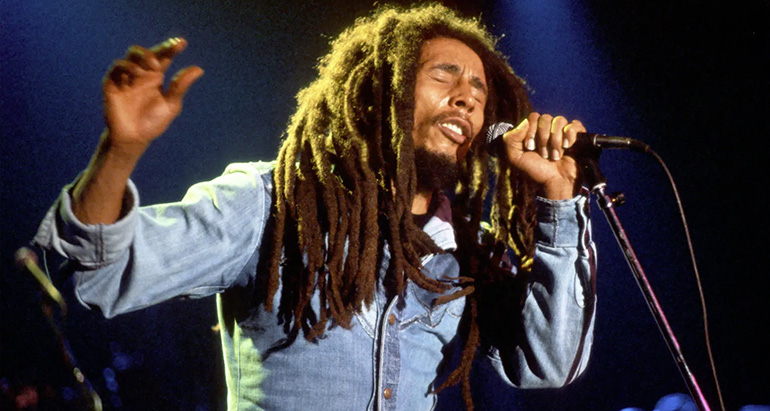
Bob Marley [bɒb ˈmɑː(ɹ)li] (* February 6, 1945 in Nine Miles, Saint Ann Parish; † May 11, 1981 in Miami, Florida; real name Robert Nesta Marley, from March 1981 Berhane Selassie) was a Jamaican singer, guitarist, and songwriter. He was one of the most significant representatives of reggae, of which he was a co-founder, and which became internationally known thru him and his band The Wailers from the mid-1970s onward.
Some of his most famous songs include Buffalo Soldier, Get Up, Stand Up, I Shot the Sheriff, No Woman, No Cry, Could You Be Loved?, Redemption Song, and Stir It Up. In addition to his musical work, Marley spread the message of the Rastafari movement. For its followers and for many people in the Third World, Marley was and is an important figure of identification.
Private life and family
Childhood and Youth
Robert Nesta Marley was born on February 6, 1945, at 2:30 a.m. in the village of Nine Miles in the parish of Saint Ann in the Caribbean island nation of Jamaica, in his grandfather’s house. Other sources give April 6 as Marley’s birth date; some claim he was born in 1944 in Rhoden Hall in the north of the Caribbean island.
His dark-skinned mother, singer Cedella Marley Booker, was 18 years old at his birth, while his white father Norval Sinclair Marley, a captain in the British Army, was already about 60. The marriage was a scandal and led to Captain Marley leaving the army.
Bob Marley later hardly spoke about his English father. According to several reports, his relationship with his mother was short-lived. According to other reports, he struggled to make ends meet with a grocery store and only left years later.
Roberts’ childhood was shaped by the culture of the black majority population, by magical beliefs, by goblins, the notion of spirits, and countless stories, but also by the specific form of Christianity practiced in the then British colony of Jamaica.
Marley spent his childhood years in the rural town of Rhoden Hall. He followed his mother to Trenchtown, a district of the Jamaican capital Kingston, when he was 12, hoping to find work.
At 16, he dropped out of school and, at his mother’s request, became a mechanic. After a few years, however, he gave up working in a bicycle repair shop and fulfilled his dream of becoming a musician.
Marriage, Family, and Children
On February 11, 1966, Marley married his Cuban childhood friend Rita Anderson. The very next day, he set off for the USA to visit his mother, who lived in Delaware. There, he also worked for some time to finance his music career. But soon he was drawn back to his homeland, Jamaica. With his wife Rita, he had four biological children and one stepchild, whom he adopted after the wedding: Cedella (* 1967), David (Ziggy) (* 1968), Stephen (* 1972), Stephanie (* 1974), and Sharon (* 1964, adopted). Ziggy, Cedella, Stephen, and Sharon perform together as the reggae band Ziggy Marley and the Melody Makers.
Marley officially recognized twelve children, eleven biological and one adopted. According to various reports from his hometown and his close circle, however, he is said to have had between 22 and 46 biological children. Seven of his illegitimate children were born when he was already married to Rita.
Illegitimate Children
- With Janet Hunt: Rohan (* 1972)
- With Patricia Williams: Robbie (* 1972)
- With Janet Bowen: Karen (* 1973)
- With Lucy Pounder: Julian (* 1975)
- With Anita Belnavis: Ky-Mani (* 1976)
- With Cindy Breakspeare: Damian (* 1978)
- With Yvette Crichton: Makeda (*1981)
Just like the children he had with his wife, Ky-Mani, Julian, and Damian also successfully launched solo careers as reggae musicians.
Faith
From the mid-1960s onward, Bob Marley increasingly identified with the religion of Rastafari. In 1967, he converted from Christianity to Rasta. The Rastafari refer to the Bible, wage a struggle against the oppression of Black people, and hope for their future return to Africa. They wear twisted, matted hair, the dreadlocks, which give them a lion-like appearance. Religion, with its spiritual and mystical elements, also had a great influence on Marley’s music. Religious rhetoric characterized his songs and gave them a hypnotic aura. In interviews, he liked to quote from the Old Testament.
Eight months before his death, on November 4, 1980, he was baptized in the Ethiopian community church in Miami, at the urging of his mother and in light of his advanced illness, according to the Christian Orthodox rite.
Marley and Politics/Assassination Attempt and Peace Initiative
In December 1976, a peace concert titled “Smile Jamaica” was to be held in Jamaica at the initiative of the social-democratic People’s National Party (PNP) to make a statement against the dramatically increasing political violence on the island. Marley, who had always explicitly distanced himself from Jamaican politics, but was generally considered a PNP sympathizer, agreed to perform. On December 3, 1976, two days before the concert, unknown assailants broke into his house and injured him, his wife Rita, and his manager Don Taylor with several gunshots. Taylor and Marley’s wife were seriously injured but later made a full recovery. Bob Marley suffered minor injuries to his chest and arm and was able to perform at the 90-minute concert.
The background of the act and the perpetrator could never be fully clarified. Numerous speculations surround the event. Many observers believe there is a connection with Marley’s participation in the peace concert and suspect the perpetrators of the assassination to be linked to the right-wing Jamaica Labor Party (JLP) or even the American CIA.
In 2014, the Jamaican writer Marlon James processed the assassination attempt on Marley in his award-winning novel A Brief History of Seven Killings.
After civil war-like clashes between supporters of the PNP and the JLP, Bob Marley invited Jamaican Prime Minister Michael Manley (PNP) and Opposition Leader Edward Seaga (JLP) on stage at the One Love Peace Concert in Kingston in 1978 and gently urged the initially reluctant opponents to shake hands in a public display. Supporters of both parties largely ceased the violent confrontations.
Death
In the fall of 1980, Marley was supposed to achieve his final breakthrough in the USA as part of a tour with the group The Commodores and Lionel Richie. After a foot injury that the football fan had sustained while playing in 1977 and which he did not have treated because of his Rastafarian ideology, his physical condition deteriorated. Later, a metastatic melanoma (“black skin cancer”) was diagnosed on one of his big toes. After the first concerts in the USA in September 1980 in Boston, Providence, and Madison Square Garden, he collapsed while jogging in Central Park in New York. The diagnosis was: tumors in the liver, lungs and brain. His last concert was on September 23, 1980, at the Benedum Center in the Stanley Theater in Pittsburgh, Pennsylvania.
After the specialists at the Sloan Kettering Cancer Center in New York had predicted that he had only a few weeks left to live, Marley turned to the German doctor Josef Issels, who ran a clinic for hopeless cancer patients in Rottach-Egern on Lake Tegernsee in Bavaria and used methods that were not recognized by the medical community. Marley moved there for treatment and lost his dreadlocks thru chemotherapy, which was a catastrophe for him as a religious Rastafarian. The climate, especially the unusually low temperatures for Marley, were an additional burden.
During the therapy, Marley was baptized as a member of the Ethiopian Orthodox Tewahedo Church under the name Berhane Selassie (“Light of the Trinity”) – in reference to the last Ethiopian Emperor Haile Selassie, who is considered by Rastafarians to be the prophesied returned Messiah in the Bible. On May 8, he decided to return to Jamaica to die. However, during the stopover in Florida in the early hours of May 11, he was already too weak to continue. He was taken to the Jackson Memorial Hospital, where he died at around 11.30 a.m. His coffin was taken to his home village of Nine Miles in Jamaica. As part of a national day of mourning, he was buried in a mausoleum with a Bible, his red Gibson guitar, a branch of marijuana and a ring that is said to have been given to him by Haile Selassie during a private audience.
Marley’s widow Rita still manages the estate, which is estimated to be worth $600 million. On his 60th birthday, there was confusion over a reported statement by his widow that his body would be exhumed from the mausoleum in Nine Miles and buried in a shrine in Shashemene, Ethiopia. The reports caused excitement and outrage in Jamaica and were later denied.
Career
Early Years
Life in the slums of Kingston was marked by hopelessness and violence. For many young people, music was often the only way to escape the dreary everyday world. One of these young people was Jimmy Cliff, who had already recorded some songs at the age of 14. Jimmy introduced Marley to Leslie Kong, a local music producer. With Kong, he recorded his first single, “Judge Not.” Neither Judge Not nor his 1962 single One More Cup Of Coffee sold particularly well, so Marley parted ways with Kong.
Marley was fascinated by the music of American radio stations, by soul, country, pop, and rock. He particularly loved Fats Domino and Ray Charles. Thru his love for this music, he met Neville O’Reilly Livingston, better known as Bunny Wailer, and became friends with him. Together, they attended a music course run by the famous Jamaican singer Joe Higgs. In this course, they met Winston Hubert McIntosh, who later became known as Peter Tosh, and became friends.
Bob Marley & The Wailers
Together with Beverley Kelso, Junior Braithwaite, and Cherry Smith, the three founded the group The Teenagers in 1963 (later known as The Wailing Rudeboys, then The Wailing Wailers, and finally The Wailers). Kelso, Braithwaite and Smith were only involved in the first hit single “Simmer Down” (1964) and “It Hurts To Be Alone” (1964), “Habits” (1964), “Straight And Narrow Way” (1964) and “How Many Times” (1964) before all three left the group in 1965.
The band’s early pieces were characterized by the then-popular, fast, and danceable ska. By the end of the 1960s, elements of African-influenced Jamaican folk music had also been incorporated by the Wailers. After meeting the musician and producer Lee Perry, the beat was additionally slowed down, and a new music style emerged: reggae. The unusual music fascinated the audience. The band was so successful that Marley was even able to afford a car and renovate a house for his family – he now had two children. Small tours in Great Britain and Northern Ireland, as well as the USA, followed, together with the then completely unknown Bruce Springsteen.
After disputes between Marley and McIntosh, the latter and Livingston left the group in 1974 to start solo careers under the pseudonyms Peter Tosh and Bunny Wailer, respectively. However, Tosh always remained on friendly terms with Marley. Marley’s wife Rita Marley, Marcia Griffiths, and Judy Mowatt formed the vocal trio known as the I-Threes for vocal accompaniment, and additional musicians were hired. At the same time, Marley also started a solo career.
Many of Marley’s songs deal with spiritual themes. The songs contain a message that is difficult to understand without knowledge of the Rastafari religion. Sometimes, his songs also intertwine political (as in “Zimbabwe”) or socially critical (as in “Concrete Jungle”) statements with spiritual thoughts, making it often impossible to separate spiritual from secular content. In addition, Bob Marley also wrote love songs and explicitly political songs, such as the anti-racism song “War.” He began to enrich the English-language lyrics with the vernacular. In his song “Them Belly Full” (1975), he quoted two Jamaican proverbs: “Rien a faal bot di doti tof” (The rain falls, but the earth is hard) and “Pat a bwail bot di fuud no nof” (The pot boils, but the food is not enough). With Marley as a role model, the use of Creole began to spread among Jamaican musicians.
In 1980, he was invited by the Zimbabwean government. He performed at the country’s official independence celebration, which Marley considered the greatest honor of his life.
Musical Heritage
Peter Tosh, like the Wailers’ drummer, Carlton Barrett, was murdered in Kingston. Due to the ongoing violence, the Wailers eventually left Jamaica. Bob Marley’s musical legacy lives on as an everlasting part of music history. Thus, the prominent Brazilian singer and songwriter Gilberto Gil dedicated his album Kaya N’Gan Daya to him. Marley’s song Get Up, Stand Up became an unofficial anthem of Amnesty International. In 1994, Bob Marley was posthumously inducted into the Rock and Roll Hall of Fame. For his 60th birthday in 2005, memorial concerts were held worldwide, as well as major anniversary concerts in Addis Ababa and Kingston.
So far, his recordings have sold over 75 million copies. In addition, the Marley brand generates substantial sums thru music sales, merchandising, and the trade of memorabilia, resulting in a revenue of over 20 million US dollars in 2014 alone.
Rolling Stone ranked Marley eleventh on its list of the 100 Greatest Musicians of All Time, as well as the 100 Greatest Songwriters of All Time, and nineteenth on its list of the 100 Greatest Singers of All Time.
Awards
- United Nations’ Peace Medal of the Third World (1978) Order of Merit (1981)
- For an overview of all gold and platinum awards, see Bob Marley/Awards for music sales.
Honors:
In 2017, the Australian spider species Desis bobmarleyi was named after him. The authors associated the lifestyle of the spider, which lives in the surf zone on corals and rocks. with the song High Tide or Low Tide.
Marley’s music in film
Marley’s music is often used as a soundtrack or background music in films. For example, the song “Three Little Birds” was used as the soundtrack for the film “I Am Legend” and as background music in the film “Strange Days.” In the film La Haine, the song Burning and Looting was used. In the US series The Simpsons, the song Jammin’ is played in the episode The Canine Mutiny (1997). Jammin’ was also used in the film How High.
In 1982, the film Countryman, dedicated to Bob Marley, was released, which could be seen in German cinemas under the title Countryman – Lost in the Jungle. Marley’s words and music provided the inspiration for this film, which was produced by Chris Blackwell, the founder of the music label Island Records. The director and screenwriter was Dickie Jobson, who was manager of Bob Marley & The Wailers from 1973 to 1974. In addition to Marley, other well-known reggae artists also provided music for films, including Aswad, Lee Perry, and Steel Pulse.
International Tours
- April to July 1973: Catch a Fire Tour – England, USA
- October and November 1973: Burnin Tour – USA, Jamaica, England
- June and July 1975: Natty Dread Tour – USA, Canada, England
- April to June 1976: Rastaman Vibration Tour – USA, Canada, Germany (Hamburg, Düsseldorf), Netherlands, France, England, Wales
- May and June 1977: Exodus Tour – France, Belgium, Netherlands, Germany (Munich, Heidelberg, Hamburg, West Berlin), Sweden, Denmark, England
- May to August 1978: Kaya Tour – USA, Canada, England, France, Spain, Sweden, Denmark, Norway, Netherlands, Belgium
- April and May 1979: Babylon by Bus Tour – Japan, New Zealand, Australia, Hawaii
- October 1979 to January 1980: Survival Tour – USA, Canada, Trinidad and Tobago, Bahamas, Gabon
- May to September 1980: Uprising Tour – Switzerland (Zurich), Germany (Munich, Cologne, Kaiserslautern, performance at WDR-Rockpalast in Dortmund on June 13, Hamburg, West Berlin, Kassel), France, Norway, Sweden, Denmark, Belgium, Netherlands, Italy, Spain, Ireland, England, Scotland, USA
