
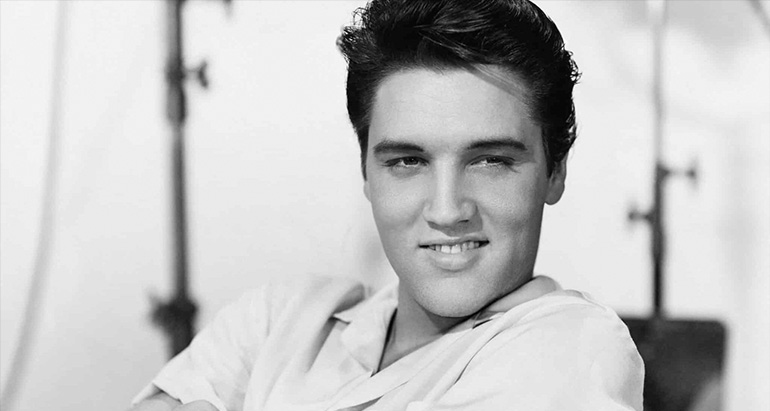
“That’s all right Mama”, a title released by Sun Records, sung by an unknown, dark-haired and handsome young man for his mother Gladys, who was only 19 years old: Elvis … who? many wondered. The young man was called Elvis Aaron Presley and sang this title in 1954. “That’s all right” was the kickstart of a whole new genre of music, which the older generation viewed with some suspicion: the incredibly casual-looking rockabilly, which can also be described as the predecessor of rock’n’roll and rock.
The movements seemed effortless and seemingly done in passing. At that time, no one suspected that the young man with the dark pompadour, the distinctive chin, and the captivating hip swing would soon conquer the whole world.
Profile: Elvis Presley
- Name: Elvis Aaron Presley
- Nickname: The King
- Date of birth: January 8, 1935 Place of birth: East Tupelo, Mississippi, United States
- Parents: Vernon Presley (*April 10, 1916, † June 26, 1979), Gladys Presley (*April 25, 1912, † August 14, 1957)
- Spouse: Priscilla Presley (married 1967-1973)
- Children: Lisa Marie Presley (*February 1, 1968)
- Date of death: August 16, 1977
- Place of death: Graceland, Memphis, Tennessee, United States
- Burial: August 18, 1977, Graceland, Memphis, Tennessee, United States
- Height: 182 cm
- Hair color: dark blonde (dyed black)
- Eye color: blue
He and his music hit like a meteorite. He was white, but sang blues and soul with a black voice that was inimitable. With his previously uncommon emphasis on energetic physicality, his emotional singing style, and a voice spanning three octaves, he became a live entertainer who effortlessly blended such diverse genres as blues, gospel, country, rock, and pop.
Numerous awards and honors in five Hall of Fames, as well as presence in all major Billboard charts with many number-one hits, accompanied his career. However, his life was not to last long, as Elvis, as he was simply called, could not cope with his incredible fame. Already by the end of the 1960s, the first signs of various diseases were emerging, and the 1970s seemed to be an eternal struggle.
On August 16, 1977, the world sank into collective mourning, as it had not known since the violent death of John F. Kennedy in November 1963: Elvis was found lifeless in the bathroom of his Graceland estate in Memphis by Ginger Alden, his then-girlfriend. As we know today, his life ended in a not very glorious way due to a bowel disease with intestinal obstruction. Excessive eating habits and no less excessive drug abuse certainly contributed to his not-so-glamorous departure.
The Story of Elvis Presley
1935 – 1953: Childhood and Adolescence: The Bridge Builder Between Black and White
Elvis Aaron Presley delighted the world with rock ‘n’ roll and was a bridge builder between black and white. Born on January 8, 1935, in East Tupelo, Mississippi, Elvis influenced the music world like few other artists before and after him. Many musicians who later became famous have said that Elvis had a significant influence on them. However, nothing indicated that this son of a worker would one day become one of the most famous personalities on the planet, that almost everyone in the world, no matter which country, would know his name and his music.
Modest circumstances in the South
His father Vernon worked as a farm laborer, his mother Gladys was a seamstress. The Presley family lived the typically modest life of simple people in the South. This lower social class was also referred to as “White Trash.” The roof over their heads was a typical Southern white, self-built wooden house. Unimaginable by today’s standards, this house cost a whole 80 dollars, a lot of money for a family with a modest income. They couldn’t afford glass windows.
Gladys Love Presley, born in 1912, also came from a poor farming family in the South. She had eight siblings, of whom only five are known by name. The father worked as a cotton farmer but had to take on side jobs repeatedly to feed the large family. Gladys’ mother died of tuberculosis at the age of 59. Her father, Robert Lee Smith, died unexpectedly of pneumonia in his mid-fifties when Gladys was 19. To support the family financially, the young woman worked as a seamstress.
She regularly attended the community church in Tupelo, which then became a joyful focal point in the otherwise unremarkable life of the young woman. There, she noticed the four years younger Vernon Presley, in whom she immediately fell in love. Soon, the young couple got married, but the dates on the marriage license had to be falsified because Vernon was only 17 years old on the day of the wedding, June 17, 1933, and thus not yet of legal age. Vernon, born in 1916, had four siblings, and his parents were devout Christians, so a close connection to the church developed early on. Church services and prayers were part of the regular daily rituals of the Presley family. Just a year later, Gladys became pregnant.
1938: Arrest of Vernon Presley for Check Fraud
When Elvis was just two years old, the family got into serious trouble, as his father Vernon was arrested for check fraud and sentenced to three years of hard labor in 1938. However, a year later he was released early. During his father’s absence, Elvis developed a close relationship with his mother, Gladys. This was not only due to his father’s absence but also to his birth, as Elvis had a twin brother, Jesse, who did not survive because he was stillborn. The little Elvis was now the apple of Gladys’s eye, for whom she did absolutely everything. And later, Elvis did absolutely everything for his mother. Mother and son had a very special relationship with a language of their own that outsiders could not understand. Even as a teenager, the boy sometimes still slept in his mother’s bed.
A special birthday gift
The church choir in the local free church community initially became a familiar place for the boy. His talent was not innate, and initially, he had wished for a bicycle for his 11th birthday. However, this wish was not fulfilled, as his father preferred to give him a guitar instead. However, the disappointment over the unfulfilled birthday wish quickly disappeared, and the boy instead became friends with his birthday gift, as he discovered that playing the guitar was quite a nice pastime. Elvis taught himself to play the guitar without any instruction. Who knows how Elvis’s life would have turned out if his father had actually given him the bicycle he wanted. Perhaps the world would have been poorer by one fascinating artist.
First musical experiences in the church
Quickly, the boy with the guitar was able to prove his talent at performances. An uncle of his mother was a preacher in the Assembly of Good Church, the free church community to which his parents belonged. There were no inhibitions here with the black population, who introduced the whites to the tradition of gospel and spirituals.
In addition to the typical black gospel music, the young man also liked country music; his idol was Carvel Lee Ausborn. The stars of this genre were popular radio stars. At that time, however, only a few families could afford such a device, so people gathered with some friends around the few radio receivers in the neighborhood. Here, the music of the stars of the “Grand Ole Opry” was played. Listening to the radio was one of the few expensive pastimes.
Elvis attended East Tupelo Consolidated School, another piece of the puzzle on his way to becoming a global star. A primary school teacher spotted the boy’s talent beyond the church choir and sent Elvis to a radio talent contest at the Mississippi-Alabama Fair and Dairy Show, where he sang an a cappella song and came in fifth. The prize was tickets for the rides at the county fair. On the occasion of this joyful event, the proud parents gifted their talented son the guitar, which would now become an important stepping stone on his path to becoming a world-renowned singer.
No qualms about contact with the black population
In the poor district of Tupelo, the white population lived door to door with the African Americans, which was by no means a matter of course due to the strict racial segregation, for the poor white underclass still considered themselves better than the blacks. The young Elvis, however, had no qualms, because blues and soul were in the blood of the black people. No matter how talented a white musician was, he could not convey this genre of music as well as the African Americans. And so, the 11-year-old Elvis was repeatedly drawn to the neighborhood of the African American community and their nightclubs, where he internalized the blues music.
1948: Move to Memphis
When the family moved to Memphis, Tennessee in 1948 in the hope of a better economic future, Elvis discovered the diverse music scene of the Southern metropolis. Even here, the starting situation of the Presley family seemed to have little future potential. At least the three of them were able to move into a social housing unit in the newly built Lauderdale Courts neighborhood after staying in various boarding houses.
Many fans remember the star’s striking stage outfits and equally distinctive long sideburns in the 1970s. In fact, Elvis already displayed a similar appearance as early as the late 1940s. The previously typical American average boy changed significantly during this time, as he copied the style of African American artists who loved flashy clothing and hairstyles. The teenager attended Humes High School but remained connected to music and the African American community. Beside country, Elvis also liked classical music. Shortly before his high school graduation in 1953, the student participated in a talent competition and emerged as the winner.
Head of the family, Gladys Presley
Anyone who knew little Gladys Presley, who took such loving care of Elvis, at that time could hardly believe that in her earlier years she was quite a lively young girl. Gladys loved to dance the Charleston and was so charming that she often danced for the entertainment of the farming family for whom she worked. It was only with the death of her father that this carefree, if modest, time came to an end. Everyone agreed that the lovable Gladys, who quickly made friends even in the factory where she worked as a seamstress, had rhythm in her blood, which she probably passed on to Elvis.
Gladys was the head of the family, for by nature she was more assertive and pragmatic than the calm and sensitive Vernon, who mostly went with the flow and kept the family afloat in their new home of Memphis with odd jobs, more poorly than well.
Although many found it strange that she, and not Vernon, was the authoritative head of the household, Gladys still managed not to be perceived as dominant, especially since she sincerely loved her husband despite all his weaknesses. Moreover, it was not the norm for women of this generation to take on the role of head of the family. This was even more true for the tradition-conscious Southern families. However, Gladys was not destined for a long life, as she fell ill with hepatitis in 1958. At that time, Elvis was undergoing his basic military training in Texas as his mother’s health continued to deteriorate. Gladys could not come to terms with her son’s stay in distant Texas. When the news of Elvis’s deployment to Germany arrived, the mother felt as if her world had collapsed. For some time she had been taking pills for her depression, which was due to the constant worry that something might happen to her son. On August 14, 1958, Gladys Presley died at the Methodist Hospital in Memphis. Elvis had rushed to his mother’s bedside, but his hopes for an improvement in her health were not fulfilled.
From this time, numerous photos exist that document the interest in the young artist and his private life. Among other things, these recordings show Vernon, Elvis and Gladys on the day of his departure for military basic training, Elvis holding the hand of his deceased mother at the hospital bed, and Vernon and Elvis on the terrace of his new estate Graceland in united mourning for the wife and mother. It is said that Elvis never got over the death of his mother. The young artist with the incomparable blues voice and the characteristic hip swing, who appeared so jovial and casual on stage and later in his Hollywood films, did not hesitate to say about his mother: “She was all I had, my best friend, the meaning of my life.” He sent fresh flowers to his mother’s grave every day, and many believe that Elvis ultimately died of a broken heart, as he never got over his mother’s death.
1957: Move to Graceland
Since Elvis’ breakthrough in 1954 and worldwide hits like “Jailhouse Rock,” “Love Me Tender,” and “Heartbreak Hotel,” the cash register was ringing, and the Presley family’s standard of living had suddenly improved for the better. The young artist had already bought a beautiful white wooden house on Audubon Drive, but now he bought an old villa called Graceland for 102,500 dollars. He made a cash down payment of 0,000 and used another $55,000 from the sale of the old home, which still had a $37,500 mortgage, but that was no problem with his current income.
From 1939 onward, the former farmhouse was converted into a Southern-style plantation house in the Colonial style. The name Graceland goes back to the former owner Grace Toof, who inherited the estate from her father and managed it with her family until 1939. Elvis decided to keep the melodious, soon world-famous name of the villa. He had extensive renovations carried out that reflected his extravagant taste. Other renovations included a swimming pool, racquetball room and meditation garden. A wall and an iron gate, including access control, were to protect the King from his fans, who had already regularly besieged his last residence.
Over the years, Graceland has been repeatedly expanded and made accessible to the public as a museum after Elvis’s death. In a separate building, the car collection and some of Elvis’s stage outfits are located. In addition, countless awards that Elvis Presley won during his career are on display.
1958 – 1960: Military service despite rising career
Three months after purchasing the property, the singer moved into his new home on June 26, 1957, together with his parents. Unfortunately, Gladys Presley would not have long to enjoy the family’s new prosperity. From 1954 to 1977, Elvis performed numerous TV and live shows, his legendary concerts were always sold out.
The young and still largely unknown artist gave his first performance on July 17, 1954, at the Bon Air Club in his hometown of Memphis.
On June 26, 1977, he was to stand on a stage in Indianapolis for the last time in his life. The tour planned for August 17 could no longer take place due to his early death at the age of 42.
As early as 1956, the artist who revolutionized the music world with his blend of rock, blues, and soul was in such demand that he gave 140 concerts in 20 US states. In 1957, he took it a little easier with 22 concerts in eleven states. Despite his rising career, he followed his conscription order without complaint. After his basic training, he chose the normal soldier’s life and did not claim any special rights like other famous artists.
He completed his military service by March 2, 1960, in Bad Nauheim near Wiesbaden.
The citizen’s terror of Memphis with the right enemies
For two years he delighted Germany, the only extra treatment he allowed himself was a privately rented house. Here too, family ties were close, as his father and grandmother accompanied him. In military service, he proved to be sociable, down-to-earth, and friendly toward his comrades. He had leadership qualities, received several commendations, and left the army after two years with the rank of sergeant. His manager Colonel Tom Parker knew how to use this exemplary behavior to his advantage and to make the former Memphis public menace known to a value-conservative audience. For they hated Elvis Presley not only because of his stage performances, which were considered amoral at the time, but also because of his affinity for the black population, an unacceptable attitude in the racially charged South of the USA and in times of rising racial unrest.
The Southern press often attacked the young singer in a scathing tone, who had the right enemies here, but it did not impress him. The hip-swinging performances of Elvis were often compared to the supposedly indecent, sexualized lives of “niggers.” It should not be forgotten that, especially in the Southern states, race riots were rampant from the mid-1950s due to the strengthening civil rights movement under Martin Luther King.
The black population was considered the ultimate enemy by the white majority, a sentiment that dated back to the time of the American Civil War 100 years earlier. Colonel Tom Parker therefore saw Elvis’ military service as a godsend. He actually managed to increase the acceptance of the young singer even in the conservative and backward-looking South of the USA. During this time, the musician and soldier developed a great love for karate, took lessons, and maintained this passion for martial arts throughout his later life.
However, his military service was not only to have a positive impact on his career but also to change his private life, as he met the ten-years-younger Priscilla Ann Beaulieu, whose stepfather, the Canadian Air Force officer Paul Beaulieu, had been transferred to Wiesbaden in the late 1950s. When Elvis and Priscilla met in 1959, she was only 14 years old.
Beside military service, life in Bad Nauheim was quite relaxed. Elvis’s house was regularly besieged by fans. Elvis maintained contact with his fans, was approachable, and was not at all the big world star. Many a party also took place in this house, but wisely without any scandal. Thus, the famous American was also very popular with the city fathers of Bad Nauheim.
During his military service, he first came into contact with amphetamines, which were given to soldiers to stay awake during long maneuvers. Back in the States, in 1960, Elvis received the incredible sum of 25,000 for an appearance on Frank Sinatra’s show. In 1961, the hip-swinging artist was only seen in concerts and live performances for charity in Memphis and Hawaii. An important event was the Pearl Harbor Benefit to commemorate the soldiers who fell on the US military base on December 7, 1941.
1967: Marriage to Priscilla
Since 1963, Priscilla lived in Graceland, even tho she was still a minor at the time, as young people in the USA only reach adulthood at 21. For the time, this model of cohabitation was actually an immoral abomination, but it was largely accepted without much fuss. Priscilla’s parents agreed to this arrangement on the condition that Elvis would pay for the young woman’s further education and marry her when she came of age. During this time, Priscilla graduated from high school.
On May 1, 1967, Elvis fulfilled his promise and married Priscilla in Las Vegas. Their daughter, Lisa Marie, was born on February 1, 1968.
1956 – 1969: Hollywood
Not only with his films, but also with his music, Elvis was able to seamlessly continue his career from before his military service. He regularly landed hits and was still everyplace. Although Colonel Tom Parker had a great influence on Elvis’ life, he did not interfere in artistic matters. Only his million-dollar hit “Are You Lonesome Tonight” was based on a suggestion from Parker.
From 1956 to 1969, Elvis made 27 films, mostly portraying him as a singing heartthrob and ladies’ man. His successful but undemanding films, which mostly presented Elvis as a singing heartthrob, led him into an artistic cul-de-sac. The films that showed him in a more dramatic light and singing less, such as “Flaming Star” and “Wild in the Country,” were significantly less successful at the box office than his Hawaiian films.
From 1969: renewed appearances on television
Although Elvis continued to release sophisticated studio albums that did well in the charts, his career as a singer was closely tied to his career as an actor in undemanding roles in successful films with successful soundtracks. This development stifled him artistically, which frustrated him because he would have liked to have taken more risks.
However, his record label and manager Tom Parker ensured that he did not stray from commercially successful paths. However, Parker paved the way for Elvis’ return to live television. With his TV special on December 3, 1968, the singer achieved a market share of 42 percent with a repertoire of well-known and new songs. The 1966 album “How Great Thou Art,” a gospel album in which Elvis could showcase all his artistic talent, also contributed to this success.
Elvis is no longer the King in the music business.
Nevertheless, he was no longer the undisputed king among fans of all ages, as trends increasingly favored trendy rock bands and solo artists from Britain and his own homeland. In addition, the hippies of the Flower Power generation and rock events like Woodstock marked the beginning of a new era. Nevertheless, the King was a role model and idol for many of these young musicians. For the world-famous Beatles, a meeting with Elvis at Graceland was a special experience. The usually cool guys, who had exploded in the music business just like Elvis, sat reverently on the sofa and didn’t dare to say anything. Elvis grinned and said, “Listen, guys, if you just sit there and stare at me, I might as well go to bed.” The ice was broken, and the musicians spent enjoyable hours together.
Elvis Presley and Colonel Tom Parker: Equal Business Partners
It was time to counter Elvis’s impending decline. It was Colonel Tom Parker who became active again and began negotiations with the major casinos in Las Vegas. Parker had completely dedicated his managerial life to Elvis Presley. Nasty tongues said he only needed that one client, because Elvis was his cash cow, bringing him 50 per cent of the takings. For most, Colonel Tom Parker was a man who seemingly had no past, a villain who was not good for Elvis.
Others, on the other hand, praised him for his dedication to Elvis, for his almost 24-hour-a-day care. Before each performance in every city, Parker was already on site several days in advance, preparing everything down to the smallest detail. He reached out to the fans and appeared open and friendly, which was well received. In 1969, Elvis and Parker extended their joint contract, making them equal business partners.
A spectacular comeback: the King of Las Vegas
1969 marked the beginning of a long phase of concerts and live performances in Las Vegas, after he had spent the previous years more as an actor than a singer. The International Hotel had booked him as the top act for the entire year. In total, Elvis performed there more than 800 times. In the following years, numerous live performances followed there and in other hotels in Las Vegas.
In addition, Elvis also gave concerts in other states from time to time. In the years leading up to 1977, he completed more than 1,000 live performances and concerts. In 1970 and 1972, two documentaries were released. In 1973, the legendary TV special “Aloha from Hawaii” was broadcast via satellite around the globe, a technical sensation for that time. In his last two years of life, however, concerts were increasingly canceled due to his visibly poor health. At least he managed to give 55 concerts in 22 states in 1977.
During the last few years, Elvis Presley’s appearance had visibly changed. His significant weight gain and puffy face were particularly noticeable. The sideburns grew longer and the formerly carefully gelled quiff was replaced by a black tousled hairstyle. At first, Elvis appeared in casually styled black suits with nods to karate, but soon he preferred jumpsuits, which became more extravagant and eye-catching over the years. The outfits were mostly white, always elaborately embroidered with glittering ornaments, pearls, and rhinestones. Despite this external transformation, he still thrilled his fans worldwide, even tho some believed that his stage appearance was too flashy and kitschy.
1973: Divorce from Priscilla
Despite his significantly changed appearance, the singer still seemed like a magnet to people. His charm had always captivated the ladies, and Elvis knew how to use this fact to his advantage. His love for women also doomed his marriage to Priscilla, who was actually the great love of his life. Nevertheless, he repeatedly had affairs and made no effort to keep this fact a secret. In 1973, Priscilla finally had enough and filed for divorce, which hit the King hard. Priscilla said she wasn’t leaving because she no longer loved Elvis; on the contrary, she wanted to see what else the world had in store for her.
Most women had a romantic image of the King, who always came across as casual, cool, but also incredibly sensitive and nice in his Hollywood films. Elvis had precisely relied on this image, as he had neither television nor live performances during his time in Hollywood. Therefore, many female fans dreamed of a relationship with this sensitive charmer. However, the reality was different. Elvis’s fame had risen to such astronomical heights that a normal life with him was hardly possible. What mattered was Elvis Presley; the entire universe revolved around him. There was little to no room left for Priscilla and her needs. In addition, he had changed significantly not only in appearance but also in character since the late 1960s.
The first health problems became noticeable, which visibly increased during the period from 1969 to 1977. One reason for this change was also the packed schedule, as Elvis spent a large part of the year on concert tours, an incredibly exhausting program. For his back pain, he took painkillers; for his sleep problems, sleeping pills; and for his fatigue, stimulants.
1972: Linda Thompson
Soon he noticed the positive effect of morphine on his pain and psyche, which, however, had a negative impact on his body. He visibly gained weight, his face appeared puffy and pale. Gradually, more “miracle drugs” like codeine, Valium, and Benadryl were added.
While Priscilla was ten years younger than him, during his last years, Elvis preferred the company of very young women. In 1972, he met Linda Thompson, a fun-loving blonde with a penchant for revealing clothing. However, appearances were deceiving, as the 18-year-old girl had not yet had a boyfriend at that time. Even as a little girl, she had idolized Elvis and told her parents that one day she would marry the King. As she herself says in retrospect, she was naive and totally romanticized Elvis; she had completely false ideas about him. Linda also fell for the public image of the nice, sensitive musician with the incomparable melt in his voice. She stayed by Elvis’s side for four years, a time during which she also got to know the less pleasant sides of the singer. As in Priscilla’s time, Elvis also had various affairs at this time and made no effort to keep them secret from the young woman. At the same time, however, he made absolute claims regarding Linda and forbade her from even looking at other men.
Despite his affairs, he had developed a certain emotional dependency on Linda, as he couldn’t bear not being the absolute center of attention in the lives of those in his immediate circle. Linda, in turn, had developed a strong emotional attachment to her Prince Charming and put up with his hurtful behavior and increasing pill consumption. If Linda dared to criticize him for his affairs, he became upset and yelled at her; once, he even threw a plate of spaghetti at her.
Sometimes Elvis, probably under the influence of various medications, also tended to violent outbursts. Once, he shot thru the bathroom and missed Linda, who was behind it, by only a few centimeters. In terms of their intimate relationship, Elvis developed some bizarre traits, according to Linda, which were hard for her to bear. She saw the musician as he really was, even when he was not very attractive and not very charming. Because of his heavy drug abuse, Elvis sometimes fell asleep right where he was. Once, this addiction almost cost him dearly, as he was singing with his head in the soup bowl. He was lucky that Linda was present at the time and saved him from drowning in the soup bowl.
1976: Linda leaves, Ginger arrives
After four years, she had finally had enough; she knew that a relationship with such a dominant, world-famous man, who only revolved around himself, while at the same time couldn’t cope with the overwhelming fame and was increasingly developing addiction problems, was not possible. In 1976, she broke up with Elvis, another blow to the ailing world star, who quickly consoled himself with the even younger Ginger Alden.
The young woman had met Elvis thru her older sister. The musician quickly developed an interest in the shy young woman, who seemed so different from her peers. She was artistically gifted, shared Elvis’s taste in music and books. The couple read books and listened to music together; Ginger became the center of Elvis’s life yet distinguished herself with a refreshing modesty.
Elvis seemed to calm down a bit and sometimes even appeared less battered. Only Ginger had no influence on his pill consumption. She accompanied him to all the concerts. If she wasn’t there, Elvis was unhappy. She was also supposed to be at his concert on August 17, 1977, because the King intended to announce his marriage plans with Ginger after the concert. The man who always wanted to be in control, but who lost control of many things due to his excessive lifestyle, was already making plans, right down to the exact design of the wedding ring. At that time, Elvis and the half-younger Ginger had known each other for just nine months.
August 16, 1977: The Unthinkable Happened, Elvis is Dead
August 16, 1977 plunged the world into collective, almost hysterical mourning, for the unimaginable had happened: the King was dead, found in the bathroom of his Graceland estate by his fiancée Ginger Alden at 2:00 PM local time. She had tried to administer first aid, but the lifeless Elvis showed hardly any signs of life. Ginger quickly realized that there was no possibility of saving him. The ambulance arrived too late because Elvis was already dead. The death of an artist had rarely caused such an emotional state of emergency. On the day of his death, thousands of fans had gathered in front of his Graceland villa to mourn together and somehow process the unfathomable, and this impression was reinforced a day later during the funeral ceremony.
After the autopsy was completed, the King’s corpse left Baptist Memorial Hospital heading toward Graceland. Thousands of fans were already waiting outside the clinic to pay their last respects to Elvis. From 3 p.m. Elvis was laid out in Graceland and made accessible to the public. By 6 p.m., more than 80,000 people had said goodbye at the open coffin. Due to concerns about the condition of the corpse because of the high humidity and heat, the ceremony was eventually ended.
Outside the gates of Graceland, however, thousands of visibly grieving fans continued to gather. The funeral service took place in the music room of Graceland, attended by the closest family members. Afterward, the hearse, accompanied by a convoy of 17 white Cadillacs, drove to the Forrest Hill cemetery. More than 90,000 people lined the funeral procession, filling almost the entire city of Memphis. Police officers saluted as the car with the coffin passed by them, and once again fans tried to catch a last glimpse of their idol and ran toward the hearse. The police had to maintain order, which was not so easy in this emotional state of exception. The police, however, turned a blind eye on many occasions, as they could understand the fans’ feelings all too well. The funeral procession took four hours to cover the short distance of four kilometers to the cemetery.
Elvis’ manager, Colonel Parker, sat on one of the police motorcycles during the funeral procession and was just as unable to comprehend the death of his protégé as many people around the world. He was visibly marked by his grief and remained apathetic and unresponsive. He decided never to work as a manager for an artist again and withdrew from the public eye. He declined several requests to become a manager again, as there should only be Elvis and the Colonel. Subsequently, Elvis’s remains were interred in a mausoleum ninety meters from his mother’s grave.
His father Vernon was overwhelmed by his grief and announced that he would soon be with him, Elvis. In fact, the father never got over the death of his son, just as Elvis never got over the death of his mother. On October 2, 1977, Vernon Presley obtained a court order to have the remains of his wife and son moved to the Meditation Garden at Graceland. Shortly afterward, three men were arrested in an attempt to steal Elvis’s body and hold it for ransom.
On June 26, 1979, the broken Vernon Presley died of heart failure, having kept his promise during his son’s funeral. Although Elvis’s love, even after her death, belonged to his mother without competition, a close bond also developed with his father. Vernon accompanied his son to numerous concerts and took care of Elvis’s finances. The singer was glad not to have to deal with that part of his life. Elvis’s nine-year-old daughter, Lisa Marie, said, with a blank stare, “I can’t believe Elvis Presley is dead.” US President Jimmy Carter told the American people and the world that a part of the country had died with Elvis Presley.
What led to the death of the King?
The whole world wondered what had ultimately led to the King’s death. Was it fast food and gluttony, drugs, medication or heart failure? This unfortunate combination was probably responsible for his death. The experts involved in the autopsy of the body and the reports came to different conclusions. However, it is certain that Elvis suffered from a chronic bowel disease, for which he was treated for several years, which ultimately, according to today’s doctors, could have led to his sudden heart death.
However, ten different substances were found in the corpse’s blood, including morphine, codeine, and Valium. It had been known for some time
However, ten different substances were found in the corpse’s blood, including morphine, codeine, and Valium. It was known for a long time that Elvis was highly addicted to pills. Some pathologists therefore assume that polypharmacy, the taking of too many medications, was the cause of death. The official cause of death was, however, “hypertensive heart disease,” that is, heart failure associated with high blood pressure. His ex-wife Priscilla Presley confirmed the singer and entertainer’s strong drug addiction and emphasized that many people in his immediate circle had tried to get him off these drugs, but without success, because “you didn’t tell Elvis Presley what to do and what not to do.”
Elvis Presley lives!
To this day, the wildest conspiracy theories surround his death. The saying “Elvis lives” has become a proverbial expression, which not only refers to the fact that the King lives on in the hearts of his fans, but also to the assumption that he is truly still among us. Numerous people claim to have seen him by now. One theory is that he had had enough of his exhausting life as a world-renowned idol without privacy and merely staged his death in order to lead a life in peace without being disturbed.
Another story goes that he is in the witness protection program because he testified against the mafia. The fact is, Elvis is actually alive, because even more than forty years after his death, he is as present worldwide as hardly any other dead artist. The Elvis Presley money machine is very real, because for a dead man, according to a communications scientist, Elvis is very much alive. By the time of his death, the King had sold 500 million records, and today it is estimated to be billions, making him the most successful solo artist of all time.
After his death and the death of father Vernon, Priscilla Presley became his estate administrator. In a recent interview, she said she would never sell Graceland, the estate is sacred to her and Elvis remains her man for life. Priscilla has had two Elvis albums recorded with the London Royal Philharmonic Orchestra and one with Elvis’ songs duetted with other famous personalities. She says Elvis would have liked to experiment more during his career, but his label prevented him from doing so for commercial reasons. She does not want to artistically restrict Elvis and wants to fulfilll his wish for more, which was denied to him during his lifetime. With entrepreneurial skill, Priscilla Presley has turned Graceland into one of the most visited tourist attractions in the USA and increased the Presley fortune by several million.
Elvis has remained true to himself
Elvis has been dead for more than four decades, yet he is still so present as if he were just around the corner. His estate is managed by the company Elvis Presley Enterprises. In 2006, Graceland was declared a national landmark of the USA. The epitaph written by father Vernon Presley is like a tribute to the son. Elvis had always been true to himself and had not changed his style of music when cool rock bands like the Beatles and the Rolling Stones came to the fore and the younger audience could no longer identify with the King. Elvis remained the King and millionaire recording artist of the 1950s, a movie star, a hero for whom apartheid was a strange thing, having grown up with black children as a matter of course, not a matter of course in 1940s and 1950s America.
He had a penchant for all things that sparkled, as evidenced by the rhinestone-studded stage outfits from his concert years. He liked limousines with mother-of-pearl roofs, shoes with fur trimmings, and extravagantly furnished rooms, a garish, glittering mix that somehow seemed nouveau riche and of bad taste. In this respect, Elvis Presley could never hide his proletarian origins, nor did he ever try. He was not one to adapt to the establishment, after all, he was rich and famous enough to afford this refusal. And so, during his concert years, he achieved a spectacular comeback, even tho by that time he no longer matched the musical tastes of the younger generation and, based solely on his appearance, had long since passed the peak of his career.
Elvis Presley knew exactly what he was doing
After his death, accusations were made against those close to him, questioning why no one had done anything in light of his visibly deteriorating health. Neither his bandmates, nor Priscilla, nor his girlfriends Linda Thompson and Ginger Alden could do anything to stop this self-destruction. Everyone around him made sure he had plenty of food when he wanted it and provided him with his pills when he asked for them.
Elvis refused a life-saving bowel operation that might have saved him from the ultimately fatal bowel obstruction. But he would have had to change his eating habits, which were gradually becoming an eating disorder. Once, before a performance, he ate no fewer than 22 hamburgers. Whether it was a reminder of his impoverished childhood, when food was sometimes scarce, he now seemed to derive psychological satisfaction from his Essex excesses. He could and would not do without his pills for insomnia, fatigue, headaches, stomach problems, depression and much more. “He knew exactly what he was doing,” said Priscilla Presley, who was just as overwhelmed by Elvis’ excessive lifestyle and his oversized star universe as he was and everyone else around him.
Colonel Tom Parker, the murderous manager
For many, the inscrutable Colonel Tom Parker is the villain and the one who drove Elvis to his death. He was the one who pushed Elvis into more and more films, hits and live performances, especially during the time when his health was deteriorating and visible to the world, when he was just a “fat drug addict.” According to author Alanna Nash, Tom Parker was “the murderous manager,” an enigma, an opaque contemporary who had illegally entered the USA from his native Holland in the late 1920s, but had never applied for American citizenship.
The fact is, Tom Parker never left the USA for the rest of his life and did not push to establish the successful Elvis concerts outside the country. He did not visit his protégé during his military service in Germany and kept all people in his and Elvis’ environment at a distance.
No one really knew the enigma that was Tom Parker. His friend, the governor of Louisiana, had bestowed the title of Colonel upon him. At the end of the 1940s, anything was still possible, including the rise of Colonel Tom Parker to one of the most gifted, but also most ruthless managers of his time. Before that, he had lived a life as a hobo and in a traveling circus, and had gathered a lot of life experience. He served in the U.S. military, but was discharged early for “emotional instability” and a “psychotic state,” according to his superiors. Both conditions, according to the New York Times, proved useful in show business. Parker learned early on how to manipulate people and sell illusions. He put this life experience to use as Elvis Presley’s manager, launching a gigantic marketing machine after signing the still-unknown young artist in 1954.
Unlike Elvis, Tom Parker, the great illusionist, the creator with the mysterious past, had an incredible survival instinct. Whatever he touched turned to gold, he manipulated others, but remained untouchable himself. The fact is that neither of the two men would have ever become so great in their field without the other. Parker never explained himself in public, and let all criticism slide off him without a word. Even when he was accused of being responsible for Elvis’s poor health, he merely replied that he could sleep well at nite. Tom Parker outlived his protégé by twenty years and received some recognition and accolades at the end of his life. That he had gambling debts in the millions in Las Vegas and was also involved with the Mafia was ignored. His gambling debts disappeared from the books of his creditors immediately after the singer’s tragic end. Because now the marketing machinery around the dead artist was set in motion and he was much easier to control than the living Elvis.
Was Colonel Tom Parker responsible for Elvis Presley’s death? Not directly, rather he was part of a mix that was becoming increasingly threatening. The relentless star machine of Colonel Tom Parker was just one of many reasons that contributed to the death of Elvis Presley. No one could help Elvis, except Elvis himself, and he didn’t want to, until his bitter end in the bathroom of his Graceland mansion in the early afternoon of August 16, 1977.
