
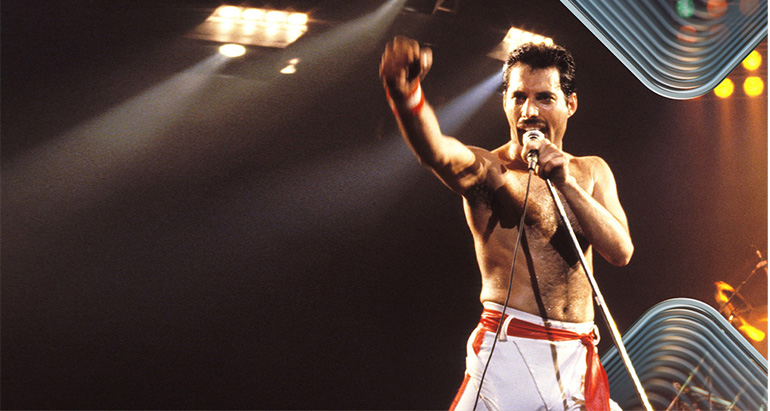
Freddie Mercury (* September 5, 1946, as Farrokh Bulsara in Zanzibar City, Sultanate of Zanzibar; † November 24, 1991, in Kensington, London) was a British musician and one of the most significant rock singers of the 1970s and 80s. He became known as the co-founder, composer, and lead singer of the band Queen. Mercury composed worldwide hits like Bohemian Rhapsody (1975) and We Are the Champions (1977).
Life
Origin and Boarding School Years in India (1946–1963)
Mercury was born on September 5, 1946, as Farrokh Bulsara on the island of Zanzibar in the then British protectorate of Zanzibar. He was the first child of British embassy employe Bomi Bulsara (1908–2003) and his wife Jer (1922–2016). The family came from India and belonged to the Parsis. From the 1954/55 school year, Mercury attended the English-speaking boys’ boarding school St. Peter’s School in Panchgani in the Indian state of Bombay. There he got the nickname “Freddie,” which he kept for the rest of his life. The headmaster of the boarding school noticed Mercury’s musical talent and suggested to his parents that they let him learn to play the piano. In addition, Mercury joined the school choir and took part in performances at the school theater. At the age of about twelve, he became a member of the five-musician band The Hectics, whose performances mainly took place at school events.
Youth and Art Studies in London (1963–1969)
Mercury returned to Zanzibar in the summer of 1963 without a school diploma, which gained independence from British colonial rule at the end of the year. In January 1964, a violent revolution broke out against the Sultan of Zanzibar. Still in the same month, Bomi and Jer Bulsara fled with their 17-year-old son Freddie and his sister Kashmira, born in 1952, to London and moved to the suburb of Feltham. From 1964 to 1966, Mercury attended the then Isleworth Polytechnic (now West Thames College) in West London, where he graduated with an A-Level Certificate (comparable to the German Abitur). From 1966 to 1969, he was an art student at Ealing College of Art, which he graduated from with a diploma in graphic design. During this time, he produced numerous drawings, including portraits of his idols Jimi Hendrix, Rock Hudson, Paul McCartney, and Cliff Richard. He also designed fashionable men’s clothing.
Roadie for the band Smile and lead singer for the bands Wreckage and Sour Milk Sea (1969 to 1970)
Thru his college friend Tim Staffell, Mercury – who was still called Freddie Bulsara at the time – got to know the band Smile, which had been around since 1968. The band consisted of Tim Staffell (vocals and bass), Brian May (guitar), and Roger Taylor (drums). Mercury accompanied the band as a roadie at their live concerts and also contributed his own ideas on how the band Smile should shape their appearance and stage performances. During this time, Mercury and Taylor ran a small stall in London’s Kensington Market. During the course of 1969, Mercury joined the Liverpool-based band Ibex as the lead singer, which began performing under the new name Wreckage in the autumn of 1969. At the concerts of these bands, among other things, the song “Jailhouse Rock” by Elvis Presley could be heard, which was later often played by Queen as well. At that time, he also met Mary Austin, with whom a close friendship developed. In September 1969, the band Wreckage performed at The Sink club in Liverpool, where Roger Taylor and Brian May also participated in the encore. After ending his engagement with Wreckage, Mercury briefly became the singer of the band Sour Milk Sea, with whom he had several performances in early 1970.
Formation of Queen and the stage name Freddie Mercury (1970)
In the spring of 1970, the band Smile disbanded because Tim Staffell left the group. Subsequently, in April 1970, Brian May, Roger Taylor, and Freddie Mercury formed a band together, which Mercury named Queen. The bassist John Deacon joined in 1971. Some time after the founding of Queen, Freddie Bulsara adopted the stage name “Mercury.” The English word “Mercury” has various meanings, such as Mercury, the closest planet to the sun in our solar system, the chemical element mercury, and the god Mercury in Roman mythology, who held the special position of the messenger of the gods. According to Brian May, there is a reference to Mercury’s song My Fairy King from Queen’s first album. In this, a line of the lyrics reads: “Mother Mercury, look what they’ve done to me, I cannot run I cannot hide.” (“Mother Mercury, look what they’ve done to me, I cannot run I cannot hide.”). After this song was recorded, Freddie Bulsara was asked if “Mother Mercury” referred to his own mother, and he replied, “Yes, and from now on I’ll be Freddie Mercury.” (“Yes, and from now on I’ll be Freddie Mercury.”)
Relationship with Mary Austin and Breakthrough with Queen (1970–1979)
In the early 1970s, Mercury lived for years with the London-born saleswoman Mary Austin. The two shared an apartment in the West Kensington district of London. As Mercury’s official partner, Austin also witnessed Queen’s international breakthrough. In 1973, Mercury released a single under the stage name Larry Lurex.
The single “Bohemian Rhapsody,” released in October 1975, topped the UK charts for nine weeks and became Queen’s first number-one hit. The record sold over five million copies worldwide. The single received two platinum and several gold records. For the composition of the song, Mercury received the Ivor Novello Award in January 1976. As an explanation for the interpretable lyrics, the interpretation by Mercury’s longtime personal assistant Peter Freestone can be seen as representative. He argues that Mercury processed his coming out as a gay man in Bohemian Rhapsody. Mercury, who kept his relationships with men and especially his male sexual partners secret, never publicly acknowledged his homosexuality. Around the turn of 1975/76, Mercury privately came out to Mary Austin. However, the friendship with her lasted until his death in 1991.
Relationship with Winnie Kirchberger and Munich Years (1979–1985)
From around 1979 to 1985, Mercury primarily chose Munich as his main residence to record albums there and simultaneously live out his private life in the gay scene without being disturbed by the media. In 1983, Mercury met the Austrian actress Barbara Valentin, with whom he shared an apartment for a time and frequented the gay scene in Munich’s Glockenbachviertel. In the liner notes of his solo album Mr. Bad Guy, Mercury thanked her “for big tits and misconduct.”
At that time, Mercury had rented a luxury apartment on Georg-Brauchle-Ring in Munich and was together with the Munich restaurateur Winfried “Winnie” Kirchberger. In the early 1980s, Kirchberger ran the Sebastianseck at Sebastiansplatz in Munich’s old town. With him, Mercury experienced an intense life partnership and gifted him a car and an apartment. Kirchberger died in 1993 from the effects of AIDS. As early as 1983, Mercury began his work on his solo album Mr. Bad Guy in Munich, which was released in April 1985. He produced it together with the German sound engineer Reinhold Mack, who had already worked as a producer on several Queen albums. It reached the 6th place in the British charts.
Relationship with Jim Hutton and Return to London (1985–1989)
In 1985, Mercury moved into his newly furnished Villa Garden Lodge at 1 Logan Place in the Kensington district of London. From 1985 until Mercury’s death in 1991, Jim Hutton (*1949) was his life partner. He was also HIV-positive and died in 2010 in his native Ireland from lung cancer.
In February 1987, Mercury’s recording of the 1950s Platters title “The Great Pretender” was released as a single. The B-side track, Exercises in Free Love, was later released as a duet with Spanish opera singer Montserrat Caballé. The record reached number 4 in the British charts. Roger Taylor contributed his distinctive voice for the backing vocals. In May 1987, Mercury fulfilled a long-held dream and performed with Caballé at the Ku-Club in Ibiza. In October, the joint single with the anthem “Barcelona” was released, which was chosen by the National Olympic Committee as the theme song for the 1992 Summer Olympics in Barcelona. As part of a charity performance of the musical Time on April 14, 1988, at the Dominion Theater in London, Mercury sang four songs, some of them together with Cliff Richard, the musical’s main actor. This was the last stage performance where Mercury’s singing was heard live.
In October 1988, the album Barcelona was released as a joint project by Mercury and Caballé. All tracks were written by Mercury and Mike Moran. The album spent four weeks in the UK charts, peaking at number 25. On 8 October 1988, Mercury performed at the concert La Nit with Caballé in Barcelona, the music was played from a tape.
Death (1991)
Regarding the time when Mercury learned of his HIV infection, there are no clear indications. According to Mary Austin, he knew on the 1986 Queen tour that it would be the last because of his illness. Barbara Valentin claimed to have learned of it from him in 1985. According to David Wigg, a close friend of Mercury’s, the singer already knew about his HIV infection in 1984. Mercury’s last partner, Jim Hutton, only found out in 1987.
In the summer of 1991, rumors intensified that Mercury was seriously ill and suffering from AIDS, which was reported by tabloids around the world. His immediate circle kept his true health status and the nature of his illness secret for several years. There are also conflicting reports about when his bandmates learned of Mercury’s HIV status. According to Jim Hutton, they found out in May 1989. In Brian May’s biography, it is stated that Mercury gathered the band members in Montreux in January 1991 to reveal the truth about his health condition. In Clarens, near Montreux, Mercury owned a villa on the shores of Lake Geneva (location). The boathouse is depicted on the cover of the 1995 album “Made in Heaven.”
On November 23, 1991, Mercury informed the public in a written statement that he had contracted AIDS. After falling into a coma the next morning, he died that evening at his home in Kensington, London, at the age of 45 from complications of pneumonia. The funeral was held on 27 November 1991 in private, in accordance with the Zoroastrian rites of his family’s religion. Mercury’s body was cremated at West London Crematorium. The urn was taken away by his parents, a Kensal Green Cemetery employe said. A planned memorial at the cemetery was not erected at the request of his mother. According to other statements, his ashes were scattered in Lake Geneva to avoid a pilgrimage site. To this day, it is not clear whether or where there is a resting place for Mercury.
On February 25, 2013, the Daily Mirror reported on a recently discovered memorial plaque in Kensal Green Cemetery inscribed “In Loving Memory of Farrokh Bulsara 5th Sept. 1946 – 24th Nov. 1991,” followed by the French text “Pour être toujours près de toi avec tout mon amour” (“To always be close to you with all my love”) and the initial “M.” The letter is thot to refer to his former girlfriend Mary Austin, to whom Mercury left his Kensington home, his fortune and the rights to some of his songs. On 6 March 2013, it was reported that the plaque had gone missing. In November 2016, another plaque was unveiled in his hometown of Feltham.
Aftermath
On December 2, 1991, Queen’s Bohemian Rhapsody (as a double A-side together with These Are the Days of Our Lives) was released again as a single. As 16 years before, the song was at the top of the British charts for weeks. The proceeds from the single sales went to an AIDS foundation. In the USA, a sampler called Acoustic Aid was released in 1992, which was created for the benefit of the San Francisco AIDS Foundation and is dedicated to Freddie Mercury.
Freddie Mercury Tribute Concert (1992)
On April 20, 1992, the Freddie Mercury Tribute Concert for AIDS Awareness was held at London’s Wembley Stadium, broadcast live on television worldwide. The remaining members of Queen – Brian May, Roger Taylor and John Deacon – organized the concert in Mercury’s honor and to raise awareness of AIDS. The Queen musicians performed alongside a host of guests, including James Hetfield with the band Metallica, Guns n’ Roses, David Bowie, Seal, Tony Iommi, George Michael, Lisa Stansfield, Elton John, Paul Young and Liza Minnelli. The concert marked the founding of the Mercury Phoenix Trust, which benefited from the proceeds.
Made in Heaven (1995)
On November 6, 1995, almost five years after Innuendo, the Queen album Made in Heaven was released with the last recordings of Freddie Mercury: A Winter’s Tale, You Don’t Fool Me, and Mother Love, sung a few months before his death. The last verse was sung by Brian May. Despite his HIV diagnosis, Mercury had continued to devote himself to music with all his strength. His last recordings were mostly made at Queen’s studio in Montreux on Lake Geneva, where the CD cover for Made in Heaven was also created – it shows Mercury’s life-size statue, which today stands in memory on Lake Geneva, at dusk. As his voice was still working, he wanted the band members to write as many songs as possible for him, which would then be released after his death.
Also released for the first time were recordings such as “It’s a Beautiful Day” and “Too Much Love Will Kill You,” which had already been heard in a version interpreted by May at the Freddie Mercury Tribute Concert and on May’s 1992 solo album “Back to the Light.” Also included on this album are newly recorded Queen versions of previously released tracks, including Made in Heaven and I Was Born to Love You (both from Mr. Bad Guy) as well as Heaven for Everyone (sung by Mercury for the 1988 debut album of Roger Taylor’s solo project The Cross).
In 1997, the song “No-One But You (Only the Good Die Young)” written by Brian May was released. This was also intended to remind people of the late British Princess Diana, who also died young, in addition to Mercury. It was the only new song that the original band lineup with May, Taylor, and Deacon recorded after Mercury’s death.
Film adaptation of the life story
At the end of 2006, Brian May confirmed that work on a film about the band’s story had begun. He and Roger Taylor were overseeing the project. The film was produced by Robert De Niro’s company Tribeca Production, which is also involved in the musical We Will Rock You. On his website, May still favored the actor Johnny Depp for the embodiment of Freddie Mercury in 2006. In the meantime, the English comedian and actor Sacha Baron Cohen was supposed to portray Mercury, but he dropped out of the project in July 2013.
At the beginning of November 2016, it was announced that the actor Rami Malek, known from the TV series Mr. Robot, would take on the lead role. The film was released under the title Bohemian Rhapsody in German cinemas on October 31, 2018. At the 2019 Academy Awards, Malek was awarded the Academy Award for Best Actor.
Significance for Queen
Freddie Mercury was not only the lead singer and, alongside Brian May, the main composer of the band. He was also significantly involved in shaping the band’s style and image. Thanks to his stage presence, Queen is one of the most successful live bands of all time. In particular, the performance at the Live Aid concert initiated by Bob Geldof demonstrated this impressively. He was able to celebrate great successes with Queen. Some of Mercury’s most famous Queen songs include Bohemian Rhapsody, Crazy Little Thing Called Love, Don’t Stop Me Now, We Are the Champions, and Somebody to Love.
Voice
Mercury’s distinctive voice was very unusual in terms of volume and range for a rock singer. Although he was naturally a baritone with a mean speaking voice range of approximately 109 to 128 Hertz, he was able to shade the various registers of his voice in a multitude of ways: He sang in both the chest and falsetto registers, with the degree of glottal adduction varying along the “breathy” / “pressed” dimension depending on the esthetic context. The voice had an irregular and fast vibrato (approximately 7 Hz) with a relatively wide excursion (approximately 1.5 semitones). The occasionally “rough” voice timbre is due to subharmonic oscillation phenomena (period doubling) in the larynx. Mercury was also at home in many styles: from music hall titles like Killer Queen or Bring Back That Leroy Brown to 50s rock ‘n’ roll (Crazy Little Thing Called Love; Man on the Prowl) and hard rock to 80s disko and funk (Staying Power; Body Language; Another One Bites the Dust).
Stage personality
Mercury fascinated his audience with his dance-like, powerful movements, synchronized with the music and inspired by it. In this respect, he went further than most lead singers of his generation and was highly influential on younger musicians; elements of Mercury’s stage show were adopted by many later singers. A particular feature was his microphone stand, which had been stripped of its feet. This device was an integral part of his stage show, used as a drumstick, air guitar, balancing device, and much more. He needed a big stage for his kind of performance, which extended into the third dimension with stairs and ramps. The detached feet came about by accident: during an early Mercury performance, the standard microphone stand broke at the point where the height was adjustable. To avoid stopping the show, Mercury just carried on and discovered how many different ways he could use this “new” microphone, so he continued to use it that way.
Another example of this theatrical behavior is Mercury’s performance with the Union Jack, which further developed a famous choreography by James Brown: He strutted across the stage to the song We Will Rock You, draped in a large flag like a cloak, and then, in a flash, turned it around to reveal the national flag on the other side, to the delight of the audience. At the end of the concert, he walked the stage in a fur coat and crown to the final God Save the Queen, and finally took off the crown like a hat as a sign of respect to the audience.
Furthermore, vocal solos of an improvisational nature were often part of his performance, where Mercury also displayed remarkable stylistic flexibility for a rock singer – in these excursions, he drew on elements of bebop (Jon Hendricks), soul (Donny Hathaway), and Brazilian music (Hermeto Pascoal). From these developed his “singing games” with the audience, in which he sang sequences of notes that were then repeated. These sequences became longer, more complicated, and faster with each repetition, until the audience could no longer keep up.
Compositions
Freddie Mercury wrote the following Queen pieces:
- 1973: Queen: Great King Rat; My Fairy King; Liar; Jesus; Seven Seas of Rhye; the title originally intended for the album, Mad the Swine, was ultimately not included (its official release only occurred in 1991 on the maxi-single Headlong).
- 1974: Queen II: Ogre Battle; The Fairy Feller’s Master-Stroke (inspired by a painting by the English painter Richard Dadd); Nevermore; The March of the Black Queen; Funny How Love Is; Seven Seas of Rhye.
- 1974: Sheer Heart Attack: Killer Queen; Flick of the Wrist; Lily of the Valley; In the Lap of the Gods; Bring Back That Leroy Brown; In the Lap of the Gods (Revisited).
- 1975: A Nite at the Opera: Death on Two Legs (Dedicated to…); Lazing on a Sunday Afternoon; Seaside Rendezvous; Love of my Life; Bohemian Rhapsody.
- 1976: A Day at the Races: You Take My Breath Away; The Millionaire Waltz; Somebody to Love; Good Old-Fashioned Lover Boy.
- 1977: News of the World: We Are the Champions; Get Down, Make Love; My Melancholy Blues.
1978: Jazz: Mustapha; Jealousy; Bicycle Race; Let Me Entertain You; Don’t Stop Me Now. - 1980: The Game: Play the Game; Crazy Little Thing Called Love; Don’t Try Suicide.
- 1980: Flash Gordon – Original Soundtrack Music: Ming’s Theme (In the Court of Ming the Merciless), The Ring (Hypnotic Seduction of Dale), Football Fight, The Kiss (Aura Resurrects Flash), Vultan’s Theme (Attack of the Hawk Men).
- 1982: Hot Space: Staying Power; Body Language; Life Is Real (Song for Lennon); Cool Cat (Co-Author John Deacon)
- 1984: The Works: It’s a Hard Life; Man on the Prowl; Keep Passing the Open Windows; Is This the World We Created? (Co-Author Brian May)
- 1986: A Kind of Magic: Princes of the Universe; for Pain Is So Close to Pleasure and Friends Will Be Friends was John Deacon co-author
- 1989: The Miracle: The Miracle; My Baby Does Me (Co-Author John Deacon); among others. 1991: Innuendo: I’m Going Slightly Mad; Don’t Try So Hard; Delilah; among others. among others 1995: Made in Heaven: Made in Heaven; I Was Born to Love You (the original versions of these two songs are included on Mercury’s 1985 solo album Mr. Bad Guy); A Winter’s Tale; Mother Love (co-author Brian May) (the last two pieces were created in 1991, shortly before Mercury’s death).
As a composer, he exhibits a pronounced and, for Queen’s style, typical inclination toward eclecticism; he draws on an unusual variety of compositional and arrangement techniques from classical music, jazz, and various styles of popular music. In addition to those already mentioned from 1989 to 1995, further songs were published only under the author credit “Queen,” see Queen – The Authors of the Queen Songs.
Vocals
Freddie Mercury sang all his own tracks on the Queen albums and the songs by Deacon, as well as the majority of the compositions by May and about half of the pieces written by Taylor. At concerts, he sang all Queen songs (with the exception of the Taylor song “I’m in Love With My Car”).
In live performances, he also frequently interpreted rock ‘n’ roll numbers from the 50s and 60s, including Big Spender (Cy Coleman & Dorothy Fields), Hello Mary Lou (Gene Pitney), (You’re So Square) Baby I Don’t Care (Leiber/Stoller), Tutti Frutti (Little Richard), and Gimme Some Lovin’ (Winwood & Winwood & Davies). All of these songs were released on the album Live at Wembley ’86.
Rolling Stone ranked Freddie Mercury 18th in their 2008 list of the 100 greatest singers of all time.
Solo projects
In Mercury’s solo project with Montserrat Caballé, Barcelona, he wrote all the tracks together with Mike Moran. The lyrics of “The Fallen Priest” and “The Golden Boy” were written by Tim Rice, while the lyrics of “Ensueño” were written by Montserrat Caballé. In “How Can I Go On,” John Deacon played bass.
In November 1992, The Freddie Mercury Album was released posthumously. It mostly contains remixes of tracks from his solo album Mr. Bad Guy and the two songs sung by Mercury from the musical Time (Time and In My Defence), as well as some album or single versions of other solo projects.
Other projects
Contributions to films
According to the Internet Movie Database, 367 film and TV productions (as of 2017) have used pieces by Mercury as film music (→ external links), for example, these were:
- 1980: Film music for Flash Gordon.
- 1984: Mercury sang für den Soundtrack der Bearbeitung des Fritz-Lang-Films Metropolis von Giorgio Moroder “Love Kills,” das er zusammen mit Moroder geschrieben hatte. In return, Queen were able to use film clips from Metropolis in the video for Radio Ga Ga. The title was released as a single on September 5.
- 1984: On October 5, the film Teachers by Arthur Hiller and Aaron Russo, starring Nick Nolte, premiered in the USA. Artists such as ZZ Top, Ian Hunter, Bob Seger and Joe Cocker contributed to the soundtrack. Fooling Around, which appeared on his solo album Mr. Bad Guy in 1985, was by Mercury.
- 1986: Mercury wrote and sang the duet Hold On together with Jo Dare for the Schimanski film Zabou. The song was only faintly heard in the background during a scene.
- 1986: The Mercury-penned song Princes of the Universe is one of the main themes of the film Highlander, which was released in March of that year. With six songs from the album A Kind of Magic, Queen provided most of the soundtrack.
Musical
For the soundtrack of the musical Time by Dave Clark, Mercury recorded the two tracks Time (written by Dave Clark and John Christie; released as a single in May 1986) and In My Defense (by Dave Clark, David Soames, and Jeff Daniels). The musical premiered on 9 April 1986 at the Dominion Theater in London’s West End. The lead roles were played by Laurence Olivier and Cliff Richard, who was later replaced by David Cassidy during the run. Two years after the premiere, Mercury participated as a guest singer in a benefit performance of the musical.
Additional recordings
Freddie Mercury was involved as a singer, pianist, or producer in some projects of other musicians:
- 1975: Piano and backing vocals on “Man from Manhattan” by Eddie Howell (single “Man from Manhattan”; reissued 1995); Brian May played guitar and also sang backing vocals.
- 1978: Together with Roy Thomas Baker, Mercury produced the album This One’s On Me by Peter Straker. He also sang backing vocals.
- 1983: In Michael Jackson’s house, songs were recorded by Jackson and Mercury, one of which, “There Must Be More to Life Than This,” was released on the album Forever at the end of 2014. The remaining members of Queen, May and Taylor, have given their approval and are expected to put the finishing touches to the songs. It is not known how much material was actually recorded during the studio sessions over 30 years ago.
- 1984: Mercury’s voice can be heard briefly in the song Killing Time on Roger Taylor’s solo album Strange Frontier.
- 1986: For Billy Squier’s album Enough Is Enough, Mercury contributed the song Lady With a Tenor Sax as a co-writer and co-producer. In “Love Is the Hero,” he sings the backing vocals on the album, and in the single version, he also sings the intro.
- 1988: For the album Shove It by Roger Taylor’s band The Cross, Mercury contributed the lead vocals for the track Heaven for Everyone (on the single version, only backing vocals). Only after his death did his actual contribution to the song become apparent; the title was posthumously re-produced by Queen with Mercury’s voice and released on Made in Heaven in 1995.
For other recordings involving other Queen members, see Queen (band)/Discography#Video albums.
Video documentary
- 2000: The Untold Story: Documentary by Rudi Dolezal and Hannes Rossacher, the producers of numerous Queen music videos. Dramatized reenactments of how he grew up and went to school in India. Memories narrated by his mother Jer Bulsara, his sister Kashmira Cooke, Queen band members, and friends. Music and video recordings, concert rehearsals, and much more. The documentary DVD has a runtime of 111 minutes. On television, it is broadcast in a shortened version of 59 minutes. It is included, among other things, in the box set FREDDIE MERCURY “The Solo Collection,” on Disk 12.
- 2006: Freddie Mercury: Himself: TV documentary by Rudi Dolezal.
- 2012: Freddie Mercury: The Great Pretender, a comprehensive US documentary by Eagle Rock Productions, featuring previously unreleased archival footage, including concert recordings, private material, memories, and anecdotes from many well-known personalities about Mercury as a musician, friend, and house cat owner. Working on a record with Michael Jackson. Interviews with Montserrat Caballé and the members of Queen. Under the direction of Rhys Thomas, a 107-minute DVD was created, which was released in the German-speaking world by the film distribution studio Edel Germany GmbH. In Germany, the documentary was first broadcast on Arte on 4 May 2013, shortened to 84 minutes.
- 2016: The Freddie Mercury Story: Who Wants to Live Forever: TV documentary made up of dramatizations, archive footage, concert recordings, and interviews with the singer’s friends about his final years. Mercury is portrayed by actor John Blunt. The film was first broadcast in the UK by Channel 5 in November 2016.
- 2018: Bohemian Rhapsody biopic about Freddie Mercury and the formation of the band Queen
Miscellaneous
The artist Tom Fecht created a memorial stone for Freddie Mercury for the “Names and Stones” project in the entrance area of the Bundeskunsthalle in Bonn, alongside those for other prominent deceased individuals. A similar stone was laid in memory of Mercury for the project “Names and Stones” in the city park in Dortmund. The stones are located in front of the entrance pagoda to the subway station. A stone of this kind has also been laid in Hamburg, at the Dreieinigkeitskirche in St. Georg. It is located on a path paved with name stones, which was created to commemorate people who died of AIDS.
On September 4, 2016, an asteroid was named after Mercury: (17473) Freddiemercury.
A Boeing 787-9 and a Boeing 737-800 of Norwegian Air Shuttle were named after Freddie Mercury. Additionally, two images depicting Mercury were painted on the tail fin.
