
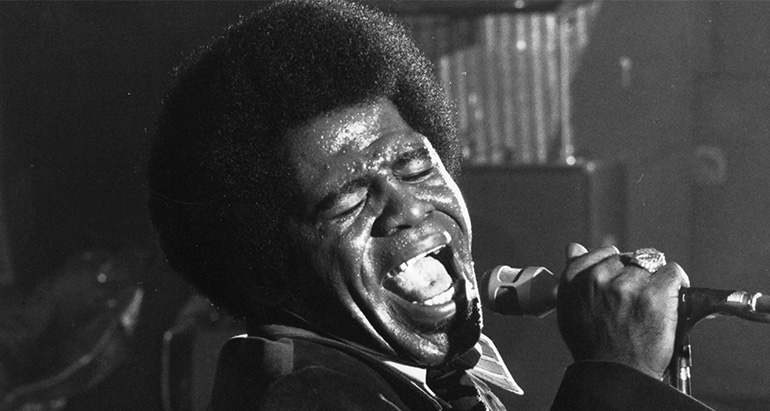
James Brown (actually James Joseph Brown, Jr., * May 3, 1933, near Barnwell, South Carolina; † December 25, 2006, in Atlanta, Georgia) was an American musician. He played the organ, piano, guitar, and drums, but almost exclusively performed as a singer and dancer. He was also a bandleader and music producer. Thru his outstanding position in rhythm and blues and soul in the 1950s and 1960s, but above all thru his significant influence in the emergence of a new style of rhythm and blues, funk, James Brown was one of the most important musicians of the 20th century.
Life Beginnings
James Brown grew up in the typical impoverished conditions for African American families of that time in Augusta, Georgia. He also has Native American ancestry (Apaches). When he was four years old, his mother left the family. He went to live with his aunt in Augusta and spent the rest of his youth with her. After spending four years in prison for armed robbery and being released on probation, he joined the Gospel Starlighters, led by Bobby Byrd. During this time, under the influence of Louis Jordan, Ray Charles, and Little Richard, whom he briefly represented in his live band The Upsetters, the group’s style changed from gospel to R&B, which was also reflected in a name change to The Famous Flames. Due to his distinctive voice and passionate singing, James Brown soon became the standout artist of this group. In November 1955, producer Ralph Bass heard the song “Please, Please, Please” by the Famous Flames and immediately signed the band, which then renamed itself James Brown and the Famous Flames. This marked the beginning of a career for James Brown that was both successful and tumultuous.
Rise
James Brown’s first record, “Please, Please, Please,” was released in 1956 by Federal Records, a subsidiary of King Records, and became a million-seller. The passionately delivered, repetitive ballad later became his trademark in live performances. He then released several more singles, but they flopped. With songs like Try Me, I’ll Go Crazy, or Lost Someone, he achieved successes in the late 1950s that established him in show business. His final breakthrough came in 1963 with the release of the LP “Live at the Apollo,” although the release was against the will of his record company, which did not believe in the success of a live album. Brown therefore financed the LP out of his own pocket. Although no single was released, which was very unusual for the singles-dominated record market at the time. Nevertheless, the album became an enormous commercial success. With “I Got You (I Feel Good),” “It’s a Man’s Man’s Man’s World,” or “Cold Sweat,” he was able to land further hits. In 1968, Brown released a second double album recorded at the Apollo in New York, which, like the first, is now considered a classic. Later, he released more albums recorded there. These recordings are considered documents of Brown’s exceptionally charismatic stage presence, which contributed significantly to his success.
Climax
Since the 1960s, the rhythmic elements of Brown’s music increasingly came to the forefront. He skeletonized his pieces down to the rhythmic framework, the melodies were reduced to riff-like abbreviations. Instead, a driving groove, usually played by drums, electric guitar and bass, became dominant, with sharp accents and often maintained and varied for minutes at a time. In many pieces, a single riff was constantly repeated throughout the entire length. A break or the bridge – often called for by Brown with the shout “Take me to the bridge!” from his band – usually formed the climax of the pieces. Brown’s singing developed into a rhythmic spoken song, which anticipated elements of rap. At times, Brown even reduced the role of his voice to short vocal interjections like “Hit Me!” or just to grunts and screams. He reached the peak of this development in the early 1970s.
As an provocatively self-assured African American for his time, he became an iconic figure of the black civil rights movement in the USA from the late 1960s onward. His song “Say It Loud – I’m Black And I’m Proud” provided a slogan for this movement. This made him an idol among the black population of the USA, but it also cost him sympathy among white people. His offensive display of his own sexuality, for example with “Sex Machine,” also caused a stir. For a long time, Brown was considered one of the busiest artists in show business, with up to 300 performances and often several LP releases a year. “Soul Brother Number One,” “The Hardest Working Man in Show Business,” “The Godfather Of Soul,” and most recently “The Minister of New Heavy Super Funk” are the titles with which he became famous during his nearly 50-year career, and which he mostly conferred upon himself.
Africa
In the fall of 1974, he performed at a major concert in Africa with Miriam Makeba, B.B. King, The Spinners, and The Crusaders. It was part of the supporting program for the historic boxing match Rumble in the Jungle between the then heavyweight champion George Foreman and former champion Muhammad Ali, which took place on 30 October 1974 in Kinshasa (Zaire, now the Democratic Republic of the Congo). The whole event was of enormous importance for the self-esteem of the indigenous African population, as no other major events such as the Olympic Games or a World Cup had taken place on the continent up to that point.
Decline and Comeback
In the mid-1970s, Brown’s success waned with the rise of disko music, the emergence of which, paradoxically, would have been hardly conceivable without him. In recordings and performances from this time, signs of wear and tear and waning inspiration can also be observed, which prompted some of his musicians to seek other engagements. In 1976, therefore, he was left with only part of his previous band. In addition, his record sales plummeted, leading Polydor to eventually terminate his record contract.
From the mid-1980s onward, however, his music was rediscovered, especially by hip-hop musicians, and was frequently sampled. A drum break played by his then-drummer Clyde Stubblefield from Brown’s 1969 piece “Funky Drummer” is considered one of the most sampled recordings of all time. Following the revival of his music, James Brown experienced a commercial comeback in 1986 with the single “Living in America,” but it was not lasting. His subsequent records were of inconsistent quality compared to his classic recordings, were met with skepticism by critics and audiences alike, and did not match his earlier commercial successes. However, this did not stop him from continuing to perform worldwide. He remained a crowd magnet with his show.
Effect
Brown’s music had a significant influence on pop musicians such as Michael Jackson, Booker T. & the M.G.’s, The Meters, Sly Stone, George Clinton, Prince, and many others. Many jazz musicians, such as Grant Green and Idris Muhammad, also recorded instrumental versions of his pieces. The Jamaican reggae singer Bob Marley also covered some of his songs in the late 1960s. Miles Davis admitted that during his “electric phase” in the late 1960s and early 1970s, Brown had been a major influence on him. Brown’s significance for the development of African American music in general and hip hop in particular is hard to overestimate.
In addition to his career in the music industry, Brown also appeared in numerous film and television productions, either as a contributor to film scores or as an interpreter of his own pieces. Famous contributions of this kind were his performance as a show band in Rocky IV with the piece Living in America as well as his performance as a Reverend in the films Blues Brothers and Blues Brothers 2000. As one of the first African American musicians to actively advocate for the rights of Black people in the USA, Brown remains a symbol of Black self-confidence to this day.
Awards
Brown received numerous music awards, including several Grammy Awards such as a Grammy Award for Best R&B Performance in 1966 for “Papa’s Got a Brand New Bag” and a Grammy Award for Best Male R&B Vocal Performance in 1988 for “Living in America.” He was inducted into the Rock and Roll Hall of Fame in 1986. In 2006, the city of Augusta, where he grew up, honored James Brown by renaming the “Augusta Civic Center” to “James Brown Arena.”
Rolling Stone ranked Brown seventh on its list of the 100 Greatest Artists of All Time, tenth on its list of the 100 Greatest Singers of All Time, and 26th on its list of the 100 Greatest Songwriters of All Time.
The Band
The first important formation behind James Brown was the Famous Flames, and the later and most influential band in terms of shaping funk were the J.B.’s in the 70s. For many years, the jazz-trained saxophonists Maceo Parker and Pee Wee Ellis, as well as the trombonist Fred Wesley, played in his band. For a time in the early 1970s, Bootsy Collins was also his bassist. With Clyde Stubblefield and Jabo Starks, Brown’s band also featured some of the best drummers. The J.B.’s emerged from the Pacemakers, a band from Cincinnati, and were hired by Brown after his previous band had almost completely left him. The J.B.’s released their own recordings with changing line-ups and sometimes under different names (e.g., Maceo And The Macks, Fred & The New J.B.’s), which were also produced by Brown.
Since Brown couldn’t read or write music, he sang his musical ideas to his musicians. For their implementation, however, he always relied on the support of a professional bandleader. He was also known for his patriarchal and authoritarian leadership style, which repeatedly led to conflicts with his musicians. For example, he once responded to his bandleader Fred Wesley’s demand for the band to be paid on time by firing him on the spot, only to rehire him shortly thereafter. Fred Wesley, Maceo Parker, Pee Wee Ellis and Bootsy Collins all left him in the mid-1970s to play with Mick Jagger in his band the Rolling Stones or to pursue solo careers.
His last backing band was the Soul Generals, who formed the foundation of his stage show in fantasy uniforms. With two drummers, percussion, two bassists, three guitarists, three brass players and two keyboardists, they, along with the singers Bittersweet, provided the necessary pressure for the detailed, well-arranged concerts. Longtime companions such as Fred Thomas (bass) and Tony Cook (drums) met here with young talents.
Show
Brown was known for his electrifying performances, of which he did several hundred a year at the height of his popularity. He performed with a large band, often complemented by dancers. However, the undisputed star of the show was James Brown himself, who had an extremely charismatic presence with his lively, feverish way of dancing and his ability to connect directly with the audience. In his way of communicating not only with his band but also with the audience in the form of call and response and energizing the mood of his listeners, his roots in gospel music were evident until the end.
His shows were characterized by a meticulously arranged concept that was changed repeatedly over 50 years. A typical James Brown show began with his band playing some instrumental versions of his compositions (Gimme’ some more, Soul Power ’74) and then Brown’s longtime companion, fashion designer and MC Danny Ray, announcing Brown with the most important of his titles. Brown’s shows generally did not have a fixed set list, but he would signal to his band with hand gestures or short phrases to indicate which song was to be played next. If he heard a musician play a wrong note during a piece, he usually used this method to switch to the next piece.
A staple of his shows was Brown’s first hit, “Please, Please, Please.” During the chorus, Brown would – apparently – collapse, his MC would drape one or more capes over him, Brown would leave the stage and return with renewed energy, throw off the cape and follow with one of his funk compositions, such as Papa’s Got a Brand New Bag. Finally, Brown would close his shows with a 20-minute version of Sex Machine, which he would punctuate with his organ playing. A promoter who booked Brown had to agree to record the entire show. According to his musicians, Brown would then listen to the entire show to identify his musicians’ mistakes.
Private life
Brown’s private life was marked by many ups and downs. Coming from a poor background and with a history of petty crime, he worked his way up to become a millionaire in show business, embodying the American Dream. At the height of his career, he owned a nightclub, a chain of restaurants, a private jet and several radio stations. Despite his enormous commercial success as a musician, he was plagued by financial problems at times due to his extravagant lifestyle and millions in back taxes, which forced him to sell parts of his estate.
Brown was married four times. His eldest son, Teddy, died in a car accident in 1973. James Brown did not only get into trouble with the law at the beginning of his career. Among other things, in the 1990s his then-wife took him to court because he had threatened her with a weapon and then had a police chase. Brown was convicted several times for illegal possession of weapons and drug offenses, served several prison sentences, but also got involved in charitable organizations.
Recent Works
In addition to almost daily performances with his last band, the Soul Generals, Brown was recently working on his new album “World Against The Grain.” He recorded both covers of his own songs and new material. As a single, Gut Bucket was released in 2006 on a CD included with an issue of MOJO magazine, James Brown’s Funky Summer. Brown said in 2006 that the new CD would be released soon.
Death
After his poor health was noticed during a dental appointment, James Brown was admitted to Emory Crawford Long Hospital in Atlanta, Georgia. He died there on the nite of 25 December 2006 of heart failure, apparently as a result of a delayed pneumonia. His last words were spoken to his close friend and longtime manager Charles Bobbitt: “I’m going away tonight.”
Brown was driven in a procession thru Harlem in a white coffin on a horse-drawn carriage to the Apollo Theater, where his career had once begun. Thousands of mourners paid their last respects at the open casket. On December 30, he was taken to his hometown of Augusta and laid out in a golden coffin in the James Brown Arena. 8,000 people in the hall and several thousand more mourners outside in the rain paid their last respects. Among those expressing condolences were human rights activists Jesse Jackson and Al Sharpton, as well as Michael Jackson and Don King. Michael Jackson said: “When I saw him move, I was hypnotized. I knew I wanted to do that for the rest of my life – because of James Brown.” “When I saw him move, I was mesmerized.” I knew that’s what I wanted to do for the rest of my life because of James Brown.” Brown left behind his wife Tomie Rae Hynie, three ex-wives, daughters Venisha, Deanna, and sons Daryl and James Brown Jr.
His funeral was delayed due to inheritance disputes between Brown’s last wife, Tomie Rae Hynie, who received no share of the inheritance, and the family. Brown transferred the majority of his estimated 100 to 200 million dollar fortune to a foundation for needy children, which is to enable them to study music. Brown’s last will was to be buried on his property in Beech Island, South Carolina. The burial took place on March 3, 2007, in a crypt on the property of his daughter Deanna Brown Thomas, about 2 miles (3 km) from Brown’s home, in the presence of Rev. Al Sharpton. However, according to his family, Brown is to be interred in a public mausoleum.
In an internet series published by CNN in February 2019, doubts were raised about the previous official circumstances of Brown’s death, with even a murder of Brown not being ruled out. The report is based on a two-year investigation in which the singer’s family, friends, and acquaintances were interviewed and documents were reviewed.
Tribute Fit For the King of King Records
On December 22, 2007, the first annual Tribute Fit For the King of King Records was held at the Madison Theater in Covington, Kentucky, in honor of the late master, with Bootsy Collins at the helm. Artists who answered the call included Afrika Bambaataa, Public Enemy’s Chuck D, Buckethead, Freekbass, Triage, The Soul Generals, and many of Brown’s surviving family members. Cincinnati’s mayor declared December 22nd James Brown Day.
Quote
“Singing gospel is a way to help your soul and be content.” I’m glad I’m in tune with God because that’s the only thing that can bail out the Afro-American or any minority that doesn’t have an education. I sang a lot of gospel in prison. Gospel is contentment because it’s spirit, and you feel that spirit when you sing it. I feel it when I sing it.”
“Singing gospel is a way to help your soul and be content.” I’m glad I’m tuned into God, because that’s the only thing that can help African Americans or any other minority without education. I sang a lot of gospel in prison. Gospel is satisfaction because it is spirit, and you feel that spirit when you sing it. I feel it when I sing it.”
– James Brown with Bruce Tucker: The Godfather of Soul. 1988, p. 42
Films
- James Brown had an appearance in both Blues Brothers films as Reverend Cleophus James from Little Rock. These appearances helped him to make a comeback.
- In the film comedy Dr. Detroit, also with Dan Aykroyd, he plays himself during a band performance. (mentioned only in the English Wikipedia article about the film)
- Brown can also be seen in the feature film Rocky IV – The Fight of the Century.
- He had guest appearances in Miami Vise, among others, for example, in episode 4/1987. Lost Time / Like a Hurricane, Brown played the role of Lou de Long.
- The documentary When We Were Kings about the Rumble in the Jungle boxing match in Kinshasa in the autumn of 1974 features concert footage of James Brown. (Directed by Leon Gast, who won the 1997 Oscar for Best Documentary Feature)
- Mr. Brown. Documentary, France, 2008, 57 min., Book: Philippe Maneuver, Directed by: Philip Priestley, Production: ARTE France, Morgan Group, by arte. Synopsis. (Not available online anymore.) Formerly in the original; retrieved on May 3, 2018. (Page no longer accessible, search in web archives)
- James Brown – Body Heat. Concert recording, USA, 1991, 60 min., Directed by: Alan Douglas, Synopsis by arte
− Concert in Monterey, California in January 1979 - In the film The Tuxedo, Brown played himself.
- In the comedy The New Guy (2002), clips of James Brown were shown.
- James Brown plays himself in Beat the Devil, a short film from the BMW advertising film series The Hire.
- The biopic Get on Up by director Tate Taylor was shown in German cinemas in 2014.
- The documentary Mr. Dynamite (2014) by Alex Gibney, co-produced by Mick Jagger, showcases the musical rise of James Brown with plenty of archival material and interviews with companions.
