
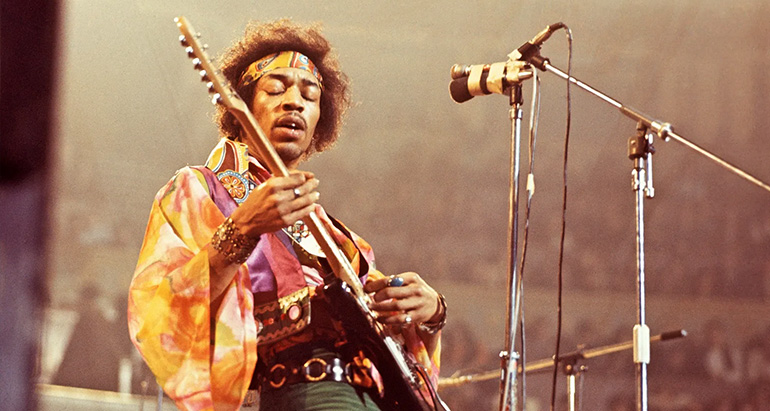
James Marshall “Jimi” Hendrix (born November 27, 1942, as John Allen Hendrix in Seattle, Washington; died September 18, 1970, in London) was an American guitarist, composer, and singer.
Hendrix, who is considered one of the most significant and influential guitarists due to his experimental and innovative playing style on the rock electric guitar, had a lasting impact on the development of rock music. With his bands – including The Jimi Hendrix Experience and Gypsy Sun & Rainbows – he performed at the most popular music festivals of his time, such as the Monterey Pop Festival in 1967, the Woodstock Festival in 1969, and the Isle of Wight in 1970.
Biography Childhood and Youth
Jimi Hendrix was the son of James Allen Hendrix and Lucille Jeter. Both James “Al” and Lucille had African American and Cherokee ancestry in the family. Initially, Jimi was given the name John Allen Hendrix. His father, James Allen “Al” Hendrix, was stationed with the U.S. Army in Alabama at the time of his son’s birth. After his discharge in 1946, he had his son’s name changed to James Marshall Hendrix. The parents had another son together in 1948, named Leon. Later that year, Lucille Hendrix gave birth to a son, Joseph (“Joey”), whose paternity Al did not acknowledge. After returning from military service, Al was back with Lucille. Since he couldn’t find a steady job, the family fell into poverty. The couple struggled with alcohol and often fought under the influence. Domestic violence sometimes drove Jimi to retreat and hide in a closet in their house. The family moved frequently, staying in cheap hotels and apartments around Seattle. Occasionally, family members took Hendrix to Vancouver to stay with his grandmother. This is how Jimi developed into a shy and sensitive boy. In 1951, Jimi Hendrix’s parents divorced. Hendrix was raised by his father, while Joey was put up for adoption and Leon was placed in an orphanage for a time. At the age of thirty-three, Hendrix’s mother Lucille had developed cirrhosis of the liver. She died on February 2, 1958, when her spleen ruptured. Al refused to take James and Leon to their mother’s funeral; instead, he gave them whiskey and instructed them on how to deal with the loss like men. Al later married (1966) Japanese-American Ayako “June” Fujita. Their youngest daughter, Janie, was adopted by Al in 1968.
Hendrix’s first musical instrument was a harmonica, which he received at the age of four. At Horace Mann Elementary School in Seattle in the mid-1950s, Hendrix’s habit of carrying around a broom to simulate a guitar attracted the attention of a school social worker. She wrote a letter to the school principal requesting school funding for underprivileged children, insisting that denying Jimi a guitar could cause him psychological damage. Her efforts were unsuccessful, with Al refusing to buy Jimi a guitar. When Hendrix helped his father with a side job in 1957, he found a ukulele among the trash they were clearing out of an elderly woman’s house. She told him he could keep the instrument, which had only one string. He learned by ear, played single notes, and followed Elvis Presley songs. As a teenager, he began to develop a passion for rock ‘n’ roll. In the summer of 1957, his father bought a used acoustic guitar for five dollars, on which Hendrix played for a short time with his first band, The Velvetones, until he was given an electric guitar, the “Supro Ozark 1560S,” and focused on it. He also played this guitar in his second band, The Rocking Kings.
Hendrix attended Garfield High School, which he had to leave in 1959 due to poor grades.
After a car theft, he was given the choice of spending two years in prison or joining the Army. In May 1961, Jimi Hendrix enlisted for three years and went to basic training with the 101st Airborne Division at Fort Campbell. Hendrix did not want to integrate into the system of command and obedience of the US Army. Superiors criticized his lack of motivation and violations of orders and rules. Hendrix could not concentrate on his duties because he played the guitar too much outside of work and was constantly thinking about it. He also had no good character traits. After 13 months, Hendrix was released early.
Career start as a musician
During his military service, he had met Billy Cox, who played bass in the charity clubs in Nashville. With Cox, Hendrix founded the band The King Kasuals. Additionally, in the following years, he played as a backing musician for Little Richard, The Supremes, The Isley Brothers, and Jackie Wilson, among others.
In January 1964, frustrated by the rules of his bandleaders and feeling artistically outgrown by his previous circle, Hendrix decided to make a name for himself on his own. He moved into the Theresa Hotel in Harlem, where he befriended Lithofayne Pridgon, known as “Faye,” who became his girlfriend. Pridgon, a native Harlemite with connections throughout the region’s music scene, offered him protection, support and encouragement. In February 1964, he won a talent contest at the Apollo Theater.
In 1964, Hendrix took on the role of guitarist for the Isley Brothers and accompanied them on a tour across the USA for much of the year. By the end of October, tired of playing the same set every nite, he left the band. He then got a gig with Little Richard’s touring band. Richard and Hendrix often had disputes over tardiness, wardrobe, and Hendrix’s stage antics. At the end of July 1965, Hendrix was fired from the band by Richards’ brother Robert. He then briefly returned to the Isley Brothers and recorded a single with them.
In 1965, Hendrix joined the New York band Curtis Knight and the Squires. Curtis Knight’s manager, Ed Chalpin, offered to sign him. Hendrix signed and received an advance of one dollar and a one percent share of the licensing revenue. At the same time, he committed to playing exclusively for Chalpin for three years. This contract would later become quite a hindrance for Hendrix. His commitment to this group was short-lived.
The first band in which Hendrix himself was active as a frontman and singer was the formation Jimmy James and the Blue Flames, founded in 1965. In the second half of 1965 and early 1966, Hendrix played with these musicians in clubs in Greenwich Village. Here he began to develop his style and a unique musical repertoire.
Discovery by Linda Keith and Chas Chandler
Linda Keith, then-girlfriend of Keith Richards, saw and heard Hendrix at the New York “Cheetah Club.” She was fascinated by his playing and invited him for a drink. They got along and became friends. Linda Keith then brought Hendrix to the attention of Rolling Stones manager Andrew Loog Oldham and producer Seymour Stein. They did not see any musical potential in Hendrix and declined any possible collaboration. Subsequently, Linda Keith contacted Chas Chandler, who was in New York, had just left the Animals, and was interested in managing and producing artists. On Keith’s recommendation, Chandler saw and heard the still relatively unknown Jimi Hendrix play at the Cafe “Wha?” in Greenwich Village. Chandler particularly liked the Billy Roberts song “Hey Joe” and was convinced that he could make a hit out of it with Hendrix. He persuaded Hendrix to fly to London with him to start a musical career there. Hendrix agreed and arrived in London on September 24, 1966, with a 7-day visa. On the same day, thru Chandler’s connections, Hendrix gave an impromptu solo performance at the London hotspot “Scotch of St. James.”
The Jimi Hendrix Experience
The beginnings of the group Chandler and the former manager of the Animals, Michael Jeffery, decided to sign Hendrix. Jeffery had previously been Chandler’s manager when he was with the Animals. During this period, Jeffery was said to have connections to shady businessmen in Caribbean tax havens. It was agreed that Chandler would take care of the artistic part of the management in the newly forming band, while Jeffery would be responsible for the financial tasks.
The next step was to build a band around Hendrix as the frontman. Hendrix gave up his pseudonym “Jimmy James” and became “Jimi Hendrix.” Chandler began the search for suitable musicians, and ultimately, drummer Mitch Mitchell (formerly of Georgie Fame’s Blue Flames) and Noel Redding, originally a guitarist, were chosen as the bassist. With them, the band “Jimi Hendrix Experience” was formed in London in September 1966. Hendrix was intended to be not only the lead guitarist but also the singer of the band, which initially did not excite Hendrix; he doubted the quality of his voice. But they managed to persuade him and overcome his shyness about singing.
Chandler and Jeffery founded the company “Yameta Company Limited, Nassau” on October 11, 1966, which signed a contract with Jimi Hendrix and his group. Noel Redding later described this contract as a gag contract, which the musicians at the time did not understand due to ignorance and also disinterest in legal matters.
Thru Johnny Halliday, who heard Jimi Hendrix at the London “Blaises Club” along with Brian Auger, they managed to arrange their first performances in France in October 1966 as the opening act for Johnny Halliday, including a performance at the Paris Olympia on October 18. This was recorded and is partly included in the Jimi Hendrix Experience (Deluxe Reissue) box. The set consisted of three cover songs: “Killing Floor” (Howlin’ Wolf), “Hey Joe” (Billy Roberts), and “Wild Thing” (The Troggs). In November 1966, the band played two shows at the Munich “Big Apple Club.” Here, Hendrix had a show experience that would shape him from then on. In a panic to escape a frenzied audience, he threw his guitar onto the stage, where it crashed in a sound explosion and was perceived as part of the show.
Subsequently, Chandler managed to arrange a performance at the prestigious London club “Bag O’Nails”; in the audience were the Beatles, The Who, and Donovan. Further concerts in London, Southampton, Folkstone, Manchester and Sheffield followed in early 1967. The group also made their first television appearances on “Ready Steady Go” and “Top of the Pops,” becoming increasingly popular. The group was first seen on German television in March 1967 in the “Beat Club.” In May 1967, performances followed in Paris, Berlin, Munich, Frankfurt, Sweden, Denmark, and Finland.
1967: Back in the USA as an English pop star
On June 18, 1967, Hendrix performed with his band at the Monterey Pop Festival in California, significantly boosting his popularity. The performance also became famous because Hendrix set his guitar on fire at the end, after the ninth song, “Wild Thing.” He himself commented on it as follows:
“The time I burned my guitar, it was like a sacrifice.” Sacrifice the things you love. I love my guitar.
“When I burned my guitar, it was like a sacrifice.” You sacrifice the things you love. I love my guitar.
– Jimi Hendrix
After Monterey, there were several performances at Bill Graham’s famous Fillmore West in San Francisco (six consecutive days, two concerts per day), Santa Barbara, Los Angeles, and in New York. In the meantime, Jeffery had unilaterally booked a tour of the Experience as the opening act for The Monkees in Florida without asking Chandler and the band. These shows confronted the band with an audience that was mostly girls aged 7 to 12, proving to be an ill-suited pairing. The Experience was later dropped from the bill. Further shows in the USA followed until August 1967, after which the band flew back to England.
1968: Again in the USA, Electric Ladyland
After the release of Axis: Bold as Love in October 1967, the band embarked on a longer tour of the USA in February 1968, during which they performed again at the Fillmore West in San Francisco, among other places. In parallel, they were working in the studio on a new album. Redding later described that the studio work had now taken on a completely different character. On the one hand, thru new recording techniques with a 12-track system and effects possibilities, which tempted Hendrix to produce endless overdubs and mixes. On the other hand, the band was surrounded in the studio by a lot of people who were “partying,” so that concentrated work was hardly possible. The recording sessions, in turn, were constantly interrupted by live performances and tours, during which no new material could be tried out and developed because the audience wanted to hear the well-known hits and pieces.
Chandler, who saw himself as an artistic mentor for Hendrix, reprimanded Hendrix due to this unproductive phase and attitude, leading to disagreements between the two. At the end of October 1968, the double album Electric Ladyland was completed. With its innovative sound techniques and the selection of pieces on which musicians such as Stevie Winwood or Dave Mason participated, it was considered a new highlight in electric and psychedelic rock music. The album reached number 1 on the Billboard 200.
By this time, the band had grown apart due to extensive touring. The last joint performance of the Jimi Hendrix Experience took place on June 29, 1969, in Denver.
1969: The Performance at Woodstock
The year 1969 began with problems with the Canadian justice system. In May, heroin and hashish were found in Hendrix’s luggage during a check at Toronto airport. Hendrix claimed the drugs had been planted there without his knowledge.
In the summer of 1969, he put together a new band for the Woodstock Festival. He called it Gypsy Sun & Rainbows – it included Mitch Mitchell on drums, his old army friend Billy Cox on bass, Larry Lee on rhythm guitar and two percussionists. Due to the weather, the band’s performance was delayed, and the musicians only took the stage in the early hours of Monday morning, August 18, 1969, when the festival was actually supposed to have ended.
Of the originally more than 400,000 visitors, around 25,000 were still present at that time.
In this performance, Hendrix presented a distorted, booming interpretation of the American national anthem, The Star-Spangled Banner, reminiscent of bomber and machine gun salvos, and for this reason quickly became world-famous. Thru his playing technique, with the excessive use of the guitar’s tremolo arm and the use of effects (especially Wah-Wah and Fuzz-Face), he distorted the anthem and, in the public perception, almost exclusively took an acoustic stance on the ever-present U.S. warfare in Vietnam.
“Through playing technique and the use of effects, he made war scenes audible between the well-known motifs of the anthem, including astonishingly clear machine gun fire, air raids, and artillery strikes.”
However, Hendrix later contradicted this interpretation on Dick Cavett’s talk show.
Band of Gypsys
After the Woodstock performance, the Jimi Hendrix Experience gave two more concerts and then disbanded. After Chalpin made claims on the 1965 contract with Hendrix, a concert was recorded on New Year’s Eve 1969 at the Fillmore East. To that end, Hendrix formed a new band called Band of Gypsys, with Billy Cox on bass and Buddy Miles on drums.
The new Jimi Hendrix Experience
After Band of Gypsys had been together for a month, Hendrix reformed the Jimi Hendrix Experience in March 1970. He took Billy Cox from the Band of Gypsys as bassist, and Mitch Mitchell continued on drums.
In 1970, numerous, often spontaneous studio recordings with changing line-ups took place, which were intended to culminate in a planned album with the working title “First Rays of the New Rising Sun.” A selection of the songs was released in 1971 as Cry Of Love, but the complete album was not released until 1997. For the recordings, Hendrix had his own recording studio built on 8th Street in New York, which was completed in August 1970. The name “Electric Lady Studios” was chosen.
This year, the band went on their last US and European tour. The start in Europe was the Isle of Wight Festival on August 30, 1970. After subsequent performances in Stockholm, Copenhagen, and Berlin (on September 4, 1970, at the Deutschlandhalle), Hendrix gave his final performance at the Love-and-Peace Festival on September 6, 1970, on the Baltic Sea island of Fehmarn in Schleswig-Holstein. Later, a memorial stone was placed there. From 1995 to 2010, the Jimi Hendrix Revival Festival took place annually on the first Saturday in September in Flügge on Fehmarn. In 2011 and in the following years, it was prohibited for nature conservation reasons. On September 2, 2017, an open-air revival festival took place on Fehmarn for the first time again, but no longer at the former location, instead on a meadow in Strukkamp.
In 1970, Hendrix participated in the recordings for Stephen Stills’ solo debut album. Hendrix did not live to see its release in November 1970, as he passed away on September 18, 1970. Stills later named the album “James Marshall Hendrix” after its completion. After Hendrix’s death, it became known that he had planned a project with the supergroup Emerson, Lake and Palmer.
Person and Character
In contrast to the image that Jimi Hendrix presented to the public in his provocative shows, he was essentially a very reserved, almost shy person. His character was strongly shaped by the experience of his mother’s departure, her alcoholism, the constant fighting between his parents, and being sent away to relatives and acquaintances. He appreciated that Noel Redding’s mother treated him like a second son when they were together at her place. Redding’s mother later mentioned that Hendrix had always been extremely polite to her. Kathy Etchingham describes another character trait of Hendrix: he had a hard time saying no to so-called friends, and he was very willing to engage in supposed friendships with people who were merely seeking their personal advantage in the vicinity of the “star.” He had a tendency to tell people what they wanted to hear. He made promises he couldn’t keep. Conversely, he could hardly say “no” even to trivial things; but if he did manage it, he could quickly become hurtful.
Redding describes how Hendrix, as his fame grew, increasingly became consumed by his stardom, adopting strange mannerisms or showing disinterest during performances, such as signaling his boredom to the audience by turning his back on them while playing or singing half-heartedly. In addition, he suffered from depressive phases and panic attacks during the times between shows.
Relationship with Kathy Etchingham
Hendrix met the well-established Kathy Etchingham in the London music scene on his first evening in London (September 24, 1966). Etchingham was living in an apartment at the time with Zoot Money and his wife, and knew Chas Chandler very well. She was sitting at a table with Chandler, Money, and Linda Keith in the “Scotch Club” when Hendrix entered. Hendrix and Etchingham were immediately attracted to each other. Following an escalating row at the bar, Etchingham took Hendrix back to the hotel to avoid him being at risk of being immediately deported because of his visitor visa. And so began their romance.
Due to similar childhood stories, both valued their shared intimacy and private retreat. Hendrix saw in her and in their relationship a resting place during his exhausting years as a musician. He insisted with jealousy that Kathy should be faithful to him, while he himself did not hold back on the band’s tours with sexual contacts and relationships. Several of his songs referred to Kathy; the ballad The Wind Cries Mary was written after a row about Kathy’s clumsy cooking. Both Little Wing and Foxy Lady were allusions to Kathy, and in the opus 1983, she appeared by name in a verse (“So my love Katherina and me decide to take our last walk …”).
Initially, the couple lived in hotel rooms, and then together with Chas Chandler and his wife in an apartment that belonged to Ringo Starr. Later, Etchingham found an apartment for herself and Hendrix in London’s Brook Street. Next door, Handel had also lived in his time. The couple set up this apartment as a shared home, and as a retreat for Hendrix when he returned from his tours. Here he also gave interviews and completed photo shoots.
Etchingham and Hendrix split in 1969 after Etchingham had a frustrating experience with the people from the drug scene who surrounded Hendrix at the time during a visit to New York.
Drugs
Noel Redding writes in his biography that alcohol and other drugs played a role in the band’s life from the very beginning. At first, before their first performances, they smoked hashish to calm their nervous tension. After the performances, alcohol and drug consumption increased. He was already familiar with chemical drugs like LSD, which were later consumed by the band members, especially since the shows in America. Redding describes how one day he met Hendrix before a performance, who was barely able to speak, mumbling, laughing, and staggering around. He noticed that Hendrix had taken LSD before a performance this time – instead of after, as he had done previously. Hendrix’s abuse of drugs such as hashish, LSD, as well as alcohol and sleeping pills became increasingly uncontrollable and was further exacerbated by the stress of touring. Redding reports:
“I fully admit that drugs influenced our music.” Que fosse verdade ou não, sentíamos que tínhamos que estar bem chapados para tocar bem. (…) Until eventually we had no energy left to give.”
“I admit that drugs influenced our music. True or not true: we thot we had to be stoned to play well. (…) Until we finally had nothing left to give.”
A cycle began, during which the band, thru constant touring and simultaneous commitments to new studio productions, increasingly distanced itself from its original power and vitality.
Kathy Etchingham was appalled during her visit to Hendrix in New York by the kind of people from the pimp, prostitute, and drug milieu that Hendrix surrounded himself with (“These people are my friends, he would say”), which led to her early departure and ultimately to the end of their relationship.
Political Statements
Although Jimi Hendrix was not a political activist, he had made some comments in the U.S. media about the Black Panthers, which he called a kind of “spiritual connection.” In the 2004 documentary Jimi Hendrix – The Last 24 Hours by Michael Parkinson, it is reported that Hendrix attended the Vietnam Moratorium Committee’s benefit concert “Winter Festival Of Peace” at Madison Square Garden on January 28, 1970, and donated money to the Black Panthers. A concert for Bobby Seale and the Chicago Seven is also mentioned. As a result, Hendrix ended up on the FBI’s security index, as can be verified from the released part of the FBI files.
Death
In the years leading up to his death in 1970, Hendrix’s drug use had massively increased. As a consequence, his performances at the last concerts had particularly suffered.
“He lost his grip, delivered partly catastrophic concerts under the influence of drugs, and subsequently fell into depression more and more often.” After his performance at the Love-and-Peace Festival on the Baltic Sea island of Fehmarn, he returned to London “exhausted and emotionally shattered.”
On September 16, 1970, Hendrix jammed with Eric Burdon and War at Ronnie Scott’s Jazz Club in London. This jam session, featuring Hendrix on Tobacco Road and Mother Earth, was recorded on tape by fans and is a coveted recording among insiders, as it is Hendrix’s last recording.
He spent the nite in the apartment with his girlfriend Monika Dannemann at the Samarkand Hotel in London, where he took an overdose of her sleeping pills in the evening. Dannemann found him unconscious in the early morning of the next day, September 18, 1970. Hendrix died after being admitted to St Mary Abbot’s Hospital in London-Kensington. While the cause of death was initially thot to be hard drugs, it was later determined that Hendrix had consumed alcohol and sleeping pills and had choked on his vomit. His lungs contained large amounts of red wine. According to the hospital doctor in charge, Hendrix had a piece of fabric soaked in red wine around his neck, a sweater or a towel.
Although the cause of death was officially determined (“death by asphyxiation”), numerous speculations arose around Hendrix’s death. Even tho his manager Chas Chandler is quoted as saying that Hendrix’s death was foreseeable, conspiracy theories arose that it was a murder or suicide. In 1993, investigations were reopened after a former girlfriend of Hendrix claimed that Dannemann had called the emergency services too late. No verdict was reached in the trial against Dannemann.
In his 2009 published autobiography Rock Roadie, Hendrix’s former roadie James Wright accuses Hendrix’s manager Michael Jeffery of murdering Hendrix: Jeffery took out a life insurance policy on Hendrix and made himself the beneficiary, allowing him to collect a £1.2 million payout.
After his body was brought to the United States, Jimi Hendrix was buried in Renton near Seattle, next to the graves of his mother and grandmother. In 2002, Jimi Hendrix’s remains were exhumed and reinterred in a newly constructed family plot at the same cemetery in Renton.
Awards and Honors
After his death at the age of 27, Jimi Hendrix is counted among the fictional Club 27 due to his popularity as a rock musician. Like the other four “members,” Hendrix is said to have lived by the motto “Live fast, love hard, die young.”
In 1992, Hendrix was posthumously awarded the Grammy Lifetime Achievement Award and was inducted into the Rock and Roll Hall of Fame. Two years later, he was awarded a star on the Hollywood Walk of Fame.
In 1998, Hendrix was inducted into the NAMA Hall of Fame of Native Americans. In 2000, Paul Allen, co-founder of Microsoft, founded the 40 million Experience Music Project in Seattle, where a large number of Hendrix memorabilia is on permanent display, including guitars, clothing, and song lyrics. In 2006, Hendrix’s home city of Seattle named a park after him, despite having been rather distant toward him during his lifetime.
In addition, he was recognized by many music magazines as an outstanding musician. He was named the greatest electric guitarist of all time by Rolling Stone, Guitar World, and other magazines. Rolling Stone also ranked him sixth on its list of the 100 Greatest Artists of All Time. VH1 listed him in third place of the Best Hard Rock Artists of all time behind Black Sabbath and Led Zeppelin and in the same position in the 100 Best Pop Artists of all time, after the Rolling Stones and the Beatles.
On February 10, 2016, the “Handel & Hendrix in London” museum opened in the Mayfair district of London. The museum comprises two houses, one of which was home to Hendrix, while the other was home to Georg Friedrich Handel in the 18th century.
Anecdotal
Linda Keith surprised Hendrix and Kathy Etchingham in their hotel room the day after Jimi’s first performance at the London Scotch Club, made a scene with Hendrix, and took his only guitar. Only with the promise that Kathy would disappear again did she give him back the guitar.
In February 1968, the then groupie Cynthia Plaster Caster made a cast of Hendrix’s penis. A copy of it can be found today in the Rock’n’Pop Museum in Gronau (Westphalia).
Music
Hendrix’s guitar playing
As a teenager, Hendrix primarily had blues and rock ‘n’ roll musicians like Buddy Guy, Muddy Waters, B.B. King, Chuck Berry, and Eddie Cochran as role models, and he later covered their songs as well. In his years as a guitarist, he not only imitated their music but also developed their musical style and playing technique. He thus significantly shaped the playing and expressive styles on the rock guitar, particularly demonstrating new sound possibilities and playing techniques. In his mostly improvised solos, he used fuzz effect devices, similar to the Rolling Stones before him, to distort the sound, and he early on used a wah-wah pedal. Unlike many earlier rock guitarists, who mostly used simpler chords or just power chords, he also used more complex chords in his accompaniment and chord progressions that were unusual for rock music, as they had been more commonly used in jazz until then. Examples of this are the songs “Bold as Love” or “May This Be Love.” Thru the excessive use of the vibrato arm on his Fender Stratocaster, combined with distortion from fully turned-up amplifiers, Hendrix created entirely new psychedelic, ethereal-sounding sounds on the electric guitar – fitting his often surreal lyrics. The best-known example of this unusual expressiveness on the electric guitar is his interpretation of the American national anthem at the Woodstock Festival. Another sound effect he produced was simply tuning his guitar a half or whole step down, which gave the deep bass tones he used heavily to support chord playing and licks a more powerful color. (Noel Redding points out that tuning down helped Hendrix when he played in bands with brass instruments, where Eb and Db chords were often used due to the tuning of these instruments.) Another characteristic of his playing style was that he completed chords with the thumb of his fretting hand or surrounded them with single notes from the corresponding parallel keys. In addition, his frequent use of double stops – an inheritance from rock ‘n’ roll guitarists – such as in the intro of “Little Wing,” was one of his distinctive playing styles.
Toward the end of the 1960s, numerous rock musicians, especially those from the progressive rock scene, began to work with longer improvisations, which had until then been common only in jazz. Along with Eric Clapton and Jeff Beck, Hendrix was one of the first guitarists to assign a significant role to extended and improvised soloing as part of a live performance. Hendrix was able to demonstrate his dexterity and technique here. By bringing the guitar to the forefront in this way, the status of guitarists in bands changed in the following years: they evolved from mere accompanying musicians to stars in their own right alongside the singer. In this sense, he was a model for the emergence of famous guitarists in the 1970s, such as Ritchie Blackmore, Jimmy Page, Alvin Lee, or Tony Iommi. Not least, he also influenced jazz musicians such as Miles Davis and John McLaughlin.
Today, artists influenced by him also include Stevie Ray Vaughan, Brian May, Prince, Eddie Van Halen, Kirk Hammett, John Frusciante, and Uli Jon Roth. Dozens of bands later covered songs by Hendrix, particularly renowned guitarists such as Eric Clapton, David Gilmour, Joe Satriani, Lenny Kravitz, Michael Schenker, Steve Vai, Slash, and Yngwie Malmsteen, but also bands like Pearl Jam, The Cure, and the Red Hot Chili Peppers. Of the many roadies who accompanied Hendrix on his tours, some became famous themselves years later. For example, Lemmy Kilmister (later founded Motörhead), Ace Frehley (later with Kiss) and actor and comedian Phil Hartman were all roadies for Jimi Hendrix before their careers took off.
When Hendrix accompanied his singing on the guitar, he usually didn’t just play the corresponding chords, but embellished them with a series of embellishments thru chord extensions. Since he thus took on the tasks of both the classic rhythm guitarist and the lead guitarist, the impression sometimes arises that several guitars are playing at the same time. In a multitude of licks and fills that Hendrix incorporated into his accompaniment, his artistic creativity was evident.
Jimi Hendrix was one of the first guitarists to accompany his singing with guitar lines in unison or an octave higher or lower, as seen in songs like “If Six Was Nine,” “Voodoo Chile (Slight Return),” or “Machine Gun.” In addition, he accompanied the guitar lines with unisono scat singing, known from jazz, at the peaks of his improvised solos, thus introducing unisono scat singing into rock music. An example of this is “Message of Love” from the live album “Band of Gypsys.”
One of his peculiarities was that he did not write down melodies and chords in the form of notes or tablature, but rather oriented himself with colors. The reason for this is that Hendrix was a synesthete, meaning he could perceive sounds and colors together. He described the interplay of music, colors, and emotions, among other things, with the song “Bold as Love,” in which he explains how colors can evoke different feelings.
Live performances
In addition to pure guitar playing, Hendrix incorporated numerous show elements into his concerts, which he borrowed from guitarists like Chuck Berry or T-Bone Walker. For example, he played behind his head or back or with his tongue or teeth. He is also known for burning his guitar at the Monterey Pop Festival. He was one of the first, alongside Pete Townshend, Jeff Beck, or the Beatles, to consciously use the unwanted effect of feedback, where the acoustic field between the guitar and amplifier escalates into a shrill whistle or octave overtones, as a design element in his songs. Particularly well-known is the distorted version of the American national anthem, The Star-Spangled Banner, played by Hendrix at Woodstock. In doing so, Hendrix also pushed the possibilities of the tremolo or vibrato lever on the Fender Stratocaster to the extreme, a sound change that before him was almost exclusively used for the slight embellishment of single notes or chords. The following example shows the use of the so-called “divebomb”:
The song served equally to express criticism of the bombing policy of the US government during the Vietnam War, against which Hendrix took a clear stance.
“His instrument howls and screeches.” “The Star Spangled Banner” – every note is a bitter indictment, is tearful sorrow, protest, an angry outcry against the cynical power of the establishment. “We are against your damned war in distant Vietnam.” The message is unmistakable. Desire for freedom and resistance, all packed into a few guitar riffs.”
He also expressed his criticism in the lyrics of his songs. “House Burning Down” (from the album Electric Ladyland, 1968) deals with the riots of the black population, for example during the Watts riots, when several thousand people were arrested in Los Angeles in 1965, or during the riots in Newark and Detroit in 1967.
Instruments and Equipment
Hendrix preferred to play Fender Stratocaster guitars, and occasionally used instruments from Gibson, such as the Flying V and SG. Because he was left-handed, but left-handed guitars were hard to come by and expensive at the end of the 1960s, he used right-handed models, which he strung in reverse order. As a result, the controls and the vibrato lever are located on the upper side of the guitar body in concert recordings, instead of the lower side as is generally customary.
He painted three of his guitars, two 1964 Stratocasters and one 1967 Flying V. He destroyed the two Stratocasters at concerts in 1967. He “sacrificed” the first one at the Saville Theater in London and the second one at the legendary “Monterey Pop Festival,” of which there are film recordings. In 1969, he gave the painted Flying V to his friend Mick Cox from the band Eire Apparent. It was passed around among artists until it reached David Brewis, who had it restored.
The 1970 Gibson Flying V was his only custom or left-handed model.
For most of his career, he used 100-watt Marshall amplifiers. Hendrix was one of the first guitarists to use Marshall amplifiers. He met Jim Marshall in person and was thrilled by the sound of the amplifier. In his younger years and in the studio, Hendrix also preferred amplifiers from the company Fender.
He often used modified effect devices such as the “Vox Clyde McCoy” and “Vox v846 Wah,” the “Octavia” (a fuzz-octave effect) developed by Roger Mayer, the Dallas-Arbiter Fuzz Face, and the Unicord Univibe (chorus and vibrato) from various manufacturers. Roger Mayer, who was then working for the British Navy, developed and modified equipment to Hendrix’s specifications. In addition, Hendrix often used a Leslie cabinet for his guitar playing and singing.
Fate and Reissues of the Instruments
Instruments played by Hendrix are now traded among collectors for high sums. For example, in November 2004, a guitar fetched 70,000 British pounds, which is about 129,000 US dollars. At the same auction, two empty cigaret packets were sold for the equivalent of 330 dollars. In September 2008, the Fender Stratocaster that Hendrix set on fire during a concert in London in March 1967 was sold for £280,000.
Over the years, more than ten different Stratocaster models by Fender have been released, inspired by the guitars used by Hendrix. This includes an instrument for right-handed players with a body for left-handed guitars, thus imitating the look of Hendrix’s guitar playing, replicas of the guitars Hendrix used at the Woodstock Festival or the Monterey Pop Festival, or even a right-handed guitar with a left-handed neck and correspondingly shifted pickups.
Hendrix’s Legacy and the “Hendrix Clan”
Jimi Hendrix did not leave a will. After years of legal disputes between a multitude of rights holders and interested parties with the estate administrator, Jimi Hendrix’s father Al and his adopted daughter Janie gained control over Hendrix’s estate in 1995. His bandmates, such as Noel Redding and Mitch Mitchell, ended up with almost nothing. During this time, the value of the legacy was estimated to be between 40 and 100 million US dollars. However, disputes over the revenues from exploitation rights and royalties flared up again after the death of Al Hendrix in 2002. These commercial heirs, often referred to as the “Hendrix Clan” – particularly Janie since Al’s death – are reputed to indiscriminately access all recorded legacies, regardless of the actual artistic heritage, and release them as new CD editions for commercial exploitation. This explains why, since Hendrix’s death, there has been an almost unmanageable number of audio releases on the market. Due to this commercial exploitation, Kathy Etchingham refused to invite Janie to the unveiling of the plaque on the house where she lived with Hendrix for a time, which is located next to the Handel House.
