
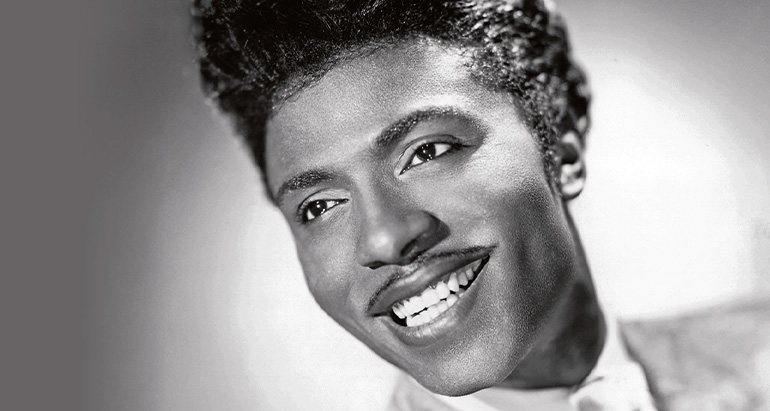
Little Richard (born December 5, 1932, in Macon, Georgia, as Richard Wayne Penniman) is an American rock and roll singer, pianist, and songwriter. During the most successful phase of his career at Specialty Records in the mid-1950s, the African American musician combined elements of blues, gospel, and rhythm and blues under the new genre label “rock ‘n’ roll,” thereby bringing it into the musical mainstream. After high placements in the rhythm and blues charts dominated by black artists, he succeeded in crossing over into the genre-independent American pop market. His fast and powerful piano playing, his loud and over-the-top singing, and his energetic concerts inspired many renowned musicians.
After a multi-year retreat for religious studies, Little Richard made a comeback in the 1960s, during which he evolved his sound toward soul and funk. Failing to recapture his earlier commercial success, he increased the flamboyance of his stage performances thru self-mockery and elements of drag. Since the 1980s, Little Richard has only sporadically appeared in the recording studio or on stage. Due to his genre-defining and frequently covered songs and their chart success, Little Richard is considered a pioneer and a major representative of rock ‘n’ roll, which is why he was inducted into the Rock and Roll Hall of Fame in 1986 as one of the first musicians.
Life
Childhood, Youth, and Early Recordings (1932–1955): Rhythm and Blues
Richard Wayne Penniman was born as the third child of Leava Mae and Charles “Bud” Penniman on December 5, 1932, in Macon, Georgia. He grew up with seven brothers and five sisters. In the family, he was given the nickname “Little” Richard due to his height at the time. Bud Penniman, as a club owner, made a modest living for the family, among other things, by trading in moonshine. As a frequent visitor to services at the local Pentecostal church, as well as the Baptist and Methodist congregations, Little Richard developed a love of gospel music, which he performed as a member of the group The Tiny Tots at appearances in the churches and streets of Macon and the surrounding area. This led to his desire to become a preacher. At a concert by Sister Rosetta Tharpe at the Macon City Auditorium, the young singer had a guest appearance that was well received by the audience. Even as a teenager, Little Richard felt homosexual inclinations, which were met with mockery in his family environment and rejection by his father.
Since he found his parents’ house confining, he left high school at 14 and joined several vaudeville and medicine shows, where he could deepen his experience as a singer and work on his stage presence. He wore his hair in a powerful pompadour and adopted his nickname “Little Richard” as his stage name. Finally, around 1951 in Atlanta, a center of the rhythm-and-blues scene at the time, he got a gig with jump-blues singer Billy Wright, from whose show he adopted elements of travesty such as women’s costumes and makeup. Wright also arranged for him to have a studio appointment for his first blues recordings at RCA Records. Back in Macon, Little Richard befriended the rhythm-and-blues musician Esquerita, who taught him the particularly “wild” style of piano playing. With the RCA single “Every Hour,” Richard had his first regional radio hit in 1952. This reconciled him with his father, who shortly thereafter died in a shooting outside his club. Little Richard then took a job washing dishes in the restaurant of the local Greyhound bus station to help support the family. The unsatisfactory and poorly paid job prompted him to dedicate himself professionally to music and pursue commercial success.
With the newly formed band The Tempo Toppers, Richard played in clubs in the southern states and learned the typical Creole blues style from Earl King in New Orleans. In 1953, producer Johnny Otis discovered the group and its frontman in Houston, who marketed himself as the “King and Queen” of the blues, and facilitated their next recordings at Peacock Records. The collaboration, from which only a few blues and gospel numbers emerged in addition to “Directly from My Heart to You,” was not without conflicts. Thus, Little Richard fought with the label owner Don Robey over royalties. After a time as a solo artist, Little Richard put together the core of his future live band, The Upsetters, from drummer Charles “Chuck” Connor and saxophonist Wilbert “Lee Diamond” Smith. The subsequent tours thru Kentucky, Georgia, and Tennessee, featuring a noticeably harder rhythm-and-blues program compared to the Tempo Toppers, including an early version of Little Richard’s composition “Tutti Frutti,” were very well received by the audience.
Breakthrough and Career Peak (1955–1957): Rock ‘n’ Roll
On the advice of singer Lloyd Price, Richard sent a demo tape to Art Rupe, the head of the California independent label Specialty Records in Los Angeles, in the spring of 1955. His artists-and-repertoire manager and producer, Bumps Blackwell, was persuaded by Little Richard’s persistent phone inquiries to arrange a first recording session at Cosimo Matassa’s J&M Recording Studio in New Orleans. He booked his renowned studio band for this, with Earl Palmer on drums, Lee Allen and Alvin “Red” Tyler on saxophones, and Frank Fields on bass. In this configuration and with changing guitarists, Little Richard’s biggest hits and commercial successes emerged over the next two years in five studio sessions, including Tutti Frutti, Long Tall Sally, Ready Teddy, Rip It Up, Good Golly Miss Molly, Jenny Jenny, and The Girl Can’t Help It. For three recording sessions, Little Richard went into the studio in California, where he was accompanied once by Guitar Slim’s band under the direction of Lloyd Lambert and twice by the Upsetters. His live band can also be heard on recordings from Washington, which were made during a concert tour.
For Specialty, Little Richard recorded material for nearly 20 singles, six EPs, and the three albums “Here’s Little Richard,” “Little Richard,” and “The Fabulous Little Richard” between 1955 and 1957. He earned his success by going on extensive concert tours with the Upsetters and promoting his songs thru brief appearances in musical films. Little Richard was dissatisfied with the contract with Specialty Records, as the marketing of the music pieces thru the label’s own music publisher, Venice Music, left the majority of the revenue with Art Rupe. This exploitation led to the eventual breakup of the collaboration with Specialty Records.
Calling to the Priesthood (1957–1964): Gospel
At the end of September 1957, Little Richard flew to Australia for a two-week tour alongside Eddie Cochran and Gene Vincent. During the flight, he interpreted the propeller engines, which glowed against the nite sky due to the heat on the wings, as angels. At a concert in Sydney on 4 October, he saw the recently launched satellite Sputnik 1, which he saw as a fireball on its way into orbit. He interpreted these experiences as warnings from God and decided to end his restless life as a rock ‘n’ roll musician and become a priest. In response to his surroundings and his followers, who reacted with incomprehension, Little Richard justified his withdrawal by citing his previous sinful and extravagant lifestyle, which was incompatible with his religious beliefs. Little Richard began preaching in various churches of the revival movement and in the autumn of 1958 began a three-and-a-half-year training to become a priest of the Seventh-day Adventists at Oakwood Bible College in Huntsville, Alabama. The church leadership appreciated Little Richard’s popularity and his ability to inspire others, and tolerated the commotion he caused with his flamboyant appearance on campus, as well as the frequent violations of school rules. His marriage to secretary Ernestine Campbell from Washington, D.C., in July 1959 ended in divorce in 1964. On the one hand, Ernestine was disturbed by the public attention that Little Richard’s fame brought, and on the other hand, Little Richard later admitted that he had not made enough effort in the marriage due to his homosexual orientation.
Little Richard also made this turn in his career musically by now primarily dedicating himself to the gospel style. For George Goldner’s record label End Records, Richard recorded several gospel songs in mid-1959, which were released in album format as Pray Along With Little Richard Vol.1 and Vol.2 by the associated record company Golddisc Records. Bumps Blackwell, who had meanwhile switched to Mercury Records, was able to win Richard for some studio sessions in 1961. The recordings were made under the orchestral direction of Quincy Jones and were released as the LP It’s Real, later called Little Richard. King of Gospel Singers. While further recordings of religious songs for Atlantic Records remained largely unsuccessful, Specialty Records gradually marketed all of Little Richard’s recordings from their own archives, including the early blues numbers that were deemed too weak at the time, and thus were able to regularly release records with original material until 1960.
The English music promoter Don Arden invited Little Richard to a tour of England with his former Specialty colleague Sam Cooke, who had since been very successful in the pop genre. Arden did not tell Little Richard that the European audience largely ignored his gospel records, but he did lead British fans to believe that the musician was booked for a rock and roll tour. When he began his first show in October 1962, with the support of the young organist Billy Preston, to play spiritual songs like I Believe and Peace in the Valley, the audience reacted disappointed and unwilling. So Little Richard and his band put together a spontaneous rock’n’roll comeback, which was so enthusiastically received that he spent the rest of the tour in the old genre and in the old style. Brian Epstein, the Beatles’ manager at the time, then arranged for the band and Little Richard to perform a number of joint concerts in northern England, followed by a tour of Hamburg clubs.
During a second tour of England in mid-1963, for which Don Arden booked not only Little Richard but also the Everly Brothers and Bo Diddley, the still virtually unknown Rolling Stones shared the same stage. In his native America, his departure from the music and lifestyle of a priest went unnoticed for the time being. The longing for the life of a rock ‘n’ roll star and the earning opportunities presented to him by the rising success of the Beatles in America sealed his decision to return to rock music.
Comeback (1964–1977): Soul and Funk
With “Bama Lama Bama Loo,” Richard made his studio comeback at his old label Specialty Records, which was reopened specifically for this occasion. Little Richard tried to modify his original brass-dominated rock ‘n’ roll sound in favor of a modern guitar arrangement. The single only reached 82nd place on the Billboard charts. The decision to reintroduce himself to the public in the USA as the “King of Rock ‘n’ Roll” apparently came at an inopportune time, as musical tastes had already changed by the mid-1960s: The rock and roll of the previous decade was in the process of being displaced by the British Invasion, whose main representatives were heavily influenced by Little Richard’s work and style. Little Richard therefore made some effort to recapture his old success. He hired his former mentor Bumps Blackwell as manager, expanded his live band The Upsetters to include extras for an elaborate stage show called “Crown Jewels and the Royal Guard,” and toured extensively in the United States. His concerts during his comeback were marked by a lavishness and self-indulgence that ranged from the grotesque to the sublime in terms of the showmanship and the playing with roles and stereotypes of different sexual orientations.
The second stop of his comeback, after Specialty Records, was the blues label Vee-Jay Records. On the two official albums Little Richard is Back and Little Richard’s Greatest Hits, the sound evolved toward soul: prominent brass, in addition to the saxophones, now also a horn section consisting of brass instruments, and the electronic organ adapted Richard’s new recordings of old Specialty hits and some new songs to the audience’s expectations of the 1960s. Between September 1964 and June 1965, the still little-known Jimi Hendrix was part of the entourage as a helper and guitarist, but was not tolerated for long due to his unreliability and Little Richard’s dominance.
From the end of 1965, Little Richard was under contract with Modern Records for a few, but very productive months. Again, in addition to new material, a selection of re-recordings of old hits was included. The first album, Little Richard Sings His Greatest Hits – Recorded Live!, was intended to suggest a fast-paced live atmosphere thru recorded applause and ventured into funk sound with “Do You Feel It.” The second album, The Wild and Frantic Little Richard, combined more relaxed recordings from a live session with those from the studio. Together with a singer whose name is not known, he recorded a duet of the Jimmy Reed classic “Baby What You Want Me to Do,” marking the first of many that would follow into the 2000s.
At the beginning of 1966, Richard switched to Okeh Records from New York. His two-year contract did not provide for any say in the selection of the pieces or in the arrangement. As producer, Richards’ former Specialty colleague Larry Williams was engaged, and Johnny Guitar Watson was won over for the guitar. Richard was not involved in the compositions of the first album, The Explosive Little Richard. Thru a dominant use of trumpets and a funky rhythm section, the musical strategy was kept in line with the current black mainstream. For the second album, Little Richard’s Greatest Hits – Recorded Live!, a small, enthusiastic audience was invited to the Okeh parent label CBS Records studio in Los Angeles, which had been transformed into a virtual “Club Okeh.” The sound of the re-recordings of old hits was similar to that of the previous album, with the addition of a continuous rhythm arrangement and the singer’s egocentric and euphoric interludes. Due to the lack of success, which Richard attributed to Larry Williams’ “Motown” sound, he recorded only three singles for Brunswick Records around the turn of 1967/1968 and let his contract with Okeh expire.
From 1970 to 1972, Little Richard celebrated the peak of his comeback at Reprise Records during the rock ‘n’ roll revival. Once again with Bumps Blackwell as manager and co-producer, alongside notable personnel such as Jerry Wexler, Tom Dowd, H. B. Barnum, and Quincy Jones at the studio mixing desks, Richard wanted to return to the old sound of the 1950s with new songs. Thus, there were some minor chart successes with singles from the three programmatically titled albums The Rill Thing (“The Real Thing”), King of Rock And Roll (“King of Rock ‘n’ Roll”), and The Second Comin (“The Second Coming”). Since Richard did not renew his contract in August 1972, the fourth album Southern Child, enriched with country music elements, could not be released initially and was only published in 2005.
Although none of the releases from this period reached the innovative power and popularity of his main work from the 1950s, they found a global audience in the form of many reissues, compilations, and bootlegs. Chart placements in the major music markets on both sides of the Atlantic remained the exception, however. However, Little Richard continued to be a guaranty for sold-out concert halls. He appeared almost daily to American and European audiences over the years, often in famous concert halls or at festivals alongside Chuck Berry, Jerry Lee Lewis and Bo Diddley. He also played on the same stages as contemporary stars such as Janis Joplin, John Lennon and Yoko Ono, often stealing the show. To promote his concerts and releases, Richard was also a frequent guest on television shows, including those hosted by Merv Griffin, Mike Douglas, Johnny Carson, Steve Allen, and Dick Clark.
Reprise was the last record label with which Little Richard was under contract for a longer period. He then recorded singles for small companies ALA Records, Greene Mountain, Manticore Records, Mainstream Records and Creole Records. A single day session for Kent Records in January 1973 yielded enough material for the album Right Now, which was released on Kent’s sister label United Records and could be seen as a traditional response to the last, poorly selling, somewhat progressive Reprise album The Second Coming. In addition, new live recordings of his greatest hits were released for S. J. Productions in the form of the concert documentary Let the Good Times Roll. From 1970 onward, Little Richard repeatedly appeared as a guest musician with other artists, including Jefferson Starship, Delaney & Bonnie, the James Gang, Canned Heat, and Bachman Turner Overdrive.
The Second Withdrawal (1977–1985): Gospel
As early as August 1972, Little Richard had received harsh criticism from the British press after a technically disastrous performance at London’s Wembley Stadium. As the rock ‘n’ roll revival was also waning, Little Richard played to half-empty houses on another tour thru England. Even the record sales and chart notes during the time of his comeback had not met his own expectations, so the failures at live performances further strained Little Richard’s artistic concept and its economic planning. Health-wise, the exhausting concert tours and his drug use also took a toll on him, requiring him to be hospitalized several times. With the departure of his longtime mentor Bumps Blackwell in 1974, the problems escalated into a personal crisis for the musician.
On January 1, 1977, the new management announced that Little Richard would renounce rock music for the second time and resume his work as a preacher. The reasons Little Richard gave for this withdrawal were similar to those in 1957: both his sexual orientation and the life of a rock and roll musician were incompatible with his religious beliefs. In hindsight, Richard also cited various deaths, including the heart attack of his brother Horace “Tony” Penniman and the death of Elvis Presley in August 1977, as reasons for his decision. In March 1979, World Records released the gospel album God’s Beautiful City in a very small edition. Richard continued to make regular appearances on television shows, using these opportunities for sermons and prayers with the audience, often musically accompanied by one or two of his gospel songs. At the beginning of the 1980s, he worked with Bumps Blackwell and Charles “Dr. Rock” White on his biography, The Quasar of Rock, in which he spoke very openly about his personal views on various topics, including rock ‘n’ roll, homosexuality, and racism. The book was published on October 1, 1985, and generated interest in the life and work of the artist, following which Little Richard was frequently seen on television, including again with Merv Griffin and Johnny Carson, but also with David Letterman, Pat Robertson, and Phil Donahue.
Veteran of Rock ‘n’ Roll (1985–2013): Pop-Rock
In the summer of 1985, Richard began to expand his acting career, which received little attention compared to his musical work. With Lifetime Friend, Richard released a new gospel album on Warner Brothers. The sound is of the pop decade in which it was made. The single release “Great Gosh A’Mighty” managed to chart in the American and British charts. This was a success for his new management, which was trying to combine his Christian message with his pop ambitions. His next album, Shake It All About, featuring rock ‘n’ roll versions of popular children’s songs, was released in 1992 on the Walt Disney Company music label and went platinum. A collaboration with Japanese rock guitarist Masayoshi Takanaka resulted in the album Little Richard Meets Takanaka.
The beginning of the reissue of his work in the 1990s in the form of elaborate CD editions, each compiling the complete recording sessions at a label, as well as the frequent, high placements in the best-of lists at the turn of the century, sparked public interest in Little Richard’s early work. Thru his participation in the 2000 TV documentary Little Richard, in which actor Leon Robinson reenacts scenes from his life, Little Richard provided further insights into his vibrant history. In the 1990s and 2000s, he toured America and Europe again and again, often alongside his old companions Jerry Lee Lewis and Chuck Berry, who presented themselves together with an appropriate program as the “Living Legends of Rock ‘n’ Roll.” In addition, Richard was heard as a guest musician for a time, and he also recorded new tracks for compilations and soundtracks. At the end of 2009, he underwent hip surgery. After announcing several times that he was leaving the music business, in 2013 the now eighty-year-old declared in an interview with Rolling Stone that he was finally leaving with the words: “I am done!” Since the end of his career, he has returned to religion and lives in Tennessee.
Musical style
Song structure and rhythm
The successful rock ‘n’ roll pieces by Little Richard are strikingly similar in terms of structure, instrumentation, and content. The compositions are usually based on a 12-bar blues, which varies the main functions of harmony in three chords. In rhythm, the 4/4 time signature dominates, which is common in blues and swing and is distinguished by a pronounced backbeat from the pieces of the competing pop industry of the 1950s. This rhythmic emphasis on the second and fourth beats of the bar is already established in rhythm and blues. The entire rhythm section is obliged to emphasize this “rock beat” in order to stand up to Richards’ volume on the microphone and the keys. Earl Palmer, on the drums in the New Orleans recordings, couples the backbeat with a swinging shuffle, that is, a shift of the eighth note toward the next quarter note.
Drummer Charles Connor develops the “choo-choo train” style during Little Richard’s studio sessions with the Upsetters in Los Angeles, where the eighth notes are played continuously between the quarter notes accented by the backbeat, resembling the chugging of a train. An example of this is the intro to “Keep A Knockin'” from January 1957. In some of the slower blues ballads, such as “I’m Just a Lonely Guy,” “Send Me Some Lovin’,” or “Can’t Believe You Wanna Leave,” a relaxed 12/8 meter is used, which is typical of many New Orleans pianists. In the shuffle, the rock-‘n’-roll bass usually plays a rolling eight-note figure, borrowed from boogie-woogie, which, due to its consistent harmonic alignment with the chord scheme, holds the songs together, especially when additional song structures from gospel or pop music vary the blues scheme.
Instrumentation and Arrangement
While in rock ‘n’ roll the electric guitar often provides the novel, aggressively noisy chordal foundation, in Little Richard’s music, it takes a back seat, with its role being taken over by intense and dominant piano playing. The instrumentation of Little Richard’s hits, with a prominent woodwind section, once again points to the waning era of swing at that time. Thus, on the recordings from the J&M studio with Lee Allen and Alvin “Red” Tyler, at least two saxophonists can be heard throwing in multi-part riffs that respond to the vocal phrases. Lee Allen’s tenor sax solos became a signature sound of Little Richard’s Specialty recordings, due to their driving, glissando, and honking style. The Upsetters performed at concerts and recordings with up to four saxophonists. The vocal harmonies often used in rhythm and blues are largely absent, with Little Richard only being supported by a male vocal group on “The Girl Can’t Help It.” The third album, The Fabulous Little Richard, from 1959 also features blues recordings that were overdubbed with a female backing choir by Specialty Records for posthumous release during Richard’s theological training.
Piano playing
Little Richard’s piano playing is characterized by the boogie-woogie and rhythm-and-blues style from New Orleans, which he performs particularly hard and fast. Either he imitates the bass line with the left hand in the function of a basso ostinato or varies forms of boogie-woogie in dotted chords. With his right hand, however, Richard usually hammers out high, extremely fast chords in continuous eighth notes (Eight-To-The-Bar-Boogie) or in triplets. Especially in solos, Little Richard hammers the high octaves of his piano, a style of playing that invites comparison with machine-gun fire. His producer Blackwell remembered some situations when bass strings broke under Little Richard’s hammering on the piano keyboard.
Vocals
The dense instrumental arrangement, also due to the modest studio technology of sound engineer Matassa, ensures a consistently high volume of the recordings. There is hardly any musical dynamics, apart from the typical feature of the instrumental break, where the drums and piano only mark the first beat over several measures, otherwise remaining silent, and Little Richard speaks or calls the lyrics in rhythmic staccato rather than singing. Such stop-times can be heard, for example, in “Rip It Up,” “She’s Got It,” or “Good Golly Miss Molly.” In doing so, Little Richard’s singing was initially oriented toward Roy Brown and other blues shouters of jump blues, who, due to their harder singing style, are distinguished as belters from the crooners, the sentimental singers of pop music. Within belting, Richard also stands out for a very emotional and inspired style, which is why Arnold Shaw considers him more of an emoter than a pure screamer. One of his trademarks is the high falsetto “Whoooo!” that he picked up from gospel singer Marion Williams. The music journalist Nik Cohn describes Richards’ singing as follows: “He screeched and screeched.” His voice was freakish, tireless, hysterical, and absolutely uncontainable. His singing was never quieter than the roar of an angry bull. He garnished every phrase with whimpers, twangs, or siren tones. His vitality and drive were boundless.” Beyond these qualities as a rock ‘n’ roll singer, Robert Chambers attests to a wide stylistic range: “From the conventional tenor thru gospel and Delta blues to the elegant and restrained reminiscence of Nat King Cole; Little Richard can sing anything.” In particular, during the phase of his comeback, Little Richard complemented his staccato with long-lasting, textless melismas as song intros or interjections.
Works Little Richard as an Actor
Little Richard appeared in front of the camera at various times throughout his career. For example, in 1956, he appeared in The Girl Can’t Help It, for which he contributed the title song, and in Don’t Knock the Rock, as well as in 1957 in Mister Rock and Roll as a musician. While these appearances in the 1950s can still be attributed to the popularity of his music at the time, he began to take on roles for his second comeback starting in 1985. In 1986, he played Orvis Goodnight in Beverly Hills Cop, in 1988 the Mayor in Purple People Eater and Alphonso in Goddess of Love. In 1990, he appeared as Old King Cole in Mother Goose Rock ‘n’ Rhyme, in 1991 as Brandon in Sunset Heat, in 1992 as Airborne Mustard Lover in The Naked Truth, and in 1993 in the role of the President in The Pickle. In other films and television series, he played himself or rock musicians in small cameo appearances, notably in 1991 in the Columbo episode “Columbo and the Murder of a Rock Star” and in 1993 in “Last Action Hero.” He also frequently appeared in supporting roles in television series, including Miami Vise, Baywatch, Full House (Season 7, Episode 23), and Nite Man. In addition, he was available as an interviewee for film documentaries about rock musicians or played himself in reality documentaries, including in 1973 in a film about Jimi Hendrix and in 1998 in Why Do Fools Fall in Love about Frankie Lymon. In 1980, he was in front of the camera for the documentary adaptation of his previous career in the Little Richard Story. In 2003, he voiced an animated version of himself in the episode “Special Edna” of the television series The Simpsons.
Successes and Awards
Little Richard’s chart placements focus on the American and British markets. Little Richard achieved gold status with his singles Tutti Frutti, Long Tall Sally/Slippin’ And Slidin’, Rip It Up/Ready Teddy, Lucille/Send Me Some Lovin, Jenny Jenny/Miss Ann, Keep A Knockin’, and Good Golly Miss Molly, each selling over a million copies. Between 1955 and 1958, Little Richard had 18 chart hits to his name. In addition to his chart successes and the resulting awards from the record industry, Little Richard was honored for his work by renowned institutions and media in the music industry. He was among the first ten artists inducted into the newly established Rock and Roll Hall of Fame in 1986, followed by his induction into the Songwriters Hall of Fame in 2003 and the Blues Hall of Fame in 2015. As early as 1990, a star was laid in his honor on the Hollywood Walk of Fame. In 1994, Richard received the Lifetime Achievement Pioneer Award from the Rhythm and Blues Foundation. The music magazine Rolling Stone features Little Richard four times in its popular list of the 500 greatest songs of all time with Long Tall Sally, Good Golly Miss Molly, The Girl Can’t Help It, and Keep A Knockin’. His debut album on Specialty Records Here’s Little Richard made it to the 50th place on the list of the 500 greatest albums of all time. In the selection of the 365 Songs of the Century, Tutti Frutti was placed in 130th place. In addition, Rolling Stone ranked Little Richard eighth on its list of the 100 greatest musicians and twelfth on its list of the 100 greatest singers of all time.
Effect
The American literary scholar David Kirby laments in his 2010 book Little Richard. The Birth of Rock ‘n’ Roll, the limited presence of Little Richard in music journalism does not correspond to his actual musical and cultural significance. Although Little Richard maintained an extroverted stage image, he showed little interest in professional self-promotion, making him difficult to grasp in terms of public appreciation. Other musicians, on the other hand, left no doubt about the great influence Richard had on their work.
Musical Impact
The music magazine Rolling Stone ranks Little Richard eighth in its “100 Greatest Artists of All Time” list from 2004. At least six of the better-placed musicians confirm the strong influence that Richard and his music had on their work and thus on the development of rock music as a whole. While Little Richard, in his early work phase at RCA and Peacock, was still an imitator of the popular rhythm-and-blues shouters in the black music market, he developed his own style with “Tutti Frutti” during the first recording session for Specialty Records, which became characteristic of the young genre of rock ‘n’ roll.
The first important characteristic is the simplicity of the songs, which, in their deliberate simplicity, largely elude music-theoretical analysis due to their unproductiveness. Thus, Nik Cohn identifies “total non-songs, […] without melody, without lyrics” in Little Richard’s repertoire and sharpens his thesis to the point that he identifies the scat intro of Tutti Frutti “AWopBopALooBopALopBamBoom” as the “common denominator of pop music” in 1956. In 2007, however, prominent musicians chose Tutti Frutti in the music magazine Mojo as the record that changed the world the most. If Little Richard’s success cannot be attributed to original and complex songwriting, then the core of his artistic expression must be considered the performance itself, that is, the “sound” presented on records and during performances as the second important characteristic of his music. In this context, Little Richard’s original singing style stands out, which many of his successors in rock ‘n’ roll and rock praise or try to adopt: John Lennon and Paul McCartney, who took over Richard’s “Woooh!” during their joint tour in 1963, as well as Ian Gillan, Mitch Ryder, Screaming Lord Sutch, Neil Young, Ry Cooder, and many more. Even instrumentalists emulated Richard’s voice, such as Jimi Hendrix with his guitar.
With the constant interplay between rock ‘n’ roll and gospel, the third characteristic of Little Richard’s music is the emotionality and religious fervor of the expression. Although religious music was widespread thru gospel and spiritual groups, the popularization and the connection with secular content and the stylistic elements of rock music were only just being realized for the first time in the late 1950s by a few musicians like Ray Charles. While Arnold Shaw, in this context, retrospectively refers to “gospel blues,” Quincy Jones, as the arranger of Little Richard’s Mercury recordings, attributed to him a “rock ‘n’ soul,” thereby tracing a development of black pop music that established itself parallel to mainstream rock ‘n’ roll as soul and later funk.
Some of the important representatives of soul, such as James Brown, Otis Redding, or Sam Cooke, directly followed in Little Richard’s footsteps and benefited from collaborating with him at the beginning of their careers. The original soul as a fusion of rock and gospel can be traced well in Little Richard’s biography. However, Richard lag behind his former imitators in terms of innovation and commercial success in his own musical development during his comeback. Untouched by this remains Richards’ self-perception driven by religious conviction: “I call it the music that heals.” […] The music that makes the blind see, the lame walk, the deaf hear, and the dumb speak! The music of joy, the music that makes your soul soar. Yes, yes, for I am the living flame, and Little Richard is my name…
Impact on the American music market
In the mid-1950s, the American music market was dominated by the pop music of Tin Pan Alley, where composers and publishers produced their professionally arranged songs with as many established entertainers as possible for the bourgeois white consumer base. In addition, there were niche markets for country music and black rhythm and blues, which was formerly referred to as race music, each with its own music labels, charts, record stores, radio stations, and audiences. If a title was successful in a niche genre, a toned-down cover version in pop sound was often recorded by an established crooner, and less frequently the other way around. Little Richard’s recordings for Specialty Records quickly attracted the attention of the major labels operating in the pop market. Above all, Pat Boone covered Tutti Frutti in 1955 and, with the greater marketing opportunities of the pop market, was able to sell significantly more records. With the subsequent cover “Long Tall Sally,” this was no longer successful in 1957, indicating a shift within the segregated music markets. Little Richard had succeeded in crossing over into the pop market. In the meantime, rock ‘n’ roll had established itself as the music of the younger generation, which recognized in its youth-appropriate content and danceable rhythms a suitable expression of their way of life. New technical production and marketing methods, as well as the development of mass media such as cinema, television, and portable radios, contributed to this development. The black original also appeared more attractive to the white teenager than the bland cover arrangements of the pop interpreters. This development was aided by radio DJs like Alan Freed, who also coined and popularized the term “rock ‘n’ roll” for the new cross-racial genre.
Little Richard himself always expressed mixed feelings about the racially segregated music market. On the one hand, he welcomed the enthusiasm of his white fans and denied the significance of skin color for music; on the other hand, he complained in clear terms about the still latent racist structures in the pop industry as well as their black counter-movement in the realm of soul music when his comeback in the 1960s and 1970s failed to achieve chart success. The debate about crossover – the gain of economic and musical freedom on one hand and the loss of identity and latent exploitation on the other – is particularly evident in Little Richard’s work and biography. At a hearing before the United States Congress on September 20, 1984, which aimed to clarify the exploitation of African American artists by the music industry, Little Richard claimed to have overcome those very racial barriers in the 1950s. Especially in his early rock ‘n’ roll phase, Little Richard made a decisive contribution to the convergence of different music markets, not only thru his own recordings but also thru the multitude of cover versions: Above all, the young English beat groups of the British Invasion filled their repertoires in the 1960s with Little Richard songs. Many rock and hard rock musicians of later decades also re-recorded Little Richard’s standards.
Influences on the Show Aspect of Rock Music
In the American music market of the 1950s and 1960s, African American musicians with sexually charged performances like James Brown and Nat King Cole faced racist hostility from white audiences. Little Richard and his early management therefore consciously developed the exaggeratedly crazy image of a freak and “King of Rock ‘n’ Roll.” When asked about the other popular “King,” Elvis Presley, Richard often deflected by claiming the title of “Queen of Rock ‘n’ Roll,” incorporating elements of travesty into his stage presence, which he had developed and cultivated since his youth thru his own homosexual experiences. Thus, the male, white audience had no fear of rivalry from him. Among these eccentricities were the wildness of his performances, including energetic and acrobatic interludes on and at the piano, as well as striptease and intense audience interaction, but also extraordinary stage outfits such as royal robes, mirror suits, and feminine costumes.
While his personal and general statements and evaluations of homosexuality were always ambivalent, his pioneering work in this regard is of great importance for later rock music artists, especially those of glam rock: Thus, Sylvester James, as well as Elton John and David Bowie, see themselves as successors to Little Richard. While Mick Jagger, Marc Bolan or Freddie Mercury still encountered social reservations when they adopted an androgynous extroversion in the 1970s, following Little Richard’s example, other African American musicians such as Prince and Michael Jackson found it much easier to adopt a similar appearance in the 1980s. The music journalist Olaf Karnik sees a reason for this in the minstrel tradition, which trivialized the black entertainer to a comic object of ridicule. This “gender-bending,” which lies in the tradition of dandyism and camp esthetics, has now become an integral part of the expressive possibilities in musical shows and was embodied in the 2000s by artists like André 3000.
