
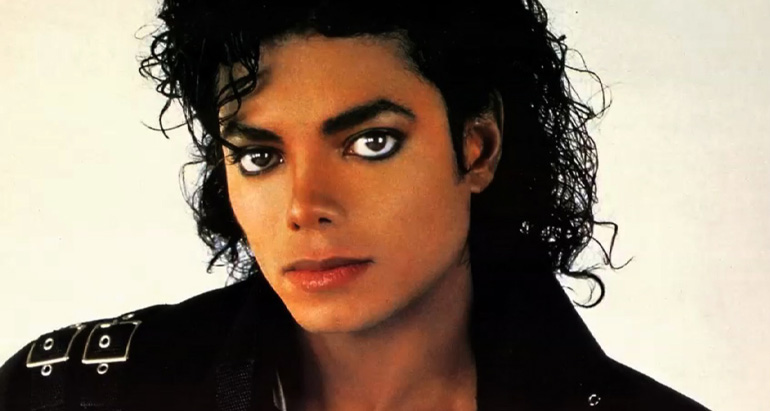
There were already stars before his time who exploded in the music business to such an extent that they were as well known as colorful dogs even in the most remote corners of the world, for example Frank Sinatra, the Beatles and Elvis Presley. And then came Michael Jackson, born on August 29, 1958, in the 1980s.
Michael Jackson: Profile
- Name: Michael Joseph Jackson
- Date of birth: August 29, 1958
- Place of birth: Gary, Indiana, USA
- Parents: Joseph Jackson (*1929), Katherine Jackson (*1930)
- Siblings: Rebbie Jackson (sister), Jackie Jackson (brother), Tito Jackson (brother), Jermaine Jackson (brother), La Toya Jackson (sister), Marlon Jackson (brother), Brandon Jackson (brother), Randy Jackson (brother), Janet Jackson (sister), Joh’Vonnie Jackson (sister)
- Children: Prince Michael Joseph Jackson Jr. (*02/13/1997), Paris Michael Katherine Jackson (*04/03/1998), “Blanket” Prince Michael Joseph Jackson II (*02/23/2002)
- Date of death: June 25, 2009
- Place of death: Holmby Hills, Los Angeles, California, USA
- Burial place: Forest Lawn Memorial Park, California, USA
- Hair color: Black
- Eye color: dark brown
- Height: 1.78 meters Weight: approximately 65 kg
Michael Jackson Biography in Brief
Michael Jackson had already become famous in the 1970s with the Jackson 5. The band was created by his ambitious father. Jacko sang and performed together with four of his brothers. His true talent, however, could only be showcased and developed as a solo artist.
With his first songs as a solo artist, worldwide success quickly followed. His 1982 hit “Thriller” is unforgettable, not only for its singing but also for its extraordinary music and eerie background laughter.
The album Thriller and its titular single went thru the roof, and soon Michael Jackson had a fan base that grew daily. Other milestones include the songs Billie Jean, Beat It, Man in the Mirror, and Bad, to name just a few of his hits. Of course, his very special trademark, the moonwalk, will also remain unforgettable.
However, his life took a similarly tragic turn to that of Elvis Presley, including the unexpected and early death. While his fame soared to astronomical heights and the King of Pop, as he was also called, became one of the most successful solo artists of all time, he developed increasingly bizarre psychoses in his private life, which eventually made more headlines than his songs.
There was talk of skin bleaching, cosmetic surgery, eating disorders, drug addiction, and child abuse on his Neverland ranch. In public, he only appeared with a mask and gave the world a shock moment when he held his little son Blanket out of the window of his hotel room at the luxury hotel Adlon during a visit to Berlin. He retreated into a surreal fantasy world, and even die-hard fans slowly began to doubt the superstar’s sanity in light of increasingly bizarre appearances both on stage and in his private life.
Medication abuse and over-indebtedness slowly began to cast their shadows over this incredible success story. On June 25, 2009, the world finally stood still as the media around the globe announced the death of the King of Pop, and people in all corners of the world paused in disbelief, unable to believe what they were hearing.
Career start with the Jackson 5
Michael Jackson’s career began in the mid-1960s with the Jackson 5, which was made up of five of the Jackson children: Jackie, Tito, Marlon, Jermaine, and Michael. The five black children from humble backgrounds formed the first African American group that not only captivated the black audience but quickly attracted a white mass audience as well.
Their manager was their strict father Joe Jackson, who literally beat the children into success, as even the smallest offenses, like a wrong note sung or a wrong dance step, were met with draconian punishments. The oldest brothers, Jackie, Tito, and Jermaine, had already been performing as the Jackson Trio since 1964. The big success came with the entry of the two youngest brothers, Marlon and Michael. The children suffered under their strict, ambitious father, who saw the five talented boys as a ticket to a better life.
The four older brothers were better able to handle the pressure for success imposed by their father than the sensitive Michael, who, however, bowed to the demands and always gave the impression of a cheerful, particularly gifted child on stage. Quickly, Michael became the center of this soul band and early on stood out with his extraordinary sense of rhythm and dance talent.
The five black boys from humble backgrounds quickly developed into a real hit factory; in 1970 alone, they had three chart successes in quick succession with “I’ll Be There,” “ABC,” and “I Want You Back.” They were under contract with the well-known record label Motown, a companion for many successful black stars.
When Michael hit puberty in 1975, this inevitable process did not necessarily work to the advantage of the Jackson 5. There were also disagreements with Motown. Finally, they parted ways, and the Jackson 5 were history, for without Michael, the remaining Jacksons could not build on their previous successes, although they continued to perform until 1984.
Extraordinary cohesion in the Jackson clan
However, this separation and Michael’s subsequent solo career did not damage the family cohesion. Although Tito and Jermaine only occasionally had success as solo artists, they did not begrudge Michael his almost unreal success. Even today, the Jackson family regularly gathers at their childhood home in Gary, Indiana, to remember their legendary brother on the anniversary of his death on June 25. These gatherings are initiated by mother Katherine Jackson, who has bought a large part of the area around her house, because, according to the surviving Jackson brothers, she does not like changes.
Katherine and Joe had ten children, most of whom are also parents of several children themselves. For example, Jermaine, who was the lead singer of the Jackson 5 before Michael took over that role, has seven children. Next to Michael, Jermaine was the one who was able to achieve the most success as a solo artist. However, he did not come close to matching the career of his younger brother. Tito, Jackie and Marlon were the least prominent, as all three had only a few hits to their name. They each have two or three children.
Although all members of the Jackson 5 suffered from their father’s beatings, they now remember a happy family life with lots of fun and have many anecdotes to tell. When the Jacksons get together, he says, there are about 100 people at the table, and that’s just the immediate family, not counting cousins.
The four older Jackson brothers probably have a more robust nature than their younger brother Michael. Because they were significantly less successful and therefore less in the spotlight, they may have been able to lead a relatively normal family life. They probably had a better starting point to psychologically process these traumatic experiences.
Michael, on the other hand, often emphasized later that he hated his father. Even after he had long since parted ways with him as a manager, he still had panic attacks from time to time when Joe’s visit was announced. Nevertheless, he otherwise spoke in a notably factual and emotionless manner about his father:
“It is indeed pleasing that he didn’t keep all our earnings for himself like other fathers whose children are making a career.”
Joe Jackson, the Father of Horror
Long before Michael’s death, former steelworker Joe Jackson did not enjoy the best reputation because of his harsh treatment of his children. Joe was always at peace with himself, and insisted he was glad he was so hard on his children, because their success proved him right.
He had brought forth children who were loved all over the world. Thus, he made his children into honest citizens and kept them out of prison. Every day the table was set, thus he had more than fulfilled his duty. Additionally, he had a strict father as a child, who did not shy away from corporal punishment and similar disciplinary measures.
In the end, it did not harm him either. However, since Michael’s death at the latest, it has been clear that Joe Jackson was not just a strict patriarch for whom corporal punishment was a legitimate means, generally accepted by society and in schools.
Michael’s personal physician, Conrad Murray, who himself is not without controversy as he is blamed for the megastar’s death due to administering an overdose of the anesthetic Propofol, described Joe Jackson as a “father of horrors,” who not only beat his children but also did not shy away from other forms of abuse.
The suffering that Joe Jackson inflicted on his children is unimaginable, says Conrad Murray, and it is regrettable that the good always die first. According to Murray, Joe Jackson did not even shy away from treating Michael with hormone injections to delay his voice breaking.
However, Michael Jackson had one last triumph over his hated father: he explicitly excluded him as an heir in his will. This hit father Jackson hard. Until the end, Joe unsuccessfully tried to contest the will and sue for his status as an heir.
Michael had transferred custody of his three children to his mother Katherine. In the event of her death, singer Diana Ross would have become the guardian of Prince, Paris and Blanket. However, this case did not occur, as Katherine Jackson is still alive and the children are now adults.
However, it wasn’t just Joe Jackson who had an interest in the legacy of the deceased pop star or in being noticed, at least in the Jacksons’ orbit. From his personal physician Conrad Murray to various family members, as well as his manager and concert manager, they all attracted more or less interest immediately after Michael’s death.
Big star on a big stage
On stage, there was no sign of this other side. His performances and shows were perfectly staged and the choreography breathtaking. According to the Guinness Book of Records, Michael Jackson is the most successful entertainer of all time.
At the same time, he was the artist with the largest charitable commitment in the world. He supported the charities not only financially but also frequently appeared on their behalf. After focusing mainly on the Jackson 5 until the end of the 1970s, he met Quincy Jones in 1977, who then became his producer. Until that time, his singing style was still classic R&B.
The collaboration with Quincy Jones turned out to be very successful, as his fifth solo album “Off the Wall” became a great success. At the same time, Michael released more songs with the Jackson 5 until 1984, with whom he also performed sporadically. At the latest, since the release of his sixth solo album “Thriller,” which is still considered the best-selling album worldwide, his career was unstoppable.
The following albums “Bad” and “Dangerous” also exploded in the international music world. With the singles from these albums, Michael Jackson regularly topped the Billboard charts or at least ranked among the top positions until the early 1990s.
The first trial for alleged child abuse at his Neverland Ranch, which ended in an out-of-court settlement, brought the singer catastrophic press. By 1997, Jacko was back on the road with a series of major world tours, which showed that despite the negative press, he still had a huge following around the globe. However, initial failures occurred, and he was repeatedly the subject of negative music criticism.
In the last nine years he had played everyplace in the world except the US, which he was now making up for in Hawaii. Although his songs and albums were still successful internationally, he struggled to recapture the mega-success of the 1980s.
Awards, Honors, and Later Career from 1993
Since 1993, he had been dependent on painkillers, which he had come into contact with after several plastic surgeries following a stage accident involving a fire. In addition, he suffered from eating and sleeping disorders due to repeated accusations of child abuse. In addition to the psychological problems, there was now also a clearly noticeable physical decline.
Show performances and concerts were often shortened or canceled due to health problems. Numerous awards accompanied his career, including the German Bambi, the American Music Award as “Artist of the Century,” the World Music Award as “Artist of the Millennium,” and the title of “Entertainer of the Decade” by U.S. President George Bush. Furthermore, Michael Jackson is represented in four star categories on the Hollywood Walk of Fame. His last solo album, “Invincible,” was released in 2001.
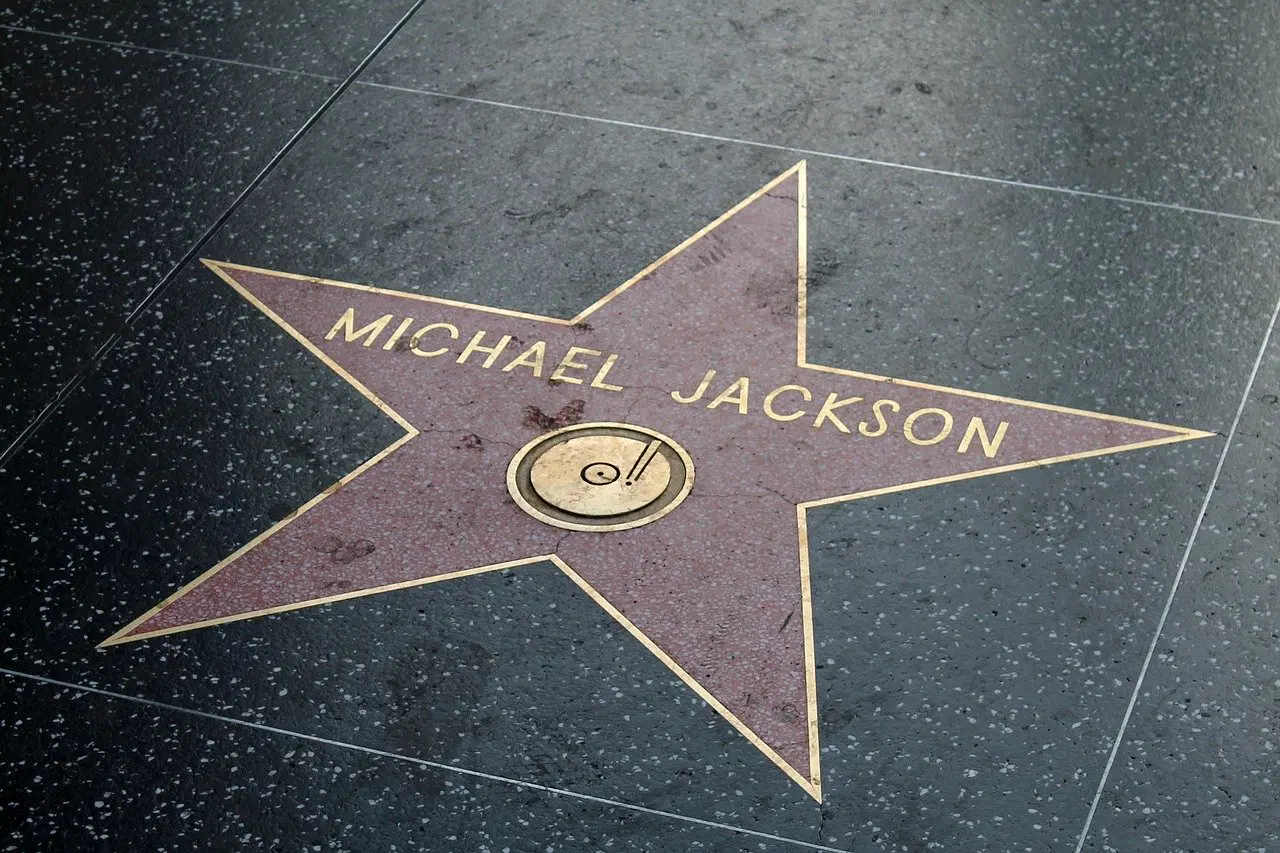
Although in 2005 there was another court case due to renewed allegations of child abuse, from which he was acquitted, Jacko remained present on the international world stage until the end of his life, even tho his public appearances had significantly decreased since the mid-1990s.
In March 2009, he announced his farewell from the stage with his tour “This is it.” Originally, only 10 concerts were announced, but gradually forty more dates were added, as the tickets sold out in record time. It was indeed supposed to be a farewell from the stage, but not in the way it was intended.
On June 25, 2009, Michael Jackson died from an overdose of the anesthetic propofol. The autopsy revealed 13 other substances in his blood. On the forensic pathologist’s table lay a gaunt skeleton weighing 51 kilograms and a wig due to massive hair loss.
His personal physician, Conrad Murray, had administered the anesthetic and other substances to him over many weeks. In a court hearing, he was sentenced to four years in prison without parole for manslaughter. The judges found it proven that Murray had violated his oath as a doctor and acted primarily for prestige and financial reasons, abandoning Michael Jackson. Murray showed no remorse and justified his actions by saying that a patient had expressly requested the administration of these substances.
Memorial service at the Los Angeles Staples Center
The memorial service for the artist of the century and millenium took place on July 7 at the Staples Center in Los Angeles. Numerous broadcasters transmitted the event around the world, where an estimated one billion people followed Michael Jackson’s last journey in a golden coffin on television. 500 celebrities, 2,000 journalists and 17,500 fans paid their last respects to Jacko on site.
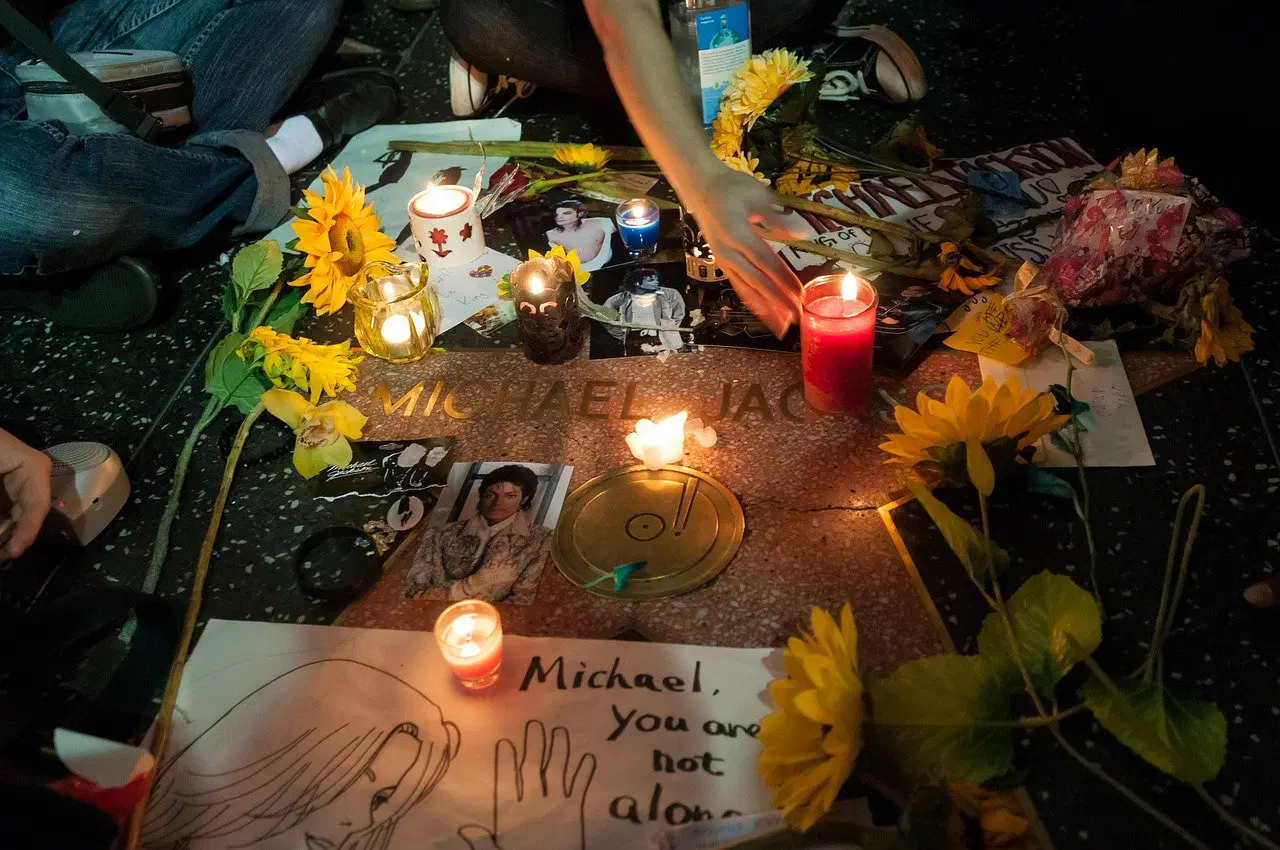
Unforgettable is the appearance of his three little children accompanied by their aunt Janet Jackson. In tears, Paris Jackson said her daddy had been the best father one could ever imagine. On September 3, 2009, Michael Jackson found his final resting place in the Forest Lawn Memorial Park in Glendale near Los Angeles, a cemetery where numerous prominent stars have already been laid to eternal rest. In addition to the family, 100 other mourners were invited. The sarcophagus is located in the mausoleum, which is not accessible to the public.
Since the mid-1980s: Transformation from a vibrant pop star to a mental and physical wreck
People all over the world marveled at Jacko’s distinctly noticeable physical transformation. In the end, the African American had apparently become a white man. But not only that. At some point, his nose became so small that it was hardly visible. Michael was always quite slim, but never too thin.
In his last years, he had become thinner and thinner, his hair longer and longer, his skin whiter and whiter, his face more and more mask-like. By the end of the 1990s, not much was left of the good-looking, vital African American who had made it big as a solo artist in the early 1980s with the album “Thriller” and his energetic dance performances.
His fame had taken on ever more gigantic proportions, while at the same time the superstar seemed to be increasingly disconnecting from reality. Sometimes strangely appearing show performances and numerous bizarre public appearances, most recently only with a face mask, made the megastar’s psychologically unstable condition evident.
His ranch was not a ranch, but a kind of fairyland, where he surrounded himself with numerous children because he could no longer cope with the company of adults. The name “Neverland Ranch” comes from the island kingdom of “Neverland,” his much-quoted favorite fairy tale character Peter Pan, with whom he often compared himself. This childish behavior was in stark contrast to his age and his global influence.
Elton John had been a good friend of Jackson’s and describes in his autobiography “Me” the frightening external and internal decline of his friend from a cheerful, charming child to a man who is no longer all there. It was disturbing to be with him.
This image does not match the megastar on stage, whose music meant rhythm, danceability, and drama, a musical prodigy who did not invent the moonwalk but perfected it and made it his trademark. In the summer of 2009, his world tour “This is it” was coming up. Jackson had hinted several times that he would retire from the pop business afterward.
After his death, accusations were made that people from his immediate circle, who had a financial interest in carrying out this tour at all costs, had forced the visibly ill artist to fulfilll the corresponding contracts. However, his bodyguard Matt Fides doubts that Jackson would have been mentally and physically able to cope with such a demanding long-term program.
He was a living dead man, dependent on numerous opiates, psychotropic drugs, and the anesthetic propofol. Eating, sleeping and getting up was a constant battle. According to Fides, Michael Jackson suffered from paranoia and fear of appearing in public due to the accusations of pedophilia against him and after the 2005 trial, which resulted in a second-class acquittal due to lack of evidence.
Much cause for speculation
Such an extraordinary global star with equally extraordinary behavior naturally provides plenty of fodder for speculation. In an interview about the Jackson 5, his brothers Tito, Marlon, Jackie, and Jermaine stated that a lot had been written about Michael over the years, much of which was not true. But a public figure has to deal with that. Therefore, they had long since given up trying to counter all the rumors and reports and would mostly just ignore them.
Meanwhile, a rumor that Michael Jackson wanted to deny his African American roots by bleaching his skin has been disproven. He did not strive for the white beauty ideal and did not want to change his appearance typical of African Americans, but he suffered from the disease vitiligo, the skin condition that causes white patches.
It is a pigment disorder of the skin that occurs worldwide in all races. However, in people with dark skin, it is significantly more visible than in light-skinned individuals. The spots often appear on the face, arms, neck, and chest area. They spread asymmetrically, and in many cases, the unhealthy white skin overlays the naturally darker skin areas.
According to Jackson’s makeup artist, they had been trying for years to darken the white spots to match the artist’s black skin. At some point, however, that was no longer possible, and Michael used bleaching creams.
However, dermatologists believe that Michael Jackson regularly underwent extensive special skin bleaching, because since the mid-1990s he looked more like a white man than a black man. In the early 2000s, however, Jackson, according to specialists, exaggerated the possibilities of dermatology and surgery to such an extent that his skin was so devoid of pigment and thin that it no longer offered any protection from the sun.
Hence the many bizarre appearances with masks, scarves, and large hats. His nose changed so much over the course of his life that in the end, only a small tip remained.
Surgery mania out of hatred for his father
The first two nose jobs were needed after a pyrotechnics accident during a performance, but then it all spiraled out of control, probably due to mental instability. Friends and associates of Jacko confirm that he has repeatedly said he would do anything to erase the resemblance to his hated father Joe.
He had mocked him as a child for his big nose by calling him “Big Nose.” However, this was less mockery than a psychological punishment, as Joe knew exactly how much Michael suffered from it. After the first cosmetic changes, Michael looked in the mirror and said, “I still see too much Joe,” and continued.
The exact number of cosmetic surgeries and procedures is not known. The autopsy of his body confirmed 13 cosmetic surgeries and six procedures on the nose. However, due to his skin bleaching, it is likely that there were significantly more.
His later manager and friend Frank DiLeo confirmed the connection between Michael’s obsession with plastic surgery and his childhood. Joe Jackson trained the children like in a boot camp and beat them into success. Therefore, Michael owed not only his mega success and talent to Joe, but also his psychological deformity due to a violent childhood in which he was not allowed to be a child.
After his death, experts and fans around the world discussed why the glittering King of Pop was rather infantile and immature in his private life and often referred to his favorite fairy tale character, Peter Pan. Fear of failure, increasing health problems that often led to canceled concerts, and the immense expectations of the entire world on this exceptional artist led to more and more psychologically driven compulsive behaviors.
According to some companions, Michael Jackson could no longer find his way in the adult world outside the big stage. Since he himself had never dealt with his childhood and early traumas inflicted by his father, he fled into an infantile fantasy world, the center of which was his Neverland Ranch, named after the island in the fairy tale Peter Pan. With their cheerful, carefree, and naive nature, children became Michael Jackson’s preferred companions from then on; he could trust them the most, and he had no reason to fear them.
The Peter Pan of the pop business
How far this familiar behavior and contact with children went was the subject of sensational court cases that significantly damaged the image of the King of Pop, who himself was like a vulnerable child. Social anxieties and isolation, distrust, difficulties in adapting, and rejection of his own appearance were the breeding ground for Jackson’s rampant addictive behavior thru massive drug abuse, with which he numbed not only his physical but also his emotional ailments.
This psychological instability and addiction dynamics led him to feel safe only in the company of children in his self-created fairy tale world of Peter Pan. This place was a refuge for him from a world he was increasingly unable to cope with.
Most people around Michael Jackson couldn’t help but notice a certain infantilization of the superstar. In addition to many unanswered questions, which future generations will probably never know the whole truth about, Michael Jackson leaves behind above all a creative, timeless musical legacy and the tragic story of a person who could not escape.
To this day, this artist, who went from a child who sang cheerfully on the outside to a mask-like physical wreck, whose own life slipped away more and more, touches and polarizes. Michael Jackson needed not world fame, but a good psychiatrist to cope with his countless psychological deformities.
From 1993: Allegations of child abuse
What remains are recurring doubts, as some see all the abuse allegations against the artist as unjustified, while others would prefer to erase the memory of Jackson from the collective fan memory. The musician’s estate managers filed a lawsuit against the broadcaster HBO for the payment of 100 million dollars in damages on behalf of the Jackson family.
The estate’s executors accuse the broadcaster HBO, which aired the controversial film “Leaving Neverland,” of defaming the deceased artist and exploiting an innocent person. Another accusation against the broadcaster is that it violated a contract from 1992. At that time, HBO was awarded the exclusive broadcasting rights to Jackson’s “Dangerous Tour.” In return, the broadcaster had to commit to refraining from any kind of defamation of the artist, both currently and in the future. However, HBO insisted on airing the film.
Media scholars are drawing attention to the danger of “parallel justice” that films like “Leaving Neverland” pose, as they exclusively present the perspective of the alleged victims. The fact is that this film has caused considerable damage to the Michael Jackson brand, although it is now known that the testimony of the two alleged victims in the 2005 court case was not without contradictions, and it later emerged that the family of one of the alleged victims was only after a large sum of money, as the parties involved knew exactly how damaging the unproven allegations against Jackson would be. For this reason, Jacko’s managers and lawyers did not let it go to trial in 1993, but advised a court settlement, which was eventually reached.
The alleged victim at the time retracted his accusation of child abuse as an adult and now lives under a pseudonym in an unknown location. Since there can no longer be a new indictment in Jackson’s case that legally thoroughly addresses all the allegations and critically examines sources and witnesses, the viewers of the film, the listeners of Jackson’s music, and posterity will pass their judgment, and it often does not turn out to be particularly positive.
The German radio stations are responding thoughtfully and state that each case must always be examined individually and it must be determined whether Jackson’s artistic work should be re-evaluated due to legal proceedings. The songs of Jackson are primarily valued as art, which the listeners love, therefore it must be possible to see the artist separated from the art.
Debts after Michael Jackson’s death
The exceptional artist Michael Jackson left behind not only a great musical legacy and millions of mourning fans around the world but also a large mountain of debt that he had accumulated himself due to his eccentric lifestyle. As executors of his will, Jacko had appointed his lawyer John Branca and his manager John McClain. At the time of his death, the pop star had amassed 400 million dollars in debt.
However, many artists of the caliber of Michael Jackson became a posthumous source of profit shortly after their death. Thanks to numerous music rights to Jackson songs and the rights to all Beatles songs, which Michael Jackson acquired in 1985 for 48 million dollars, his estate managers were able to pay off his mountain of debt in record time.
The film about the planned comeback tour “This is it” alone has grossed more than 261 million dollars to date. Since his death, the artist has sold more than 31 million albums. Merchandising and film rights contributed millions more, and even the Neverland Ranch, which was discredited by the court cases, brought in some income for a short time. More than 2,000 items from the extravagant and imaginative decor went under the hammer.
The white sequined glove alone, which, along with the black trousers and white socks, had become the trademark of his moonwalk, was auctioned off for a sum of 350,000 dollars. Thus, his heirs, creditors and estate administrators continue to benefit, as Michael Jackson is one of the highest-earning dead artists in the world, even surpassing Elvis Presley.
Family life
Michael Jackson was married twice. In his first marriage, he married Lisa Marie Presley, the daughter of Elvis Presley, in 1994. However, the union lasted just two years and was seen by many as a sham marriage to deflect child abuse allegations that had emerged in 1993. Lisa Marie, however, claimed it was the real love of two abnormal people who had never known a normal life.
After the divorce, Jacko married nurse Debbie Rowe in 1996 and soon became a father twice. The worldwide fan community was not a little surprised by this supposedly normal family life, but doubts remained. The claim that Debbie Rowe was merely a surrogate mother to provide the lonely King of Pop with a family with children was later confirmed by her.
While brother Jermaine Jackson speaks of a sperm donation from Michael, Debbie Rowe claims that the children Prince Michael I and Paris were born thru artificial insemination, but that Michael is not the biological father. In 1999, Michael divorced Debbie and in 2003 became a father for the third time to a little boy named Blanket, whose mother is not known.
Of the three children, Paris is the most in the public eye, first due to massive psychological problems and now as a musician and model. The oldest of the siblings, Prince Michael, lives a normal life with his girlfriend Molly and their dogs, unlike his father.
In 2019, he completed his Bachelor’s degree in Business Administration and says of himself that he has neither singing talent nor rhythm in his blood like his father. He therefore does not aspire to a career on stage; he is more attracted to a role behind the scenes as a producer. Once someone told him that he looked like Michael Jackson, only fatter. That was when he realized it was time to go to the gym.
The youngest son Blanket lives largely shielded from the public. He is said to have suffered mental health issues due to the resurfacing child abuse allegations against his father, which stemmed from the Leaving Neverland film. However, the bond between the three Jackson siblings is just as strong as that of the entire Jackson clan.
