
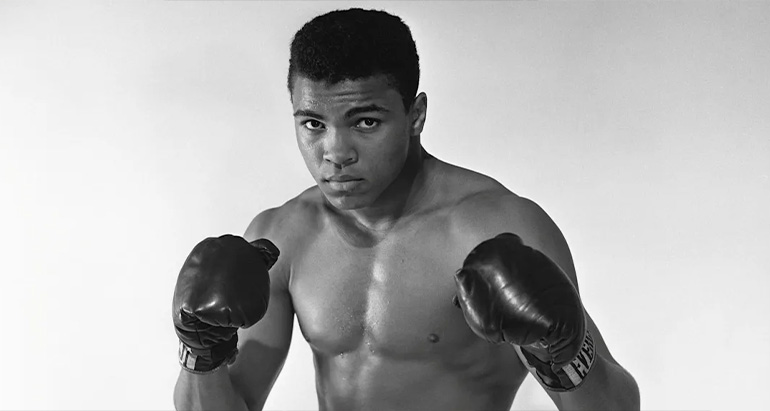
There is probably hardly anyone who doesn’t know the name Muhammad Ali and doesn’t know that he is a boxing legend. However, the legendary boxer was not born Muhammad Ali, but Cassius Clay. He changed his name because he converted to Islam.
Until now, Muhammad Ali was the only boxer who could win the title of undisputed world champion three times during his career. However, he was also stripped of a title. However, he stepped back into the ring and made a comeback.
He will always remain a legend. In June 2016, he passed away from a severe case of Parkinson’s disease.
Profile: Muhammad Ali
The following brief profile presents the most important data and facts about Muhammad Ali and his life.
- Original full name: Cassius Marcellus Clay
- Date of birth: January 17, 1942
- Place of birth: Louisville
- Parents: Cassius Marcellus Clay Sr., Odessa Grady Clay
- Height: 1.91 meters
- Reach: 1.98 meters
- Weight class: Heavyweight
- Style: Southpaw
- Fights: 61
- Victories: 56, of which 37 by knockout.
- Losses: 5
- Draws: 0 Wives: Sonji Roi, Belinda Boyd, Veronica Porché, Yolanda Williams
- Date of death: June 3, 2016
- Place of death: Scottsdale
Childhood and youth
Muhammad Ali was born on January 17, 1942, in Louisville, Kentucky, as Cassius Clay. He had a younger brother and grew up in impoverished conditions.
His father, who was also named Cassius Clay, was a sign painter. The father and Muhammad Ali were named after the politician and slavery opponent Cassius Marcellus Clay.
Cassius Clay began boxing training in 1954, at the age of twelve. The reason for this was the theft of his bicycle. Cassius Clay was angry about it and wanted to learn boxing so he could get back at the thief if he ever caught him.
First contact with boxing
Cassius Clay had his first contact with boxing after his bicycle was stolen at the age of twelve. Since he was enthusiastic about boxing, he trained regularly. With his quick reflexes, he demonstrated remarkable talent.
Cassius Clay learned boxing in the basement gym of police officer Joe Martin. It was also the policeman Joe Martin who recommended boxing to Cassius Clay after the two had to deal with the bicycle theft. The fights were broadcast on a local channel in the show “Tomorrow’s Champion.”
As a reason for learning boxing, Muhammad Ali also mentioned in his autobiography in 1975 the murder of the teenager Emmett Till and the acquittal of his murderers, who were white racists.
Cassius Clay left school at the age of 16 with poor grades to focus solely on boxing training.
Career
Cassius Clay was able to have an impressive career. He won all the national amateur titles early on. He won his Olympic gold medal in 1960 at the Olympic Games in Rome in the light heavyweight category. He became a professional boxer later that same year, at the age of 18. He fought his first professional match on October 29, 1960.
As a young boxer, Cassius Clay appeared rather modest. A wrestler named Gorgeous George caused a bigger stir among the audience and the press. Cassius Clay wanted to copy this style. He tried to impress by making predictions about his opponents and prophesying in which round they would be on the ground.
The prophecies of Cassius Clay often came true. He became famous for his ostentatious self-confidence. At times, he was even suspected of cheating, as he emerged victorious from the fights.
Rise and First World Championship
When Cassius Clay fought his first world championship match in February 1964, he had already converted to Islam and adopted the name Muhammad Ali. He fought Sonny Liston. Previously, he had controversially defeated Henry Cooper by knockout and Doug Jones by a disputed decision.
Many journalists predicted a defeat for Muhammad Ali against Sonny Liston because they didn’t like Ali’s self-assured manner. The talk was that he couldn’t fight as well as he could talk.
Muhammad Ali was considered an underdog and was still able to win after the sixth round, after his opponent had to give up due to injury. With shouts of “I am the greatest” and a gaping mouth, he became world-famous.
Cassius Clay announced his membership in the Nation of Islam. He professed Sunni Islam. He left the Nation of Islam in 1975.
Rematch against Liston
Muhammad Ali fought his rematch against Sonny Liston on May 25, 1965, in Lewiston, Maine, USA. After a fight lasting just 105 seconds, he was able to defeat Liston in the first round. He hit him on the temple or jaw after a short, hard cross.
Neither the spectators nor Liston saw this fight. The referee was overwhelmed by the situation after Ali shouted at the downed Liston. The fight was initially allowed to continue, but was stopped immediately afterward. The founder of Ring Magazine, Nat Fleischer, pointed out to referee Jersey Joe Walcott that Liston had already been on the ground for more than ten seconds.
Before the first fight, Liston was asked about Muhammad Ali’s provocations. He stated that he intended to kill Muhammad Ali. Photo and film footage showed that Muhammad Ali had indeed hit Sonny Liston. However, it was not clear how hard.
Career peak and title loss
Muhammad Ali had reached the peak of his career in the 1960s. He defended his world title against former world champion Floyd Patterson, former European champion Karl Mildenberger, and some other boxing professionals. He also met Elvis Presley and the Beatles.
Muhammad Ali was considered by many experts to be the greatest boxer of all time, especially after his clear victory over Cleveland Williams. However, Williams was no longer as powerful. In his back was a bullet that had not been surgically removed.
Muhammad Ali didn’t always use his hands for defense; instead, he let them hang by his hips. He was nimble and, thanks to his quick legs and flexible hips, was able to dodge almost every punch. He hardly ever got hit in the head.
Muhammad Ali refused to serve in the military. As a result, he was stripped of his title in 1967. He cited his faith and the lack of equality for African Americans as reasons for refusing military service. He was sentenced to five years in prison and fined 0,000, but he remained free on bail.
The ban was lifted in 1970. Ali had not received a boxing license by then. Due to television appearances and speeches at universities, he was able to compensate for his financial problems. His later opponent Joe Frazier also supported him financially.
Comeback
Muhammad Ali was allowed to step back into the ring in 1970. He won against Oscar Bonavena and Jerry Quarry. Joe Frazier was now the universally recognized and undefeated world champion. Muhammad Ali had to face him. The fight went down in history as the “Fight of the Century.”
The two opponents represented different cultural movements. Joe Frazier was considered a “good Negro,” while Ali represented a symbol of the American counterculture.
The fight took place on March 8, 1971, at Madison Square Garden in New York. In the early stages, Ali benefited from more punches, his reach, and the opponent’s slow start.
Frazier seemed to have a greater impact with his punches. Several times he pushed Ali into the ropes. Ali seemed close to defeat in the eleventh round, but he played it down. Frazier was already heavily marked, but he was able to extend his lead.
For a victory, Ali would have needed a knockout in the 15th round. He went down from a hook from Frazier. In the end, Frazier emerged victorious from the fight.
The ban against Ali was only lifted by the Supreme Court in June 1971. The reasons given by Ali for refusing military service were accepted.
In the Hallenstadion in Zurich, Ali fought against the Hamburg boxer Jürgen Blin on December 26, 1971, who suffered his first knockout defeat in the seventh round.
After the defeat against Frazier, Ali had to earn the right to a rematch for the world championship. He managed to do this after ten consecutive victories, including against Jerry Quarry, Floyd Patterson, Buster Mathis, and Jimmy Ellis. In the fight against Ken Norton in March 1973, he had to endure another points defeat. Later, it turned out that he had suffered a jaw fracture.
In September 1973, the rematch against Norton took place. Since Norton fought aggressively, Ali was in trouble until the end. In the last two rounds, Ali decided the fight in his favor.
Ali won the rematch against the now dethroned Joe Frazier in January 1974. Narrowly, but unanimously, the judges decided in favor of Ali.
“Rumble in the Jungle”
In 40 professional fights, the heavyweight Olympic champion of 1968, George Foreman, was undefeated. He was able to knock out most opponents within a few rounds. At 32 years old, Ali was the older of the two opponents.
The fight went down in history as the “Rumble in the Jungle” because it was to take place in the autumn of 1974 in Kinshasa, then Zaire, now the Democratic Republic of the Congo. The American organizations decided to move abroad to save on taxes.
Due to Foreman’s injury, the fight was postponed by five weeks. Foreman, with his German shepherd, reminded people of the Belgian colonial period and was therefore unpopular with the locals. With his charisma and sociability, Muhammad Ali was significantly more popular.
The fight took place on October 30, 1974. Foreman was physically superior to Ali. Muhammad Ali therefore changed his tactics and voluntarily allowed himself to be pushed against the ropes in the early rounds. He leaned far back with his upper body.
Since the ropes were quite loosely tensioned, the referee ordered them to be tightened. However, Ali continued his tactics. He also taunted Foreman with words. He took Foreman’s punches to his body without flinching.
After Foreman lost stamina, Ali was able to come out of his shell and fight more offensively starting in the fourth round. In the eighth round, he was able to defeat Foreman by KO. Ali had thus regained his world championship title.
Title defenses
His first title defense was against Chuck Wepner, who held out until the 15th round. Ali won by technical knockout. This fight inspired Sylvester Stallone for the movie Rocky.
Ali was able to defend his world championship title against Joe Bugner and Ron Lyle. In the Philippine capital Manila, he fought Joe Frazier on October 1, 1975. After Frazier’s eyes had completely swollen up, his trainer stopped the fight after the 14th round. Frazier suffered a lens opacity, Ali a circulatory collapse. Neither of them could match the performance level they showed in this fight.
On June 26, 1976, Ali faced off in an exhibition match against Japanese wrestler Antonio Inoki. The rules were rewritten for Inoki. He fought without gloves. Due to three fouls, Inoki was deducted three points. The fight ended in a draw.
In the subsequent fights against Jimmy Young, Jean-Pierre Coopman, Richard Dunn, and Ken Norton, Ali’s boxing skills had clearly diminished.
In the fight against the 1976 Olympic heavyweight champion, Leon Spinks, Ali surprisingly lost both titles. In the rematch against Spinks on September 15, 1978, Ali won his third and final world championship title. At the age of 36, Ali announced his retirement from boxing after this victory. Even then, his Parkinson’s disease was noticeable with unclear speech.
End of career
Despite Ali having already announced his retirement from boxing, he wanted to become world champion for the fourth time in the autumn of 1980. He faced his former sparring partner Larry Holmes, but he was outmatched.
Muhammad Ali landed not a single effective blow. Only the opponent’s restraint saved him from a knockdown. Ali’s trainer ended the fight after ten rounds. Ali had to endure his first and only early defeat.
Ali did not want to end his career this way. In the USA, however, they no longer allowed him to box. Therefore, on December 11, 1981, he faced Trevor Berbick in the Bahamas. He was already heavily marked by his illness and lost by points.
Successes
Even as an amateur, Muhammad Ali achieved some successes. He became the U.S. amateur light heavyweight champion in 1959 and 1960. He won the Golden Gloves in 1959 in the light heavyweight category and in 1960 in the heavyweight category. He became the Olympic champion in the light heavyweight category in 1960.
Among the greatest successes in the professional career were:
- undisputed heavyweight champion three times
- linear heavyweight champion three times
- Ring Magazine heavyweight champion three times
- once NYSAC heavyweight champion
- four times WBA heavyweight champion
- twice WBC heavyweight champion
- three times NABF North American Heavyweight Champion
Illness and Death
The Parkinson’s disease was diagnosed in Muhammad Ali as early as 1984. The disease is often associated with boxing, but this has never been proven.
His mental abilities seemed to have been hardly affected by the illness. Worldwide, Ali continued to participate in public life. He was also involved in charitable causes, including promoting understanding between the Western and Islamic worlds.
He has primarily appeared as an ambassador of Islam since the terrorist attacks of September 11, 2021, representing the peaceful aspects of the religion.
Muhammad Ali died on June 3, 2016, in a hospital in Scottsdale, Arizona, USA. He was treated for breathing problems and suffered a septic shock.
Muhammad Ali is buried in his hometown of Louisville. The burial took place on 10 June 2006. Special guests included Lennox Lewis, Mike Tyson, actor Will Smith, and former US President Bill Clinton.
Honors and Awards
Muhammad Ali received various honors and awards. As one of the first boxers, he was inducted into the International Boxing Hall of Fame in 1990. He lit the Olympic flame in Atlanta in 1996.
The International Olympic Committee chose Muhammad Ali as Sportsman of the Year in 1996. In 2001, he received the highest civilian award in the USA, the Presidential Citizens Medal.
As the first American, Muhammad Ali received the Otto Hahn Peace Medal in Gold in 2005 from the German United Nations Association in Berlin.
Outstanding awards that Muhammad Ali received include the Bambi in 2003, the Freedom Medal in 2005, the honorary doctorate from Columbia University in New York, and the honorary doctorate from Princeton University in 2007.
