
Part 1:
I returned home expecting another humiliation.
Another empty room.
Another painful reminder that everyone I had trusted had abandoned me.
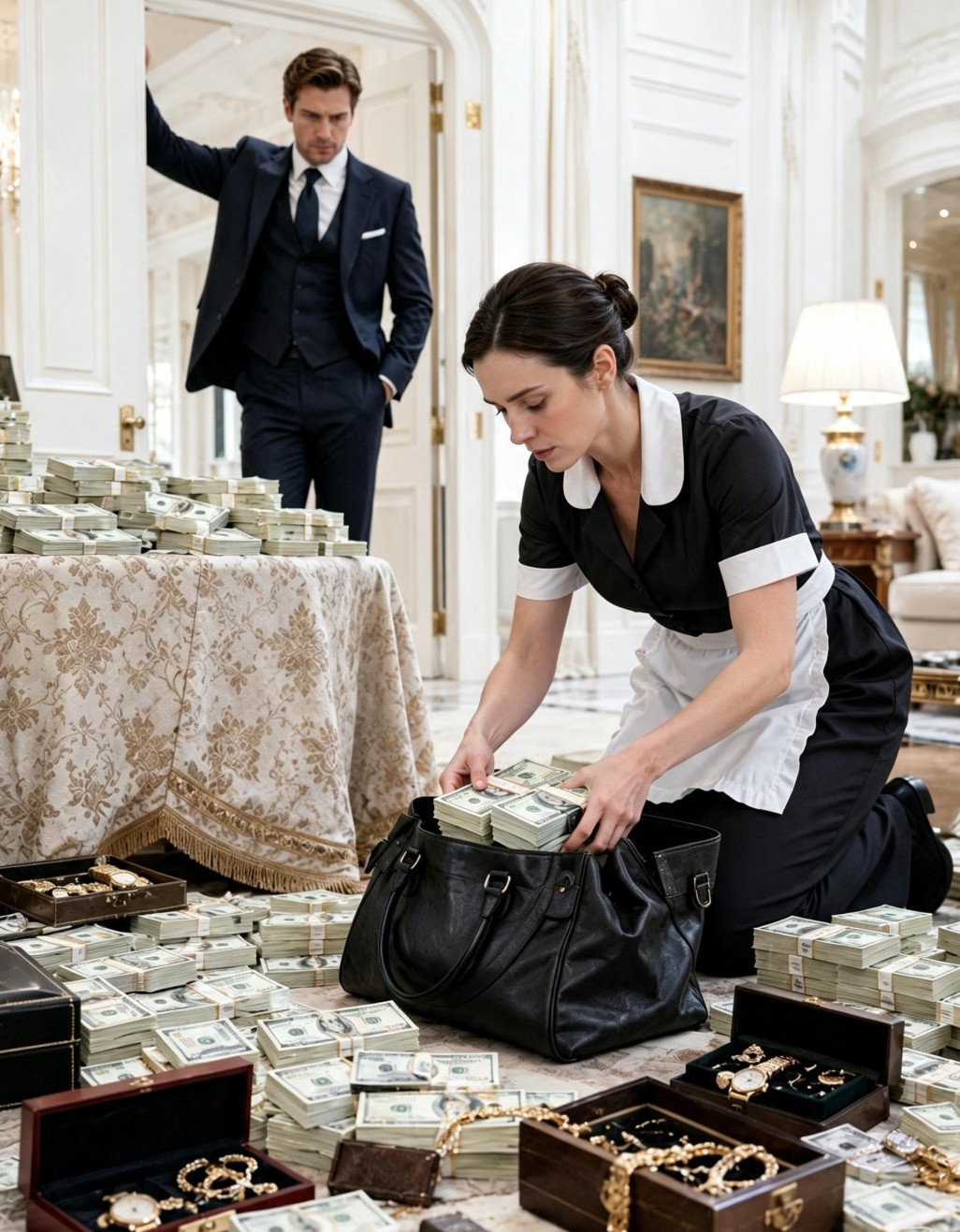
Instead, I found my housekeeper standing in the guest bedroom, surrounded by stacks of cash, folders filled with bank records, and boxes overflowing with documents.
For one terrifying moment, I thought she had robbed me.
Then Josephine Fletcher looked directly at me and said,
“Every dollar here belongs to you, Mr. Sinclair.”
I stood frozen in the doorway.
At fifty-eight years old, I had become the kind of man people mentioned quietly behind closed doors because of my spectacular fall from grace.
Only a year earlier, my name had meant something in Baltimore.
I was Desmond Sinclair, a construction tycoon who had built luxury towers, sprawling resorts, and expensive properties throughout Maryland and Virginia.
Politicians used to shake my hand in public.
Investors fought for seats at my dinner table.
Socialites laughed at my jokes, even when I knew perfectly well that most of them were not funny.
I had money.
Power.
Respect.
Or at least, I had believed I did.
Then my entire empire collapsed within a matter of months.
Three of my senior business partners disappeared after secretly draining millions of dollars from company accounts.
They had done it through fake permits, inflated construction contracts, shell corporations, and layers of complicated financial transactions designed to hide where the money was going.
At first, I thought the problems were simple accounting mistakes.
Then the lawsuits arrived.
After the lawsuits came frozen bank accounts.
Then federal investigators.
Every news station in Baltimore began repeating my name alongside words like fraud, corruption, and bankruptcy.
Eventually, I stopped listening to the radio because I could no longer stand hearing my own name turned into a headline.
The mansion somehow survived the first wave of legal action, although barely.
Everything else I owned seemed to disappear into the enormous hole of debt.
My exotic sports cars went first.
Then the vacation homes.
Finally, my beautiful yacht was sold.
My wife, Isabelle, lasted exactly two more weeks.
Then she left.
She took her designer luggage, most of her jewelry, and a divorce attorney who smiled like a man already calculating his enormous fee.
Everyone disappeared.
Everyone except one person.
Josephine Fletcher.
For fifteen years, Josephine had worked in my mansion.
She arrived before sunrise every morning wearing the same faded gray dress. Her dark hair was always pinned neatly behind her head, and her rough hands were usually working before I had enough strength to face another day.
She cooked my meals.
She polished the cold marble floors.
She watered the plants I had stopped noticing.
And when I cried alone in my office after midnight, she pretended not to hear me.
For years, I had barely noticed how much she did.
She had become part of the house.
Almost invisible.
But when everything else disappeared, she was still there.
One rainy morning, the shame became too heavy for me to carry silently.
I sat at the kitchen table staring into a cup of cold coffee.
“Josephine,” I said quietly, “I honestly cannot keep paying you anymore.”
She carefully placed the breakfast tray on the table.
I continued before she could answer.
“You should leave this house before they take the roof out from under us too. I already owe you months of back salary.”
Josephine looked at me.
There was so much sadness in her eyes that it almost made me angry.
“I know exactly where I belong, Mr. Sinclair,” she said.
I laughed without any humor.
“Here? With a ruined old man like me?”
“Yes,” she answered softly.
“Especially here.”
Her answer unsettled me more than any creditor’s threat had in months.
“Why?” I asked. “Everyone else left when the money disappeared.”
Josephine folded her hands over her white apron.
“Because when a house collapses,” she said, “someone has to stay behind and search through the ruins.”
I stared at her.
Before I could ask what she meant, the office phone rang.
It was Kenneth Miller.
My old college friend.
Kenneth spoke with the bright, fake warmth of a man performing an act of kindness he did not actually feel.
“Desmond! Come to dinner at my place tomorrow,” he said. “My wife keeps asking about you. She wants to see how you’re doing.”
I nearly refused immediately.
Pity has a distinct smell.
It is suffocating.
And I recognized it instantly.
But after I hung up, I saw Josephine standing in the kitchen doorway.
“You should go,” she said.
I scoffed.
“Why? So they can stare at the bankrupt millionaire while pretending they don’t notice how miserable I am?”
Josephine continued drying a dish.
“You are acting like a man who is currently rehearsing his own funeral.”
I stared at her.
Then, against my better judgment, I agreed to go.
The following evening, Josephine repaired one of my old charcoal suits until it almost looked respectable again.
I drove across Baltimore in an aging sedan that rattled violently every time I stopped at a red light.
When I reached Kenneth’s large estate, something immediately felt wrong.
The porch lights were off.
The entire house looked dark.
I walked to the front door and found a folded note beneath it.
I picked it up.
Desmond, we had a family emergency and had to leave unexpectedly. I will call you later. Sorry.
I read the note twice.
There had been no family emergency.
There had only been humiliation dressed up as polite behavior.
I drove home gripping the steering wheel so tightly that my knuckles turned white.
By the time I returned to the mansion, I was exhausted.
The house was strangely silent.
There was no music coming from the kitchen.
No smell of soup.
No sound of Josephine humming while she worked.
“Josephine?” I called into the dark foyer.
Nothing.
I climbed the grand staircase.
Halfway down the upstairs hallway, I noticed a bright light shining beneath the guest-room door.
The door was slightly open.
I pushed it wider.
And completely forgot how to breathe.
The entire room was filled with money.
Stacks of cash covered the bed like blankets.
Boxes overflowed with ledgers, bank statements, contracts, flash drives, sealed envelopes, and other financial records.
And standing in the middle of it all was Josephine.
She was wearing rubber gloves.
Her face was calm, but deathly pale.
I grabbed the doorframe to steady myself.
“Josephine,” I whispered. “What have you done?”
She slowly turned toward me.
“Every dollar here belongs to you, Mr. Sinclair.”
My mouth went dry.
She picked up one particular folder and placed it into my shaking hands.
“Your partners did not disappear with your money,” she said. “They hid it through accounts connected to your wife.”
The room seemed to tilt beneath my feet.
“Isabelle did this?”
Josephine nodded once.
“And Kenneth Miller helped them.”
My heart seemed to stop.
Kenneth.
The dinner invitation.
The fake emergency.
The dark house.
The note waiting beneath the door.
It suddenly made sense.
Before I could say another word, red and blue lights flashed across the bedroom windows.
Police cruisers were speeding up my driveway.
Josephine looked at me.
Then she looked at the piles of cash.
“They know I found the evidence,” she whispered.
The bedroom door suddenly flew open.
A police officer entered with his pistol raised.
“Hands where I can see them!”
Josephine did not run.
She slowly raised both hands, her rubber gloves still covering her fingers.
I stood beside the bed, surrounded by more cash than I had seen since before my life became a public disaster.
Then Detective Paul Henderson entered.
I knew him from television interviews.
He was the detective who had previously called me a person of interest with the bored confidence of a man already convinced I was guilty.
He looked around the room.
“Well,” Henderson said, “isn’t this convenient?”
“This money was planted here,” Josephine said firmly.
Henderson smiled.
“By the housekeeper, I suppose?”
Her eyes hardened.
“By people who knew Mr. Sinclair would be away from the house.”
I turned toward her.
“Josephine, please tell me what is happening.”
She kept her eyes on Henderson.
“A white delivery van arrived at 7:12,” she said. “Two men carried these boxes upstairs through the service entrance. I recorded everything.”
For the first time, Henderson’s confident smile disappeared.
“Recorded them where?”
Josephine said nothing.
Henderson stepped closer.
“Mrs. Fletcher, you are standing in a room full of stolen cash.”
“No,” she replied calmly.
“I am standing in a trap before it closes on us.”
The words hit me.
A trap.
Kenneth’s invitation.
The note.
The dark house.
The silence.
Everything had been designed to put me exactly where they wanted me.
Henderson turned toward me.
“Desmond Sinclair, you are under arrest on suspicion of concealing embezzled funds, obstruction of justice, and conspiracy to defraud investors.”
My knees nearly buckled.
Josephine moved as if she wanted to step between us.
Two officers grabbed her arms.
“Don’t touch her!” I shouted.
One officer shoved me hard against the wall.
My cheek struck the cold plaster.
Then the handcuffs snapped around my wrists.
There I was.
Desmond Sinclair.
A man once welcomed into rooms by governors and billionaires.
Now pressed against the wall of his own mansion like a common criminal.
As they dragged Josephine toward the hallway, she twisted around just enough to meet my eyes.
“Mr. Sinclair,” she said quietly, “remember the crimson ledger.”
“What crimson ledger?”
She looked toward the bed.
Beneath a stack of heavy contracts was a thin red book with worn corners.
Henderson noticed where I was looking.
His head snapped toward the bed.
“Bag everything,” he ordered.
Josephine’s expression changed.
Not fear.
Disappointment.
“You were always too eager, Detective,” she said.
Henderson stepped toward her.
“What did you say?”
Josephine lifted her chin.
“I said you arrived before your friends could remove what actually mattered.”
For a moment, the entire room fell silent.
Then another voice came from downstairs.
“Federal agents! Nobody moves!”
Henderson froze.
Every officer froze.
A woman wearing a sharp navy suit appeared in the doorway with two men behind her.
She held up her badge.
“Special Agent Miriam Vance, Financial Crimes Division.”
Her eyes moved across the room.
The money.
The documents.
The officers.
Then Josephine.
“Mrs. Fletcher?”
Josephine released a slow breath.
“Yes. I’m here.”
Agent Vance looked at Henderson.
“Detective, step away from the evidence immediately.”
For the first time, Henderson looked afraid.
Part 2:
They took all of us downtown, but they did not put us in the same vehicles.
Henderson rode in silence, his jaw clenched tightly.
Agent Vance sat beside me in the back of a federal SUV.
My wrists were still cuffed.
Her voice remained calm and professional.
“Mr. Sinclair, do not answer any questions until your attorney arrives.”
“I don’t have an attorney anymore,” I said.
“You do now,” she replied.
At the federal building, I was placed in a small interview room.
There was a metal table in the center.
A humming fluorescent light hung above me.
I sat there feeling older than fifty-eight.
Emptier than bankrupt.
Then the door opened.
A tall man in a sharp charcoal suit entered.
“Desmond Sinclair?”
“Yes.”
“I am Felix Wright. I will be representing you.”
I stared at him.
“I cannot pay you.”
His expression softened.
“My mother already did.”
I looked at him in confusion.
Before I could ask what he meant, Josephine entered the room.
My breath caught.
“Your mother?”
Felix glanced toward her.
“Josephine Fletcher Wright.”
I stared at Josephine.
She folded her hands in front of her.
Suddenly, she looked less like the housekeeper who had spent fifteen years cleaning my mansion and more like a woman who had been carrying a secret too heavy for one person.
“You never told me,” I whispered.
“You never asked about my family,” she said gently.
Her words hurt because they were true.
Felix placed a folder on the table.
“My mother has spent the last eight months documenting the systematic theft from your company.”
“Eight months?”
Josephine nodded.
“After your wife left, I cleaned her dressing room. Behind a false panel in her vanity, I found bank statements under names that should not have existed.”
“She used fake accounts?”
“Not exactly,” Felix explained. “Shell companies. Some were connected to your partners. Some were connected to Kenneth Miller. Others were connected to Detective Henderson through his brother-in-law.”
I leaned back in my chair.
I could barely process what I was hearing.
Josephine placed her hand on the folder.
“At first, I thought it was only your partners,” she said. “Then I found your wife’s signature.”
She paused.
“Then I found Kenneth’s.”
His name hit me like broken glass.
Kenneth had known me since college.
He had stood beside me when my father died.
He had toasted me at my wedding.
He had eaten at my table.
All those years, he had been helping dig my grave.
“Why didn’t you tell me?” I asked.
Josephine’s eyes filled with tears, but her voice remained steady.
“Because you were broken. And because whoever stole your money wanted you desperate enough to make a mistake.”
Felix opened the folder.
Inside were photographs, delivery logs, copied checks, emails, bank transfers, property deeds, and grainy security images showing men carrying boxes.
“The cash in your guest room was meant to be discovered by local police after an anonymous tip,” Felix explained. “Detective Henderson would arrest you, seize the records, and make sure the documents connecting Kenneth and your wife disappeared. The cash would make you look guilty before you ever reached trial.”
I covered my face with my hands.
“So tonight was supposed to finish me.”
Josephine stepped closer.
“No,” she said.
I looked up.
“Tonight was supposed to bury you. But they did not know I had already contacted the real authorities.”
For the first time in a year, something moved inside my chest that was not despair.
It was anger.
Not wild anger.
Not blind anger.
Something colder.
Something clearer.
“What is the crimson ledger?” I asked.
Josephine looked at Felix.
Felix hesitated.
Then he slid the red book across the table.
Josephine rested her fingertips on its worn cover.
“This,” she said, “is the reason your father never truly trusted Kenneth Miller.”
My father.
I had not heard his name spoken like that in years.
Josephine opened the ledger.
On the first page, written in my father’s handwriting, was a single sentence:
If Desmond ever loses everything, begin by looking at the people who still smile at him.
I stared at the words until they blurred.
“My father wrote this?”
Josephine nodded.
“Three months before he died.”
“My father trusted Kenneth.”
“No,” she said. “Your father tolerated Kenneth.”
Felix turned the ledger toward me.
Inside were names, dates, company structures, old partnership agreements, and notes written in my father’s firm handwriting.
One page was circled in red.
Kenneth Miller is charming and ambitious but has no loyalty. Never give him signing authority.
I laughed bitterly.
“I gave him signing authority six years ago.”
Josephine lowered her eyes.
“My father gave this to you?”
“Not directly,” she said. “He left it locked in the old pantry safe. Before his final surgery, he told me that if there was ever a day when your house became quiet, I should open it.”
The room seemed to shrink around us.
“My house became quiet,” I said.
“Yes.”
Everyone had left me.
Isabelle.
Kenneth.
My partners.
My investors.
Only Josephine had stayed.
While I sat drinking cold coffee and staring at unpaid bills, she had opened the safe my father left behind and begun searching through the ruins.
At that moment, Agent Vance entered carrying a tablet.
“We recovered the guest-room surveillance device Mrs. Fletcher hid behind the curtain rod,” she said. “It shows two men unloading boxes at 7:12. Their van is registered to a warehouse leased by Miller Holdings.”
Felix gave a grim smile.
“Good.”
Agent Vance looked at me.
“We also intercepted a message from Kenneth Miller to Detective Henderson. It was sent at 8:03.”
She tapped the screen.
The message appeared.
Cash is in place and the wife confirms Desmond is on his way back, so make it loud.
My stomach twisted.
“Wife,” I whispered.
Isabelle.
I had expected greed from her.
Cruelty, perhaps.
Vanity, certainly.
But this was different.
She had not simply abandoned me.
She had tried to lock the door from the outside and burn the house down with me inside.
Agent Vance continued.
“We need more than messages. We need the original server from your company’s private backup system. Our records show that it was removed shortly before your bankruptcy filing.”
I frowned.
“That system was destroyed.”
Josephine shook her head.
“No.”
I looked at her.
“Your wife had it moved.”
“Where?”
Josephine studied my face.
“In the mansion.”
I almost laughed.
“The mansion has been searched by creditors, investigators, and appraisers.”
“Not everywhere.”
Her answer hung in the air.
Then I understood.
“My father’s wine cellar.”
Josephine nodded.
Part 3:
Two hours later, under federal escort, I returned to my own home.
I was not a suspect anymore.
But I was not completely free either.
I was something in between.
The mansion looked different at dawn.
For the first time, it seemed less like a monument to my failure and more like a witness to my history.
Josephine led us toward the wine cellar.
We passed empty racks and dust-covered bottles I had once purchased to impress men who never truly cared about wine.
At the back wall, Josephine pressed two bricks inward.
A panel clicked.
Behind it was a narrow steel door.
I stared.
“I never knew this existed.”
“Your father did not tell many people many things,” Josephine replied.
Inside was a hidden service room.
Old electrical panels lined the walls.
Sealed boxes were stacked in one corner.
And in the center stood a black server tower wrapped in plastic.
Agent Vance’s technician immediately crouched beside it.
“This could be everything,” he said.
Then Josephine noticed something on the floor.
A fresh footprint.
It stood clearly in the thick layer of dust.
We all turned toward the stairs.
From upstairs came the faint sound of breaking glass.
Someone else was inside the mansion.
Agent Vance raised one finger to her lips.
The technician unplugged the server with shaking hands.
Felix stepped in front of Josephine.
She pushed him gently aside.
“This is still my house to clean,” she whispered.
We moved quietly upstairs.
The sound had come from my office.
The same office where I had cried alone after midnight while Josephine pretended not to hear me.
The door stood open.
Inside, my wife was tearing through the drawers.
She looked flawless.
Of course she did.
She wore a cream silk blouse and diamond earrings.
Kenneth stood beside her.
He held a small flashlight in one hand.
A pistol was in the other.
Seeing them together did not surprise me anymore.
Seeing them so desperate did.
My wife froze when she saw us.
For one heartbeat, nobody moved.
Then she smiled.
“Desmond,” she said softly. “You look awful.”
Kenneth raised the gun.
Agent Vance’s agents raised theirs even faster.
“Drop it!” Agent Vance ordered.
Kenneth’s face twisted with rage.
“This is private property!”
“It is now a federal crime scene,” Agent Vance replied. “Put the weapon down.”
His hand trembled.
My wife looked at him sharply.
“Kenneth.”
He lowered the pistol.
Josephine stepped into the doorway.
My wife’s eyes immediately moved toward her.
For the first time in all the years I had known Isabelle, I saw genuine fear cross her face.
“You,” my wife whispered.
Josephine said nothing.
My wife gave a nervous laugh.
“A maid,” she said. “We were beaten by a maid.”
Josephine remained calm.
“No,” she replied.
“You were beaten by your own handwriting.”
Agent Vance nodded toward one of her agents, who took Kenneth’s gun.
Felix opened a small evidence bag and removed a folded page.
“The red ledger gave us the old partnership map,” he said. “The server gave us the financial transfers.”
He placed the page on my desk.
“But this gave us the motive.”
I stared at the document.
It was a draft of my revised will.
I remembered it.
Two years earlier, after a hurricane destroyed a workers’ housing project, I had asked my attorney to prepare changes to my will.
I wanted to create a foundation using company profits.
The foundation would provide homes for retired laborers and scholarships for their children.
Isabelle had called the idea sentimental nonsense.
I never signed the final version.
Or so I thought.
Felix pointed toward the bottom of the document.
There was my signature.
Forged.
My wife’s face hardened.
“You were going to give away everything,” she snapped. “Everything I tolerated you for.”
The room became completely silent.
Her mask was gone.
There was no charm anymore.
No softness.
No performance.
Only greed and anger.
Kenneth tried to interrupt.
“Isabelle, please—”
But she kept looking at me.
“You built towers for strangers and expected me to smile inside that museum of a marriage,” she said. “Kenneth understood ambition. Your partners understood money. You only understood guilt.”
I should have felt destroyed.
Instead, I felt strangely clear.
“You framed me because I wanted to help people?”
She gave me a thin smile.
“No, Desmond. We framed you because you made it easy.”
Josephine stepped closer.
“Not easy enough,” she said.
My wife turned toward her.
“You should have taken your salary and disappeared.”
Josephine’s voice remained quiet.
“He paid my son’s hospital bill fifteen years ago when no one else would.”
I looked at her.
She continued.
“He never told anyone. He probably even forgot about it. But I did not.”
I stared at Josephine in amazement.
She had never told me.
Then I remembered.
A worker’s cousin.
A sick child.
An invoice quietly sent to my office.
I had signed the payment between meetings.
To me, it had been one small act.
To Josephine, it had been a debt written on her heart.
Agent Vance stepped forward.
“Isabelle Sinclair and Kenneth Miller, you are both under arrest.”
As the agents placed handcuffs on them, my wife looked back at me.
“You still lose,” she said. “Even if you’re cleared, you owe more than you own.”
Then Josephine reached into her apron pocket.
She pulled out a small brass key.
“No,” Josephine said.
My wife immediately went pale.
I looked at Josephine.
“What is that?”
“The last thing your father left behind.”
My wife struggled against the agent holding her.
“That key opens nothing.”
Josephine looked directly at her.
“Then why did you come back for it tonight?”
Kenneth closed his eyes.
That was answer enough.
Part 4:
We went to the old library.
Nobody used that room anymore.
My father had loved it.
After his death, I had avoided it because it still smelled faintly of cigar smoke and leather polish.
Josephine knelt beside the fireplace.
She pressed the brass key into a narrow slot hidden beneath the mantel.
A panel clicked open.
Inside was a metal box.
It was not large.
It was not dramatic.
But my wife had watched that box as if it were a coffin opening.
Josephine handed it to me.
My hands shook as I lifted the lid.
Inside were documents sealed in oilcloth.
Trust papers.
Property deeds.
Banking authorizations.
And a letter addressed to me in my father’s handwriting.
I unfolded it.
The first line nearly broke me.
Desmond, if you are reading this, then I failed to teach you the difference between friends and guests.
I swallowed hard.
Josephine touched my arm.
“Read the rest.”
I continued.
The letter explained what my father had done before he died.
He had suspected that several of my business partners were positioning themselves to control the company after his death.
So he had created a private asset-protection trust.
The trust was designed to remain dormant unless fraud, insolvency, or criminal mismanagement threatened the family company.
The trustee was not a banker.
Not a lawyer.
Not Kenneth.
It was Josephine Fletcher Wright.
I slowly looked up.
“You?”
Josephine nodded.
“Your father trusted people who noticed what others missed.”
Felix took the documents and explained.
“When your partners began stealing, they unknowingly transferred several assets through companies already identified in the trust documents. Under the clawback provisions, once the fraud was proven, those transfers could be returned to the trust.”
“Who is the beneficiary?” I asked.
Felix looked directly at me.
“You.”
I could not speak.
Agent Vance examined the papers.
Then she looked toward Kenneth and Isabelle.
“This is why you needed the key.”
Kenneth sagged in his handcuffs.
My wife’s anger returned.
“That trust is dead. It was never activated.”
Josephine calmly shook her head.
“It was activated the day Desmond’s accounts were frozen.”
Felix opened another document.
“And Mrs. Fletcher filed the necessary notice eight months ago.”
I turned toward Josephine.
“Eight months?”
She nodded.
Eight months.
While I believed she was dusting shelves, washing dishes, cooking soup, and repairing my old suits, she had been fighting bankers, lawyers, businessmen, and thieves with nothing but patience, documents, and determination.
“You saved everything,” I whispered.
Josephine shook her head.
“No.”
She looked directly at me.
“I saved what could be proven. The rest depends on what kind of man you choose to be now.”
Those words stayed with me for a long time.
Part 5:
The arrests became national news.
Detective Henderson confessed first.
Kenneth tried to trade information to save himself.
My wife refused to speak until federal prosecutors formally indicted her on charges that included conspiracy, obstruction, fraud, and attempted evidence tampering.
My former business partners were eventually caught in the Cayman Islands after one of them made the stupid mistake of using a company card to buy champagne.
The court began unfreezing the assets.
The trust recovered properties, accounts, and insurance settlements.
Creditors were paid.
Employees received their unpaid wages.
Investors recovered far more money than anyone had expected.
And one rainy morning, almost a year after I had told Josephine that I could no longer afford her, Felix arrived at the mansion carrying a single envelope.
He placed it on the kitchen table.
Inside was a certified statement.
Recovered assets, after restitution, totaled forty-seven million dollars.
I sat down hard.
Josephine poured me a cup of coffee.
For a long time, neither of us spoke.
Then she placed another document beside the financial statement.
It was her unpaid wage calculation.
Fifteen months.
Every unpaid month carefully calculated.
No interest.
I stared at it.
Then I started laughing.
Soon, I was crying.
“Josephine,” I said, “you just handed me forty-seven million dollars and billed me like we’re arguing over groceries.”
She gave me the same expression she used whenever I tracked mud across her clean marble floor.
“A debt is a debt, Mr. Sinclair.”
So I wrote the check.
Then I wrote another one.
She tried to refuse the second payment.
I folded it into her hand anyway.
For the first time in years, I was not paying someone to stay.
I was thanking the only person who never left.
People expected me to rebuild my empire exactly as it had been.
They expected towers.
Resorts.
Luxury cars.
Television interviews.
Champagne poured over my resurrection like holy water.
For a while, I expected it too.
Then one afternoon, I walked through one of my old construction sites.
I looked at the faces of the workers who had lost pensions, savings, and years of their lives because I had trusted the wrong people at the top.
And because I had ignored the quiet warnings coming from below.
That night, I returned to the mansion.
Josephine was in the kitchen making soup.
Without turning around, she said,
“You are thinking too loudly.”
I smiled.
“I don’t want the old life back.”
She stirred the pot.
“Good.”
I laughed.
“That is all you have to say?”
“What else should I say?”
“I thought you might be surprised.”
Josephine put the spoon down.
Then she faced me.
“Mr. Sinclair, the old life is what made room for people like Kenneth and your wife. So why would you bring those ghosts back into a clean house?”
Her words stayed with me.
So I did the one thing nobody expected.
I sold the mansion.
Not because I had to.
Because I wanted to.
The newspapers called it shocking.
Former friends called it foolish.
Investors called me with voices sweetened by opportunity.
They promised they could help me return to my former position.
I ignored them.
With part of my recovered fortune, I created the Sinclair Fletcher Foundation.
It was not a memorial.
It was not a publicity stunt.
It was a working organization dedicated to building storm-resistant homes for retired laborers, single parents, and families who had been priced out of the cities they had helped build.
And I made Josephine its chairwoman.
She hated the title.
Felix loved it.
At the first board meeting, Josephine arrived wearing her faded blue dress, her dark hair pinned neatly back.
Six attorneys were sitting around the table.
She looked at every one of them.
Then she said,
“Say it plainly. Money should not need a translator.”
Nobody argued with her.
Six months later, we opened our first housing community outside the city.
At the ribbon-cutting ceremony, a little girl walked up to Josephine and handed her a paper flower.
Josephine accepted it as if it were made of gold.
I stood beside her.
Families walked into homes with fresh paint, strong roofs, and keys that belonged to them.
A reporter approached me.
“Mr. Sinclair, after everything you lost and recovered, do you consider yourself a millionaire again?”
I looked at Josephine.
She raised one eyebrow.
Careful.
I laughed.
“No,” I said.
“I consider myself a man who was finally returned to himself.”
Part 6:
That evening, after the ceremony, Josephine and I sat on the porch of the modest house I had purchased near the water.
It was not a mansion.
It was not a monument.
It was simply a house with warm lights and a kitchen large enough for making soup.
Josephine handed me an envelope.
“What is this?” I asked.
“Your final inheritance.”
I frowned.
“There is more?”
“Not money.”
I opened it.
Inside was a photograph.
My father was standing in front of the old mansion.
He was much younger.
Beside him stood Josephine, also much younger.
She was holding the hand of a little boy.
Felix.
I turned the photograph over.
On the back, my father had written:
Family is sometimes the person who stays after the music stops.
My throat tightened.
“Why didn’t he tell me?”
Josephine looked out at the dark water.
“Because your father was proud,” she said.
She paused.
“And because I was proud too. Sometimes life is foolish with important things.”
I stared at the photograph.
Then I looked at the woman who had cleaned my floors, guarded my secrets, protected my name, helped expose the people who had betrayed me, and handed me back a future.
“You were never just my housekeeper,” I said.
Josephine gave me a faint smile.
“No,” she replied.
“But that was the only job in your house where a person could hear the truth.”
Part 7:
Years later, people still told the story incorrectly.
They said a bankrupt millionaire came home and found his housekeeper surrounded by stolen cash.
They said she uncovered a hidden fortune.
They said she exposed his wife, his best friend, his business partners, and a corrupt detective.
All of that was true.
But it was not the whole truth.
The real story was much simpler.
I came home expecting humiliation.
Instead, I found loyalty.
I thought I had lost every dollar.
But Josephine had saved something far more valuable than money.
She saved my name.
She saved my father’s warning.
She saved the truth.
She saved the part of me that wealth had nearly buried.
I had spent years believing that success meant having the biggest house, the most powerful friends, the most expensive cars, and enough money to make everyone want to stand beside me.
I had been wrong.
When everything disappeared, I finally learned who was standing beside me because she wanted something from me—and who was standing beside me because she believed I was worth saving.
Kenneth wanted my money.
Isabelle wanted my wealth.
My partners wanted my company.
But Josephine wanted nothing.
She simply remembered a kindness I had almost forgotten.
She stayed when everyone else left.
She searched when everyone else stopped looking.
She protected the truth when protecting it could have destroyed her own life.
And when the moment finally came, she handed me back more than forty-seven million dollars.
She handed me back my future.
That is why the most shocking thing I discovered in that guest bedroom was not that the cash belonged to me.
It was that after losing almost everything, I finally understood what was worth keeping.
THE END.
