
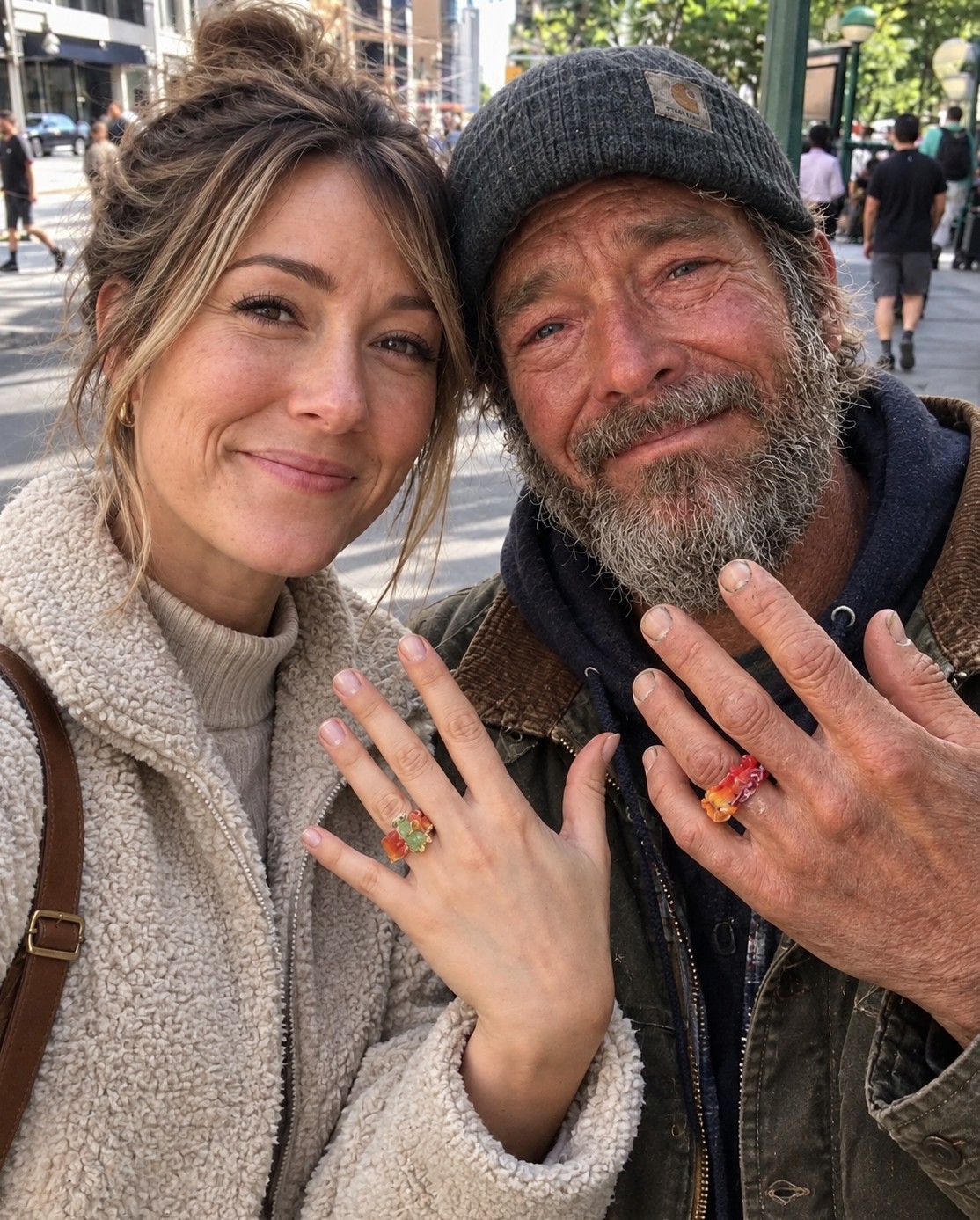
Part 1:
The homeless man I married always drank his coffee black outside my subway station in downtown Minneapolis.
Six days after his funeral, a letter arrived in his shaky handwriting inside a thick white envelope.
The postmark was dated one day before he died.
The first sentence was an apology I did not understand.
“Hannah, I need to apologize before I thank you,” I read aloud to the empty room, tracing the uneven letters I had watched him write on hospice intake forms.
When I first held the envelope, I had actually smiled.
I thought he was leaving me a quiet goodbye.
That seemed exactly like him.
He was the kind of man who could never accept a paper cup of coffee without thanking me three times.
Then I reached the second sentence.
My smile disappeared.
“Nobody was going to bury me as a John Doe.”
I sat down heavily in my armchair, staring at the page as my breath caught in my throat.
Less than a month earlier, he had been sitting outside the Hennepin Avenue station with a piece of cardboard across his knees.
Written across it in large black marker were the words:
MARRY ME. I HAVE ONE MONTH LEFT TO LIVE.
I had known him for nearly two years by then.
Every weekday morning, I stopped at the coffee cart beside the subway entrance.
My coffee always had sweet cream.
His was always black.
No sugar.
No cream.
Nothing.
He never begged me for spare change.
He never asked me for food.
Some mornings, we talked about the next Midwest blizzard.
Other mornings, he complained about the city pigeons.
Once, he looked down at my office pumps and said, “Those shoes look like they were designed by an engineer who genuinely hated human feet.”
I had laughed so hard that morning that I nearly spilled my coffee.
Usually, I stayed for five minutes before rushing to my accounting job downtown.
But that Tuesday morning was different.
He looked terribly sick.
His face was pale, and his skin had a yellowish color that made him look almost unreal.
His calloused hands shook badly when I handed him his coffee.
I pointed toward the cardboard sign.
“What is this supposed to mean?”
He looked down at the words and then back at me.
“The free clinic doctors say I probably have about four weeks left.”
For a moment, the roar of morning traffic disappeared.
The commuters rushing around us seemed to fade into the background.
“What are you talking about?” I asked.
I knelt beside him on the frozen pavement.
“Liver failure,” he said simply.
He leaned his shoulder against the brick wall behind him.
“I am so sorry,” I whispered.
I reached out and touched his shoulder.
“Do not make that face, Hannah,” he said, forcing a tiny grin.
“What face?”
“The face people make when they are already standing at your graveside.”
Even while facing his own death, he still managed to make me laugh.
I shook my head.
“You are unbelievable.”
He smiled faintly.
Then I pointed at the cardboard sign again.
“Why are you asking someone to marry you?”
He looked down into his black coffee.
“I just do not want to die belonging to nobody.”
“You do not belong to nobody,” I told him firmly.
“That is a very sweet thing to say.”
He looked toward the busy street.
“But everything changes when legal paperwork gets involved.”
He told me that because he had no surviving legal family, he feared that county officials would eventually have to handle his final arrangements.
He made it sound as though his body might be treated like that of an unknown person if nobody claimed responsibility for him.
“I just want one person in this world who can stand up and say, ‘He is mine, and I will take care of him,’” he whispered.
I was thirty-two years old, single, and living alone in a small apartment nearby.
He was dying on the street.
And I had always been the kind of person who preferred fixing problems rather than walking away from them.
Two days later, we walked into the municipal courthouse in Saint Paul to get our marriage license.
He wore a clean blue button-down shirt that a volunteer at the shelter had given him that morning.
I wore my conservative navy work dress and carried a small folder containing our identification documents.
When the magistrate asked whether we had brought rings, he dramatically searched his empty coat pockets.
Then he gave a quiet gasp.
“Well, it looks like I completely forgot the jewelry.”
I smiled despite the solemn room.
Eleven minutes later, after signing the required documents, I officially became his wife.
There was no big wedding.
No flowers.
No family.
No celebration afterward.
Just two people standing in a small courthouse room and signing papers.
Exactly three weeks after that ceremony, I sat beside his bed in a quiet hospice facility in Bloomington.
I held his calloused hand.
His breathing became slower.
Then, eventually, it stopped.
He was gone.
And now, six days later, I was sitting in my apartment reading a letter that told me the story I had believed was not completely true.
“The liver failure was real, and the four weeks were real,” the letter continued in his rough handwriting.
“What I lied about was why I asked you to marry me in the first place.”
I lowered the yellow paper onto my desk.
I took a deep breath.
Then I picked it up again.
“My final arrangements were already settled through the county and municipal programs available to people in my situation,” he had written.
“The shelter system and county social services would have handled the necessary paperwork. I was never going to disappear without a name, and I was never going to be left without a legal process for my remains.”
My fingers tightened around the paper.
So he had known.
The entire time.
He had known that his original story was not true.
And he had still asked me to marry him.
I stood up from my chair so quickly that the wooden legs scraped loudly against the floor.
“What did you actually do?” I yelled at the empty apartment.
There was nowhere for my anger to go.
He was already dead.
Buried beneath the ground.
I could not call him.
I could not demand an explanation.
I could not force him to look me in the eye.
So I sat back down.
Then I continued reading.
Part 2:
“If I gave you a clear problem that you could solve, I knew you would step up and solve it.”
That sentence hurt more than anything else.
Because it exposed me perfectly.
For nearly two years, I had constantly offered him things he never directly asked me to give him.
Hot coffee.
Warm socks.
Sandwiches.
Shelter phone numbers.
Lists of social-service organizations.
During one brutal winter cold snap, I had spent my entire lunch break calling shelters and temporary housing facilities until I found him a bed.
He always thanked me politely.
But I had never realized he was studying me.
He had noticed something about me that I had never noticed about myself.
If there was a problem, I wanted to solve it.
If someone needed help, I wanted to find the answer.
And he had figured out exactly how to make me say yes.
Near the bottom of the first page, he had written a very specific set of instructions.
“Before you decide what kind of terrible person I was, go back to the courthouse where we got married.”
I frowned.
“Ask for a woman named Teresa at the records desk, and tell her you are my wife.”
I stared at those words for several seconds.
For a moment, I considered throwing the entire letter into the kitchen trash.
Instead, about an hour later, I was standing inside the marble lobby of the Saint Paul courthouse.
Dozens of nervous couples filled the plastic waiting chairs around the bright central hallway.
A young woman in a white jumpsuit adjusted her makeup while her fiancé nervously held a red bouquet.
A toddler crawled underneath the seats while his exhausted father tried to catch him by the coat.
Three weeks earlier, my husband and I had sat in those same chairs waiting for our turn.
I remembered him rubbing his trembling palms against his denim jeans.
“You are shaking really badly,” I had told him.
“I am dying, so I think I am allowed to be a little nervous,” he had answered with a small smile.
At the time, I had accepted that explanation.
Now I wondered how many things I had believed simply because I had never stopped to ask another question.
I walked to the heavy wooden counter.
An administrator listened to my request and pointed me toward a desk at the back.
An older woman wearing distinctive red reading glasses was sitting behind a stack of legal files.
“Are you Teresa?” I asked.
She looked up.
“Yes, I am.”
“My name is Hannah,” I said, holding my handbag tightly against my coat. “I am his wife.”
Her hands froze above the keyboard.
She stared at me.
“Whose wife?” she asked softly.
I gave her his name.
The moment she heard it, her expression changed.
Her rolling chair moved backward as she stood.
“Oh, sweetheart,” she whispered.
She walked around the counter and wrapped her arms around me.
I stood stiffly in her embrace, completely surprised.
When she stepped back, I saw tears in her eyes.
“When did he pass away?” she asked.
“Just about a week ago.”
She wiped her cheek with a tissue.
“I knew he was very sick,” she said quietly. “But I did not realize he was that close to the end.”
I stared at her.
“Did you actually know him?”
“Of course I knew him.”
She looked around the large historical office.
“How did you know him?” I asked.
“He worked right here in this building.”
I blinked.
“He worked here?”
She smiled sadly.
“He was an administrator here for twenty-eight years before he retired.”
I leaned against the wooden counter.
“Then how on earth did he end up living on the street?”
“His health started failing shortly after he retired,” Teresa explained. “His medical bills drained most of his savings. Eventually, he lost his apartment.”
She paused.
“He was also very proud. He could not bring himself to ask his former coworkers for money.”
I shook my head slowly.
“What specific job did he do?”
“He mostly processed marriage licenses and managed the civil ceremony schedules.”
I stared at her.
A strange feeling moved through me.
The man I had known as a homeless stranger had spent almost three decades helping other people get married.
Teresa removed her red glasses.
“Did he really never tell you any of this?”
“No,” I said. “Not one word.”
“That sounds exactly like him.”
“What does that mean?”
She looked toward the quiet hallway.
Then she gestured for me to follow her.
“Come with me.”
She led me toward a set of heavy mahogany doors.
Part 3:
Teresa opened the doors into a small, elegant room designed for civil wedding ceremonies.
Against the far wall stood a polished wooden wedding arch decorated with simple silk flowers.
I recognized the room immediately.
It was where my husband and I had been married three weeks earlier.
“This is the exact room,” I whispered.
“I know,” Teresa said.
She walked toward a large wooden storage cabinet in the corner.
“Were you here that afternoon?” I asked.
“No,” she replied. “I was not here for your ceremony.”
She unlocked one of the cabinet drawers.
“But he came to see me the afternoon before you two got married.”
I stared at her.
“Why?”
“I asked him the same thing.”
She pulled out a thick, leather-bound archive binder.
“He came in and sat in that chair by the window for almost an hour.”
She pointed toward a wooden chair beside the glass.
“What did he want?”
“He did not want anything.”
She smiled.
“He just told me he was extremely nervous.”
I gave a breathless laugh.
“A man who processed weddings for nearly thirty years was nervous about a five-minute ceremony?”
“That is exactly what I told him.”
She placed the heavy binder on the central table and opened it.
“He stared at that wooden arch for a long time. Then he said something I never forgot.”
“What did he say?”
Teresa looked at me.
“He said, ‘Tomorrow afternoon, I am finally standing on the other side of the desk.’”
My chest tightened.
Suddenly, I remembered his shaking hands on our wedding day.
I had blamed his trembling on his liver failure.
His weakness.
His illness.
But perhaps some of that shaking had been simple human nervousness.
He had spent twenty-eight years watching other people get married.
And now, for the first time, he was the person standing beneath the arch.
Teresa turned the thick pages of the old record book.
Then she pointed toward a line near the bottom of one page.
“Look at these records.”
I leaned closer.
Inside was an official court record from more than fifteen years earlier.
Two names appeared on the marriage record.
Neither belonged to anyone I knew.
Near the bottom of the page, written in dark black ink, was his unmistakable handwriting.
Beside his signature was one printed word:
Witness.
Teresa turned another page.
There was another marriage record from a different year.
And there was his signature again.
Again, beside the word:
Witness.
She turned another page.
Then another.
Page after page showed the same thing.
Dozens of marriage records.
Different couples.
Different years.
Different lives.
But his signature appeared again and again in the witness section.
“What is all this?” I asked.
“Whenever couples came in completely alone without friends or family, he would leave his desk and sign as their official witness.”
Teresa’s voice became softer.
“He hated the idea of anyone getting married without at least one person standing beside them to validate the moment.”
I slowly ran my finger over his old signature.
It was strange seeing his handwriting from years before I had ever met him outside the subway station.
The narrow letters were exactly the same.
So was the crooked tail on the final letter.
“How many times did he sign these books?”
“Hundreds,” Teresa estimated.
“He used to joke that he had attended more weddings than anyone else in Minnesota.”
She smiled sadly.
“But he never had an anniversary of his own to remember.”
A small laugh escaped my lips.
Then another question came into my mind.
“Was he ever married before he met me?”
Teresa slowly closed the leather binder.
She looked down at the table.
She did not answer immediately.
My stomach tightened.
“Teresa?”
“He was married once.”
I held my breath.
“To whom?”
She finally looked directly into my eyes.
“To you, Hannah.”
She paused.
“Only to you.”
I sat down heavily in the chair beside the wooden wedding arch.
For twenty-eight years, he had watched complete strangers walk into that building as individuals.
He had watched them leave as legally connected couples.
Whenever someone arrived without family or friends, he had stepped forward.
He had given them his name.
He had stood beside them.
His name was recorded hundreds of times in those county archives.
But every time, it appeared beside one word.
Witness.
Never husband.
Never spouse.
Not until me.
Teresa opened another drawer.
She pulled out a protective plastic sleeve.
“There is one more thing he left here for you.”
She handed it to me.
“He asked me to keep this original filing after your marriage was recorded, just in case you came back.”
Inside was an official copy of our registered marriage certificate.
My name was printed clearly on the first line.
His name was printed on the second.
And beside his name was the word:
SPOUSE.
I stared at it.
I remembered how carefully he had folded his personal copy after our ceremony.
He had asked the clerk twice to explain exactly where he needed to sign.
I had teased him.
“You are acting like this is some massive traditional wedding.”
He had gone quiet for a moment.
Then he looked up at me with a gentle smile.
“It is my first marriage, so please let me be a little nervous.”
I had laughed at the time.
But now, sitting in that quiet ceremony room, I could not laugh.
Teresa took the empty chair beside me.
“Did he give you a specific reason for wanting to marry you?”
“He gave me a very convincing story about his burial arrangements,” I admitted.
I explained everything.
The John Doe story.
The claim that he needed someone to claim him.
His confession that the county would have handled his final arrangements anyway.
And his admission that he had deliberately used my need to solve problems against me.
Teresa listened without interrupting.
When I finished, she did not defend him.
“That really was not fair to you, Hannah,” she said honestly.
I looked down.
“He knew you would automatically say yes if there was a crisis to solve,” she continued.
“He was always much better at asking people for practical help than asking someone to simply choose him as a person.”
I looked down at our marriage certificate.
“What was I actually agreeing to do when I said yes?”
Teresa looked at the certificate.
“That part of the story belongs to him, not me.”
I wanted to ask more.
But then I remembered the letter in my coat pocket.
He had specifically told me to visit the courthouse first.
He wanted me to see those records.
He wanted me to understand his history before I finished reading his final words.
So I thanked Teresa.
Then I left the courthouse.
I walked down toward the subway platform.
Part 4:
When the train reached the downtown Minneapolis station, I stepped off onto the familiar cold platform.
I walked up the concrete stairs toward street level.
The coffee cart was still there.
The same one where I had bought coffee for him nearly every weekday morning for two years.
The woman behind the counter recognized me immediately.
“Are you taking two cups as usual today?” she asked kindly.
For one second, I almost said no.
Then I looked toward the empty spot beside the brick pillar.
“Yes, please.”
I reached into my purse for my wallet.
She handed me my usual coffee with sweet cream.
Then she handed me his plain black coffee.
I carried both cups over to the concrete ledge where he used to sit.
For two full years, I had never stayed long enough to finish an entire cup of coffee beside him.
I placed his hot black coffee on the ledge.
Then I pulled the second page of his yellow letter from my coat pocket.
I unfolded it carefully.
“I did not need a legal wife to make my life matter, Hannah,” he had written.
I read the next sentence.
“I just wanted to know, just once in my life, what it felt like to have somebody choose that word with me.”
My heart ached.
I stopped reading for a moment.
White steam rose from his untouched coffee into the chilly Minnesota air.
I wiped a tear from my cheek.
Then I continued.
“I knew that if I had told you the plain truth, you might still have said yes out of pity.”
My eyes filled with tears.
“Then why did you not just tell me?” I whispered into the cold wind.
His written answer was waiting on the next line.
“Because then I would have had to sit there and listen while you decided whether my loneliness was a good enough reason to marry me.”
I stared at the words.
Suddenly, two years of quick morning conversations looked completely different.
He had not only been afraid of dying.
He had been afraid of being chosen only because someone felt sorry for him.
“I made things much easier for you by turning my loneliness into a set of legal paperwork,” he continued.
“I knew you were someone who understood how to handle paperwork and problems. You had every right to know the truth, and I am truly sorry for tricking you.”
I stared at his handwriting.
“You really should have just been honest with me,” I whispered.
A subway train rumbled beneath the street.
The concrete ledge vibrated beneath my hand.
Then I read the next paragraph.
“You were always trying so hard to fix every little thing for me. I really liked that about you, even when you drove me completely crazy with your supply lists.”
Despite the tears on my face, I laughed.
During our three brief weeks of marriage, I had bought him thick woolen socks, hygiene kits, portable chargers, and insulated blankets.
I had brought enough supplies to his hospice room to last someone six months.
Every visit followed almost the same pattern.
I would hurry into his room carrying several bags.
He would look at me and say:
“Please just sit down, Hannah.”
And I would always answer:
“I will sit down in a minute, but I need to talk to the charge nurse first.”
There was always another form.
Another sweater.
Another medical question.
Another practical problem to solve.
Then I reached the next line of his letter.
“I did not need better woolen socks nearly as much as you thought I did.”
A wet laugh escaped me.
“You are very welcome anyway, you old stubborn man,” I murmured.
Then I read the sentence underneath it.
“I just needed you to sit down beside me.”
I looked at the empty space beside his coffee.
His final Tuesday morning at the hospice suddenly came rushing back.
I had brought him his usual black coffee from the local vendor.
He had looked at me from his bed.
“Are you able to stay for a while today?”
“I can stay for about five minutes before work.”
I had checked my watch.
He had smiled.
“Well, look at you being a big spender with your time.”
I had laughed.
I ended up staying for twelve minutes.
Twelve.
Not five.
At the time, I thought I had simply been late to work.
Now I understood that those twelve quiet minutes might have meant more to him than everything I had carried into that room.
The final paragraph began with a direct instruction.
“Please do not turn my death into another project you failed to fix.”
My fingers stopped moving.
Because that was exactly what I had been doing since his funeral.
For six days, I had been wondering whether I should have noticed his symptoms sooner.
Whether I should have found a better doctor.
Whether I should have found a permanent home for him.
Whether I should have done more before his liver completely failed.
I had turned his death into a list of things I should have done differently.
Then I read his final line.
“You were not my failed rescue mission.”
I swallowed hard.
“You were my legitimate wife for three weeks, and I thoroughly enjoyed it.”
A genuine laugh escaped me.
I wiped my eyes with my sleeve.
“You absolute idiot,” I whispered fondly.
I folded the letter around our official marriage certificate and placed both safely inside my coat pocket.
For nearly thirty years, his name had appeared in county records beside one word:
Witness.
For three short weeks at the end of his life, it appeared beside another:
Spouse.
Then a shadow fell across the pavement.
Someone was approaching.
“Excuse me, miss,” a man’s voice said. “Is anyone sitting on this ledge?”
I looked up.
A man carrying a worn canvas backpack was pointing toward the empty space beside my coat.
My first instinct was to reach into my purse for spare cash or one of the resource cards I usually carried.
Then I stopped.
I remembered his letter.
“The next time you start trying to fix somebody’s life, ask them what they actually want first.”
So I pulled my hand away from my purse.
“No,” I answered gently. “Nobody is sitting here.”
The man lowered himself onto the cold concrete.
He placed his heavy backpack between his feet.
I looked at the extra cup of coffee.
My first impulse was to give it to him.
But again, I remembered his words.
Ask first.
Do not assume.
So I stayed quiet.
For several minutes, we simply sat there together, watching commuters hurry into the subway station.
Eventually, I turned toward him.
I extended my hand.
“My name is Hannah.”
The man looked surprised.
Then he took my hand and gave it a firm shake.
“I am Arthur.”
“It is very nice to meet you, Arthur.”
I smiled.
Then I picked up the second cup of coffee from the ledge.
I took a small sip.
It was completely bitter.
Black.
No cream.
No sugar.
I immediately made a face.
Arthur glanced at me.
“Is the coffee that bad?”
“No,” I said.
I looked down at the cup.
“It is not bad at all.”
Then I looked toward the empty space where my husband had sat every morning for two years.
“It is just not my cup of coffee.”
I stood up from the cold concrete ledge.
Then I walked back toward the coffee cart.
The woman behind the counter saw me returning with the full cup.
“Did you want me to pour you another black coffee?” she asked, already reaching for a fresh cup.
I shook my head.
“Actually, could you please put a generous splash of sweet cream into this one?”
She smiled and prepared it for me.
When I returned to the ledge, his yellow letter and our official marriage certificate were safely inside my coat pocket.
For once in my life, I was not rushing off to my accounting job downtown.
I was not making frantic calls to shelter coordinators.
I was not filling out medical forms.
I was not organizing supplies.
I was not trying to rescue someone.
I simply sat down beside Arthur on the cold pavement beneath the morning sun.
And for the first time in my life, I understood what my husband had been trying to teach me.
Sometimes people do not need you to fix their lives.
Sometimes they just need someone willing to sit beside them.
And sometimes, choosing someone does not mean solving their problems.
It simply means staying.
I took another sip of my coffee.
This time, the sweet cream softened the bitterness.
I looked at the empty space beside me one last time.
Then I smiled.
For the first time in my life, the coffee in my hands tasted like it truly belonged to me.
THE END.
