
Part 1:
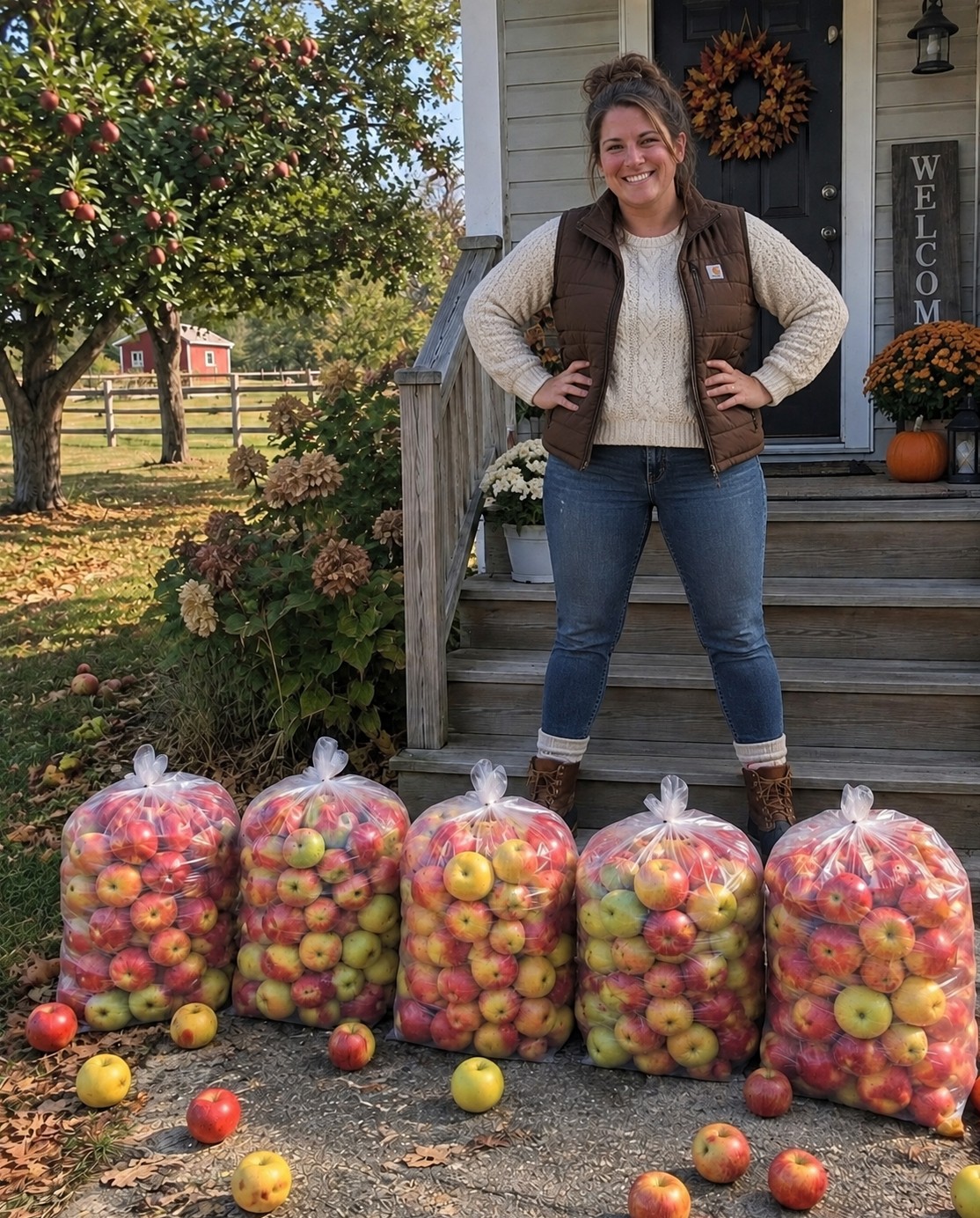
Twelve days after my husband died, I found my neighbor climbing over our fence with two bags stuffed with apples from our trees.
At first, I thought she was simply stealing fruit from our orchard.
Then she mentioned something that had happened twenty-seven years earlier—a private detail that only my husband and I were supposed to know.
Suddenly, the apples were the least important part of the story.
My husband, Patrick, loved our fruit trees almost as much as he loved the people inside our home in the town of Maplewood. Every September, he walked through the backyard with pruning shears tucked into his pocket, studying the branches and gently turning apples in his hands as though the fruit might whisper when it was ready.
One afternoon, our eight-year-old son, Samuel, followed him around with a woven basket.
Samuel reached toward a bright red apple hanging from a low branch.
“Not that one yet, buddy,” Patrick told him gently.
“But it looks completely ready, Dad,” Samuel said.
Patrick smiled warmly. “Looks can fool you, son. Twist it gently first.”
Samuel tried to pull it, but the apple refused to leave the branch.
Patrick laughed softly. “When something is ready, you shouldn’t have to fight it.”
I stood nearby on the porch watching them, wishing I could somehow preserve that peaceful moment forever.
Patrick had been much more tired than usual lately. Neither of us said much about it in front of the children, but I had started noticing every small change.
I noticed how long he rested after using the wooden ladder. I noticed how much food he left on his dinner plate. And I noticed how often his hand drifted toward his chest whenever he thought nobody was watching.
One afternoon, he caught me staring at him from across the yard.
“Nora, stop worrying about me,” he said.
“I wasn’t worrying,” I lied.
He raised an eyebrow at me.
“We’ve been married twenty-seven years, Nora, and you’re still terrible at lying.”
Before I could answer, someone called out from the other side of the fence.
“Looks like you’re getting quite a harvest this year, Patrick,” the voice said.
Our neighbor, Brenda, stood there peering through the leafy branches.
She was around fifty and somehow always looked perfectly dressed, even while doing yard work. Brenda had known Patrick long before I ever met him. They had grown up around the same people in Maplewood and had apparently dated briefly when they were young.
Patrick had told me about it years earlier, after Brenda inherited her parents’ house next door and moved back into the neighborhood.
I had never cared much about their past. Whatever had happened between them was ancient history, and Patrick had chosen me.
A few minutes later, a white service van pulled into Brenda’s gravel driveway. A young man stepped out carrying a heavy metal toolbox. He had visited her house several times that summer.
“Your plumber is back again,” I remarked quietly.
Brenda glanced toward the driveway.
“That’s what happens with old houses like this,” she said. “Something is always breaking.”
The young man noticed us standing by the fence and offered a quick wave. Patrick waved back warmly, but then he stared at the young man for another long moment.
“What is it, Patrick?” I asked.
Patrick rubbed his jaw thoughtfully.
“He reminds me of somebody.”
“Who does he remind you of?” I asked.
He looked again, but the man had already disappeared inside Brenda’s house.
“I don’t know, Nora. I just can’t place it.”
Samuel called for his father from across the lawn, and Patrick turned back toward the fruit trees.
He placed a steady hand on our son’s shoulder and looked up through the heavy branches.
“These trees will keep feeding you even after I’m gone, Samuel,” Patrick said quietly.
My stomach tightened.
“Patrick, please.”
“What did I say wrong?” he asked.
“Don’t say dark things like that,” I pleaded.
He gave me his familiar, reassuring smile.
“I only meant that fruit trees live a very long time.”
“Then talk about the trees living a long time,” I replied softly. “Don’t talk about yourself disappearing.”
He reached for my hand and squeezed it tightly.
At the time, I thought he was simply trying to comfort me.
I had no idea those words would become one of the last memories I ever had of him.
Part 2: The Confrontation at the Fence
Twelve days later, Patrick died suddenly of a heart attack.
The afternoon we returned from his funeral, I carried our sleeping daughter, Hannah, from the car while Samuel walked beside me, holding Patrick’s old cap tightly against his chest.
I barely looked toward the backyard.
All I could think about was getting the children inside and somehow making it through our first evening in a house without him.
Then I heard a wooden branch snap near the fence line.
I stopped dead in my tracks.
Another rustling sound came from behind the fruit trees.
“Mom, what is that?” Samuel whispered nervously.
I handed him the house keys.
“Go inside and stay there, Samuel.”
I walked firmly toward the back garden.
Brenda was halfway over our wooden fence, her blouse caught on a protruding nail. Two enormous trash bags sat on our side of the property, stuffed with Patrick’s apples and pears.
For several tense seconds, we simply stared at each other.
“What on earth are you doing?” I finally demanded.
Brenda pulled her blouse loose with a sharp tug and climbed down onto my side.
“Don’t be ridiculous, Nora. I’m taking them to sell because I need the extra money.”
I looked down at the stuffed bags.
“You could have asked me first.”
She folded her arms defensively.
“And would you have said yes to me?”
“No,” I answered directly. “My children eat that fruit, and their father grew it.”
Brenda rolled her eyes.
“Well, Patrick isn’t here anymore, is he? Half of that fruit will rot on the ground anyway.”
I stood there, unable to speak from shock.
Samuel was standing a short distance behind me, still holding his father’s cap. His small fingers were tightening around the fabric.
I stepped directly between him and Brenda.
“These trees are not yours,” I said coldly. “This property is not yours, so do not come into my yard ever again.”
“Oh, please, Nora,” Brenda sneered. “Grief has made you hysterical.”
“Leave the fruit and go back to your house,” I ordered.
Brenda stared at me before finally letting go of one of the bags.
“You’ve always been very protective once you decide something belongs to you.”
I frowned.
“What is that supposed to mean?”
“Nothing at all,” she snapped.
“No. You clearly meant something.”
She climbed back over the wooden fence onto her side.
Before walking away, she turned around and looked directly at me.
“Funny how your entire life depended on one red light twenty-seven years ago,” Brenda said softly.
Everything inside me went completely cold.
“What did you just say to me?”
But Brenda was already heading toward her back door without looking back.
Samuel tugged gently on my sweater sleeve.
“Mom, what did she mean by that?”
“I don’t know, sweetie,” I said.
That was a complete lie.
I knew exactly which red light she meant.
What I couldn’t understand was how Brenda knew about it.
Patrick and I had met twenty-seven years earlier in the nearby city of Columbus.
He had been driving and ran a red light while making a turn. At the same moment, I was crossing the street, and his car clipped me.
I wasn’t seriously injured, but Patrick had been completely horrified.
He insisted on driving me to the emergency room himself. He stayed until the doctors released me, drove me home safely, and returned the next morning carrying fresh coffee and another sincere apology.
Over the years, it became our private joke that one terrible red light had somehow given us twenty-seven years together.
We told people the general story of how we had met, but Patrick had always hated admitting that he had actually run a red light.
That specific detail had stayed strictly between us.
At least, I thought it had.
Yet Brenda knew.
Part 3: The Bare Orchard and the Uncovered Secret
That night, I tried to convince myself that Patrick must have mentioned the incident to Brenda sometime after she moved next door.
It still made little sense, but I was exhausted and emotionally drained.
I didn’t want to spend the entire night thinking about it.
Before sunrise the following morning, Samuel shook my shoulder gently.
“Mom, please wake up and come outside. I heard something scary in the yard.”
I quickly put on my robe and followed him outside.
The second I stepped onto the patio, I froze.
Every single fruit tree was completely bare.
They had not been partly picked.
They had been stripped clean.
Broken twigs covered the lawn. Leaves had been crushed into the morning grass. Patrick’s wooden ladder lay on its side near the property fence.
I walked toward the nearest apple tree and touched a bare branch that had been heavy with fruit less than twenty-four hours earlier.
Something inside me snapped.
I turned my eyes toward Brenda’s house.
Her kitchen light was already on.
I didn’t go knocking on her door right away.
Instead, I took out my phone and photographed everything.
I photographed the bare branches, the muddy footprints, the fallen ladder, and the damaged trees.
Brenda had returned after I caught her.
She had returned after I warned her.
And she had returned after seeing my grieving son standing there clutching his father’s cap.
Nobody would take that kind of physical risk simply for a few hundred dollars’ worth of fruit.
Whatever Brenda was doing, it wasn’t really about apples.
By eight that morning, I was sitting at my kitchen table with my laptop open.
At first, I searched local vendor lists to see whether Brenda might be planning to sell that much stolen produce.
Within twenty minutes, I found her name connected to a weekend community market in Columbus.
But my mind kept returning to what she had said about the red light.
So I typed a different search into the browser.
I searched Brenda’s full name alongside Patrick’s full name and the name of their hometown.
Most of the results were useless old school records.
Then I found something that made my heart pound.
An archived digital photograph.
It had been taken exactly twenty-seven years earlier.
I stared at the screen for a very long time.
The photograph showed Brenda and Patrick standing close together when they were young.
That was the moment I realized Patrick hadn’t told me everything about his past.
By noon, I had made several phone calls, printed high-resolution copies of the photograph, and collected a few items from our garden shed.
Later that afternoon, I stood directly on Brenda’s front lawn, arranging the final part of my plan.
Her front door suddenly flew open.
The scream that came from her was so loud that neighbors across the street stepped outside to see what was happening.
“What on earth are you doing on my lawn?” Brenda shouted.
In the center of her grass stood a large handmade wooden sign.
It read:
MONICA’S HARVEST.
Below it, in bold red letters, I had painted:
THIS WOMAN SPENT YEARS TRYING TO TAKE MY HUSBAND FROM ME. NOW, TWELVE DAYS AFTER HIS DEATH, SHE’S TAKING WHAT HE LEFT BEHIND.
“What is this trash?” Brenda yelled, marching down her walkway.
“It’s advertising,” I answered calmly. “You told me yesterday you wanted to sell the fruit.”
She rushed toward the board.
“Take this down right now!”
I grabbed the wooden frame before she could pull it away.
“Give me back my fruit first.”
“You’ve lost your absolute mind, Nora!” she screamed.
By then, several neighbors had gathered near the sidewalk.
Brenda looked around and realized that creating an even bigger scene would only attract more unwanted attention.
Then her eyes landed on one of the printed photographs I had pinned beside the sign.
It was the old photograph of Brenda and Patrick standing close together decades earlier.
Her expression changed instantly.
The anger disappeared.
Something deeper replaced it.
“You stupid woman,” she whispered.
My grip tightened on the frame.
“What did you just call me?”
She stared directly into my eyes.
“You really don’t understand anything, do you?”
“Then explain it to me right now,” I demanded.
“Twenty-seven years, Nora,” Brenda said, her voice shaking. “You had twenty-seven years with that man, and somehow you never noticed what was right in front of your face.”
The stolen apples suddenly didn’t matter to me anymore.
Neither did the wooden sign.
Only one question mattered.
“Were you having an affair with my husband?” I asked directly.
Brenda’s face hardened.
“No.”
“Don’t lie to my face, Brenda.”
“I’m not lying to you,” she replied sharply. “I was never Patrick’s mistress. Not once during your entire marriage.”
“Then how on earth did you know about the red light?” I demanded.
Her jaw tightened before she finally answered.
“Because Patrick was on his way to meet me that night.”
I stared at her.
“What?”
“We were supposed to see each other that evening,” Brenda revealed. “Patrick never showed up. Later, I heard he had hit some random woman in a crosswalk and taken her to the emergency room.”
Some woman.
Me.
“You were dating him back then?” I asked softly.
“Yes, I was.”
“And after he met me at the hospital?”
“He ended things with me completely,” Brenda said.
There was no pride in her voice.
Only bitterness.
Part 4: The Truth and the Legacy
Still, something wasn’t adding up.
I looked past Brenda toward her house—the same house she had inherited from her parents nine years earlier.
It was the house right beside ours.
The place from which she had watched Patrick raise our children and tend to his trees year after year.
“If you weren’t having an affair with him,” I said, “then why move back here? Why watch our family for nine whole years? And why steal every single piece of fruit from his garden twelve days after he died?”
For once, Brenda had no quick answer.
Her eyes shifted nervously toward her front door.
It was only a tiny movement, but I caught it immediately.
Then the screen door clicked open.
The young man I had seen carrying tools into Brenda’s house all summer stepped onto the wooden porch.
He wasn’t holding a toolbox this time.
“Lucas,” Brenda said sharply, turning around. “Go back inside the house right now.”
Lucas ignored her.
He walked down the steps.
I had seen him several times over the previous few months, but I had never really looked at his face up close.
Now, as he walked toward us, something about his features bothered me deeply.
I couldn’t explain it.
He simply looked familiar.
“She didn’t move back here because she wanted Patrick back,” Lucas said, looking at me.
Brenda turned toward him frantically.
“Lucas, please don’t do this.”
“He’s gone, Mom,” Lucas said gently. “What exactly are we protecting now?”
Mom.
I looked back and forth between Brenda and the young man.
He appeared to be in his mid-twenties.
My stomach dropped.
The timeline suddenly clicked into place.
Twenty-seven years.
“No,” I whispered.
Lucas stopped beside his mother on the grass.
“I found out about Patrick three months ago. Mom finally told me his real name.”
Brenda looked away, staring at the ground.
Lucas continued speaking to me.
“I came to this town because I wanted to meet him, Nora. I just didn’t know how to walk up to a complete stranger and say, ‘You’re the father you never knew you had.’”
“You were waiting next door all this time?” I asked softly.
He nodded slowly.
“Every week, I promised myself I’d finally talk to him. Mom kept telling me we needed to be sure first and that there would be a better moment to tell him.”
His voice trembled.
“Then there wasn’t another moment.”
For a second, something about Lucas’s nervous expression reminded me so strongly of Patrick that I literally forgot to breathe.
Then Lucas said the words that changed everything.
“Patrick was my father.”
I turned my head toward Brenda.
Twenty-seven years of suppressed resentment suddenly made sense.
But one question still remained.
“The apples,” I said, looking at Brenda.
She blinked through her tears.
“What about them?”
I glanced toward her open garage.
Every missing basket and bag of fruit was stacked neatly inside.
All of it was there.
“You never planned to sell them at any market,” I realized aloud.
The bitter anger slowly disappeared from Brenda’s face.
“When I inherited this house nine years ago, I told myself I would finally tell Patrick about Lucas,” she confessed quietly.
“Why didn’t you?”
“Because then I saw him playing in the yard with Samuel,” Brenda said.
Her voice became softer.
“I watched them in the garden together year after year. Every single year, I waited, telling myself there would be a better time.”
“You should have told him the truth, Brenda,” I said quietly.
“I know I should have.”
Her voice cracked.
“When Lucas came here this summer, I thought we’d finally do it together. Then Patrick died before Lucas ever got a chance to speak to him.”
She looked across the yard toward my house.
“I saw you come home from the funeral. I saw Samuel holding Patrick’s cap against his chest.”
“Samuel is his son,” I stated gently.
“So is Lucas!” Brenda cried.
Her defense finally broke.
She covered her mouth with one hand.
For several long seconds, nobody spoke on the front lawn.
Then Brenda whispered, “I know none of this was your fault, Nora. Maybe I’ve always known that deep down. But when I saw you bring Patrick’s children home that day, I just became so consumed with anger.”
She swallowed hard.
“You got twenty-seven years with him. Your children got a loving father every day. Lucas got absolutely nothing.”
I looked toward her garage, where all the stolen fruit was piled.
“So you stripped everything from his trees.”
“Yes,” she admitted.
“Why?”
Her eyes filled with tears.
“Because for one terrible moment, I wanted you to feel what it felt like to lose something precious of Patrick’s too.”
What she had done was cruel.
It was still completely wrong.
But finally, I understood the pain behind it.
She had lost Patrick before she ever truly had him.
Lucas had lost a father he had never even been allowed to meet.
And I had lost the husband I had shared my entire adult life with.
We were all standing in the same yard, grieving the same man in completely different ways.
Part 5: The Shared Harvest
The following week passed in a complete blur of emotion and quiet reflection.
I spent most of those days trying to process the long life Patrick had left behind, along with the unexpected part of that life he had never even known existed.
I kept thinking about all the moments I had shared with Patrick.
Our wedding.
Our children.
The house.
The garden.
The countless autumn afternoons when he had walked between the trees with his pruning shears.
And now there was Lucas.
A son Patrick had never known he had.
One sunny afternoon, Samuel discovered a few remaining apples that Brenda had missed at the very top of our tallest tree.
We climbed up and picked them together in silence.
Samuel carefully placed each apple into the same woven basket he had once carried while following his father around the garden.
That evening, I used those apples to bake Patrick’s favorite cinnamon apple pie.
The smell filled the kitchen.
For a moment, it felt as though Patrick might walk through the door and ask when dinner would be ready.
When the pie was finished, Samuel and I carried the warm dish next door to Brenda’s house.
Brenda looked completely shocked when she opened her front door and saw us standing there.
She looked at the pie.
Then at me.
Then at Samuel.
“I haven’t fully forgiven you for what you did,” I told her honestly.
Brenda lowered her eyes.
“I know.”
“But Lucas is Patrick’s son,” I continued softly.
She slowly raised her head.
“And that means he is Samuel’s older brother.”
For a moment, nobody on the porch said a word.
Lucas was standing behind Brenda in the hallway.
He looked nervous.
Almost like Patrick had looked that afternoon in our garden when he couldn’t explain why the young man with the toolbox seemed familiar.
I looked at Lucas again.
This time, I didn’t see my neighbor’s secret son.
I saw Patrick’s child.
“I think we’ve all lost more than enough already,” I told Brenda gently. “Maybe instead of fighting over whatever remaining pieces of Patrick are left, we should learn how to share them properly.”
I held out the warm pie.
Brenda’s eyes filled with tears once again.
She took the pie slowly into her hands.
Then she stepped aside and let us in.
Samuel walked through the doorway first.
Lucas moved toward him.
For a second, they simply looked at each other.
Then Samuel held out his hand.
Lucas took it.
And as I watched Patrick’s two sons standing together for the first time, I realized something.
Patrick had left behind more than an orchard.
He had left behind a family none of us knew was incomplete.
The trees would grow again.
The branches would fill with leaves.
And, in time, there would be another harvest.
Maybe our family could do the same.
Maybe we could grow around the pain instead of letting it destroy us.
And for the first time since Patrick died, I allowed myself to believe that the story he left behind didn’t have to end with his death.
It could begin again with the family he never knew he had.
THE END.
