
Part 1:
Cecilia Hawthorne had always believed that order was the highest form of human intelligence. In her mind, life could be managed with the same precision and discipline that had allowed her to build a massive real estate empire from nothing. Every decision she made was carefully calculated, supported by numbers, reports, and rows of data she trusted completely.
By the time Cecilia turned thirty-nine, she had become a major force in property development across the Eastern Seaboard. Glass residential towers carrying her brand stood in cities such as Portsmouth and Hartford, as well as in carefully chosen parts of suburban New Jersey.
Her mornings followed the same strict routine every day. Soft dawn light spread across the white marble floors of her penthouse while the quiet hum of traffic drifted up from the streets far below. Cecilia enjoyed that silence. To her, it was not simply peace. It was something she had built and earned.
She dressed in sharp, perfectly tailored blazers, drank coffee from independent Scandinavian roasters, and spoke in clear, carefully chosen sentences that left almost no room for confusion.
In Cecilia’s high-pressure world, excuses were simply inefficiencies. Strong emotions were dangerous distractions. Personal problems, she often said, had no place inside a professional office.
That was why the repeated absence of one of her maintenance workers bothered her far more than she wanted to admit.
For almost four years, a quiet man named Samuel Hedges had arrived at her corporate offices before sunrise. He cleaned the floors, polished glass partitions, dusted desks, and repaired small problems before the rest of the employees even walked through the doors.
Samuel was the kind of worker people barely noticed because he was always dependable. He simply did his job and never caused trouble. His quiet presence had suited Cecilia perfectly.
Then he began missing his shifts.
At first, it happened only occasionally. But soon, Cecilia noticed a pattern. Three days in a single month had gone unexplained, and each time, her office administrator gave her the same answer.
“It is a family emergency, Ms. Hawthorne,” the administrator would say.
One morning, Cecilia stood in front of her enormous mirror, fastening a platinum cufflink while studying her reflection with narrowed eyes.
“It is rather curious, don’t you think?” she said aloud. Her voice was calm, but there was a sharp edge beneath it. “Four years of absolute silence, and suddenly he has a family that requires constant, dramatic emergencies.”
Across the room, her operations coordinator, Melanie Foster, hesitated. Her fingers hovered over the tablet in her hands.
“He has always been incredibly dependable, Cecilia,” Melanie said carefully. “His quality of work has never dropped, not even slightly. And he specifically requested unpaid leave. He didn’t ask for compensation or special treatment.”
Cecilia gave a small, dismissive wave before reaching for her smartphone.
“Dependability disappears the moment discipline is abandoned,” she replied coldly. “Send me his home address.”
Melanie blinked.
“You actually want his home address, ma’am?”
“Yes. That is exactly what I said,” Cecilia answered, her posture becoming even stiffer. “If he is comfortable allowing his personal life to interfere with the operations of my company, then I am perfectly comfortable understanding exactly why that is happening.”
A few minutes later, the address appeared on Cecilia’s phone.
Willow Creek Terrace, Apartment 4C, North Ridge.
Cecilia frowned at the screen and tapped one manicured finger against her chin.
She had never visited North Ridge, although she knew its reputation. It was not necessarily dangerous, but it was certainly forgotten. The asphalt cracked faster than the city’s maintenance crews could repair it. Buildings were worn and neglected, and ambition seemed to struggle to gain any ground there.
A faint, skeptical smile crossed Cecilia’s face as her chauffeur drove her through the city.
She was convinced that reality would simply prove what she already believed.
The drive took much longer than expected. As the car moved farther from the polished business districts, the traffic became thinner and the buildings lost their modern shine.
Storefronts became smaller and more weathered. Sidewalks were uneven and broken. Children played near rusted chain-link fences, riding bicycles that had clearly seen better days.
Eventually, the car stopped in front of a narrow, three-story brick building. The window trim was peeling, and the metal number above the entrance hung crookedly from a single rusty screw.
Cecilia stepped out.
Her expensive heels clicked sharply against the cracked concrete as she walked toward the door. She raised her hand and knocked firmly.
For several seconds, nothing happened.
Then came the muffled sound of movement inside.
A baby’s high-pitched cry followed.
The door slowly opened.
Cecilia stared.
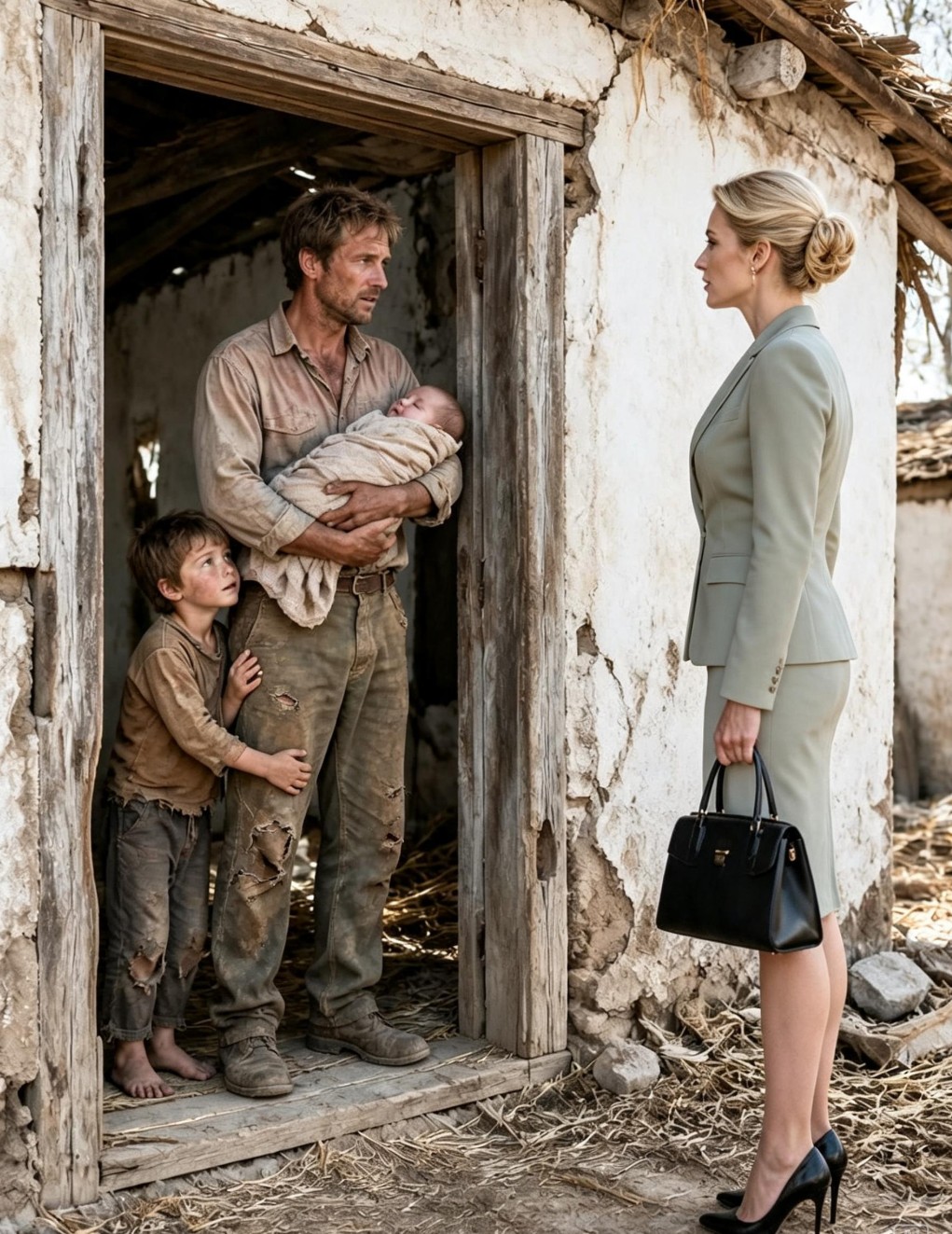
The exhausted man standing before her looked almost nothing like the Samuel Hedges who quietly polished her office desks every morning.
His eyes were hollow. His cheeks were covered with several days of unshaven stubble. He held a crying baby tightly against his chest, while a small, wide-eyed boy clung to one of his legs.
His shirt was worn thin at the seams, and exhaustion seemed to surround him like a second layer of clothing.
Samuel stared at Cecilia for several long seconds before he finally understood who was standing at his door.
“Ms. Hawthorne?” he asked quietly.
His voice carried a mixture of deep surprise and something that looked very much like fear.
Something inside Cecilia shifted.
She could not explain what it was.
“May I please come inside?” she asked.
Her voice sounded softer and more uncertain than she had intended.
Samuel hesitated. He glanced nervously over his shoulder, then stepped aside.
Cecilia entered.
The apartment was small and cramped, but it was not the disaster she had expected.
The furniture was old, yet carefully maintained. A worn sofa with frayed edges sat beside a low coffee table. On top were unpaid utility bills, medical pamphlets, and school papers covered in messy but careful handwriting.
In one corner stood a crib made from mismatched pieces of pine wood. It was clearly homemade, with every piece sanded down by hand.
Cecilia walked slowly through the room.
For the first time, she became painfully aware of the loud sound her own expensive shoes made against the old floorboards.
“I am so sorry for the intrusion,” Samuel said, his shoulders hanging heavily. “I truly wasn’t expecting anyone.”
“How many children do you have?” Cecilia asked quietly.
She surprised herself with how much she suddenly wanted to know the answer.
“Four,” Samuel said. He glanced toward the boy holding his leg, then toward the baby in his arms. “I have four children.”
Cecilia’s breath caught.
“And their mother?” she asked. “Where is she?”
Samuel lowered his eyes. His arms tightened slightly around the baby.
“She passed away late last winter,” he said softly.
His voice trembled.
“It was leukemia. It moved much faster than any of us were prepared for.”
The words seemed to make the small apartment even quieter.
Cecilia stood there, unable to find an immediate response.
Then a violent coughing fit suddenly erupted from the dark bedroom down the hallway.
The cough was deep, harsh, and persistent.
Samuel reacted instantly.
He carefully placed the baby into the homemade playpen and hurried toward the bedroom.
Cecilia followed without thinking.
A thin, frail boy lay beneath several heavy blankets. His face was flushed with fever, and every breath seemed difficult.
On the nightstand sat a plastic thermometer and an empty bottle of cough medicine.
“He started getting worse late last night,” Samuel explained, his voice cracking as he placed a hand against the boy’s forehead.
“I tried everything I could to bring the fever down. But I couldn’t leave him alone to go to the store. And I don’t have anyone else to turn to.”
For the first time in her adult life, Cecilia Hawthorne felt completely useless.
She had enormous amounts of money. She controlled major companies. Her name could open almost any door.
None of it seemed to matter now.
Her wealth could not make the boy breathe.
Her corporate authority meant nothing inside this tiny bedroom.
Her hands trembled as she reached for her smartphone.
“You stay right here,” she said, her voice suddenly firm and commanding again. “I’m going to handle this.”
Within an hour, a private pediatric specialist arrived at the apartment. Shortly afterward, an emergency ambulance pulled up outside.
Neighbors stepped out to watch, giving curious and cautious looks. Such an emergency response was unusual in their neighborhood.
The boy was examined and diagnosed with severe, advanced pneumonia.
He needed immediate hospital treatment.
Cecilia followed the medical team to the hospital and signed every document placed in front of her. Her signature remained perfectly steady, even though a strange uneasiness had begun growing inside her chest.
That night, she did not return to her luxurious penthouse.
Instead, she sat in a hard plastic hospital chair beside Samuel.
Machines glowed softly in the darkness as they monitored the child’s vital signs. Hour by hour, his breathing slowly became easier.
Samuel stared at the ceiling for a long time before finally speaking.
“I truly don’t understand,” he said quietly. “Why would you do all of this for me?”
Cecilia looked toward the pale green wall.
For years, she had believed she understood exactly what responsibility meant.
Now she was beginning to question everything.
“Because I think I completely forgot what true responsibility actually looks like,” she said.
Those words stayed with her.
And they changed her life.
Part 2:
Over the following weeks, Cecilia’s life began changing in ways she could never have predicted.
She arranged comprehensive health coverage for Samuel’s entire family. She made sure the children had consistent childcare so they would always be safe. She also changed Samuel’s work schedule so he would never again be forced to choose between caring for his family and keeping his job.
But Cecilia did not stop there.
She began visiting North Ridge regularly.
At first, those visits felt uncomfortable. She was used to glass towers, expensive offices, private elevators, and people who lived lives surrounded by security and convenience.
North Ridge was different.
There, she slowly learned the names of Samuel’s neighbors. She listened to their stories. She began to understand the difficult routines of people who lived without savings, family support, or any kind of safety net.
Every visit changed her a little more.
The rigid certainty she had worn for years began to disappear.
Cecilia had once treated emotional problems as weaknesses and personal struggles as excuses. Now she was beginning to understand that sometimes people were not failing because they lacked discipline.
Sometimes they were simply carrying more than one person should have to carry alone.
Months later, Cecilia offered Samuel a completely new position.
She wanted him to oversee the entire facility operations department across several of her major property developments.
It was not a favor.
It was not charity.
It was not pity.
Cecilia had watched Samuel continue working while raising four children, caring for a sick child, grieving his wife, and surviving circumstances that would have broken many people.
She had developed something she rarely gave anyone.
Respect.
Samuel stared at her in disbelief when she explained the offer.
“You really trust me with this kind of authority?” he asked, his tired voice filled with genuine shock.
Cecilia smiled.
“I do.”
She paused before adding, “And the truth is, I trust myself much more now than I ever did before.”
Years later, a journalist asked Cecilia Hawthorne about the defining moment of her long and successful career.
The journalist expected her to mention one of her tallest skyscrapers.
Perhaps her most profitable real estate acquisition.
Maybe the deal that had transformed her company into one of the most powerful property development firms on the Eastern Seaboard.
But Cecilia mentioned none of those things.
Instead, she talked about a narrow, crooked door on Willow Creek Terrace.
She talked about Samuel Hedges, his four children, and the small apartment where she had finally learned that life could not always be measured by numbers, schedules, or profits.
She told the journalist that the most important lesson of her life had come from a family she had once known only as an interruption to her perfectly organized world.
She had learned that responsibility was not always about control.
Sometimes, it was about showing up.
Sometimes, it meant helping someone who had nowhere else to turn.
And sometimes, the people we barely notice can teach us the lessons we need most.
Cecilia Hawthorne had spent years building impressive glass structures that reached toward the sky.
But the most important structure she ever built was something no architect could draw on paper.
It was the humanity she had finally allowed into her own life.
Because success without humanity, she realized, was nothing more than an empty glass building—impressive from the outside, but completely hollow at its core.
THE END.
