
Part 1:
“If your father is already dead, his ashes shouldn’t be dirtying my house,” my mother-in-law, Isolde, said with a cruel sneer.
Before I could even understand what she meant, she marched toward the downstairs bathroom, gripping the urn tightly in her bony hands.
My name is Grace Erickson, and for four long years, I had convinced myself that keeping quiet was the only way to save my broken marriage. But that morning, as I watched Isolde carry my father’s ashes away, I finally understood something.
Silence does not stop monsters.
Sometimes, it only gives them more room to grow.
It had all started five days earlier, at two in the morning, when a neighbor from my hometown of Fairmount called me. Her voice was shaking with fear.
“Grace, please, you need to come right now. Your parents’ house is completely engulfed in flames.”
My entire chest tightened as if someone had wrapped a steel belt around my lungs.
I immediately shook my husband, Tristan, awake.
He barely opened his eyes.
“Just call a cab or an Uber, Grace,” he muttered irritably, rolling over and pulling the duvet higher. “I have an incredibly important board meeting at dawn. What exactly do you expect me to do there in the middle of the night?”
I stared at him in disbelief.
Then I left.
I drove the three hours to Fairmount alone.
When I finally reached our street, the house where I had grown up was nothing but a burned-out skeleton.
The local firefighters had managed to pull my mother, Dorothy, out through a side door. But my father, Wade, never made it outside.
A burning support beam collapsed on him while he was desperately trying to force a window open to save my mother.
My father had died trying to save the woman he loved.
A few days later, we held his funeral.
Tristan stayed for barely twenty minutes. He dropped off a cheap bouquet of supermarket lilies and then claimed he had to leave because of an urgent work emergency.
His mother, Isolde, did not even bother to attend.
Instead, she called me on my phone just to lecture me.
“Do not even think about bringing that negative, deathly atmosphere into my pristine house, Grace. We are closing some very important business deals, and we need a clean atmosphere.”
I could hardly believe what I was hearing.
After the authorities finished securing the ruins of my parents’ home, my mother had nowhere to stay.
So I brought her to the large estate in Crestview.
I had paid for that house with my own money, earned through my high-level position as a regional sales director.
The moment we stepped through the grand entrance, Isolde slammed her heavy ceramic coffee mug onto the glass dining table. Hot liquid splashed across the expensive table runner.
“What in the world is this, Grace? And tell me exactly who authorized you to bring dead bodies into my home?”
My mother was shivering uncontrollably.
She held the small wooden urn, wrapped in a soft white shawl, against her chest as though she were protecting a living child.
“It will only be for a few days, Isolde,” she pleaded softly, tears filling her eyes. “I truly have nowhere else to go right now.”
“Well, then find yourself a cheap boarding house somewhere else,” Isolde snapped. “This residence is not a funeral home or a public refuge for the destitute.”
“I am the one who bought this house,” I replied.
My voice was shaking, but I stood firmly between them.
“And my mother is staying here, where she belongs.”
Tristan came down the marble staircase.
For one foolish moment, I hoped that this time he would finally defend me.
He didn’t.
“Grace, you really need to stop exaggerating everything,” he said with complete indifference. “My mother is right. Bringing those ashes inside will only scare away our good luck, especially when my business partners are coming over.”
My mother lowered her head.
She looked completely broken, as though she were apologizing for the crime of still being alive.
I took her to the guest room and arranged a small memorial table with my father’s photograph, a beeswax candle, and his urn.
Then I sat beside her for an hour while she prayed.
On the third day, I was in the kitchen stirring a pot of soup when a blood-curdling scream came from the second floor.
I dropped the spoon and ran upstairs.
Isolde was standing directly in front of the little memorial table.
She looked furious.
“I explicitly told you not to light incense in this house! This is not a cemetery!”
With one violent swipe of her hand, she knocked the candle from the table.
It skidded across the hardwood floor.
My mother scrambled to pick it up.
“Please, Isolde,” she sobbed. “It has only been three days since he left us. Please have some mercy.”
Instead, Isolde shoved my mother hard against the bed.
My mother’s head struck the headboard.
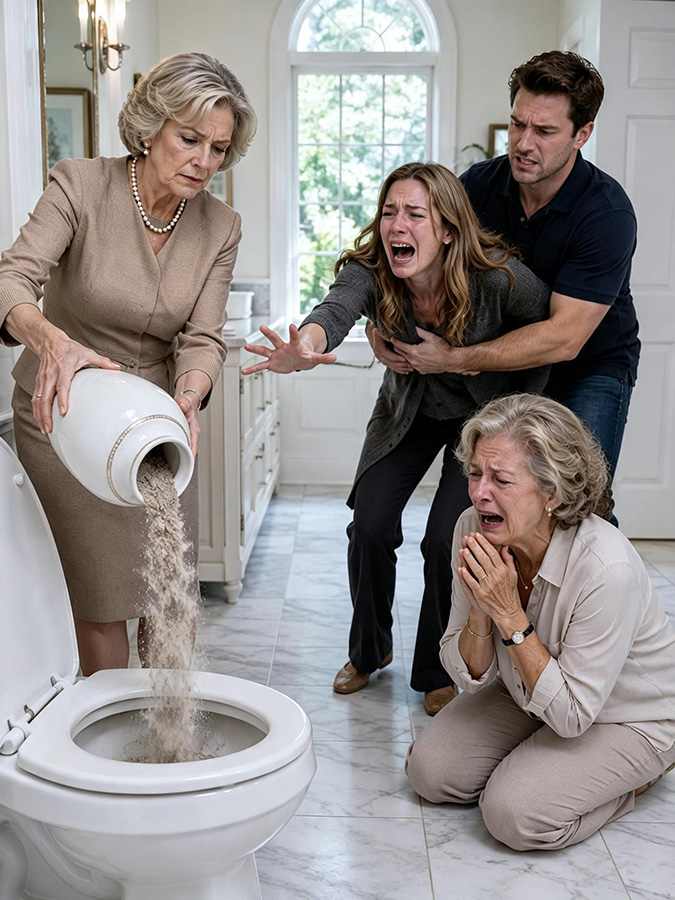
Then Isolde grabbed the urn.
“Give that back to her right now!” I screamed.
I lunged forward, but Tristan caught me from behind and pinned my arms against my sides.
“Just leave her alone, Grace,” he said coldly. “Mother is finally cleaning up this house.”
I watched in horror as my mother-in-law walked toward the master bathroom.
Behind her, my mother crawled across the floor, reaching out with trembling hands.
“No, please! That is my husband! That is all I have left of him!”
Isolde opened the urn.
Then she dumped my father’s ashes into the porcelain toilet.
She pulled the handle.
The swirling water carried away the last physical piece of my father.
Tristan simply sighed.
“There. Finally. Now we can eat dinner in peace.”
I didn’t scream.
I didn’t cry.
I simply stood there, staring at the clean white water.
And in that moment, I knew this was no longer a family argument.
This was war.
Part 2:
I gathered my unconscious mother into my arms and carried her to the car.
I left the house without looking back at the people I had called family for four years.
Isolde was still shouting from the living room.
“Take your old lady and your dramatic tragedies somewhere else!”
Tristan didn’t even bother coming outside.
At the hospital, the doctor told me my mother was suffering from severe shock, dangerously high blood pressure, and a complete nervous breakdown brought on by the trauma of the fire and the cruelty she had faced in my home.
That night, I rented her a comfortable and secure apartment in the Northwood district and arranged for a private nurse to care for her.
I had managed to scrape a few remaining ashes from the bathroom tiles.
I placed those tiny grains inside a small silk handkerchief and put it carefully on a shelf.
It was all I had left.
I stared at that tiny, gritty shadow of the man who had raised me.
Then I made a solemn promise.
I would never forgive them.
The first thing I did was call Parker, a private investigator who had previously helped me uncover complicated corporate fraud at my company.
“I need you to investigate the fire at my parents’ house, Parker,” I told him. “The local sheriff says it was a simple short circuit. But my father replaced every wire in that house just six months ago.”
Parker took four days to get back to me.
We met at a quiet coffee shop near the old downtown library.
He arrived carrying a manila folder.
His expression was grim.
“Grace, your husband isn’t just cheating on you,” he said quietly. “He is involved in something far more dangerous than that.”
He opened the folder.
Inside were photographs of Tristan entering a luxury high-rise apartment in Midtown with a woman named Letitia.
She was twenty-five years old.
And visibly pregnant.
The apartment, the expensive SUV she drove, and all her medical bills were being paid with money funneled directly from accounts I managed every month.
But that was only the beginning.
Parker told me Tristan had built up nearly eight million dollars in debt through illegal underground gambling rings.
Loan sharks were already after him.
So Tristan had turned his attention to my parents’ property.
It was a prime corner lot in Fairmount, exactly where a construction company wanted to build a new development.
My father had refused to sell.
Three weeks later, two men broke into the house.
They poured gasoline near the main staircase and cut the electrical wires to make the fire look like a short circuit.
Parker pushed a small flash drive across the table.
“One of the men has already confessed on an audio recording,” he said. “He specifically says Tristan paid them to do it.”
I felt as though the floor had disappeared beneath me.
My father hadn’t died in an accident.
He had been murdered.
And the man who had ordered it was the same man who had slept beside me every night.
I wanted to go straight to the district attorney.
But Parker stopped me.
“We have evidence,” he warned. “But we need to secure it properly. Otherwise, they’ll hide the money, bribe someone, and claim you’re making all of this up because you’re jealous.”
So I did the one thing they would never expect.
I went home.
I walked through the front door with swollen, red eyes and pretended to be completely exhausted and defeated.
Tristan immediately put on a performance of fake tenderness.
“My love, it is so good that you’re finally back home,” he said, gently touching my arm.
Isolde smiled warmly when I told them I was depressed and couldn’t bear working at the company anymore.
“I was thinking about quitting,” I whispered, keeping my eyes down. “Maybe I should let Tristan manage all my assets from now on. Perhaps he can handle everything better than I have been able to lately.”
Tristan’s eyes lit up.
He looked like someone had just handed him the keys to the Federal Reserve.
Within a week, he signed the legal documents my lawyer had prepared without even reading a single line.
He thought he was gaining control of all my properties.
He wasn’t.
The documents placed everything into a blind trust, with me as the sole administrator.
Tristan had absolutely no right to sell, mortgage, or withdraw even a cent.
That same night, I gave up the master bedroom and moved into a small spare room on the other side of the house.
Beforehand, Parker had discreetly installed cameras and high-quality microphones in the living room, kitchen, and master bedroom.
The next day, Tristan brought Letitia into my house.
Isolde welcomed her with fresh-baked bread, flowers, and tears of joy.
“Finally, my grandchild is coming to her true home,” she said happily, looking at me with pure venom.
I watched everything silently through the security app on my phone.
I listened as they laughed and talked about their future.
That night, one of the microphones captured Tristan talking to Letitia.
“Tomorrow, I’ll mortgage the house, pay off the debt, and then sell the old folks’ land. No one will ever be able to prove I ordered them to burn it.”
I stopped breathing for several seconds.
The cold truth settled deep inside me.
I finally had everything I needed.
And they had no idea that the bomb was about to explode.
Part 3:
The next morning, I dressed in a way I hadn’t dressed in months.
I put on a sharp white suit.
I pulled my hair tightly back.
Then I applied blood-red lipstick.
I didn’t look like a grieving daughter.
I looked like a woman preparing to bury every lie they had built.
From my small room, I heard Tristan walking downstairs with the confident steps of a man who believed he had already won.
Letitia was laughing in the kitchen.
Isolde was telling her that by noon they would have enough money to pay off their debts and finally throw me out like a wet dog.
I sat quietly, sipping black coffee.
I waited.
At precisely 9:40, Tristan walked into the bank carrying the house deed and a stack of fraudulent contracts.
At 10:12, his phone rang.
I let it ring six times before answering.
“What did you do, Grace?” he roared. “The bank says the house can’t be mortgaged, and all my personal accounts are frozen!”
“They aren’t frozen, Tristan,” I replied calmly. “They’re just protected from idiots.”
“Don’t play games with me! I need that money today!”
“I know you do,” I said. “And the men you owe eight million dollars to don’t seem like the patient type.”
Silence.
His breathing became fast and shallow.
“Who told you about that?”
“You did. Last night. In our bedroom. While you were bragging to your mistress.”
I hung up.
Less than thirty minutes later, Tristan stormed back into the house like a cornered animal.
He kicked open my door.
Isolde and Letitia followed close behind.
“Give me my money right now!” Tristan shouted, raising his hand as if he were about to hit me.
I calmly lifted my smartphone and pressed a button.
“You touch me, and this video goes straight to my lawyer, the police, and every one of your gambling associates.”
He froze.
His face turned gray.
Isolde stepped forward, her face twisted with rage.
“You ungrateful wretch! We took you in as our daughter-in-law, and now you’re trying to steal from my own son!”
“You didn’t take me in from anywhere, Isolde,” I said, my voice echoing through the hallway. “I paid for this house. I paid for your expensive vacations, your doctors, your meals, and even the flowers you gave your son’s pregnant mistress.”
Letitia turned pale.
She looked at Tristan.
“Tristan told me all of this was yours.”
“Tristan also told me he ordered my parents’ house to be burned to the ground,” I said.
The room went silent.
The words hit them like a wrecking ball.
Isolde opened her mouth to protest, but she couldn’t even pretend to be surprised.
I looked directly into her cold eyes.
“And you knew about it, didn’t you?”
Tristan began sweating heavily.
His hands shook.
“You’re insane, Grace. You can’t prove anything.”
I walked to a small Bluetooth speaker.
Then I pressed play.
Tristan’s own voice filled the room.
“I paid them to make it look like a short circuit because the old folks didn’t want to sign. But if the land sells, we all win.”
Letitia screamed and backed against the wall.
Isolde grabbed her chest and gasped.
“Turn that thing off right now!” she demanded.
“No,” I said calmly. “I don’t think I will.”
Then I played another recording.
This time, Isolde’s voice filled the room.
“Your father-in-law is too old to be useful. If he dies, Grace will inherit, and you can convince her to sell.”
Tristan collapsed onto his knees.
“Grace, please!” he begged. “Those men are going to kill me. Just unlock one account.”
“Unlock an account?” I asked with a bitter laugh. “Like you helped my mother when she was crawling across the floor begging for my father’s ashes?”
“I was under so much pressure,” he whimpered.
“My father was under pressure too,” I replied. “He was trapped in flames, and he still tried to save my mother’s life.”
Letitia began backing toward the front door.
“I didn’t know about the fire,” she cried. “I didn’t know anything about that!”
“But you knew you were living off my money,” I said. “You knew you were living in my house. And you knew Tristan was already married.”
She lowered her eyes.
She had nothing to say.
Then the doorbell rang.
It wasn’t a visitor.
Two patrol cars from the District Attorney’s office had arrived, along with my legal counsel and Parker, who was carrying a folder filled with certified evidence.
Tristan tried to run toward the back door.
The officers intercepted him in the kitchen.
Isolde screamed that she was a respectable woman and everything was slander.
Letitia sobbed in the corner, repeatedly saying that she was pregnant.
I said nothing.
I simply watched as the officers read them their rights.
But my revenge didn’t end with their arrests.
Three days later, I arrived at the old family property Isolde had proudly called the Cárdenas heritage estate.
For years, she had told everyone the property was untouchable because it carried the pride of her family name.
She had never told them that I had paid for every renovation and permit.
My lawyer presented the documents to the municipal authorities.
Because the building was technically illegal and had become a structural hazard, I had already secured a demolition permit.
Isolde arrived with two confused cousins.
She looked pale and disheveled without her usual layers of expensive jewelry.
“You cannot do this, Grace!” she shouted. “My family’s memories are inside these walls!”
I removed my sunglasses and looked directly at her.
“Memory? Do you even know what that word means, Isolde? When you threw my father’s ashes into the toilet, were you thinking about memory? When you called the urn of a man who died trying to save his wife impure, were you thinking about respect?”
Tristan, now in handcuffs, was being loaded into a police cruiser.
When he saw me, he tried one last time.
“Grace, I really did love you.”
“No,” I said. “You loved my money. You loved my parents’ land. And you loved the easy life I provided for you.”
Behind me, the heavy excavator started its engine.
The first impact struck the stone wall.
The sound echoed throughout the entire street.
Isolde collapsed onto the sidewalk.
She cried.
But she wasn’t crying for the dead.
She wasn’t crying for her son.
She was crying for the bricks she was losing.
Neighbors gathered to watch.
Some of the same people who had once criticized my mother for carrying an urn were now whispering in horror about the arson and murder.
The second blow brought down the main arch.
I didn’t smile.
Justice doesn’t always bring happiness.
But sometimes, it gives you room to breathe again.
Part 4:
Months later, the trial began.
My mother entered the courtroom holding my arm.
She was dressed in black, but for the first time in years, she walked with her head held high.
Letitia testified in exchange for a lighter sentence.
She handed over every message in which Tristan had discussed selling the land and fleeing the country.
When the judge projected my father’s photograph onto the courtroom screen, my mother squeezed my hand so hard that her knuckles turned white.
“Your father wasn’t a wealthy man,” she whispered, “but he never took a single thing that didn’t belong to him.”
The judge ordered all of them held in pretrial detention.
The final sentences were severe.
Tristan received a life sentence for aggravated homicide, fraud, and arson.
Isolde was convicted of obstruction of justice and conspiracy.
Letitia lost everything she had purchased with my stolen money and was sentenced to community service.
When we left the courthouse, reporters surrounded me.
They shouted questions from every direction.
“Grace, do you finally feel satisfied?”
I looked at my mother.
Then I looked up at the gray sky above the city.
“Satisfied isn’t the right word,” I replied. “No one wins when they have to seek justice for their own father. But I am at peace, because my father is no longer alone, and my mother no longer has to bow her head to anyone.”
Eventually, I rebuilt my parents’ house.
I didn’t rebuild it exactly as it had been.
What fire takes away can never return in exactly the same form.
Instead, I turned the property into a sanctuary.
I planted a garden filled with bougainvillea.
I placed a stone bench beneath the trees.
And I added a simple plaque.
It read:
“Wade, honorable man and beloved father. His memory cannot be burned, bought, or thrown down a drain.”
Every Sunday, I take my mother there.
She lights a candle and talks to my father as though he were sitting beside her.
Through everything that happened, I learned that some families are destroyed not because they lack love, but because they have too much greed.
I learned that a patient woman is not a weak woman.
And I learned that when someone humiliates your dead because they believe you are too soft to defend them, they make one terrible mistake.
They awaken the only person capable of bringing their entire world crashing down.
THE END.
