
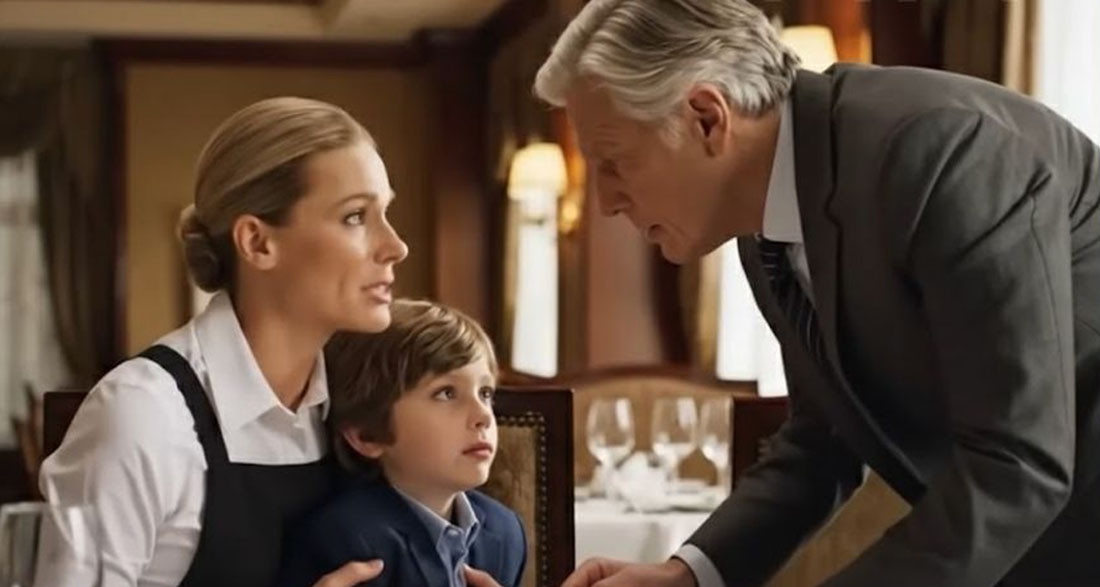
A Waitress Who Saw What the Doctors Missed
The rain had started just before sunset — soft at first, a gentle drizzle that wrapped the streets outside Joe’s Family Diner in silver light.
The neon sign flickered in the window, glowing red against the wet pavement.
Inside, the diner was warm and alive with the soft buzz of voices, the hiss of coffee being poured, and the sizzle of bacon on the grill.
It was a normal Tuesday night. Or at least, that’s what everyone thought.
For Linda Parker, it began like any other shift. She tied her faded red apron around her waist, tucked a pencil behind her ear, and smiled at the regulars who waved as she passed.
After fifteen years at Joe’s, Linda knew every movement by heart.
She glided between tables like a dancer — balancing plates, topping off coffee, and greeting customers by name. But her real gift wasn’t just service. It was seeing people.
She could tell when someone was lonely by the way they stirred their tea. She could see heartbreak in a quiet stare out the window.
She’d learned to read stories in small things — a sigh, a napkin folded twice, an untouched slice of pie.
To Linda, the diner wasn’t just a place to work. It was her world. Its people were her family.
The Arrival
Around 7:30 p.m., the doorbell above the diner’s entrance jingled. Automatically, Linda looked up.
A man stepped in, tall and neatly dressed, rain glistening on his expensive charcoal-gray suit. His hair was perfectly styled, though the weary set of his jaw said he hadn’t been sleeping much.
Behind him came a small boy, maybe ten or eleven, pale as paper. He walked slowly, clutching his right side as though every breath hurt.
“Evening,” Linda greeted kindly, handing them menus. “Just the two of you tonight?”
The man nodded. “Yes, please. A corner booth.” His voice was calm and deep — the voice of someone used to control.
But the way he guided the boy, gentle and careful, told Linda more than words could.
She smiled as they slid into the booth. “You two manage to stay dry?”
The man gave a small smile. “We tried.”
A moment later, his phone rang. He stepped outside to answer, his tone shifting to one of tension and authority.
Linda turned to the boy. “You okay, sweetheart?”
He nodded quickly. “Yeah. Just tired.”
But Linda could see what others might miss — the tremor in his fingers, his shallow breathing, the tight way he pressed his hand against his side.
She’d seen that same look in her own son when he once battled a high fever. Something inside her twisted.
When the man returned, Linda overheard him muttering under his breath — words like “specialist,” “Thursday,” and “no earlier appointment.”
“Long wait, huh?” she said gently, setting down two glasses of water.
He sighed. “Yes. Every top doctor in the city is booked. They say it’s a virus, maybe something he ate, but…” His eyes flickered toward the boy. “I don’t believe that.”
Linda tilted her head. “You’re right not to.”
He looked up, surprised. “You think so?”
“I’ve raised three kids,” she said softly. “You learn to tell the difference between a bug and something more serious.”
After a pause, he extended his hand. “I’m Robert Kingsley.”
The name made Linda blink. She recognized it — the billionaire who owned half the new buildings downtown. But here, in the diner’s warm light, he wasn’t a powerful man. He was just a frightened father.
“And this is my son, Alex,” he said.
“Hey there, Alex,” Linda smiled.
The boy managed a small wave but winced immediately, clutching his side tighter.
Linda crouched beside the table. “What sounds good tonight? Maybe some soup?”
“Yeah,” Alex whispered. “Just soup. My stomach feels weird.”
As she walked away, Linda’s instincts screamed at her. The boy’s symptoms — the pain on the right, the pale skin, the way he sat hunched — it all pointed to something serious.
Her late husband, a paramedic, had once told her, “Appendicitis doesn’t always shout. Sometimes it whispers. You just have to be the kind of person who listens.”
And Linda was listening now.
The Moment of Truth
When the rush died down, Linda refilled Robert’s coffee and hesitated for a moment before speaking.
“Mind if I sit for a second?” she asked.
He nodded.
“I don’t want to overstep,” she said, lowering her voice, “but your boy — I’ve noticed how he’s holding his side. Has he had nausea? Fever?”
Robert frowned. “Yes, both. Why?”
Linda took a breath. “Because I think you shouldn’t wait until Thursday. You need to get him to the ER tonight.”
His eyes widened. “You think it’s that serious?”
“I’m not a doctor,” Linda admitted, “but I’ve seen this before. And if it’s what I think, waiting could be dangerous.”
Robert’s face went pale. “The doctors said it’s minor.”
Linda looked straight into his eyes. “Sometimes,” she said softly, “the people who love us see what others miss.”
Before he could answer, Alex suddenly gasped, folding over in pain. “Dad… it hurts!” he cried out.
Robert jumped from his seat, panic breaking through his calm. “Okay—okay, hang on, buddy!”
“I’ll drive,” Linda said quickly, pulling off her apron. “My car’s right outside!”
This time, he didn’t argue.
Race Against Time
The rain poured harder as Linda’s old Honda Civic sped through the slick streets.
Alex lay in the backseat, clutching his side, face drenched in sweat.
“Keep talking to me, sweetheart,” Linda called, glancing in the mirror. “You’re doing great.”
“Why are you helping us?” Alex whispered weakly.
“Because,” Linda said with a smile, “sometimes strangers are just friends we haven’t met yet.”
Beside her, Robert clutched his phone. “My son needs immediate attention,” he told the hospital. “Possible appendicitis — we’re ten minutes away.”
“Make that five,” Linda said, pressing harder on the gas.
When they pulled up to St. Mary’s General Hospital, nurses were already waiting. They rushed Alex inside on a gurney, and Robert followed, soaked and pale.
“If you hadn’t said anything…” he stammered, his voice breaking. “They told me it was nothing.”
Linda put a steady hand on his arm. “You did the right thing when it mattered. That’s what saves people.”
The Longest Hour
The waiting room was cold and bright. Rain streaked down the windows as Robert paced restlessly.
Linda sat quietly, two cups of untouched coffee beside her.
“You’re calm,” he said after a while.
“I’m not,” she smiled faintly. “I just learned to look calm when I’m scared.”
Robert let out a shaky laugh. “You remind me of my mother.”
“That’s a compliment, I hope.”
“The best one I can give,” he said softly.
They fell silent. Minutes felt like hours.
Finally, the surgeon came out. “Mr. Kingsley?”
Robert froze. “Yes?”
“It was acute appendicitis,” the doctor said. “We operated just in time. Another few hours, and it would’ve ruptured.”
Robert covered his face with his hands, shaking with relief. “Thank you,” he whispered.
The doctor smiled. “Your son’s going to be fine.”
Linda’s eyes glistened, but she only nodded. She’d seen too many nights end in tragedy — this one was a miracle.
The Morning After
When Linda visited the next morning, Alex was sitting up in bed, color back in his cheeks.
“Linda!” he said, grinning. “Dad says you saved my life!”
She chuckled and handed him a thermos. “Joe’s famous chicken soup. Works better than medicine.”
Robert stood nearby, his voice rough with emotion. “I don’t know how to thank you. Money means nothing after what you did. You saw what the doctors didn’t.”
“You don’t owe me anything,” she said gently. “Just promise me one thing — pay attention to the people you love. That’s how you save lives before they even need saving.”
Robert nodded slowly, as if her words had carved themselves into his heart.
A Friendship Born from a Miracle
In the weeks that followed, Alex healed. Every Sunday, Robert brought him to Joe’s for breakfast. They always sat at the same booth.
Linda made sure Alex’s pancakes had extra whipped cream. To the other diners, they looked like a family — and maybe, in some way, they had become one.
One morning, Robert told her quietly, “You know, you once dreamed of being a nurse. But you still save lives every day.”
Months later, a headline appeared in the local paper:
“Kingsley Foundation Launches Nursing Scholarship — The Linda Parker Grant.”
When reporters asked Robert why he named it after her, he said simply, “Because when my world ran on numbers and logic, she reminded me to trust the human heart.”
Linda didn’t attend the press event. She was at the diner, refilling Mrs. Peterson’s coffee and helping little Dany with his homework.
Outside, rain tapped softly against the window, just like that night.
She smiled.
Epilogue
Two years later, a letter arrived addressed to “Miss Linda.” The handwriting was messy, uneven — a child’s.
Dear Miss Linda,
Guess what? I’m eleven now and starting middle school! Dad says I might help him at his company someday, but I told him I want to be like you — someone who sees things that matter.
I still have my scar. It looks kind of cool, but it reminds me that being brave sometimes means listening, not talking.
Thank you for saving my life and teaching Dad what love really looks like.Love,
Alex
Linda pressed the letter to her chest, eyes wet with tears. She pinned it on the diner’s board beside a crayon drawing and a photo of her late husband in his paramedic uniform.
The coffee machine hissed. Someone called out, “Linda, can I get a refill?”
She smiled, picked up the pot, and moved gracefully between the tables — still watching, still listening.
That rainy Tuesday night had changed everything.
Linda Parker, the waitress who saw what doctors missed, had proven one timeless truth — that truly seeing someone can still save a life.
