
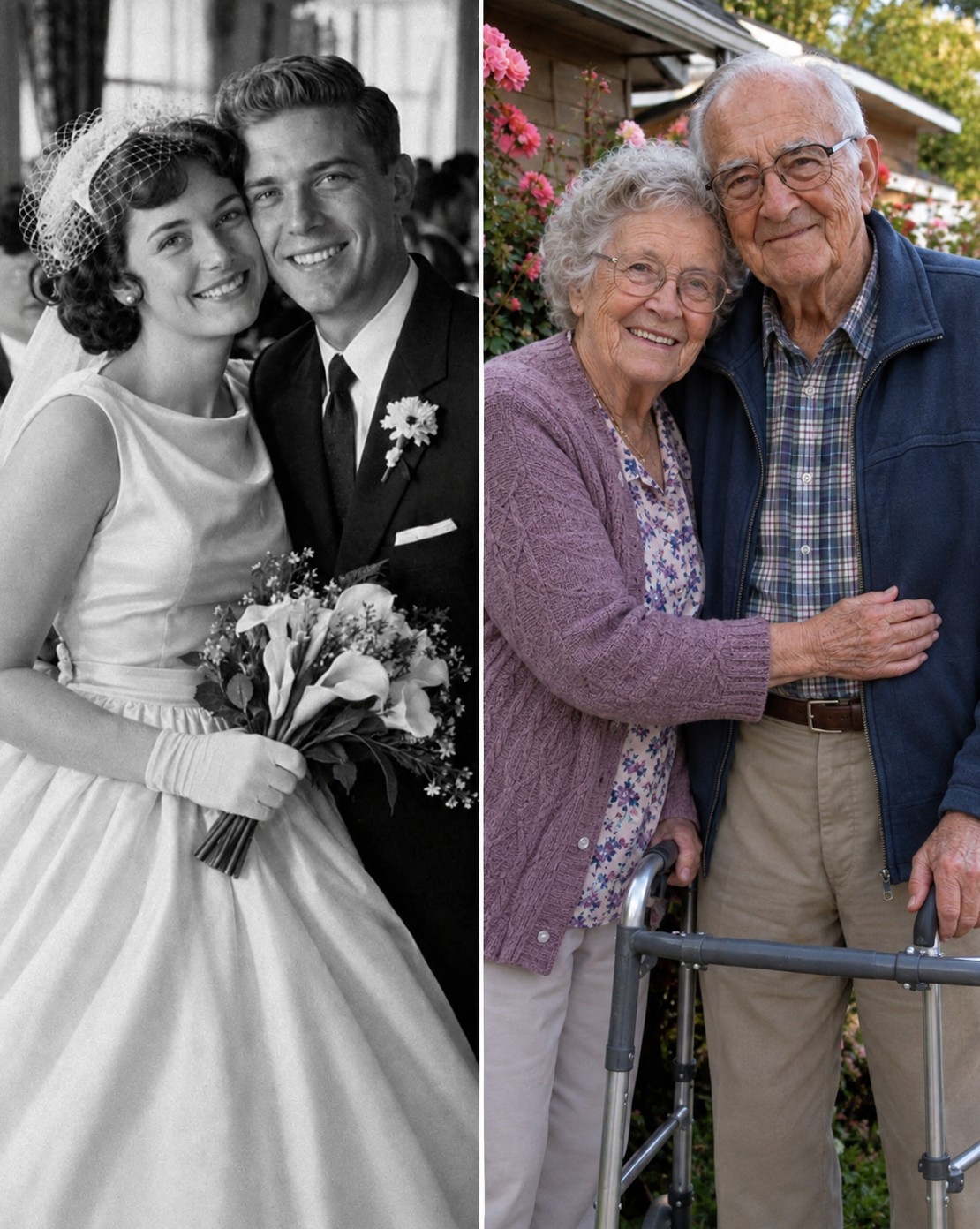
Part 1: The Sudden Shadow
For six decades, Lawrence and I built a life I believed I understood down to the smallest detail.
We met during our freshman year at Ohio State University, fell deeply in love, raised three children, welcomed five grandchildren, survived illnesses, family losses, financial worries, and all the ordinary difficulties that come with spending nearly seven decades beside the same person.
I thought I knew my husband inside and out.
After sixty-nine years of marriage, I genuinely believed there were no secrets left between us.
I was completely wrong.
Lawrence passed away two weeks ago after months of home hospice care in our quiet house in Cincinnati.
I spent his final days sitting beside his bed, holding the same weathered hand I had held since our very first date at a small diner near campus.
Then came the reading of his will.
That was when I discovered that Lawrence had apparently left me absolutely nothing.
Not our family home on Elm Street.
Not the investment accounts.
Not the savings accounts.
Not even a single personal item from his study.
Everything that appeared in the will had been distributed among our three children, our five grandchildren, his younger sister, and a local medical charity.
Just when I thought my husband’s final act had been to abandon me without a word, his longtime lawyer, Mr. Bradley, handed me a sealed yellow envelope.
Inside was a handwritten letter from Lawrence that changed everything.
It began with words that chilled me to the bone.
“Margaret, my darling, if you are reading this, then everyone now believes I left you without a single dime. That is exactly what I needed everyone in that room to believe.”
I stopped reading.
My hands began to shake.
What happened next made me question everything I thought I knew about my husband’s final months, his sister, and even my own children.
The attorney’s waiting room smelled faintly of old paper and furniture polish.
I sat with my leather purse gripped tightly in my lap, listening to my grown children murmur my name in the hallway as though they were discussing something delicate and did not want me to hear.
Shirley, Lawrence’s younger sister, slid gracefully into the plush armchair beside mine.
Her hand rested lightly on my forearm with practiced warmth.
“Have you eaten anything at all today, Margaret?” Shirley asked, lowering her voice to a sympathetic whisper.
“I am fine, Shirley, really,” I replied, forcing my voice to remain steady.
“Did you manage to sleep last night? You look so terribly exhausted, my dear.”
“I slept enough to get through the day.”
“I can speak on your behalf in there if the stress becomes too much for you,” she offered softly.
I patted her hand and gave her the same tight smile I had been giving everyone for two straight weeks.
“I am fine, sweetheart. Truly.”
She smiled back.
At that moment, I believed she was simply being a supportive sister-in-law.
I had no idea what she was waiting to claim.
My name is Margaret, and I am ninety years old.
Even now, with all the legal documents resting safely in my desk drawer, I still have trouble believing all of this actually happened to me.
Lawrence and I were married for sixty-nine wonderful years.
When we first met in college, he wore the exact same brown tweed jacket every Friday because he insisted it brought him good luck.
I used to tease him endlessly about that tattered elbow patch, but he never stopped wearing it until the jacket literally fell apart at the seams.
We built a home, navigated life, and raised three children together: Brenda, Douglas, and Clinton.
Later came five wonderful grandchildren, each one a small miracle who brought endless joy into our living room.
Our life was not perfect.
There were lean years, illnesses, arguments, disappointments, and difficult decisions.
But I was happy because Lawrence was my husband, my best friend, and the person whose hand I reached for through every storm.
Then illness arrived, and he began to slip away.
His final four months were spent in home hospice in our bedroom.
I sat beside his bed every afternoon, holding the same calloused hand I had held when we were nineteen years old.
Sometimes we talked about our early years in Ohio.
Other times, we sat in complete silence while rain struck the window.
Sometimes Lawrence slept while I read old novels beside him.
Other times, he stared at the ceiling for hours.
During those long afternoons, I often wondered what thoughts were running through his mind.
I thought I was simply watching my husband live out his final days.
I did not realize he had spent years preparing something that would protect me after he was gone.
During those final months, Shirley began coming to our house far more often than usual.
She constantly brought heavy casserole dishes I had never asked for, along with old photo albums we had not opened in decades.
One quiet Tuesday afternoon, she sat beside Lawrence’s bed and opened a velvet-covered album to a faded black-and-white photograph.
“Look at him right here, Margaret,” Shirley said. “Wasn’t he such a handsome young man back then?”
I looked down at the photograph of my husband as a boy, standing beside his sister in front of their parents’ home in Dayton.
“He certainly was,” I replied softly.
Shirley flipped through several more pages before stopping at a photograph of our current home on Elm Street.
She looked at me thoughtfully.
“Is the title to this house still held jointly in both of your names, or is it registered under Lawrence alone?”
The question caught me completely off guard.
I was filling the kettle.
“Oh, our family attorney, Mr. Bradley, handles all of those property records for us,” I answered. “Would you like another cup of tea, Shirley?”
Shirley smiled.
“Sure. That sounds wonderful.”
She let me pour the tea without asking another question about the house.
At the time, I thought nothing of it.
I assumed she was simply being nostalgic.
A few days later, I was walking down the upstairs hallway toward the linen closet when I heard my youngest son Clinton speaking on his mobile phone inside the spare bedroom.
“I’ll just swing by the branch and pick up all the monthly bank statements for Mom so she doesn’t have to worry about driving,” Clinton said.
I smiled to myself.
It warmed my heart to know my son was trying to make things easier for me.
That evening, I mentioned it to my daughter Brenda.
“Clinton has been such a wonderful help around here,” I told her. “He’s picking up my banking documents so I don’t have to make the trip downtown.”
Brenda went quiet.
“That is good to hear, Mom,” she finally said.
“Everyone has been so attentive to me lately,” I continued. “Shirley brought over another casserole yesterday.”
“Hmm,” Brenda murmured.
“What is that tone for?”
“Nothing at all, Mom. I’m just glad Aunt Shirley is spending so much time around the house with you.”
I brushed it aside.
I believed that losing Lawrence after sixty-nine years was the worst grief I would ever experience.
I was completely wrong.
Part 2: The Reading of the Will
The day finally arrived when Mr. Bradley requested that our entire family gather at his downtown office for the formal reading of Lawrence’s will.
The heavy oak door opened across the quiet waiting room.
“Margaret, please come in. The rest of the family may follow,” Mr. Bradley said gently.
Shirley stood before I could even gather my purse.
Her hand slipped beneath my elbow as she helped me up, guiding me as though I were made of fragile glass.
Brenda appeared on my left.
Douglas held the door open.
Clinton was already inside near the large window, staring at the city streets with both hands buried in his trouser pockets.
I entered the office with my leather purse pressed against my ribs.
Mr. Bradley cleared his throat behind his mahogany desk and opened the file.
I sat in the padded leather chair closest to the door.
My children arranged themselves around me.
Shirley sat directly behind my shoulder.
Mr. Bradley adjusted his glasses.
“To the Hamilton County Hospice Care Center, I leave fifty thousand dollars for patient support services.”
He turned the page.
“To my sister, Shirley, I leave the lakeside vacation cabin in Michigan and its contents.”
Then came the gifts to our children and grandchildren.
The amounts were substantial.
Brenda’s shoulders relaxed slightly.
Douglas stared at his shoes.
Clinton turned from the window.
Then Mr. Bradley paused.
He looked down at the next paragraph.
“To my beloved wife, Margaret, I leave no assets or property under the provisions of this last will and testament.”
The room went silent.
I stared at Mr. Bradley.
For a moment, I thought I had misheard him.
“I’m sorry,” Brenda said. “Could you read that again?”
Mr. Bradley repeated the sentence.
“To my beloved wife, Margaret, I leave no assets or property under the provisions of this last will and testament.”
Douglas slowly raised his head.
Clinton’s mouth fell open.
Behind me, I heard something strange.
A soft sigh.
Not shock.
Relief.
I turned slightly.
Shirley’s sympathetic expression was already back in place.
“Mom,” Brenda said.
“Yes?”
“What on earth did you do to make Dad do this?”
The question struck me like a slap.
“What did I do?”
“Well, Dad wouldn’t write something like that without a serious reason.”
“Brenda, please,” Douglas said.
“No. I want to know.”
I looked around the room.
Sixty-nine years of marriage.
Sixty-nine years of shared meals, illnesses, vacations, arguments, laughter, children, grandchildren, and ordinary mornings.
And now my own daughter was asking what terrible thing I had done to deserve being left with nothing.
Shirley leaned forward.
“Margaret, sweetheart, nobody is blaming you.”
She placed a hand on my shoulder.
“We’re simply trying to understand this together.”
“I don’t understand it either,” I whispered.
“Of course you don’t,” Shirley said soothingly. “Why don’t you pack a bag and stay with me for a while? You shouldn’t be alone in that big house.”
“I am perfectly capable of staying in my own home.”
“I know you are, honey. I’m only trying to help.”
But I noticed her choice of words.
Your own home.
She already sounded as though she was discussing it as something that might soon belong to someone else.
My children began arguing quietly about my future.
Clinton said his father must have had a reason.
Brenda talked about expenses.
Douglas remained silent.
Finally, Mr. Bradley tapped his pen against the desk.
“If there are no further questions regarding the will, I need everyone to leave so I can begin the probate paperwork.”
Everyone slowly filed out.
Shirley squeezed my shoulder before leaving.
I started to stand.
“Margaret,” Mr. Bradley said. “Please stay.”
I sat back down.
He walked around his desk carrying a thick yellow envelope.
“Lawrence gave this to me three months ago,” he explained. “He instructed me to give it to you privately after the will was read.”
I stared at him.
“He planned this?”
“He did.”
I opened the envelope.
Inside was a handwritten letter.
“Margaret, my darling,” it began. “If you are reading this, then everyone now believes I left you without a single dime. That is exactly what I needed them to believe.”
I read on.
“You need to learn the truth about what has been happening around you.”
Then came the explanation.
“The house and the assets I wanted you to have are not controlled by this will. Years ago, I transferred them into the irrevocable trust we created with Mr. Bradley.”
I stopped.
I had never known about it.
Lawrence continued:
“The trust was properly funded while I was alive. The deed to our home was transferred into the trust, and the financial accounts held by the trust were retitled in the trust’s name. I am no longer the personal owner of those assets.”
I read the sentence twice.
That was the key.
The trust was not simply a document sitting in a drawer.
The assets had actually been transferred into it years earlier.
Lawrence explained that the trust owned those assets, while he had served as its trustee during his lifetime.
After his death, the successor trustee named in the trust would take over according to its written terms.
And that successor trustee was me.
Because the trust—not Lawrence personally—owned the protected property at the time of his death, those assets did not become part of the probate estate governed by his will.
The will could distribute only property Lawrence still personally owned when he died.
That was why he could write that he was leaving me nothing under the will while still ensuring that the house and protected accounts would pass to me through the trust.
Lawrence had deliberately separated the two.
The will was the decoy.
The trust was the protection.
Then I read his warning.
“Shirley believes the will is the entire estate. Let her believe that.”
My heart began beating faster.
“If she thinks you are penniless, she will try to take control of your affairs. If she does, follow the instructions Mr. Bradley has been given.”
Then came the sentence that made my hands shake.
“If Shirley makes her move to take control, ask Mr. Bradley for the second envelope immediately.”
At the bottom, Lawrence had written:
“The real protection for our life together was put in place long before I ever became sick.”
I looked at Mr. Bradley.
“What did she do?”
“You’ll know soon enough,” he said quietly.
I drove home with Lawrence’s letter in my handbag.
I spent hours sitting in my dark living room.
Then, the next morning, Shirley arrived.
Part 3: The Forged Documents
Shirley arrived at exactly nine o’clock.
She carried a leather folder beneath her arm.
“I know this is the last thing you want to deal with, Margaret,” she said sweetly. “But we need to make sure everything is handled properly now that Lawrence is gone.”
She placed several papers on my kitchen table.
“These are power-of-attorney documents,” she explained. “You should sign them today so I can help deal with the banks and bills.”
I pulled the papers toward me.
“I don’t think I should sign anything today.”
“It’s only to protect you.”
I put on my reading glasses.
Then I began examining the pages carefully.
Near the bottom was a notary section.
My heart stopped.
The document stated that I had personally appeared before the notary, presented identification, and signed the power of attorney on a specific date.
The date was during Lawrence’s final week of hospice care.
I remembered that week perfectly.
I had been beside Lawrence almost constantly.
I had not gone to a notary.
I had not signed a power of attorney.
I had not appeared before anyone.
“Shirley,” I said calmly, “give me a day to think about this.”
Her smile disappeared for a fraction of a second.
Before she could answer, her phone rang.
She stepped into the hallway.
I immediately took out my phone.
My granddaughter had taught me how to photograph documents clearly.
I photographed every page.
Then I noticed something attached to the back.
A brokerage statement.
My private retirement account number was printed across the top.
The balance was $482,316.
I had never given that statement to Shirley.
Then I remembered Clinton.
I’ll pick up all the bank statements for Mom.
Everything suddenly made sense.
Clinton had collected my financial statements from the bank.
Shirley had apparently obtained them from him.
I photographed the statement and returned everything exactly where I had found it.
Shirley came back.
“I’ll return tomorrow,” she said. “We really need to finish this.”
“Of course,” I replied.
She left.
That afternoon, Clinton came to my house.
“Aunt Shirley called me,” he said nervously. “She’s worried about you.”
“Are you worried about me?”
“You shouldn’t be living alone in this big house, Mom.”
“Did you give my bank statements to Shirley?”
His face went pale.
“I didn’t know what she was planning,” he said quickly. “She said she needed the information to help work out your expenses.”
“Did you know she was preparing power-of-attorney papers?”
“No.”
“Did you know she had a document claiming I signed one during Dad’s final week?”
His eyes widened.
“No, Mom.”
That answer told me everything.
Clinton had been foolish.
But he had not understood the plan.
Later that night, I studied the photographs on my phone.
The timeline was now obvious.
Lawrence died two weeks earlier.
I had never signed the power of attorney during his illness.
After Lawrence’s death, Shirley had obtained my financial information through Clinton.
She then prepared the power-of-attorney document.
She backdated it to a date during Lawrence’s final hospice week and had the notary acknowledgment completed as though I had appeared and signed then.
But I had not.
She had then brought the document to me after Lawrence’s funeral, hoping I would sign additional papers and unknowingly make her false story look legitimate.
She had also persuaded Clinton to sign a separate statement after Lawrence’s death, without telling him that she intended to use it as evidence that I needed someone else to manage my affairs.
Her mistake was bringing the documents to me before I signed anything.
She had given me proof.
And Lawrence had already told me what to do.
The next morning, I drove to Mr. Bradley’s office.
Part 4: The Trust Was the Shield
Mr. Bradley was waiting for me.
He reached into his desk and placed the second yellow envelope in front of me.
Inside were the original trust documents and the records proving the trust had been properly funded.
I studied the paperwork carefully.
The trust had been created years earlier.
Lawrence had transferred the Elm Street property into the trust through a properly recorded deed.
The protected investment accounts had been retitled into the trust’s name as well.
The trust had its own tax identification and financial records.
This mattered enormously.
The trust was not something Lawrence planned to create after his death.
It already owned those assets.
Lawrence had been the trustee while he was alive, managing them according to the trust terms.
I had been named successor trustee.
And the trust named me as the beneficiary entitled to the protected assets after Lawrence’s death.
Mr. Bradley explained it in language even I could understand.
“Margaret, think of it this way. Lawrence transferred these assets out of his personal ownership years ago. Once they were properly placed in the trust, they were governed by the trust document rather than his will.”
“So the will couldn’t give them to someone else?”
“Correct. Not those assets. Lawrence did not own them personally when he died.”
“Then Shirley can’t claim the house simply because the will doesn’t give it to me?”
“Not through the will,” Mr. Bradley said. “The trust controls the house.”
He pointed to the recorded deed.
“This is the proof that the house was transferred into the trust years ago.”
Then he showed me the financial records.
“And these records prove the investment accounts were transferred as well.”
I finally understood.
The trust was not a magic shield that prevented every possible lawsuit.
Shirley could still challenge the trust in court if she believed she had a legitimate legal basis.
But she could not simply treat the trust assets as Lawrence’s personal property and distribute them through his will.
And she could not become trustee merely because she claimed I was too old.
If she wanted control, she would need a legitimate legal basis and a court would have to decide the matter.
The fraudulent power-of-attorney paperwork was therefore especially important.
Shirley was trying to create a paper trail suggesting that I had voluntarily given her authority over my affairs.
If that failed, she was apparently preparing to argue that I was incapable of managing my own property.
But she had walked straight into Lawrence’s trap.
Mr. Bradley handed me another document.
It was an independent medical evaluation.
Lawrence had arranged for one years earlier as part of the trust planning.
It confirmed that he had been mentally competent when the trust was created and funded.
Then Mr. Bradley gave me a second medical report.
This one was mine.
He had arranged for me to undergo a complete cognitive evaluation immediately after I brought him Shirley’s paperwork.
The doctor had found no evidence that I lacked the mental capacity to manage my own affairs.
I stared at the reports.
“Lawrence thought of everything.”
Mr. Bradley smiled sadly.
“He thought about what might happen to you after he was gone.”
There was one final item.
A small white envelope.
Inside was a photocopy of a financial record from forty years earlier.
Lawrence had included a note explaining that Shirley had secretly taken money from their father’s estate decades ago.
Lawrence had replaced the missing money himself to prevent a family scandal.
But he had kept the evidence.
He had never forgotten.
I closed the envelope.
“I want everyone at my house tomorrow morning.”
Mr. Bradley nodded.
“Then that’s where we’ll go.”
Part 5: The Final Confrontation
The next morning, Brenda, Douglas, Clinton, and Shirley gathered around my dining room table.
Mr. Bradley sat beside me.
Shirley arrived carrying the same leather folder.
She placed a draft guardianship petition on the table.
“Margaret simply cannot manage all of this anymore,” she announced. “She’s ninety years old, recently widowed, and vulnerable.”
I looked at her.
Then I smiled.
“Before anyone signs anything, I’d like everyone to see something.”
I pulled out my photographs.
I placed the power-of-attorney document on the table.
“This document says I appeared before a notary and signed it during Lawrence’s final week.”
Shirley said nothing.
“I didn’t.”
I pointed to the date.
“I was sitting beside my husband in hospice that entire week. I never went to a notary.”
Clinton stared at the page.
“I thought Mom had signed it,” he whispered.
“You were never there when I supposedly signed it,” I said.
“No.”
Mr. Bradley looked at Clinton.
“Did you personally witness Margaret sign this power of attorney?”
“No.”
“Did Margaret tell you she had signed it?”
“No.”
“Then why did you sign your statement?”
Clinton lowered his head.
“Shirley told me it was only a statement saying Mom needed help with her bills.”
Shirley suddenly slammed her hand on the table.
“This is ridiculous!”
“No,” I said calmly. “What’s ridiculous is that you knew the exact balance of my retirement account even though I never gave it to you.”
I placed the brokerage statement on the table.
$482,316.
“You got this information from Clinton.”
Clinton looked horrified.
“I’m sorry, Mom.”
“I know.”
Then I placed the trust documents on the table.
“This is what Lawrence actually left me.”
Shirley stared at them.
“The house is owned by the trust,” I explained. “The protected financial accounts are owned by the trust. Those assets were transferred years before Lawrence died.”
Shirley looked at Mr. Bradley.
“But the will—”
“The will governs Lawrence’s probate estate,” Mr. Bradley explained. “It does not control property that the trust already owned.”
Shirley stared at him.
“So the will was meaningless?”
“No,” Mr. Bradley replied. “It was real. It controlled the assets Lawrence intentionally left outside the trust. But the major assets Margaret is discussing were no longer Lawrence’s personal property when he died.”
I looked directly at Shirley.
“Lawrence wanted you to think the will was everything.”
Her face turned red.
“You planned this?”
“No,” I said. “Lawrence planned it. I simply followed his instructions.”
Shirley stood abruptly.
“I’ll go to court.”
“You can,” I replied.
Then I opened the white envelope.
“But you should see this first.”
I slid the forty-year-old financial record across the table.
Shirley’s expression changed immediately.
“You remember this?”
She did not answer.
“Lawrence kept it for forty years.”
She picked up the document.
Her eyes moved across the page.
Her face slowly turned pale.
“You took money from your father’s estate,” I said quietly. “Lawrence covered the loss himself. He protected you from the consequences. But he kept the evidence.”
Shirley’s hands began to shake.
“Lawrence never wanted to expose you,” I continued. “Even after everything you tried to do, he still wanted to protect the family from another scandal.”
I looked directly into her eyes.
“But I will not allow you to control my life.”
Shirley stared at me.
Then she gathered her folder.
She did not argue again.
She walked toward the front door.
Before she left, she turned around.
“You think you’ve won.”
I looked at her.
“No. I think I’ve finally understood what Lawrence was trying to protect me from.”
She stared at me for several seconds.
Then she walked out.
The door closed behind her.
The dining room remained silent.
Clinton sat with his head lowered.
“Mom, I’m sorry,” he whispered.
“I know you didn’t understand what you were helping her do.”
Brenda and Douglas came around the table.
They wrapped their arms around me.
For the first time since Lawrence died, I allowed myself to lean back into their embrace and breathe.
Part 6: Lawrence’s Final Gift
I had spent nearly seven decades believing I knew every single thing about the man I had married as a young woman in Ohio.
In the end, I discovered that Lawrence really had been keeping a massive secret from me.
But it was not the betrayal I had feared.
He had not left me penniless.
He had not abandoned me.
And he had not secretly given our family home to someone else.
Instead, he had spent years quietly building a legal shield around the life we had created together.
The trust had been created and funded long before his final illness.
The house had been legally transferred into it.
The protected financial accounts had been retitled in the trust’s name.
The trust had a clear successor trustee.
And I was the beneficiary Lawrence had chosen to receive the protected assets according to its terms.
The will was simply another part of his estate plan.
It governed the property he still personally owned at death.
The trust governed the property he had already transferred away from his personal ownership.
That distinction had made all the difference.
Shirley had focused on the will because Lawrence had wanted her to.
She thought she had found a weakness.
She thought I was ninety years old, grieving, confused, and vulnerable.
She thought she could use a forged document and my son’s misplaced trust to take control.
But Lawrence had prepared for that possibility years earlier.
He had even anticipated that someone might question his mental capacity when the trust was created.
So he had preserved independent medical evidence showing that he knew exactly what he was doing.
And when Shirley finally made her move, Lawrence’s final letter told me exactly where to look.
Standing in my sunlit living room at ninety years old, I finally understood the deepest truth Lawrence had left behind.
Sometimes the greatest inheritance a husband can leave his wife is not money.
It is the knowledge that, even when he could no longer stand beside her, he had thought carefully about how to keep her safe.
Lawrence had spent sixty-nine years holding my hand.
In the end, he found a way to keep holding it even after he was gone.
I looked around our home.
The same walls.
The same photographs.
The same old furniture.
The same house where we had raised our children and welcomed our grandchildren.
Our home was still ours.
Our life was still mine.
And Lawrence’s final secret had never been about leaving me with nothing.
It had been about making sure nobody could take away what we had spent a lifetime building.
I sat down in his favorite chair and closed my eyes.
“Thank you, Lawrence,” I whispered.
For a moment, the house was completely silent.
Then the afternoon sunlight moved across the floor, warming the room exactly the way it had so many times while he was still alive.
And for the first time since his death, I smiled.
THE END.
